

Saved Bookmarks
This section includes 7 InterviewSolutions, each offering curated multiple-choice questions to sharpen your Current Affairs knowledge and support exam preparation. Choose a topic below to get started.
| 1. |
For an oblique projectile find the ratio of slope at any instant to the initial slope if x, R denote horizontal distance and horizontal range. |
|
Answer» |
|
| 2. |
The correctness of equations can be checked using the principle of homogeneity.State the principle of homogeneity. |
| Answer» SOLUTION :In any correct EQUATION, the DIMENSIONS of all the TERMS must be-identical. | |
| 3. |
Draw the P-T and V-T diagrams for an isothermal process, corresponding to one mole of an ideal gas at an initial pressure and volumeP_(0)and V_(0)respectively, expanding to a volume 2V_(0). |
|
Answer» Solution :The TEMPERATURE T during the process is, evidently, given by `T=(P_(0)V_(0))/(R )` (for one MOLE) ALSO, for an isothermal process PV = constant `:.P_(0)V_(0)=P_(2)(2V_(0)) or P_(2)=(P_(0))/(2)`  The P-T graph is a STRAIGHT line parallel to the pressure AXIS, with pressure decreasing from `P_(0)` to `P_(0)//2` as shown in figure. (b) The V-T graph is also a straight line parallel to the volume axis, with volume increasing from `V_(0)`to `2V_(0)`as shown in figure. |
|
| 4. |
A constant current flows along a wire of radius R and heat conductivity coefficient lamda. Heat is produced in unit volume of the wire at a constant rate W. Find the temperature distribution along the radius in the steady state, when the constant temperature of the surface of the wire is T_(0). |
|
Answer» |
|
| 5. |
Show that if the rate of change of temperature with height dT//dh called lapse rate is a constant, a sound wave travelling horizontally is refracted along an arc of radius of curvature rho=2T// (dT)/(dh) |
| Answer» | |
| 6. |
Matchthe column I with Column II. |
|
Answer» A-q,B-r, C-s,D-p A-r The in the ropes ofa suspended bridge involves Young's modulus of elasticity as theextension of ropes takesplaceduetothe load ofthebridge. B-p In an autombiletyre, BULK modulus of elasticity isinvolved, as the volume of the air in THETYRE changes. C-q A solid body whensubjected to a deformingforce,all themoduli of elasticity are involved D-s |
|
| 7. |
Two identical buggies 1 and 2 with one man in each move along parallel rails. When the buggies are opposite to each other, the men jump in a direction perpendicular to the direction of motion of buggies, so as to exchange their places. As a consequence, buggy 1 stops and buggy 2 keeps moving in the same direction with its final velocity v. Find the initial velocities v_(1) and v_(2) of buggies. Mass of each buggy (without man) equals M mass of each man is ignore frictional effects anywhere and the buggies are constrained to move along the rails only. |
|
Answer» <P> Solution :In the PROBLEMS involving mass EJECTION and mass addtions, the ejected and added mass both are part of a system. When the men jump they push on the floor of the bugy (action), the same force acts on them as well (reaction).This action reaction pair is intenal force for the system of man and buggy. similarly, when men jump in, there is an action reaction force between them and the buggy. Let buggy 1 moves to the right and buggy 2 to the left, when the men jump. Man in 1 brings momentum `mv_(1)` directed towards right in buggy 2. similarly, the main 2 brings momentum `mv_(2)` in `2` directed towards left. for system 1: `P_(i)(M+m)v_(1)-mv_(1)-v_(2)=Mv_(1)-mv_(2)` `P_(f)=0` Form law of conservation of momentum. 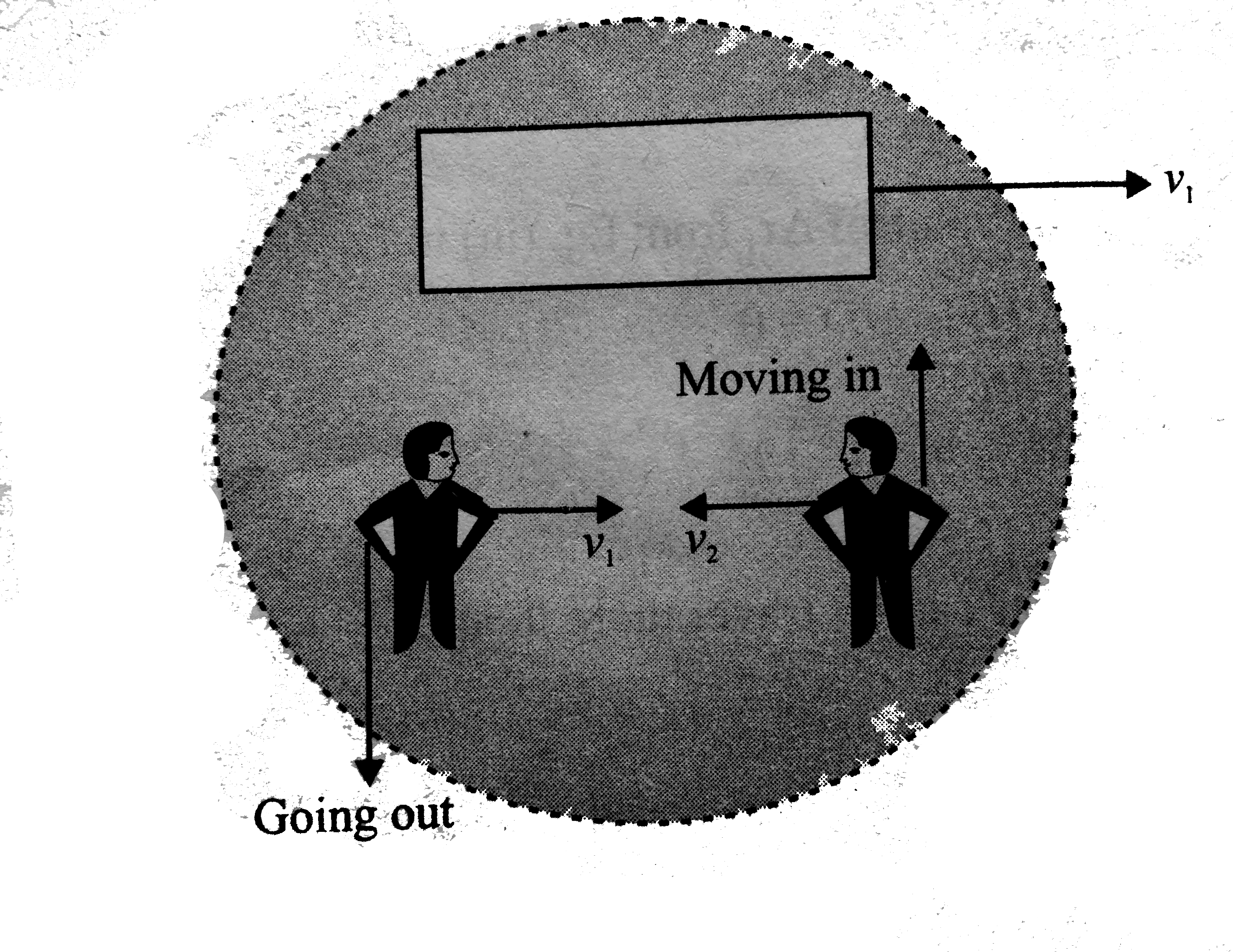 `P_(1)=P_(f)` `Mv_(1)=mv_(2)=0.............i` For system 2: `P_(i)=(M+m)v_(2)-mv_(1)-mv_(2)` `P_(f)=(M+m)v` `P_(i)=P_(f)`.............ii `(M_(m))v_(2)-mv_(1)-mv_(2)=(M+m)v`..........ii 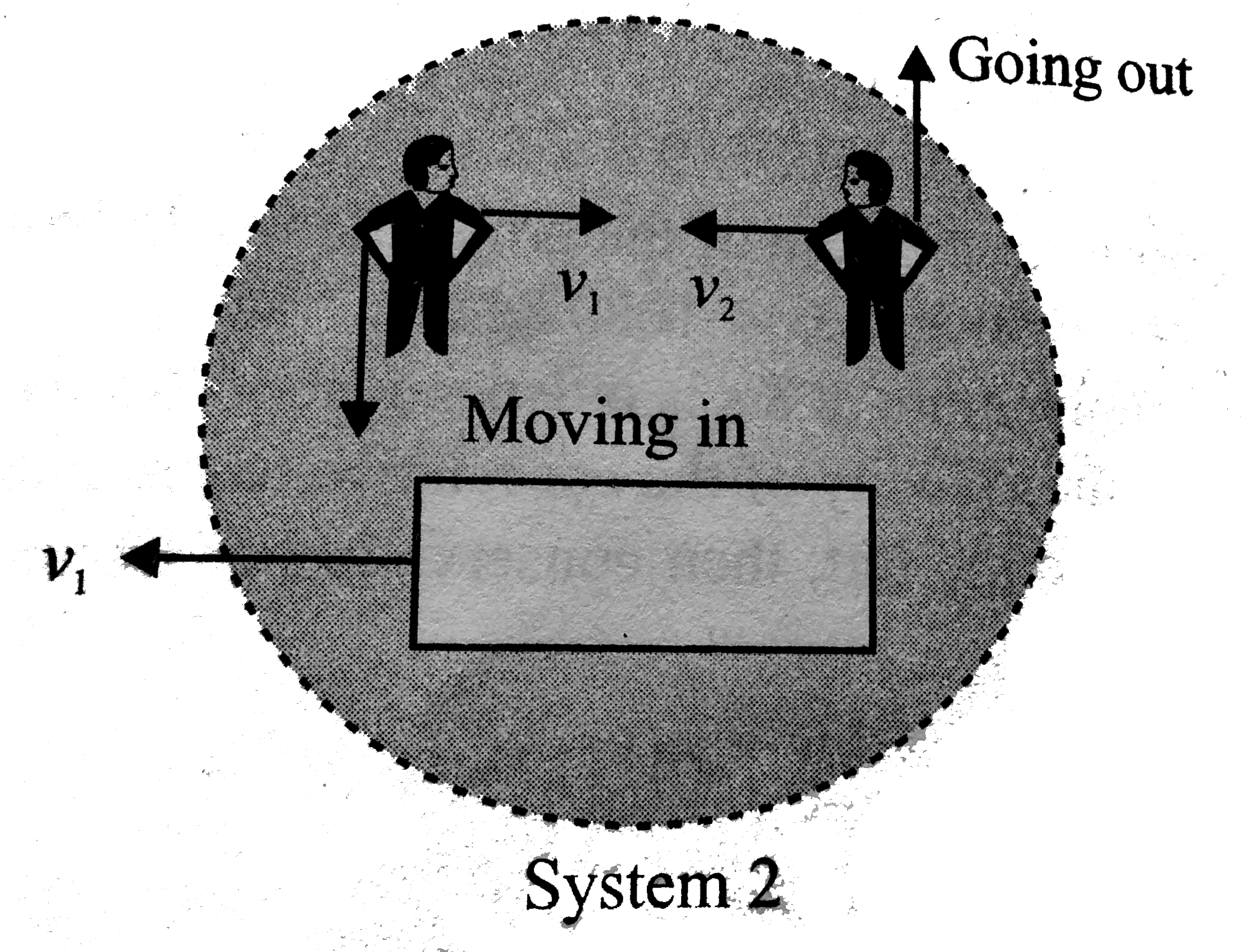 On solving eqn i and ii simultaneouysly we obtain `v_(1)=(mv)/((M-m)), v_(2)=(Mv)/((M-m))` |
|
| 8. |
A satellite orbiting close the surface of reatth does not fall down because the gravitaional pull of earth |
|
Answer» is balanced by the gravitational pull of moon |
|
| 9. |
Two particle 'A' and 'B' start SHM at t = 0. Their positions as function of time are given by X_A = A sin omega t , X_B = A sin (omega t + pi//3) {:("Column - I ","Column-II"),("A) Minimum time when x is same ","P)"(5pi)/(6 omega)),("B) Minimum time when velocity is same ","Q)" pi/(3 omega)),("C) Minimum time after which "v_a < 0 " & "v_B < 0,"R)" pi/omega),("D) Minimum time after which "x_A < 0 " & " x_B < 0,"S)" pi/(2 omega)):} |
|
Answer» |
|
| 10. |
A) All zeros to the right of the last nonzero digit after the decimal point are significant. B) If the number is less than one, all the zeros to the right of the decimal point but to the left of the first nonzero digit are not significant. |
|
Answer» Only A is correct |
|
| 11. |
Explain why we cannot hear an echo in a small room ? |
| Answer» Solution :For an echo to be heard, the MINIMUM DISTANCE between the SPEAKER and the walls should be 17 m. As the LENGTH of a room is generally less than 17 m, we do not hear an echo | |
| 12. |
lf x = a + bt + ct^(2), where x is inmetre and t in seconds, what is the unit of c? |
|
Answer» Solution :The unit of LEFT handside is METRE so the unitsof `ct^(2)` Should ALSO be metae. SINCE `t^(2)` has unit of `s^(2)` , so the unit of c is `m//s^(2)` |
|
| 14. |
A force of magnitude F is acting on a rolling body of mass m and radius R as shown in figure. What happens if the pulling force F is removed ? Discuss the different posibilities when the pulling acts on the body. a. At centre, b. Above centre, c. Below centre |
Answer» Solution :If the PULLING force `F` is removed from a body rolling on a rough surface, the friction force also disappears, because the point of contact has no more tendency to SLIP with respect to the surface. The linear and angular speeds of the body remain constant and the body keeps on rolling. 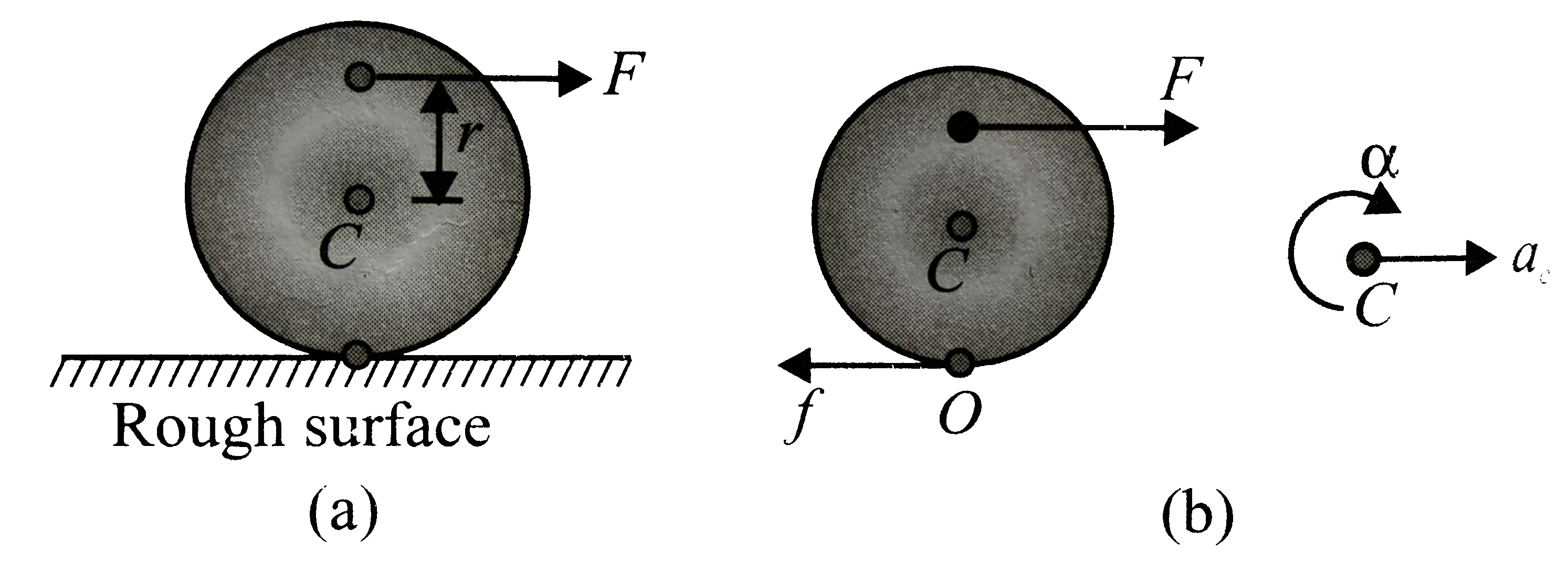 As body is rolling, the friction will be of static nature and `Q`-unknown (both in magnitude and direction) .Let friction act in the backward direction. Equation of motion `F-f=ma_(c)`....i here we can apply torque equation about centre of MASS as well as about point of contact with ground (instantenous centre of rotation) About centre of mass : `Fx-fR-I_(c)alpha` ..........ii About point of contact `O:F(R+r)+I_(c)alpha` `implies F(R+r)=(I_(c)+MR^(2))alpha`..........iii Taking torque equation about `O`, we cann directly calculate the VALUE of `alpha` Hence `alpha=(F(R+r))/((I_(c)+MR^(2)))`........iv As the body is rolling `a_(c)=alphaR=(F(R+r)R)/((I_(c)+MR^(2)))` or `a_(c)=F/M[((1+r/R))/((1+I_(C))/(MR^2))]` .............v Substituting value of `a_(c)` in eqn i we get force of friction `f=F[(I_(C)-MrR)/(I_(c)+MR^(2))]`...........vi a. If force acts through `C` figure. i.e, `r=0` 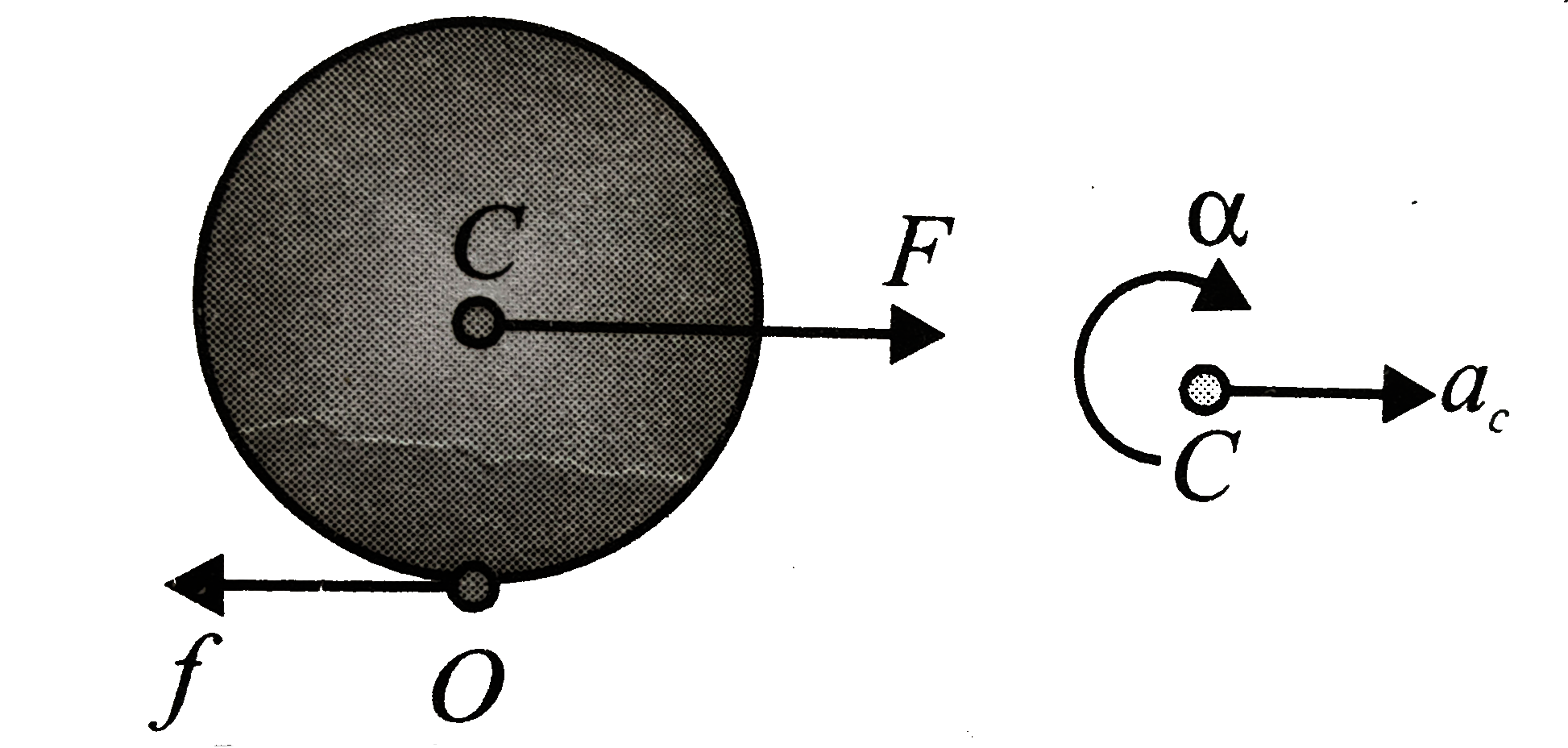 From eqn v we get `a_(C)=F/M[1/(1+I_(C)/(MR^(2)))]` From eqn vi we get `f=F[1/(1+(MR^2)/I_(C))]` From the values of `a_(c)` and , it is clear that body moves forward friction acts backward B. Force acts above `C` i.e, `r` is positive From eqn v and vi it is clear that the body moves forward rotation about the centre of mass is clockwise the friction force may act forward or backward Backward if `rlt(I_(c))/(MR)` Forward if `rgt(I_(c))/(MR)` No friction force acts when `r=(I_(C))/(MR)` c. Force acts below `C` i.e, `r` is negative 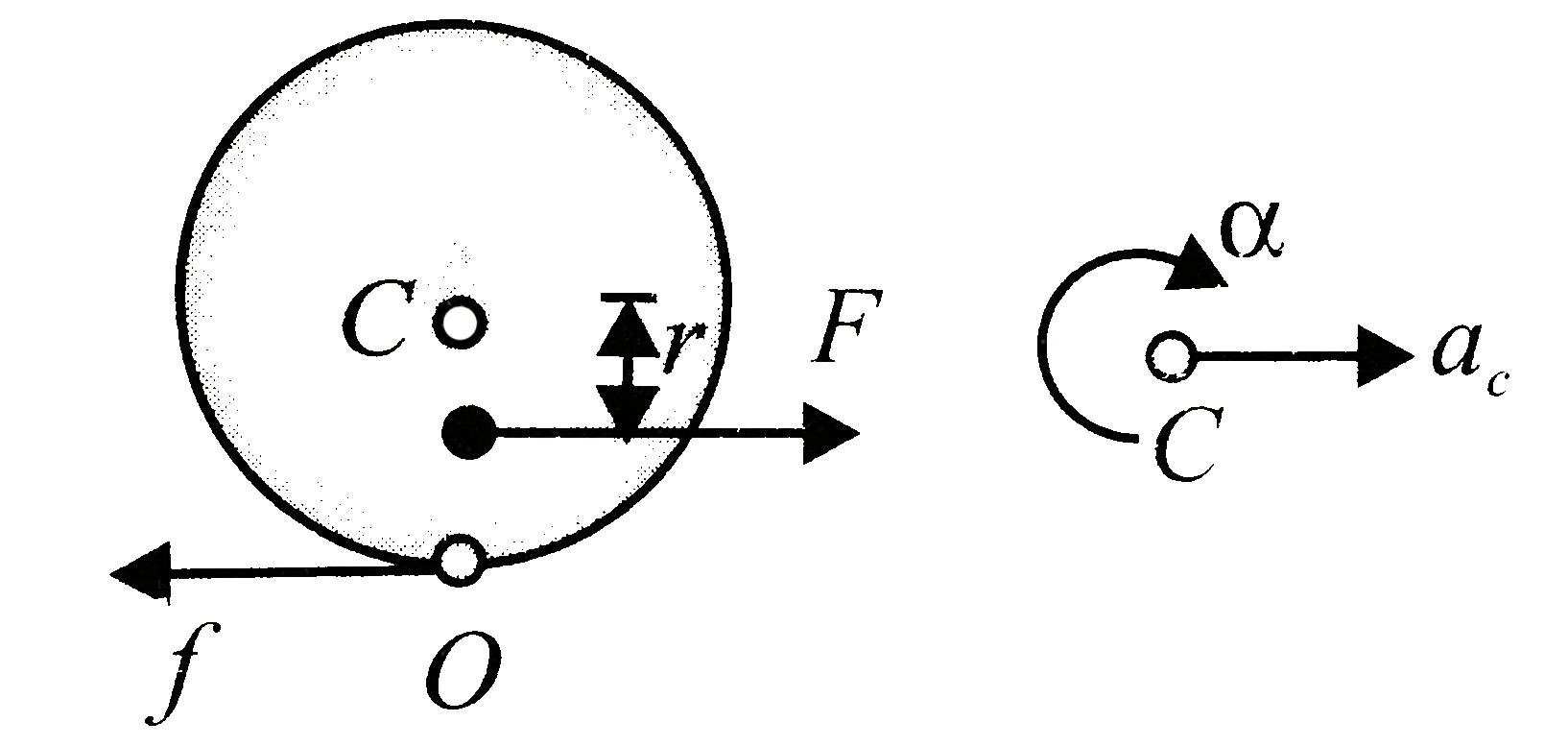 Frictioin force acts backward `r` is negative the body moves forward. Rotation about the centre of mass is clockwise. Friction force acts backward `(fltF)`. |
|
| 15. |
A bus 150 m long is moving with a speedof 90 km/h . Inwhat time shall it cross 850 m long bridge ? |
|
Answer» Solution :Given :`{:("LENGTH of"),("the bus"):}}= 150` Speed ` = 90 km//h = (90xx5)/(18)` 25 m/sec ` {:("Length of"),("the bridge"):}}= 850 m {:("TOTAL distance"),("To be covered"):}}= 150 + 850 = 1000M` Formula : Velocity `= ("Distance")/("Time")` Time`= ("Distance")/("Velocity") = (100)/(25)` = 40 SECOND 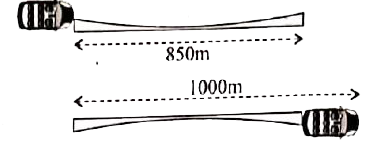
|
|
| 16. |
A satellite is launched into circulation orbit ofradius R around the earth while a second satellite is launched int an orbit of radius .1.02R. The percentage change in the time periodof the two statellite is |
|
Answer» 0.7 |
|
| 17. |
Two particlesstart moving from the same point along the same straight lime. The first moves with constant velocity v and the second with constant acceleration a. During the time that elapses before the second catches the first, the greatest distance between the particles is |
| Answer» Answer :B | |
| 18. |
A rod of length / is held vertically stationary with its lower end located at a point P, on the horizontal plane. When the rod is released to topple about P, the velocity of the upper end of the rod with which it hits the ground is |
|
Answer» `SQRT(g/L)` |
|
| 19. |
For a gas if ratio of specific heats at constant pressure and volume is Y then value of degrees of freedom is |
|
Answer» `(3gamma-1)/(2gamma-1)` |
|
| 20. |
The mass of earth is 9 times of that of Mars. The radius of the earth is twice that of Mars. The escape velocity on the earth is 12 "kms"^(-1) ,then the escape velocity on the Mars is |
|
Answer» 5.65 `"KMS"^(-1)` |
|
| 21. |
One kilograme of coal produces 3.6xx10^(6) cal of heat during combustion. Assuming that only 1/10 th energy so generated is utilised for useful purpose, find the mass of coal required per hour for running 210 kW engine. |
|
Answer» |
|
| 22. |
Identify the meaningless |
|
Answer» temperature of the surface of a body |
|
| 23. |
Consider a cycle tyre being filled with air by a pump. Let V be the volume of the tyre (fixed) and at each stroke of the pump DeltaV(lt ltV) of air is transferred to the tube adiabatically. What is the work done when the pressure in the tube is increased from P_1 to P_2 ? |
|
Answer» Solution :The pressure is increased by `DeltaP`, when volume is increased by `DeltaV` at each stroke. `therefore P_1V_1^gamma=P_2V_2^gamma` (INITIALLY) `therefore P(V+DeltaV)^gamma =(P+DeltaP)V^gamma` (`because` volume is FIXED ) `PV^gamma [1+(DeltaV)/V]^gamma=P[1+(DeltaP)/P]V^gamma` As `DeltaV lt lt V` so by using BINOMIAL theorem we get , `therefore PV^gamma (1+gamma (DeltaV)/V)=PV^gamma (1+(DeltaP)/P)` `therefore gamma(DeltaV)/V=(DeltaP)/P` `therefore DeltaV=1/gamma . V/P . DeltaP` But `DeltaV` and `DeltaP` are very small. `dV=1/gamma . V/P . dP` HENCE, work done in increasing the pressure in tube from `P_1` to `P_2` is `W=int_(P_1)^(P_2)P dV=int_(P_1)^(P_2)Pxx1/gammaxxV/P.dP` `=V/gamma int_(P_1)^(P_2)dP` `=V/gamma (P_2-P_1)` `therefore W=((P_2-P_1)V)/gamma` |
|
| 24. |
A boy and lamb post are 80 m away from a concave mirror of focal length 20 cm. the boyd walks 40 m towrds the mirror. The boy will see |
|
Answer» his imagesn inverted and same size while that of the lamp POST as inverted and dimunished. |
|
| 25. |
The effect of temperature on the value of modulus of elasticity for different substances in general |
|
Answer» INCREASES with INCREASE in temperature |
|
| 26. |
According to Hooke.s law of elasticity the ratio of stress to strain |
|
Answer» Does not REMAIN constant |
|
| 27. |
The pair of quantities having neither units nor dimensions is |
|
Answer» Plane angle and SPECIFIC gravity |
|
| 28. |
A heavy particle is tied to the end A of a string of length 1.6 m. Its other end O is fixed. It revolves as a conical pendulum with the string making 60^(@) with the vertical. Then (take g = 9.8 m//s) |
|
Answer» Its period revolution is `(4PI)/(7) ` sec |
|
| 29. |
When n number of particles each of mass m are at distances x_(1)=1, x_(2)=2, x_(3)=3, ………., x_(n)=n units from origin on the x-axis, then find the distance of their centre of mass from origin. |
|
Answer» SOLUTION :`X_(CM)=(m(1)+m(2)+m(3)+…….+m(n))/(m+m+m+……+m("n terms"))` `=(m(1+2+3+………..+n))/(NM)=(m((n(n+1))/(2)))/(nm)=(n+1)/(2)` |
|
| 30. |
A spherical soap bubble A of radius 2 cm is formed inside another bubble B of radius 4 cm. Show that the radius of a single soap bubble which maintains the same pressure difference as inside the smaller and outside the larger soap bubble is lessser than radius of both bubbles A and B. |
|
Answer» Solution :EXCESS of pressure inside the liquid due to surface TENSION, `DeltaP=(2T)/(R)` Where T - surface tension In the case of soap bubbles, the excess of pressure inside the soap bubble, `DeltaP_(b)=(4T)/(R)` Excess of pressure of air inside the bigger bubble `DeltaP_("bigger")=(4T)/(4)=T` Excess of pressure of air inside the smaller bubble `DeltaP_("smaller")=(4T)/(2)=2T` Air pressure DIFFERENT between the smaller bubble and the atmosphere will be equal to the sum of excess pressure inside the bigger and smaller bubbles. `{:("Pressure"),("difference"):}}DeltaP=DeltaP_("bigger")+DeltaP_("smaller")=T+2T=3T` Excess pressure inside a single soap bubble `=(4T)/(R)=(4T)/(4)=T` `therefore` Pressure different of single soap bubble less than the radius of both `Tlt3T`. |
|
| 31. |
A constant power is supplied to a rotating disc. The relationship of angular velocity (w) of disc anf number of rotations (n) made by the disc is governed by |
|
Answer» `W ALPHA N^(1//3)` |
|
| 32. |
An artifical satellite is moving in a circularorbit around the earth with a speed equal to half the magnitude escape velocity from the earth. Kinetic energy with which it is to be projected from the surface of the earth so as to orbit as mentioned in the passage is |
|
Answer» `(MGR)/(2)` |
|
| 33. |
The ratio of angle of minimum deviation of a thin prism in air and when dipped in water will be |
|
Answer» `1//8` |
|
| 34. |
An artifical satellite is moving in a circularorbit around the earth with a speed equal to half the magnitude escape velocity from the earth.The height of the satellite above the Earth surface : |
|
Answer» 6400 KM |
|
| 35. |
An artifical satellite is moving in a circularorbit around the earth with a speed equal to half the magnitude escape velocity from the earth. If the satellite is suddenly stopped in its orbit and allowed to fall freely on tothe earth. Find the speed with whichit hits the surface of the earth : |
|
Answer» 28512 km/h |
|
| 36. |
A uniform rod of length L and mass M is pivoted freely at one end (at bottom level) and placed in verticla position. What is the tangential linear acceleration of the free end when the rods is horizontal? |
| Answer» Answer :B | |
| 37. |
The energy radiated per hour from the surface of a filament 0.5 cm long and of radius 0.32 cm of an incandescent lamp at a certain temperature is 2.625xx10^(5) J. If the relative emittance of the surface is 0.8 calculate the temperature of the filament. |
|
Answer» |
|
| 38. |
Two particles of masses 2 m and 3 m are at a distance 'd' apart. Under their mutual gravitational force, they start moving towards each other. The acceleration of their centre of mass when they are d/2 apart is |
| Answer» Answer :D | |
| 39. |
If vec(A) = 2hat(i) - 3hat(j) + 4hat(k) its component in xy plane is |
| Answer» Answer :B | |
| 40. |
A uniform circular disc of mass m and radius R is rolling without slipping on a smooth horizontal surface as shown in figure. The disc collides with a rough vertical wall having coefficient of restitution 0.6. If the disc rolls without slipping after collision with the wall, and the coefficient of friction is n/10, then find n. |
|
Answer» |
|
| 41. |
An endless cord consists of lengths 2l and 2l^(') and their masses per unit length are m and m^('). It is placed in stable equilibrium over a smooth peg as shown in the figure. It is slightly displaced and left to itself. Show that motion is simple harmonic. Find the period of oscilattions. |
|
Answer» |
|
| 42. |
Moment of inertia of a thin hollow sphere about an axis passing through the edge along its tangent is |
|
Answer» `(2)/(3)MR^(2)` |
|
| 43. |
A body is uniformly rotating about an axis fixed in an interial frame of reference. Let vec(A) be a unit vector along the axis of rotation and vec(B) be the unit vector along the resultant force on a particle P of the body away from the axis. The value of vec(A).vec(B) is |
|
Answer» 1 |
|
| 44. |
Mass of a body is……….of………………of the body…………….. |
| Answer» SOLUTION :MEASURE , INERTIA , in LINEAR MOTION | |
| 45. |
Match correctly Column I and Column II. |
|
Answer» A-P, B-Q, C-R, D-S `"VELOCITY gradient" = ("Velocity")/("Distance")= ([LT^(-1)])/([L])= [T^(-1)]= [M^(0)L^(0)T^(-1)]` `"Pressure" = ("Force")/("Area")= ([MLT^(-2)])/([L^(2)])= [ML^(-1)T^(-2)]` `"Coefficient of VISCOSITY" = ("Force")/("Area" XX "Velocity gradient")= ([MLT^(-2)])/([L^(2)][T^(-1)])= [ML^(-1)T^(-1)]` |
|
| 46. |
To a system 300 joules of heat is given and it - does 60 joules of work. How much does theinternal energy of the system change in this process |
|
Answer» 240 JOULE |
|
| 47. |
An ideal gas is maintained at constant pressure. If the temperature of an ideal gas increase from 100K to 1000K then the rms speed of the gas molecules: |
|
Answer» INCREASES by 5 TIMES `v_(rms)propDeltaT` `Delta` is increased by 10 times . `:.` rms speed is increased by 10 times. |
|
| 48. |
A force system is saidto be concurrent id the lines of all forces |
|
Answer» intersect at a common point |
|
| 49. |
A body projected up reaches a point A in its path at the end of 4th second and reaches the ground after 5 seconds from the start. The height of A above the ground is (g=10 "m/s"^2) |
|
Answer» 19.6m |
|
| 50. |
Two cylindrical hollow drums of radii R and 2R, and of a commom height h, are rotating with angular velocities omega (anti-clockwise) and omega (clockwise), respectively. Their axes, fixed are parallel and in a horizontal plane separated by (3R + delta). They are now brought in contact (delta rarr 0). (a) Show the frictional forces just after contact. (b) Identify forces and torque external to the system just after contact. (c ) What would be the ratio of final angular velocities when friction ceases ? |
Answer» Solution : Considerthesituation shownbelowwe haveshownthe frictional forces . (B)`F'= F=F` whereF and F are external forces throughsupport `IMPLIES F_("net")=0 ("one each cylinder")` Externaltorque `=Fxx3R` (anti- CLOCKWISE ) 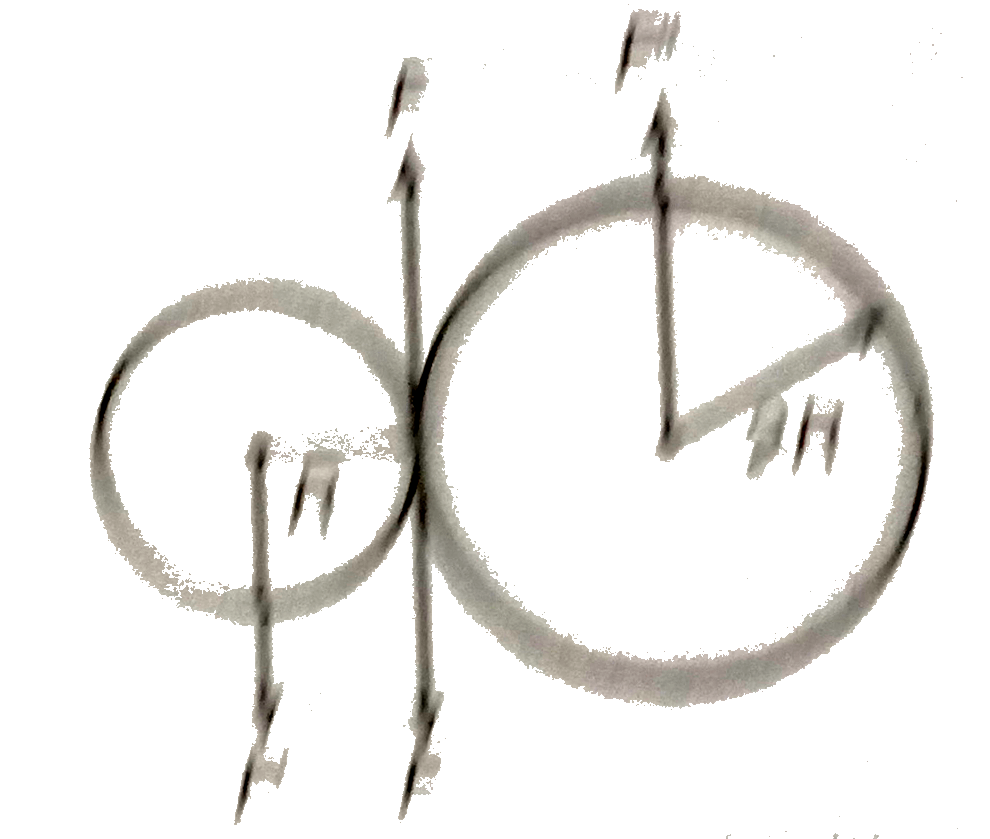 ( c)LET`omega _(1)` and `omega_(2)`be finalangularvelocitesofsamallerandbigger drumrespectively(anti - clokwise andclockwise Respectivelty) Hence, `Romega_(2)implies(omega_(1))/(omega_(2))=2` Note :-We shouldbe very carefulwhileindicatingdirectionoffrictional forces. |
|


