

Saved Bookmarks
This section includes 7 InterviewSolutions, each offering curated multiple-choice questions to sharpen your Current Affairs knowledge and support exam preparation. Choose a topic below to get started.
| 1. |
A disc of radius r is removed from the disc of radius R then (a) The minimum shift in centre of mass is zero (b) The maximum shift in centre of mass cannot be greater than (r^(2))/((R+r)) (c ) Centre of mass must lie where mass exists (d) the shift in centre of mass is (r^(2))/((R+r)) |
|
Answer» only a and B are correct |
|
| 2. |
Assertion : A solid object of iron is dipped in water, both are at same temperature of 2^(@)C. If the temperature of water is increased by 2^(@)C, then the buoyancy force action of the object will increase. Reason : If we increase the temperature of water from 2^(@)C " to " 4^(@)C, then density of water will increase. Ignore expansion of solid sphere. |
|
Answer» If both Assertion and REASON are correct and Reason is the correct EXPLANATION of Assertion. |
|
| 3. |
The minimum speed with which a body must be thrown to reach a height R/4 above the surface of the earth is (R —> Radius of the earth) |
|
Answer» `sqrt((GR)/2)` |
|
| 4. |
The planet mercury is revolving in an Elliptical orbit around the sun as shown in the figure. The kinetic energy of mercury will be greatest at |
|
Answer» A |
|
| 5. |
The conclusion of second law of thermodynamics is that |
|
Answer» no heat engine can have efficiency `ETA` EQUAL to zero. |
|
| 6. |
A gas at 27^(@)C and pressure of 30 atm is allowed to expand to atmosphere pressure and volume 15 times larger. The final temperature of the gas is ..... |
|
Answer» `-123^(@)C` |
|
| 7. |
A car travelling with a speed 125 KMPH along a straight line comes to rest after travelling a distance 245 m.The time taken by the car to come to rest,in second it (AP EAMCET-2016) |
|
Answer» 11 |
|
| 8. |
A long horizontal belt is moving from left to right with a uniform speed 2 m/s. There are two ink marks A and B on the belt 60 m apart. An insect runs on the belt to the fro between A and B such that its speed releatice to belt is constant and equals 4 m/s. When the insect is moving on the belt in the directoin of motion of the belt, its speed as observed by a person standing on ground will be: |
|
Answer» Solution :`v_("in/belt") = 4 m//s` `v_("belt/ground") = 2 m//s` `v_("in/ground") = 6 m//s` 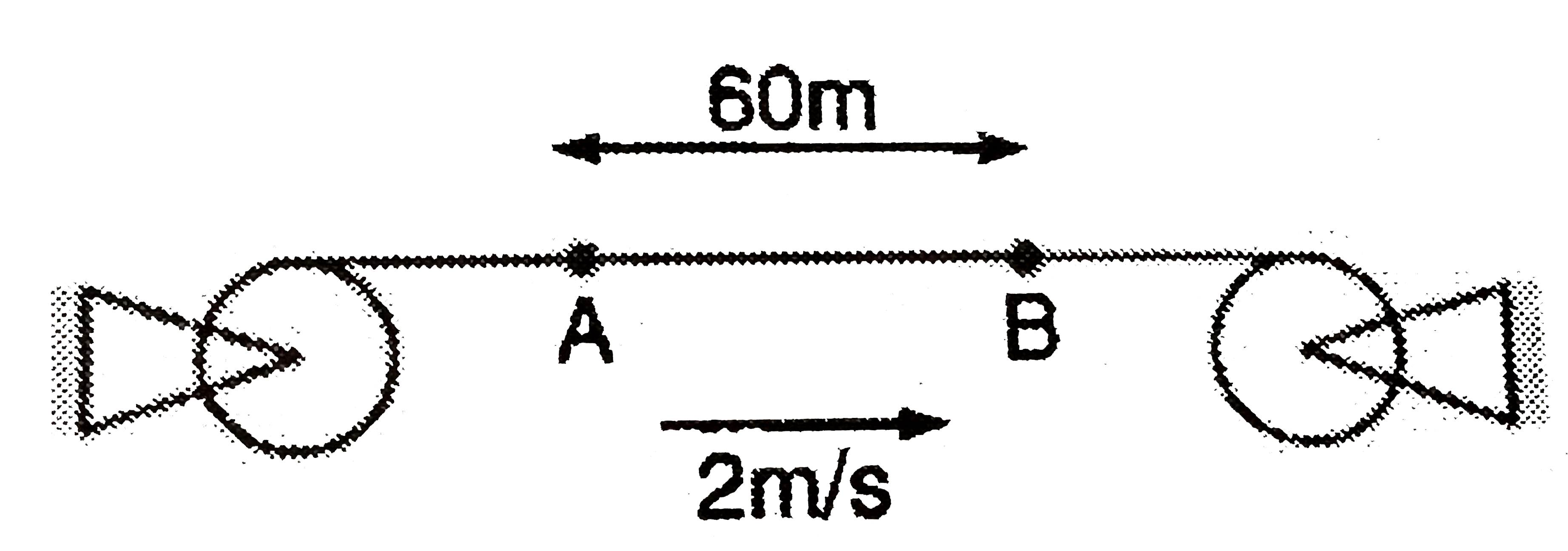
|
|
| 9. |
Two particles A and B move on a circle. Initially particles A and B are diagonally opposite to each other and start with velocities pi, 2pi "rad"//"sec" respectvely in the same direction. Particle A has angular acceleration pi//2 "rad"//"sec^(2)" and B moves with uniform angular velocity. Find the time after which both the particle A and B will collide. (in seconds) |
|
Answer» |
|
| 10. |
Four uniform solid spheres each of diameter sqrt(5) cm and mass 0.5 kg are placed with their centres at the corners of a square of side 4 cm. The moment of inertia of the system about the diagonal of the square is Nxx10^(-4)"kg m"^(2), then the value of N is . |
|
Answer» |
|
| 11. |
Find an experssion for the acceleration of the particle and hence indicate its direction . |
|
Answer» SOLUTION :Acceleration of the particle, `VEC(a) = (d vec(V))/(dt) = R omega(- COS theta hat(i) - sin theta hat(j) ) (d theta)/(dt)` ` = - r omega^(2) (cos theta hat(i) + sin theta hat(j)) " " [ because omega = "constant"]` = `- omega^(2) vec(r )` ` therefore vec(a) and vec(r)` are acted in opposite direction. |
|
| 12. |
A body is liding down a rough inclined plane which makes an angle 30^(@) with the horizontal. The coefficient of friction between the surfaces of contact of the body and the plane and the plane is 0.25. Calculate the accerleration of the body. |
|
Answer» SOLUTION :2.78 m/s |
|
| 13. |
Which of the diagramshown in figure represents variation of total mechanical energy of a pendulum oscillating in air as function of time? |
|
Answer»
The FLUCTUATION is represented by curve |
|
| 14. |
A particle is placed in a field characterized by avalue of gravitational potential given by V = -kxy, where 'k' is a constant. If bar(E)_(g) is the gravitational field then |
|
Answer» `bar(E_(g)) = k(x hat(i) + y hat(j))` and is conservative in NATURE |
|
| 15. |
A small block of mass m slides along a smooth track as shown in the fig.(i) If it starts from rest at P, what is the resultant force acting on it at Q ?(ii) At what height above the bottom of the loop should the block be released so that the force it exerts against the track at the top of the loop equals its weight ? |
|
Answer» Solution :By conservation of mechanical energy between points P and Q. `mg(5R)=mgR + (1)/(2) mv^(2)` i.e., `v= SQRT(8gR)` Now in case of circular motion. N (or T) `= (mv^(2))/(R )+mg cos theta` And as at Q, `theta = 90^(@)`  `N= (mv^(2))/(R )=(m(8gR))/(R )=8mg` So resultant force on m at Q. `F = sqrt((8mg)^(2)+(mg)^(2))=(sqrt(65))mg` (ii) At HIGHEST point `N=(mv^(2))/(R )-mg"" (as theta = 180^(@))` But according to given problem N = mg so `(mv^(2))/(R )=mg + mg`, i.e., `v=sqrt(2gR)` If for achieving it h. the height, by conservation of mechanical energy again `MGH. =(1)/(2)mv^(2)+mg(2R)` or `h.=2R+(v^(2))/(2g)=2R+(2gR)/(2g)=3R` |
|
| 16. |
A rolling body is kept on a plank B.There is sufficient friction between A and B and no friction between B and the incline,d plane. Then body: |
|
Answer» A ROLLS |
|
| 17. |
A wire of length .L. and cross sectional area .A. is made up of a material of young.s modulus .Y.. If the wire is stretched by .X. the work done is |
|
Answer» `(YAX)/(L)` |
|
| 18. |
A vehicle moves safe on a rough, curved and unbanked road. Then(a) The direction of static friction is radially out wards(b) The direction of static friction is radially inwards(c ) The direction of kinetic friction is tangential to curved path (d) Static friction does not exist |
|
Answer» A and B are CORRECT |
|
| 19. |
A motor pump lifts water from an average depth of 15m at the rate of 5kg per second. If the water is coming out of the pump with a velocity of 4ms^(-1), the power of the motor is (g= 10 ms^(-2)) |
|
Answer» 200W |
|
| 20. |
The u p p er half of an in clin ed p lane of inclination theta is perfectly smooth while lower half is rough. A block starting from rest at the top of the plane will again come to rest at the bottom, if the coefficient of friction between the block and lower half of the plane is given by |
|
Answer» `2 TAN PHI` |
|
| 21. |
A monkey of mass 40 kg climbs on a rope. which can stand a maximum tension of600 N. In which of the following cases will the rope break: the monkey (a) climbs up with an acceleration of 6 m s^(-2)(b) climbs down with an acceleration of 4 m s^(-2 )(c) climbs up with a uniform speed of 5 m s^(-1)(d) falls down the rope nearly freely under gravity? (Ignore the mass of the rope). |
|
Answer» Solution : (a) T – 400=240, T = 640 N (b) 400 – T = 160, T = 240 N ( C) T = 400 N (d) T = 0 The ROPE will break in case (a). |
|
| 22. |
Two vibrating tuning forks produce waves given by y_(1)=4 sin 500 pit and y_(2)= 2 sin 506 pi t. Number of beats produced per minute is : |
|
Answer» 180 `y_(2)= 2 sin 506 pit` `omega_(1)=2piv_(1)=500 PI` `:.v_(1)=250 Hz` `omega_(2)=2 pi v_(2)=506 pi` `:.v_(2)=253 Hz` Beat frequency `=v_(2)-v_(1)=3` beats Number of beats PRODUCED per MINUTE. |
|
| 23. |
The position of an object moving along x-axis is given by x=a+bt^(2) where a = 8.5 m, b = 2.5 m s^(-2) and t is measured in seconds. What is its velocity at t = 0 s and t = 2.0 s. What is the average velocity between t = 2.0 s and t = 4.0 s ? |
|
Answer» Velocity at t=2 SEE is zero |
|
| 24. |
Two plane mirrors are inclined at angle theta is shown in figure. IF a ray parallel to OB strikes the other mirror at P and finally emerges parallel to OA after two reflections then theta is equal to |
| Answer» ANSWER :B | |
| 25. |
A rod of length 50 cm is made of metal A and elongates by 0.2 cm when it is heated from 0^@C to 100^@C . Another rod made of metal B is of length 60 cm and elongates by 0.18 cm when heated from 0^@C to 100^@C . A composite rod of length 80 cm is made by welding pieces of rods A and B, placed end to end. When metal C is heated from 0^@C to 50^@C , it gets elongated by 0.08 cm.What is the ratio of linear expansion of metal A and metal B? |
|
Answer» `2:1` ` Delta L_A = alpha_A L_A Delta T` ` therefore alpha_A = (Delta L_A)/(L_A Delta T) = (0.2)/(50 XX 100) = 4 xx 10^(-5) ""^@C^(-1)` For rod of metal B `alpha_B = (Delta L_B)/(L_B Delta T) = (0.81)/(60 xx 100) = 3 xx 10^(-5) ""^@C^(-1)` ` therefore alpha_A/alpha_B = 4/3 = 4:3` |
|
| 26. |
A rod of length 50 cm is made of metal A and elongates by 0.2 cm when it is heated from 0^@C to 100^@C . Another rod made of metal B is of length 60 cm and elongates by 0.18 cm when heated from 0^@C to 100^@C . A composite rod of length 80 cm is made by welding pieces of rods A and B, placed end to end. When metal C is heated from 0^@C to 50^@C , it gets elongated by 0.08 cm.The length of the rod of metal B in the composite rod is |
| Answer» Solution :`L._B = 40 cm` | |
| 27. |
A body is projected vertically from the surface of the earth of radius R with velocity equal to half of the escape velocity. The maximum height reached by the body is |
|
Answer» R |
|
| 28. |
Some gas (C_(p)//C_(V)=gamma=1.25) follows the cycle ABCDA as shown in the figure. The ratio of the energy given out bythe gas to its surrounding durning the isochoric section of the cycle to the expansion work done during the isobaric section of the cycle is |
|
Answer» 2 `Q_(isochoric)=nC_(V)DeltaT=(nR)/(gamma-1)(T_(B)-T_(C))` `W_(ISOBARIC)=nRDeltaT=nR(T_(A)-T_(D))=nR(T_(B-T_(C)))` `therefore` Required RATIO =`(Q_(isochoric))/(W_(isobaric))=(1)/(gamma-1)=4` |
|
| 29. |
Length is one of the dundamental quantities. Justify this statement. |
| Answer» Solution :The length of an OBJECT is measured in metres. One metre is equal to the length of PATH travelled by light in vaccum in TIME interval `1"/"299,792,458` of a SECOND. Since the VALUE is always same, it is a fundamental quantity. | |
| 30. |
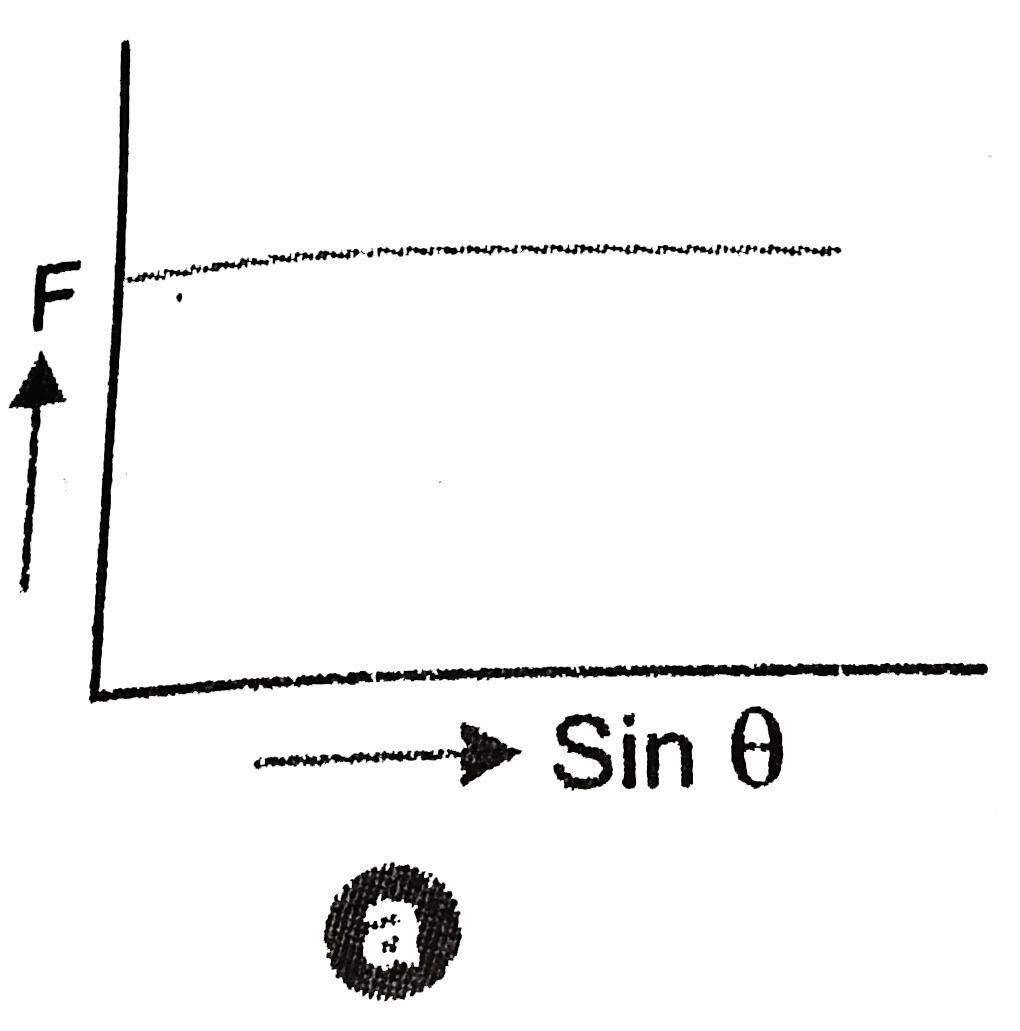
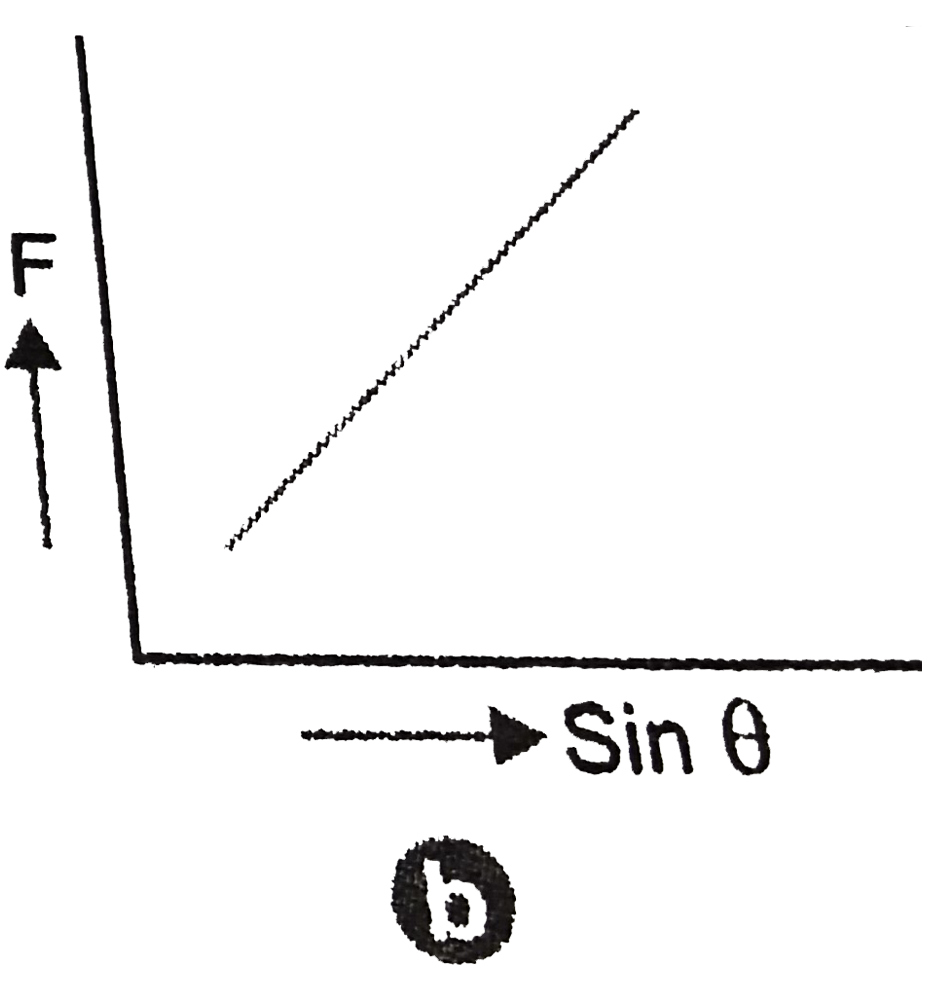
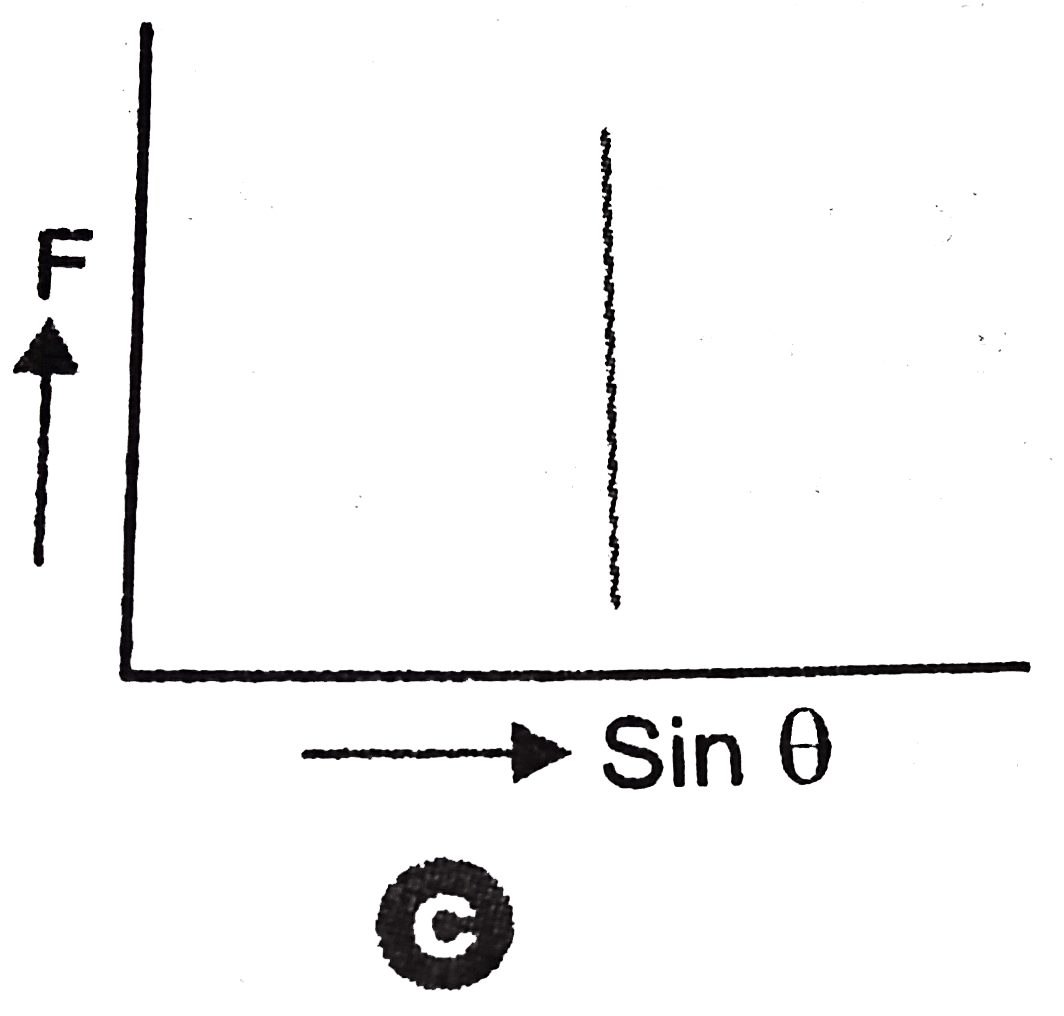
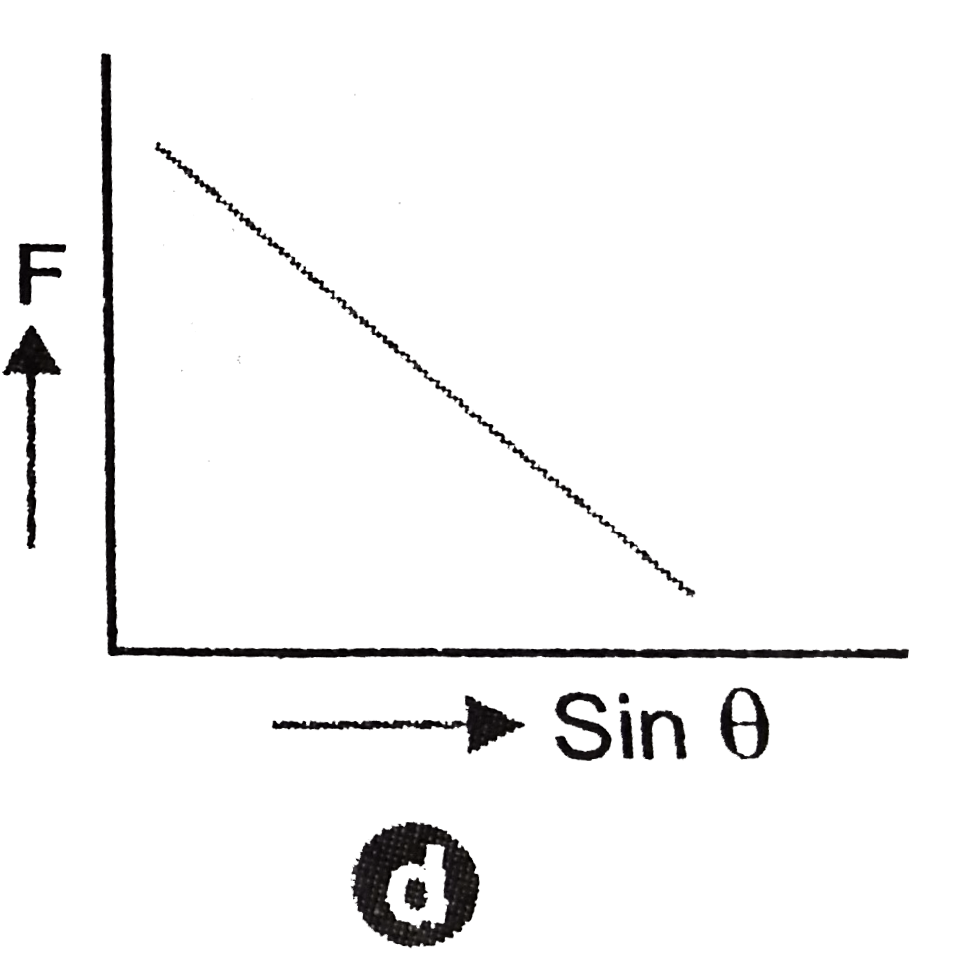
The variation of net downward force F on a body on a rough inclined plane versus sine of angle of inclination is shown by the four graphs The correct one is |
|
Answer» wheref is the constant force of friction As `sin theta` increases `F` increases Choice is correct . |
|
| 31. |
Factors do not controls the better flow rate of a liquid through the syringe? |
|
Answer» the pressure exerted by the thumb |
|
| 32. |
A body of mass 0.3 kg is tken up an inclined plane of length to m and height 5 m and then allowed to slide down to bottom again. Find kinetic energy at the end of the trip. |
Answer» SOLUTION : `sintheta=(5)/(10)=(1)/(2)=SIN.(pi)/(6)` so, `theta=(pi)/(6)` P.E at top = `0.3xx9.8xx5=14.7J` `{:("K.E at the END"),("of TRIP"):}}={{:("P.E at top"),("- Work done"),("against friction"):}` `K.E=14.7-7.6` `=7.1J` |
|
| 33. |
A uniform electric field of 500 V//m is directed at 150^(@) to the positive X-axis, in the X-Y plane as shown in figure |
|
Answer» If the COORDINATES of two POINTS A and B be (4 cm , 0) and `(-3 cm, 0)`, then the potential difference `V_(A) - V_(B)` will be 30.3 V |
|
| 35. |
The length of a wire is measured witha metre scale having least count 1mm. Its diameter is measued with a vernier calipers of least count 0.1mm. Given that length and diameter of the wire are measured as 5cm and 4mm, the percentage error in the calculated value of volume of the wire will be |
|
Answer» 0.03 |
|
| 36. |
Consider that an ideal gas (n Moles) is expanding in a process given by P=f (V), which passes through a ponts (V_(0),P_(0)) . Show that the gas is absorbing heat at (P_(0),V_(0)) if the slope of the curve P=f(v) is larger that the slope of the adiabat passing through (P_(0),V_(0)) . |
|
Answer» Solution :Slope of P=f(V), curve at `(V_(0),P_(0))=f(V_(0))` Slope of adiabat at `(V_(0),P_(0))=k(-gamma)V_(0)^(-1-gamma)=-gammaP_(0)//V_(0)` Now hrat absorbed in the PROCESS P=f(V) `dQ=dU+dW=nC_(v)dT+PdV` SINCE `T=(1//nR)PV=(1//nR)Vf(V)` `dT=(1//nR)[f(V)+Vf^(.)(V)]dV` Thus `(dQ)/(dV_(v=v_(0)))=(CV)/R[f(V_(0))+V_(0)f^(.)(V_(0))]+f(V_(0))` `=[1/(gamma-1)+1]f(V_(0))+(V_(0)f^(.)V_(0))/(gamma-1)` `=gamma/(gamma-1)P_(0)+V_(0)/(gamma-1)f^(.)(V_(0))` Heat is absorbed when `dQ//dVgt0` when gas EXPANDS, that is when `gammaP_(0)+V_(0)f^(.)(V_(0))gt0 "" ,f^(.)(V_(0))gt-gammaP_(0)//V_(0) ` |
|
| 37. |
Arrange the basic forces in the ascending order of their strengths and mention which of the forces, weaknuclear or gravitational is weaker ? |
| Answer» Solution :Gravitational FORCE < WEAK force, ELECTROMAGNETIC force < Strong nuclear force Gravitational force is WEAKER than weak nuclear force. | |
| 38. |
Given that: y= A sin[ (2pi)/(lambda)(vt-x)] where y and x are measured in metres. Which of the following statements is true? |
|
Answer» The unit of `lambda` is same as that of x and A |
|
| 39. |
Which one of the following statements is wrong? |
|
Answer» Young's modulus for a PERFECTLY RIGID body is zero. |
|
| 40. |
Radius of gyration of a body depends upon: |
|
Answer» AXIS of rotation |
|
| 41. |
Three identical spheres each of radius .R. are placed touching each other so that their centres A,B and C lie on a straight line, the position of their centre of mass from A is |
|
Answer» `(2R)/(3)` |
|
| 42. |
What would be the duration of the year if theA artificial satellite moving in a circular orbit around the earth has a total (kinetic + potential) energy E0. Its potential energy is |
|
Answer» 2E0 |
|
| 43. |
State in the following cases, whether the motion is one ,two (or) three dimensional .A speeding bike on a highway |
|
Answer» |
|
| 44. |
A metal metre scale gives correct measurement at 0^(0)C.is generally used at a temperature of 40^(@)C. The correction to be made for every metre is (alpha = 10^(-6) //1^(0) C ) |
|
Answer» `4 xx 10^(-5)` m |
|
| 45. |
A body of mass 0.3 kg is taken up an inclined plane of length 10m and height 5 m and then allowed to slide down to bottom again. Find work done by frictional force over the round trip if mu=0.15. |
Answer» Solution :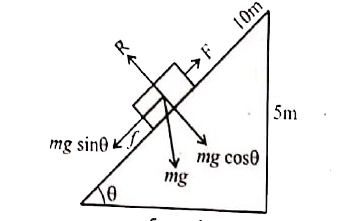 `sintheta=(5)/(10)=(1)/(2)=sin.(pi)/(6)` so, `theta=(pi)/(6)` WORK done by frictional FORCE, `W=2vecf.vecl` `W=2flcosalpha(alpha=pi,cosalpha=-1)` `W=-2fl=-2muRl=-2mumgcosthetal` `W=-2xx0.15xx0.3xxcos.(pi)/(6)xx10xx9.8` `=-7.6J` |
|
| 46. |
Find the length of a simple pendulum on the surface of the moon that has a time period same as that of a simple pendulum of the earth's surface. Mass of earth is 80 times that of moon and the radius of earth is 4 times that of moon. |
|
Answer» Solution :If MASSES of the EARTH and the moon are `M_(1)andM_(2)` respectively, `M_(1)/M_(2)=80`. Again, their radii are `R_(1)andR_(2)` (SAY). So, `R_(1)/R_(2)=4` Acceleration due to gravity on earth, `g_(1)=(GM_(1))/R_(1)^(2)`, acceleration due to gravity on moon, `g_(2)=(GM_(2))/R_(2)^(2)` `therefore" "(g_(1))/(g_(2))=M_(1)/M_(2)xxR_(2)^(2)/R_(1)^(2)=M_(1)/M_(2)xx(R_(2)/R_(1))^(2)=80xx(1/4)^(2)=5` Also, in the case of simple pendulum, time period on earth surface `T=2pisqrt(L_(1)/g_(1))` and time period on the moon.s surface `T=2pisqrt(L_(2)/g_(2))` `therefore" "sqrt(L_(1)/g_(1))=sqrt(L_(2)/g_(2))or,L_(1)/L_(2)=(g_(1))/(g_(2))=5` `therefore" "L_(2)=L_(1)/5` Hence, length of pendulum on the moon.s surface should be `1/5`th of its length on the earth.s surface. |
|
| 47. |
A body of mass 0.3 kg is taken up an inclined plane of length 10 m and height 5 m and then allowed to slide down to bottom again. Find kinetic energy at the end of the trip. |
|
Answer» Solution : `sintheta=(5)/(10)=(1)/(2)=sin.(PI)/(6)` so, `THETA=(pi)/(6)` P.E at top = `0.3xx9.8xx5=14.7J` `{:("K.E at the end"),("of TRIP"):}}={{:("P.E at top"),("- Work done"),("against friction"):}` `K.E=14.7-7.6` `=7.1J` |
|
| 48. |
Two metallic plates P(collector) and Q (emitter) are separated by a distance of 0.2 m. These are connected through an 0.2 m. These are connected through an ammeter without any cell. A magnetic field B exists parallel to the plates. Light of wavelengths between 2000 Å and 3000 Å fall of the plate Q whose work function is 2.22 eV. The minimum value of B for which the current registered with ammeter is zero, is |
|
Answer» `3.8 xx10^-5 T` |
|
| 49. |
A mass of 0.2 kg is attached to the lower end of a massless spring of force constant 200 N/m, the upper end of which is fixed to a rigid support. Which of the following statements is/are true? In equilibrium, the spring will be stretched by 1 cm. |
|
Answer» If the mass is raised till the SPRING becomes unstretched and then released, it will go down by |
|


 .
.