

Saved Bookmarks
This section includes 7 InterviewSolutions, each offering curated multiple-choice questions to sharpen your Current Affairs knowledge and support exam preparation. Choose a topic below to get started.
| 1. |
Poor accuracy involces errors that can often be correct, Do you agree? |
| Answer» SOLUTION :YES, we AGREE | |
| 2. |
The frequency of the mass when it is displaced slightly is |
|
Answer» `upsilon=(1)/(2pi)sqrt((k_(1)k_(2))/((k_(1)+k_(2))m))` `m(d^(2)x)/(dt^(2))=-k_(1)x-k_(2)x=-(k_(1)+k_(2))xor(d^(2)x)/(dt^(2))=-((k_(1)+k_(2))/(m))x=-omega^(2)x` where `omega^(2)=(k_(1)+k_(2))/(m)oromega=sqrt((k_(1)+k_(2))/(m))` `therefore` Frequency, `upsilon=(omega)/(2pi)=(1)/(2pi)sqrt((k_(1)+k_(2))/(m))` 
|
|
| 3. |
If L=2.01m+-0.01mwhat is 3L? |
| Answer» SOLUTION :Here, we should EQUATE 3L with `(L+L+L)`to FIND out the absolute ERROR in 3L. Thus , `L=(3xx2.01 )m+-3xx0.01m=6.03m+-0.03m` | |
| 4. |
A mass m moving horizontally (along the x-axis) with velocity v collides and stricks to a mass of 3 m moving vertically upward (along the y-axis) with velocity 2v. The final velocity of the combination is |
|
Answer» `3/2 V HATI + 1/4 v hatj`  According to conservation of momentum, we GET `m v hati + (3m) 2v hatj= (m + 3 m)v.` where `v.` is the final VELOCITY after collision `v.= 1/4 v hati + 6/4 v hatj = 1/4 v hati + 3/2 v hatj` . |
|
| 5. |
A 2kg stone is swung in a vertical circle by attaching it at the end of a string of length 2m. If the string can with stand a tension 140.6N, the maximum speed with which the stone can be rotated is |
| Answer» Answer :D | |
| 6. |
Momentum of a lighter and a heavier mass are equal.Which one of them has a greater kinetic energy? |
|
Answer» Solution :Let MASS of the LIGHTER body =m and its velocity =v , mass of the HEAVIER body= M and its velocity =V Given ,MV =MV . Now, the KINETIC energy of the lighter body , `K_l =1/2 mv^2` and the kinetic energy of the heavier body, `K_h =1/2 MV^2` `therefore (K_l)/(K_h) =(1/2 mv^2)/(1/2 MV^2) = (m^2v^2)/(m) xx(M)/(M^2V^2)=M/mgt 1 [because mv =MV]` So, the kinetic energy of the lighter body is greater than that of the heavier body. |
|
| 8. |
(A): Force constant K = (YA)/(l) where Y is Young's modulus. A is Area and I is original length of the given spring.(R): Force constant is the case of the given spring is called spring constant. |
|
Answer» Both (A) and (R) are TRUE and (R) is the CORRECT explanation of (A) |
|
| 10. |
The coefficient of friction is 0.75. If sin 37^(@)=0.6, the angle of friction is |
|
Answer» `18^(@)` |
|
| 11. |
When a conservative force does positive work on a body , the potential energy of the body increases /decreases/ remains unaltered . |
| Answer» SOLUTION :DECREASE | |
| 12. |
Excess pressure can be ((2T)/(R )) for |
|
Answer» SPHERICAL drop |
|
| 13. |
The steam point and the ice point of a mercury thermometer are marked as 80^(0)and 20^(0) . What will be the temperature in centigrade mercury scale when this thermometer reads 32^(0) |
| Answer» Answer :A | |
| 14. |
Two particles, each of m, are connected by a light inextensible string of length 2l. Initially they lie on a smooth horizontal table at points A and B distant l apart. The particle at A is projected across the table with velocity u. Find the speed with which the second particle begins to move if the direction of u is , (a) along BA, (b) at an angle of 120^(@) with AB, (c) perpendicular to AB. In each case calculate (in terms of m and u) the impulse of tension in the string. |
|
Answer» By conservation of MOMENTUM `rArrmv_(1)+mv_(1)=0+m u` `rArr2mv_(1)=m u` `rArrv_(1)=(u)/(2)` Impulse of tension=change in momentum of particle `B` `=mv_(1)-0=(m u)/(2)` (b) 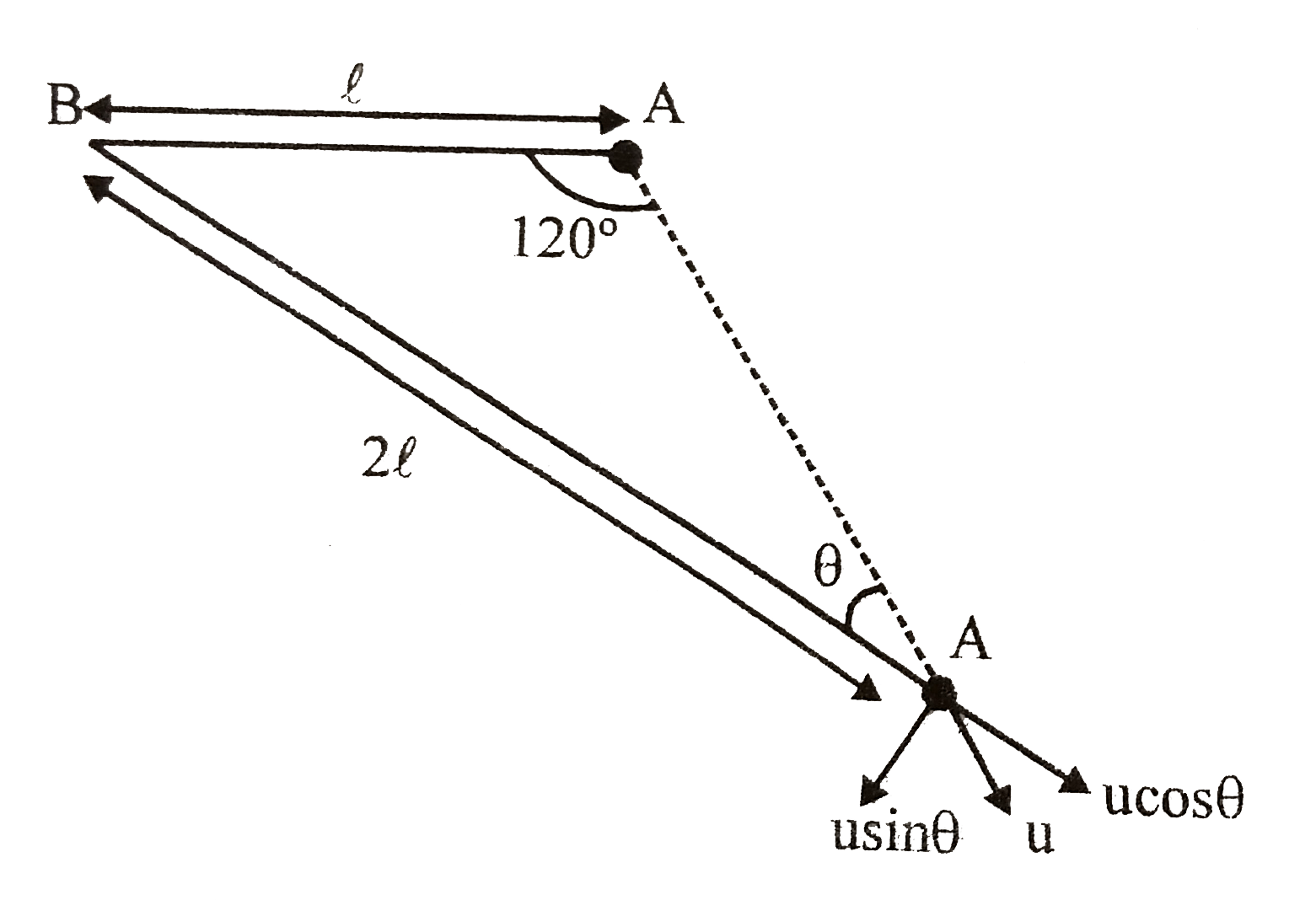 (just before taut) (just before taut) 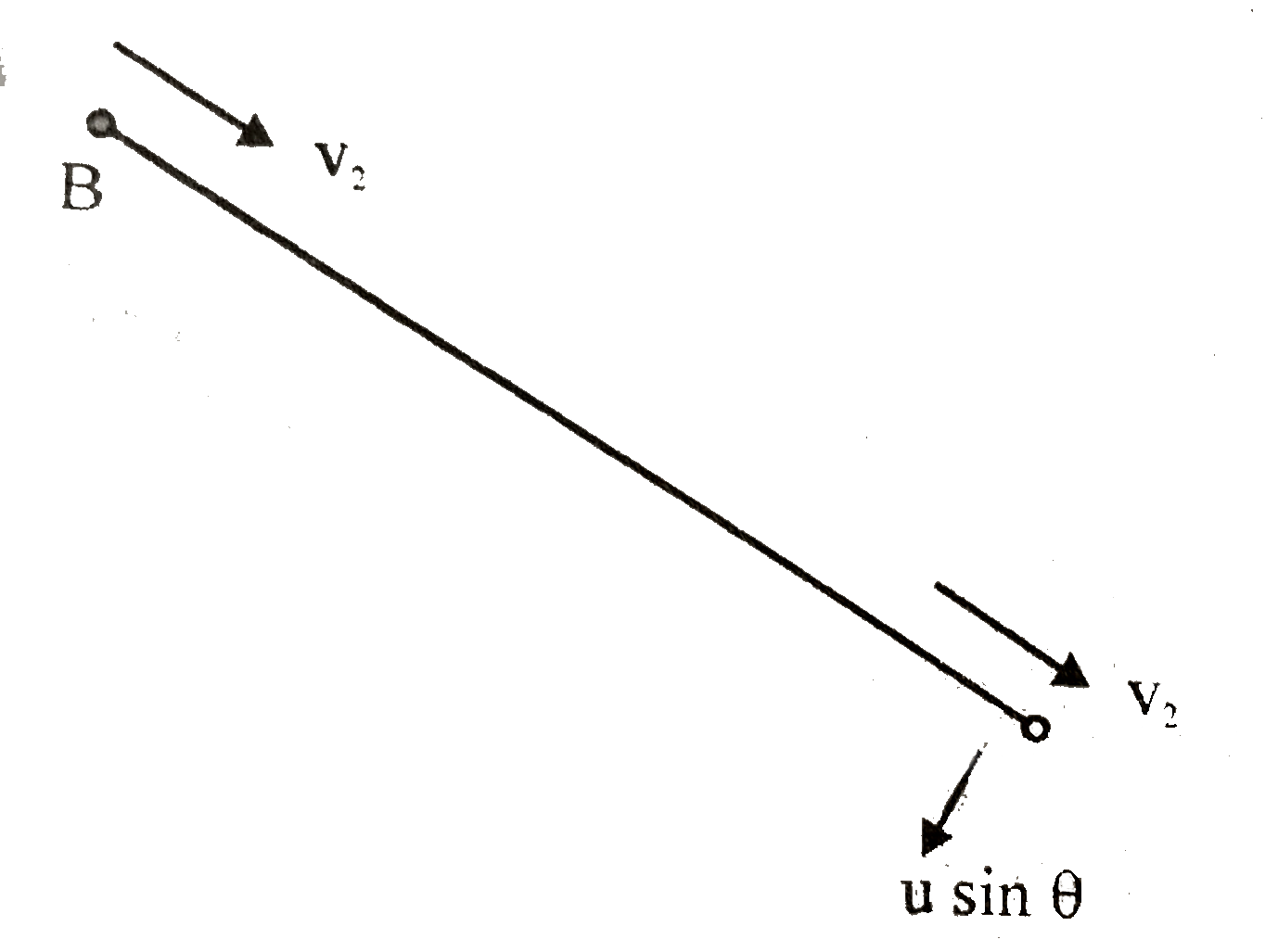 (just after taut) (just after taut) By sine rule `rArr(L)/(SINTHETA)=(2l)/(sin120^(@))rArrsintheta=(sqrt3)/(4)rArrcostheta=(sqrt(13))/(4)` By conservation of momentum along the string `mv_(2)+mv_(2)=m(ucostheta)+m(0)` `rArr""v_(2)=(1)/(2)ucostheta=((1)/(2)u)((sqrt(13))/(4))=(sqrt(13))/(8)u` Impulse=change in momentum of MASS `B` `=m((sqrt(13))/(8)u)-0=(sqrt(13))/(8)m u` (c) 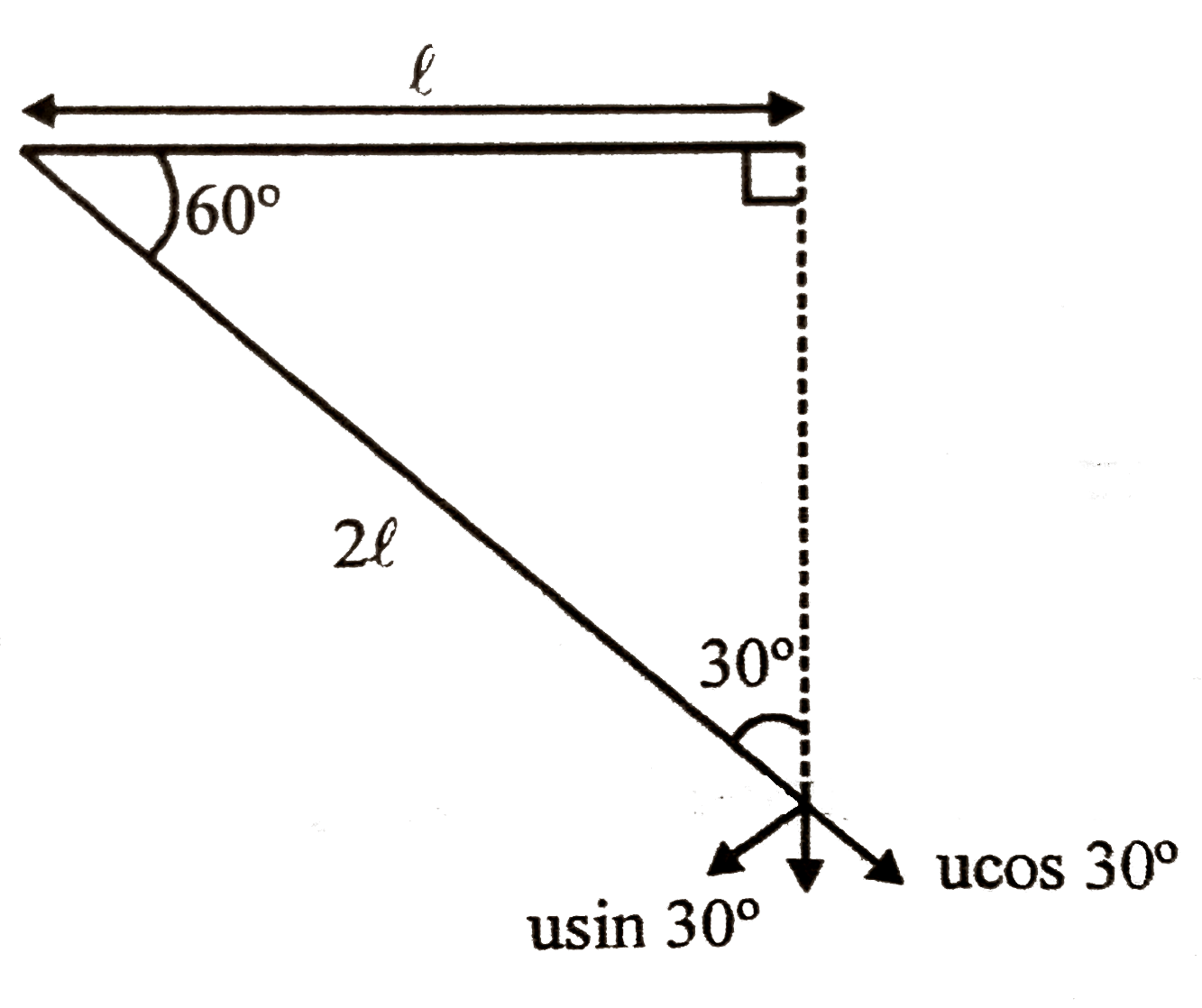 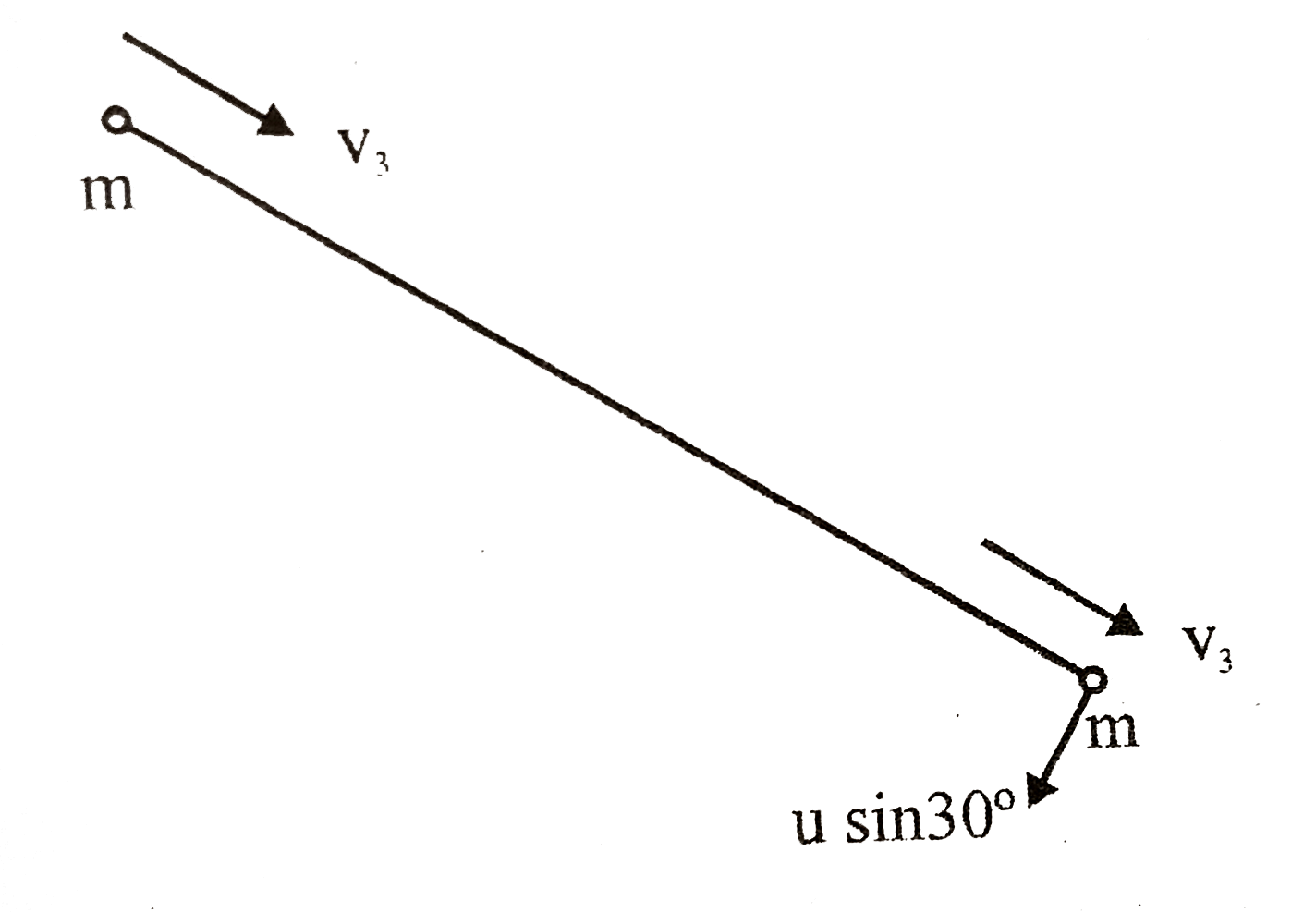 By conervation of momentum along the string `mv_(3)+mv_(3)=m(ucos30^(@))+0` `rArrv_(3)=(1)/(2)ucos30^(@)=u(sqrt3)/(4)m u` Impulse=change in momentum of mass `B` `=m(u(sqrt3)/(4))-0=(sqrt3)/(4)"mu"` |
|
| 15. |
The length of a smooth inclined plane of inclination 30^(@) is 5m. The work done in moving a 10kg mass from the bottom of the inclined plane to top is |
|
Answer» 245J |
|
| 16. |
An open knife edge of mass M is dropped from a height 'h' on a wooden floor. If the blade penetrates a distance 's' into the wood, the average resistance offered by the wood to the blade is : |
|
Answer» `MG` |
|
| 17. |
Does the velocity of the particles increase or decrease when the velocity increases in Brownian motion in a medium? |
|
Answer» |
|
| 18. |
A point mass moves with uniform acceleration . If V_(1) , V_(2) , V_(3) be the average velocities in three successive intervals of time t_(1), t_(2) , t_(3). Then (V_(1)-V_(2))/(V_(2)-V_(3))=(k(t_(1)+t_(2)))/(t_(2)+t_(3)). The value of 'k' is |
|
Answer» |
|
| 19. |
Two clocks are being tested against a standard clock located in a national laboratory. At 12:00:00 noon by the standard clock, the readings of the two clocks are : {:(,"Clock1", "Clock 2"),("Monday",12:00:05:,10:15:06),("Tuesday",12:01:15,10:14:18),("Wednesday",11:59:08,10:15:18),("Thursday",12:01:50,10:15:07),("Friday",11:59:15,10:14:53),("Saturday",12:01:30,10:15:24),("Sunday",12:01:19,10:15:11), ("Sunday",12:01:19,10:15:11):} If you are doing an experiment that requires precision time interval measurements, which of the two clocks will you prefer? The range of variation in time of clock? |
|
Answer» |
|
| 20. |
To get five images of a single object, one should have two plane mirrors at an angle of |
| Answer» ANSWER :B | |
| 21. |
A solid sphere of radius R is floating in a liquid of density rho with half of its volume submerged. If the sphere is slightly pushed and released, it starts performing simple harmonic motion. Find the frequency of these oscillations. |
|
Answer» |
|
| 22. |
A man of mass 62 kg is standing on a stationary boat of mass 238 kg. The man is carrying a sphere of mass 0.5 kg in his hands. If the man throws the sphere horizontally with a velocity of 12 ms^(-1), find the velocity with which the boat will moeve (in magnitude) |
|
Answer» `0.02 MS^(-1)` |
|
| 23. |
For a particular tube, among six harmonic frequencies below 1000 Hz, only four harmonic frequencies are given: 300 Hz, 600 Hz, 750 Hz and 900 Hz. What are the two other frequencies missing from this list? |
|
Answer» 100 Hz, 150 Hz If the tube is open at both ends so the HARMONIC frequencies are based on 150 Hz. `1^(st) = 150 , 2^(nd) = 300 Hz , 3^(RD) = 450 Hz , 4^(th) = 600 Hz , 5^(th) = 750 Hz , 6^(th) = 900 Hz` The above frequencies the MISSING frequency in the list 150 Hz, 450 Hz |
|
| 24. |
When a mass 'M' is attached to the spring of force constant 'K', then the spring stretches by 'l'. If the mass oscillates with amplitude 'l', what will be the maximum potential energy stored in the spring |
| Answer» ANSWER :D | |
| 25. |
The sciences which deal with …….. Are called …………. |
|
Answer» |
|
| 26. |
Assertion: The heat supplied to a system is always equal to the increase in its internal energy. Reason: When a system changes from one thermal equilibrium to another some heat is absorbed by it. |
|
Answer» Both ASSERTION and REASON are TRUE and the reason is the CORRECT EXPLANATION of the assertion. |
|
| 27. |
If angle between veca and vecb is (pi)/(3), then angle between 2veca and -3vecb is |
|
Answer» `(PI)/(3)` |
|
| 28. |
Two particles of equal mass move in a circle of radius r under the action of their mutual gravitational attraction. Find the speed of each particle it its mass is m. |
Answer» Solution : The particle will always remain diametrically opposite, so that the force on each particle will be directed along the radius. When each particle is describing a circular orbit, the GRAVITATIONAL force on one of the particles MUST be equal to the necessary centripetal force. `(mV^(2))/(r) = (Gm m)/((2r)^(2)) ""` i.e, `V = sqrt((Gm)/(4r))` |
|
| 29. |
A particle is executing simple harmonic motion given by x=5sin(4t-(pi)/(6)). The velocity of the particle when its displacement is 3 units is……………. |
|
Answer» `(2PI)/(3)` units |
|
| 31. |
Which of the following cannot be a resultant of two vectors of magnitude 3 and 6? |
|
Answer» 3 |
|
| 32. |
A motor pump is delivering water at certain rate. In order ot increase the rate of delivery by 100%, the power of the motor is to be increased by |
|
Answer» 3 |
|
| 33. |
The force required to tow a car at constant velocity is directly proportional to velocity. If it requires 160 W to tow a car with a velocity of 4 ms^(-1), the power it required to move the car with a velocity of 9 ms^(-1)is: |
| Answer» ANSWER :C | |
| 34. |
A container of large uniform cross-sectional area A resting on a horizontal surface, holds two immiscible, non-viscous and incompressible liquids of densities d and 2d, each of height (H)/(2) as shown in figure. The lower density liquid is open to the atmosphere having pressure P_(0). (a) A homogeneous solid cylinder of length L(L lt (H)/(2)) cross-sectional area (A)/(5) is immersed such taht it floats with its axis vertical at the liquid-liquid interface with the length (L)/(4) in the denser liquid. Datermine: (i) The density D of the solid and (ii) The total pressure at the bottom of the container. (b) The cylinder is removed and the original arrangement is restored. A tiny hole of area s (s lt lt A) is puched on the vertical side of the container at a height h (h - ((H)/(2))). Determine : (i) The initial speed of the efflux of the liquid at the hole (ii) The horizontal distance x travelled by the liquid initially and (iii) The height h_(m) at which the hole should be punched so that the liquid travels the maximum distance x_(m). initially. Also calculate x_(m). [ Neglect air resistance in these calculations ] |
|
Answer» WEIGHT of cylinder `=` unthurst due to upper liquid `+` upthrust due to lower liquid Note that `h_(1)` and `h_(2) ne (H)/(2)` `:. ((A)/(5)) (L) D.g = ((A)/(5)) ((3L)/(4)) (d)g + ((A)/(5)) ((L)/(4)) (2d)(g)` `:. D = ((3)/(4)) d + ((1)/(4)) (2d)` `D = (5)/(4) d` `(ii)` Considering vertical equilibrium of two liquids and the cylinder. `(P - P_(0))A =` weight of two liquids `+` weight of cylinder `:. P = P_(0) + ("weight of liquids" + "weight of cylinder")/(A) ...(1)` Now, weight of cylinder `= ((A)/(5))(L)(D)(g) = ((A)/(5)Lg) ((A)/(5)d)` `= (ALdg)/(4)` Weight of upper liquid `= ((H)/(2)Adg)` and Weight of lower liquid `= (H)/(2)A(2d)g = HAdg` `:.` Total weight of two liquids `= (3)/(2) HAdg` `:.` From Eq. `(1)` pressure at the bottom of the container will be `P = P_(0) + (((3)/(2))HAdg + (ALdg)/(4))/(A)` or `P = P_(0) + (dg(6H + L))/(4)` (b) `(i)` Applying Bernoulli's theorem at `1` and `2` `P_(0) + dg((H)/(2)) + 2dg ((H)/(2)-h) = P_(0) + (1)/(2)(2d)v^(2)` Here, `v` is velocity of EFFLUX at `2`. Solving this, we get `v = sqrt((3H - 4h)(g)/(2))` `(ii)` Time taken to reach the liquid to the bottom will be `t = sqrt(2h//g)` / Horizontal distance `x` travelled by the liquid is `x = vt = sqrt((3H - 4h'(g)/(2))) (sqrt((2h)/(g)))` 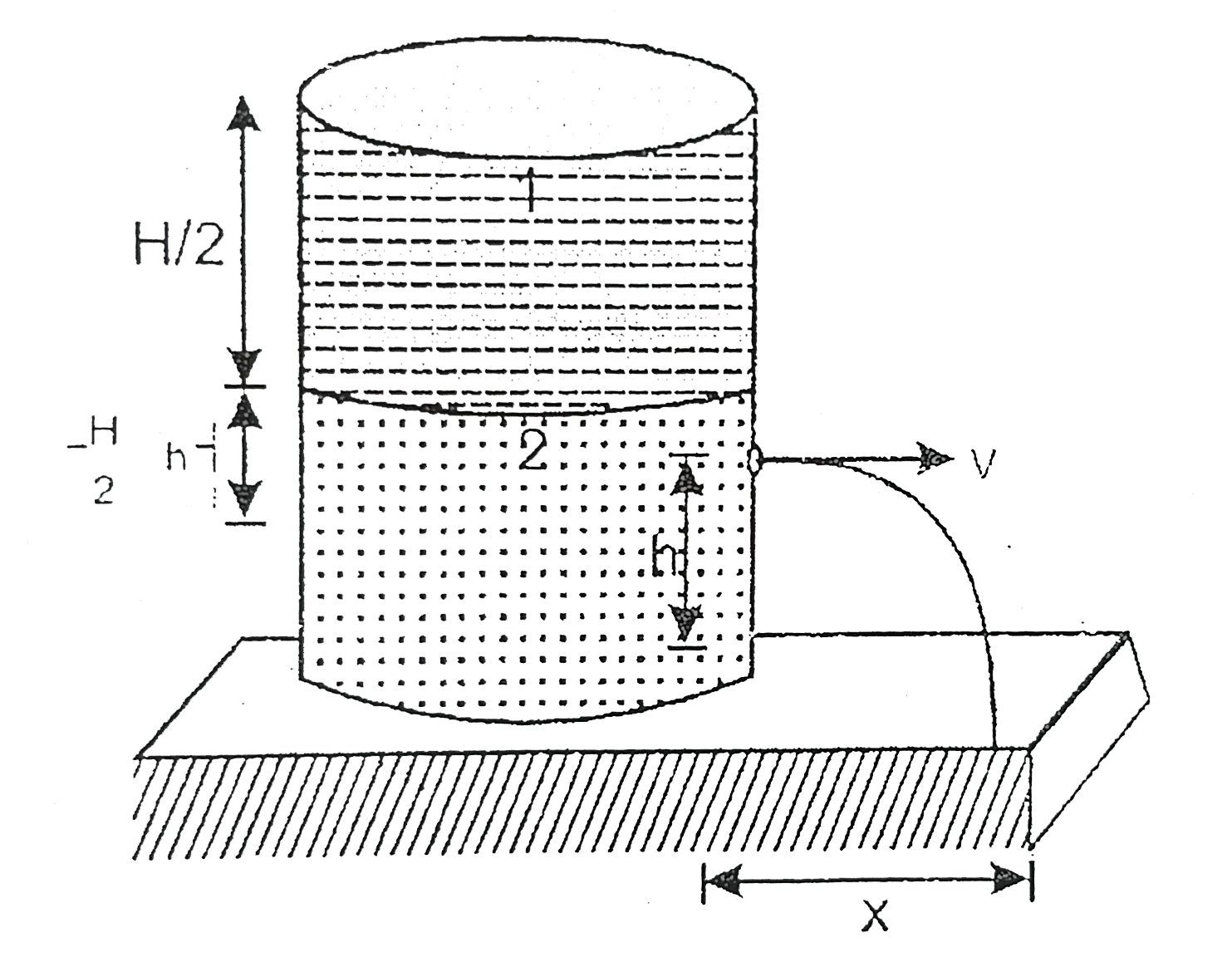 `(iii)` For `x` to be maximum `(dx)/(dh) = 0` or `(1)/(2sqrt(h(3H - 4h))) (3H - 8h) = 0` or `h = (3H)/(8)` Therefore, `x` will be maximum at `h = (3H)/(8)`. The maximum value of `x` will be `x_(m) = sqrt((3H)/(8)3H - 4(3H)/(8))` `x_(m) = (3)/(4)H` |
|
| 35. |
A body will speed up if |
|
Answer» velocity and ACCELERATION are in the same direction. |
|
| 36. |
The wavelength of light in vaccum is lamda_0. When it travels normally through glass of thickness t. Then find the number of waves of light in t thickness of glass (refractive index of glass is mu). |
|
Answer» SOLUTION :Number of waves is a thickness t of a MEDIUM of refractive index `MU` is number of waves `=(thickn ess)/(wavel en GTH) =t/lamda_m` But `lamda_m=lamda_0/mu`,`therefore` number of waves `(t mu)/lamda_0` Where `lamda_0` is the wavelength of light in VACCUM. |
|
| 37. |
The specific heat of a substance varies with temperature t("^@C) as c = 0.20 + 0.14t + 0.023t^2("cal"//"gm"^@C) Heat required to raise the temperature of 2 gm of the substance from 5^@C " to " 15^@C is |
| Answer» Answer :C | |
| 38. |
A small particle is placed at the pole of a concave mirror and then moved along the principal axis to a large distance. During the motion, the distance between the pole of the mirror and the image is measured. The prodedure is them repeated with convex mirror, a concave lens and a convex lens. the object is plotted between image distance versus shown in graph with the mirror or lens that is corresponding it. (curve 1 has two segments) |
|
Answer» <P> |
|
| 39. |
Due to which the surface charge density arises on the surface of a dielectric slab, when it is placed in a uniform electric field ? |
|
Answer» `1.5 m//s, 3 m//s` `S = ((u + v )/( 2 )) t` `= (( 0 + 6)/( 2 )) (1) = 3m ` If distance = 9m, then AVERAGE speed, `= (9m)/(3S) = 3 m//s` If displacement = 3m, then average velocity, `= (3m)/(3s) =1 m//s` 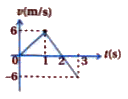
|
|
| 40. |
What provides the restoring force for SHM in the following cases? Column of Hg in U tube |
| Answer» SOLUTION :WEIGHT of DIFFERENCE COLUMN | |
| 41. |
If the angle of inclination of the inclined plane is sin^(-1)((1)/(2)) when the body just starts sliding find the angle of repose and coefficient of static friction between the body and the inclined plane. |
|
Answer» `60^(@), (2)/(SQRT(3))` |
|
| 42. |
Two solidmetal spheres of same material and radius .r. are in contact with each other. The gravitational force of attraction between the spheres is proportional to |
|
Answer» `R^(4)` |
|
| 43. |
The work done by a force (2hat(i) - hat(j) + 5hat(k)) when it displaces the body from a point (3, 4, -6) to a point (7, 2, 5) is |
| Answer» Answer :A | |
| 44. |
If bar(u)=2bar(i)-2 bar(j)+3bar(k) andthe final velocity is bar(v)=2bar(i)-4bar(j)+5bar(k) and it is covered in a time of 10 sec, find the acceleration vector |
|
Answer» `(3bar(i)-2BAR(J)+2bar(k))/(10)` |
|
| 45. |
A uniform rod AB of mass 1 kg is supported on a horizontal smooth surface by a small roller of negligible mass and dimension. If the cofficient of friction between end B and vertical wall is 1/3 . The rod is released from rest in the shown position. (Given length of rod =2m, g=10 m//s^(2)).Match Table-1 with Table-2 and select the correct answer using the codes given below the lists: |
|
Answer» |
|
| 46. |
Three bodies A, B and C have equal surface area and thermal emissivities in the ratio e_(A):e_(B):e_(C)=1:(1)/(2):(1)/(4). All the three bodies are radiating at same rate. Their wavelengths corresponding to maximum intensity are l_(A),l_(B) and l_(C) respectively and their temperature are T_(A),T_(B) and T_(C) on kelvin scale, then select the incorrect statement. |
|
Answer» `SQRT(T_(A)T_(C))=T_(B)` |
|
| 47. |
If the position vector of a particle is given by vec r= 5t^(2)hat i +7t hat j +4 hat k, then its velocity lies in: |
|
Answer» X-Z plane Velocity`vec V= (d vecr)/(dt)= (d(5t^(2)hat i +7t hat j +4 hat k))/(dt)` `vec v= 10T hati+ 7 hat j` |
|
| 48. |
Assertion : Bulk modulus of an incompressible liquid is infinite. Reason : Compressibility is inverse of bulk modulus. |
|
Answer» If both Assertion and Reason are correct and Reason is the correct explanation of Assertion. `implies beta =OO` |
|
| 49. |
10^(-18) is called as ........... |
|
Answer» nano |
|