

Saved Bookmarks
This section includes 7 InterviewSolutions, each offering curated multiple-choice questions to sharpen your Current Affairs knowledge and support exam preparation. Choose a topic below to get started.
| 1. |
The rate of flow of heat through 12 identical conductors made of same material is shown in the figure. Then, which of the following is correct ? |
|
Answer» The rate of flow of heat through rod DE is `8 JS^(-1)` |
|
| 2. |
An air pump is pumping air in to a large vessel against a pressure of 1 atmosphere. In each stroke 1000C.C of air enters in to the vessel. If the number of strokes made by the pump per minute is 30, the power of the pump is (1 atm= 10^(5)Pa) |
| Answer» ANSWER :D | |
| 3. |
A certain particle undergoes erratic motion. At every point in its motion, the direction of the particle's momentum is always |
|
Answer» the same as the DIRECTION of its VELOCITY |
|
| 4. |
Find the resultant of the vectors vec(OA), vec(OB), vec(OC) as shown in figure. The radius of the circle is r. |
|
Answer» Solution :`vec(R) = vec(OA) + vec(OB) + vec(OC)` `vec(R) = r hat(i) + r cos, 45 I + r SIN 45 hat(J) + r hat(j)` `vec(R) + (r+(r)/(sqrt(2)))hat(i) + (r + (r)/(sqrt(2)))hat(j)` `|vec(R)| = (sqrt(2)r + r)` along `vec(OB)`. 
|
|
| 5. |
Two protons are travelling along the same straight path but in opposite directions. The relative velocity between the two is |
|
Answer» Solution :One of the velocity `V_1= V ` , other velocity `V_2 = - V` Relative velocity `(V_("NET")) = (V_1-V_2)/([1+V_2/C_2]) = (V - (-V) )/([1 + V^2/C^2]) =(2V)/(2) ` ` V_("relative") = C` |
|
| 6. |
Mass of a body is defined as the ………. Which can ……………. |
|
Answer» |
|
| 7. |
When the temperature of a liquid is raised by200^(@)C (1)/(100) thof the mass of the liquid is expelled. Calculate its 100 coefficient of apparent expansion. |
| Answer» SOLUTION :`5.05 XX 10 ^(-5) //^(@)C` | |
| 8. |
Check The correctness of the following equation using dimensional analysis. Make a comment on it. S = ut + 1//2 "at"^(2) where s is the displacement, u is the initial velocily, t is the time and a is the acceleration produced, |
|
Answer» Solution :DIMENSION for distances s = [L] Dimension or initial velocity u = `[LT^(-1)]` Dimension for TIME t = [T] Dimension for acceleration a = `[LT^(-2)]` According to the principle of homogeneity, Dimensions of LHS = Dimensions of RHS Substituting the dimensions in the given FORMULA `S = ut + 1//4 at^(2), 1/4` is a number. It has no dimensions [L] = `[LT^(-1)][T^(1)] + [LT^(-2)][T^(2)]` [L] = [L] + [L] As the dimensional formula of LHS is same as that of RHS, the equation is dimensionally correct. Comment: But actually it is a wrong equation. We know that the equation of motion is `s = ut + 1//2 at^(2)` So, a dimensionally correct equation need not be the true (or) actual equation But a true equation is always dimensionally correct. |
|
| 10. |
Parsec is the unit to measure |
|
Answer» Time |
|
| 11. |
If resultant wave of two waves, each of amplitude A is also A then, phase difference between those two waves is |
|
Answer» `60^(@)` `A .= sqrt (A _(1) ^(2) + A _(2) ^(2) + 2 A _(1) A _(2) COS delta)` ` therefore A^(.2)= A _(1) ^(2) + A _(2) ^(2) + 2 A_(1) A _(2) cos delta ` But here, ` A_(1) = A _(2) =A. =A` (suppose) and so: `A ^(2) = 2A ^(2) + 2 A ^(2)cos delta ` `therefore A ^(2) =2A ^(2) (1 + cos delta )` `therefore 1/2 =1 + cos delta ` `therefore cos delta =-1/2` `therefore delta = 120^(@) (becausecos 120 ^(@) =-(1)/(2))` |
|
| 12. |
A wire is suspended from the ceiling and stretched under the action of a weight F suspended from its other end. The force exerted by the ceiling on it is equal and opposite to the weight. |
|
Answer» Tensile stress at any cross section A of the wire is `F/A` Now Stress = `("Tensile force ")/("Area") = F/A` `THEREFORE` Tensile force T = Force F exerted. |
|
| 13. |
If the period of oscillation changes from 2 sec to 1.5 sec and the length of simple pendulumis 1m, then the change in length is |
|
Answer» INCREASED by `7/16` m |
|
| 14. |
(A) : The area under force - displacement cure and displacement axis is exactly equal to the work done by force.(R ) : For a varying force the work done can be expressed as a definite integral of force overdisplacement. |
|
Answer» Both (A) and (R ) are TRUE and (R ) is the correct EXPLANATION of (A) |
|
| 15. |
Two rods of different materials are clamped at their ends rigidly. When they are heated for the same rise in temperature, same thermal stresses are produced in them. If their Young.s modulii are in the ratio x:y then ratio of coefficients of their linear expansion is |
|
Answer» `X:y` |
|
| 16. |
If the coefficient of friction between M and the inclined surfaces is mu = 1//sqrt(3) find the minimum mass m of the rod so that the of mass M = 10 kg remain stationary on the inclined plane |
|
Answer» SOLUTION :Angle of repose ` phi = tan^(-1)((1)/(sqrt(3)))= 30^(@)` Here ` theta gt phi` HENCE , the block has a tendency to slide down 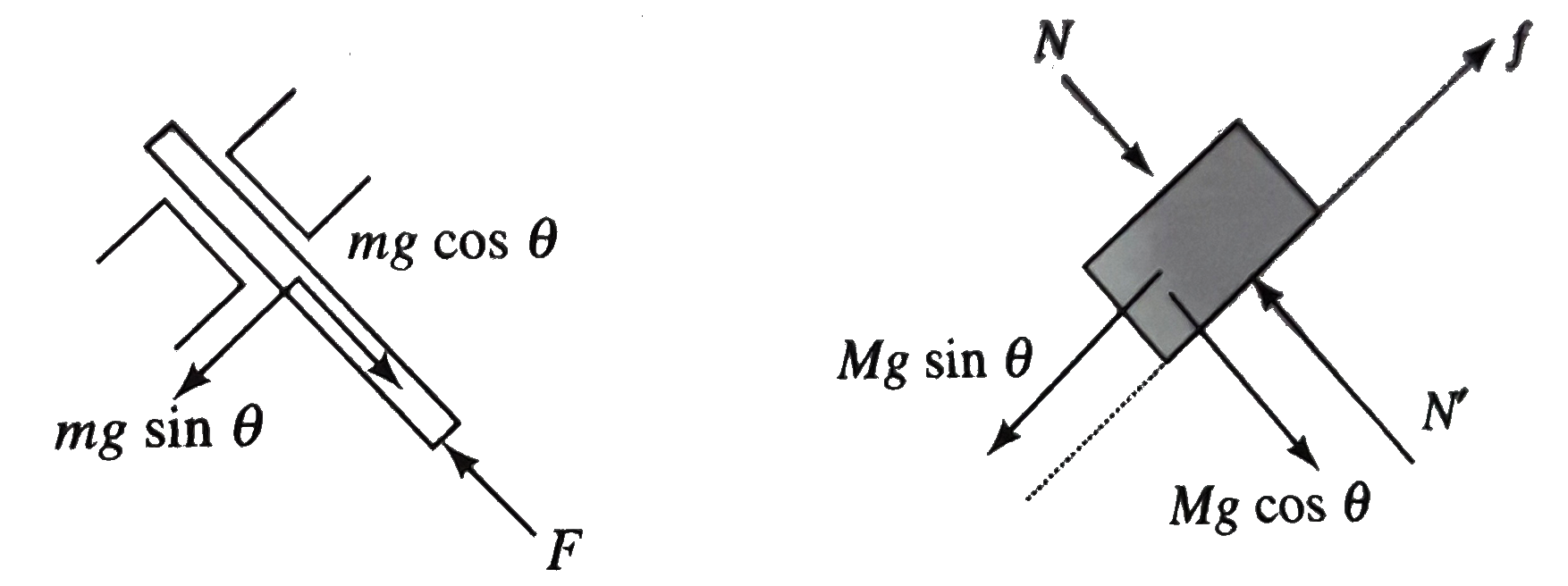 `Mg cos theta+ N' , N = mg cos theta` `N' = Mg cos theta + mg cos theta`….(i) For the block to remain stationary . `f = Mg sin theta`...(ii) If f is static as nature `f LT f_(max)` `Mg sin theta lt mu N'` `Mg sin theta lt mu(Mg cos theta + mg cos theta)` `Mg sin theta - mu mg cos theta lt mu mg cos thetan` `m gt M((tan theta)/(mu) -1) rArr m gt 10((sqrt(3))/(1//sqrt(3)) - 1) rArr m gt 20 kg` 
|
|
| 17. |
(A) : Raindrops falling from a large height, accelerate initially and then fall with constant velocity. (R ) : For a spherical body falling with constant velocity, Buoyant force is equal and opposite to the weight of the drop. |
|
Answer» Both (A) and (R ) are true and (R ) is the correct EXPLANATION of (A) |
|
| 18. |
If pressure P, velocity of light C and acceleration due to gravity g are chosen as fundamental units, then dimensional formula of mass is |
|
Answer» `PC^3 G^(-4)` |
|
| 19. |
A hollow sphere of radius R is made of a material of relative density rho. It will float if the thickness of its surface is |
|
Answer» `t GT R//3 RHO` |
|
| 20. |
(A) : Banking of roads reduces wear and tear of the tyres. (R ) : Dependence on friction to provide centripetal force increases with banking of a road. |
|
Answer» Both 'A' and 'R' and true and 'R' is the correct explantation of 'A' |
|
| 21. |
Explain the behaviour of the oscillator when the driving frequency is close to natural frequency in small damped oscillation and define the resonance. |
|
Answer» Solution :Amplitude of FORCED OSCILLATION `A= (F_0)/([m^(2)(omega^(2)-omega_(0)^(2))^(2)+(omega_(d)^(2)b^(2))]^(1/2))` If `omega_(d)` is very close to `omega`, then `m(omega^(2)-omega_(d)^(2))` is MUCH less than `omega_(d)b` so it is neglected `A= (F_0)/(omega b)`. Hence, the MAXIMUM amplitude for a given driving frequency is governed by the driving frequency and the damping and is never infinity. Resonance : ..The phenomenon of increase in amplitude when the driving force is close to the natural frequency of the OSCILLATOR is called resonance... |
|
| 22. |
A block of mass 5kg is lying on a rough horizontal surface. The coefficient of static and kinetic friction are 0.3 and 0.1 and g=10 ms^(-2). The frictional force on the block is |
| Answer» ANSWER :D | |
| 23. |
A particle is fired vertically upwards from the surface of earth and reaches a height 6400km. Find the initial velocity of the particle if R = 6400km and g at the surface of earth is 10m//s^2 |
|
Answer» Solution :`1/2"m"upsilon^2=(mgh)/([1+(h//R)])` hereh = R = 6400 km and `g = 10 m//s^2` so `upsilon^(2)=GH` , i.e. `upsilon=sqrt(10xx6400xx10^(3))=8km //s` |
|
| 24. |
The displacement (x) of a particle is given by x= a sin (bt+c) where a, b and c are constants of motion. Select the incorrect statement from the following . |
|
Answer» The energy ofthe partical in simple harmonic motion remains constant |
|
| 25. |
Density of ice is rho and that of water is sigma. What will be the decrease in volume when a mass M of ice melts. |
|
Answer» `( M)/( SIGMA- RHO)` |
|
| 26. |
A liquid rises to a height of 50cm in a capillary tube of diameter 0.04mm. If density of liquid is 0.8xx10^(3)kgm^(3) and angle of contact is 20^(@), the surface tension of the liquid is (Cos20^(@)=0.94) |
|
Answer» `4.17(N)/(m)` |
|
| 27. |
A body of mass m is pushed with the initial velocity v_(0) up an inclined plane set at an angle theta to the horizontal. The fricitional coefficient is equal to mu. What distance will the body cover before it stops and what work do the frictional forces perform over this distance ? |
|
Answer» SOLUTION :The net force on the body in the downward direction is given by `m g SIN theta + mu m g cos theta` `THEREFORE` retardating `a = - g(sin theta + mu cos theta)` Applying the formula `v^(2) = u^(2) + 2as`, we have , `0 = v_(0)^(2) - 2g(sin theta + mu cos theta)s or s = (v_(0)^(2))/(2g (sin theta + mu cos theta))`. WORK done by frictional force `= - mu m g cos theta xx s` `therefore W_(f_(r)) =-(mu m g cos theta xx v_(0)^(2))/(2g (sin theta + mu cos theta))=-(mumg v_(0)^(2)cos theta)/(2(sin theta + mu cos theta)g) = - (mu m v_(0)^(2))/(2(TAN theta + mu))`. |
|
| 28. |
In the above problem if the first reaches the ground at a horizontal distance .x. the speedbody reaches the ground at a horizontal distance |
|
Answer» 5x |
|
| 29. |
India has had a long and unbroken tradition of great scholarship - in mathematics, astronomy, linguistics, logic and ethics. Yet, in parallel with this, several superstitious and obscurantistic attitudes and practices flourished in our society and unfortunately continue even today - among many educated people too. How will you use your knowledge of science to develop strategies to counter these attitudes ? |
| Answer» Solution :In order to POPULARISE SCIENTIFIC explanations of everyday phenomena, mass media LIKE radio, television and newspapers should be used. We shall use our knowledge of science to educate masses and shall try to tell them the real cause of an event so that their superstitious beliefs are rejected. | |
| 30. |
The tube shown in of uniform cross-section. Liquid lows through it at a constant speed in the direction shown by the arrows. The liquid exerts on the tube |
|
Answer» a NET FORCE to the right |
|
| 31. |
the earth rotates faster ? |
|
Answer» SOLUTION :If the earth rotates faster, the value of `OMEGA`will increase. This will cause a further decreases in the apparent value of G. If is to be noted that changes in the speed of ROTATION of the earth about its axis do not influence the value of g at the poles. |
|
| 32. |
A spring of force constant k is cut into two equal parts The force constant of each part of the spring will be |
|
Answer» `k/2` |
|
| 33. |
The vernier scale of a travelling microscope has 50 divisions which coincide with 49 main scale divisions. If each main scale division is 0.5 mm. Calculate the minimum inaccuracy in the measurement of distance. |
|
Answer» SOLUTION :MINIMUM inaccuracy = Vernier constant = 1 MSD - 1 VS.D `= 1 MSD (49)/(50) MSD ` = `(1)/(50) (0.5 mm) = 0.01` mm |
|
| 34. |
What is the orbital velocity of satellite ? Derive its equation. |
Answer» Solution :`implies` The velocity of satellite to revolve it around EARTH in a given orbit is known as orbital velocity of satellite.  `implies` A satellite of mass m at height from the surface of earth revolving around the earth as shown in figure. Its distance from the centre of earth `r = R_(E) +h` `implies ` The orbital velocity of satellite is `v_0` `impliesF= (GM_(E) m)/(r^2) ""...(1)` `implies`The centripetal force on satellite is , `F = (mv_0)/r^2 "" ....(2)` `implies` The necessary centripetal force for this circular MOTION of satellite is provided by the earth.s gravitational force on it. `implies :.` Centripetal force of satellite `implies` = Gravitational force exerted by earth on Satellite. `:. (mv_0^2)/(r)=(GM_(E)m)/r` `implies :. v_(0)^2=(GM_(E))/r""...(3)` but `r = R_(E) +h` `:. v_(0) = sqrt((GM_(E))/(R_E+h))""....(4)` `implies` Equation indicates that as h INCREASES Vo decreases. `implies`Gravitational acceleration on earth.s surface, `implies g = (GM_(E))/(R_E^2)` `:. GM_(E) = gR_(E) ^(2) ""...(5)` `implies` Substituting the VALUE of equation (5) in equation (4), `:. v_0=sqrt((gR_E^2)/((R_(E)+h)))` `:. v_(0) =R_(E) sqrt((g)/(R_(E)+h))""...(6)` `implies` For a satellite very close to the surface of earth h can be neglected in COMPARISON to RE Equations (4) and (6) written as below , `v_(0) =sqrt((GM_(E))/R_E)""..(7)` `v_(0) =sqrt(gR_E)""...(8)` |
|
| 35. |
Match the following : {:("List - 1","List - 2"),((a) "second" ,(e) "carbon " - 12),((b) "mole", (f) "Platinum iridium "),((c) "Metre", (g) Cs- 133),((d) " Kilogram" , (h) Kr- 86):} |
|
Answer» a-e b-g c-h d-f |
|
| 36. |
As astronaut dropped a spoon from outside spacecraft will the spoon reach the surface of earth? |
| Answer» Solution :No. When the spoon is DROPPED from the SPACECRAFT it ALSO starts moving in circular path with the speed of spacecraft. It never REACHED at the SURFACE of earth. | |
| 37. |
The SI unit of surface tension is |
|
Answer» dyne/cm |
|
| 38. |
In the question number 15, the ratio of the velocity of the satellite at apogee and perigee is |
|
Answer» `(1)/(2)` Angular momentum at perigee= Angular momentum at apogee `:. mv_(P)r_(P)=mv_(A)r_(A)` where m is the MASS of the SATELLITE. `:. (v_(A))/(v_(P))=(r_(P))/(r_(A))=(2R_(E))/(6R_(E))=(1)/(3)` |
|
| 39. |
A bullet of mass 2 g travelling with a velocity of 500 ms^(-1)is fired into a block of wood of mass 1kg suspended from a string of 1 m length. If the bullet penetrates the block of wood and comes out with a velocity of 100 ms^(-1) find the vertical height through which the block of wood will rise (assuming the value of g to be 10 ms^(-2)). |
|
Answer» Solution :Let the masses of the bullet and the block be .m. and .M. respectively . Let their velcities after the impact be v and V respectively. Let the INITIAL VELCITY of the bullet be .u.. According to the law of conservation of LINEAR momentum mu = mv + MV Here `m = 2 XX 10 ^(-3)kg, u = 500 ms ^(-1), v = 100 ms ^(-1)` `(2 xx 10 ^(-3)) xx 500 = (2 xx 10^(-3)) xx 100 + (1 xx V)` `V = 0.8 ms ^(-1).` When the block rises to a height of .h., according to the law of conservation of energy, `(M+m) gh = 1/2 ( M +m) V ^(2) , i.e., h = (1)/(2) (V ^(2))/(g) = ((0.8 )^(2))/( 2 xx 10) = 0.032 m` |
|
| 40. |
A measured value to be close to targeted value, percentage error must be close to ......... |
| Answer» SOLUTION :0 | |
| 41. |
Weight of a body of mass m decreases by 1% when it is raised to height h above the earth’s surface. If the body is taken to a depth h in a mine, change in its weight is: |
| Answer» Solution :The KINETIC ENERGY of the hammer is converted into heat energy, which is TURNS raises the TEMPERATURE, | |
| 42. |
The horizontal speed of a jet of water is 100 cm/sec and 50 cm^(3) of water hits the plate each second. Assume that the water moves parallel to the plate after striking it. The force exerted on the stationary plate if it is held perpendicular to the jet of water is : |
| Answer» Answer :A | |
| 43. |
A blacksmith fixes Iron ring on the rim of the wooden wheel of a horse cart. The diameter of the rim and the fron ring are 5.243 m " and " 5.231m,respectively at 27 ^(@)C. To what temperature should the ring be heated so as to fit the rim of the wheel? |
|
Answer» Solution :GIVEN, `T_(1) = 27^(@) C` ` L_(T 1) = 5.231 m` ` L_(T2) = 5.243 m` So, ` L_(T2) = L_(T1) [1 + alpha_(1) (T_(2) - T_(1)]` ` 5.243 m = 5.231 m [1 + 1.20 xx 10^(-5) K^(-1) (T_(2) - 27^(@) C)]` or `T_(2) = 218^(@) C`. |
|
| 44. |
Is fuel required for a satellite to orbit the earth? |
| Answer» Solution :`implies` No, because PULL of the earth being BALANCED by the centripetal FORCE caused DUE to its rotation. | |
| 45. |
What is the temperature of the triple-point of water on an absolute scale whose unit interval stze is equal to that of the Fahrenheit scale ? |
| Answer» SOLUTION :`491.69`. | |
| 46. |
In the previous problem, the rod on which the ring slide is vertical Repeat the problem. |
Answer» SOLUTION :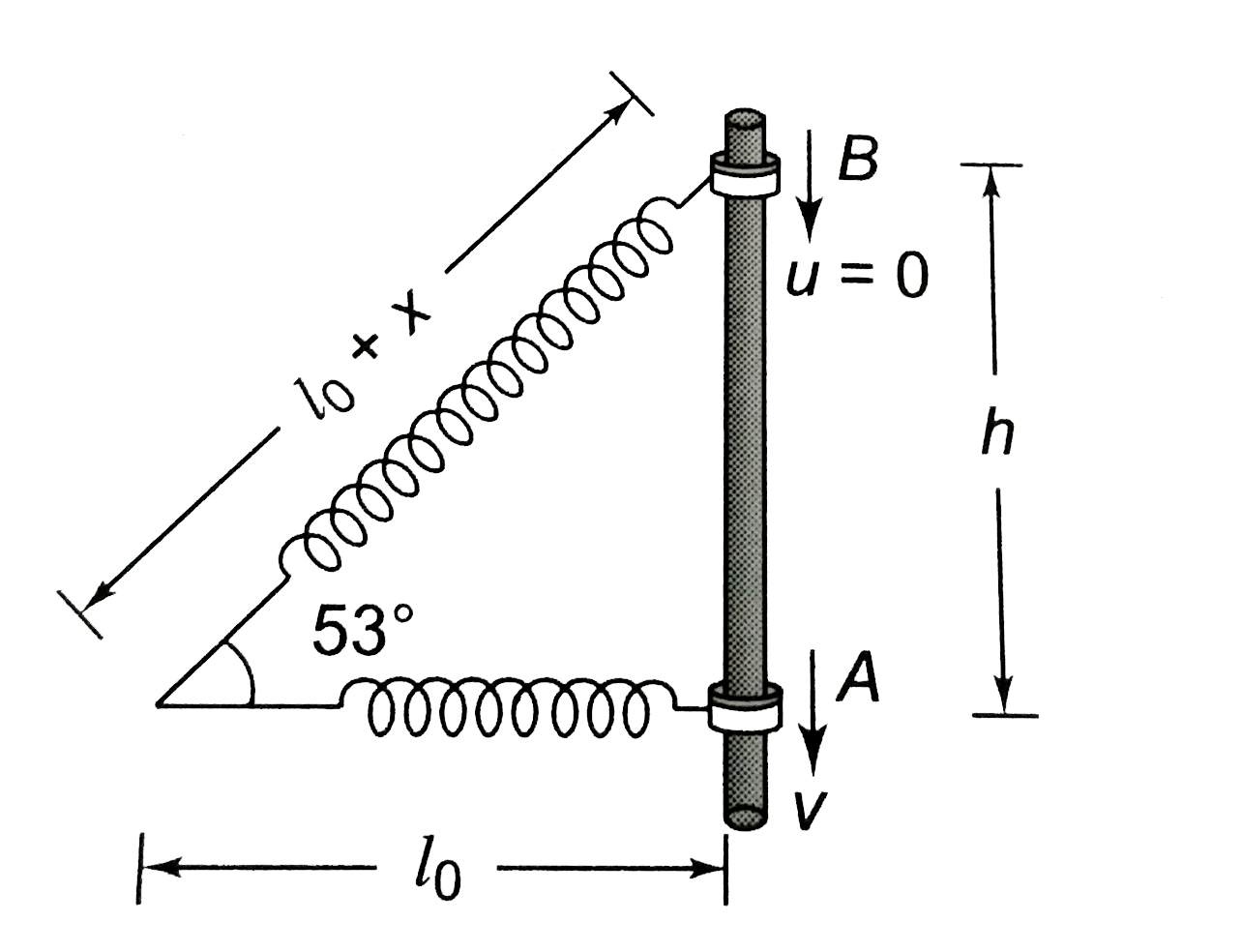 `tan45^@=(h)/(l_0)` `(4)/(3)=(h)/(l_0)impliesh=(4l_0)/(3)` `cos53^@=(l_0)/(l_0+x)implies(3)/(5)=(l_0)/(l_0+x)impliesx=(2l_0)/(3)` Mechanical ENERGY conservation between B and A `mgh+(1)/(2)kx^2=(1)/(2)mv^2` `v^2=2gh+(kx^2)/(m)=2gxx(4l_0)/(3)+(k)/(m)xx(4l_0^2)/(9)` `v=sqrt((4l_0)/(3)(2g+(kl_0)/(m)))` |
|
| 47. |
If veca+vecb+vecc "and " a^(2)+b^(2)=c^(2), the angle between the vectors vecc"and "veca is |
|
Answer» |
|
| 48. |
Gravel is falling on a conveyor belt at the rate of 12 kg s^(-1). The extra power required to movethe beltwith a velocity of 5ms^(-1) is |
|
Answer» 15 W |
|
| 49. |
Consider the motion of a ball in a tunnel through the earth (radius of the earth is R and mass of the earth is M), the tunnel is along a chord and the ball is released from the surface. The time period of the ball is sqrt(x) (approx), find x. |
|
Answer» |
|
| 50. |
The bulb and the stem of a mercury-in-glass thermometer contains 1 cm^(3) of mercury up to thezero mark. If the internal diameter of the stem is 0.3 mm, what is the length of a degree celsius on the scale?Coefficient of real expansion of mercury =18 times 10^(-5@)C^(-1) and coefficient of linear expansion of glass =8 times 10^(-6@)C^(-1). |
|
Answer» |
|