

Saved Bookmarks
This section includes 7 InterviewSolutions, each offering curated multiple-choice questions to sharpen your Current Affairs knowledge and support exam preparation. Choose a topic below to get started.
| 1. |
The weakest force found in nature is…….. |
|
Answer» STRONG nuclear force |
|
| 2. |
A string of mass 2.50 kgis under a tension of 200 N. The length of the stretched string is 20.0 m. If the transverse jerk is struck at one end of the string, how long does the disturbance take to reach the other end ? |
|
Answer» SOLUTION :Speed of TRANSVERSE wave in a string is, `v = sqrt ((T)/(mu)) = sqrt ((TL)/(M)) ""(because mu = (M)/(L))` If time taken by distubance to travel from one to another end of string is t then, br> `v= L/t` (Where L= length of string) Comparing above two equations, `L/t = sqrt((TL)/(M)) implies t =L sqrt ((M)/(TL))` `THEREFORE t = sqrt ((ML)/(T)) = sqrt ((2.5 xx 20)/(200)) = 1/2 =0.5s` |
|
| 3. |
The position of moving object at time 't', x=2t^(3), then find the acceleration. |
|
Answer» Solution :`X = 2t ^(3)` `v = (dx)/(dt) = (d)/(dt) (2t ^(3))` `v = 6t ^(2)` Now, acceleration `a = (DV)/(dt) = (d)/(dt) ( 6t ^(2))` `therefore a = 12 t` |
|
| 4. |
A capillary tube of radius 'r' is immersed in water and water rises to a height of 'h'. Massof water in the capillary tube is 5xx10^(-3)kg. The same capillary tube is now immersed in a liquid whose surface tensionis sqrt(2) times the surface tension of water. The angle of contact between the capillary tube and this liquid is 45^(@). The mass of liquid which rises into the capillary tube now is, (in kg) |
|
Answer» `5XX10^(-3)` |
|
| 5. |
Referring to figure of previous quesion letAU_(1) and AU_(2)be the changes in internal energy of the system in the processes A andB. Then |
|
Answer» `DeltaU_(1) GT DeltaU_(2)` |
|
| 6. |
Consider three converging lens L_1 L_2 and L_3 having identical geometrical construction. The index of refraction of L_1 and L_2 are mu_1 and mu_2 respectively. The upper half of the lens L_3 has a refractive index mu_1 and the lower half has mu_2. A point object O is imaged at O_1 by the lens L_1 and at O_2 by the lens L_2 placed in same positions IF L_3 is placed at the same place (A) there will be an image at O_1 (B) there will be an image at O_2 (C ) the only image will form somewhere between O_1 and O_2 (D) the only image will form away from O_2 |
|
Answer» (A) (C ) and (D) |
|
| 7. |
The weakest force found in nature is |
|
Answer» WEAK NUCLEAR force |
|
| 8. |
Out of the following functions representing motion of a particle which represent SHM? (a) y= sin omega t- cos omega t (b) y= sin^(2) omega t (c ) y= 5cos ((3pi)/(4)-3 omega t) (d) y= 1+ omega t+ omega^(2) t^(2) |
|
Answer» Only (a) and `y= 5 cos ((3pi)/(4)-3 omega t)` `= 5cos (3 omega t- (3pi)/(4))`. These equations represents a SHM with similar to the equation of displacement `y= A sin (omega t+x)`. |
|
| 9. |
A vessel of large uniform cross-sectional area resting on a horizontal surface holds two immiscible, non-viscous and incompressible liquids of densities d and 2d each of height H/2. If a small hole is punched on the vertical side of the container at a heighth h(h lt (H)/(2)) the efflux speed of the liquid al the hole is |
|
Answer» `SQRT(2g(H-h))` |
|
| 10. |
The dimensions of heat capacity are |
|
Answer» `[ML^(-2)T^(-2)K^(-1)]` |
|
| 11. |
Two earth satellites of same mass are revolving round the earth in circular orbits of radii 6400km and 19,200 km from the centre of the earth. Ratio of their orbital velocities will be: |
|
Answer» `1:SQRT(3)` |
|
| 12. |
Two pulses travelling in opposite directions along a string are shown for t=0 in the figure. Plot the shape of the string at t= 1.0, 2.0, 3.0, 4.0 and 5.0s respectively . |
Answer» Solution :LET us PLOT at `t = 3S` 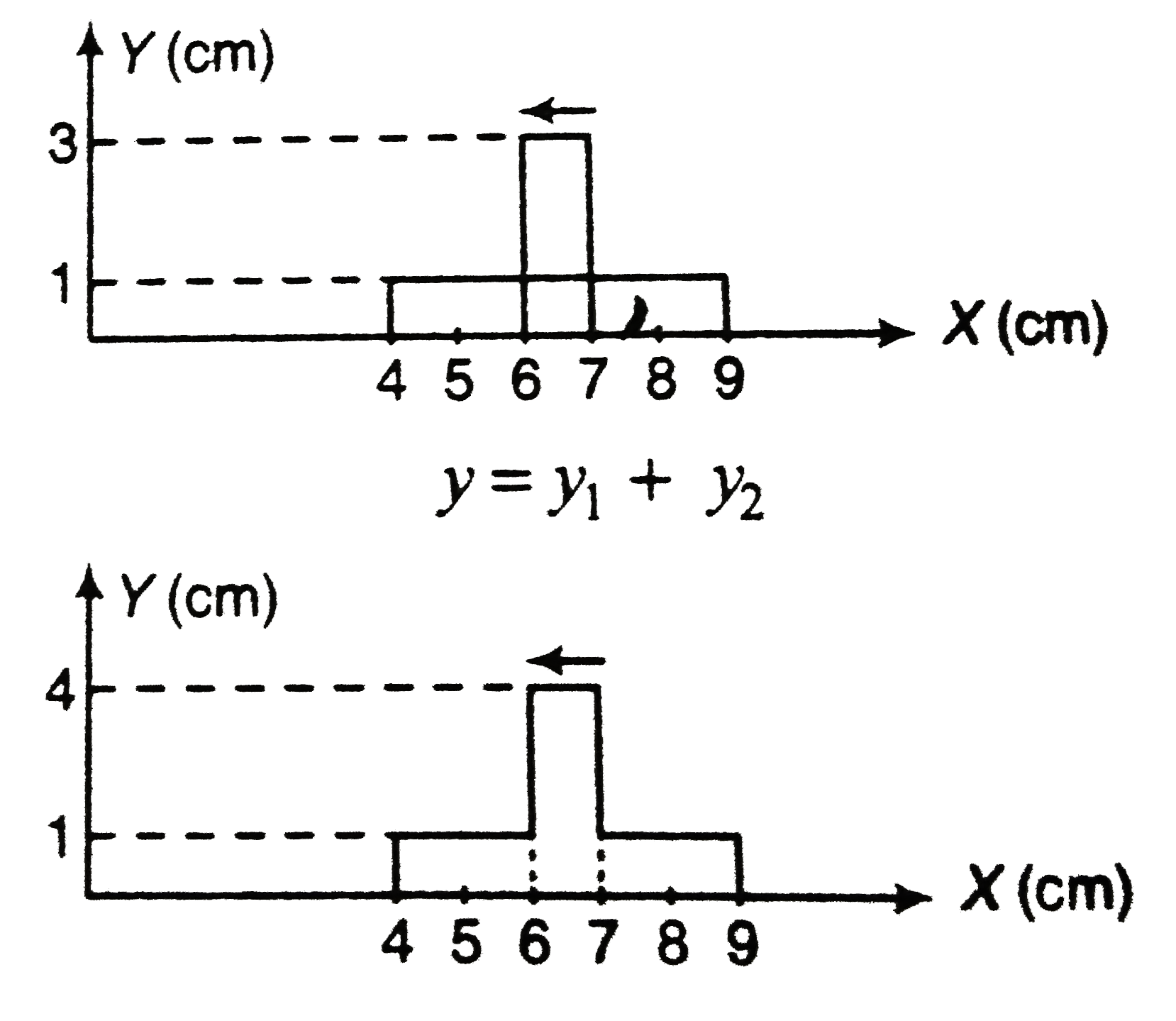 SIMILARLY, we can draw at other times. |
|
| 13. |
Three rods AB, BC and CA identical in shape and size are hinged together to form an equilateral triangle. Rods AB and CA have coefficient of linear expansion alpha_(1) = 12 xx 10^(-6)//°C, while that of rod BC is alpha_(2) = 18 xx 10^(-6)//°C. What should be the rise in temperature of the system of rods, so that the angle opposite to the rod BC increases by an amount 0.02°? |
|
Answer» `( 150 SQRT3)/( 27)° C` |
|
| 14. |
If. .g. is acceleration due to gravity on the earth and R is radius of the earth and angular speed of rotation of the earth about its axis is made to be sqrt((2g)/(5R)), then weight of a body at the equator decreases by |
|
Answer» 0.6 |
|
| 15. |
The amlitude of a particle executes SHM is 2 cm and the force acting at extreme position on particle is 4N, then what is force at midway between mean position and extreme point? |
|
Answer» SOLUTION :`F= kA` At EXTREME position `F= kA` `4= kxx 2 xx 10^(-2)` `THEREFORE k= 200 Nm^(-1)` Now, at midway point `x= (A)/(2) = (2)/(2)= 1cm` Force `F = k(1xx 10^(-2))` `= 200 xx 1xx 10^(-2)= 2N` Now, maximum acceleration `a_("max") = OMEGA^(2)A` `= omega^(2)sqrt(A_(1)^(2) +A_(2)^(2)+ 2A_(1) A_(2))`. |
|
| 16. |
Which type of elesticity a medium must posses for transverse wave motion to be possible ? |
| Answer» SOLUTION :For transverse WAVS MOTION. The medium must posses eleasticity of SHAPE. | |
| 17. |
A satellite P is revolving around the earth at a height =h radius of earth=(R) above equator. Another satellite Q is at a height =2h revolving in oppisite direction. At an instant the two are at same vertical line passing through centres of sphere. Find the least time of after which again they are in this situation. |
|
Answer» It will continue to MOVE with the same speed v along the ORIGINAL ORBIT of spacecraft |
|
| 18. |
A stone tied to a string is whirled in a vertical circle with uniform speed. If the difference between the maximum and minimum tensions is 1kgwt, the mass of stone is |
|
Answer» 1kg |
|
| 19. |
The unit of thermal conductivity is: |
|
Answer» `W m^(-1) K^(-1)` `:. K= ((dQ)/(dt))/(A xx (dT)/(dx))` `:.` Unit of k `= (""_(J)//""_(S))/(m^(2) xx ("kelvin")/(m))` `= (W)/(m xx "kelvin")` `=W m^(-1) K^(-1)` |
|
| 20. |
A ball bounces more on the surface of the moon than on the earth. Explain why? |
| Answer» SOLUTION :Ball bounces more on the surface of the moon because ACCELERATION due to GRAVITY at the moon is 1/6 TH that of the earth. | |
| 21. |
Potential energy is defined for |
|
Answer» non-CONSERVATIVE FORCE only |
|
| 22. |
Breaking stress is known as elasticity. |
| Answer» SOLUTION :False.Corresponds to BREAKING STRESS is KNOWN . As stress. | |
| 23. |
Dimension of force is |
|
Answer» `[M^(2)L^(1)T^(1)]` |
|
| 24. |
The absolute temperature of a body A is four times that of another body B. For the two bodies, the difference in wavelengths, at which energy radiated is maximum is 3.0mum. Then the wavelength at which the body B radiates maximum energy, in micrometers is |
|
Answer» 2 |
|
| 25. |
A heat conducting piston can move freely inside a closed thermally isolated cylinder which contains an ideal gas. In equilibrium the piston divides the cylinder in two equal parts, the temperature of the gas being T_(0). The piston is slowly displaced. Find the temperature of the gas when the volume of one part is n times greater than that of the other part. The adiabatic exponent of the gas is gamma. |
|
Answer» |
|
| 26. |
Why are the roofs of some houses blown off during a wind storm? |
Answer» Solution :The roofs of the huts or houses were designed with a slope as shown in Figure. During cyclonic condition, the roof is blown off WITHOUT damaging the order PARTS of the house. In accordance with the Bernoulli's principle, the high WIND blowing over the roof creates a low-pressure `P_(1)`. The pressure under the roof `P_(2)`is greater. THEREFORE, this pressure DIFFERENCE `(P_(2)-P_(1))` creates an up thrust and the roof is blown off. |
|
| 27. |
If a ball of mass 0.4 kg moving with a velocity of 3ms^(-1) collides elastically with another ball of mass 0.6 kg which is at rest, find their velocities after collision. |
|
Answer» `-0.6 MS^(-1), 2.4 ms^(-1)` |
|
| 28. |
Check the correctness of the equation y=a"sin"(2pi)/(lamda)(vt-x) using dimensional analysis where y is the displacement of a particle at a distance x from the origin at time t, lamda- wavelength v-wave velocity, a- amplitude. |
|
Answer» |
|
| 29. |
Assertion : The interference of two identical waves moving in same direction produces standing waves.Reason : Various elements of standing waves do not remain in constant phase. |
|
Answer» If both ASSERTION and reason are true and reason is the CORRECT explanation of assertion. |
|
| 30. |
In the above question velocities of two blocks in the centre of mass frame just after the kick are respectivelygiven by : |
|
Answer» 4 m/s , 10 m/s |
|
| 31. |
What is meant by displacement in SHM? |
|
Answer» Solution :The DISTANCE TRAVELLED by the vibrating particle at any INSTANT of TIME t from its mean position is KNOWN as displacement `y=Asinomegat` The maximum displacement from the mean position is known as amplitude (A) of the vibrating particle. |
|
| 32. |
Calculate the energy radiated from the hot body at 400K to the walls at 373 K per second (sigma= 5.735 xx 10^(-8) Wm^(-2)K^(-4)) |
| Answer» SOLUTION :`358 W.m^(-2)` | |
| 33. |
A ray of light is incident on the surface of a glass plate of thickness t. IF the angle incidence theta is Small, the emerging ray would be displaced sideways by an amount (take refractive index of glass as n. |
|
Answer» `t THETA N//(n+1)` |
|
| 34. |
A body of mass m and momentum p is in motion over a rough surface. It stops after covering a distance x. What is the coefficient of friction between the body and the plane ? |
|
Answer» <P> |
|
| 35. |
The force required tostop a moving object depends on its |
|
Answer» MASS ALONE |
|
| 36. |
Explain why, a brass tumbler feels much colder than a wooden tray on a chilly day. |
|
Answer» SOLUTION :Brass is good conductor of heat than wood. By touching brass tumbler, heat will be PASSED to it from hands so it is felt to be cool. And in CASE of WOODEN tray, heat is not transferred, so it is felt cool. |
|
| 37. |
A particle is projected horizontally with a speed u from the top of plane inclined at an angle theta with the horizontal. How far from the point of projection will particle strike the plane? |
|
Answer» Solution :Suppose particle is projected from height y, it strikes the ground at a horizontal distance x, then distance `R=sqrt(x^(2)+y^(2))`……..i  It t is the time of MOTION then `x=ut` and `y=1/2"gt"^(2)` From equation (i) we get `t=x/u` `:.y=1/2tg(x/u)^(2)=(gx^(2))/(2u^(2))`........iii From figure `y/x=tan theta` or `y=x tan theta`........IV From equation iii and iv we have `x tan theta=(gx^(2))/(2u^(2))` or `x[(gx)/(2u^(2))-tan theta]=0` As x=0 is not possible So `[(gx)/(2u^(2))-tan theta]=0` or `x=(2u^(2)tan theta)/g`...........v Now from equation i, iv and v we get `R=sqrt(x^(2)+y^(2))=sqrt(x^(2)+(x tan theta)^(2))=xsqrt(1+tan^(2)theta)=x SEC theta` or `=(2u^(2))/g "tan" theta sec theta` |
|
| 38. |
In a circus, a joker stands on a highly elevated plank with a ball in his hand. Another joker also stands with a rifle in his hand pointing it directly at the ball. If the fifle is fired precisely at themoment when the ball is released, will the bullet hit the ball ? Air resistance is negligible. |
|
Answer» Solution :The gravitational acceleration acting on the bullet and the ball areequal in magnitude and act vertically downwards. As the bullet is firedat the MOMENT the ball is released, the vertical displacements of both the bullet and the ball are the same. Therefore, the bullet will hit the ball. Alternative method : The bullet from the rifle is DIRECTED straight to the ball. Let `v_0` be the velocity with which the bullet leaves the rifle at an angle `theta` with thehorizontal . Let us consider , time taken by the bullet to pass across the vertical line MB at A is t.  Horizontal distance TRAVELLED by the bullet =OB=x [Fig.2.79] `x=v_0cos theta xxt or, t=(x)/(v_0 cos theta)` `therefore t^2=(x^2)/(v_0^2 cos^2 theta)` For thevertical motion of thebullet, `AB=v_0 sin theta xxt-1/2"gt"^2` `=v_0 sin thetaxx(x)/(v_0cos theta)-1/2gxx(x^2)/(v_0^2 cos^2 theta)` `=x tan theta -1/2 (gx^2)/(v_0^2cos^2 theta)` From the`Delta OMB`, `tan theta =(MB)/(OB)=(MB)/x therefore MB=xtan theta` Now, `MA=MB-AB=xtan theta -[xtantheta-1/2*(gx^2)/(v_0^2 cos^2theta)]` `=1/2(gx^2)/(v_0^2cos^2 theta)=1/2"gt"^2` Thus in a time t the bullet falls through a vertical distance `1/2"gt"^2` below M. The vertical distance fallen by the ball is `h=ut+1/2"gt"^2=1/2"gt"^2[because u=0]` Thus the bulletand the ball will always reach the point A at the same time. HENCE the bullet will always hit the ball whatever be the velocity of the bullet. |
|
| 39. |
Find the change in internal energy in joule. When 10g of air is heated from 30^@C to 40^@C (C_v = 0.172 kcal//kg K, J = 4200 J//kcal) |
|
Answer» 62.24 J |
|
| 40. |
A small piece of wire 4cm long, is floating on surface of water. If a force of 560 dynes in excess of its weight is required to pull it up from the surface, find the surface tension of water. |
|
Answer» Solution :Length of wire L = 4 cm Contact length of solid with liquid surface L = 2l = 8 cm `therefore` surface tension force F= 560 DYNES Surface tension `T=F/LrArrT=560/8=70` DYNE/cm Surface tension of water = 70 dyne `cm^(-1)=0.07Nm^(-1)`. The force REQUIRED, F = T(L) = `0.08xx1.32,F=0.1056N`. |
|
| 41. |
Two cars start off to race velocity 4 m/s and 2 m/s & travel in straight line with uniform acceleration 1m//s^(2) and 2 m//s^(2) respectively if with they reach the final point at the same instant, then the length of the path is : |
|
Answer» 30 m |
|
| 42. |
Assertion: Average kinetic energy per molecule of any ideal monoatomic gas is 3/2k_(B)T Reason: Aveerage kinetic energy depends only on temperature and is independent of the nature of the gas. |
|
Answer» If both assertion and REASON are true and reason is the correct EXPLANATION os assertion. |
|
| 43. |
Find the greatest length of the wire made of material of breaking stress 8 xx 10^8Nm^(-2) and density 8xx10^3 kgm^(-3)that can be suspended from a rigid support without breaking. |
|
Answer» Solution :Greatest LENGTH of the wire without breaking. ` L = ("Braking Stress ")/(RHO g)` Here, breaking stress `= 8 xx 10^(8)Nm^(-2)`, `rho = 8 xx 10^(3)kgm^(-3), g= 10ms^(-2).` `L= (8 xx 10^(8))/(8 xx 10^(3) xx 10)=1 xx 10^(4)m=10km` |
|
| 44. |
Dimensions of (1)/(mu_(0)in_(0)), where symbols have their usual meaning are |
| Answer» Answer :C | |
| 45. |
A body cools from 71^(@)Cto 69^(@)c in 2 minutes 40 seconds/ What os the required for it to cool its temperature from 61^(@) C to 59^(@) C ? |
| Answer» SOLUTION :2 MIN, 40S | |
| 46. |
A wire of length l and mass m is first bent in a circle, then in a square and then in an equilateral triangle. The moment of inertia in these three cases about an axis perpendicular to their planes and passing through their centrer of mass are I_(1),I_(2) and I_(3) respectively. Then maximum of them is |
| Answer» Answer :A | |
| 47. |
Dimensional formula of the product of the two physical quantities P and Q is ML^(2) T^(-2), the dimensional formula of P/Q is MT^(-2). P and Q respectively are |
|
Answer» FORCE, velocity |
|
| 48. |
A simple pendulum has time period 3sec. The pendulum is completely immersed in a non - viscous liquid whose density is 1//10th of that of the material of the bob. Then time period of that pendulum is |
| Answer» Answer :D | |
| 49. |
The arrangement shown below consists of a uniform metre scale of length 1 m, balanced on a fixed hemisphere of radius 20 cm. when one end of the scale is slightly pressed and released, it performs S.H.M. Determine the angular frequency of oscillations. (Take g = 10 ms^(-2)) |
Answer» Solution :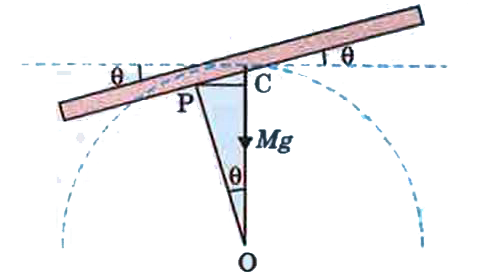 Let `theta` be the angle be which the rod is pressed. The restoring forc on the rod will be its weight, acting downwards at C. The MAGNITUDE of the restoring torque = force `xx` perpendicular DISTANCE ` = Mg xx CP = Mg xx OP sin theta = mg xx R sin theta` (where) OP = R = radius of sphere). Since `theta` is small so `sin theta = theta` where `theta` is in radains, IF I is the moment of inertia of the rod. then the equations of motion of the scale is `I(d^(2)theta)/(dt^(2)) = mgRtheta` or `(d^(2)theta)/(dt^(2)) = (-(mgR)/(I))theta`{negative sign due to restoring nature.} Thus, the motion is simple haromonic with angular frequency `omega^(2) = ((MgR)/(I))` `rArr omega = sqrt((MgR)/(I)) (because (ML^(2))/(12))` `therefore omega = sqrt((12gR)/(L^(2)))` Using the VALUES L = 1m, g = 10 `ms^(-2)` and R = 0.2 m, we get= 4.898 rad/s. |
|
| 50. |
Three points A, B, C are located in a straight line AB=a and AC=b.Two particles start from points B and C and move with uniform velocities v_(1) and v_(2)respectively such that angle between vec(v_(1)) and line ABC and vec(v_(2)) and ABC is theta. If point A and both the particles are always in a straight line then the relation between a, b, V_(1), V_(2) is aV_(2)= kb V_(1). The value of 'k' is |
|
Answer» |
|