

Saved Bookmarks
This section includes 7 InterviewSolutions, each offering curated multiple-choice questions to sharpen your Current Affairs knowledge and support exam preparation. Choose a topic below to get started.
| 1. |
When we jump out of a boat standing in water, it moves |
| Answer» Answer :D | |
| 2. |
A thin, uniform chain is hanging vertically and its bottom end is touching a table . The mass of the chain is m and its length is l . At the moment t=0, the chain is released. Calculate the force that the chain exerts on the table after t seconds. |
|
Answer» |
|
| 3. |
Bubbles of air can rise up through a liquid Why? |
| Answer» Solution :The DENSITY of air is LESS than density of liquid through which it rises. HENCE terminal velocity is negative. So the bubbles rise up. SINCE terminal velocity is proportional to SQUARE of radius, smaller bubbles rise with smaller velocity | |
| 4. |
A liquid will not wet the surface of a solid if the angle of contact is ……………. . |
| Answer» ANSWER :B | |
| 5. |
What do you mean by capillarity or capillary action ? |
| Answer» Solution :In a LIQUID whose angle of contact with SOLID is less than `90^@`, suffers capillary rise. On the other hand, in a liquid whose angle of contact it is greater than `90^@`, suffers capillary FALL. The rise or fall of a liquid in a narrow tube is called capillary are capillary action. | |
| 6. |
The surface tension of soap water is 0.04 Nm^(-1) The excess of pressure inside a soap water bubble of diameter 10 mm is |
| Answer» ANSWER :C | |
| 7. |
One end of a uniform glass capillary tube of radius r=0.025 cm is immersed vertically in water to a depth h = 1cm. The excess pressure in N//m^(2) required to blow an air bubble out of the tube: Surface tension of water = 7 xx 10^(-2) "N/m" Density of water = 10^(3) "kg/m"^(3) Acceleration due to gravity = 10 "ms"^(-3) |
|
Answer» `0.0048 XX 10^(5)` |
|
| 8. |
(A) : A needle placed carefully on the surface of water may float, where as a ball of the same material will always sinks (R ) : The buoyancy of an object depends both on the material and shape of the object. |
|
Answer» Both (A) and (R ) are TRUE and (R ) is the correct explanation of (A) |
|
| 9. |
ABCDEFGH is a hollw cube made of an insulator(figure) face ABCD has positive charges on it. Inside the cube, we have ionsed hydrogen. The usual kinetic theory expression for pressure |
|
Answer» will be valid |
|
| 10. |
A pin is placed 10cm in front of a convex lens of focal length 20cm and refractive index 1.5. The surface of the lens farther away from the pin is silvered and has a radius of curvature of 22cm. How far from the lens is the final image formed? |
|
Answer» 10 cm |
|
| 11. |
A person of mas 50 kg carryign a load of 20 kg walks up a staircase. If the width and heigh of each step are 0.25 mand 0.2 m respectively, the work done by the man in walking up 20 steps is (g=10ms^(-2)) |
|
Answer» 1400 j |
|
| 12. |
Name the unit used for measuring small area of cross section like nuclear cross section. |
| Answer» SOLUTION :Barn 1 barn `=10^(-24)m^(2)` | |
| 13. |
Consider a pendulum consisting of a massless string with a mass at one end. The mass is held with the string horizontal and then released. The mass swings down, and on its way back up, the string is cut at point P when it makes an angle of with theta the vertical. Find the angle for theta which horizontal range 'R' is maximum. |
Answer» Solution :The speed at angle is given by conservation of energy  `(1)/(2) mv^(2)= mgh RARR (1)/(2) mv^(2)= mg l cos theta` `v= SQRT(2GL cos theta)` When string is cut particle moves as a projectile with velocity component. `v_(x)= v cos theta v_(y) = v sin theta` The time of flight is `t=2 ((v_(y))/(g))` RANGE is, `R=v_(x), t= v_(x) ((2v_(y))/(g))` `= (2v_(x)v_(y))/(g)= (2 (v cos theta) (v sin theta))/(g) = (2v^(2) sin theta cos theta)/(g)` `=(2(2gl cos theta) sin theta cos theta)/(g)= 4l cos^(2) theta sin theta` Differentiating .R. with respect to `.theta.` and EQUATING it to zero we get `0= 4l (-2 cos theta sin theta) sin theta + cos^(2) theta cos theta` `or, 2 sin^(2) theta cos theta= cos^(3) theta or, tan theta = 1//sqrt2` |
|
| 14. |
What is meant by 'temperature' ? Give its unit. |
| Answer» SOLUTION :Temperature is the DEGREE of hotness or coolness of a body. Hotter the body HIGHER is its temperature. The temperature will determine the direction of heat flow when two bodies are in THERMAL contact. The SI unit of temperature is kelvin (K). | |
| 15. |
A student performs an experiment for determination of g= ( 4 pi^(2) L)/( T^(2) ), L ~~ 1m, and the commits an error of Delta L for the length, the time of n oscillations with the stop watch least count Delta T. For which of the following data the measurement of g will be more accurate? |
|
Answer» `DELTA L = 0.5 , Delta T = 0.1, N = 20` |
|
| 16. |
If E, m, l and G denote energy, mass, angular momentum and gravitational constant respectively, the quantity (El^(2)//m^(5)G^(2))has the dimensions of |
|
Answer» angle `[G]= ([MLT^(-2)][L^(2)])/([M^(2)])= [M^(-1)L^(3)T^(-2)]` `:. [(El^(2))/(m^(5)G^(2))]= ([ML^(2)T^(-2)][M^(2)L^(4)T^(-2)])/([M^(5)][M^(-2)L^(6)T^(-4)])= [M^(0)L^(0)T^(0)]` As angle has no dimensions so this has the same dimensions as that of angle. |
|
| 17. |
A block is placed on a ramp of parabolic shape given by the equation y=x^(2)//20. If mu_(s)=0.5, then the maximum height above the ground at which the block can be placed without slipping is |
Answer» Solution :Let the block can be placed on the ramp at a height h above the ground and `theta` is INCLINATION of the ramp at the position. In the position the component of weight along the slope of ramp is mg SIN `theta` downwards. The limiting frictional force is `= mu_(s)N=mu_(s)mg cos theta` In equilibrium, `mg sin theta = m_(s) mg cos theta qm sin theta = TAN theta = m_(s)=0.5` but, `y=X^(2)//20` Slope `tan theta = (dy)/(dx)=(2x)/(20)=(x)/(10)` `(x)/(10)=0.5 rArr x = 5` From the figure maximum height, `h=y_(MAX)=(x^(2))/(20)=(25)/(20)=1.25m` |
|
| 18. |
The measured mass and volume of a body are 2.42 g and 4.7 cm^(3) respectively with possible errors 0.01g and 0.1 cm^(3). Find the maximum error in density. |
|
Answer» Solution :Density,`d=(mass(m))/(VOLUME(V))` Here `m=2.42g, Deltam=0.01g,v=4.7cm^(3)` , `DeltaV =0.1cc` Maximum error in density,`(DELTAD)/d XX100=((Deltam)/mxx100)+((DeltaV)/Vxx100)` `=((0.01)/(2.42)xx100)+((0.1)/(4.7)xx100)=0.413%+2.127%=2.54%` |
|
| 19. |
Is centre of gravity changes it's position if the shape changes of a body without change of it's weight? |
|
Answer» |
|
| 20. |
Two children are playing a game in which they try to hit a small box using a spring loaded machine gun, which is fixed rigidly to a table at a height h above the top of the box. The spring hasspring constant k and the box is at a horizontal distance l from O. The first child compresses the spring a distanc x_(0) and find that the marble falls short of box by a horizontal distance y. The second child compreses the spring by an extra amount Deltax so that marble lands in the box. The value of Deltax is |
|
Answer» `lsqrt((MG)/(HK))` |
|
| 21. |
A particle performs uniform circular motion with an angular momentum L. If the angular frequency of particle is doubled and kinetic energy is halved, its angular momentum becomes: |
|
Answer» 4 L |
|
| 22. |
In the system shown in figure m_(1)gtm_(2). System is held at rest by thread BC. Just after the thread BC is burnt. |
|
Answer» ACCELERATION of `m_(1)` will be equal to zero |
|
| 23. |
Two masses m_1 = 5 kg and m_2= 4 kg tied to a string are hanging over a light frictionless pulley. What is the acceleration of each mass when left free to move? (g =9.8ms^(2)) |
| Answer» Solution :`a = (m_1- m_2)/(m_1 + m_2) XX G = (5-4)/(5 +4) xx 10= 1/9 xx 10 = 1.1 ms^(-2)` | |
| 24. |
A sample of ideal gas is at equilibrium. Which of the following quantity is zero? |
| Answer» Solution :average velocity | |
| 25. |
A particle moves from a point (-2hat(i) +5hat(j)) "to" (4 hat(j) +3 hat(k)) .When a force of (4hat(i) +3hat(j))Nis applied.How much workhas been by the force ? |
|
Answer» Solution :`W = vec(F ) . d vec(s) ` `d vec(s) = (4 hat(j) +3 hat(K)) - (-2hat(i) + 5 hat(j))` `= + 2 hat(i) - hat(j) =3 hat(k)` ` :. W = (4hat(i) +3hat(j)).(2hat(i)-hat(j) +3hat(k))` ` = 8-3 +0` ` :. W = 5J ` |
|
| 26. |
Explainwhy at high altitude,water boils below 100? |
| Answer» Solution :The BOILING POINT of substance depends upon the PRESSURE it is 100°C under normal pressure at the sea LEVEL .AT higher altitudesthe pressure is much LESS than that the at sea levelunder normal pressure at the sea level .So the boiling point of water decreases.Hence,it boils below 100°C. | |
| 27. |
if the man can move with maximum acceleration a_(1)and a_(2) relative to the trolley car in forward and backward directions, respectively then : |
|
Answer» `mu_(s)= (a _(1) +a _(2))/( 2G)` |
|
| 28. |
The period of vibration (T) of the prongs of a tuning fork depends upon density of the material d, Young's modulus Y and length of the prongs L. Then |
|
Answer» `T ALPHA (sqrt(DY))/(L)` |
|
| 29. |
Water is flowing through two capillary tubes under constant pressure head. The ratio of their lengths is 3:1 and of diameters is 2 : 1. Find the ratio of rate of flow of water through two tubes. |
|
Answer» |
|
| 30. |
Displacement between maximum potential energy position and maximum kinetic energy position for a particle executing simple harmonic motion is…….. |
|
Answer» Solution :MAXIMUM potential energy is at `y= pm A` and maximum KINETIC energy at `y=0`. Displacement between maximum potential energy and maximum kinetic energy is `pm A`. |
|
| 31. |
A mass of Hg is executin SHM which is given by x=6.0(100t+(pi)/(4)) cm.What is the maximum kinetic energy? |
|
Answer» |
|
| 32. |
A man standing , observes rain falling with velocity of 20m//sat an angle of 30^(@) with the vertical Find out velocity of man so that rain appers to fall vertically Find out velocity of man so that rain again appears to fall at 30^(@) with the vertical. |
|
Answer» SOLUTION :`vecV_(m)=-vhati("let")` `vecV_(R)=-10hati-10sqrt3hatj` `vecV_(RM)=-(10-v)hati-10-sqrt3hatj` `rArr-(10-v)=0` (for vertcal fall , horizontal component MUST be zero) (or)`v=10m//s`  `vecV_(R)=-10hati-10sqrt3hatj` `vecV_(m)=-v_(x)hati` `vecV_(RM)=-(10-v_(x))hati-10sqrt3hatj` Angle with the vertical =`30^(@)` `rArr TAN 30^(@)=(10-v_(x))/(10sqrt3)rArr v_(x) =20m//s` 
|
|
| 33. |
The number of molecules of hydrogen in 1 cc of hydrogen gas at NTP. |
|
Answer» `2.688 XX 10^(19)` |
|
| 34. |
Passage - VI : A uniform rectangular plate of length l and height h has a small triangular wedge like support welded to its right bottom and has a small light rigid wheel fitted to its other bottom edge. There is no friction at the axle of the wheel. This plate is placed with its length horizontal as shown on a rough horizontal plank. If the plank moves with rightward acceleration of a_(0) the plate just begins to slide on the plank. While sliding, the wheel rolls. Since the wheel has negligible inertia, net force required to accelerate its centre of mass and net torque required to impact then angular acceleration can be neglected. The plank and the plate are initially at rest. If a_(0) (as mentioned in the passage) is large enough, the maximum value of acceleration of the plank towards left in a new experiment for which plate will not topple on the plank is |
|
Answer» `(a_(0)gl)/(gl-a_(0)h)` |
|
| 35. |
When a small lead shot is released from the upper surface of a viscous liquid, |
|
Answer» the LEAD SHOW will go on descending with an acceleration g |
|
| 36. |
A body is projected horizontally from the top of a hill with a velocity of 9.8 m/s. What time elapses before the vertical is twice the horizontal velocity ? |
|
Answer» 0.5 sec |
|
| 37. |
Passage - VI : A uniform rectangular plate of length l and height h has a small triangular wedge like support welded to its right bottom and has a small light rigid wheel fitted to its other bottom edge. There is no friction at the axle of the wheel. This plate is placed with its length horizontal as shown on a rough horizontal plank. If the plank moves with rightward acceleration of a_(0) the plate just begins to slide on the plank. While sliding, the wheel rolls. Since the wheel has negligible inertia, net force required to accelerate its centre of mass and net torque required to impact then angular acceleration can be neglected. The plank and the plate in a new experiment are first given a constant velocity towards right. The plank is then given a constant retardation a. If l is large enough, the maximum value of a for which plate will not slide is |
|
Answer» `a_(0)` |
|
| 38. |
If P = 2i + 3j - 4k and Q= 5i + 2j + 4k find the angle between the two vectors |
|
Answer» `30^(@)` |
|
| 39. |
Assertion : Water can be boiled inside satellite by convection.Reason:Convection is the process in which heat is transmitted from a place of higher temperature to a place of lower temperature by means of particles with their migrations from one place to another. |
|
Answer» If both assertion and REASON are TRUE and the reason is the correct EXPLANATION of the assertion. |
|
| 40. |
The sum of the numbers 436.32, 227.2 and 0.301 in appropriate significant figure is : |
|
Answer» 663.82 In APPROPRIATE SIGNIFICANT figure sum = 664. |
|
| 41. |
On a certain day the temperature of the air is s30^(@)C and relative humidity 50%. What fraction of the mass of water vapour would condense if the temperature fell to 10^(@)C? [Saturated vapour pressure at 30^(@)C=31.7mm and 10^(@)C=9.2mm] |
|
Answer» |
|
| 42. |
Figure 6.18 shows the V-T graph for a fixed mass of an ideal gas at pressure p_1 and p_2. Can you infer from the graph whether p_1 is greater than p_2? |
|
Answer» SOLUTION :We have pV=nRT or, `V=(nR)/P T` this shows that the V-T graph is a STRAIGHT line PASSING through the origin for any fixed PRESSURE p(n=constant for a fixed mass). The slope `(nR)/p` Is greater for a smaller value of p. In fig.6.18, the graph for `p_2` has a higher slope. So, `p_2 lt p_1` Thus `p_1` is greater than `p_2`. |
|
| 43. |
A simple pendulum is vibrating with an angular amplitude of 90^(@). For what values of theta with vertical, the acceleration is directed. 1. vertically upwards 2. horizontally 3. verticaly downwards |
|
Answer» `0^(@),COS^(_1)1//sqrt(3),90^(@)` |
|
| 44. |
In Exercise 14.9, let us take the position of mass when the spring is unstreched as x = 0, and the direction from left to right as the positive direction of x-axis. Give x as a function of time t for the oscillating mass if at the moment we start the stopwatch (t = 0), the mass is (a) at the mean position, (b) at the maximum stretched position, and (c) at the maximum compressed position. In what way do these functions for SHM differ from each other, in frequency, in amplitude or the initial phase ? |
|
Answer» Solution :`a = 2 cm, omega = SQRT((k)/(m)) = sqrt((1200)/(3)) s^(-1) = 20s^(-1)` (a) SINCE time is measured from mean position, `x = a sin omega t = 2 sin 20t` (b) At the maximum stretched position, the body is at the extreme RIGHT position. The initial phase is `(pi)/(2)` `:. x = a sin (omega t +(pi)/(2)) = a cos omega t = 2 cos 20 t` (c) At the maximum compressed position, the body is at the extreme left position. THEINITIAL phase is `(3pi)/(2)` `:. x = a sin (omegat +(3pi)/(2)) =- a cos omega t =- 2 cos 20 t` Note: The functions neither DIFFER in amplitude nor in frequency. They differ only in initial phase. |
|
| 45. |
When a motor car travels on a convex road the passengers inside feel lighter. Why? |
|
Answer» Solution :When a motor car travels on a convex road, the resultant of the weight (W)of any passenger inside it and the upward normal force (R ) on the surface of the car supplies the necessary centripetal force to the passenger to TRAVEL ALONG the convex road (i.e.,circular path ), i.e.,W - R = `(MV^(2))/(r),` where,m = mass of the passenger, V= linear velocity of the car ANDR = radius of the circular path or,R=W - `(mv^(2))/(r) ""`....(1) Due to this normal force R, the passenger feels his weight. now, according to equation (1) , since R `lt` W, the passenger feels lighter. |
|
| 46. |
When a long spring is stretched by 2 cm, its potential energy is U. If the spring is streched by 10 cm, the potential energy in it will be |
| Answer» Answer :B | |
| 47. |
How will the velocity of a particle in SHM vary as it moves from the mean position to an extreme position? |
| Answer» Solution :The VELOCITY of the particle in SHM DECREASES from maximum at the mean position to zero at the EXTREME position according to the equation `v= OMEGA SQRT(A^2 - y^2)` . | |
| 48. |
A wind - powered generator converts wind energy into electric energy. Assume that the energy intercepted by its blades into electrical energy. For wind speed v, the electrical power output will be proportional to, |
| Answer» Answer :C | |
| 49. |
Give reason why mercury does not wet glass . |
| Answer» Solution :The cohesive forces among the MOLECULES of mercury are STRONGER ,while the ADHESIVE FORCE between the molecules of mercury and glass are weak. Hence mercury does not STICK and wet to glass surface . | |
| 50. |
In the previous problem , if the horizontal surface is rough with friction coefficient 0.5 and collision is elastic , head - on , the distance travelled by the block on the rough surface |
|
Answer» `5 m` `0 = v^() - 2 mu GD` `0 = 2gL - 2 mu gd` `d = (L)/(mu) = (5)/(1//2) = 10 m` 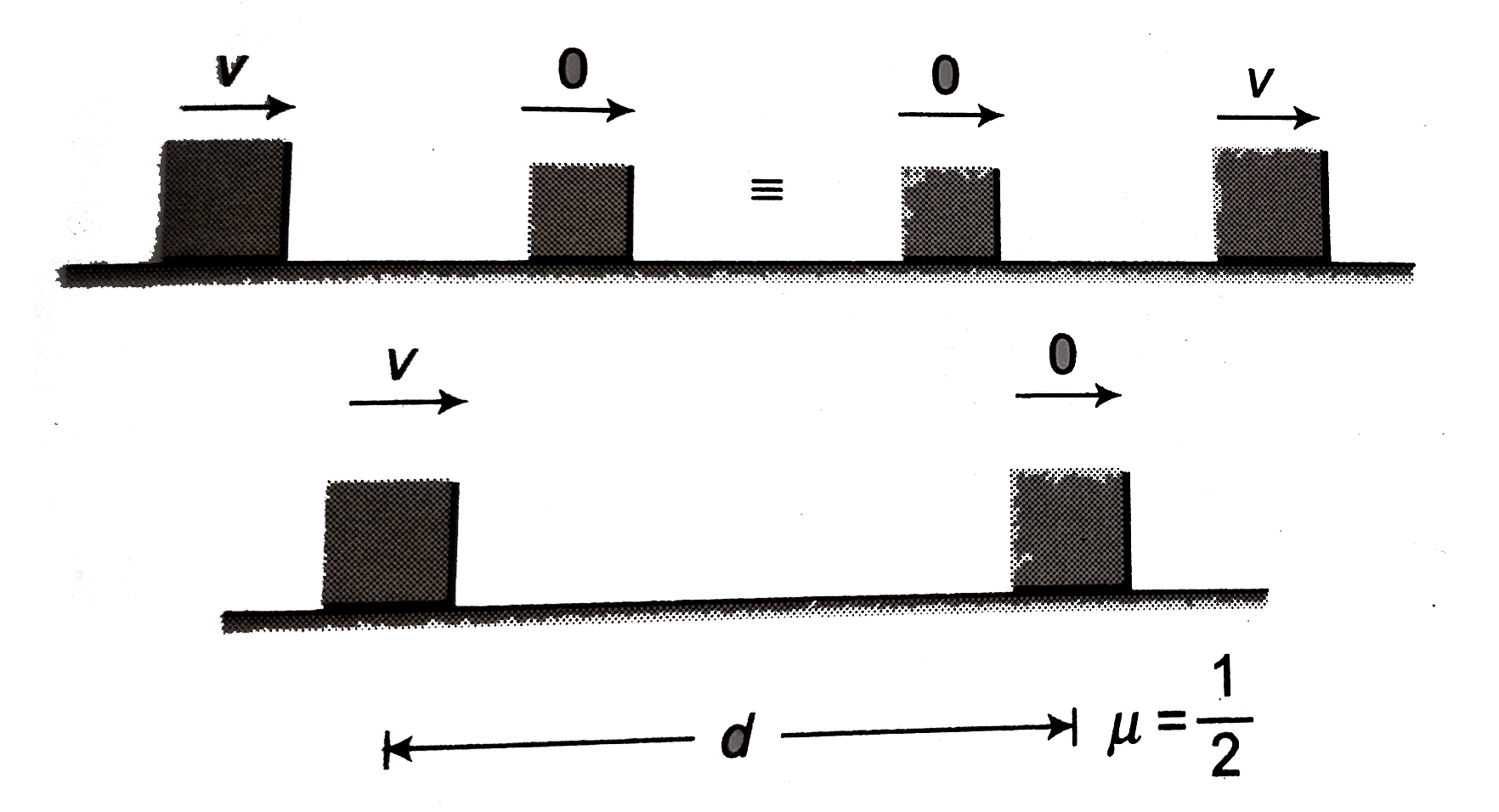
|
|