

Saved Bookmarks
This section includes 7 InterviewSolutions, each offering curated multiple-choice questions to sharpen your Current Affairs knowledge and support exam preparation. Choose a topic below to get started.
| 1. |
Two blocks of masses m and 2m rest on a frictionless horizontal surface. They are connected by an ideal spring of relaxed length l and stiffness constant k. By means of a massless thread connecting the blocks the spring is held compressed to a length l//2. the whole system is moving with speed v in a direction perpendicular to the length of the spring. the thread is then burnt. Answer the following questions in terms of l,km,v Before burning, the rato of kinetic energy to potential energy is: |
|
Answer» `(12mv^(2))/(KL^(2))` |
|
| 2. |
The wavelength of maximum intensity of radiation emitted by a star is 289.8 nm. The radiation intensity for the star is |
|
Answer» `5.67xx10^(8)Wm^(-2)` |
|
| 3. |
Two cars start in a race with velocities u_(1) and u_(2) and travel in a straight line with acceleration 'a' and b .If both reach the finish line at the same time,the range of the race is |
|
Answer» `(2(u_1-u_2))/((BETA - ALPHA)^2) (u_1 beta - u_2 alpha)` |
|
| 4. |
A small ball of mass m is projected with a minimum horizontal velocity v_(0) on a smooth wedge of mass M so that it will reach the highest point of the wedge. Find the value of v_(0) |
|
Answer» <P> Solution :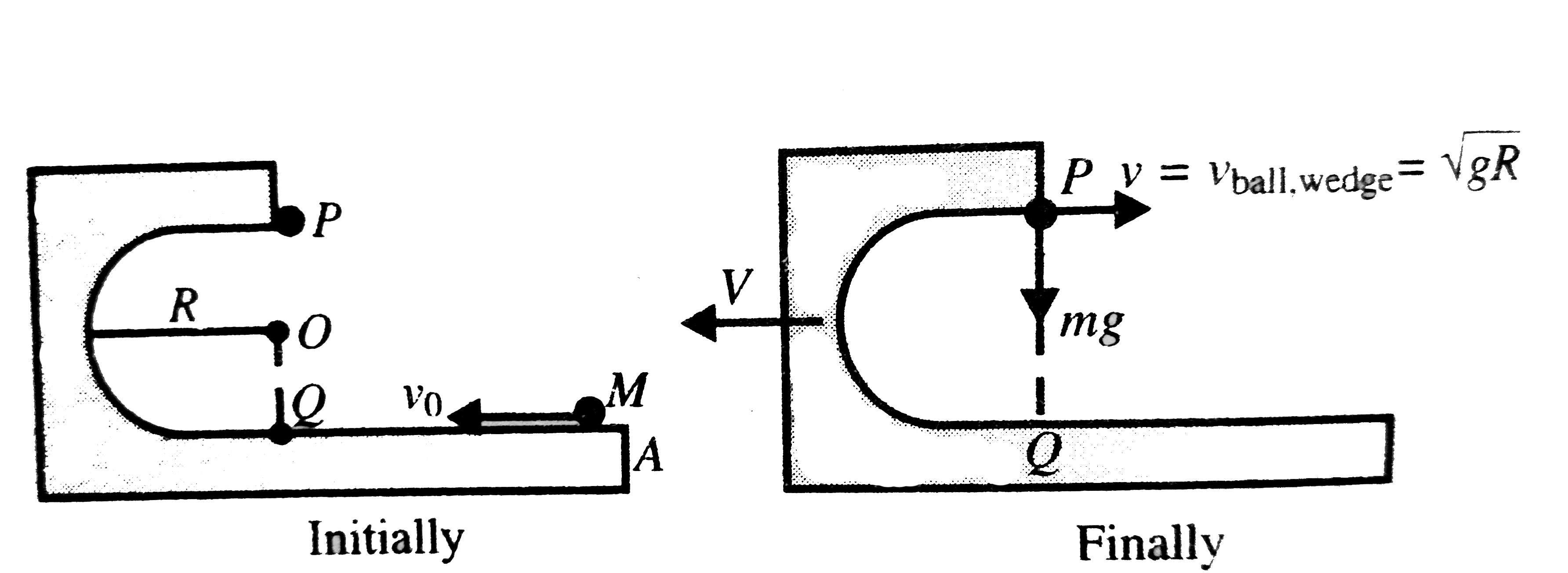 if the ball reaches at point `P`, the VELOCITY of the ball with respect to wedge should be `sqrt(gR)` using work energy theorem from centre of mass frame at `A` and the HIGHEST point `P` ltbr `W_(ext)+W_(int)+0=(/_\K)-(cm)` `W_("gravity")=(/_\K)_(CM)` `-mg(2R)=[1/2muv_(rel)^(2)]_("final")-[1/2muv_(rel)^(2)]_("initial")` `-mg2R=1/2mu(V+v)^(2)-1/2muv_(0)^(2)`..............i `mu=((mM)/(m+M))` and `v=sqrt(gR)` As there is no EXTERNAL forces acting on the system in HORIZONTAL direction. the linear momentum of the system should be conserved. i.e. `mv_(0)=m(V-v)+MV` `V=(m(v_(0)+v))/((m+M))` ............ii from eqn i and ii we get `implies v_(0)=sqrt((5+(4m)/M))gR` |
|
| 5. |
The mass of 1 litre of helium under a pressure of 2 atm and at a temperature of 27^(@)C is |
|
Answer» 0.16 g `"MASS of one ofHe"=4G` `"Mass of n moles "=(nxx4)=(0.08xx4)=0.32g` |
|
| 6. |
5 gm of steam at 100^@C is passed into calorimeter containing liquid. Temperature of liquid rises from 32^@C " to " 40^@C . Then waternequivalent of calorimeter contents is |
|
Answer» 40 GRAM |
|
| 7. |
The weight of an empty balloon on a spring balance is W_(1). The weight becomes W_(2) when the balloon is filled with air. Let the weight of the air itself be w. Neglect the thickness of the balloon when it is filled with air. Also neglect the difference in the densities of air inside and outside the balloon. a) W_(1)=W_(1) b) W_(2)=W_(1)+w c) W_(2)ltW_(1)+w d) W_(2)gtW_(1) |
|
Answer» a, and C are CORRECT |
|
| 8. |
{:("List -I","List -II"),((a)"Isobaric process ",(e)dQ=dw),((b)"Isochoric process",(f) d Q=dU+dw),((c)"Isothermal process ",(g)dU=-dw),((d)"Adiabatic process",(h) dQ=dU):} |
|
Answer» a-e, B-f, c-h, d-g |
|
| 9. |
Two bodies of mases 5kg and 3kg are moving towards each other with 2ms^(-1) and 4ms^(-1) respectively. Then velocity of centre of mass is |
|
Answer» `0.25 MS^(-1)` towards 3kg |
|
| 10. |
A load of 31.4 kg is suspended from a wire of radius 10^(-3)m and density 9xx10^(3)kg//m^(3). Calculate the change in temperature of the wire if 75% of the work done is converted into heat. The Young.s modulus and heat capacity of the material of the wire are 9.8 x10^(10) N//m^(2) and 490 J/kg K respectively. |
|
Answer» Solution :As work done in stretching an elastic BODY per unit volume is given by `(W)/(V)=(1)/(2) "stress" xx "strain" =(1)/(2) ("stress")/(Y)[ as Y=("stress")/("strain")]` `So W=(1)/(2)[(Mg)/(A)]^(2)(V)/(Y)[ "as stress" =(F)/(A)=(Mg)/(A)]` Now according to given Problem `H=(75//100)W` `ms DELTA theta=(3)/(4)xx(1)/(2)[Mg)/(pir^(2))](V)/(Y)(or) (rho V) s Delta theta=(3)/(4)xx(1)/(2) [(mg)/(pi^(2))]^(2) (V)/(Y)` `:. Delta theta=(3)/(8)[(31.4xx9.8)/(pixx10^(-6))]^(2)(1)/(9.8xx10^(10))xx(1)/(9XX10^(3)xx490)` `i.e, Delta theta=(1)/(120)K=8.33 xx10^(-3)K` |
|
| 11. |
Light of wavelength 4500 A^@ in air in incident on a plane boundary between air and another medium at an angle 30^@ with the plane boundary. As if enters from air into the other medium, it deviates by 15 towards the normal. Find refractive index of the medium, and also the wavelength of given light in the medium? |
|
Answer» Solution :Angle of INCIDENCE `i=90^@-30^@=60^@` As the ra bends towards the normal, it deviates by an angle `i-r=15^@` (given) `therefore r=45^@` Applying snell.s LAW `mu_(air) SIN I=mu_(med) sin r` `therefore 1 TIMES sin 60^@=mu times sin 45^@` `therefore mu = (sin 60^@)/(sin 45^@) =(sqrt3//2)/(1//sqrt2)(or) mu =sqrt1.5` In terms of wavelength `mu=sqrt1.5=lamda_(air)/lamda_(med) (or) lamda_(med)= lamda_(air)/sqrt1.5=4500/sqrt1.5=3674 A^@` 
|
|
| 12. |
If vecR=vecP+vecQ, then which of the following is true? |
|
Answer» `PgtQ` |
|
| 13. |
Match Column-I with Column-II : {:("Column-I","Column-II"),("(1) Definition of force.","(a) Newton's third law of motion."),("(2) Magnitude of forec.","(b) Newton's second law of motion."),("","(c) Newton's first law of motion."):} |
|
Answer» |
|
| 14. |
Define thermal conductivity. Give its unit. |
| Answer» Solution :The quantity of HEAT TRANSFERRED through a UNIT length of a material in a direction normal to unit surface area due to a unit temperature difference under steady state conditions is known as thermal conductivity of a material.’ | |
| 15. |
What will be the wavelength of sound when the source of sound is moving towards the stationary observer ? |
| Answer» SOLUTION :`lambda =(v-v_(s))/( f_(0))` .i.e., the wavelength of SOUND INCREASES. | |
| 16. |
One solid sphere A and another hollow sphere B are of same mass and same outer radii. Their moment of inertia about diameters are respectively I_(A)andI_(B) such that………….. |
|
Answer» `I_(A)=I_(B)` `I_(A)=(2)/(5)MR^(2)=0.4MR^(2)` and moment of inertia of hollow sphere `I_(B)=(2)/(3)MR^(2)=0.67MR^(2)` `THEREFORE I_(A)ltI_(B)` |
|
| 17. |
A 3000 kg rocket is fired. If the exhaust speed is 500 ms^(-1), how much gas must be ejected per second to supply the thrust needed, (a) to overcome the weight of the rocket, (b) to give the rocket an initial acceleration of 19.6 ms^(-2) ? |
|
Answer» |
|
| 18. |
A rectangular block has a square base measuring axxa,and its height is h, moves with a speed v on a smooth horizontal surface |
|
Answer» It will TOPPLE if `v gtsqrt(2gh)` |
|
| 19. |
A solid ball of metall has a spherical cavity inside it. The ball is heated. The volume of cavity |
|
Answer» DECREASES |
|
| 20. |
A circular disc reaches , from top to bottom , of an inclined plane of length S . When it slips down the plane , it takes time t_(1) . When it rolls down the plane , it takes t_2 . Calculate the ratio (t_(2))/(t_(1)) |
|
Answer» Solution :Time taken in rolling down = `SQRT(2S (1 + (K^2)/(R^2)))/(G sin theta)` For a disc, `K^2 = R^2//2 ,= 1 + (K^2)/(R^2) = (3)/(2)` `THEREFORE t_(2) = sqrt((2 S xx 3)/(g sin theta xx 2))` or `t_(2) = sqrt((3 S)/(g sin theta))` Time taken in SLIPPING down `t_1 = sqrt((2S)/(g sin theta))` `therefore (t_(2))/(t_(1)) = sqrt((3S)/(g sin theta) xx (g sin theta)/(2 S))` or `(t_(2))/(t_(1)) = sqrt((3)/(2))` |
|
| 21. |
Two capillary tubes of same material are dipped -vertically in the same liquid. If their radii are in the ratio of 2:3, the ratio of rise of liquid in the tubes is |
|
Answer» `2:3 ` |
|
| 22. |
The displacement x of a particle moving in one direction is given by t=sqrtx+3, where x is in meter and t in sec . What is its displacement when its velocity is zero ? |
|
Answer» |
|
| 23. |
If the coefficient of restitution is 0.5, the collision is |
|
Answer» perfectly elastic COLLISION |
|
| 24. |
A metal disc has a hole in it. What happens to the size of the hole, when the disc is heated? |
| Answer» SOLUTION :The SIZE of the HOLE INCREASES. | |
| 25. |
If suddenly the gravitational force of attaractiion between the earth and a satellite revolving around it becomes zero, then the satellite will |
|
Answer» continue to move in its orbit with the same velocity |
|
| 26. |
There are two vessels, each of them containing one mole of an ideal monoatomic gas. Initial volume of each gas in each vessel is 8.3 xx 10^(-3)m^3 at 27^@ C. Equal amount of heat is supplied to each vessel. In one of the vessels, the volume of gas is doubled without change in its internal energy, whereas the volume of gas is held constant in the other vessel. The vessels are now connected to allow free mixing of the gas. Find the final temperature and pressure of the combined gas system. |
| Answer» SOLUTION :`369.3 K ,2.46 XX 10^5 N//m^2` | |
| 27. |
If v=(3i+4j+5k)ms^(-1) is the instantaneous velocity of a body of mass 1.50 kg. calculate its kinetic energy. |
|
Answer» Solution :`V=(3i+4j+5k)MS^(-1)M=1.5 KG` KINETIC energy K.E. `=(1)/(2)mv^(2)` `=(1)/(2)1.5(3i+4j+5k).(3i+4j+5k,)` = 37.5 joules. |
|
| 28. |
A particle is performing SHM. Its |
|
Answer» root mean square velocity is times of its maximum velocity. |
|
| 29. |
A stationary sound source S of frequency 334 Hz and a stationary observer O are placed near a reflecting surface moving away from the source with velocity2 m * s^(-1)as shown in Fig. If the velocity of the sound waves in air isV=330 m s^(-1)then calculate apparent frequency of the echo . (##CHY_DMB_PHY_XI_P2_U10_C05_E08_005_Q01.png" width="80%"> |
|
Answer» |
|
| 30. |
A sonometer wire is vibrating in the second overtone. In the wire there are ……….. . |
|
Answer» TWO nodes and two ANTINODES |
|
| 31. |
A bullet comes out of the barrel of gun of length 2 meter with a speed of 20 m/s. The average acceleration of the bullet is ...... m//s^(2). |
|
Answer» 10 `therefore a = (v _(0) ^(2))/(2d)` `= (400\)/(4) ` `therefore a = 100 ms ^(-2)` |
|
| 32. |
Temperature of body A of 0.5 to mass is 60^(@)C Temperature of body B of 0.3 kg mass is 90^(@)C. If both are joined by conducting rod, then heat. . . . . . . Specific heat of A is 0.85 J/gm K Specific heat of B is 0.9 J/gm K |
|
Answer» will flow from A to B |
|
| 33. |
A ship is moving due east with a velocity of 12m/sec, a truck is moving across on the ship with velocity 4 m/sec. A monkey si climbing the vertical pole mounted on the truck with a velocity of 3m/sec. Find the velocity of the monkey as observed by the man on the shore |
|
Answer» 10 m/sec |
|
| 34. |
Two absolute scales A and B have triple of water defined to by 200A and 300 B. A temperature is measured on these scales T_(A) and T_(B)What is the relation between T_(A) and T_(B)? Given, that triple point of water as 273 .16 K. |
|
Answer» SOLUTION :200 A on absolute SCALE A corresponds to 273.16 K on Kelvin scale. SIZE of one degree on absolute scale A in terms of the size of the degree on Kelvin scale `=(273.16)/200` The value of temperature `T_A` on Kelvin Scale `=((273.16)/200)T_A` Similarly, the value of temperature `T_B` on Kelvin scale `=((273.16)/(300))T_B`. But, `T_A and T_B` represent the same temperature `((273.16)/200)T_A=((273.16)/300)T_BimpliesT_A=2/3T_B` |
|
| 35. |
What are the rotational equivalents for the physical quantities (i) mass and (ii) force? |
| Answer» SOLUTION :The ROTATIONAL equivalents for (i) mass and (II) force are moment of inertia and torque respectively. | |
| 36. |
Define specific heat and mention its unit in SI. |
| Answer» SOLUTION :The amount of heat energy REQUIRED to rise temperature of UNIT mass of substance through unit rise of temperature `JKG^(-1)K^(-1)`. | |
| 37. |
Using mass (M), length (L), time (T) and electric current (A) as fundamental quantities the dimensions of permittivity will be |
|
Answer» `MLT^(-1) A^(-1)` |
|
| 38. |
Two masses m, and m, moving with velocities v_a and v_b in opposite direction collide elastically and after the collision m_a and m_b move with velocities v_b and v_a respectively. Then the ratio (m_a)/(m_b) is |
|
Answer» `((v_a - v_b)/(v_a + v_b))` `:. (m_a)/(m_b) = 1 " or " m_a = m_b` |
|
| 39. |
An object placedon an inclined plane starts sliding when the angle of incline becomes 30^(@)the coefficentof statyic friction between the object and the plane is |
|
Answer» `(1)/sqrt(3)` |
|
| 40. |
A particle is projected horizontally with a speed "u" from the top of plane incline at an angle ..theta.. with the horizontal. How far from the point of projection will the particle strike the plane ? |
Answer» Solution : `R = sqrt(x^(2) + y^(2)) ""((y)/(x) = tan theta)` `= sqrt(x^(2) + (x tan theta)^(2)) = xsqrt(1+ tan^(2) theta) = x SEC theta` `x = u t , y = (1)/(2)g t^(2) , (y)/(x) = (1)/(2)(g t^(2))/(u t)` `tan theta = (g t)/(2u), t = (2u)/(g) tan theta` `x = u t = (2u^(2))/(g) tan theta, ""THEREFORE R = (2u^(2))/(g) tan theta sec theta` |
|
| 41. |
A rocket burns 50g of fuel per second ejecting it as a gas with a velocity of 5 xx 10 cm s^(-1). What force is exerted by the gas on the rocket? |
|
Answer» Solution :We are to calculate the upward THURST on the rocket . Upward THRUST `=v_t (Deltam)/(Delta t) : " Now " , (Delta m)/(DELTAT ) = 50 gs^(-1)` ` v_r= 5 xx 10^(5) cms^(-1)` `:. ` upward thrust `= 5 xx 10^(5) cms^(-1) xx 50 gs^(-1) = 250 xx 10^(5) " dyne " = 250 N` |
|
| 42. |
A solid sphere, solid cylinder anda disc are allowed to roll down from the top of an incline plane from the same height. Then |
|
Answer» Disc will REACH the bottom FIRST |
|
| 43. |
A block of mass 3 kg which is on a smooth inclined plane making an angle of 30° to the horizontal is connected by a cord passing over a light frictionless pulley to a second block of mass 2 kg hanging vertically. What is the acceleration of each block and what is the tension of the cord? |
|
Answer» `0.98m//s^(2), 17.6 N` |
|
| 44. |
How tunneling microscope has become useful to estimate size of atom ? |
|
Answer» Solution :Tunneling MICROSCOPE is developed to STUDY nanotechnology. It has RESOLUTION power of more than. This is USED to ESTIMATE size of atom. |
|
| 45. |
Two blocks of masses 'M' and 'm' are placed on one another on a smooth horizontal surface as shown in the figure. The force 'F' is acting on the mass 'M' horizontally during time interval 't'. Assumings no relative sliding between the blocks, The work done by friction on the blocks is __________ |
|
Answer» `(MF^(2)t^(2))/(2(M+m)^(2))` |
|
| 46. |
Moment of inertia of a thin uniform rod about an axis passing through the center of mass and perpendicular to the length is |
| Answer» Answer :A | |
| 47. |
The temperature of the atmosphere is observed to be 27^(@)C and the dew point 18^(@)C. If the temperature falls to 22^(@)C what will be the new dew point? The saturated vapour pressure at 18^(@)C=15.46mm of mercury, at 22^(@)C=20.88mm and at 17^(@)C=14.78mm of mercury. |
|
Answer» |
|
| 48. |
A non-homogenous sphere of radius R has the following density variation. rho = rho_(0), r le r//3 , rho = rho_(0)//2, (R )/(3) lt r le 3 (R )/(4), rho = (rho_(0))/(8), (3R)/(4 lt r le R, What is the gravitational field due to sphere at R = R//4 , R//2 , 5 R//6 and 2R? |
|
Answer» Solution :(i) Refer to Fig. At `R = R//4`, density `= rho_(0)`. Mass of the spherical portion of the given sphere of RADIUS `R//4` is `= (4)/(3) pi ((R )/(4))^(3) rho_(0)`. Gravitational field at s DISTANCE `(R)/(4)` from the CENTRE of sphere 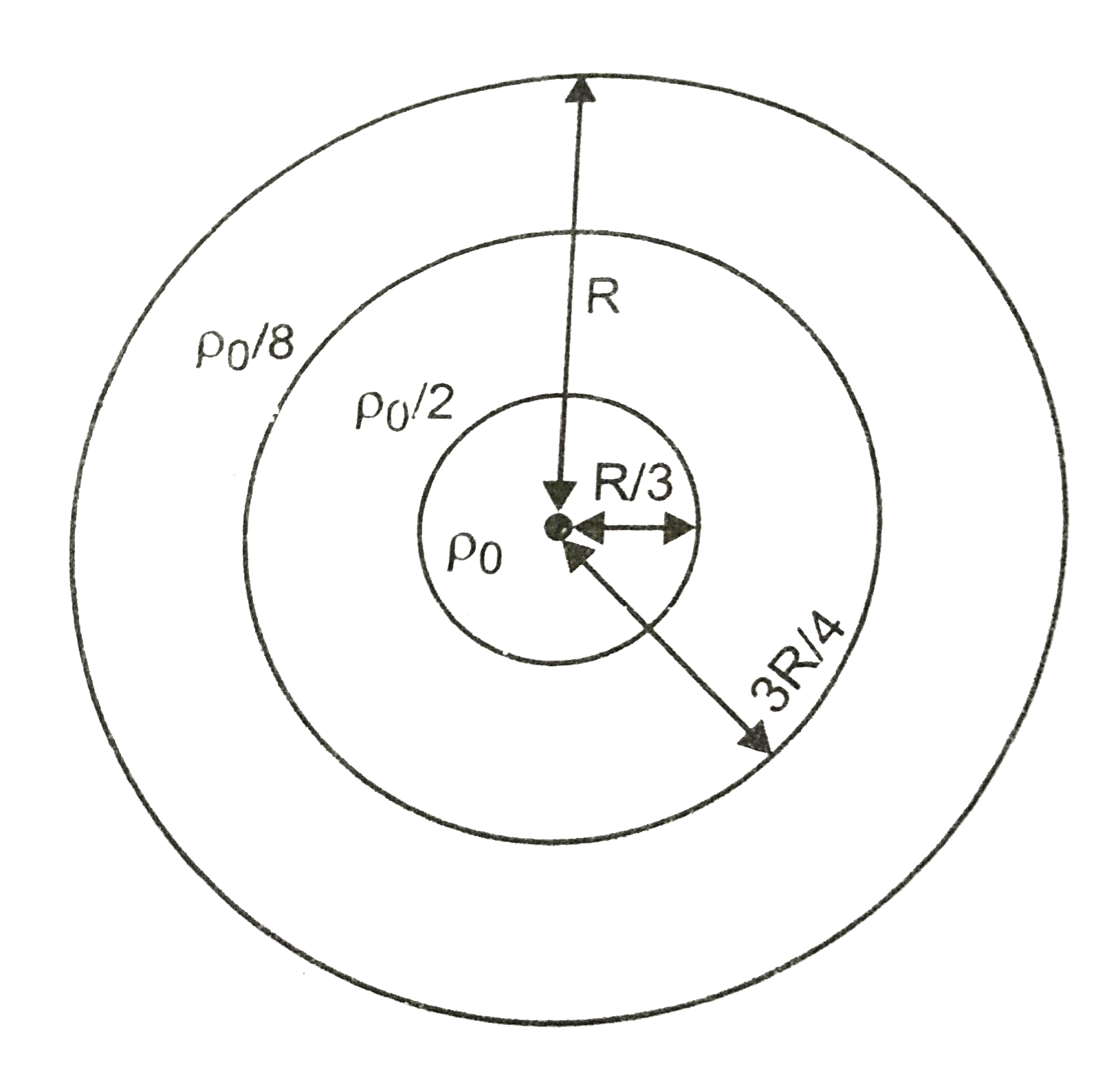 `I _(1) = G xx (4)/(3) pi ((R )/(4))^(3) rho_(0) xx (1)/((R//4)^(2))` `= (4)/(3) pi G(R )/(4) rho_(0) = 0.33 pi GR rho_(0)` (ii) When `r = (R )/(2)`, then for the portion of sphere of radius `R//3`, the density is `rho_(0)` and for the portion between `R//3` and `R//2`, the density is `rho_(0)//2`. So the mass of spherical portion of radius `R//2` is `= (4)/(3) pi ((R )/(3))^(3) rho_(0) + [(4)/(3) pi ((R )/(2))^(3) - (4)/(3) pi ((R )/(3))^(3)] (rho_(0))/(2)` `= (4)/(3) pi R^(3) rho_(0) [(1)/(27) + (1)/(16) - (1)/(54)]` `= (4)/(3) pi R^(3) rho_(0) xx 0.081 = 0.108 pi R^(3) rho_(0)` Gravitational field at distance `R//2` from the centre of sphere is `I_(2) = (G xx 0.108 pi R^(3) rho_(0))/((R//2)^(2)) = 0.43 pi GR rho_(0)` (ii) When `r = 5 R//6`, then for the portion of sphere of radius `R//3`, the density is `rho_(0)`, for the portion between `R//3` and `3 R//4`, the density is `rho_(0)//2` and theportion between `3 R//4` and `5 R//6`, the density is `rho_(0)//8`. Therefore, mass of the spherical portion of radius `5 R//6` is `= (4)/(3) pi ((R )/(3))^(3) rho_(0) + [(4)/(3) pi ((3R )/(4))^(3) - (4)/(3) pi ((R )/(3))^(3)] (rho_(0))/(2)` `+ [(4)/(3) pi ((5R)/(6))^(3) - (4)/(3) pi((3R)/(4))^(3)] (rho_(0))/(8)` `= 0.332 pi R^(3) rho_(0)` (on simplification) Gravitational field at a distance `5 R//6` is `I_(3) = (G xx 0.332 pi R^(3) rho_(0))/((5 R//6)^(2)) = 0.478 pi G R rho_(0)` (iv) When `r = 2 R`, then effective mass of the sphere is `= (4)/(3) pi (R//3)^(3) rho_(0) + [(4)/(3) pi ((3R )/(4))^(3) - (4)/(3) pi ((R )/(3))^(3)] (rho_(0))/(2)` `+ [(4)/(3) pi R^(3) - (4)/(3) pi ((3R)/(4))^(3)] (rho_(0))/(8)` `= 0.402 pi R^(3) rho_(0)` (On simplification) Gravitational field at disatnce `2R` is `I_(4) = (G xx 0.402 pi R^(3) rho_(0))/((2R)^(2)) =0.1 pi G R rho_(0)` |
|
| 49. |
The figure shows the variation of specific heat capacity (c) of a solid as a function of temperature (T). The temperature is increased continuously from 0 to 500 K at constant rate. ignoring any volume change, the following statement(s) is (are) correct to reasonable approximation. |
|
Answer» The rate at which HEAT is ABSORBED in the RANGE 0 - 100K varies linearly with temperature T |
|
| 50. |
Obtain the equation of speed of sound wave in air and give the error in this equations. |
|
Answer» Solution :Equationof sound in gas (air), `v = sqrt ((B)/(RHO)) ""…(1)` NEWTON suggested that the propagation of sound is an isothermal PROCESS. `In PV = Nk _(B)T, N k _(B) T=` constant, `therefore PV=` constnat `""…(2)` For an isothermal change in equation (2), `VDelta P +PDelta V=0` `therefore (Delta P)/(Delta V//P) = P` `therefore B =P` `therefore B = (-Delta P )/(Delta V//V)` Therefore, from equation (1) the speed of a ongitudina wave in an IDEAL gas is given by, ` v = sqrt ((P)/(rho))` It is known as Newton.s formula. `v = sqrt ((P )/(rho )) = sqrt ((1.01 xx 10 ^(5))/( 1.29))` `therefore v ~~ 280 ms ^(-1)` Thus, value of speed of sound is `280 ms ^(-1)` according to Newton.s formula but its experimental value is `331 ms ^(-1).` Hence, value from Newton.s formula is `15%` less. So, assumption of Newton is not correct. |
|