

Saved Bookmarks
This section includes 7 InterviewSolutions, each offering curated multiple-choice questions to sharpen your Current Affairs knowledge and support exam preparation. Choose a topic below to get started.
| 1. |
Which of the following transitions in hydrogen atoms emits photon of highest frequency? |
|
Answer» n=1 to n=2 |
|
| 2. |
The path of photoelectrons emitted due to electromagnetic radiation incident on a sample of material A, is found to have a maximum bneding radium of 0.1 m in a magnetic field of ((sqrt2)/(3))xx10^-4T. When the radiation is incident normally on a double slit having a slit separation of 0.1mm, it is observed that there are 10 fringes in a width of 3.1 cm on a screen placed at a distance of 1 m from the double slit. Find the work function of the material. and the corresponding threshold wavelength. What sould be the wavelength of the incident light so that the bending radius is one-half of what it was before? Given that mass of the electron=0.5Me(V)/(c^2),hc=12400eV-A |
|
Answer» Solution :The bending radias r of a PARTICLE of mass m and charge e moving with a velocity v in a uniform magnetic FIELD is given by `(mv^(2))/r=evB`, e being the charge and B the strength of the firld. Momentum, `mv=BER`..(i) When the em radiation, `lamda`, satisfies, `FW=(lamdaD)/(d)` `lamda=(d)/(D)xxFW` `=(0.1xx10^(-3)xx3.1xx10^-3)/(1)m=3100A` The kinetic energy of the electron is `KE=((Ber)^(2))/(2m)=((Brec)^(2))/(2mc^(2))=(((sqrt2)/(3)xx10^(-4)xx10^(-1)xx3xx10^(8))^(2))/(2xx0.5xx10^(6))=2eV` The threshold wavelength is given by `(hc)/(lamda)=KE+(hc)/(lamda_(th))` `(12400)/(3100)=2+(hc)/(lamda_(th))` `(hc)/(lamda_(th))=2eV`,`lamda_(th)=(12400)/(2)=6200A` The kinetic energy of the most energetic photoelectron is directly proportional to the square of the radius of its track in a magnetic field. So, if the bending radius is half of what it was before, the kinetic energy of the electron is one-fourth of the previous value. `(KE')=2xx((1)/(2))^(2)EV` or `0.5eV` The wavelength, `lamda`, is given by `(hc)/(lamda)=2eV+0.5eV=2.5eV` `implieslamda=(12400)/(2.5)=4960 A` |
|
| 3. |
A projectile is projected with velocity V such that its range is twice the greatest height attained, the correct value of its range is : |
|
Answer» `V^(2)/g` `implies tantheta=2/1` `:. Sintheta=2/sqrt(5)` and `costheta=1/sqrt(5)` `:. R=(2v^(2)xx2/sqrt(5) xx 1/sqrt(5))/g=(4v^(2))/(5g)` |
|
| 4. |
A cyclotron can accelerate |
|
Answer» proton |
|
| 5. |
An electric dipole is held in a uniform electric field. The dipole is aligned parallel to the field.Find the work done is rotating it through the angle of 180^@. |
|
Answer» Solution :Here `theta_1 = 0^@ and theta_2 = 180^@` `:.` WORK done fore ROTATION of dipole `W = PE( costheta_1 - cos theta_2)` `= pE [ cos 0^@ - cos 180^@]` `= + 2pE`. 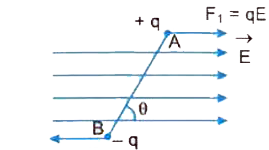
|
|
| 6. |
there is a table having 3 columns and 4 rows. Based on the table, there are 3 questions. Each question has 4 options (a), (b), (c) and (d), ONLY ONE of these four options is correct. Doppler's effectWhat happens when the source is at rest, but observer is moving? |
| Answer» Answer :D | |
| 7. |
A bar magnet of moment M is divided into two equal parts by cutting it perpendicular to its length. The magnetic moment of each piece will be : |
|
Answer» ZERO |
|
| 8. |
there is a table having 3 columns and 4 rows. Based on the table, there are 3 questions. Each question has 4 options (a), (b), (c) and (d), ONLY ONE of these four options is correct. Doppler's effectWhat happens when the source is moving but observer is at rest? |
|
Answer» (I) (ii) (M) |
|
| 9. |
Deduce the dimension of magnetic flux. |
|
Answer» Solution :`PHI= BA COSTHETA` `THEREFORE B = F/qv` we have `phi = FcosthetaxxA/qv` `[phi] = [MLT^-2]XX[L^2]//[AT][LT^1] = [ML^2A^-1]` |
|
| 10. |
there is a table having 3 columns and 4 rows. Based on the table, there are 3 questions. Each question has 4 options (a), (b), (c) and (d), ONLY ONE of these four options is correct. Doppler's effectWhat happens when the observer and source are stationary? |
| Answer» Answer :A | |
| 11. |
A steel wire of length l has a magnetic moment M. It is bent into L shape from the middle. The new magnetic moment is : |
|
Answer» M |
|
| 12. |
A uniform bar of length 6a and mass 8m lies on a smooth horizontal table. Two point masses m and 2m moving with the same horizontal speed 2v and v respectively, strike the bar as shown in the figure and stick to the bar after collision. Denoting angular velocity (about the centre of mass), total energy, and centre of mass velocity after collision by omega, E and v_(C) respectively, we have after collision |
|
Answer» `v_(C)=0` `therefore2m(-v) + m(2v) + (8m XX 0) = (2m + m + 8m)v_(C)` or `-2mv + 2mv + 0 = 11mv_(C)` or `v_(C)=0` ….(i) Again since angular momentum, about CENTRE of mass is conserved, we have `(2mvxxa)+(mxx2vxx2a)=Iomega` or 2mva + 4mva `=[(2mxxa^(2))+(mxx4a^(2))+(8mxx(6a)^(2))/12]omega` or `6mva=30ma^(2)omega` or `omega=v/(5a)` ...(iii) After COLLISION, let rotational KE = E `thereforeE=1/2Iomega^(2)` or `E=1/2xx(30ma^(2))xx(v/(5a))^(2)=(30ma^(2)xxv^(2))/(2xx25a^(2))=(3mv^(2))/5` or `E=(3mv^(2))/5` ...(iii) Hence options (a), (c), (d) are correct. |
|
| 13. |
A mirror is inclined at an angle of theta with horizontal. If a ray of light is incident at an angle of incidence theta then the reflected ray makes the following angle with horizontal |
| Answer» Solution :(d) | |
| 14. |
The proper mean lifetime of a muon is 2.2xx10^(-6)s. A beam of muons is moving with speed 0.6c relative to an inertial observer. How far will a muon in the beam travel, on average, before it decays? |
| Answer» ANSWER :B | |
| 15. |
Water is ..... |
|
Answer» diamagnetic |
|
| 16. |
Find the minimum number of cells required to produce an electric current of 1.5 A through a resistance of 30 Omega. Given that the emf of each cell is 1.5 V and internal resistance 1.0 Omega. |
|
Answer» |
|
| 17. |
The curved surface of a concave spherical mirror with a radius of curvature of 0.2 m is silvered. What is the focal power of this system? Refractive index of water is 4/3. |
| Answer» SOLUTION :`(40)/(3) D` | |
| 18. |
A double slit apparatus is immersed in a liquid of refractive index 1.33. It has slit separation of 1mm and distance between the plane of slit and screen 1.33m. The slits are illuminated by a parallel beam of light whose wavelength in air is 6300 Å. (a) Calculate the fringe width (b) One of the slits of the apparatus is covered by a thin glass sheet of refractive index 1.53. Find the smallest thickness of the sheet to bring the adjacent minima on the axis. |
|
Answer» Solution :(a) As FRINGE WIDTH `beta = (D lamda // d)`and by presence of medium the wavelength becomes `(lamda//mu)` , so the fringe-width in LIQUID will be `beta. = (D lamda)/(mu d) = (1.33 xx 6300 xx 10^(-10))/(1.33 xx 1 xx 10^(-3))` ` =0.63 mm` (b) Now as the distance of a minima from ADJACENT maxima is `beta. //2 `so ACCORDING to given problem, shift `y_0 = D/d (mu_r - 1)t = (beta.)/(2)` with `mu_r = (mu_P)/(mu_M)` `D/d [ (mu_P)/(mu_M) - 1] t = (D lamda)/(2mu_M d) i.e., t = (lamda)/(2(mu_P - mu_M))` so `t = (6300 xx 10^(-10))/(2(1.53 - 1.33)) = 1.575 mu m` |
|
| 19. |
A point charges of 2.0 muCis at the centre of a cubic Gaussian surface 9.0 cmon edge . What is the net electric flux through the surface? |
|
Answer» SOLUTION :` because ` Charges inside the cubic Gaussian SURFACE `q= 20 muC =2.0 xx 10^(6) C ` ` therefore ` Total electric flux through the surface of cube ` PHI _in =(q)/(in_0)=(2.0xx10^(-6))/(8.85xx10^(-12))=2.2 xx 10^(5)Nm ^(2) C^(-1) ` |
|
| 20. |
If momentum (P), area (A), time (T) and temperature (theta) are assumed to be fundamental quantities, then thermal capacity has dimensional formula |
|
Answer» `[P^(1) A^(-1//2)T^(-1) THETA^(-1)]` |
|
| 21. |
""_(92)U^(238) decays to a stable nucleus of ""_(82)Pb^(206) In this process |
|
Answer» `8 alpha` -PARTICLES and `BETA` --particles are emitted |
|
| 22. |
The magnituge of 'B' from a conductor carrying 35A at a perpendicular distance of 20cm from it, in tesla is |
|
Answer» `3.5xx10^(-5)` |
|
| 23. |
Indicate the only correct statement In the following |
|
Answer» The MAXIMUM amount of heat that can be converted into mechanical ENERGY is 100% |
|
| 24. |
What is hysterisis? Define the terms 'coercivity' and 'retentivity' of a ferromagnetic material. |
|
Answer» Solution :Hysteresis: The phenomenon of LAGGING behind of magnetic induction (B) with respect to the magnetizingfield (H) is called hysteresis. COERCIVITY : It.s a phenomenon of completely demagnetizing the magnetic material by APPLYING the magnetizing field in the opposite DIRECTION. Retentivity: The property of the magnetic material to RETAIN magnetismeven in the absence of the magnetizing field is known as retentivity. |
|
| 25. |
A prism having an apex angle 4o and refraction index 1.5 is located in front of a vertical plane mirror as shown in figure. Through what total angle is the ray deviated after reflection from the mirror |
|
Answer» `176^(@)` |
|
| 26. |
If a source of sound approaches a stationery observer with velocity v then he observes an increase in frequency equal to Deltan_(1)if source recedes away from the stationary observer with same velocity v then he observer a decrease in frequency equal to Deltan_(2)then: |
|
Answer» `Deltan_(1)=Deltan_(2)` `Deltan_(2)=f_(0)-"f"_(0) (v)/(v+v_(s)) = (v_(s)f_(0))/(v+v_(s))` clearly `Deltan_(1)geDeltan_(2)` |
|
| 27. |
In which layer of the atmosphere, the water vapour is present? |
|
Answer» TROPOSPHERE |
|
| 28. |
An ideal solenoid of inductance L = 1H. Radius a = 0.5 m and numbers of turns per unit length is 1000 turns/meter. The solenoid is fixed and empty from inside. A wooden whell is co-axially to the solenoid and it is free to rotate about its axis of symmetry without any friction. The weeden wheel has radius b = 1m, moment of inertia 1 = 1 kg m^(2), about its axis of symmetry and is initially stationary. Charge of 1000 muC is applied uniformly on the periphery of the wheel. Now the solenoid is connected to a voltage source whose emf varies with time as epsilon = ((2)/(mu_(0)))t volt. Now switch is on at t = 0. Neglect the resistance of the solenoid and mutual-inductance between the wheel and solenoid. Angular velocity of the wheel at t = 2 sec. will be :- |
|
Answer» 0.5 rad/sec `E_(out)=(a^(2))/(2b)((DB)/(dt))=(250)t` Torque experienced by the wheel `tau=(1000xx10^(-6))xx250 txx1=t//4` `I alpha =(t)/(4)rArr alpha=(t)/(4)` `(d OMEGA)/(dt)=(t)/(4)rArromega = (t^(2))/(8)` at `t = 2, omega = (4)/(8) = 0.5 rad//sec` |
|
| 29. |
An ideal solenoid of inductance L = 1H. Radius a = 0.5 m and numbers of turns per unit length is 1000 turns/meter. The solenoid is fixed and empty from inside. A wooden whell is co-axially to the solenoid and it is free to rotate about its axis of symmetry without any friction. The weeden wheel has radius b = 1m, moment of inertia 1 = 1 kg m^(2), about its axis of symmetry and is initially stationary. Charge of 1000 muC is applied uniformly on the periphery of the wheel. Now the solenoid is connected to a voltage source whose emf varies with time as epsilon = ((2)/(mu_(0)))t volt. Now switch is on at t = 0. Neglect the resistance of the solenoid and mutual-inductance between the wheel and solenoid. Now at t =2, switch is suddenly off. The angular velocity of the wheel after switching off will be : |
|
Answer» zero `E=(a^(2))/(2b)=((dB)/(dt))` Impulsive torque will be `TAU = (qE) (b)` `=(1000xx10^(-6))XX((0.5)^(2))/(2xx1)((dB)/(dt))xx(1)` `tau=(25)/(2)xx10^(-5)((dB)/(dt))` ANGULAR impulse `= tau dt = (10^(-3))Delta B = (25)/(2) xx 10^(-5) xx 4000 = 0.5 N-m sec` `L_(f)=L_(i)+J_(ext)` `(1)omega_(f)=(1)(0.5)-0.5 =0`. |
|
| 30. |
An ideal solenoid of inductance L = 1H. Radius a = 0.5 m and numbers of turns per unit length is 1000 turns/meter. The solenoid is fixed and empty from inside. A wooden whell is co-axially to the solenoid and it is free to rotate about its axis of symmetry without any friction. The weeden wheel has radius b = 1m, moment of inertia 1 = 1 kg m^(2), about its axis of symmetry and is initially stationary. Charge of 1000 muC is applied uniformly on the periphery of the wheel. Now the solenoid is connected to a voltage source whose emf varies with time as epsilon = ((2)/(mu_(0)))t volt. Now switch is on at t = 0. Neglect the resistance of the solenoid and mutual-inductance between the wheel and solenoid. Magnetic field in the solenoid at time t is : |
|
Answer» `(1000)t^(2)`TESLA `(1) INT di=(2)/(mu_(0)) underset(t=0) overset(t=t)(int) t dt rArr i=(1)/(mu_(0))t^(2)` `B=mu_(0)ni=(mu_(0))(1000)((t^(2))/(mu_(0)))=(1000)t^(2)` |
|
| 31. |
Einstein's mass energy equivalence is "______________". |
|
Answer» `E = MC^(2)` |
|
| 32. |
When the narrator sat down to write, Gillu wanted to catch her : |
|
Answer» attention |
|
| 33. |
Describe a simple experiment ( or activity) to show that the polarity of emf induced in a coil is always such that it tends to produce a current which opposes the change of magnetic flux that produces it. |
Answer» Solution : When a bar magnet is brought close to the coil ( fig a ), the approching North Pole of the bar magnet INCREASES the magnetic flux linked to it. This producesan induced EMF which PRODUCES ( or TENDS to produce, if the coil is open ) an induced current in an anti-clockwise direction. The face of the coil, facing the approaching magnet, then has the same polarity as that of the approaching pole of the magnet. The induced current, therefore, is seen to OPPOSE the change of magnetic flux that produces it. |
|
| 34. |
The magnitude of the gravitational potential at point O will be |
|
Answer» `(Gm)/(2r)` `V=Gm[(1)/(r)+(1)/(2r)+(1)/(4r)+(1)/(8R)+…]` `=(Gm)/(r)[1+(1)/(2)+(1)/(4)+(1)/(8)+…]` `=(Gm)/(r)[(1)/(2^(0))+(1)/(2^(1))+(1)/(2^(2))+(1)/(2^(3))+…]` `=(Gm)/(r)((1)/(1-(1)/(2)))=(2Gm)/(r)` |
|
| 35. |
A copper conductor of area of cross- section 40 mm^(2) on a side carries a constant current of32 xx 10^(-6)A. Then the current density is (in amp//m^(2)) |
|
Answer» 1.6 |
|
| 36. |
Define activity of a sample of a radioactive substance. The value of the disintegration constant of a radioactive substance is 0.0693h^(-1). Find the time after which the activity of a sample of this substance reduces to one-half that of its present value. |
|
Answer» Solution :ACTIVITY of a sample of a radioactive substance is defined as the RATE of of distingeration of that substance PER unit time. Activity `R_((f))=-(d N_((t)))/(t)=lambda N_((t))`. where `lambda`= disintegration and `N_((t))` the number of radioactive nuclei at that time. We know that activity of a sample is reduced to one half of its initial time `t=T_(1/2)=(0.0693)/(lambda)` As per question `lambda=0.0693 h^(-1)` `rArr t=(0.0693)/(0.0693) =10H` |
|
| 37. |
Which one of the following is a renewable resource? |
|
Answer» Coal |
|
| 38. |
What do you mean by modulation index in AM? |
| Answer» Solution :it is the RATIO of the change in amplitude the modulated CARRIER WAVE to the amplitude of the ORIGINAL carrier wave. | |
| 39. |
A parallel beam of white light falls on a thin film whose refractive index is equal to 4//3. The angle of incidence i=53^@. What must be the minimum film thickness if the reflected light is to be coloured yellow most intensively? (tan53^@ =4//3) |
|
Answer» `:. 4/3 = (sin 53^@)/(sin r) = (4//5)/(sin r)`  `:. Sin r =3/5` `:. r = 37^@` Refer FIGURE (a) 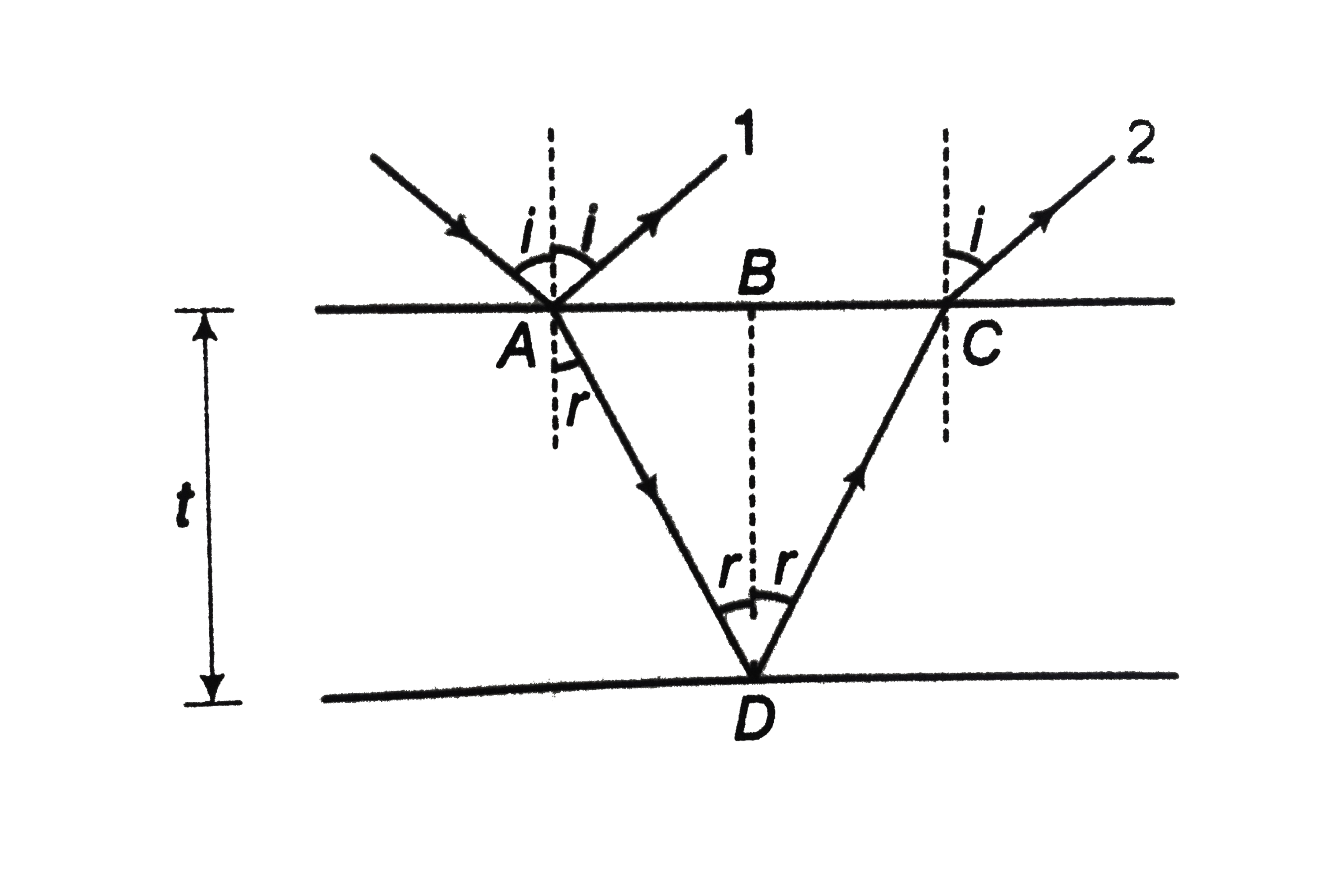 `Deltax_1` = between 2 and 1 = `2(AD)` ` = 2BD sec r ` `=2t sec r ` Their OPTICAL path `Delta x_1= 2mu t sec r. ` Refer figure (B) 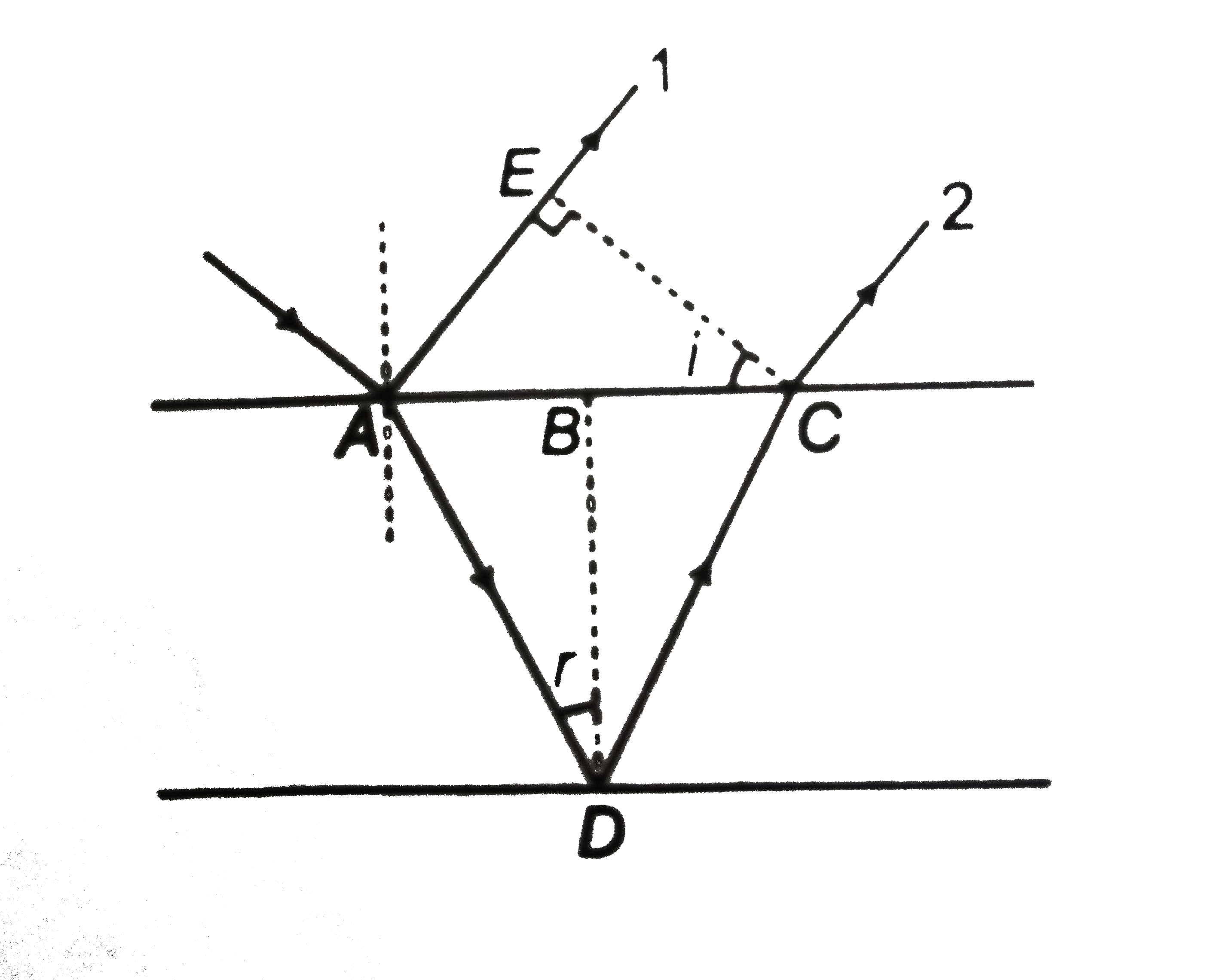 `Deltax_2 = AC sin i = (2t tan r)sin i ` `:. (Delta x)_"net" = Deltax_1 - Deltax_2` ` = 2mutsecr = 2t (tanr)(sin i)` `= 2 xx 4/3 xx t xx 5/4 -2 xx t xx 3/4 xx 4/5 =32/15 t ` Phase difference between 1 and 2 is `pi`. `:.` For constructive interference, `32/15 t = lambda/2` or `t = (15lambda)/64 = (15 xx 0.6)/64` ` = 0.14 mu m `. |
|
| 41. |
For the wave shown in figure, find its amplitude, frequency and wavelength if its speed is 300 m/s. Write the equation for this wave as it travels out along the negative x-axis if its position at t = 0 is as shown |
| Answer» SOLUTION :Amplitude = 0.06 m, FREQUENCY = 3750 HZ, Wavelength = 8cm, `y = (0.06m) sin[(78.5m^(-1)) x+ (23562s^1)t` | |
| 42. |
A parallel plate capacitor is to be designed which is to be connected across 1kv potential.The dielectric meteral which is to be Filled between the plates has dielectric constant K=6pi and dielectric strenght 10^(7)V//m.For safly the eletric field is never to exceed 10 % of the dielectirc strenght.With such specification, of we want a capacitor of 50pF, What minumim area (in mm^(2)) of plates is required for safe working ? ("use"" " epsilon_(0)=(1)/(36pi)xx10^(-9)"in""MKS") |
|
Answer» |
|
| 43. |
In question number 5, find the kinetic energy of the most energetic photoelectron emitted at t = 10 s when it reaches plate B. (Neglect the time taken by the photoelectron to reach plate B) |
|
Answer» 23 eV `=8xx10^(-12)` Charge on B, `Q_(B)=(33.7-8)xx10^(-12)C=25.7xx10^(-12)C` `:.E=(sigma_(B))/(2epsilon_(0))-(sigma_(A))/(2epsilon_(0))ORE=(1)/(2Aepsilon_(0))(Q_(B)-Q_(A))` or `E=(1.77xx10^(-12))/(2xx(5xx10^(-4))xx(8.85xx10^(-12)))` or `E=2000N//C` Energy of photoelectrons on plate B energy = E-W=(5-2)eV=3eV Increase in energy `=(Ed)eV=(2xx10^(3))(10^(-2))eV=20eV` `:."Energy of photoelectrons on plate"` B=(20+3)eV=23eV |
|
| 44. |
A long cylindrical vessel is half filled with a liquid. When the vessel is rotated about its own verticalaxis, the liquid rises up near the wall. If the radius of vessel is 5 cm and its rotational speed is 2rotations per second, then the difference in the heights between the centre and the sides, in cm, will be: |
|
Answer» |
|
| 45. |
A straight steel wire of length l has magnetic moment m. If the wire is bent in the form of a semicircle the new value of the magnetic dipole moment is ......... . |
|
Answer» `m` `m=pl` Now wire of length `l` is bent in the form of a semicircle its radius `R= (l)/(pi)` `THEREFORE` Distance between two ENDS of wire (new length of a magnet) `l.= 2r` `thereforel. = (2l)/(pi)` New magnetic dipole moment `m. = pl. = (2pl)/(pi)` `therefore m. = (2m)/(pi)` |
|
| 46. |
What did State do for Maharaja? |
|
Answer» All the tigers were sent to Palace |
|
| 47. |
Consider a uniform electric field bar(E)=3 xx10^(3) NC^(-1). What is the flux of this field through a square of 10 cm on a side whose plane is parallel to the YZ plane? |
| Answer» Answer :A | |
| 48. |
In an experiment of find the focal length of a concave mirror a graph is drawn between the magnitudes of u and v. the graph looks like |
|
Answer»
|
|
| 49. |
A rigid body rotates about a fixed axis with variable angular speed omega=A-Bt where A and B are constant. Find the angle through which it rotates before it comes to rest : |
|
Answer» `(A^(2))/(2B)` `d theta=(A-Bt)dt` When `omega=0,t=(A)/(B)` INTEGRATING `UNDERSET(0)overset(theta)intd theta=underset(0)overset(A//B)intAdt-underset(0)overset(A//B)intBtdt` `theta=A[t]_(0)^(A//B)-B[(t^(2))/(2)]_(0)^(A//B)` `=(AxxA)/(B)-B[(A^(2))/(2B^(2))]` `=(A^(2))/(B)-(A^(2))/(2B)=(A^(2))/(2B)` |
|
| 50. |
Sky wave have a wavelength |
| Answer» Answer :A | |


