

Saved Bookmarks
This section includes 7 InterviewSolutions, each offering curated multiple-choice questions to sharpen your Current Affairs knowledge and support exam preparation. Choose a topic below to get started.
| 1. |
Which of the following have dimensions of frequency? |
|
Answer» `(1)/(sqrt(LC))` L//R is time constant of LR circuit and hence INVERSE of it `R//L` must be having dimensions of frequency. Hence, option (c) is correct. RC is time constant of standard RC circuit and hence inverse of it `(1)/(RC)` must be having dimensions of frequency. Hence, option (d) is correct. Options (a), (c) and (d) are correct. |
|
| 2. |
An air-cored solenoid with length 30 cm, area of cross-section 25 "cm"^2 and number of turns 500, carries a current of 2.5 A. The current is suddenly switched off in a brief time of 10^(-3) s. How much is the average back emf induced across the ends of the open switch in the circuit ? Ignore the variation in magnetic field near the ends of the solenoid. |
|
Answer» Solution :`B= (mu_0 NI)/(l)` (Inside the solenoid away from the ENDS) `PHI = (mu_0 NI)/(l) A` Total FLUX linkage `= N Phi` `=(mu_0 N^2 A)/(l) I` (Ignoring end VARIATIONS in B) `|epsi| = (d)/(dt) (N Phi)` `|epsi|_(av) = ("total change in flux")/("total time")` `|epsi|_(av) = (4pi xx 10^(-7) xx 25 xx 10^(-4))/(0.3xx10^(-3)) xx (500)^2 xx 2.5` =6.5 V |
|
| 3. |
The period of a pendulum whose suspension is stationary relative to the Earth's surface is 1.50 s. What will its period be, if it is placed in a car moving horizontally with an acceleration of 4.9 m//s^(2)?What will be the change in the pendulum's angle of equilibrium? |
|
Answer» The equilibrium POSITION will be DEFLECTED from the vertical by an angle `varphi=arc tan""(a)/(g)` |
|
| 4. |
State Heisenberg’s uncertainty principle. |
| Answer» SOLUTION : It STATES that the POSITION and the VELOCITY of an object cannot both be measuredexactly at the same TIME. | |
| 5. |
A capacitor made of two parallel plates each of plate area A and separation d, is being charged by an external a.c. source. Show that the displacement current inside the capacitor is the same as the current charging the capacitor. |
|
Answer» Solution :Yes, ammeter will SHOW a momentary deflection. The momentary deflection is due to the flow of ELECTRONS in the CIRCUIT during the CHARGING process. During the charging process the electric field between the capacitor plates is changing and hence a DISPLACEMENT current flows in the gap. Hence we can say that there is a continuity of current in the circuit. Expression `I_d = epsi_0 (d theta)/(dt)` |
|
| 6. |
Which of the following waves have the maximum wave length ? |
|
Answer» X RAYS |
|
| 7. |
In a biprism experiment, when a convex lens is placed between the biprism and eyepiece at a distance of 30 cm from the slit, the virtual images of the slits are 7mm apart. If the distance between the slit eyepiece is 90 cm, find the linear magnification of the image. |
| Answer» SOLUTION :LINEAR magnification, `m=v/d = (D-|U|)/u = (90-30)/-30= 60/(-30) = -2` | |
| 8. |
Fraunhoffer diffraction experiment at a single slit using light of wavelength 400 nm , the first minimum is formed at an angle of 30^(@).The directionthetaof the secondary maximum is |
|
Answer» `SIN^(-1) (3//2)` |
|
| 9. |
Two similar coaxial coils, separated by some distance, carry the same current I but in opposite directions. The magnitude of the magnetic field B at a point on the axis at the mid point of the line joining the centre is : |
|
Answer» zero |
|
| 10. |
A bar magent AB with magnetic moments vecm is cut into two equal parts perpendicular to its axis. One part is kept over the other so the end B is exactly over A. The magnetic moment of the combination formed in this manner is |
| Answer» SOLUTION :zero | |
| 11. |
Find magnetic moment in following cases. |
|
Answer» (ii) Zero (III) `B_(0)l_(0)lhatj` (iv) `B_(0)i_(0)L(-HATI)` (V) `B_(0)i_(0)2Rhatj` (vi) Zero |
|
| 12. |
A concave mirror of focal length/produces a real image n times the size of the object. What is the distance of the object from the mirror ? |
|
Answer» Solution :As IMAGE is real, it will be inverted one and HENCE magnification `m=-v/U = -n RARR v = mu` So, from mirror formula `1/v + 1/u = 1/f`, we have `1/(mu) + 1/u =1/(-f) rArr (1+n)/(nu) = -1/f rArr u=-((n+1)/n)f` THUS, object is in front of mirror at a distance `((n+1)/n)f` |
|
| 13. |
Find out work done by the battery during he process of charging |
|
Answer» ` 1500 mu J ` |
|
| 14. |
Other unit for the quantity having the units (C^(2))/(Nm^(2)) is |
|
Answer» FARAD |
|
| 15. |
K_(1) and K_(2) are the maximum kinetic energies of the photo electrons emitted when light of wave lengths lamda_(1) , and lamda_(2), respectively are incident on a metallic surface. If lamda_(1)=3lamda_(2) then |
|
Answer» `K_(1)GT(K_(2))/(3)` |
|
| 16. |
Explain the difference in the behaviour ofa conductor and dielectric in the presence of external electric field. |
|
Answer» Solution :There are charge carriers in conductor. When a conductor is subjected to external electric field. The free charge carriers move and charge distribution in the conductor ADJUSTS itself in such a way that the electric field due to the induced charges `(E_("in"))` opposes the external field`(E_(0))` within the conductor. This happen until the two fields cancel each other and the net electrostatic field in the conductor is zero. `:. E_(0)+ E_("in") =0` In a dielectric free movement of charges is not POSSIBLE but the external field induces dipole moment by stretching or reorienting molecules of the dielectric. The collective effect of all the molecular dipole moments is net charges on the surface of the dielectric which produce a field that opposes the external field. Hence external electric field reduces. But, doesn.t become zero. `:. E_(0)+ E_("in") ne 0` The EXTENT of the effect depends on the nature of the dielectric. The behaviour of a conductor and dielectric in the presence of external electric field are shown as in below . 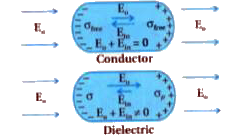 Dielectric : "Dielectric is such a substance that it does not allow the charges to pass through it but allows the electric force on charged to each other. Actually is an ~ulator that can be polarized by LIMITED displacement of charges. |
|
| 17. |
Light of frequency 7.21 xx 10^(14) Hz is incident on a metal surface. Electrons with a maximum speed of 6.0 xx 10^(5)m//s are ejected from the surface. What is the threshold frequency for photoemission of electrons? |
| Answer» SOLUTION :`4.73xx10^(14)HZ` | |
| 18. |
Some physical constants are given in List-1 and their dimensional formulae are given in List-2. Match the correct pairs in the lists {:("List-I","List-2"),((a)"Planck's constant",(e)ML^(2)T^(-2)),((b)"Gravitational constant ", (f) ML^(-1)T^(-1)),((c)"Bulk modulus" ,(g) ML^(2)T^(-1)),((d) "Coefficient of viscosity " ,(h) M^(-1)L^(3)T^(-2)):} |
|
Answer» a - h`""` b- g `""`C -F `""` d-e |
|
| 19. |
Resistance of galvanometer is G. If shunt required to make its range n times is S, n = _____ . |
|
Answer» `G/S` Here, `I=nI_(G)` `thereforeS=(GI_(G))/(nI_(G)-I_(G))=G/(n-1)` `thereforen-1=G/S""thereforen=G/S+1` |
|
| 20. |
The number density of electron is a semiconductor is 8xx10^(13) cm^(-3) and number density of hole is 5xx10^(12) cm^(-3) then, (1) Which type of this semiconductor is? (2) How much is resistivity of it?(Mobility of electron is 23000 cm^(2)V^(-1)s^(-1) and mobility of hole is 100 cm^(2)V^(-1)s^(-1) and e=1.6xx10^(-19)C) |
|
Answer» `p-29.45xx10^(-2)Omegam` `n_(e )=8xx10^(13)cm^(-3)=8xx10^(19)m^(-3)` `n_(h)=5xx10^(12) cm^(-3)=5xx10^(18)m^(-3)` `mu_(e )=23000 cm^(2)V^(-1)s^(1)=2.3m^(2)V^(-1)s^(-1)` `mu_(h)=100cm^(2)V^(-1)s^(-1)=0.01m^(2)V^(-1)s^(-1)` Here, the number of ELECTRONS is HIGHER than the holes so semiconductor will be n-type semiconductor `(n_(e ) gt n_(h))` `sigma=(1)/(rho)=e(mu_(e )mu_(e )+n_(h)mu_(h))=1.6xx10^(-19)` `[8xx10^(19)xx2.3xx5xx10^(18)xx0.01]` `=1.6xx10^(-19)[1.84xx10^(20)+5xx10^(16)]` `(1)/(rho) ~~29.45"mho m"^(-1)` `therefore rho=(1)/(29.45)=3.396xx10^(-2)`ohm m `therefore rho=3.396xx10^(-2)Omegam` |
|
| 21. |
A concave or convex lens is given such that radii of curvature are same. If refractive index of glass is 1.5, then its focal length = ...... where R = radius of curvature. |
|
Answer» R `=(1.5-2)2/R=1/R` (convex) `thereforef=R` `1/f=(n-1)(-1/R-1/R)` (CONCAVE) `=-(1.5-1)2/R=-1/R` `THEREFORE f=-R``therefore`f=R(value) |
|
| 22. |
In previous example, what is the magnitude of the shear force? |
|
Answer» |
|
| 23. |
Green light of wavelength 5640 in incident on an airglass interface. If the refractive index of glass is 1.5 what will be the wavelength of light in glass? |
|
Answer» Solution :wavelength of the LIGHT in air, `lambda_(0)` = 5460 Å REFRACTIVE index of GLASS with RESPECT to air, `mu = 1.5` If the wavelength of the light in glass is `lambda`, then `mu = (lambda_(0))` `or, "" lambda = (lambda_(0))/(mu) = (5460)/(1.5) = 3640` Å |
|
| 24. |
The velocity of image in a situation as shown in the figure is |
Answer» Solution : `vecV_0` Velocity of object `= (9 HATI+12 hatj)m//s ` ` vecV_m ` Velocity of mirror `= -2hati m//s` `m= (f)/(f-u) =(-20 )/( - 20 - (-30))=-2` For velocity COMPONENT parallel to optical axis ` (vecV_(I//m))_(।। )=-m^2 ( vecV_0 //m)_(।। )` ` (vecV_(I//m),=-(-2)^2 (9 hati-(-2hati)=-44 hatim//s` For velocity component perpedicular to optical axis ` ( vecV_(I//m))_(bot)=m( vecV_(O//m))_(bot)=(-2)12 hatj =-24 hatj m//s` ` :.vecV_(I//m) =`velocity of imagew.r.t mirror ` = ( vecV_(I//m))_(II)+( vecV_(I//m))_(bot) = (-44 i - 24 hatj)m//s` also`vecV_(I//m) = vecV_1 - vecV_mor ` `vecV_I= ( -44 hati - 24 hatj ) - 2 hati` `=( -44 hati - 26 hatj ) m//s` |
|
| 25. |
Atoms whose nuclei contain different number of protons but same number of neutrons are called : |
|
Answer» ISOTONES |
|
| 26. |
A parabolic section of wire, as shown in figure is located in the X-Y plane and carries a current of 12A. A uniform magnetic field B = 0.4T making an angle of 60° wihath X-axis exists throughout the plane. The total force acting on a wite between the origin and the point x = 0.25m, y = 1.00 m. |
|
Answer» `0.68hatk N` |
|
| 27. |
You are given two convex lenses. a. What is the focal length of the combined lens formed by the lenses put in contact ? b . What is the advantage in the combination ? c. if one of the lenses is concave, how will you find its focal length with the help of lens combination ? |
|
Answer» Solution :`a.(1)/(F) = (1)/(f_(1)) + (1)/(f_(2))` F - Focal LENGTH of COMBINATION of lenses `f_(1)` - Focal length of one lens `f_(2) -` Focal length of second lens `f_(2)` - Focal length of second lens b, i. increases magnifying power . ii. For ERECTING an IMAGE. c. the focal length .f. of CONVEX lens and .F. of the lens combination can be found out by u-v method. Let `f_(2)` be the focal length of the concave lens. Then `(1)/(f_(2)) = (1)/(F) - (1)/(f_(1))` Knowing `f_(1) and F, .f_(2).` can be found out . |
|
| 28. |
A particle of mass m travels with speed v along + ve direction of x-axis parallel to line y=6. At t=0, the particle is at (0, 6). The angular momentum of particle about origin is : |
|
Answer» 0 `vecL=vecrxxvecp=-6mvhatk` 
|
|
| 29. |
In the figure shown the four rods have lambda resistance per unit length . The arrangement is kept in a magnetic field of constant magnitude B and directed perpendicular to the plane of the figure and direction inwards . Initially the sides as shown form a square . Now each wire starts moving with constant velocity v towards opposite wire . Find as a function of time . Total power required to maintain constant velocity . |
|
Answer» `(4B^(2)v^(2))/(LAMBDA) ( L + 2vt)` |
|
| 30. |
In the figure shown the four rods have lambda resistance per unit length . The arrangement is kept in a magnetic field of constant magnitude B and directed perpendicular to the plane of the figure and direction inwards . Initially the sides as shown form a square . Now each wire starts moving with constant velocity v towards opposite wire . Find as a function of time . Thermal power developed in the circuit. |
|
Answer» `(4B^(2)V^(2))/(lambda) ( L - 2vt)` |
|
| 31. |
In the figure shown the four rods have lambda resistance per unit length . The arrangement is kept in a magnetic field of constant magnitude B and directed perpendicular to the plane of the figure and direction inwards . Initially the sides as shown form a square . Now each wire starts moving with constant velocity v towards opposite wire . Find as a function of time . Force required on each wire to keep its velocity constant . |
|
Answer» `(B^(2)v)/(LAMBDA) ( l + 2vt)` |
|
| 32. |
The wavelength of light in the visible region is about 390 nm for violet colour, about 550 nm (average wavelength) for yellowgreen colour and about 760 nm for red colour. (a) What are the energies of photons in (eV) at the (i) violet end, (ii) average wavelength, yellow-green colour, and (iii) red end of the visible spectrum? ("Take h "= 6.63xx10^(-34)" J s and 1 eV" = 1.6xx10^(-19)J.) (b) From which of the photosensitive materials with work functions listed in Table 11.1 and using the results of (i), (ii) and (iii) of (a), can you build a photoelectric device that operates with visible light? |
|
Answer» Solution :(a) Eneergy of the incident photon, `E=hv=hc//lambda` `E=(6.63xx10^(-34)Js)(3xx10^(8)m//s)//lambda` `=(1.989xx10^(-25)Jm)/(lambda)` (i) For violet light, `lambda_(1)=390nm" (lower wavelength end)"` `"Incident photon energy, "E_(1)=(1.989xx10^(-25)Jm)/(390xx10^(-9)m)` `=5.10xx10^(-19)J` `=(5.10xx10^(-19)J)/(1.6xx10^(-19)J//eV)` `=3.19eV` (ii) For yellow - green light, `lambda_(2)=550nm"(average wavelength)"` `"Incident photon energy, "E_(2)=(1.989xx10^(-25)Jm)/(550xx10^(-9)m)` `=3.62xx10^(-19)J=2.26ev` (iii) For RED light, `lambda_(3)=760nm"(higher wavelength end)"` `"Incident photon energy, "E_(3)=(1.989xx10^(-25)Jm)/(760xx10^(-9)m)` `=2.62xx10^(-19)J=1.64ev` (b) For a photoelectric DEVICE to OPERATE, we require incident light energy E to be equal to or greater than the work function `phi_(0)` of the material. Thus, the photoelectric device will operate with violet light (with E = 3.19 ev) photosensitive material `Na ("with "phi_(0) = 2.75 eV), K ("with "phi_(0) = 2.30 eV) and Cs ("with "phi_(0) = 2.14 eV)`. It will also operate with yellow-green light `("with E "= 2.26 eV)" for Cs "("with "phi_(0) = 2.14 eV)` only. However, it will not operate with red light (with E = 1.64 eV) for any of these photosensitive materials. |
|
| 33. |
Explain the term modulation index for F.M. and F.M. band width. Give the advantages of frequency modulation. |
|
Answer» Solution :Modulation index`(m_(f))`. The modulation index for FM, `m_(f)` is defined as `m_(f)=("maximum Frequency DEVIATION")/("modulating frequency")radians` `(delta)/(f_(m))=(k_(f)E_(m))/(2pif_(m))=(k_(f)E_(m))/(w_(m))` FM has an infinite number of side bands, the side frequencies are `(f_(c)+-f_(m)),(f_(c)+-2f_(m)),(f_(c)+-3f_(m))` etc. The modulation index determines the amplitudes of the side band components. The side- bands at equal distances from `f_(c)` have equal amplitudes, so that the side- band distribution is symmetrical about the carrier frequency. The amplitudes are negligible when the carrier and side frequencies are largely separated from each other. In practice, therefore, the number of significant side frequency pairs is limited. Band Width In frequency modulated signal, the information is contained in the side frequency components. Hence the band width required for transmission or reception through FM is given by `(BW)_(FM)=2nf_(m.)` where `n` is the number of side frequency pairs of significant amplitude. It must be noted that in AM, increased depth of modulation INCREASES the side band power and therefore the total transmitted power. In FM, however, the total transmitted power. In FM, however, the total transmitted power always remains constant, but with increase in `m_(f)` the required bandwidth increases. Here, the power in side frequency components is achieved at the reduction of power of the carrier component. Advantages of FM Following are the advantages of FM transmission : `1`. It gives noiseless reception, because noise is a form of amplitude variation. As in FM, amplitude remains constant, so noise factor does not creep up. `2`. Operating range is quite LARGE. `3`. It gives high fidelity reception. `4`. EFFICIENCY is high. |
|
| 34. |
In an experiment for calibration of voltmeter, a standard cell of emf 1.5V is balanced at 300cm length of potentiometer wire. The P.D across a resistance in the circuit is balancedat 1.25m. If a voltmeter is connected across the same resistance. It reads 0.65V. The errorin the volt meter is |
|
Answer» 0.05V |
|
| 35. |
In the figure shown the four rods have lambda resistance per unit length . The arrangement is kept in a magnetic field of constant magnitude B and directed perpendicular to the plane of the figure and direction inwards . Initially the sides as shown form a square . Now each wire starts moving with constant velocity v towards opposite wire . Find as a function of time . Induced current in the circuit with direction |
|
Answer» `(2Bv)/(LAMBDA)` |
|
| 36. |
Locate the image of the point object O in the situtaion shown. The point C denotes the centre of curvature of the separating surface. |
|
Answer» SOLUTION :GIVE: u = - 15 cm, R = 30 cm, `n_(1) = 1 and n_(2)` = 1.5 Equation for single spherical surface is `(n_(2))/(v)-(n_(3))/(u)=((n_(2)-n_(1))/(R))` Substituing the vlues, `(1.5)/(v)-(1)/(-15)=((1.5-1))/(30):(1.5)/(v)+(1)/(15)=(0.5)/(30)` `(1.5)/(v)+(1)/(15)=(1)/(60)(1.5)/(v)=(1)/(60)-(1)/(15),` `(1.5)/(v)=(1-4)/(60)=(-3)/(60),=-(1)/(20)` The imageis a virtual IMAGEFORMED 30 cm to the spherical surface. 
|
|
| 37. |
Trackof three chargedparticlesin a uniform electroastatic field give the sign of the three charges which particle has the highest charge to mass ratio |
| Answer» SOLUTION :`5.7 xx10^(-3) N` | |
| 38. |
A magnetic needle vibrates in a vertical plane parallel to the magnetic meridlian about a horizontal axis passing through its centre. Its frequency is t. If the plane of oscillation is turned about a vertical axis by 90^(@), the frequency of oscillation in vertical plane will be : |
|
Answer» `PI` |
|
| 39. |
Express the amount of heat received by a system in the course of isothermic expansion in terms of temperature and entropy. |
|
Answer» |
|
| 40. |
AB and CD are two resistance wires cut from a uniform long wire. Lengths of AB and CD are L and 2L respectively and resistance of AB is R. The two resistances are connected in parallel to a supply. P and Q are two points on the resistance AB such that AP = QB = (L)/(3). Two conductors PS and QT are connected between two resistors such that no current flows through both the conductors. A resistance R is connected between points M and N as shown. Neglect resistance of PS and QT. (a) find the equivalent resistance of the circuit between X and Y. (b) Will there be any current in resistance connected across MN ? |
|
Answer» (b) YES |
|
| 41. |
As per Ampere - Maxwell.s circuital law |
|
Answer» `ointvecB.vecdl=mu_(0)I_(C )` `ointvecB.vecdl=mu_(0)(I_(C )+I_(D))=mu_(0)[I_(C )+in_(0)(dphi_(E))/(dt)]` |
|
| 43. |
What are delayed neutrons? Discuss their role. |
| Answer» Solution :Some neutrons produced in fission are delayed by some time as they are produced in SUBSEQUENT decays of the initial fission FRAGMENTS. These are CALLED delayed neutrons. This situation is crucial to mechanical control of the reactor. If all the fission neutrons were produced INSTANTLY in fission, there would be no time for the minute adjustment required in a reactor to KEEP it critical. | |
| 44. |
While travelling back to his residence in the car, Dr. Pathak was caught up in a thunderstorm. It became very dark. He stopped drivingthe car thewaited for thunderstom to stop. Suddenly he noticed a child walking alone on the road. He asked the boy to come inside the car till the thunderstorm stopped. Dr. Pathak dropped the boy at his residence. The boy insisted that Dr. Pathak should meet hsi parents. The parents expressed their gratitudeto Dr. Pathak for his concern for safety of the child. Answer the following questions based on the above information: (a) Why is it safer to sit inside a car during a thunderstorm? (b) Which two values are displayed by Dr. Pathak in his actions? (c ) Which valuesare reflected in parents response to Dr. Pathak ? (d) Give an example of a similar action on your part in the past from everyday life. |
|
Answer» Solution : (a) It is safer to be inside a car during thunderstorm because thecar acts like a FARADAY CAGE. The metal in the car will shield you from any external electric field and thus prevent the lightning from travelling within the car. (b) Awareness and humanity. (c ) Gratitude and obliged. (d) I once cameacross to a situation where a puppy was struck in the middle of a BUSY road during rain and was not able to go cross due to heavy flow, so I quickly RUSHED and helped him. |
|
| 45. |
A pulse is propagating on a long stretched string along its length taken as positive x-axis. Shape of the string at t = 0 is given byy = sqrt(a^2 - x^2)when |x| lt= a = 0when |x| gt= a.What is the general equation of pulse after some time 't' , if it is travelling along positive x-direction with speed V? |
|
Answer» `y(x,t) = SQRT(a^2 - (x + VT)^2) " when " |x+ Vt| lt= a = x + Vt " when " | x + Vt| GT= a ` |
|
| 46. |
When ultraviolet light of wavelength 1000Å isincident on molybdenum, then find the maximum velocity of ejected electrons (given : work function of molybdenum = 5.0 eV): |
|
Answer» `2.1xx10^(6)CMS^(-1)` |
|
| 47. |
In an A.C. circuit, the capacitive reactance is defined as ........ |
|
Answer» `Z_C=jomegaC` `THEREFORE Z_C=(-j^2)/(jomegaC)` [ `because` MULTIPLY and divide by j] `therefore Z_C=(-1(-1))/(jomegaC)=1/(jomegaC)` |
|
| 48. |
A paraticale of mass m and charge (-q) entersthe region between the two charged plates initially movingalong x-axiswith speed v_(x). The lengthof plateis L and a uniform electricfieldE is maintainedbetweenthe plates. Show that the verticale deflection of the particleat the faredge of the plate is qEL^(2)//(2m v_(x)^(2)). Comparethis motionwith motion of a projectille in gravitional field. |
|
Answer» Solution :In the verticledirection, initial velocity, `u = 0` accleration, `a = (F)/(m) = (qE)/(m)` , deflection,`s = y = ?` , time takento crossthe FIELD, `t = ("distance")/("velocity") = (L)/(v_(x))` This is becausevelocity along the horizonatalis constant. From `s = ut + (1)/(2) at^(2) , y = 0 + (1)/(2) ((qe)/(m)) ((L)/(v_(x)))^(2) , y = (qE L^(2))/(2m v_(x)^(2))` Comparison shows that THECASE is exactly similarto motion a horizontalprojectile in a graviationalfiled, where we find `y = (1)/(2) g t^(2)` |
|
| 49. |
On which factors (i) emf of an electric cell and (ii) electrical energy supplied by the cell depend on? |
|
Answer» SOLUTION :(i) The ELECTROMOTIVE force of an electric cell only depends on the active ELEMENTS i.e., the positive and the negative poles and the nature of ELECTROLYTE, but not on the amount of the elements. (ii) More the amount of the active elements , more is the electrical ENERGY supplied by the cell. |
|
| 50. |
At t =0 S_w is closed, if initially C_1 is uncharged and C_2 is charged to a potential difference 2epsi then find out following ("Given "C_1= C_2= C) (a) Charge on C_1 and C_2 as a function of time. (b) Find out current in the circuit as a function of time. (c) Also plot the graphs for the relations derived in part (a) |
|
Answer» Solution :Let q charge FLOW in time 't' from the BATTERY as shown. The charge on various plates of the capacitor is as shown in the FIGURE. Now applying KVL `epsi-q/C-iR -(q-2epsiC)/(C)=0` `epsi-q/C-q/C+2e-iR=0` `3epsi=(2q)/(C)+iR` 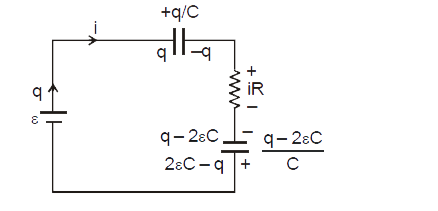 `3epsi-iR=(2q)/(C)` `3epsi-iRC=2q` `(dq)/(dt)RC=3epsiC-2q` `underset(0)OVERSET(q)int (dq)/(2epsiC-2q)=underset(0)overset(t)int (dt)/(RC)` `-1/2ln ((3Cepsi-2q)/(3Cepsi))=t/(RC)` `ln ((3epsiC-2q)/(3epsiC))=-(2t)/(RC)` `3epsiC-2q=3epsiC e^(-2t//RC)` `3epsiC (1-e^(-2t//RC))=2q` `q=3/2epsiC(1-e^(-2t//RC)` `i=(dq)/(dt)=(3epsi)/(R) e^(-2t//RC)` On plate B `q' =2epsiC-q` `=2epsiC-3/2epsiC+3/2epsiCe^(-2t//RC)` 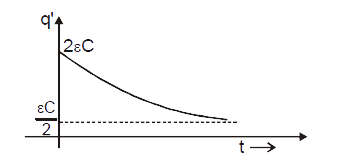 `=(epsiC)/(2)+3/2epsiCe^(-2t//RC) =(epsiC)/(2) [1+3e^(-2t//RC)]` 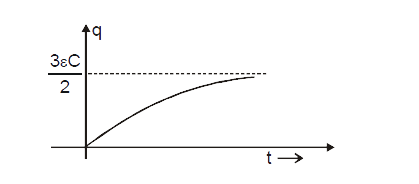
|
|