Saved Bookmarks
This section includes 7 InterviewSolutions, each offering curated multiple-choice questions to sharpen your Current Affairs knowledge and support exam preparation. Choose a topic below to get started.
| 1. |
The discharging current in the atmosphere due to the small conductivity of air is known to be 1800 A on an average over the globe. Why then does the atmosphere not discharge itself completely in due course and become electricallyneutral ? In other words, what keeps the atmosphere charged? |
| Answer» Solution :The occurrence of THUNDERSTORMS and lighting charges the atmosphere continuously. HENCE, even with the presence of discharging current of 1800 A. the atmosphere is not DISCHARGED completely. The two opposing currents are in equilibrium and the atmosphere remains NEUTRAL. | |
| 2. |
Magnetic intensity at any point, on the equatorial line of the bar "magnet"/"dipole" is _____ to the direction of vecM . |
| Answer» SOLUTION :OPPOSITE | |
| 3. |
Figure shows a meter bridge,wire AC has uniform cross section. The length of wire AC is 100 cm X is a standard do resistor of 4 Omega and Y is a coil.When Y is immersed in melting ice, the null point is at 40 cm from point A. When the coil Y is heated to 100^@C, a 100 Omega resistor has to be connected in parallel with Y in order to keep the bridge balanced at the same point. Temperature coefficient of resistance of the coil is |
|
Answer» `6.3xx10^(-4) K^(-1)` Since null point REMAINS unchanged `x/(R.)=40/60` `6=(100R_t)/(R_t+100) ,R_t = 6.38 Omega` `therefore alpha = (R_t- R_0)/(R_0 Deltat) = 6.3xx10^(-4) K^(-1)` |
|
| 4. |
Two identical point charges q of mass m each are suspended through strings of equal length l from a common point of suspension. Find the charge q if angle subtended by the strings with the vertical is theta, when point charges are in a state of equilibrium. |
| Answer» SOLUTION :`SQRT((16piepsilon_0mgl^2 sin^3 THETA)/(COS theta ))` | |
| 5. |
Give the expression for gyromagnetic ratio of an electron revolving round thenucleus and explain the terms. |
|
Answer» SOLUTION : Gyromagnetic RATIO of the electron is GIVEN by `(mu_1)/(L) = (e )/(2m_e)` Where `to mu_1` = magnetic dipole moment l = angular momentum e = charge on electron `m_e` = MASS of electron |
|
| 6. |
Answer carefully : (a) Two large conducting spheres carrying charges Q_(1) and Q_(2) are brought close to each other. Is the magnitude of electrostaticforce between them exactly given by (Q_(1) Q_(2))/(4pi in_(0) r^(2)) where r is distance between their centers ? (b) If Coulomb law involved 1//r^(3) dependence (Instead of 1//r^(3)). would Gauss's law be still true ? (c) A small test charge is releasedat rest at a pointin an electrostatic fieldconfiguration. Will it travel along the line of force passing through that point ? (d) What is the work done by the field of a nucleus in a completecircualr orbits of electron ? What if the orbits is elliptical ? (e) We knowthat electric field is discontinnous across the surfaceof a chargedconductor conductor. Is electricpotential also discontinous there ? (f) What meaning would you give to the capacity fo a singleconductor ? (g) Guess a possible reason why waterhas a muchgreaterdielectric constant K = 80 than, say mica (K = 6). |
|
Answer» Solution :(a) When the chargedspheres are brought close together, the charge DISTRIBUTIONS on them become non-uniform. Therefore, Coulomb's LAW is not valid. Hencethe magnitude of force is not given exactly by this formula. (b) No. Gauss's law will not true if Coulomb's law involve `1//r^(3)` dependance instead of `1//r^(2)` dependence. (C) The line of force given the direction of acceleration of charge. If the ELECTRIC line of force si linear, the TEST charge will movealong the line. If the line of force is non linear, the charge will not go along the line. (d) As forcedue tothe fieldis directedtowardsthe nucleas ,and the electrondoes not movein the direction fo this force, therefore work donesi zero whenthe orbits is circular. This is trueeven whenorbits is ellipiticalas electricforces are conservative forces. (e) No, electric potential is contionous. (f) The capacity fo a singleconductorimplies that thesecond conductoris at infinity. (g) This is because a molecule of waterin its normal statehas an usysmmetrical shape and, therfore it has a permanenet dipole moment. |
|
| 7. |
Two charged spherical conductors, each of radius R, are distant d (d lt 2R) . They carry charges +qand -q will the force of attraction between them be exactly(q^(2))/(4pi in _0d^(2))? Give reasons of your answer. |
|
Answer» Solution :No , the force of attraction between charged spherical conductors will be more than `(q^(2))/(4PI in _0d^(2)) ` . On account of MUTUAL attractive force there will be a REDISTRIBUTION of charges on the spheres as shown in As a result, EFFECTIVE distance between them is reduced and the force increases. ` (##U_LIK_SP_PHY_XII_C01_E09_001_S01.png" width="80%"> |
|
| 8. |
The empirical atom model was given by: |
|
Answer» J.J Thomson |
|
| 9. |
An electron moves through a uniform magnetic fields given by vecB=B_(x)hati+(3.0B_(x))hatj. At aparticular instant, the electron has velocity vecv=(2.0hati++4.0hatj)m//s and the magnetic force acting on it is (6.4xx10^(-19)N)hatk. The value of B_(x) (in T) will |
|
Answer» `-3.0` |
|
| 10. |
A charge is distributed uniformly over a ring of radius ‘a’. Obtain an expression for the electric intensity E at a point on the axis of the ring. Hence show that for points at large distances from the ring, it behaves like a point charge. |
|
Answer» Solution :Consider a point P on the axis of uniformly charged ring at a distance x from its centre O. Point P is at distance `r =sqrt(R^2++x^2)`from each element dl of ring. If q is total charge on ring, then, charge per metre length, `lamda=q/(2piR)` The ring may be supposed to be formed of a large number of ring elements. Consider an element of length dl situated at A. The charge on element, `dq = lamda DT` The electric field at P DUE to this element `dE_1 = 1/(4piepsilon_0)(dp)/r^2=1/(4epsilon_0)(lamdadl)/r^2` , along `bar(P)C` The electric field strength due to opposite symmetrical element of length dl at B is `bar(DE)_2=1/(4piepsilon_0)(dp)/r^2=1/(4piepsilon_0)=1/(4piepsilon_0)(lamdadl)/r^2` ,along `bar(PC)` 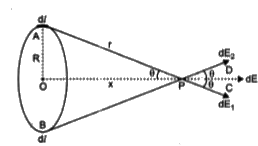 If we resolve `bar(dE) and bar(dE)_` along the axis and perpendicular to axis, we note that the components perpendicular to axis are oppositely directed and so get cancelled, while those along the axis are added up. Hence, due to symmetry of the ring, the electric field strength is directed along the axis. The electric field strength due to charge element of length dl, situated at A, along the axis will be`dE=dE_1costheta=1/(4piepsilon_0)(lamdadl)/r^2,(lamdadl)/r^2,` along `bar(PD)` But , `costheta=x/r` `:.dE(1)/(4piepsilon_0)(lamdadlx)/r^3=1/(4piepsilon_0)(lamdax)/r^3dt` The resultant electric field along the axis will be OBTAINED by adding fields due to all elements of the ring, i.e., `E=int1/(4piepsilon_0)(lamdax)/r^3dl1/(4piepsilon_0)(lamdax)/r^3intdt` But, f dl = whole length of ring `2piR and r = (R^2+x^2)^(1//2)` `E=1/(4piepsilon_0)(qx)/((R^2+x^2)^(3//2))2piR` As, `lamda=q/(2piR),""E=(1)/(2piepsilon_0)(((q)/(2piR))x)/((R^2+x^2)^(3//2))2piR` or, `E=1/(2piepsilon_0)(qx)/((R^2+x^2)^(3//2))` ,along the axis At large distances i.e., `x gt gt R,E=1/(4piepsilon_0)q/x^2` i.e., the electric field due to a point charge at a distance x. For points on the axis at distances much larger than the radius of ring, the ring behaves like a point charge. |
|
| 11. |
If yellow light emitted by sodium lamp in Young.s double slit experiment is replaced by monochromatic blue of light of the same intensity |
|
Answer» FRINGE WIDTH will decrease |
|
| 12. |
Wharn a beam incident on a transparent medium, produces a compleely polarised reflected beam, the angle between the reflected rays is found to be |
| Answer» ANSWER :D | |
| 13. |
(A): A electric field in front of infinite charged sheet is independent of distance of point from sheet (B): Electric field in front of finitecharged sheet is dependent on distance of point from sheet |
|
Answer» A &B are false |
|
| 14. |
The eletric field is discontinuous across the surface of a chained conductor, Is the electric potential also discontinuous there ? |
| Answer» SOLUTION :No, POTENTIAL CONTINUOUS. | |
| 15. |
निम्नलिखित में से कौन-सा एंजाइम अम्लीय वातावरण में कार्य करता है ? |
|
Answer» ट्रिप्सिन |
|
| 16. |
A magnetic field that varies in magnitude from point to point but has a constant direction (east to west) is set up in a chamber. A charged particle enters the chamber and travels undeflected along a straight path with constant speed. What can you say about the initial velocity of the particle? A charged particle enters an environment of a strong and non-uniform magnetic field varying from point to point both in magnitude and direction, and comes out of It following a complicated trajectory. Would its final speed equal the initial speed if it suffered no collisions with the environment? An electron travelling west to east enters a chamber baving a uniform electrostatic field in north to south direction. Specify the direction in which a uniform magnetic field should be set up to prevent the electron from deflecting from its straight line path. |
| Answer» Solution : YES, because magnetic FORCE can CHANGE the direction of V, not its magnitude. | |
| 17. |
A candle placed 25 cm from a lens forms an image on a screen placed 75 cm on the other side of the lens. The focal length and type of the lens should be |
|
Answer» `+ 18.75` CM and CONVEX LENS `1/f=1/75+1/25` `1/f=100/(75xx25)` `f=75/4=18.75cm` |
|
| 18. |
A wave disturbance in a medium is described by Y = 0.02 cos (50 pit + pi/2) cos pi x.Where x and y are in m and t in sec.The values in Column-II are in SI units. |
|
Answer» |
|
| 19. |
A bar magnet of magnetic moment 0.4Am^(2) is placed in the magnetic meridian with its north pole pointing north. A neutral point is obtained at a distance of 10 cm from the centre of the magnet. If the length of the magnet is also 10 cm, what is the value of horizontal component of earth's field at the place? |
|
Answer» Solution :Magnetic moment , `M = 0.4 Am^(2)` Distance of NEUTRAL point from centre of magnet , ` d=10 cm =10 xx 10^(-2)m ` Length of the magnet , ` 2l = 10 cm implies l =5 cm = 5 xx 10^(-2)m` Horizontal component of earth.s FIELD = `B_H` As NORTH pole is pointing north , neutral points are obtained on equatorial line `B_H = B` `B_H = (mu_0)/(4pi)(M)/((d^(2) + l^(2))^(3//2))` `B_H = (4pixx 10^(-7))/(4pi) xx (0.4)/([(10 xx 10^(-2))^(2) + ( 5 xx 10^(-2))^(2)]^(3//2))` ` =2.86 xx 10^(-5)T` |
|
| 20. |
Which of the following is a diamagnetic substance ? |
|
Answer» Glass |
|
| 21. |
Two particles have unequal charges, one is +q and the other is -2q. The strength of the electrostatic force between these two stationary particles is equal to F. what happens of F if the distance between the particles is halved? |
|
Answer» It decreases by a factor of 4 |
|
| 22. |
The maximum electric field 27 m from an isotropic point source of light is 17 V/m. What are (a) the maximumvalue of the magnetic field and ( b) the average intensity of the light there ? ( c) What is the power of the source ? |
| Answer» SOLUTION :(A) 57 nT , (b) 0.38 `W//m^(2) , `(c) 3.5 KW | |
| 23. |
A 60muF capacitor has charge on each plate 3xx10^8coulomb, then the energy stored is : |
|
Answer» `1.2xx10^24"JOULE"` |
|
| 24. |
Polarising angle of glass is 56.3^@. Critical angle for glass air interface is |
|
Answer» `1.5^@` |
|
| 25. |
n conducting wires of same dimension but having resitives 1,2,3,…..n are connected In series . The equivalent resistivity of the combination is |
|
Answer» `(N(N+1))/(2)` |
|
| 26. |
A body at temperature 310 K is kept in an atmosphere whose temperature is 300 K. The temperature versus time graph of the body will be |
|
Answer»
|
|
| 27. |
In Reimer-Tiemann reactionmolecular weightof phenol increases by: |
|
Answer» 28 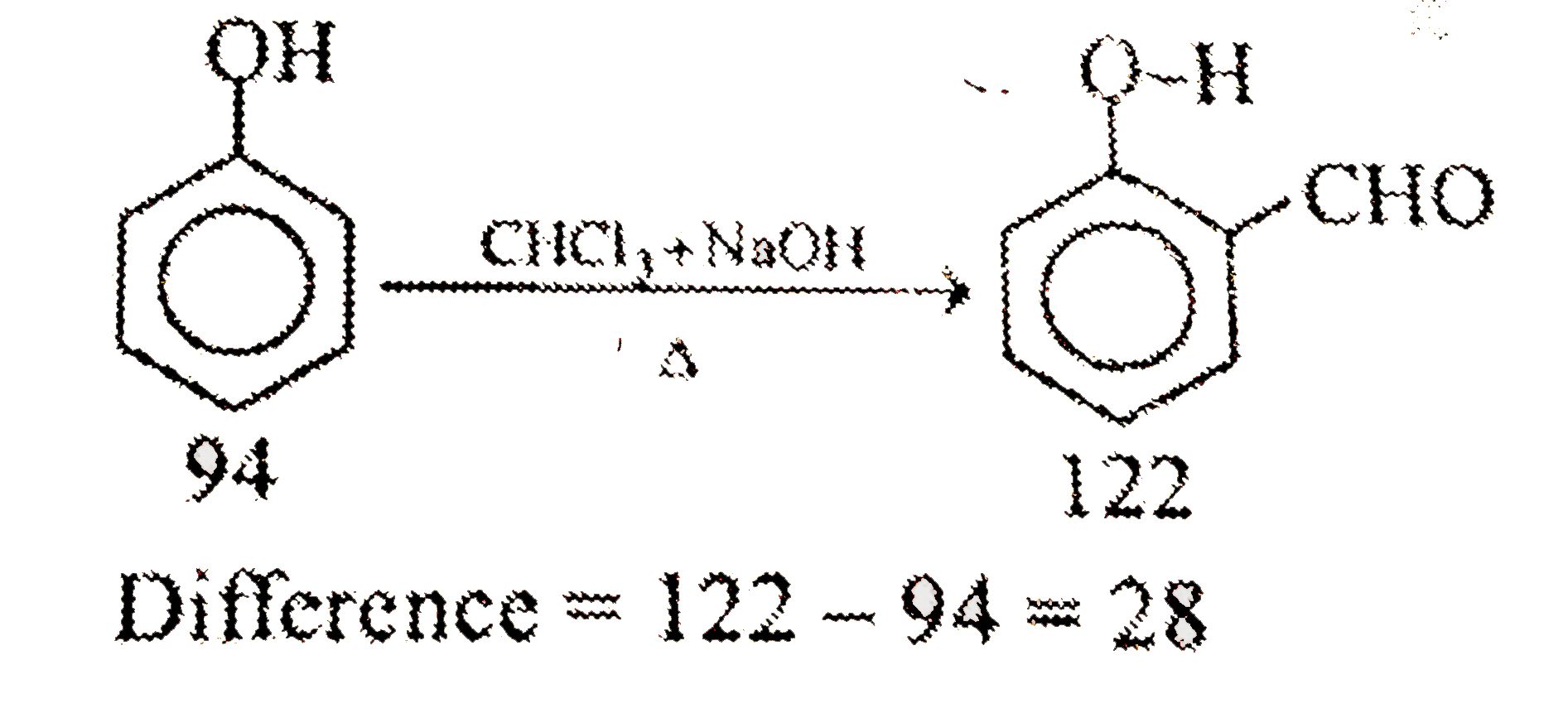 DIFFERENCE `= 122-9=28` |
|
| 28. |
A mass of 10 g moving horizontally with a velocity of 100 m/s, strikes a pendulum bob of mass 10 y. The two masses strike together. The maximum height reached by the system now is g = 10 m//s): |
|
Answer» zero |
|
| 29. |
Two beetles run across flat send, starting at the same point. Beetle 1 runs 0.50 m due east, the 0.80 m at 30^(@) north of due east. Beetle 2 also makes two runs, the first is 1.6mat 40^(@) east of due north. What must be (a) the magnitude and (b) the direction of its second run if it is to end up at the new location of beetle 1 ? |
|
Answer» Solution :(a) We find `vecD= VECA + vecB-vecC=(0.16m) HATI + (-0.83m) HATJ,and ` the magnituide is `D=0.84m.` (b) The angle is `TAN ^(-1) (-0.83//0.16)=-79^(@)` which is interpreted tomean `79^(@)` south of east (or `11^(@)` east of south). |
|
| 30. |
A wire of resistance 16 Omegais cut into 4 equal parts. These parts are then connected in parallel. The equivalent resistance of the combination is |
|
Answer» `16Omega` `THEREFORE` Resistance of PARALLEL combination of 4 such parts ` = (R.)/(4) = 4/4 = 1 Omega` |
|
| 31. |
Assertion (A) : When capacitanive reactance is smaller than the inductive reactance, the voltage leads the current Reason (R) : The phase angle is the angle between the alternating voltage and current phasors. |
|
Answer» If both assertion and reason are true and the reason is the correct explanation of the assertion. |
|
| 33. |
Obtain approximately the ratio of the nuclear radii of the gold isotope ""_(79)^(197)Au and the silver isotope ""_(47)^(107)Ag. |
|
Answer» SOLUTION :`R = R_0 A^(1//3)` For `""_(79)^(197)AU, R_(Au) = R_0 (197)^(1//3) , "For " ""_(47)^(107)AG, R_(Ag) = R_0 (107)^(1//3)` `(R_(Au))/(R_(Ag)) = (197/107)^(1//3) = 1.23`. |
|
| 34. |
What is the importance of Coulomb's law of electric force ? |
| Answer» Solution :Coulomb.s law ehablesus to calculates electrostatic force between any two POINT CHARGES. It HOLDS for distances ranging from `10^(-18)m` to `10^18m` | |
| 35. |
In a semi conductor diode, the reverse biased current is due to drift of the free electrons and holes caused by |
|
Answer» Thermal explansion only |
|
| 36. |
Explain emission line spectra and absorption spectra. |
Answer» Solution :Each element emits radiation with different wavelength depending on its temperature. Hence each element has a CHARACTERISTIC SPECTRUM of radiation which it emits.  When an atomic gas or vapour is excited at low pressure, by passing an electric current through it, the emitted radiation has a spectrum which contains certain specific wavelengths only. A spectrum of this kind is known as emission line spectrum. The spectrum emitted by atomic hydrogen is shown in figure. Emission line spectrum of any gas is STUDIED to identify that gas. When white light PASSES through a gas we find in transmitted light certain wavelengths which is characteristic of the atom are absent. So there are some black lines appearing in the spectrum of scattered light. The spectrum PRODUCED by these dark lines is called the absorption spectrum of the material of the gas. |
|
| 37. |
If the energy of a photon of sodium light (lambda=589 nm) equals the band gap of a semiconductor, calculate the minimum energy required to create hole-electron pair. |
|
Answer» Solution :`E=E_g=(HC)/(LAMBDA)=(6.6xx10^(-34)xx3xx10^(8))/(589xx10^(-9))J` `=(6.6xx3xx10^(-17))/(589xx1.6xx10^(-19))EV, E=2.1eV` |
|
| 38. |
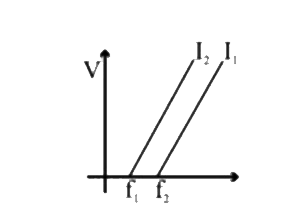
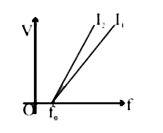
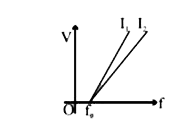
A photoelectric experiment is performed at two different light intensities I_(1) and I_(2) (I_(2) gt I_(1)). Choose the correct graph showing the variation of stopping potential versus frequency of light. |
|
Answer»
|
|
| 39. |
An LCR circuit has 1= 10mH, R = 3Omega" and "C = 1muF connected in series to a source of 15 cosomegat volt. The current amplitude at a frequency that is 10% lower than the resonant frequency is |
|
Answer» 0.5A |
|
| 40. |
The illuminance at at distance 5 meter from a 200 candle source is |
|
Answer» `"10 lumens/m"^(2)` |
|
| 41. |
A series resonant circuit contains L_(1),R_(1) and C_(1). The resonant frequency is f. Another series resonant circuit contains L_(2), R_(2) and C_(2). The resonant frequency is also f. If these two circuits are connected in series, calculate the resonant frequency. |
|
Answer» Solution :Given that resonant FREQUENCY (f) `=(1)/(2pi SQRT(L_(1)C_(1)))=(1)/(2pi sqrt(L_(2)C_(2)))` `L_(1)C_(1)=L_(2)C_(2)` `L_(1)=(L_(2)C_(2))/(C_(1))` …..(1) When these TWO CIRCUITS are connected in series The TOTAL inductance `L = L_(1)+L_(2)` Total capacitance is given by `(1)/(C )=(1)/(C_(1))+(1)/(C_(2))` (or) `C=(C_(1)C_(2))/(C_(1)+C_(2))` The resonant frequency of combinedcircuit is given by `f' = (1)/(2pi sqrt(LC))=(1)/(2pi sqrt((L_(1)+L_(2))(C_(1)C_(2))/(C_(1)+C_(2))))` `= (1)/(2pi sqrt(((L_(2)C_(2))/(C_(1))+L_(2))(C_(1)C_(2))/(C_(1)+C_(2))))` `= (1)/(2pi sqrt(L_(2)((C_(2)+C_(1))/(C_(1)))(C_(1)C_(2))/(C_(1)+C_(2))))` `= (1)/(2pi sqrt(L_(2)C_(2)))` `f' = f` |
|
| 42. |
Internal energy per mole of gas depends on its |
|
Answer» viscosity |
|
| 43. |
Electromagnetic waves with wavelength lambda_(1)is used in satellite communication, lambda_(2) is used to kill germs in water purifies, lambda_(3) is used to detect leakage of oil in underground pipelines and lambda_(4)is used to improve visibility in runways during fog and mist conditions. Arrange these wavelengths in ascending order of their magnitude |
|
Answer» `lambda_(3)gtlambda_(2)gtlambda_(4)gtlambda_(1)` |
|
| 44. |
Two particles of mass m each are tied at the ends of a light string of length 2a. The whole system is kept on a frictionless horizontal surface with the string held tight so that each mass is at a distance 'a' from the center P (as shown in figure). Now, the mid-point of the string is pulled vertically upwards with a small but constant force F. As a result, the particles move towards each other on the surface. The magnitude of acceleration, when the separation between them becomes 2x, is : |
|
Answer» `(F)/(2m)(a)/(sqrt(a^(2)-x^(2))`  Fig. (ii) 2T sin theta=F…(i) Also for the mass A, Fig. ..(ii) `R+T sin theta= mg...(ii)` ` T cos theta= mf...(iii)` where .f is the acceleration with which each ball moves. From (1) and (iii) Acceleration, `f =(F cos theta)/(2m)=(F)/(2m)xx(x)/sqrt(a^(2)x^(2))` HENCE (b) is the correct choice |
|
| 45. |
A heating element using nichrome connected to a 230V supply draws an initial current of 3.2 A which settles after a few seconds to a steady value of 2.8A. What is the steady temperture of the heating element if the heating the room temperature is 27.0^(@)C? Temperature coefficient of resistance of nichrome averaged over the temperature range involved is 1.70 xx 10^(-4) .^(@)C^(-1). |
|
Answer» Solution :Resistance at room temperature `R_(27)=(V)/(I)=(230)/(3.2)` Resistance at `theta` temp. `R_(theta)=(230)/(2.8)` `(R_(27))/(R_(theta))=(R_(0)(1+alphaxx27))/(R_(0)(1+alphaxx theta))rArr (2.8)/(3.2)=(1+27alpha)/(1+alpha theta)` `rArr (7)/(8)=(1+27alpha)/(1+alpha theta) rArr theta=(1+216alpha)/(7alpha)=(1+216xx1.7xx10^(-4))/(7xx1.7xx10^(-4))` `rArr theta = 867^(@)C` |
|
| 46. |
For a chosen nonzero value of voltage, there can be more than one value of current in |
|
Answer» COPPER WIRE |
|
| 47. |
At room temperature (28.0^(@) C)the resistance of a heating element is 100 Omega . What ic. the temperature of the element if the resistance is found to be 117Omega, given that the temperature coefficient of the material of the resistor is 1.70 xx 10^(-4)""^(@) C^(-1) . |
|
Answer» SOLUTION :If resistances of a given wire are `R_(1) and R_(Z)` at temperatures `T_(1) and T_(2)` respectively then, we have the formula, `R_(2) = R_(1) (1 + alpha (T_(2) - T_(1))) ` `therefore 117 = 100 { 1 + (1.7 XX 10^(-4)) (T_(2) - 27)} ` `therefore 1.17 = 1 + (1.7 xx 10^(-4) ) (T_(2) - 27) ` `therefore 0.17 = 1.7 xx 10^(-4) T_(2) - 45.9 xx 10^(-4) ` `therefore 0.17459= 1.7 xx 10^(-4) T_(2)` `therefore T_(2) = (0.17459)/(1.7 xx 10^(-4)) = (1745.9)/(1.7) = 1027^(@)` C |
|
| 48. |
Statement 1: While crossing a bridge, soldiers are asked to break steps. Statement 2: When natural frequency of an oscillating system equals frequency of external impulse, its amplitude of oscillating may become very high. |
|
Answer» Statement 1 is TRUE, Statement 2 is true, Statement 2 is the CORRECT explanation of Statement 1. |
|
| 49. |
A wire of uniform cross-section is stretched between two points 1m apart. The wire is fixed at oneend and n weight of 9 kg hung over a pulley at the other end produces fundamental frequency of 750Hz. If now thesuspended weight is submerged inn liquid of density (5/9) that of the weight, what will be the velocity and frequency of the waves propagating along the wire? |
|
Answer» Solution :Now as in case OFA WIRE under TENSION `v = sqrt(T/m)` so `V_A/V_B = sqrt(T_A/T_B),i.e., V_B = 1500 sqrt(T_B/T_A) (or)` `V_B = 1500 sqrt((MG.)/(Mg)) =1500 sqrt((g[1-sigma//rho])/g)[as g. =g(1 -sigma/rho)]` or `V_B = 1500 sqrt(1 - 5/9) = 1000 m//s` so from `v = f lambda , f_B = V_B/lambda_B = 1000/2= 500Hz` i.e.,in thissituation, `lambda =2m, f =500 Hz and v = 1000 m/s. |
|
| 50. |
A loop of rope is whirled at a high angular velocityomega, so that it becomes a taut circle of radius r. (a) Find the tension in the rope it the linear mass density of the rope ismu (b) A kink develops in the whirling rope. Under what condition does the kink remain stationary relative to an observer on the ground? |
|
Answer» |
|