Saved Bookmarks
This section includes 7 InterviewSolutions, each offering curated multiple-choice questions to sharpen your Current Affairs knowledge and support exam preparation. Choose a topic below to get started.
| 1. |
Three capacitors of 2 pF, 3 pF and 4 pF are connected in parallel. What is the total capacitance of a network ? |
|
Answer» 9 pF For PARALLEL CONNECTION `C_(eq)=C_(1)+C_(2)+C_(3)= 2+3+4= 9 pF` |
|
| 2. |
Focal length of a convex lens is 20 cm and its RI is 1.5. it prodcued an erect , enlarged image if the distance of the object from the lens is |
|
Answer» 40 cm If `|u|ltf` erect and ENLARGED IMAGE will be formed by CONVEX LENS. So, `u=15cm` is correct. |
|
| 3. |
A parallel plate capacitor , each with plate area A and separation d , is charged to a potential difference V . The battery used to charge it remains connected . A dielectric slab of thickness of and dielectric constant K is now placed between the plates . What change , if any , will take placein : electric filed intensity between the plates ? Justify your answer . |
|
Answer» Solution :Given that plate AREA of either plate of parallel plate CAPACITOR = A distance between the plates = d and potential difference between the plates = V Hence initially capacitance ` C = (in_(0) A)/(d)` and CHARGE on plates Q = CV As the battery remains connected THROUGHOUT the potential difference between the plates remains unchanged (V. = V)On placing a dielectric slab of the thickness .d. and dielectric constant .K. between the plates New charge on plates `Q. = C. V.. = KCV = KQ` |
|
| 4. |
The universal property of all substances is : |
|
Answer» magnetism |
|
| 5. |
When the Young's moduli of two wires are in the ratio of 1:2 and their lengths in the ratio 2:1, the stresses required to produce the same elongation are in the ratio |
| Answer» ANSWER :A | |
| 6. |
A parallel plate capacitor , each with plate area A and separation d , is charged to a potential difference V . The battery used to charge it remains connected . A dielectric slab of thickness of and dielectric constant K is now placed between the plates . What change , if any , will take placein : charge on plates ? Justify your answer |
|
Answer» Solution :Given that plate area of either plate of parallel plate CAPACITOR = A distance between the plates = d and potential difference between the plates = V Hence initially capacitance ` C = (in_(0) A)/(d)` and charge on plates Q = CV As the battery REMAINS connected throughout the potential difference between the plates remains UNCHANGED (V. = V)On placing a dielectric slab of the THICKNESS .d. and dielectric constant .K. between the plates New capacitance of the capacitor `C. = (K in_(0) A)/(d) = KC ` |
|
| 7. |
Two condensers of capacities 4 muF and 6 muF are connected to two cells as shown. Then |
|
Answer» P.D. of `6 mu `F CONDENSER is 4V |
|
| 8. |
Two cells A and B of e.m.f.2 V and 1.5 V respectively, are connected as shown in figure through an external resistance 10 Omega The internal resistance of each cell is 5 Omega. The potential difference E_A and E_B across the terminals of the cells A and B respectively are |
|
Answer» `E_A = 2.0v,E_B = 1.5 V` `2-1.5 -5I-10 I-5I =0` `implies0.5= 20I impliesI=(0.5 )/(20)=(1)/(40 )A ` terminalpotentialdiffernceacrossthe cell A ` E_A= 2-Ir=2 -(1)/(40 ) xx 5 =1.875V.` terminalpotentialdifference acrossthe cell B ` E_B= 1.5+Ir= 1.5+(1)/(40)xx 5 = 1.875V.` terminalpotentialdiffernceacrossthe cellB. ` E_B= 1.5 +Ir = 1.5+(1)/(40) xx5 =1.625 V.` 
|
|
| 9. |
Obtain the resonant frequency omega of a series LCR circuit with L = 2.0 H, C = 32muF and R = 10 Omega. What is the Q-value of this circuit ? |
|
Answer» SOLUTION :`omega = (1)/(sqrtLC) = (1)/(sqrt(2 xx 32 xx 10^(-6) )) = 125 sec^(-1)` `Q = (omega_r L)/(R ) = (125 xx 2)/(10) = 25 ` |
|
| 10. |
What is coordination number of atom in simple cubic |
|
Answer» 2 |
|
| 11. |
Explain how LC oscillations takes place in the circuit. |
|
Answer» Solution :Figure shows a capacitor with initialcharge `q_(m)` connected to ideal INDUCTOR. The electrical energy stored in the charged capacitor is `U = (1)/(2) (q^(2)m)/(C )` Since circuit is open there is no current in the circuit. The energy in the inductor is zero. `:.` Total energy of LC circuit, `U = U_(E ) = ( 1)/(2) ( q^(2) m )/( C )`   At t=0, the switch is closed and the capacitor starts to discharge. This shown in figure . At t=0, the switch is closed and the capacitor starts to discharge. This shown in figure . As the current increases it sets up a magnetic field in the inductor and there by magnetic energy stored will be `U_(B) = ( 1)/(2) LI^(2)`. As the current reaches its MAXIMUM value `I_(m)` and `t = ( T )/( 4)` , all the energy is stored in the magnetic field `U_(B) = ( 1)/(2) LI_(m)^(2)`. This is shown in figure. Since maximum electrical energy of capacitor equals the maximum magnetic energy from inductor. The capacitor nowhas no charge and hence no energy. The current now starts charging the capacitor as shown in figure. This process continues till the capacitor is fully charged at time `t = (T)/( 2)` as shown in figure. But it is charged with a POLARITY opposite to its initial state as in figure. The WHOLE process just described will now repeat itselt till the SYSTEM reverts to its original state . Thus the energy in the system oscillates between the capacitor and the inductor. Hence, charge between two plates oscillates by inductor. This phenomenon is known as LCR circuit. |
|
| 12. |
A : The pattern and position of fringes always remain same even after the introduction of transparent medium in a path of one of the slits of young.s experiment. R : The central fringe bright or darkness is independent of the initial phase difference between the two coherence sources. |
|
Answer» Both A and R are true and R is the CORRECT EXPLANATION of A |
|
| 13. |
Draw phasor diagram for X_(C ) gt X_(L) and X_(C ) lt X_(L) and give the disadvantages of this method. |
|
Answer» Solution :If `X_(C ) gt X_(L)" " phi` is positive and the circuit becomes capacitive, consequently the current in the circuit leads the source voltage. If `X_(C ) lt X_(L)" " phi` is negative and the circuit becomes inductive consequently the current in the circuit lags the source voltage. The phasor diagram and variation of V and I with `OMEGA t` for the case `X_(C ) gt X_(L)` is shown in figure.  Thus, we have obtained amplitude and phase of current for an LCR series circuit using the technique of phasors, but in this method there are certain disadvantes. First, the phasor diagram say nothing about the initial condition. Second, one can TAKE any arbitrary value of t and draw different phasors. The solution so obtained is called the steady-state solution. This is not a general solution. Moreover, we do have a transient solution which EXISTS even for V =0. The general solution is the SUM of the transient solution and the steady -statesolution. After a sufficiently long time, the effects of the transient solution DIE out and the behaviour of the circuit is described by the steady -state solution. |
|
| 14. |
A particle of mass m and charge q is projected into a region having a perpendicular magnetic field B. Find the angle of deviation of the particle as it comes out of the magnetic field if the width d of the region is slightly less than. (a) (mv)/(qB) "" (b)(mv)/(2qB) "" (c) (2mv)/(qB) |
|
Answer» Solution :The RADIUS of PATH ` r=(mv)/(QB)` For `d LT r,` we have sin `theta = d/r` `(a) d= ((mv)/(qB)) = r, therefore sin theta= (((mv)/(qB)))/(((mv)/(qB)))=1 or theta = (pi)/(2) ` rad `(b) d= ((mv)/(2qB)) lt r , sin theta = d/r = ((mv)/(2qB))/((mv)/(qB)) = 1/2 or theta =pi/6 rad` `(c) d = ((2mv)/(qB))gt r`, the deviation of particle is therefore `theta= pi` rad. |
|
| 15. |
If a light of wavelength 330nm is incident on a metal with word function 3.55eV, the electrons are emitted. Then the wavelength of the emitted electron is ( Taken h = 6.6 xx 10^(-34) Js) |
|
Answer» `lt 2.75 XX 10^(-9) m ` `K_("MAX")=(hc)/(lambda)-phi_0 = ((1240)/(330)-3.55) eV= (3.76 - 3.55) eV` `K_("max")=0.21 eV` de-Brogliewavelength of emittedelectron `lambda=(h)/(sqrt(2mKE))=(6.63 xx 10^(-34))/(sqrt(2 xx 9.1 xx 10^(31) xx 0.21 xx 1.6 xx 10^(-19)))=2.668 xx 10^(-9)` m ` lambda= 2.67 xx 10^(-9) m` The two WAVELENGTH of the emittedelectron is ` lt 2.75 xx 10^(-9)`m |
|
| 16. |
The dimensions of the ratio of magnetic flux (phi) and permeability. (mu) are |
|
Answer» `[M^(0)L^(1)T^(0)A^(1)]` `phi/mu=(BA)/((B/H))="Area"xx"magnetic intensity"` [Area] = [A] = [`L^(2)`] Magnetic intensity = H = nI = `("NUMBER of turns")/("meter")xx"current"` `[H]=[A^(1)/L]" "["Current"]=[A^(1)]` `therefore[phi/mu]=[L^(2)xxA^(1)/L]=[LA^(1)]` `therefore[phi/mu]=[M^(0)L^(1)T^(0)A^(1)]` |
|
| 17. |
Speed of an electron in the first Bohr's orbit in a hydrogen atom is: |
|
Answer» `3xx10^8 m/sec` |
|
| 18. |
A wire of silver has a resistance of 1 ohm. Specific resistance of constantan is 30 times the specific resistance of silver. Find the resistance of a constantan wire whose length is one third length of the silver wire and radius half the radius of the silver wire. |
|
Answer» Solution :`R_s = 1 OMEGA, rho_C = 30 rho_s` Resistance of constantan `R_C =?` Length `l_c =(l_s)/(3)` radius `r_s = 2r_c` We know that `R=(rhol)/(a) = (rhol)/(pir^2)` `(R_c)/(R_s) = (rho_c)/(rho_s) (l_c)/(l_s) ((r_s)/(r_c))^2 = (30)/(3) xx 4 = 40` Resistance of constantan `R_c = 40 xx 1 = 40 Omega` |
|
| 19. |
A block of copper of radius r = 5.0 cm is coated black on its outer surface. How much time is required for block to cool down from 1000 K to 300 K? Density of copper, p = 9000 kg//m^(3) and its specific heat, c = 4 kJ//kg. K. |
|
Answer» |
|
| 20. |
Three charges 6muC are fixed at the three vertices of an equilateral triangle of side 9cm. Find the potential at the mid point of the base of the triangle. |
|
Answer» |
|
| 21. |
Which of the following statement is // are true |
|
Answer» work done by kinetic friction on a rigid body may be positive If `f_(k)` and ds looth are PARALLEL to each other friction force acts up to the inclined to produce angular acceleration. |
|
| 22. |
A plane EM wave travelling along z - direction is desctribed vec(E )=E_(0)sin(kz - omega t)hat(i)andveC(B)=B_(0)sin (kz - omega)hat(j). Show thatThe average energy density of the wave is given by U_(av)=(1)/(4)in_(0)E_(0)^(2)+(1)/(4).(B_(0)^(2))/(mu_(0)). |
|
Answer» Solution :In electromagnetic WAVES due to ELECTRIC field vector MAGNETIC field vector waves carry energy `vec(E )` and `vec(B)` varies with time nad position. Let E and B is average VALUE at given time, `U_(E )=(1)/(2) in_(0)E^(2)` andenergy density due to magnetic field B, `U_(B)=(1)/(2)(B^(2))/(mu_(0))` Total average energy density of EM waves, `U_("average")=U_(E )+U_(B)=(1)/(2)E_(0)E^(2)+(1)/(2)(B^(2))/(mu_(0))` Consider EM wave propagating in z - direction hence electric field and magnetic field will be represented as `vec(E )=E_(0)sin(kz - omega t)` and `vec(B)=B_(0)sin (kz - omega t)` Average value of `E^(2)` over one cycle (periodic time) `lt E^(2)GT = (E_(0)^(2))/(2)` Hence `U_("average")=(1)/(2)E_(0)(E_(0)^(2))/(2)+(1)/(2)mu_(0)((B_(0)^(2))/(2))` So, `U_("average")=(1)/(4)[in_(0)E_(0)^(2)+(E_(0)^(2))/(4 mu_(0))] ""`...(1) |
|
| 23. |
A glass plate of size 4cm xx 2.5cm is in contact with water with its flat surface. The force of S.T. of water is 70 erg//cm^2. The force of S.T. acting on the glass plate is |
|
Answer» 700 dyne |
|
| 24. |
What does the white clouds hold now? |
|
Answer» FRESH water |
|
| 25. |
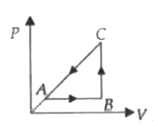
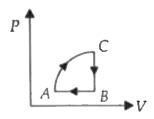
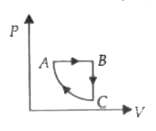
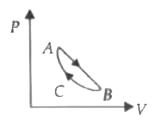
A cyclic process ABCA is shown in the given V-T diagram. Process in the P-V diagram will be |
|
Answer» <P> In process BC , V = constant and in process CA, T = constant . Therefore these processes are correctly represented on P - V diagram by graph (c ). |
|
| 26. |
If the series limit frequency of the Lyman series is v_(L), then the series limit frequency of the Pfund series is ...... |
|
Answer» `25v_(L)` `=E_(0)[(1)/(1^(2))-(1)/(OO^(2))]""n_(1)=1,n_(2)=oo` `:.hf_(L)=E_(0)""....(1)` `hf_(P)=E_(0)[(1)/(n_(1)^(2))-(1)/(n_(2)^(2))]` `=E_(0)[(1)/(5^(2))-(1)/(oo)]""n_(1)=5,n_(2)=oo` `:.hf_(P)=(E_(0))/(25)""......(2)` Taking ratio of equation (1) and (2), `:.(f_(L))/(f_(P))=25` `:.f_(P)=(f_(L))/(25)` |
|
| 27. |
An electromagnetic wave is produced by oscillating electric and magnetic field E and B. Choose the only incorrect statement from the following. |
|
Answer» E is PERPENDICULAR to B |
|
| 28. |
A carnot engine, having an efficiency eta=1/10as heat engine, is used as a refrigerator. If the work done on the system is 10 J. then the amount of energy absorbed from the reservoir at the lower temperature is |
|
Answer» 100 J |
|
| 29. |
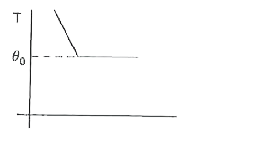
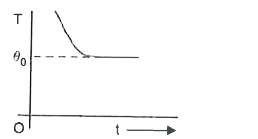
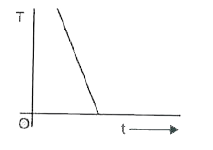
If a piece of metal is heated to temperature theta and then allowed to cool in a room which is at temperature theta_(0) the graph between the temperature T of the metal and time t will be closest to : |
|
Answer»
So correct CHOICE is (b). |
|
| 30. |
Three capacitors of a capacitances 3 mu F , 9 mu Fand 18 mu Fare connected initially in series and subsequently in parallel . The ratio of equivalent capacitance in the two cases ((C_(s))/(C_(p))) will be |
| Answer» SOLUTION :`1 : 15` | |
| 31. |
The most energetic proton ever detected in the cosmic rays coming to Earth from space had an astounding kinetic energy of 3.0xx10^(20)eV (enough energy to warm a teaspoon of water by a few degrees). Suppose that the proton travels along a diameter of the Milky Way galaxy (9.8xx10^(4)ly). Approximately how long does the proton take to travel that diameter as measured from the common reference frame of Earth and the Galaxy? |
|
Answer» Solution :Reasoning: We just saw that this ultrarelativistic PROTON is traveling at a speed barely less than C. By the definition of light-year, light takes 1 y to travel a distance of 1 ly, and solight should take `9.8xx10^(4)y` to travel `9.8xx10^(4)ly`, and this proton should take almost the same time. Thus, from our Earth-Milky WAY REFERENCE FRAME, the proton.s trip takes `Delta = 9.8xx10^(4)y`. |
|
| 32. |
The most energetic proton ever detected in the cosmic rays coming to Earth from space had an astounding kinetic energy of 3.0xx10^(20)eV (enough energy to warm a teaspoon of water by a few degrees). How long does the trip take as measured in the reference frame of the proton? |
|
Answer» Solution :KEY IDEAS 1. This problem involves measurements made from two (inertial) reference frames: one is the Earth-Milky Way frame and the other is attached to the proton. 2. This problem also involves two events: the first is when the proton passes one end of the diameter along the Galaxy, and the second is when it passes the opposite end. 3. The time interval between those two events as measured in teh proton.s reference frame is the proper time interval `Deltat_(0)` because the events occur at the same location in that frame-namely, at the proton itself. 4. We can find the proper time interval `Deltat_(0)` from the time interval `Deltat` measured in the Earth-Milky Way frame by using Eq.`(Deltat=gammaDeltat_(0))` for time dilation. (Note that we can use that EQUATION because one of the time MEASURES is a proper time. However, we get the same RELATION if we use a Lorentz transformation.) Calculation: Solving Eq. for `Deltat_(0)` and substituting `gamma` from (a) and `Deltat` from (b), we find `Delta t_(0)=(Delta t)/(gamma)=(9.8xx10^(4)y)/(3.198xx10^(11))` `=3.06xx10^(-7)y=9.7s.` In our frame, the trip takes 98 000 y. In the proton.s frame, it takes 9.7 s! As PROMISED at the start of this CHAPTER, relative motion can alter the rate at which time passes, and we have here an extreme example. |
|
| 33. |
The most energetic proton ever detected in the cosmic rays coming to Earth from space had an astounding kinetic energy of 3.0xx10^(20)eV (enough energy to warm a teaspoon of water by a few degrees). What were the proton's Lorentz factor gamma and speed v (both relative to the ground-based detector)? |
|
Answer» Solution :KEY IDEAS (1) The proton.s LORENTZ factor `gamma` relates its total energy E to its mass energy `mc^(2) (E=gamma mc^(2))`. (2) The proton.s total energy is the sum of its mass energy `mc^(2)` and its (given) kinetic energy K. Calculations: Putting these ideas together we have `gamma=(E )/(mc^(2))=(mc^(2)+K)/(mc^(2))=1+(K)/(mc^(2)). "" `(36-58) the proton.s mass energy `mc^(2)` is 938 MEV. substituting this and the given kinetic energy into Eq. 36-58, we obtain `gamma=1+(3.0xx10^(20)eV)/(938xx10^(6)eV)` `=3.198xx10^(11)~~3.2xx10^(11)`. This computed value for `gamma` is so large that we cannot use the definition of `gamma` to find v. Try it, your calculator will tell you that `beta` is effectively equal to 1 and thus that v is effectively equal to c. Actually, v is almost c, but we want a more accurate answer, which we can obtain by first solving Eq. for `1-beta`. To BEGIN we write `gamma=(1)/(sqrt(1-beta^(2)))=(1)/(sqrt((1-beta)(1+beta)))~~(1)/(sqrt(2(1-beta)))`, where we have used the FACT that `beta` is so close to unity that `1+beta` is very close to 2. (We can round off the sum of two very close numbers but not their difference.) The velocity we seek is contained in the `1-beta` term. Solving for `1-beta` then yields `1-beta=(1)/(2gamma^(2))=(1)/((2)(3.198xx10^(11))^(2))` `=4.9xx10^(-24)~~5xx10^(-24)`. Thus, `beta=1-5xx10^(-24)` and, since `v=betac`, `v~~`0.999 999 999 999 999 999 999 995c. |
|
| 34. |
An ammeter of resistance 0.80 Omega can measure current upto 1.0 A. (i)What must be the value of shunt resistance to enable the ammeter to measure current upto 5.0 A ? (ii) What is the combined resistance of the ammeter and the shunt ? |
|
Answer» Solution :(i) Shunt, `S=(R_(A)i_(G))/(i-i_(g))` `=(0.8xx1.0)/(5.0-1.0)` `=0.2 Omega` (II) Combined resistanceof ammeter and shunt `(1)/(R_("total"))=(1)/(R_(A))+(1)/(S)` `=(1)/(0.8)+(1)/(0.2)` `R_("total")=(0.8)/(5)` `rArr R_("total")=0.16 Omega` |
|
| 35. |
A small metal sphere carrying charge +Q is located at the centre of a sphereical cavity inside a large uncharged metallic spherical shell. Use Gauss' law to find the expression for the electric field At a point P_1 situated inside the cavity at a distance x_1 from centre. (ii) At a point P_2 situated in the metalic spherical shell at a distance x_2from the centre. |
|
Answer» Solution :Let charge +Q is located at the centre O of a spherical cavity inside a large uncharged metallic spherical SHELL as shown in Then a charge -Q is induced on inner surface of shell and a charge +Q is induced on the outer surface of the shell. Let `P_1 ` be a point inside the cavity at a distance `x_1 ` from the centre O. To find ELECTRIC field ` E_1 ` at point `P_1`let us consider a spherical surface of radius `x_1` as the Gaussian surface. Then ,electric flus. ` phi _in =int oversetto E . oversetto (dS) =E_1 s_1 = E_1 (4 PI x_1^(2)) ` ` "" = (1)/( in_0) ("charge ENCLOSED")=(Q)/(in_0) ` ` RARR ""E_1 =(Q)/( 4 pi in _0 x_1^(2))` Let `P_2` be a point situated in the metallic shell at a distance `x_2` from the centre. To find electric field `E_2` at point ` P_2`let us again consider a spherical surface of radius `x_2` as the Gaussian surface. Then Electric flux ` "" phi_in =E_2s_2 =E_2 ( 4 pi x_2^(2))=(1)/( in _0)("charge enclosed") = (1)/( in_0)(Q-Q)= 0 ` `rArr""E_2 =0` 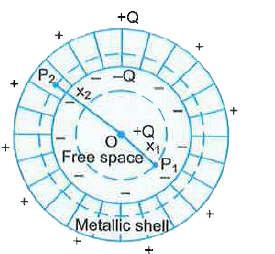
|
|
| 36. |
Function f is invertible if f is |
|
Answer» One-one |
|
| 37. |
10 muC charge Is placed on each vertex of equilateral triangle of 10 cm side. Electric potential energy of system is ...... |
|
Answer» 100 J 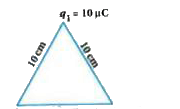 Electric POTENTIAL energy of system `U=(kq_(1)q_(2))/(a) +(kq_(2)q_(3))/(a) +(kq_(1)q_(3))/(a)` `= (k)/(q)[q_(1)q_(2)+q_(2)q(3)+q_(1)q_(3)]` `=(9XX10^(9))/(10xx10^(-2))[100xx10^(-12)+100xx10^(-12)+100xx1-0^(-12)]` `U = 9xx10^(10)[3xx10^(-10)]` `:. U = 27 J` |
|
| 38. |
A nonzero external force acts on a system of particles. The velocity and the acceleration of the centre of mass are found to be v_0 and a_0 at an instant t. It is possible that : |
|
Answer» `v_0 = 0, a_0 = 0` |
|
| 39. |
The average number of neutrons released per fission in the fission of U^(235) is |
|
Answer» 7 |
|
| 40. |
An automobile is turning round a circular road of radius r. The coefficient of friction between tyres and road is mu. The velocity of the vehicle should not be more than |
|
Answer» `sqrt(murg)` |
|
| 41. |
Two blocks rest on a horizontal frictionless surface as shown in the figure. The surface between the top and bottom blocks is roughened so that there is no slipping between the two blocks. A 30-N force is applied to the bottom block as suggested in the figure. |
|
Answer» What is the MINIMUM coefficient of static FRICTION NECESSARY to keep the top BLOCK from slipping on the bottom block? |
|
| 42. |
Two blocks rest on a horizontal frictionless surface as shown in the figure. The surface between the top and bottom blocks is roughened so that there is no slipping between the two blocks. A 30-N force is applied to the bottom block as suggested in the figure. What is the magnitude of the force of static friction between the top and bottom blocks? |
|
Answer» 0 N |
|
| 43. |
An electron moving in a circular orbit of radius r makes n rotations per second. The magnetic field produced at the centre has magnitude |
| Answer» Answer :B | |
| 44. |
If a velocity has both perpendicular and parallel components while moving through a magnetic field, what is the path followed by a charged particle ? |
|
Answer» Circular |
|
| 45. |
When an ebonite rod is rubbed with fur, the charge acquired by the fur is. |
|
Answer» |
|
| 46. |
The number of waves in 7.5 cm length in vacumm is the same as the number in 5 cm length of a medium. What is the refractive index of the medium ? |
|
Answer» 1.25 |
|
| 47. |
A plane mirror and a concave mirror are arranged as shown in figure and O is a point object. Find the position of image formed after two reflections, first one taking place at concave mirror. |
| Answer» SOLUTION :100 CM VERTICALLY below A | |
| 49. |
What is an electric dipole ? |
Answer» Solution :An electric DIPOLE is a pair of TWO equal and opposite charges SEPARATED by a small DISTANCE. 
|
|
| 50. |
What is meant by quantisation of charges ? |
|
Answer» SOLUTION :The charge q on any object is equal to an integral multiple of this FUNDAMENTAL unit of charge e. q=ne Here N is nay integer `(0, pm 1,pm 2,pm 3,pm 4..........)`. This is called quantisation of electric charge . |
|