

Saved Bookmarks
This section includes 7 InterviewSolutions, each offering curated multiple-choice questions to sharpen your Current Affairs knowledge and support exam preparation. Choose a topic below to get started.
| 1. |
What are the focal length of objective and eye piece in case of a compound microscope? |
| Answer» SOLUTION :The objective is of LARGE focal length and eye LENS is have small focal length. | |
| 2. |
A steel wire of length l hasa magnetic moment M it is bent in L shape at itsmid pointthe newmagneticmoment is |
|
Answer» m 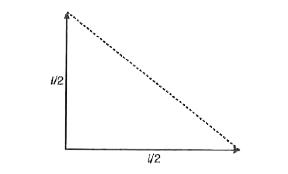
|
|
| 3. |
A parallel plate capacitor with a sheet of paper (dielectric constant K) between the plates has a capacitance C. If the sheet is removed then capacitance of the capacitor becomes |
|
Answer» KC `:.` CAPACITANCE on removing the dielectric ` = C/K` |
|
| 4. |
What is the value of charge and mass of beta particles ? Why is beta particle energy spectrum continuous ? |
|
Answer» Mass of beta particle is `m=9.1xx10^(-31)` kg Continuousspectrum of `beta`-particle Pauli suggested that in `beta`-particle disintegration, another particle NEUTRINO was simultaneously emiited along with `beta`-particle . The neutrino is supposed to be fundamental particle having : (i) zero charge, (ii) zero rest mass, and spin `1/2 (h)/(2pi)`. A `beta`-decay can thus the represented as `n rarr p+e^(-)+v` (neutrino) Under neutrino hypothesis, each `beta`-decay is accompanied by disrete energy `E_(beta)` which corresponds to the end POINT energy in the continuous `beta`-particle spectrum. The disintegration energy is shared by `beta`-particle, neutrino and the recoil NUCLEUS in a continuous range of different ways. The neutrino may take any amount of the available `beta`-disintegration energy so that the energy left at the disposal of the `beta`-particle will bedifferent for each disintegration. Thus `beta`-particles of all possible energies EXTENDING from zero to a certain maximum (end point enrgy) shall be emitted as shown in the figure . Thus Pauli.s neutrino hypothesis SATISFACTORILY explains the continuous energy range of `beta`-particle spectrum. |
|
| 5. |
A particle of change 1mu C & mass 1 gm moving with a velocity of 4m/s subjected ta a uniform electric field of magnitude 300V/m for 10 sec. Then it.s final speed cannot be : |
|
Answer» 0.5 m/s |
|
| 6. |
An electric dipole kept in a uniform electric field experiences |
|
Answer» a FORCE and a TORQUE |
|
| 7. |
Borate form green colour flame when burunt With (Conc. H_(2)S0_(4) + Ethanol). Green colour flame is obtained due to formation of - |
|
Answer» `(C_(2)H_(5)O)_(3)B` |
|
| 8. |
The wavelength of K_(alpha) line from an element of atomic number 51 is lambda. From another element wavelength of K_(alpha) line is 4lambda. What is the atomic number of the second element ? |
|
Answer» 25 In SECOND case, `4lambda alpha (1)/((Z.-1)^(2))` `4 xx 1/50^(2)=(1)/((Z.-1)^(2))` `or Z.-1=(50)/2=25` `Z.=26` |
|
| 9. |
The Balmer series for the H-atom can be observed |
|
Answer» |
|
| 10. |
We are given the following atomic masses: ""_(92)^(238) U = 238.05079 u "" _(2)^(4)He = 4.00260 u ""_(90)^(234)Th = 234.04363 u""_(1)^(1)H= 1.00783 u ""_(91)^(237)Pa = 237.05121 u Here the symbol Pa is for the element protactinium (Z = 91). (a) Calculate the energy released during the alpha decay of ""_(92)^(238)U. (b) Show that ""_(92)^(238)U can not spontaneously emit a proton. |
|
Answer» Solution :(a) The alpha decay of `""_(92)^(238)U` is GIVEN by Eq.The energy released in this process is given by `Q = (m_u - m_(He))c^2` Substituting the atomic masses as given in the data. We find `Q = (238.05079 - 234.04363 - 4.00260) u xx c^2` `= (0.00456 u)c^2` ` = (0.00456 u)(931.5 MEV//u)` `= 4.25 MeV`. (b) If `""_(92)^(238)U` SPONTANEOUSLY emitts a PROTON, the decay process would be `""_(92)^(238)U to ""_(91)^(237)U + ""_(1)^(1)H` The Q for this process to happen is `= (m_U - m_(Pa) - m_(H)) c^2` `=(238.05079 - 237.05121 - 1.00783) u xx c^2` `= (-0.00825 u)c^2` `= -(0.00825 u)(931.5 MeV//u)` `= -7.68 MeV`. Thus, the Q of the process is negative and therefore it cannot proceed spontaneously. We will have to supply an energy of `7.86 MeV` to a `""_(92)^(238)U` nucleus to make it emit a proton. |
|
| 11. |
How does mutual inductance of a pair of coils change when the distance between the coil is increased. |
| Answer» Solution :On INCREASING DISTANCE between the COILS, the magnetic flux is linked with the secondary coil due to current flowing through it , primary coil will decrease. Hence, MUTUAL inductance will decrease. | |
| 12. |
(A): p-n-p transistor is faster than n-p-n transistor (R): The mobility of electrons is greater than the mobility of holes |
|
Answer» Both 'A' and 'R' are TRUE and 'R' is the CORRECT explanation of 'A' |
|
| 13. |
The earth's field departs from its dipole shape substantially at large distances (greater than about 30,000 km). What agencies may be responsible for this distortion ? |
| Answer» Solution :At LARGE distances, the FIELD gets modified due to the field of IONS in motion in the earth.s ionosphere). The latter is SENSITIVE to extra-terrestrial disturbances such as, the SOLAR wind. | |
| 14. |
It is found experimentally that 13.6 eV energy is required to separate a hydrogen atom into a proton and an electron . Compute the orbital radius and the velocity of the electron in a hydrogen atom. |
|
Answer» Solution :Total ENERGY of the electron in HYDROGEN atom is - 13.6 eV=- 13.6 `xx 1.6 xx 10^(-19) J = -2.2 xx 10^(-18)`J. We have E = `(e^(2))/(8 pi epsilon_(0)r) = - 2.2 xx 10^(-18) `J. This gives the orbital radius . r = `(e^(2))/(8 pi epsilon_(0) E) = - ((9 xx 10^(9) Nm^(2) // C^(2)) (1.6 xx 10^(-19) C)^(2))/((2) (-2.2 xx 10^(-18)J))` =` 5.3 xx 10^(-11)`m The velocity of the revolving electron `v(e)/(sqrt(4 pi epsilon_(0)MR)) = 2.2 xx 10^(6) `m//s |
|
| 15. |
If metal section of shape H is inserted in between two parallel plates as shown in figure and A is the area of each plate then the equivalent capacitance is |
|
Answer» `(A in_0 )/(a ) - (Ain_0) /(B ) ` |
|
| 16. |
The potential of a point B (-20m, 30m) taking the potential of a point A (30m, -20m) to be zero in an electric field vec E = 10xhati - 20hatj NC^(-1) is |
|
Answer» Solution :d. `V_(a)-V_(A)=-underset(30)OVERSET(-20)int 10xdx-underset(-20)overset(30)int(-20)dy` or `V_(B)-0=3500V` |
|
| 17. |
A charged particle +q of mass m is placed at a distance d from another charge particle -2q of mass 2m in a uniform magnetic field of induction vectro B as shown in the fig.If the particles are projected towards each other with equal speeds v.(Neglect the interaction between the particles) (a)Find the maximum value of the projection speed V_(max) so that the two particles do not collide. b)Find the time interval after which collision occurs between the particles if projection speed equals 2V_(max) (c)In the previous part,assuming that the particles stick after the collision find the radius of the circular path of the particle in subsequent motion. |
|
Answer» Final CHARGE `=-Q` `R_(f)=(3mV)/(qB)` By CONSERVATION of linear momentum `2 mV_(m)sin pi/6+4mV_(m)sin pi/6=3mV_(y)` `4 mV_(m)cos pi/6-2mV_(m)cos pi/6=3mV_(x)` `V_(x)=V_(m)/sqrt3` `V=sqrt(V_(x)^(2)+V_(y)^(2))=(2Vm)/sqrt3, R_(f)=(6mV_(m))/(qBsqrt3)=(2sqrt3_(m))/(qB)xx(qBd)/(2m)=sqrt3 d` 
|
|
| 18. |
Obtain the relation of voltage applied to a series LCR circuit. |
Answer» Solution :Below figure shows a series LCR circuyit connected to an AC source `.epsilon.`. Voltage of an AC source is `V = V_(m) sin OMEGA t `. Let q is the charge on the CAPACITOR and I the current at time t, `:. V = V_(L ) + V_(R ) + V_( C )` From Kirchhoff.s loop rule `L ( dI)/( dt) + IR + ( q )/( C ) = V ` From Kirchhoff.s loop rule `L (dI)/(dt) + IR + ( q)/( C ) = V ` where potential difference across the ends `= L (dI)/( dt )` potential difference across the ends of capacitor `= ( q )/( C )` and potential difference across the ends of resistance `= I_(R )`. |
|
| 19. |
A particle is moving in a circle of a radius 40 cm has a linear speed of 30m//s at a certains intant its linear speedis increasesing at the rate of 4m//s^(2). Increasing at the instant will be |
|
Answer» `200m//s^(3)` `=(2xx30xx4)/(0.4)=600m//s^(3)` |
|
| 20. |
How does photocurrent vary with the intensity of the incident light ? |
| Answer» Solution :Photocurrent-the number of electrons emitted PER second is DIRECTLY proportional to the intensity of the INCIDENT LIGHT. | |
| 21. |
The current through 10 Omega resister in the figure is approximately |
|
Answer» `0.1 A ` |
|
| 22. |
Derive an expression for the intensity of magnetic field at any point on the axis of a circular current loop. |
Answer» Solution :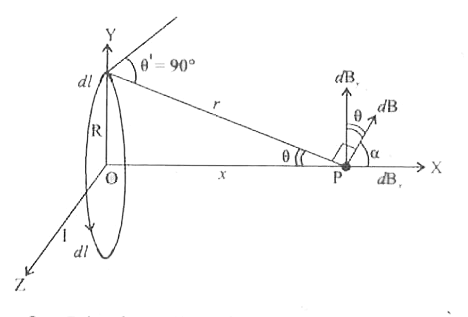 Let R be the radius of a CURRENT loop, carrying current I. Let R be a POINT on the AXIS of a conductor. Let dB be magnetic field at P, due to a current element .idl. From the figure, `theta + a= 90^@`, so that `alpha = 90^@ – 0` and `cosalpha = cos (90^@ – 0)` `sintheta = R^2/((R^2+x^2)^(1/2))`...(1) Let `dB_x` be the horizontalcomponent of dB. Applying Biot-Savart.s law , We write `dvecB=(mu_0/(4pi))(I(d vecl xx vecr))/r^3` i.e., `dB=(mu_0/(4pi))(Irdl)/r^3 sin theta.` where `theta.=90^@` i.e., `dB=(mu_0/(4pi))(Irdl)/r^3 =(mu_0/(4pi))(Idl)/r^2` ...(2) Component of dB along the horizontalis `dB_x=dBcosalpha` or `dB_x =dB sin theta` `=(mu_0/(4pi))(Idl)/r^2 sin theta` By using (1) we write `dB_x =(mu_0/(4pi))(Idl)/r^2 R/r =(mu_0/(4pi)) (IdlR)/((R^2+x^2)^(3/2))`...(3) or integrating `B_x=int dB_x = int(mu_0/(4pi)) (IR)/((R^2+x^2)^(3/2))dl` i.e., `B_x =(mu_0/(4pi)) (IR)/((R^2+x^2)^(3/2))dl ` i.e., `B_x =(mu_0/(4pi)) (IR)/((R^2+x^2)^(3/2)) (2piR)` where `intdl =2piR` or `B_x=(mu_0/(4pi))((2piIR^2)/((R^2+x^2)^(3/2)))` tesla and `VECB=B_x hati=(mu_0/(4pi)) ((2piIR^2)/((R^2+x^2)^(3/2)))hati`, `dB_y=0` For a CIRCULAR loop , and at the centre, x=0 `vecB=(mu_0/(4pi))((2piI)/R)hati` For a circular conductorcontainingn turns , `B_x hati=(mu_0/(4pi)) (2pinIR^2)/((R^2+x^2)^(3/2))hati` and at the centre , `B_0hati=(mu_0/(4pi)) ((2pinI)/(R))hati` |
|
| 23. |
Deduce an expression for the capacitance ofa parallel plate capacitor having plate area 'A' and plate separation 'd'. |
|
Answer» Solution :Consider a parallel PLATE capacitor consisting of TWO plates each of surfaces area A , held parallel to each other in AIR medium such that the separation between the plates is d . Charges on the two plates are `+Q` and `-Q` , respectively . Then surface density of charge on either plate `|sigma| = (Q)/(A)` Electric field between the plates of capacitor is uniform every where , having a value `E = E_(1) + E_(2) = (sigma)/(2 in_(0)) + (sigma )/(2 in_(0)) = (sigma)/(in_(0))` The electric field E is directed from +ve plate to the -ve plate . If V be the potential difference between the plates , then `V = E d = (sigma)/(in_(0)) d = (Qd)/(in_(0) A)` `therefore` Capacitance of the parallel plate capacitor `C = (Q)/(V) = (in_(0) A)/(d)` If a dielectric medium of dielectric CONSTANT .K. is completely filled between the two plates of capacitor , then electric field `E = (sigma)/(K in_(0)) = (Q)/(K A in_(0))` In that case `V = Ed = (Qd)/(K A in_(0)) implies` Capacitance `C = (Q)/(V) = (K in_(0) A)/(d)` 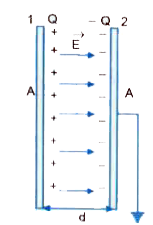
|
|
| 24. |
A body is projected from the top of a tower with a velocitybar(u) = 3 hat(i) + 4 hat(j) + 5 hat(k) ms^(-1),"where " hat (i), hat(j) and hat(k)are unit vectors along east, north and vertically upwards respectively. If the height of the tower is 0 m , horizontal range of the body on the ground is (g = 10 ms^(-2)) |
|
Answer» 15 m u = 5 m/s `hat(k)`is GIVEN vertically upward direction) `a = - 10 m//s^(2)` h = - 30 m Now using the formula `h = ut +(1)/(2) at^(2)` `- 30 = 5t - (1)/(2) xx 10 xx t^(2)` `rArr t^(2) - t - 6 = 0 ` `rArr t = - 2 s `(Not possible) or t = 3 s In this time, PROJECTILE moving in EAST and North with speeds 3m/s and 4m/s . Distances covered in these directions are , In east (x- coordinate) = speed `xx` time = `3 xx3 = 9 m ` and in North (y- coordinate) `= 4 xx 3 = 12 m ` So, Projective lando at (x,y) = (9m,12m) mark So, horizontal range of body on ground is : Range = `SQRT(9^(2)+12^(2))` `= sqrt(225)` 15 m 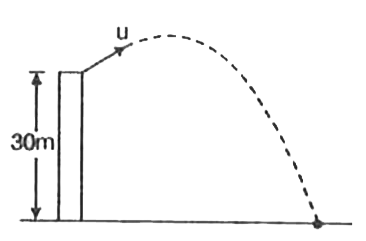 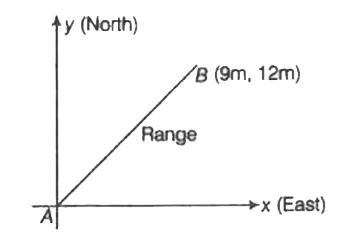
|
|
| 25. |
A body is travelling in a straight line path with a velocity given by v = ax where 'a' is a constant such that a = 5 units. What will be the work done by the force acting during its displacement from x = 0 to x = 2m ? |
|
Answer» 15 J Differentiating `(dv)/(at)=3//2a x^(1//3)(dv)/(DT)` or`a=3//2a.x^(1//2)xxv` =`3//2a x^(1//2)xx AX^(3//2)` =`3//2^2x^2` `:.` FORCE `F=ma=3//2a^2 x^2xx0.5` =`3//4a^2x^2` Now Work `W=int_0^2 F dx=int_0^2 3//4a^2x^2dx` =`3//4a^2[x^3/3]_0^2` =`3//4xx(5)^2xx8//3=50 J` |
|
| 26. |
A copper rod of length l is rotated about one end perpendicular to the magnetic field B with constant angular velocity omega . The induced e.m.f between the two ends is |
|
Answer» `(1)/(2) B omegal^(2)` |
|
| 27. |
When microwaves signals follow the curvature of earth, this is known as |
|
Answer» window |
|
| 28. |
The circuit diagram below shows n-p-n transistor in CE configuration. For this configuration, mark the correct statement(s). |
|
Answer» The POTENTIAL DIVIDER on input side is used to KEEP `V_("CE")` constant drawing input characteristics. |
|
| 29. |
IF minimumvoltage in an AM wave was found to be 2 V and maximum voltage 10 V. Find % modulation index. |
|
Answer» `80%` |
|
| 30. |
Imagine a new planet having the same density as that of earth but it is 3 times bigger than the earth in size. If the acceleration due to gravity on the surface of earth is g and that on the surface of the new planet is g', then |
|
Answer» `G'=g/9` `(g.)/(g)=(3M)/(M) rArr g.=3g`. |
|
| 31. |
Obtain the formula for the electric field due to a long thin wire of uniform linear charge density E without using Gauss's law. (Hint: Use Coulomb's law directly and evaluate the necessary integral.) |
|
Answer» Solution :Consider INFINITELY extended line of charge with constant linear charge density `lambda` . Let us determine its electric field at perpendicular distance r say at point P as shown in the figure. For this consider a charge element dq at distance y from central point O. Here, `dq = lambdady` `(therefore lambda = (dq)/(dy))` MAGNITUDE of Coulombian force exerted by above charge element dq on test charge `q_(0)`placed at point P is, `dF = k((dq)q_(0))/(CP)^(2) = (k(dq)q_(0))/(y^(2) + r^(2))`........(1) Magnitude of electric field of charge element dq at point P is, `dE = (dF)/(q_(0)) = (kdq)/(y^(2) + r^(2))`.........(2) Similary magnitude of electric field of charge element dq (selected on OPPOSITE SIDE of central point O) at point P is also, `dE = (kdq)/(y^(2) + r^(2))` When we resolve above two electric fields into two mutually perpendicular components at point p we find that dEsinG components cancel each other (because of equal magnitudes and opposite directions). Hence, we get electric field at point P only due to `dEcostheta`components which are in same directions and so we can make their scalar addition to find resultant electric field E at point P Thus, `E = int dEcostheta` `int(kdq)/(y^(2) + r^(2)).r/sqrt(y^(2) + r^(2))` From eqn. (2) and from `DeltaCOP` `therefore E = intklambda dy xx r/(y^(2) + r^(2))^(3//2)`...........(3) In right angled `triangleCOP` `tantheta = y/rrArr y = r tan theta`.......(4) For a given point P value of r is constant and so from above equation, `(dy)/(d theta) = r(d)/(d theta) (tan theta)` `therefore (dy)/(d theta) = r sec^(2)theta` `therefore dy = rsec^(2)theta d theta`........(5) Now, `(y^(2) + r^(2))^(3//2) = (r^(2)tan^(2)theta + r^(2))^(3//2)` (From equation (4)) `=(r^(2) sec^(2)theta)^(3//2)` `=r^(2)sec^(3)theta`.........(6) From equation (4) `tan theta = y/r` When `y =-infty, tan theta = -infty rArr theta = -pi/2` `y=+infty, tan theta =+ infty rArr theta = + pi/2` ............(7) From eqn (3), (5),(6) and (7), `E = int_(-pi//2)^(+pi//2) klambda(r sec^(2)theta d theta) xx r/(r^(3) sec^(3)theta)` `therefore E=(klambda)/r {sin(pi/2)- sin(-pi/2)}` `therefore E =(2klambda)/r` `therefore E = (lambda)/(2pi epsilon_(0)r) (therefore k=1/(4pi epsilon_(0)))` |
|
| 32. |
For a thin-walled solid cylinder of the same radius and mass. |
|
Answer» |
|
| 33. |
What would be your consideration while making electromagnets ? |
|
Answer» Solution :Uses of hysteresis curve. The given figure SHOWS TWO hysteresis curves, one for steel and other for iron. We find that retentivity of soft iron is higher than steel and coercivity of steel is higher than soft iron. These properties are used for MAKING permanent magnets, core of transformers and electromagnets etc. (i) For permanent magnets. Permanent magnet should have high VALUE of retentivity (to have large force of attraction for magnetic materials) and coercivity (to REMAIN magnetic for long time). But coercivity is more important than the retentivity. Hence steel is preferred than iron. Now some alloys like alnico, cobalt, steel are developed which have high value of retentivity and coercivity for making permanent magnets. (ii) For electromagnets. Electromagnets are used for lifting heavy iron materials and are continuously subjected to cyclic changes. So the materials used for electromangets must have high value of retentivity and small hystereis loss. Hence soft iron is preferred than steel. (iii) Core of transformer. The core of transformer (telephone diaphragms and chokes etc.) continuously undergo many cycles of magnetisation in one second. So we use the material which has less hysteresis loss. So soft iron is used for cores of transformers, chokes etc. 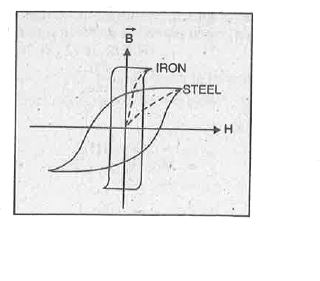
|
|
| 34. |
The electric potential at a point distant 0.1m from the middle of a short electric dipole on a line inclined at an angle of 60^(@) with the dipole axis is 900V. Calculate the dipole moment. |
|
Answer» |
|
| 35. |
A Frame of reference attached to a satellite orbiting around earth can be regarded as: |
|
Answer» An INERTIAL FRAME of reference |
|
| 36. |
What do you mean by the term impact parameter? |
| Answer» Solution : IMPACT parameter (B) is the perpendicular DISTANCE of the velocity VECTOR of the alpha-particle from the central line of nucleus, when the particle is far away from the nucleus. | |
| 37. |
Assertion : Soft iron is used as transformer core. Reason : Soft iron has narrow hysteresis loop. |
|
Answer» If both assertion and reason are true and reason is the correct EXPLANATION of assertion. Explanation : For HIGH efficiency of transformer, the energy loss will be LESSER if the HYSTERESIS LOOP is lesser area. i.e. narrow. |
|
| 38. |
In Young's experiment distance between twe slits is 0.28 mm and distance between the slit and the screen is 1.4 m. If distance betweencentral bright fringe and third bright fringe is0.9 cm wavelength of light used in Young's experiment is ..... |
|
Answer» `6000Å` `:. lambda=(x_(3))/(3D)=(0.9xx0.028)/(3xx140)` `=6xx10^(-5) cm=6000Å` |
|
| 39. |
The crystal rod of a ruby laser is of 4 mm diameter and 35 mm long. The laser radiates coherent light with wavelengths of 6943 Å and 6929 Å. Find the lowest angular divergence of its rays. |
|
Answer» |
|
| 40. |
Shown in the figure is network of capacitors & resistors. The potentials of some of the nodes are given. Find the |
|
Answer» Solution :At steady state, capacitor. offers infinite resistance to DC, therefore, no current PASSES through 1 1F capacitor and current passes through 1 Omega resistor across PQ. Since three identical resistors of resistance `(1)/(3)Omega`. each are connected in series. This series combination is connected in parallel with another resistor of 1Omega across PQ .thereforeThe effective resistance between P and Q will be`(1)/(2)Omega` Applying KCL at P, we OBTAIN `i_(1)+ i_(2) + i_(3) = 0` `implies(V_(P)-10)/(1)+(V_(P)-3)/(0.3)+(V_(p)-(-20))/(1)=0` `impliesV_(p)[1+(1)/(0.3)+1]=10+10-20` (a) `V_(p) = 0 `and `i__(1) = -10 amp`. `i_(2) = -10 amp`, `i_(3) = 20 amp`.The POTENTIAL difference across PQ `V_(PQ)=R_(PQ)i_(3)` `impliesV_(P)=(1//2)20=10V` Since, `V_(p) = 0, V_(Q)= 0 - 10` i.e.`V_(PQ) = +10 V` The potential difference between R and `S = V_(RS)` Since `i_(PR)= I_(PQ)//2 = I_(3)//2` (b) The energy stored in the capacitor `(0:4muF)` 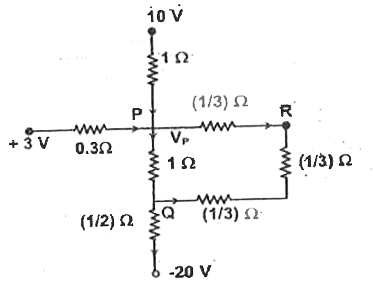 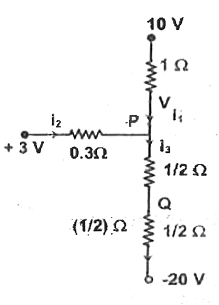 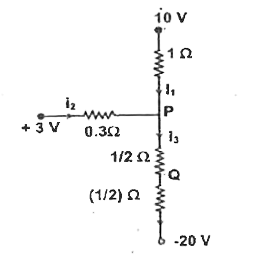 |
|
| 42. |
A steady current is set up in a network composed of wires of equal resistance ond length 'd' as shown in Figure. What is the magnetic field at the centre ? |
| Answer» Solution :By symmetry of the circuit, it is CLEAR that for each current carrying wire there is another wire such that it cancels the field of the first. For e.g. the field at P due to wire AB is CANCELLED by field of wire GF. Field of wire CD is cancelled by wire HE. Similarly, AH and CF, DG and BE, BC and HG, AD and .EF fields are cancelled and THEREFORE net field is zero at .P.. | |
| 43. |
Two concentric spherical conducting shells of radii r and R (r lt R ) carry charges q and Q respectively . The two shells are now connected by a conducting wire. The final charge on the inner shell is |
|
Answer» ZERO The net charge resides on the outer surface of the arrangement . Charge on inner surface is equal to zero. Due to FOLLOWING two reasons. (i) As electric field inside the conductor is zero . Hence there cannot be any net charge inside the conductor. (ii) MUTUAL repulsion. |
|
| 44. |
A pair of stationary and infinitely long bent wires are placed in the x-y plane as shown in Figure. The wires carry cu'rrent of 10 ampere each as shown. The segment L and M are along the x-axis. The segment P and Q are parallel to the Y-axis such that OS = OR = 0.02 m. Find the magnitude and direction of the magnetic induction atthe origin O. |
|
Answer» Solution :Since point 0 is along the length of segments L and M the field at O DUE to these TWO segments will be ZERO `therefore` Magnetic field at O is due to QS and RP. `B_(SQ) = (mu_0)/(4pi) xx (I)/(OS) odot = 10^(-7) xx (10)/(0.02) odot` `B_(RP) = (mu_0)/(4pi)xx(I)/(OR) odot = 10^(-7) xx (10)/(0.02) odot` `therefore B_0 = B_(SQ) + B_(RP) = 10^(-7) xx (10)/(0.02) xx 2 odot` `10^(-4)T odot` |
|
| 45. |
A fainter of the two stars of a binary system revolves around the brighter one in an orbit of semimajor axis 20AU with a period of 35 euars. Calculat the usm of the masses of the two stars of the binary system. |
|
Answer» |
|
| 46. |
(a) Estimate the speed with which electrons emitted from a heated emitter of an evacuated tube impinge on the collector maintained at a potential difference of 500 V with respect to the emitter. Ignore the small initial speeds of the electrons. The specific charge of the electron i.e., its e/m is given to be 1.76xx10^(11)C" "kg^(-1). (b) Use the same formula you employ in (a) to obtain electron speed for an collector potential of 10 MV. do you see what is wrong ? In what way is the formula to be modified ? |
|
Answer» Solution :(a) Here accelerating voltage `V=500V and (e)/(m)` for electrons`=1.76xx10^(11)C " "kg^(-1)` As `eV=(1)/(2)mv^(2)impliesv=sqrt((2eV)/(m))` `therefore v=sqrt(2XX(1.76xx10^(11))xx(500))=1.33xx10^(7)MS^(-1)` (b) If accelerating voltage `V=10MV=10 xx10^(6)V+10^(7)V`, then using same formula as in (a), we GET `v=sqrt(2xx(1.76xx10^(11))xx10^(7))=1.88xx10^(9)ms^(-1)` However, the answerr obtained is wrong because no material particle can ever travel with a speed greater than the speed of light having a value `c=3xx10^(8)ms^(-1)`. The formula for kinetic energy `K=(1)/(2)mv^(2)` is, in fact, valid only when `(v)/(c) LT lt 1.` At high speeds when `v/c` is comparable to 1 (although, it is still below 1), we should apply Einstein.s relativic formula. On applying Einstein.s relativistic formulae, it is found that for 10 MeV energy electron the speed is 99.9% of the speed of light. |
|
| 47. |
A spherical shell and a solid sphere, made up of same material and having same radii, are charged to their maximum capacity. If charges on their surfaces are respectively, q_(1)and q_2 then ...... |
|
Answer» `q_(1) lt q_(2)` `(E_(1))_("max") = (E_(2))_("max") = E.` `therefore (kq_(1))/(R_(1)^(2)) = (kq_(2))/(R_(2)^(2))` `therefore q_(1) = q_(2)` (`therefore` Here `R_(1) =R_(2)`) |
|
| 48. |
Which property of photoelectric particles was discovered from Hertz's experiment? |
| Answer» SOLUTION :PROPERLY of NEGATIVE CHARGE | |
| 49. |
A spherical convex surface separates object and image space of refractive index 1 and 4/3 respectively. If radius of curvature of the surface is 0.1 m, its power is |
|
Answer» 2.5D |
|
| 50. |
(A) : Radio activity is an indication of the instability of nuclei. (R) : Stability of nuclei decided by the ratio of neutron to proton to be around 1 : 1 for light nuclei an for heavy nuclei is 3:2 |
|
Answer» Both .A. and .R. are TRUE and .R. is the CORRECT explanation of .A. |
|