Saved Bookmarks
This section includes 7 InterviewSolutions, each offering curated multiple-choice questions to sharpen your Current Affairs knowledge and support exam preparation. Choose a topic below to get started.
| 1. |
If a cycle wheel of radius 0.4 m completes one revolution in two second, then acceleration in uniform circular motion is, |
|
Answer» `0.4/PI m/s^2` |
|
| 2. |
Compute the typical de Broglie wavelength of an electron in a metal at 27^(@)C and compare it with the mean separation between two electrons in a metal which is given to be about 2 xx 10^(-10) m. |
|
Answer» Solution :`T=27+273=300 K,K_(B)=1.38xx10^(-23)Jmo,^(-1)K^(-1)` `m=9.1xx10^(-31)kg,h=6.63xx10^(-34)JS` DISTANCE between two electron `r=2xx10^(-10)m` `implies` de-Broglie wavelength of electron, `lambda=(h)/(sqrt(3mk_(B)T))` `=(6.63xx10^(-34))/(sqrt(3xx9.1xx10^(-31)xx1.38xx10^(-28)xx300))` `(6.63xx10^(-34))/(sqrt(11302.3xx10^(-54)))` `=(6.63xx10^(-34))/(106.31xx10^(-27))` `=0.06236xx10^(-7)` `~~6.2xx10^(-9)`m `implies` Average distance between two electron in metal, `r=2xx10^(-10)`m `therefore (lambda)/(r)=(6.2xx10^(-9))/(2xx10^(-10))=31` Hence average distance between two electron in atom is 31 times de-Broglie wavelength of electron. |
|
| 3. |
A cylinder rolls without slipping over a horizontal plane. The radius of the cylinder is equal to r. Find the curvature radii of trajectories traced out by the points A and B(see figure) |
Answer» Solution :Let US DRAW the kinematic diagram of the rolling cylinder on the basis of the solution of PROBLEM 1.53.   As, an arbitrary point of the cylinder follows a curve, its normal acceleration and radius of CURVATURE are related by the well known equation `w_n=v^2/R` so, for point A, `w_(A(n))=(v_A^2)/(R_A)` or, `R_A=(4v_c^2)/(omega_r^2)=4r` (because `v_c=omegar`, for PURE rolling) Similarly for point B, `w_(B(n))=(v_B^2)/(R_B)` `omega^2rcos45^@=((sqrt2v_c)^2)/(R_B)`, `R_B=2sqrt2(v_C^2)/(omega^2r)=2sqrt2r` |
|
| 4. |
Radio waves do not penetrate in the bond of |
|
Answer» IONOSPHERE |
|
| 5. |
A concave mirror of 20 cm focal length is immersed into water. What is its new focal length ? |
| Answer» SOLUTION :Focal length of CONCAVE mirror EVEN in WATER is same at 20 cm. | |
| 6. |
There are 10 identical bubls conneted in series across a battery. The rate at which electric energy is consumed is x. Now when only 8 bubls are connected across the same supply then what will be the effect of electric energy consumed? |
|
Answer» Solution :Let R be the resistance of each bulb then power consumption `(P = V^( 2)//R)` can be written as follows: `x= (V^(2))/(10R)` ..(i) Note that total resistance of BULBS is 10R. Now when 8 bulbs are connected then the overall voltage is same but resistance has decreased to 8R. Hence, power consumption BECOMES as follows: `P = (V^(2))/(8R) = (10X)/(8)` Hence power consumption increases to 1.25 times the original amount. |
|
| 7. |
Attenuation of ground waves is due a) Diffraction effect to b) Radio waves induce currents in the ground because of the polarization |
|
Answer» a & B are true |
|
| 8. |
What are Neutrons and nuclides? |
| Answer» SOLUTION :The consituents of nucleus (proton and neutron )are called nucleus .Although the HYDROGEN nucleus consists of a single proton alone, the NUCLEI of other element consists of NEUTRONS and protons .The different types of nuclei are often called nuclides. | |
| 9. |
In a common base mode of a transistor, the collector current is 5.488 mA for an emitter current of 5.60 mA. The values of the base - current amplification factor (beta) will be : |
|
Answer» 48 `BETA = alpha/ (1-alpha) = (0.98)/(1-0.98)=49` |
|
| 10. |
Mass numbers of the elements A,B , C and D are 30,60,90 and 120 respectively. The specific binding energy of them are 5 MeV, 8.5 MeV , 6 MeV and 7 MeV respectively. Then, in which of the following reaction/s energy is released ? (1)Dto2B , (2)C toB +A , (3 )B to2A |
|
Answer» only in (1) |
|
| 11. |
In the formula X=3YZ^(2),X and Z have the dimensions of capacitance and magnetic induction respectively. The dimensions of Y in MKS system are : |
|
Answer» `[M^(-3)L^(-2)T^(-2)A^(-4)]` `:.X=(Q^(2))/(W).` Now `Z=B=(F)/(IL)` `:.Y=(X)/(3Z^(2))=(1)/(3)(Q^(2))/(W)xx(I^(2)L^(2))/(F^(2))=(A^(2)T^(2)A^(2)L^(2))/([ML^(2)T^(-2)][M^(2)L^(2)T^(-4)])` `=[M^(-3)L^(-2)T^(8)A^(4)]` Hence correct choice is `(c ).` |
|
| 12. |
It is found that |A+B| = |A|. This necessarily implies. |
|
Answer» B=0 |
|
| 13. |
Find the ionization energy of a doubly ionized lithium atom. |
|
Answer» |
|
| 14. |
उत्तरी मैदान में किस तरह की मिट्टी पाई जाती है? |
|
Answer» काली मिट्टी |
|
| 15. |
In the Auger process, an atom makes a transition to a lower state without emitting a photon. The excess energy is transfered to an outer electron which may be ejected by the atom. (This is called an Auger electron). Assuming the nucleus to be massive, calculate the kinetic energy of an n=4 Auger electron emitted by Chromium by absorbing the energy form a n=2 to n=1 transition. |
|
Answer» Solution :As the nucleus is massive, RECOIL MOMENTUM of the ATOM can be ignored. We can assume that the entire energy of transition is transferred to the AUGER electron. As there is a single valence electron in chromium (Z=24), the energy states may be thought of as given by Bohr model. The energy of the NTH state is `E_(n)=-(RZ^(2))/(n^(2))` where R is Rydberg constant. In the transition form n=2 to n=1, energy released, `DeltaE=-RZ^(2)(1/4-1)=3/4RZ^(2)` The energy required to ejected a n=4 electron `=RZ^(2)xx(1/4)^(2)=(RZ^(2))/16` `:.` KE a Auger electron=`(3RZ^(2))/4-(RZ^(2))/16` `KE=RZ^(2)(3/4-1/16)=11/16 RZ^(2)=11/16(13.6eV)xx24xx24=5385.6 eV` |
|
| 16. |
हिमालय की सबसे बाहरी श्रृंखला को कहा जाता है ? |
|
Answer» धौलाधार |
|
| 17. |
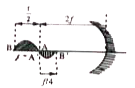
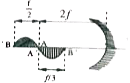
AB is the semi circular object of diameter (f/2) where f is the focal length, placed on the principal axis of a concave mirror with point A at the centre of curvature. A'B' is the image formed . The correct option is (Assume diameter of the object is along principal axis) |
|
Answer» |
|
| 18. |
Dimensions of inductance are ______. |
|
Answer» `therefore` Dimensions of INDUCTANCE `L = ([varepsilon][dt])/([dI])=[ML^(2)T^(-2)A^(-2)]]` |
|
| 19. |
Two resistors with temperature coefficients of resistance alpha_1and alpha_2 have resistances R_1 and R_2 at 0^@C. Find the temperature coefficient of the compound resistor consisting of the two resisters connected in parallel. |
| Answer» SOLUTION :`(R_1 alpha_2 + R_2 alpha_1)/(R_1 + R_2)` | |
| 20. |
Two resistors with temperature coefficients of resistance alpha_1and alpha_2 have resistances R_1 and R_2 at 0^@C. Find the temperature coefficient of the compound resistor consisting of the two resisters connected in series. |
| Answer» SOLUTION :`(R_1 alpha_1 + R_2 alpha_2)/(R_1 + R_2)` | |
| 21. |
A magnetic field is produced by : |
|
Answer» a CHANGING ELECTRIC field |
|
| 22. |
A particle of mass m is located in a unidimensional potential field U(x) whose shape is shown in fig. where U(0)=oo. Find (a) the equation defining the possible values of enrgy of the particle in the region E lt U_(0), reduce taht equation to the from sin kl=+- klsqrt( ħ^(2)//2ml^(2)U_(0)), where k=sqrt(2mE// ħ). Solving this equation by graphical means, domonstrate that hte possible values of energy of the particle from a discontinuous spectrum, (b)the minium value of the quantity l^(2)U_(0) at which the first energy level appears in the region E lt U_(0). At what minimum value of l^(2)U_(0) does the nth level appear? |
Answer» SOLUTION : (a) Starting from the Schrodinger equation in the regions I &II `(d^(2)Psi)/(dx^(2))+(2mE)/( ħ^(2))Psi=0 xi n I`....(1) `(d^(2)Psi)/(dx^(2))-(2mE(U_(0)-E))/ ħ^(2)Psi=0x` in II....(2) where `U_(0) gt E gt 0`, we easily derive the solutions in I &II (3) `Psi_(1)(x)=A sin kx+Bcoskx`....(3) `Psi_(n)(x)=ce^(alphax)+De^(-ax)`....(4) where `k^(2)=(2mE)/( ħ^(2)),alpha^(2)=(2m(U_(0)-E))/(ħ^(2))` The boundary conditions are `Psi(o)=0`....(5) and `Psi &((dPsi)/(dx))` are continous at `x=l`, and `Psi` MUST vanish at `x=+oo` Then `Psi_(I)= A sin kx` and `Psi_(II)=De^(-alpha x)` So `A sin kl=De^(-alpha l)` `kA cos kl= -alpha De^(-alphal)` Frim this we get `tan kl=-(k)/(alpha)` or `sin kl= +-kl//sqrt(k^(2)l^(2)+alpha^(2)l^(2))` `=+-kl//sqrt((2mU_(0)l^(2))/(ħ^(2)))` `=+-kl sqrt(ħ^(2)//2mU_(0)l^(2))` ....(6)  Plotting the left and right siders of this equation we can find the points at which the straight lines cross the sine curve. The roots of the equation corresponding to the eign values of energy `E_(i)` and FOUND from the intersection point `(kl)_(i)`, for which tan `(kl)_(i)lt 0`(i.e., `2^(nd)& 4^(th)` and other even quadrants). It seen that bound states do not always exist. Find the first bound state to appear (refer to the line (B) above) `(kl)_(1,mi n)=(pi)/(2)` (b) Substituting, we get `(l^(2)U_(0))_(1,mi n)=(pi^(2)h^(2))/(8m)` as the conditions for the apperance of the first bound state. The second bound state will appear when `kl` is in fourth quadrant. The magnitude of the slope of the straight line must then be less than `(1)/(3pi//2)` Corresponding `(kl)_(2,mi n)=(3pi)/(2)=(3)(pi)/(2)=(2xx2-1)(pi)/(2)` For `n` bound state, it is easy to convince one self that the slope of the APPROPRIATE straight line (upper or lower) must be less than `(kl)_(n,mi n)=(2n-1)(pi)/(2)` Then `(t^(2)U_(0))_(n,mi n)=((2n-1)^(2)pi^(2) ħ^(2))/(8m)` Do not forget to note that for large `n` both+and -signs in the Eq.(6) contribute to solutions. |
|
| 23. |
Two fly wheels A and B are mounted side by side with frictionless bearing on a common shaft. Their moments of inertia about the shaft are 5.0 kg m^(2) and 20.0 kg m^(2) respectively. Wheel A is made to rotate at 10 revolution per second. Wheel B, initially stationary is now coupled to A with the help of a clutch. The rotation speed of the wheels will become |
|
Answer» `2sqrt(5)` rps `5xx10+20xx0=(5+20)omega` `THEREFORE omega=(50)/(25)=2r.p.s` |
|
| 24. |
Check the correctness of the following state- ments about Bohr model of hydrogen atom (i) The acceleration of the electron n = 2 orbit is more than that in n = 1orbit (ii) The angular momentum of the electron in ,n = 2 orbit is more than that in n = 1 orbit (iii) The K.E. of the electron in n = 2 orbit is less than that in n = 1 orbit. |
|
Answer» All the STATEMENTS are correct |
|
| 25. |
A train is moving with a speed of 54 km/h. A monkey is running on the roof of a train against its motion with a speed of 5 ms. w.ut the train. The velocity of the monkey as observed by a man on the ground is : |
|
Answer» `20 ms^(-1)` vel. Of MONKEY w.r.t to train `v_(m-t)=-5m//s^(-1)` `impliesV_(m)-v_(t)=-5 IMPLIES v_(m)=+10 m//s` `:. V_(m,obs)=v_(m)-v_(obs)=10-0=10 m//s` |
|
| 26. |
Charges 2mC, 4mC and 6mC are placed at the three corners A, B and C respectively of a square ABCD of side x metre. Find, what charge must be placed at the fourth corner so that the total potential at the centre of the square is zero. |
|
Answer» Solution :Let each side of SQUARE = x `AO=BO=cO=DO=sqrt(2)/(2)x` 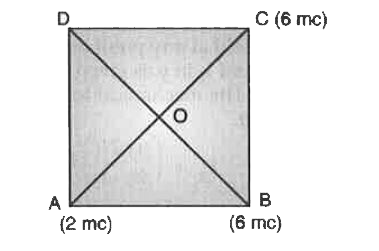 Let q be the charge placed at the centre O `(q_(1))/(AO)+(q_(2))/(BO)+(q_(3))/(CO)+(q_(4))/(DO)=0` `(4xx10^(-3)+8xx10^(-3)+12XX10^(-3)+2Q)/sqrt(2X)=0` `24xx10^(-3)+2q=0` `2q=-24xx10^(-3)` `q=-12xx10^(-3)` C |
|
| 27. |
Two metal spheres, one of radius R and the other of radius 2R, both have same surfac charge density sigma. They are brought in contac and separated. What will be new surface charge densites on them ? |
|
Answer» Solution :Let charges on metal spheres before contact are `Q_(1)` and `Q_(2)` hence `Q_(1)= sigmaxx4 piR^(2)` and `Q_(2)= sigmaxx4 pi(2R)^(2)` `= sigmaxx16piR^(2)` `4 Q_(1)` Let the charges on metal sphere, after coming in contact becomes `Q_(1)`. and `Q_(2)`.. According to law of conservation of charges `Q_(1) +Q_(2)= Q_(1)+Q_(2)` `= Q_(1)+4Q_(1)` `= 5 Q_(1)` ` = 5 (sigmaxx 4PI R^(2))` When metal spheres come in contact they acquire EQUAL potentials. `:. V_(1)=V_(2)` `(kQ_(1))/(R)= (kQ_(2))/(R)` Putting value of `Q_(1)` and `Q_(2)` in above equations `Q_(1) = (5)/(3) (sigmaxx4piR^(2))` and `Q_(2)= (10)/(2)(sigmaxx4pi R^(2))` `:. sigma_(1) = (5)/(3) sigma ` and `sigma_(2)= (5)/(6) sigma` |
|
| 28. |
Explain the difficulties occurred by using galvanometer directly as ammeter. |
Answer» Solution :1. Galvanometer can.t use directly as a ammeter in CIRCUIT. This is for two reasons.  (i) (i) Galvanometer is a very sensitive DEVICE, it gives a full scale deflection for a CURRENT of the order of `muA`. (ii) For measuring currents the galvanometer has to be connected in SERIES and as it has a large resistance, this will change the value of the current in the circuit. Original value `I=V/R` and after connection of G it become `I.=V/(R+G)`. 2. If galvanometer is used to measure the p.d. in the circuit of larger p.d. THIN copper wire of galvanometer is likely to be burnt due to large quantity of produced heat according to `I^(2)Rt`. |
|
| 29. |
Figure shows a rod of length £ resting on a wall and the floor. Its lower end A is pulled towards left with a constant velocity v. Find the velocity of the other end B downward when the rod makes an angle Q with the horizontal |
|
Answer» Solution :In such type of problems, when velocity of one part of a body is given and that of other is required, we first find the relation between the two displacements, thendifferentiate them with respect to time. Here if the DISTANCE from the corner to the point A is x and up to B Then `V=(dx)/(dt)` & `v_(b) =-(dv)/(dt)` (-sign denotes that y is DECREASING) Further `x^(2) + y^(2) =l^(2)` Differentiating with respect to time t `2x(dx)/(dt) + 2y(DY)/(dt) =0, xv=yv_(B)` `v_(B) =(v) x/y =v cot theta` |
|
| 30. |
Prove that , the equivalent or total power for a series combination of a certain number of electrical appliances is less than the power of each of them . Or, prove that , for the different electrical appliances connected in series , power consumption will be lesser for the appliances of higher watt rating . |
|
Answer» |
|
| 31. |
A magnetic needle placed in uniform magnetic field has magnetic moment 6.7 xx 10^(-2) "Am"^(2), and moment of inertia of 15 xx 10^(-6) k m^(2). It performs 10 complete oscillations in 6.70 s. What is the magnitude of the magnetic field ? |
|
Answer» Solution :Dipole moment ` = 6.7 xx 10^(-2) "Am"^(2)` Moment of inertia `I= 15 xx 10^(-6) "KGM"^2` Periodic time T `= ("time")/("No. of oscillations")` `- (6.7)/(10) -0.67` s The period of magnetic needle placed in uniform magnetic field, `T= 2pi sqrt((I)/( MB))` `therefore T^(2) = (4 pi^(2) I)/( mB)` `therefore B= (4PI^(2) I)/( mT^(2) )` `= (4 xx (3.14)^(2) xx 15 xx 10^(-6) )/( 6.7 xx 10^(-2) xx (0.67)^(2) )` `= 196.69 xx 10^(-4)` `therefore B ~~ 0.02` T |
|
| 32. |
What does hitherto mean? |
| Answer» Answer :B | |
| 33. |
Two loudspeakers are being compared. One is preceived to be 32 times louder than the other. The difference in intensity levels between the two, when measured in decibles, is |
|
Answer» 60 |
|
| 34. |
Draw a ray diagram showing formation of image by a magnifying glass when the image is formed at infinity. Find the angular magnification of image. |
Answer» Solution : The RAY diagram has been shown in Fig. 9.48. As shown in FIGURE, the small object of linear SIZE h is placed at the focal plane of magnifying glass and its magnified image is formed at infinity. The object can subtend a maximum angle, when viewed directly without the lens, and be clearly visible when it is at near point of eye. The angle subtended by the object is then  `theta_(0) = tan theta_(0) = h/D` However, when SEEN through the lens, the object is placed at u = - f distance from eye. Hence, angle subtended by the image is same as angle subtended by object at distance u. THUS, `theta_(i) = tan theta_(i) = h/f` `therefore` Angular magnification `=theta_(1)/theta_(0) =(h//f)/(h//D)= D/f` |
|
| 35. |
A galvanometer having 30 divisions has current sensitivity of 20 mu A // division. It has a resistance of 25 ohm. How will you convert it into an ammeter measuring upto 1 A ? How wil you nowconvert this ammeter into a voltmeter reading upto 1 V ? |
|
Answer» Solution :The full scale deflection current `i_g = 30 XX(20 xx 10^(-6))` `= 6 xx 10^(-4)A.` It S is the required value of the SHUNT connected in parallel with the galvanometer, then `i_g = (S)/(S+G) i or 6 xx 10^(-4) = (S)/(S +25) xx 1` After solving , we get `S = (150)/(9994) Omega = 0.0150 Omega` The resistance of the ammter `R_A = (SG)/(S+G) = (0.0150 xx 25)/(0.0150+ 25) = 0.0150 Omega` To convert this ammeter into the voltmeter , we can use `V = i_(g) (R_A + R_0)` Here `V = 1V, i_g = 1A` `THEREFORE 1 = 1(0.0150 + R_0) or R_0 = 0.985 Omega` |
|
| 36. |
Choose the correct alternative corresponding to the object distance 'u', image distance 'v' and the focal length 'F' of a converging lens from the following . The average speed of the image as the object moves with the uniform speed from distance (3F)/(4) to (F)/(2) is greater than the average speed of the image as the object moves with same speed from distance (F)/(2) "to" (F)/(4)The minimum distance between a real object and its real image in case of a converging lens is 4F where F is its focal length. |
|
Answer» both are CORRECT |
|
| 37. |
Three.condensers of capacity 4 mF, 2 mF and 3mFare connected such that 2 mF and 3 mF are in series and 4 mF is parallel to them. The equivalent capacity of the combination is |
| Answer» ANSWER :B | |
| 38. |
An a.c. source, of voltage V =V_(m) sin omega t , is applied across a series LCR circuit. Draw the phasor diagram for the circuit when the (i) capacitive reactance exceeds the inductive reactance, (ii) inductive reactance exceeds the capacitive reactance. |
|
Answer» Solution :(i) PHASOR diagram for the SERIES LCR a.c. circuit when capacitive REACTANCE `X_( c)` exceeds the inductive reactance `X_( L)` is shown in Fig. 7.22(a). Here voltage `VECV`lags behind the current `vecL`by a phase angle `phi`. (ii) The phasor diagram, when `X_(L) gt X_(C)`has been shown in Fig. 7.22(b). Here voltage `vecV`LEADS the current l by a phase angle 
|
|
| 39. |
Which phenomenon is NOT experienced by sound waves? |
|
Answer» Reflection |
|
| 40. |
Answer the following questions, which help you to understand the difference between Thomson's model and Rutherford's model better.a. Is the average angle of deflection of a-particles by a thin gold foil predicted byThomson's model much less, about the same, or much greater than that predicted by Rutherford's model? b. Is the probability of backward scattering (i.e., scattering of a-particles at angles greater than 90^@) predicted by Thomson's model much less, about the same, or much greater than that predicted by Rutherford's model? c. Keeping other factors fixed, it is found experimentally that for small thickness t, the number of alpha - particles scattered at moderate angles is proportional to t.What clue does this linear dependence on t provide? d. In which model is it completely wrong to ignore multiple scattering for the calculation of average angle of scattering of alpha particles by a thin foil? |
|
Answer» Solution :a. About the same b. Much LESS c. It suggests that the scattering is PREDOMINANTLY due to a single COLLISION, because the • chance of a single collision INCREASES linearly with the number of target atoms, and hence linearly with thickness. d. In Thomson.s MODEL, a single collision causes very little deflection. The observed average scattering angle can be explained only by considering multiple scattering. So it is wrong to ignore multiple scattering in Thomson.s model. In Rutherford.s model, most of the scattering comes through a single collision and multiple scattering effects can be ignored as a first approximation. |
|
| 41. |
The equation 4H^(+) rarr _(2)^(4) He^(2+) + 2e bar + 26 MeV represents |
|
Answer» `BETA`-decay |
|
| 42. |
Unpolarized light of intensity 32Wm^(-2) passes through three polarizers such that the transmission axis of the last polarizer is crossed with the first. If the intensity of the emerging light is 3 Wm^(-2), what is the angle between the transmission axes of the first two polarizers? At what ange will the transmitted intensity be maximum? |
|
Answer» Solution :If `theta` is the angle between the transmission axes of first polaroid `P_1` and second `P_2` while `phi` between the transmission axes of second polaroid `P_2` and third `P_3`, then according to given PROBLEM. `theta+ phi= 90^(@)" or "phi= (90^(@)-theta)""".........."(i)` Now if `I_(0)` is the intensity of unpolarized LIGHT incident on polaroid `P_(1)`, the intensity of light transmitted through it, `I_(1)= (1)/(2)I_(0)= (1)/(2)(32)= 16(W)/(m^2)"""............"(ii)` Now as angle between transmission axes of polaroids `P_1" and "P_(2)` is `theta P_(2)" and "P_(3)` is `phi`, light transmitted through `P_3` will be `I_(3)= (I_0)/(2) cos^(2) theta* cos^(2) 90-theta= (I_0)/(8)sin^(2) 2theta` According to given proble, `I_(3)= 3 W"/"m^(2)` So, `4(sin 2 theta)^(2)= 3` `i.e., sin 2theta= (SQRT(3)"/"2)" or "2theta= 60^(@) i.e., theta= 30^(@)`. |
|
| 43. |
A myopic person can see things clearly lying between 8 cm and 100 cm from his eyes. The lens which enables his to see the moon should have a focal length of : |
|
Answer» `+ 100 CM` |
|
| 44. |
About 5% of the power of a 100 W light bulb is converted to visible radiation. What is the average intensity of visible radiation (a) at a distance of 1m from the bulb? (b) at a distance of 10 m? Assume that the radiation is emitted isotropically and neglect reflection. |
|
Answer» SOLUTION :(a) `0.4 W//m^(2)`, (B) `0.004 W//m^(2)` |
|
| 45. |
The equation of S.H.M. waves is given by y = 4 sin x (t/0.02 - x/75) in C.G.S. units then its amplitude, frequency and wavelength respectively are given by |
|
Answer» 4 CM, 0.02 HZ , 75 cm |
|
| 46. |
Lencho was A Negative Person. |
|
Answer» 1Maybe True |
|
| 47. |
In the circuit shown, the potential drop across each capacitor is (assuming the two diodes are ideal) |
Answer» Solution :The diode `D_(1)` is reverse biased (open circuit), but the diode `D_(2)` is forward biased (short circuit).  `THEREFORE` the potential of the battery divides ACROSS the TWO capacitors in the inverse ratio of their capacities. i.E. `(V_(1))/(V_(2))=(C_(2))/(C_(1))=(8)/(4)=(2)/(1)` `V_(1)=(2)/(3)E=(2)/(3)xx24=16V,V_(2)=(1)/(3)E=(1)/(3)xx24=8V` |
|
| 48. |
Three uncharged capacitors are connected across a battery as shown. It is known that the energy stored in all the capacitors is same. Which of the following is not correct? |
|
Answer» `C_(1)=4C_(2)` |
|
| 49. |
Poisson's ratio of a material is 0.5 percentage change in its length is 0.04% . What is change in percentageof diameter? |
|
Answer» `0.04%` `THEREFORE (L)/(L) =0.04%` `SIGMA =(d//D)/(l//L)` `therefore (d)/(D) = s XX (l)/(L) = 0.5 xx 0.04 =0.020%` |
|
| 50. |
A long rectangular slab of transparent medium of thickness 'd' placed on a table with its length parallel to the x-axis and width parallel to the y-axis. A ray of light travelling in air makes a near normal incidence on the slab as shown. Taking the point of incidence as origin (0,0,0). The refraction index mu of the medium varies as mu = (mu_0)/(1 - (x/r)),where mu_1 andr( > d) are constants. The refractive index of air is m_0The subsequent path of the ray after it meets the upper surface of the slab air boundary is |
|
Answer» the ray retraces its path |
|