

Saved Bookmarks
This section includes 7 InterviewSolutions, each offering curated multiple-choice questions to sharpen your Current Affairs knowledge and support exam preparation. Choose a topic below to get started.
| 1. |
For the following situation of (a) and (b), current is same. Statement-1: In case of figure (a) and (b) oint vec(B) d vec(l) for two loops shown will be different. Statement-2: In case of figure (a) and (b) magnitude of magnetic field at similar points on amperian loop may be different. |
|
Answer» Statement-1 is TRUE, statement-2 is true and statement-2 is correct explanation for statement-1. |
|
| 2. |
Calculate the electric field due to a dipole on its axial line and equatorial plane. |
Answer» Solution :Case (i) ELECTRIC field due to an electric dipole at points on the axial line . Consider an electric dipole placed on the x-ax is as shown in figure . A point Cis located at a distancefo r from the midpoint O of the dipole along the axial line . The electric field at a point C due to + q is 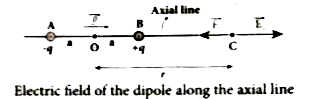 `vecE=(1)/(4piepsilon_(0))(q)/((r-a)^(2))` along BC Since the electric dipole mometn vector `vecp` is from -q is from -q to +q and is drected along BC the above equation is rewritten as `vecE_(+) =(1)/(4piepsilon_(0))(q)/((r-a)^(2)) hatp` where `hatp` is the electric dipole moment unit vector from -q to +q . The electric field at a point C due to -q is `vecE_(-)=-(1)/(4piepsilon_(0))(q)/((r+a)^(2)) hatp` Since +q is located closer to the point C than -q , `vecE_(-).vecE_(+)` us stronger than `vecE` . Therefore the length of the `vecE_(+)` vector is drawn large than that of `vecE_(-)` vector . The total electric field at point C is calculate using the superposition principle of the electric field . `vecE_("tot")=vecE_(+)vecE_(-)` `=(1)/(4piepsilon_(0))(q)/((r-a)^(2))hatp-(1)/(4piepsilon_(0))(q)/((r-a)^(2))hatp implies vecE_("tot")=(1)/(4piepsilon_(0))((1)/((r-a)^(2))-(1)/((r-a)^(2)))hatp` `vecE_("tot")=(1)/(4piepsilon_(0))q((4ra)/((r^(2)-a^(2))^(2)))hatp` Note that the total electric field is along `vecE_(+)` since +q is closer to C than -q . 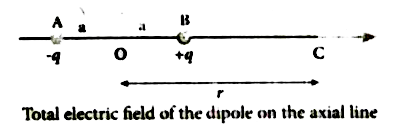 The direction of `vecE_("tot")` is shown in Figure If the point C is very far AWAY from the dipole then `(r gtgt a)` . Under this LIMIT the term `(r^(2)-a^(2))^(2)z r^(4)` . Substituting this into equation we GET `vecE_("tot")=(1)/(4piepsilon_(0))((4aq)/(r^(3)))hatP ( r gt gt a) ` since 2 aq `hatp=vecp` `vecE_("tot")=(1)/(4piepsilon_(0))(2vecp)/(r^(3)) "" (r gt gt a)` If the point C is chosen on the left side of the dipole the total electric field is still in the direction of `vecp` . Case (ii) Electric field due to an electric dipole at a point on the equatorial plane Consider a point C at a distance r from the midpoint O of the dipole on the equatorial plane as shown in Figure. Since the point C is equi -distant from +q and -q the magnitude of the electric fields of +q and -q are the same . The direction of `vecE_(+)` is along BC and the direction of `vecE_(-)` is along CA. `vecE_(+) ` and `vecE_(-)` are resolved into two components one component parallel to the dipole axis and the other perpendicular to it . The perpendicular components `|vecE_(+)| sin theta` and `|vec_(-)|sintheta` are oppositely directed and cancel each other . The magnitude of the total electric field at point C is the sum of the parallel components of `vecE_(+)`and `vecE_(-)` and its direction is along `-hatP` `vecE_("tot")=-|vecE_(+)|costheta hatp-|vecE_(-)|costhetahatp "" cdots(1)"" cdots(1) ` The magnitudes `vecE_(+)` and `vecE_(-)` are the same and are given by `|vecE_(+)|=|vecE_(-)|=(1)/(4piepsilon_(0))(q)/((r^(2)+a^(2))) ""cdots (2)` By substituting equation (1) into equation (2) we get `vecE_("tot")=-(1)/(4piepsilon_(0))(2qcos theta)/((r^(2)+a^(2)))hatp=-(1)/(4piepsilon_(0))(2qa)/((r^(2)+a^(2))^((3)/(2)))hatP"" "since cos " theta (q)/(sqrt(r^(2)+a^(2)))` At very large DISTANCES `(r gtgta )` the equation becomes `vecE_("tot")=-(1)/(4piepsilon_(0))(P)/(r^(3))( r gtgta)` 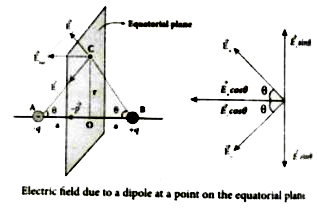
|
|
| 3. |
a-d Complete the following table, which referes to the generalized fission reaction ""^(235)U+ntoX+Y+bn. |
|
Answer» |
|
| 4. |
Two identical charged spheres suspended from a common point by two massless strings of length I are initially a distance d(dltlt1) apart because of their mutual repulsion. The charge begins to leak from both the spheres at a constant rate. As a result the charges approach each other with a velocity v. Then as a function of distance x between them, |
|
Answer» `V ALPHA X^(-1)` |
|
| 5. |
Alloys used to make standard resistors have a low value of_____but a high value of _____. |
| Answer» SOLUTION :TEMPERATURE COEFFICIENT of RESISTANCE, RESISTIVITY | |
| 6. |
(A) :Sometimes HF waves can also pass through ionosphere. (R) : The sky wave propagation depends on the vertical angle with which the radio waves are radiated from the antenna. |
|
Answer» Both 'A' and 'R' are TRUE and 'R' is the CORRECT explanation of 'A'. |
|
| 7. |
An a.c source of original frequency omega is applied to a series resonant, L,C,R circuit. If the resonant frequency is omega_0 then the current in the circuit will lag behind the voltage if: |
|
Answer» `OMEGA=omega_0` |
|
| 8. |
Four resistors P.Q, R and X whose values are 2,2,2 and 3 ohms respectively are joined to form a Wheatstone Bridge. Calculate the value of resistance with which the resistance X must be shunted in order that the bridge may be balanced. |
| Answer» SOLUTION :`6 OMEGA` | |
| 9. |
The voltage stabilizer S is a device whose idealized characteristic is depicted in Fig. 26.21. The voltage stabilizer is connected in series with a normal resistor R to the power supply whose e.m.f. is epsi. Neglecting the internal resistance of the power supply find the current in the circuit and the voltage drop across the voltage stabilizer and the resistor. |
|
Answer» (b) When the e.m.f. of the battery EXCEEDS the firing potential of the voltage stabilizer, its resistance drops to zero and the current in the circuit is determined by the resistance of the resistor and the DIFFERENCE between the e.m.f. and the firing potential of the voltage stabilizer. |
|
| 10. |
A circular tube of radius R and across- sectional radius r(r lt lt R) is filled completely with iron balls of th radius rho. Iron balls just fitting into the tube . The tension in the tube when it is rotated about its axis perpendicular to its plane with angular velocity omega |
|
Answer» `4/3pirhoomega^2r^3R` |
|
| 11. |
At what angle two vectors of magnitudes vec(A) + vec(B) and A - B act, so that their resultant is sqrt(3A^2 +B^2) ? |
| Answer» ANSWER :C | |
| 12. |
Statement A : If the antenna is vertical the vertically polarized em wave is radiated Statement B : The vertically polarized em wave has electrical variations in the vertical plae |
|
Answer» A is TRUE but B is FALSE |
|
| 13. |
A short bar magnet placed with its axis at 30^@ with an extemal field of 800 G experiences a tunque of 0.016 Nm, (a) What is the magnetic moment of the magnet? (b) What is the work done in moving it from its most stable to most unstable position? (c) The bar magnet is replaced by a solenoid of cros B-sectional area 2 xx 10^(-4) m^(2) and 1000 tums, but of the same magnetic moment. Determine the current flowing through the solenoid. |
|
Answer» Solution :(a) From Eq. (5.3). `tau =m B sin theta, theta= 30^@,` HENCE `sin theta=1//2.` THUS, `0.016 = m xx (800 xx 10^(-4)T) xx (1//2)` `m =160 xx 2//800 = 0.40Am^(2)` (b) From Eq. (5.6). the most stable position is `0 = 0^@` and the most unstable position is `theta= 180^@.` Work done is given by `W=U_(m) (theta-180^(@))-U_(m) (theta=0^(@))` `=2MB =2 xx 0.40 xx 800 xx 10^(-4)=0.064J` (c) From Eq. (4.30) `m_(s)=N//A`. From part (a), `m_(s)=0.40 Am^(2)` `0.40=1000 xx l xx 2 xx 10^(-4)` `I=0.40 xx 10^(4)//(1000 xx 2)=2A` |
|
| 14. |
Draw a labelled ray diagram of a refracting telescope. Define its magnifying power and write the expression for it. Write two important limitations of a refracting telescope over a reflecting type telescope. |
Answer» Solution :Refracting telescope : 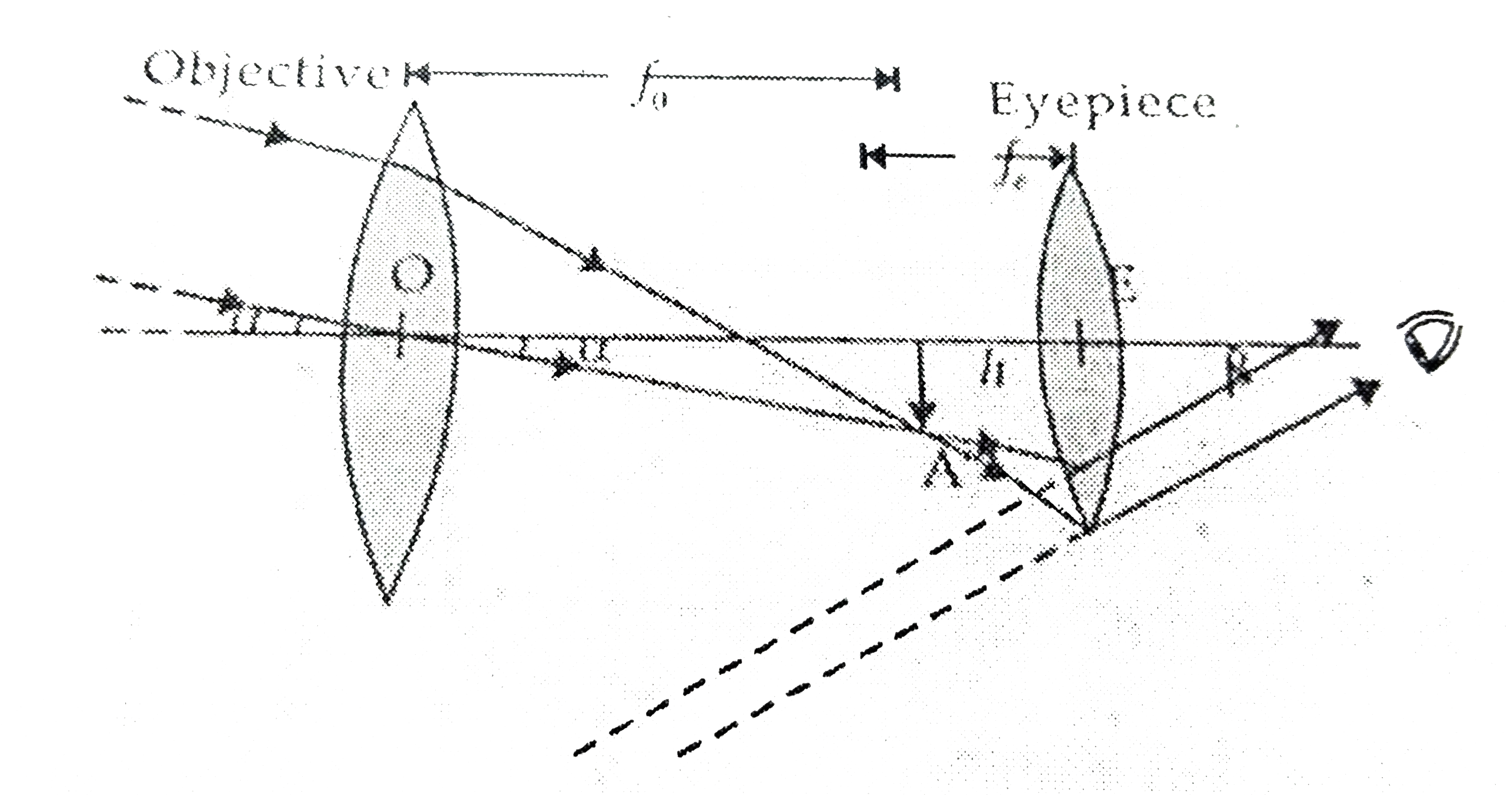 Magnifying POWER: The magnifying power is in the ratio of the angle `ALPHA` subtended at the EYE by the final image to the angle `beta` which the object subtends at the lens or the eye. `m ~~ (beta)/(alpha) ~~ (h)/(f_(E)).(f_(0))/(h)=(f_(0))/(f_(e))` Limitations of refracting telescope over reflecting type telescope - (i) Refracting telescope suffers from chromatic aberration as it USES large sized lenses. (ii) The requirements of big lenses tend to be very heavy and therefore difficult to make and support by their edges. |
|
| 15. |
A motor vehicle travelled the first 1/3 of a distance s lit a speed of v_(2)=20 kmph and the last 1/3 at a speed of v_(3)=10kmph.Determine the mean speed of the vehicle over the entire distance is. |
|
Answer» Solution :`v_(1)`=10kmph,`v_(2)`=20,`v_(3)`=60,V=? `(3)/(v)=(1)/(v_(1))+(1)/(v_(2))+(1)/(v_(3)),(3)/(v)=(1)/(10)+(1)/(20)+(1)/(20)+(1)/(60)=0.1+0.05+0.016` `therebore V=(3)/(0.166)`=18 kmph |
|
| 16. |
The forward biased diode connection is : |
|
Answer»
|
|
| 17. |
If the length of a simple pendulum is bei ng increased by 4-fold, time period ofoscillation will be |
|
Answer» |
|
| 18. |
The surface tension of a soap solution is 30 dyne/cm. A soap bubble made from this solution has a radius of 1cm. What is the work done in doubling the radius of the soap bubble? |
|
Answer» Solution :For a spap BUBBLE, we multiply the area by 2, as there are TWO free SURFACES T = dw/dA `therefore dw = T XX dA xx 2 = T xx 4PI (4r^2 - r^2) xx 2` `dw = 24pir^2T = 24 xx 3.142 xx 1^2 xx 30` = 2262 ergs. |
|
| 19. |
An isolated particle of mass m is moving in horizontal plane along the x - axis at a certain height above the ground. It suddenly explodes into two fragments of masses m/4 and (3m)/4. At an instant the smaller fragment is y=+15 cm . The larger fragment, at this instant is at |
Answer» Solution :As `vecF_(y)=0, DeltavecP_(y)=0, vecP_(y) = vecP_(yf)`  `vecP_(yi) =0, therefore m_(i) vecV_(y) + m_(2) vecV_(y2)=0, m_(1)vecy_(1) =-m_(2)vecy_(2)` `y_(2) =-(m/4 XX 15)/(3m//4),y_(2) = -5 cm` |
|
| 20. |
The path of a projectile is given by the equation y = ax – bx^(2), where a and b are constants and x and y are respectively horizontal and vertical distances of projectile from the point of projection. The maximum height attained by the projectile and the angle of projection are respectively. |
|
Answer» `(2A^2)/(B), tan^(-1) (a)` |
|
| 21. |
For the ground state, the electron in the H-atom has an angular momentum =h, according to the simple Bohr model. Angular momentum is a vector and hence there will be infinitely many orbits with the vector pointing in all possible directions. In actually, this is not true. |
|
Answer» because Bohr MODEL gives incorrect values of angular momentum |
|
| 22. |
An ideal gas is enclosed in a cylinder fitted with a frictionless piston. The piston is connected with a light rod to one plate of capacitor whose other plate is fixed as shown. Initially volume of the gas inside the cylinder is V_0Atmospheric pressure is P_0separation between the plates is L, area of the piston as well as of the capacitor plates is A and emf of battery is epsilon .A heater supplies heat to the gas so that pressure of the gas is given as P=P_(0)-("n"epsilon_0epsilon^2)/L^2when piston is displaced by a distance L/2 . Find value of n. |
|
Answer» |
|
| 23. |
What is the equivalent capacitance of the system of capacitor between A & B |
|
Answer» `7/6C` |
|
| 24. |
Kirchhoff's first law is based on |
|
Answer» LAW of CONSERVATION of energy |
|
| 25. |
A concavo-convex lens has an index of refraction 1.5 and the radii of curvature of its surface are 10 cm and 20 cm. The concave surface is upwards and it is filled with an oil of refractive index 1.6. Calculate the focal length of the oil-glass combination. |
|
Answer» Solution :for theglass lens`(1)/(F)= (mu-1) [(1)/(R_1)-(1)/(R_2)]` Here`R_1= 10 cm, R_2= 20 cm andmu = 1.5` `(1)/(f_1) = (1.5 -1) [(1)/(10 cm) - (1)/(20 cm)]=(1)/(40 cm )` FORTHE oillens ` (1)/(f_2) =(mu-1) [(1)/(R_1) - (1)/(R_2)]` Here ` R_1= 20 cmR_2= ooandmu =1.6 ` ` (1)/(f )= (1.6-1)[(1)/(20 cm) - (1)/(OO)] = (3)/(100 cm)` Forthe OIL- glasscombination `(1)/(f)=(1)/(f_1) +(1)/(f_2)= (1)/(40 cm ) +(3)/( 100 cm ) =(11)/(200 cm )` `thereforef=18.2cm ` |
|
| 26. |
Find the charge that will flow through the wire A and B if the switch S is closed. The capacitance of each capacitance of each capacitor shown in the figure is C. |
Answer» Solution :d. Charge flowing from `A` to `B` : 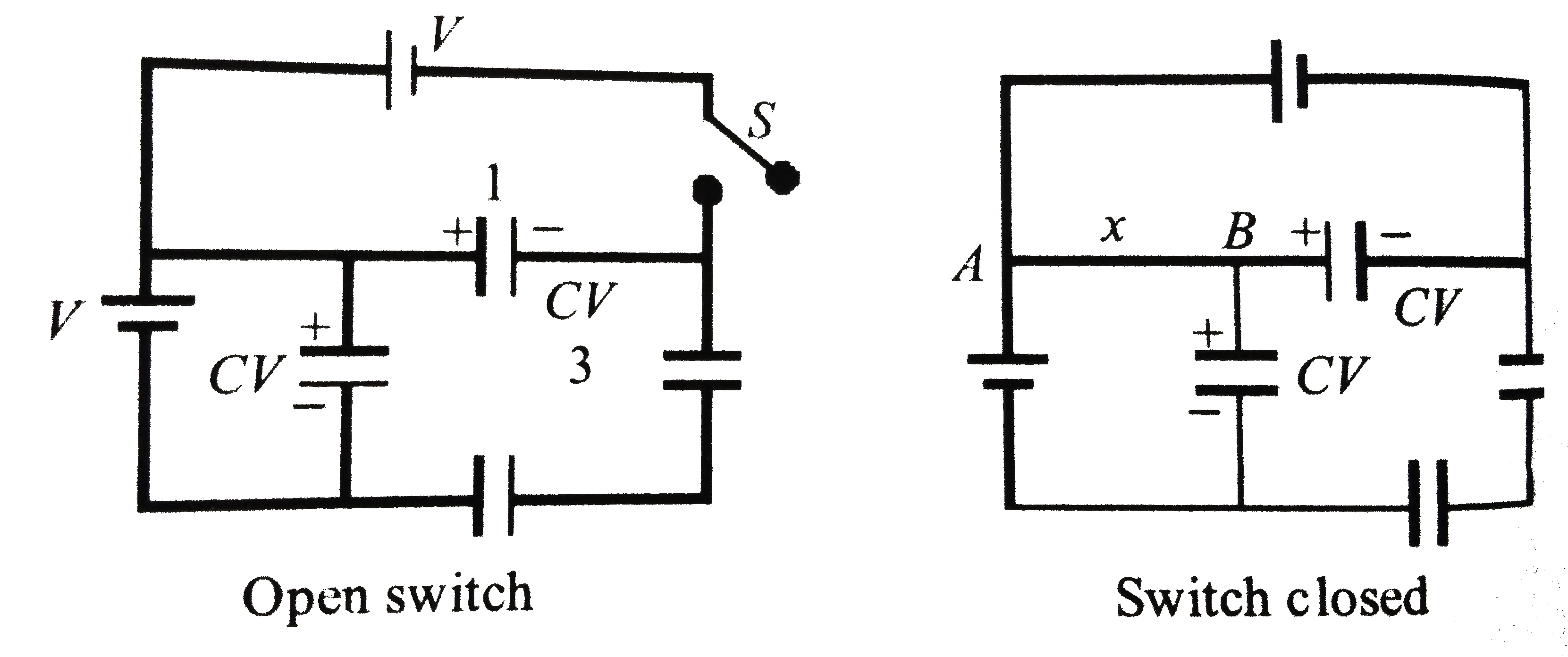 `X=` change in charge on capacitor `1` `=CV-(CV)/(3)=(2CV)/(3)` |
|
| 27. |
The resultant of two forces is 20/3 N. If one of the force is 20 N and makes an angle of 30° with the resultant, the other force has a mangitude: |
|
Answer» 10 N :.` Fcos 30^(@) = F_(1) +F_(2) cos theta`  `implies20sqrt3xx(sqrt3)/(2)=20+F_(2)costheta=10` `impliesF_(2)costheta=10...(i)` Along y-direction`Fsin30^(@)=F_(1)cos90^(@)+F_(2)sintheta` `20sqrt3xx(1)/(2)=0+F_(2)sintheta` `impliesF_(2)sintheta=10sqrt3...(ii)` Squaring and adding (i) and (ii) `F_(2)^(2)(cos^(2)theta+sin^(2)theta)=100+300` `F_(2)=20N` HENCE correct choice is (d). |
|
| 28. |
Light is incident on the cathode ofa photocell and the stopping voltages are measured for light of two different wavelengths, are given below. a. Determine the work function of the metal of the cathode in eV. b. Find the value of the universal constant (hc)/(e ). c. Define stopping potential and work function. d. Can you suggest a mathematicalrelation between kinetic energyand stopping potential? |
|
Answer» Solution :a. `(hc)/(lambda)=phi_(0)+eV_(0)""` Ans. 2.3 eV B. `1.24xx10^(-6)` c. If the applied potential is negative, the photoelectric current decreases and becomes zero for a certain negative value. This value of potentialis called stopping potential or cut-off potential. The MINIMUM amount of work required to emit electrons from a METAL surface is called work FUNCTION. d. `eV_(0)=K_("max")` |
|
| 29. |
The linear speed of an electron in Bohr's orbit is given by: |
|
Answer» `e^2/h` |
|
| 30. |
p-type semiconductor is formed when …….. (A) As impurity is mixed in Si. (B) Al impurity is mixed in Si. (C ) B impurity is mixed in Ge. (D) P impurity is mixed in Ge. |
|
Answer» A and C |
|
| 31. |
The medium in which the speed of light is half of the speed in air, if light travels from such medium to air, then for what angle of incidence light will do total internal refelction ? |
|
Answer» Solution :Refractive index `n=c/v=(c)/(c//2)=2` ACCORDING to total internal REFLECTION, `I gt C` `thereforesini gt SIN C` `thereforesin gt 1/n` `thereforei gt sin^(-1)(1/2)` `thereforesini gt1/2` `therefore I gt 30^@` |
|
| 32. |
The magnetic potential and magnetic induction at a distance along the axis of a short magnet are 900 J/A.m and 1800 Wb/m^2 respectively then that distance is : |
|
Answer» 2 m |
|
| 33. |
All the particles of gas are |
|
Answer» PERFECT INELASTIC spheres |
|
| 34. |
The speaker of a public address system emits 20 kW power, considering it a point source. What is the sound intensity level at a point 4.00 m away? |
|
Answer» 100 dB |
|
| 36. |
Stress is measured in the same units as that of |
|
Answer» force |
|
| 37. |
In the circuit shown in the figure R = 50 Omega, E_(1) = 25 sqrt(3) volt and E_(2) = 25 sqrt(6) sin omega t volt where omega = 100 pi s^(-1). The switch is closed at time t = 0 and remains closed for 14 minutes, then it is opened. Find the value of the direct currentds that will produce same amount of heat in the resistor in same time as combination of DC source and AC source produce. Specific heat of water = 4200 J//kg-^(@)C. |
|
Answer» `1.23 A` |
|
| 38. |
In the circuit shown in the figure R = 50 Omega, E_(1) = 25 sqrt(3) volt and E_(2) = 25 sqrt(6) sin omega t volt where omega = 100 pi s^(-1). The switch is closed at time t = 0 and remains closed for 14 minutes, then it is opened. If total heat produced is usedd to raise the temperature of 3 kg of water at 20^(@)C, what would be the final temperature of water ? |
|
Answer» `15^(@)C` |
|
| 39. |
What pressure can a spherical steel container withstand, if its internal radius is R and the wall thickness is d? Do calculations for R = 50 cm, d = 5 mm. |
|
Answer» elastic force `Delta T = sigma DeltaS = sigma d Deltal` ACTS on an element of area `Delta S = d Delta l` on the periphery of this segment. The normal COMPONENT of the elementary force is `DeltaT_n = DeltaT sin alpha = sigma d Deltal alpha`. SUMMING over the completo circumference of the segment, we obtain the total force of the normal pressure: `T_n = sigma d . 2 pi alpha sin alpha = 2 pi sigma Rd sin^2 alpha` This force compensates the force of the gaseous pressure `F = pS` ACTING on the segment. For a small angle the segment.s area is `S = pi a^2 = pi R^2 sin^2 alpha`, and the force of pressure is `F = pi p R^2 sin^2 alpha.` It follows from the balance of forces that `p = 2 sigma d//R`. 
|
|
| 40. |
The work function for metals A,B and C are respectively 1.92 eV, 2.0 eV and 5.0 eV. According to Einstein's equation, the metals which will emit photoelectrons for a radiation of wavelength 4100 Å is/are |
|
Answer» NONE of these `E=(hc)/(elamda)=(6.63xx10^(-34)xx3xx10^(8))/(1.6xx10^(-19)xx4.1xx10^(-7))=3.03eV` As work functions for metals A and B are 1.92 eV and 2.00 eV RESPECTIVELY and are less than the energy of incident photon, hence metals A and B will EMIT photoelectrons. |
|
| 41. |
If the total number of neutrons and protons in a nuclear reaction is conserved how then is the energy absorbed or evolved in the reaction ? |
| Answer» Solution : The TOTAL BINDING energy of nuclei on TWO sides need not be equal. The difference in energy APPEARS as the energy released or ABSORBED. | |
| 42. |
The internal resistance of a 2.1 V cell which gives a current of 0.2 A through a resistance of 10Omega is: |
|
Answer» `1.3Omega` |
|
| 43. |
Two plane mirrors are at right angles to each other. A man stands between them and combs his hair with his right hand. In how many of the images will he be seen using his right hand |
|
Answer» None |
|
| 44. |
In a nuclear reactor |
|
Answer» cadmium rods are used to slow down the NEUTRONS |
|
| 45. |
What is the shape of the wavefront on earth for sunlight? |
Answer» Solution : As shown in the figure, when a wavefror EMITTED from SUN reaches EARTH at a very lon DISTANCE it seems to be almost planar whe observed locally in a finite region. Hence the become plane wavefronts. |
|
| 47. |
A current carrying loop is free to turn in a uniform magnetic field. The loop will then come into equilibrium vhen its plane is inclined at |
|
Answer» `0^(@)` to the direction of the field |
|
| 48. |
A force is applied for a duration of 10sec on a body of mass 5kg that is at rest. As a result the body acquires a velocity of 2ms^(-1). Find the magnitude of the force applied. |
|
Answer» |
|
| 49. |
The electrical conductivity of a semiconductor increases when e.m . Radiation of wavelength shorter than 2480 nm is incident on it . The band gap in (eV) for semiconductor is : |
|
Answer» 0.5 `=(hc)/LAMDA=(6.62xx10^(-34)xx10^8)/(2480xx10^(-9)xx1.6xx10^(-9))~~0.5eV` |
|
| 50. |
In context of Doppler's effect in light , the term 'red shift' signifies |
|
Answer» DECREASES in frequency |
|



