Saved Bookmarks
This section includes 7 InterviewSolutions, each offering curated multiple-choice questions to sharpen your Current Affairs knowledge and support exam preparation. Choose a topic below to get started.
| 1. |
Two large, thin metal plates are parallel and close to each other. On their inner faces, the plates have surface charge densities of opposite signs and of magnitude 17.0xx10^(-22) C//m^(2). What is E : in the outer region of the first plate, |
| Answer» SOLUTION :`10MU C//m` | |
| 2. |
A ball is projected vertically upward with an initial velocity. Which of the following graphs best represents the K.E. of the ball as a function of time from the instant of projection till it reaches the point of projection : |
|
Answer»
|
|
| 3. |
Which of the following has same dimension as that of planck's constant? |
|
Answer» Force `therefore H=(E )/(v)` `therefore [h]=([E])/([v])=([M^(1)L^(2)T^(-2)])/([M^(0)L^(0)T^(-1)])=[M^(1)L^(2)T^(-1)]` |
|
| 4. |
In Young's double-slit experiment, coordinate system is selected in such a manner that Y-coordinate of central maximum is 1cm and the same for 9^(th) maximum is 9 cm. If the entire set-up is immersed in a fluid with refractive index 4/3, then what will be new Y-coordinates of central maximum and 9^(th) maximum? |
|
Answer» 1 CM , 9 cm Further we know that wavelength becomes `lambda//MU` on immersing in liquid and hence fringe width will also be divided by `mu` because fringe width is proportional to `lambda`. Similarly DISTANCE between `9^(th)` maximum and central maximum which is 8 cm will also be divided by `mu`. Hence new Y-coordinate of `9^(th)` maximum can be written as follows: `Y = 1 + (9 -1)/(4//3) = 7 cm`. |
|
| 5. |
What is ozone hole |
|
Answer» HOLE in the OZONE LAYER |
|
| 6. |
A cell of e.m.f E is connected to a resistance R_1 for time i and the amount of heat generated in it is H. If the resistance R_1 is replaced by another resistance R_2 and is connected to the cell for the same time i, the amount of heat generated in R_2 is 4H. Then the internal resistance of the cell is |
|
Answer» `(2R_1 +R_2)/(2)` ` H=(E^2 R_1)/( (R_1 +r ^2 ) t`   `orE^2=(H (R_1+r)^2)/(R-1 t)` forsecondcaethe amountof heatgeneratedin `R_2`in thesametime t is ` 4 H = (E^2R_2 t)/( (R_2 +r)^2 )orE^2 =(4 H( R_2 +r)^2)/( R_2 t)` EQUATING(i) and (ii ) we GET ` (H (R_1+r)^2)/( r_1 t) =(4 H( R_2+r)^2)/(R_2 t)` `((R_1 +r)^2)/( R_1) =(4 (R_2 +r)^2 )/( R_2)or((R_1 +r))/(sqrt(R_1)) = (2 (R_2 +r))/(sqrt(R_2))` `impliessqrt(R_2) (R_1 +r) = 2 sqrt(R_1) (R_2 +r)` ` impliessqrt(R_2) R_1 + sqrt(R_2 ) r = 2 sqrt(R_1) R_2 + 2 sqrt( R_1)r` `IMPLIES sqrt(R_2 ) r-2sqrt(R_1 ) r=2 sqrt(R_1)R_2- sqrt(R_2)R_1` `impliesr ( sqrt(R_2) - 2 sqrt(R_1))= sqrt(R_1 R_2 )[ 2 sqrt(R_2 )- sqrt(R_1)]` `impliesr= sqrt(R_1 R_2) ( 2 sqrt(R_2)- sqrt( R_1))/( sqrt(R_2)-2 sqrt(R_1))` |
|
| 7. |
Are Kirchhoff's rules applicable to both a.c. and d.c. ? |
| Answer» Solution :YES, KIRCHHOFF's rule are equally APPLICABLE to a.c. as well as d.c. CIRCUITS. | |
| 8. |
Demonstrate that at the boundary between two media the normal components of the Poynting vector are continuous, i.e. S_(1n) = S_(1n). |
|
Answer» Solution :Let `oversetrarr(N)` be along the `z` axis. Then `S_(In) = E_(1x) H_(1Y)-E_(1y)H_(1x)` and `S_(2n) = E_(2X)H_(2y) - E_(2y)H_(2x)` Using the bounadary condition `E_(1t) = E_(2T), H_(1t) H_(2t)` at the BOUNDARY `(t = x` or `y `) we see that `S_(1n) = S_(2n)`. |
|
| 9. |
The image of point 'P' when viewed from top of the slabs will be |
| Answer» Answer :D | |
| 10. |
(A) :Television signals are propagated through space waves. (R) : Television signals have frequency in the 100-200 MHz range. |
|
Answer» Both 'A' and 'R' are true and 'R' is the correct explanation of 'A'. |
|
| 11. |
What we call to any material in which electric current flow fairly well are called ? |
| Answer» SOLUTION :RESISTOR | |
| 12. |
A TV transmission tower has a height of 240 m. Signals broadcast from this tower will be received by LOS communication at a distance of (assume the radius of earth to be 6.4 xx 10 ^(6) m) |
|
Answer» 100km The maximum DISTANCE on EARTH from the transmitter UPTO which a signal can be recived is `d=sqrt(2Rh)=sqrt(2xx(6.4xx10^(6))xx240)` `=55.4xx10^(3)m=55.4km` |
|
| 13. |
Two coils of self-inductance 1H and 3H are connected in series to support each other. Their mutual inductance is 6H. What is the self-inductance of the combination? |
|
Answer» 10H |
|
| 14. |
The capacitors shown in the circuit have capacitance C_(1) = C and C_(2) = 3C and they have been charged to potenitals V_(1) = 2V_(0) and V_(2) = 3V_(0) respectively. Switch S is closed to connect them to the inductor L. (a) Find the maximum current through the inductor (b) Find potential difference across C_(1) and C_(2) when the current in the inductor is maximum. |
|
Answer» |
|
| 15. |
Choose the odd one: (a) Photo cells are used for reproduction of sound in motion picture. (b) Photo cells used as timers to measure the speeds of athletes during a race. ( c ) Photo cell converts light energy into thermal energy. (d) Photo cells used to measure the intercity of the light in photography. |
|
Answer» |
|
| 16. |
Two particles A_(1) and A_(2) masses m_(1),m_(2)(m_(1)gtm_(2)) have the same de-Broglie wavelegth .Then |
|
Answer» their MOMENTA are the same Energy of a particle ,`E=(p^(2))/(2m)impliesEprop(1)/(m)` (`because` p is same ) `impliesE_(1)ltE_(2)(because m_(1)gtm_(2))` `impliesE_(A_(1))ltE_(A_(2))` |
|
| 17. |
The figure shows XY separating two transparent media, medium-1 and medium-2. The lenes ab and cd represent wavefronts of a light wave travelling in medium-1 and incident on XY. The lines rf and gh represent wavefronts of the light wave in medium-2 after refraction. The phases of the light wave at c,d,e and f are phi_(c),phi_(d),phi_(e) and phi_(f) respectively. It is given that phi_(c)=phi_(f) : |
|
Answer» `phi_(C)` cannot be equal to `phi_(d)` So, `phi_(c)=phi_(d)` and `phi_(e)=phi_(f)` `therefore phi_(d)-phi_(f)=phi_(c)-phi_(f)` `D` is incorrect `phi_(d)-phi_(c)=0` `phi_(f)-phi_(e)=0` So both should be equal. |
|
| 18. |
ln a certain region, the electric potential is given by the formula V (x, y, z) = 2x^(2)y + 3y^(3)z - 4z^(4)x. Find the components of electric field and the vector electric field at point (1, 1, 1) in this field. |
|
Answer» Solution :V(x,y,Z) = `2x^(2) y + 3y^(3)y+3y^(3)z -4z^(4)x` `:. E_(x)=- (delV)/(delx)` `=- (del)/(delx)(2x^(2)y + 3y^(3)z - 4z^(4)x)` `:. E_(x) = -(4xy+0-4z^(4))` Putting x =1 , y =1 , z=1 `E_(x) = -(4-4) ` `E_(x) = 0` and `E_(y) =-(delV)/(dely)` `=- (del)/(dely) ( 2x^(2)y+3y^(3) z-4z^(4)x)` `:. E_(y) =- (2x^(2)+9y^(2)z-0)` `:. E_(y) = -(2x^(2)+9y^(2)z)` Putting x =1 , y =1 , z=1 `:. E_(y) = -(2+9) =-11 ` and `E_(z) =-(del)/(delz) (2x^(2)y+2y^(3) z-4z^(4)x)` `= - (0+3y^(3)-16z^(3)x)` Putting x =1 , y=1 , z=1 `E_(z) = (0+3-16) =13` Putting the value of COMPONENTS in equation `vecE=Exhati+Eyhatj+Ezhatk` `=0hati-11hatj-13hatk` `= - 11hatj +13hatk` |
|
| 19. |
Which group of Monera played significant role in the evolution of aerobic forms of life? |
|
Answer» Mycoplasma |
|
| 20. |
The focal length of the objective and eyepiece of a telescope are 60 cm and 5 cm respectively. The telescope is focused on an object 360 cm from the objective and the final image is formed at a distance of 30 cm from the eye of the observer. Calculate the length of the telescope. |
|
Answer» |
|
| 21. |
________ can measure small current and small voltage both. |
|
Answer» Ammeter |
|
| 22. |
A photon with enegry h omega = 0.15 MeV is scattered by a stationary free electron changing its wavelength by Delta lambda = 3.0 pm. Find the angle at which the compton electron moves. |
|
Answer» SOLUTION :Refer to the DIAGRAM. Energy momentum conservation gives `(cancel h omega')/(c )-(cancel h omega')/(c ) cos THETA = p cos varphi` `(h omega')/(c ) SIN theta = p sin varphi` `homega + mc^(2) = h omega' +E` where `E^(2) = c^(2)p^(2)+m^(2)c^(4)`.we see `tan varphi = (omega'sin theta)/(omega-omega' cos theta) = ((1)/(lambda')sin theta)/((1)/(lambda )-(1)/(lambda')cos theta)` `= (lambda sin theta)/(lambda'- lambda cos theta) = (sin theta)/((DELTA lambda)/(lambda)+2sin^(2)((theta)/(2)))` where `Delta lambda = lambda' - lambda = 2pi lambda_(c) (1- cos theta) = 4pi lambda_(c) sin^(2)((theta)/(2))` Hence `tan varphi= (2sin((theta)/(2))cos((theta)/(2)))/((Delta lambda)/(lambda)+(Delta lambda)/(2pilambda_(e)))` But `sin theta = 2 sqrt((Delta lambda)/(4pi cancel lambda_(e)) sqrt(1-(Delta lambda)/(4pi lambda_(e))) = (Delta lambda)/(2pi cancel lambda_(e)) sqrt((4picancel lambda_(c))/(Delta lambda))-1` Thus `tan varphi = (sqrt((4pi cancel h)/(m cDelta lambda)-1))/(1+(2picancel h)/(mc lambda)) = (sqrt((4pi cancel h)/(m cDelta lambda)-1))/(1+(cancel homega)/(mc^(2))) = 31.3^(@)` 
|
|
| 23. |
in n type semiconductor, electrons are majority charge carriers but does not show any negative charge, the reason is |
|
Answer» electrons are stationary |
|
| 24. |
A point charge .Q. is placed at a point inside the cone as shown. The flux due to the charge through the curved surface is given as (2 Q)/(3 epsilon_(0)). Now another charge .Q. is placed vertically above at the same distance from the base. The flux through the curved surface due to both charges is . |
|
Answer» `(Q)/(3 epsilon_(0))` |
|
| 25. |
A ball is throwfrom the top ofa towerof 61 m high with a velocity 24.4 ms^(-1) at an elevation of 30^(@) abovethe horizon. What is the distancefrom the footof the towerto the pointwhere the ball hits the ground ? |
Answer» SOLUTION : `h=1/2"gt"^(2) -(U sin theta)t rArr t=5` seconds ALSO, `d=(u COS theta)t = 105.65` m |
|
| 26. |
Half a mole of helium is contained in a container at S.T.P. How much heat energy is needed to double the pressure of the gas, keeping the volume constant ? Heat capacity of the gas is 3J/g/K: |
|
Answer» 1.638 J `(P_(2))/(P_(1))=(T_(2))/(T_(1))=2" or "T_(2)=2 T_(1)` HEAT required, `Delta Q =(1)/(2) xx12xx(2T_(1)-T_(1))` `=(1)/(2)xx12xx273=1638 J`. `therefore` CORRECT choice is (d). |
|
| 27. |
A hot plate with regulated power is designed for a voltage of 220 V and has two spiral heater elements of 120 ohm and 60 ohm resistance, respectively. Devise a circuit diagram which would enable the plate to operate at three power-outputs: of 400 W, 800 W and 1200 W. |
Answer» Solution :The circuit shown in the diagram of FIG. 26.17 ENABLES any one of the THREE powers DESIRED to be obtained. 
|
|
| 28. |
When some charge is placed on a good conductor, |
|
Answer» it REMAINS at the same position. |
|
| 29. |
What did Franz find on reaching the school? |
|
Answer» PEOPLE were dancing |
|
| 30. |
The device in figure is an acceleraometer which is fitted to a car. It consist of a spherical ball, mass 0.08 kg, attached to a pointer which can move horizontally against a fixed scale that gives the acceleration of the car, O indicates zero acceleration. On each side of the ball are attached identical springs, S_(1) and S_(2). that are fixed at their ends. The device is enclosed in a rigid transparent housing. The car accelerates towards A. If the car starts from rest at time t=0 and travels along a straight road. The accelerometer readings are recorded in table. {:("Time//s","Acceleration//ms^(2)"),(0.00-3.00,11.00),(3.00-4.50,7.00),(4.50-7.00,0.00):} How fast is the car traveling after 7.00 s? |
|
Answer» 33m/s |
|
| 31. |
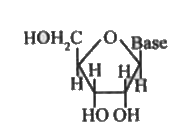
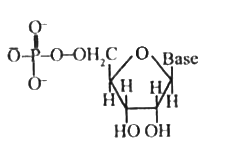
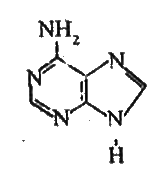
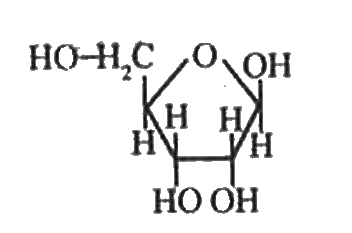
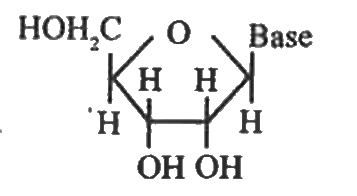
Identify the nucleoside form the following. |
|
Answer»
|
|
| 32. |
Demonstare that a closed system of charged non-relativistic particles with identical specific charges emits no dipole radiation. |
|
Answer» <P> Solution :`P. alpha |dotoversetrarr(p)|^(2)` when`oversetrarr(p) = SUM e_(i) oversetrarr(r_(i)) = sum (e_(i))/(m_(i))m_(i)oversetrarr(r_(i)) = (E)/(m) sum m_(i)oversetrarr(r_(i))` if `(e_(i))/(m_(i)) = (e)/(m) =` fixed But `(d^(2))/(DT^(2))sum m_(i)oversetrarr(r_(i)) = 0` for a closed system Hence `P = 0`. |
|
| 33. |
What is a polarizer and an analyser ? |
|
Answer» Solution :If a SHEET (polaroid) is used to obtained UNPOLARIZED light from a PLANE polarized light, then it is CALLED a polarizer. If the sheet (polaroid) is used to detect the POLARISED state of light, then it is called a analyser. |
|
| 34. |
STATEMENT 1 : Two stones are projected with different velocities from ground from same point and at same instant of time. Then these stones cannot collide in mid air. (Neglect air friction) STATEMENT 2 : If relative acceleration of two particles initially at same position is always zero, then the distance between the particle either remains constant or increases continuously wiht time. |
|
Answer» Statement-1 is TRUE, Statement-2 is True, Statement-2 is a CORRECT EXPLANATION for Statement-1. |
|
| 35. |
Calculate the refractive index of the material of the lens using the following data. |
|
Answer» SOLUTION :GIVEN,` R_(1) = 0.2m` and `R_(2) = 0.2m` `f= ( D^(2) - S^(2))/( 4D)` `f= ( D^(2) - S^(2))/( 4D) = ( 0.85^(2) - 0.206^(2))/(4 xx 0.85) = 0.2m` `f = ( D^(2) - S^(2))/(4D) = (0.9^(2) - 0.3^(2))/(4 xx 0.9) = 0.2 m` `f_(av) =0.2m` `n = 1+ (1)/(f) (( R_(1)R_(2)))/((R_(1)+R_(2)))` `n = 1+ ( 1)/( 0.2) ((0.2 xx 0.2))/((0.2+0.2))` n = 0.5 |
|
| 36. |
A coil of area 0.04 m^(2) having 1000 turns is suspended perpendicular to a magnetic field of 5.0 xx 10^(-5) Wb m^(2). It is rotated through 90^(@) in 0.2 second. Calculate the average emf induced in it. |
|
Answer» |
|
| 37. |
The property of rotatingthe plane of polarization is known as |
|
Answer» OPTICAL ACTIVITY |
|
| 38. |
Which of the following does not have the dimensions of velocity ? (Given, epsilon_(0) = permittivity of free space, mu_(0) = permeability of free space, v = frequency , is the wavelength, P is the pressure and = density, k = wave number, omega is the angular frequency) : |
|
Answer» `OMEGA k` HENCE correct CHOICE is `(a).` |
|
| 39. |
An alternating emf of e=200sin100pit is applied across a capacitor of capacitance 2muF. the capacitive reactance and the peak current is |
|
Answer» `(5XX10^(3))/(PI)Onega,4xx10^(-2)piA` |
|
| 40. |
A steady current I flows along an infinitely long straight wire with circular cross-section of radius R. What will be the magnetic field outside and inside the wire at a point r distance far from the axis of wire? |
|
Answer» Solution :`B(2pir) = mu_(0)[ (1)/(piR^2) (pir^2)]` `B= ((mu_(0) I)/(2piR^2))R""(R GE r)` `oint OVERSET(to)(B).d overset(to)(I). = mu_(0) I` `therefore B = (mu_(0) I)/(2pir) ""(r ge R)` |
|
| 41. |
What should be the length of the dipole antenna for a carrier wave of frequency 3xx10^8 Hz ? |
|
Answer» 1M |
|
| 42. |
A : The objective and the eye-piece of a compound microscope should have short focal lengths. R : Magnifying power of a compound microscope is inversely proportional to the focal lengths of both the lenses. |
|
Answer» If both Assertion & REASON are TRUE and the reason is the correct EXPLANATION of the assertion, then mark (1). |
|
| 43. |
The L-shaped conductor as shown in figure moves a 10 m//s across a stationary L-shaped conductor in a 0.10 T magnetic field. The two vertices overlap so that the enclosed area is zero at t-0 The conductor has resistance of 0.010 ohms per meter. What is current (in Amp) att=0 10 sec (Round off to nearest integer) |
Answer» 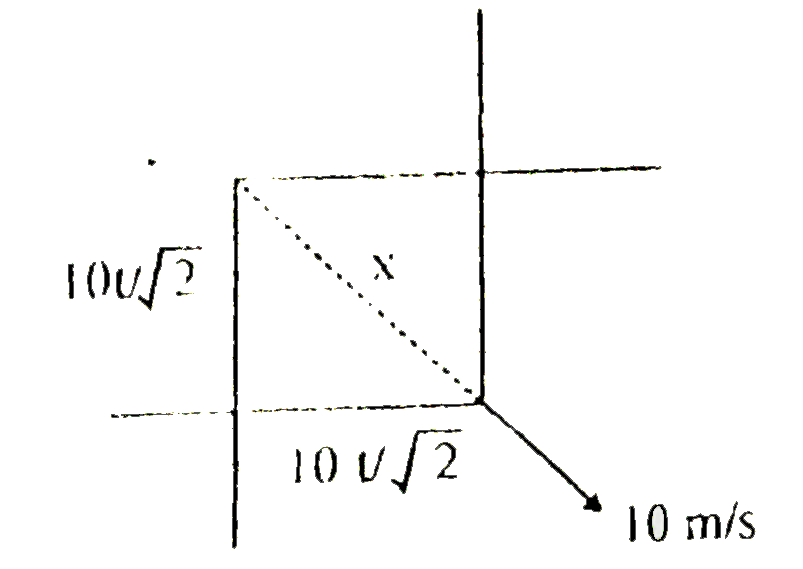 `x=10t` `phi=B[(10t)/sqrt(2)]^(2)` `(dphi)/(DT)=100Bt=100xx(.10)XX(.10)=1V(dphi)/(dt)=100Bt=100xx(.10)xx(.10)=1V` `R=(.10)xx4((10t)/sqrt(2))` `i=I/R (dphi)/(dt)=35.35 approx 35 A` |
|
| 44. |
There is a semi-infinite hollow cylindrical pipe (i.e. one end extends to infinity) with uniform surface charge density. What is the direction of electric field at a point A on the circular end face? |
|
Answer» |
|
| 45. |
A radioactive nuclide A_1with decay constant , lamda_1 transform into a radioactive nuclide A_2with decay constant lamda_2 . Assuming that at the initial moment the preparation contained only the nuclide A_1Find the time interval after which the activity of the nuclide A_2reach its maximum value. |
|
Answer» |
|
| 46. |
The amplitude of oscillation of a simple pendulum is increased from 1^(@) " to " 4^(@). Its maximum acceleration changes by a factor of |
| Answer» Answer :D | |
| 47. |
Here we find a missing force by using the acceleration. In the overhead view of Fig. 5-4a, a 2.0 kg cookie tin is accelerated at 3.0" m"//"s"^(2) in the direction shown by vec(a), over a frictionless horizontal surface. The acceleration is caused by three horizontal forces, only two of which are shown: vec(F)_(1) of magnitude 10 N and vec(F)_(2) of magnitude 20 N. What is the third force vec(F)_(3) in unit-vector notation and in magnitude-angle notation? |
|
Answer» Solution :The net force `vec(F)_("net")` on the tin is the sum of the tree forces and is related to the ACCELERATION `vec(a)` via Newton.s second law `(vec(F)_("net")=m vec(a))`. Thus, `vec(F)_(1)+vec(F)_(2)+vec(F)_(3)=m vec(a),""(5-6)` which gives us `vec(F)_(3)=m vec(a)-vec(F)_(1)-vec(F)_(2).""(5-7)` Calculations: Because this is a two-dimensional problem, we cannot find `vec(F)_(3)` merely by substituting the magnitudes for the vector quantities on the right side of Eq. 5-7. Instead, we must vectorially add `m vec(a),-vec(F)_(1)` (the reverse of `vec(F)_(1)`), and `-vec(F)_(2)` (the reverse of `vec(F)_(2)`), as shown in Fig. 5-4b. This ADDITION can be done directly on a vector-capable calculator because we know both magnitude and angle for all three vectors. However, here we shall evaluate the right side of Eq. 5-7 in terms of components, first along the x axis and then along the y axis. Caution: Use only one axis at a time. 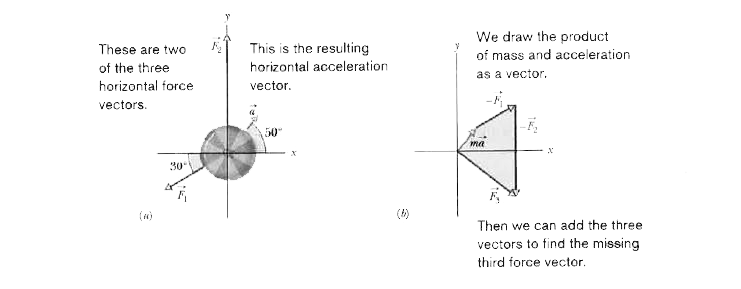 Figure 5-4 (a) An overhead view of two three horizontal forces that act on a cookie tin, RESULTING in acceleration `vec(a).vec(F)_(3)` is not shown. (b) An arrangement of vectors `m vec(a),-vec(F)_(1)`, and `-vec(F)_(2)` to find force `vec(F)_(3)`. x components: Along the x axis we have `F_(3,x)=ma_(x)=F_(1,x)-F_(2,x)` `=m(a cos 50^(@))-F_(1)cos(-150^(@))-F_(2)cos90^(@)`. Then, substituting known data, we find `F_(3,x)=(2.0" kg")(3.0" m"//"s"^(2))cos 50^(@)-(10" N")cos(-150^(@))` `-(20" N")cos 90^(@)` `=12.5` N. y comonents: Similarly, along the y axis we find `F_(3,y)=ma_(y)-F_(1,y)-F_(2,y)` `=m(a sin 50^(@))-F_(1)sin(-150^(@))-F_(2)sin 90^(@)` `=(2.0" kg")(3.0" m"//"s"^(2))sin 50^(@)-(10" N")sin(-150^(@))` `-(20" N")sin 90^(@)` `=10.4" N"`. Vector: In unit-vector notation, we can write `vec(F)_(3)=F_(3,x)hati+F_(3,y)hatj=(12.5" N")hati-(10.4" N")hatj` `~~(13" N")hati-(10" N")hatj`. We can now use a vector-capable calculator to get the magnitude and the angle of `vec(F)_(3)`. We can also use Eq. 3-6 to obtaiin the magnitude and the angle (from the positive direction of the x axis) as `F_(3)= sqrt(F_(3,x)^(2)+F_(3,y)^(2))=16" N"` and `""theta=tan^(-1)(F_(3,y))/(F_(3,x))=-40^(@)`. |
|
| 48. |
In a cloud chamber alpha, beta and gamma radiations are sent. The nature of tracks produced by these particles respectively will be |
|
Answer» THIN and LONG, THICK and SHORT thin and very long. |
|
| 49. |
A proton is moving away from an electron, then find the change in potential energy of the system. |
|
Answer» decreases `U = (k(E)(-e))/(r) =- (ke^(2))/(r)` `:.` Negative VALUE of U decreases with increase in r. Hence potential energy increases . |
|