

Saved Bookmarks
This section includes 7 InterviewSolutions, each offering curated multiple-choice questions to sharpen your Current Affairs knowledge and support exam preparation. Choose a topic below to get started.
| 1. |
F_(1) and F_(2) are focal length of objective and eyepiece respectively of the telescope. The angular magnification for the giventelescope is equal to |
|
Answer» `(F_(1))/(F_(2))` |
|
| 2. |
A bird flies down vertically towards a water surface. To a fish inside the water, vertically below the bird, the bird will appear to |
|
Answer» be FARTHER away than its actual distance |
|
| 3. |
A box is dragged along a horizontal floor by a rope which makes an angle of 60° with the horizontal. How much work is done if the tension in the rope is 150 N and the box is dragged through a distance of 10 m. |
|
Answer» 750 J =`150xx10xxcos60^(@)=1500xx1/2=750J`. |
|
| 4. |
A sinusoidal voltage of peak value 283 V and frequency 50Hz is applied to a series LCR circuit in which R= 3 ohm L= 25.48mH C= 796 mu F. Suppose the frequency of the source can be varied. (a) What is thefrequency of the source at which resonance occurs? (b) Calculate the impedance, the current,and the power dissipated at the resonant condition. |
|
Answer» Solution :a. The frequency at which the RESONANCE occurs is `omega_0 = (1)/(sqrtLC) = (1)/(sqrt(25.48 xx 10^(-3)xx 796 xx 10^(-6) )) = 222.1` rad/s `v_r = (omega_0)/(2pi) =(222.1)/(2 xx 3.14) Hz= 35.4 Hz` b. The impedance Z at resonance CONDITION is equal to the RESISTANCE `Z = R = 3 Omega` The rms current resonance is `= V/Z = V/R = ((283)/(sqrt2)) 1/3 = 66.7A` The POWER dissipated at resonance is `P = I^2 xx R = (66.7)^2 xx = 13.35 KW` Power dissipated at resonance is more than the power dissipated in the above example. |
|
| 5. |
In the previous question, if the current is I and the magnetic field at D has magnitude B . |
|
Answer» `B=(mu_(0)i)/(2sqrt2pi)` It will have not any component along x -axis any point . |
|
| 7. |
Two choherent waves represented by y_(1) = A sin((2pi x_(1))/lambda - wt + pi/4) and y_(2) = A sin((2pix_(2))/lambda - wt + pi/6) are superposed. The two waves will produce: |
|
Answer» Constructive interference at `(x_(1)-x_(2))=2lambda` |
|
| 8. |
A boat is sent across the river with a velocity of 8 km/h. in a direction perpendicular to flow of river. If resultant velocity of boat is 10 km/h, then velocity of river flow is : |
|
Answer» 18 km/h 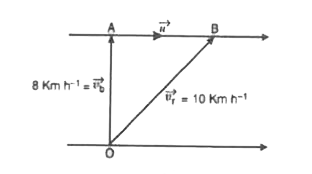 Let velocity of river flow =u and RESULTANT velocity of boat w.r.t. river flow = `v_(r)` `:.` From FIG. `v_(r)^(2) =v_(b)^(2) + u^(2)` `:. U=sqrt(v_(r)^(2) -v_(b)^(2))=sqrt(100-64)=6kmh^(-1)` |
|
| 9. |
Consider the following statements : Sound waves can undergo 1. reflection 2. refraction 3. interference |
| Answer» Answer :d | |
| 10. |
If V=V_(m)sin omegat represents instantaneous voltage connected across a resistor of resistance 'R' then write the expression for the instantaneous current in it. |
|
Answer» Solution :`i=i_(m)SINOMEGAT"where, "i=(v)/(R)andi_(m)=(v_(m))/(R)` and `i_(m)andv_(m)` represent CURRENT AMPLITUDE and voltage amplitude. |
|
| 11. |
According to Rutherford model of atom the atom consists of ____ . |
|
Answer» Positively charged nucleus surrounded by a cloud of NEGATIVE CHARGE |
|
| 12. |
Using Gauss's law derive an expression for the electric field at any point outside a uniformaly charged thin spherical shell of radius R and charge density sigma C//m^(2) . Draw the field lines when the charges density of the sphere is (i) positive (ii) negative. (b) A uniformly charged conducting sphere of 2.5 m in diameter has a surface charge density of100 mu C //m^(2)Calculate the (i) charge on the sphere (ii) total electric flux passing through the sphere. |
|
Answer» Solution :As diameter D = 2.5 m , HENCE radius R = ` (D)/( 2) = 1.25 m ` (i) ` therefore ` Total CHARGE on the sphere `Q= sigma . 4 pi R^(2)=(100 muC// m^(2)) xx 4 pi xx ( 1.25) ^(2)m^(2)= 1.96 xx 10 ^(3)C ` (II)Total electric FLUX through the sphere ` "" phi_in =(1)/( in_0) ,(Q) =( 1.96 xx 10 ^(-3))/( 8.85 xx 10 ^(-12))= 2.2 xx 10 ^(8)V. m ` |
|
| 13. |
Calculate the amount of sugar dissolved in 10^(-3)m^(3) of water so as to produce ratation of plane of polarisation of 12^(@). Given the specific rotation of sugar solution is0.01 rad m^(-1) kg^(-1) m^(3) and length of polarimeter tube is 0.21m |
|
Answer» |
|
| 14. |
For a cell, the graph between the p.d.(V) across the terminals of the cell and the current I drawn from the cell is shown in the fig. the emf and the internal resistance of the cell is E and r respectively. |
|
Answer» E = 2 V,R= 0.5`Omega ` |
|
| 15. |
A sonometer wire resonates with a given tuning fork forming standing waves with three antinodes between the two bridges when a mass of 16 Kg is suspended from the wire. When this mass is replaced by a mass '9 kg' the wire resonates with the same tuning fork for 'p' antinodes for the same positions of the bridges. Then 'p' is |
|
Answer» |
|
| 16. |
State Curie's law for a paramagnetic substance. |
| Answer» Solution :Curie.s LAW STATE that magnetic SUSCEPTIBILITY of a SUBSTANCE is inversly proportional to the ABSOLUTE temperature. | |
| 17. |
Name the gate, which represent the Boolean expressiony=bar(A*B) |
|
Answer» AND `NOT+AND=NAND ` |
|
| 18. |
A disc of mass 2 kg is rollng on a horizontal surface without slipping with a velocity of 0.1 m//s. What is it's rotational kinetic energy ? |
| Answer» Solution :Rotational K.E. =`1/2Iomega^2 =1/2(MR^2//2)Xv^2//R^2=1/4Mv^2=1/4xx2xx10^(-2)=5XX10^(-3)` J | |
| 19. |
Which of the following option for diatoms is correct? |
|
Answer» Pectocellulosic CELL wall |
|
| 20. |
The lesson "His First Flight" is about a........... |
|
Answer» pilot |
|
| 21. |
Figure 2.32 shows a charge array known as an electric quadrupole. For a point on the axis of the quadrupole, obtain the dependence of potential on r for r//a gt gt 1 , and contrast your results with that due to an electric dipole, and an electric monopole (i.e., a single charge). |
| Answer» Solution :For large R, QUADRUPOLE potential goes LIKE `1//r^(3)`, DIPOLE potential goes like `1//r^(2)` , monopole potential goes like 1/r. | |
| 22. |
पुष्पों की कृषि, प्रजनन, क्रय-विक्रय और स्था के विज्ञान को कहते हैं |
|
Answer» आरबोरिकल्चर |
|
| 23. |
Three batteries of emf 4,5 and 6V and internal resistances 1,2 and 3Omega respectively are connected in parallel with each other and the combination sends a current through an external resistance of 4Omega. Find current drawn through each battery. |
|
Answer» |
|
| 24. |
Why a thick metal plate oscillating about a horizontal axis stops when a strong magnetic field is applied on the plane? |
| Answer» SOLUTION :This is because eddy currents are produced and eddy current OPPOSE MECHANICAL MOTION (according to Lenz.s LAW). | |
| 25. |
Two ships A and B are 4 km apart. A is due west of B. If A moves with a uniform velocity of 8 km hr^(-1) due east and B moves with a uniform velocity of 6 km hr^(-1) due south, calculate (i) the magnitude of velocity of A relative to B, (ii) the closest distance apart of A and B. |
| Answer» Solution :`(I ) 10 KM HR^(-1) , (II )2.4km` | |
| 26. |
A beam of monochromatic light is incident on a glass slab at an angle of incidence of 60^@ and r=30^@ then ratio of which of beam in glass to air is: |
|
Answer» 1.732 |
|
| 27. |
In a single slit diffraction pattern, how does the angular width of central maxima change when distance betweenslit & screen is increased |
| Answer» SOLUTION :ANGULAR WIDTH REMAIN same on INCREASING D | |
| 28. |
A dipole is placed in constant electric field E as shown . If it is released from rest this position find the kinetic energy gained when it is parallel to electric field vector . ( Assume dipole is small and placed in a gravity free space ) . |
| Answer» SOLUTION :K= W= PE(1-cos `THETA)` | |
| 29. |
In the circuit shown R_(1)=R_(2)=10Omega and resistance per unit length of wire PQ=1Omega//cm and length PQ =10 cm if R_(2) is made 20Omega the to get zero deflection in galvanometer. S is midpoint of wire PQ. |
|
Answer» The JOCKEY at P can be moved towards right 2 cm 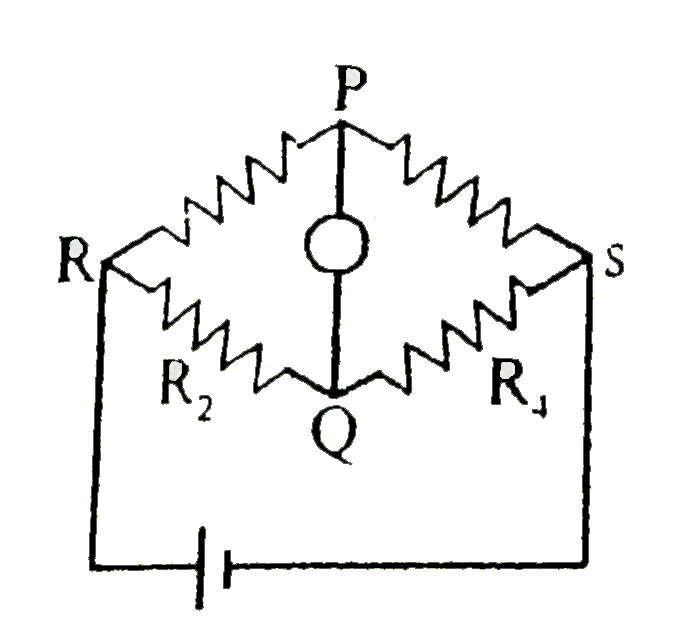 equivalent diagram is as shown is P is moved 2 cm right them `R_(1)=12,R_(3)=3 R_(1)/R_(3)=(R_(2))/(R_(4))` (Hence wheat stone will be balanced) If s is moyed left 5/3 cm then `R_(3)10/3` and `R_(4)=20/3` hence `R_(1)/R_(3)=R_(2)/R_(4)` (hence wheatstone will be balanced) |
|
| 30. |
A particle of mass m rotating in a plane circular path of radius r has angular momentum L. The centripetal force acting on its is : |
|
Answer» `(L^(2))/(mr)` `F_(C)=(m^(2)V^(2))/(mr)""(because mv=(L)/(r))` `therefore F_(C)=(L^(2))/(mr^(2).r)=(L^(2))/(mr^(3))` |
|
| 31. |
In alpha decay, why the unstable nucleus emits ""_(2)^(4)"He" nucleus ? Why it does not emit four separate nucleons? |
|
Answer» Solution :(i) The unstable nucleus is composed of many neutrons (no charge) and protons (possitive charge). (ii) According to electromagnetic forces, like charges repelect unstable NUCLEI will loose neutrons and protons when `alpha` - particle is emitted, reducing the SIZE of the nucleus. (III) In this decay, the CHANGE in B.E. appears as the kinetic energy of the `alpha` - particle and the daughter nucleus. (iv) Therefore this energy must be shared between these two particles and therefore the particle and daughter nucleus must have EQUAL and opposite momenta, the emitted `alpha` - particle and recoiling nucleus will each have a well defined energy after the decay. (v) Because of its smaller mass, most of the kinetic energy goes to the `alpha` - particle. |
|
| 32. |
What is the energy required to blow a soap bubble of radius 5 cm ? ( S.T. of soap solution = 30xx10^-2N/m.) |
|
Answer» Solution :`W = 8piTR^2 = 8 xx 3.14 xx 30 xx 10^-2 xx 25 xx 10^-4` =`1.884 xx 10^-2 J` |
|
| 33. |
Questions 61 and 62 are based on following paragraph : A Young's double slit arrangement produces interference fringes for sodium light with wavelength 5890 Å that are 0.20 mm apart. 61. Their fringe angular separation in air is |
|
Answer» `0.10^(@)` |
|
| 34. |
When a coil is rotated in a magnetic field, with constant speed then |
|
Answer» No e.m.f. is induced |
|
| 35. |
In the diagram shown, a wire carries current I. What is the value of the ointvecB.dvecl (as in Ampere's law) on the helical loop shown in the figure. The integration is done in the sense shown. The loop has N turns and part of helical loop on which arrows are drawn outside the plane of paper. |
|
Answer» `-mu_(0)(NI)` |
|
| 36. |
A wire carrying current. It is charged ? |
| Answer» Solution :No,the current in a wire is DUE to DRIFTING of electrons in a definite DIRECTION. But, the number of electrons in the wire at any instant is equal to the number of protons. HENCE, NET charge on the electron is zero. | |
| 38. |
In an experiment for determining the mass of given body using a meter scale suspended horizontally with a thread and a standard weight of 1kg, the power (mass) arm is adjustable and the weight is fixed. If the unknown mass is kept at a distance 65cm from the thread loop, then the given mass (in kg) is: |
|
Answer» `0.24` |
|
| 39. |
An LC circuit contains a 20 mH inductor and a 50 muFcapacitor with an initial charge of 10 mС. The resistance of the circuit is negligible. Let the instant the circuit is closed be t = 0.a. What is the total energy stored initially? Is it conserved during LC oscillations?b. What is the natural frequency of the circuit?c. At what time is the energy stored i. completely electrical (i.e., stored in the capacitor) ii. completely magnetic (i.e., stored in the inductor) d. If a resistor is inserted in the circuit, how much energy is eventually dissipated as heat? |
|
Answer» Solution :a. Total initial energy ` = (Q^2)/(2C) = ((10 xx 10^(-3))^2)/(2 xx 50 xx 10^(-6) )= 1J` Yes . If R = 0 , then sum of energies for L and C is conserved b. `omega = (1)/(sqrtLC) = (1)/(sqrt(20 xx 10^(-3) xx 50 xx 10^(-3) )) = 1000 rad//s ` ` v = (omega)/(2pi) = (1000)/(2 xx 3.14) = 160 Hz` c. `q=q_0 cos omega t and u = (q^2)/(2C) `. then i.Energy stored is completely electrical at t = 0 , `T/2, T, (3T)/(2) ` ,......... ii. Electrical energy is zero and energy storedis purely magnetic energy at `t = T/4 , (3T)/(4), (5T)/(4)` ,......... ` T = 1/f = (1)/(160) = 6.2 ms ` d. Energy is shared equally between L and C at `T/8 , (3T)/(8), (5T)/(8) ,...............` SINCE`E = (q_0^2 cos^2 omega t)/(2C)` if `omega t = 45^@, cos omega t= (1)/(sqrt2)` ` THEREFORE E = 1/2 . (q_0^2)/(2C) = 1/2 ` of total energy . e.Total intial energy 1J will be lost as heat due to joule heating effect in the resistor . |
|
| 40. |
A constant voltage is applied between the two ends of a uniform inetallic wire. Some heat is developed in it. The heat developed is doubled if |
|
Answer» both the length and RADIUS of the WIRE are halved |
|
| 41. |
When a lens of refractive index n_(1) is placed in a liquid of refractive index n_(2), the lens looks to be disappeared only if |
|
Answer» `n_(1)=(n_(2))/(2)` |
|
| 42. |
Pure Si at 300 K has hole and electron densities are 1.5 xx 10^(16)m^(-3). Electron density in the doped silicon is |
|
Answer» `1.5 xx 10^(16) m^(-3)` |
|
| 43. |
A metallic resistor is connected across a battery. If the number of collisions of the free electrons with the lattice is some how decreased in the resistor (for example, by cooling it), the current will |
|
Answer» INCREASE |
|
| 44. |
A: The electric field induced due to changing magnetic field is non-conservative, R: The line integral of the electric field induced due to changing magnetic field along a closed loop is always zero. |
|
Answer» If both ASSERTION & Reason are true and the reason is the CORRECT explanation of the assertion. |
|
| 45. |
The voltage applied to a purely inductive coil of self inductance 15.9 m H is given by the equation V = 100 sin 314 t + 75 sin 942t + 50 sin 1570t. Find the equation of the resulting current. |
|
Answer» |
|
| 46. |
Which one among the follov,ring is not produced by sound waves in air? |
|
Answer» Polarization |
|
| 47. |
Name the agency which administer the present system of frequency allocations. |
| Answer» SOLUTION :The INTERNATIONAL TELECOMMUNICATION UNION (ITU). | |
| 48. |
Describe the Fizeau's method to determine speed of light. |
|
Answer» Solution :Apparatus : The apparatus used by Fizeau for determining speed of light in air is shown in Figure.  (i) The light from the source S was FIRST allowed to fall on a partially silvered glass plate G kept at an angle of `45^@`to the incident light from the source.(ii) The light then was allowed to pass through a rotating toothed-wheel with N teeth and N cuts of equal widths whose speed of rotation could be varied through an external mechanism. (iii) The light passing through one cut in the wheel will GET reflected by a mirror M kept at a long distance d, about 8 km from the toothed wheel. (iv) The toothed wheel was not rotating, the reflected light from the mirror would again pass through the same cut and reach the eyes of the observer through the partiallysilvered glass plate. Working : (i) The angular speed of rotation of the toothed wheel was increased from zero to a value `omega`until light passing through one cut would completely be blocked by the adjacent tooth. (ii) This is ensured by the disappearance of light while looking through the partially silvered glass plate. Expression for speed of light: The speed of light in air v is equal to the ratio of the distance the light travelled from the toothed wheel to the mirror and back 2d to the time taken t. ` v = (2d)/(t) "" ....(1)` (v) The distance d is a known value from the arrangement. The time taken t for the light to travel the distance to and fro is calculated from the angular speed `omega` of the toothed wheel. (vi) The angular speed w of the toothed wheel when the light disappeared for the first time is, ` omega = theta / t "" ...(2)` (vii) Here, `theta` is the angle between the tooth and the SLOT which is rotated by the toothed wheel within that time t. ` theta = ("total angle of the circle in radian")/("number of teeth + number of cuts")` ` theta = (2pi)/(2N) = (pi)/(N)` Substituting of `theta` in the equation (2) . for `omega` ` omega = (pi//N)/(t) = (pi)/(NT)` Rewriting the above equation for it , ` t= (pi)/(Nomega) "" ...(3)` Substituting t from equation (3) in equation (1) ` v = (2d)/(pi //N omega)` After rearranging , ` (2d N omega)/(pi)` |
|
| 49. |
An electron moves along +x direction. It enters into a region of uniform magnetic field B directed along - z direction as shown in figure. Draw the shape of trajectory followed by the electron after entering the field. |
Answer» SOLUTION :The TRAJECTORY of electron is a circle in x-y PLANE as SHOWN here. 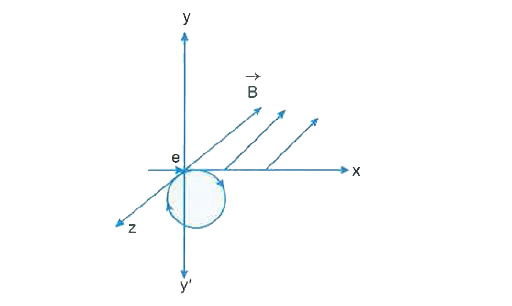
|
|