Saved Bookmarks
This section includes 7 InterviewSolutions, each offering curated multiple-choice questions to sharpen your Current Affairs knowledge and support exam preparation. Choose a topic below to get started.
| 1. |
In the given diagram, there is a conducting sphere of radius r which is surrounded by a dielectric of relative permittivity epsilon_(r). If conducting sphere is given charge q, then surface density of polarization charges, on the outer surface of the dielectric layer, is |
|
Answer» `(epsilon_(R)Q)/(4PI r_(2)^(2))` |
|
| 2. |
A star with a mass of more than three times that of the Sun contracts so much upon cooling that it is not able to radiate, neither material particles nor light are able to overcome its gravitational field. Find the radius of such an object (a ''black hole''). |
|
Answer» `c^2=2gammam//R,R=2gammaM//c^2~~9km` |
|
| 3. |
Cancer cells are more vulnerable to x and gamma radiation than are healthy cells. In the past, the standard source for radiation therapy was radioactive ""^(60)Co, which decays, with a half-life of 5.27 y, into an excited nuclear state of ""^(60)Ni. That nickel isotope then immediately emits two gamma-ray photons, each with an approximate energy of 1.2 MeV, How many radioactive ""^(60)Co nuclei are present in a 6000 Ci source of the type used in hospitals? (Energetic particles from linear accelerators are now used in radiation therapy.) |
|
Answer» |
|
| 4. |
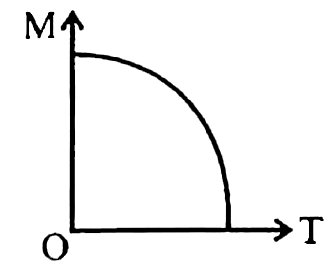
A curve between magnetic moment and temperature of amagnetbestrepresented by |
|
Answer»
|
|
| 5. |
A 12.5 MeV alpha- particle approaching a gold nucleus is deflected 180^@ . What is the closest distance to which it approaches the nucleus ? |
| Answer» SOLUTION :`1.82 XX 10^(-14)m` | |
| 6. |
How does the mobility of electrons in a conductor change, if the potential difference applied across the conductor is doubled, keeping the length and temperature of the conductor constant ? |
| Answer» Solution :MOBILITY of ELECTRONS remains unchanged because mobility`mu = (v_d)/(E ) = (e )/(m) tau ` and RELAXATION PERIOD `tau` depends on the nature of MATERIAL and temperature only. | |
| 7. |
A charge q is distributed over the volume of a sphere of radius R. Assuming the permittivty to be equal to unity, compare the energy stored inside the sphere with the energy pervading the surrounding space. [Hint: u=(1)/(2)epsilon_(0)E^(2).] |
|
Answer» |
|
| 8. |
A cannon of mass 1000 kg located at the base of an inclined of an inclined plane fires a shell of mass 100 kg in a horizontal direction with a velocity 180 km//hr.The angle of inclination of inclined plane with the horizontal is 45^(@). The coefficient of friction between the canon and inclined plane is 0.5. The height in meter to which the cannon ascends the inclined plane as a result of recoil is (g=10m//s^(2)) |
|
Answer» `=100xx180xx5/18` `=5000`kg-m/s Velocity of recoil of cannon `=5000/1000=5m//s` Let the cannon ascends a distance s on the rough inclined surface.The effective deceleration is 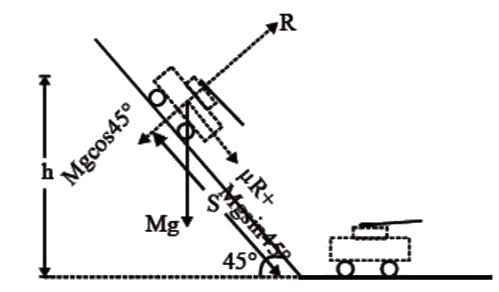 `a=(muR+Mg sin 45^(@))/M` `a=(mjMgcos 45^(@)+Mgsin45^(@))/M` `a=g/(SQRT(2))[mu+1]` `v^(2()=u^(2)=2as` `0=(5)^(2)-2xxg/(sqrt(2))(mu+1)s` or `s=25/(sqrt(2)xx10(0.5+1))=25/(sqrt(2)xx15)=5/(3sqrt(2))m` Now`h=s.sin45^(@)=5/(3sqrt(2))XX1/(sqrt(2))=5/6m` |
|
| 9. |
Two parallel very long straight wires carrying current of 5A each are kept at a separation of 1 m. If the currents are in the same direction, the force per unit length between them is ______ N/m. (mu_(0)=4pixx10^(-7)SI) |
|
Answer» `5xx10^(-5)`, ATTRACTIVE = `2XX10^(-7)xx(5xx5)/1` = `5xx10^(-6)N/m`, attractive |
|
| 10. |
X_(1) and X_(2) are susceptbiltity of a paramagnetic material at temperature T_(1) K and T_(2)K respectively , then |
|
Answer» `chi_(1)=chi_(2)` |
|
| 11. |
a. Are potential difference and potential energy the same? b. If they are not the same, then define them c. Also state how they are related. |
|
Answer» Solution :a. No. Potential difference is a FIELD property. Potential energy is the interaction energy of charge configuration. b. The electrostatic potential at a point in an electric field is defined as the work done in bringing a unit positive charge from infinity to that point against the field. Electric potential difference between two points is equal to the work done in moving a unit test charge between them. The potential energy of a SYSTEM of charges is defined as the work done in bringing the charges from infinity to form the system. Potential energy, `"U =Potential difference " xx " Charge"` |
|
| 12. |
Electric field intensity in a given region is zero. Can we conclude that electric potential must be zero? |
| Answer» SOLUTION :Not NECESSARILY, E=-dV/dr or 0=-dV/dr. This means that electric potential is constant. The constant value can be ZERO or non-zero. | |
| 13. |
a) The peak voltage of an a.c. supply is 300 V. What is the rms voltage ? (b) The rms value of current in an a.c. circuit is 10 A. What is the peak current ? |
|
Answer» Solution :(a) `therefore V_(m) = 300 V`, HENCE `V_(rms) = V_(m)/sqrt(2) = 300/sqrt(2) = 212.1` V (b) As `I_(rms) = 10A`, hence `I_(m) = sqrt(2). I_(rms) = sqrt(2) xx 10 = 14.14 A = 14.1` A |
|
| 14. |
(A) : An inductance and a resistance are connected in series with an A.C. circuit. In this circuit the current and the potential difference across the resistance lag behind potential difference across the inductance by an angle pi//2. (R): In L-R circuit voltage lags the current by phase angle which depends on the value of inductance and resistance both. |
|
Answer» Both 'A' and 'R' are TRUE and 'R' is the CORRECT explanation of 'A'. |
|
| 15. |
An electron gun fires electrons after accelerating them through a potential difference V. Electrons are coming out from a tiny hole. Most of the electrons go straight but some of them make a slightly divergent angle. A uniform magnetic field can be set up along the direction of motion of electrons. These slightly diverged electrons are to be brought to focus at a distance I from the point of exit from the electron gun. If B_(1) , is the minimum magnetic field needed to focus the electrons and B_(2), is the next possible higher value of magnetic field, calculate e/m for the electrons. |
|
Answer» Solution :Let `theta` be the angle between velocity of electron and applied magnetic field then we know that electron can be brought into focus if L is integral multiple of pitch of helix. Pitch of the helix can be written as FOLLOWS: ` p = v cos theta xx (2 pi m)/(EB) approx (2 pi m v)/(eB)` Electrons are accelerated through a potential difference V. Thus, we can write the following EXPRESSION for the kinetic energy of the electrons: ` eV = 1//2 mv^(2)` `rArr "" mv = sqrt(2 emV)` Substituting the value of mo, we can rewrite the pitch of the helix as follows: `p = (2 pi sqrt(2 emV))/(eB) = sqrt((8 pi^(2) emV)/(e^(2)B^(2))) = sqrt((8 pi^(2) mV)/(eB^(2))) ` The required magnetic field can be written in terms of pitch of the helix as follows: ` B = 1/p sqrt((8 pi^(2) mV)/e)` Let `e//m = x`,then the above expression can be rewritten as follows: `B = 1/p sqrt((8 pi^(2)V)/x) ` ...(i) For magnetic field `B_(1) `, Lis equal to the pitch and for magnetic field `B_(2)`., L is twice the pitch or we can say the pitch is half the L. We can write equation (i)for the two cases as follows: `B_(1) = 1/L sqrt((8pi^(2)V)/x) ` ...(ii) ` B_(2) = 2/L sqrt((8 pi^(2)V)/x) ` ..(iii) From the above equations, we get : `B_(2) - B_(1) = 1/L sqrt((8 pi^(2)V)/x) ` ` rArr"" (B_(2) - B_(1))^(2) = 1/L^(2) (8 pi^(2)V)/x` `rArr "" x = 1/L^(2) (8 pi^(2)V)/((B_(2) - B_(1))^(2)) ` `rArr "" e/m = ( 8 pi^(2)V)/(L^(2)(B_(2) - B_(1))^(2))` `rArr"" e/m = (8 pi^(2)V)/(L^(2)(B_(2) - B_(1))^(2))` |
|
| 16. |
Ship A is 10km due west of ship B. Ship A is heading directly north at a speed of 30 kmph while ship B is heading in a direction 60° west of north at a speed 20kmph. Their closest distance of approach will be........ |
|
Answer» Solution :`vecV_(A) = 30 j, vecV_(B) = 20 sin 60^(@)hati + 20cos 60^(@)hatj` `=-10sqrt(3i) + 10J` `vecV_(BA) = vecV_(B)-vecV_(A) =-20hati -10sqrt(3)hatj` If `phi` is the angle made by `vecV_(BA)` with X AXIS `tan theta =20/(10sqrt(3)) =2/sqrt(3)` 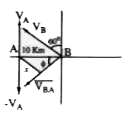 and `sinphi =2/sqrt(7)` From `triangleABC, x/10 = 2/sqrt(7)` `x=20/sqrt(7) = 7.56` km |
|
| 17. |
Why do we prefer carbon brushes than copper in an a.c. generator? |
| Answer» Solution :CORROSION FREE and SMALL expansion on heating MAINTAINS proper CONTACT. | |
| 18. |
In a modified set up of Young's double slit experiment, it is given that S S_(2)-S S_(1)=(lamda)/(4) i.e., the source S is not equidistant from the slits S_(1) and S_(2). (a) Obtain the condition for constructive and destructive interference at any point P on the screen in terms of the path difference Delta=S_(2)P-S_(1)P. (b) Does the observed central bright fringe lie above or below O ? Give reason in support of your answer. |
|
Answer» Solution :(a) The Net path difference between two waves, reaching on the screen through two slits, is given as: `S S_(2)P-S S_(1)P=(S S_(2)-S S_(1))+(S_(2)P-S_(1) P)` It is given that `S S_(2)-S S_(1)=(lamda)/(4)` and we KNOW that `(S_(2)P-S_(1)P)=DELTA=(xd)/(D)`, where .d. is the separation between slits `S_(1) and S_(2) and .D.` the DISTANCE of screen from the double-slit. `therefore` Net path difference `=(lamda)/(4)+(xd)/(D)`  (i) For constructive interference `(lamda)/(4)+(xd)/(D)=nlamda`, where `N=0,1,2,3 . . .` `implies(xd)/(D)=nlamda-(lamda)/(4)=(4n-1)(lamda)/(4)implies(x_(n))_("bright")=((4n-1)lamdaD)/(4d)` (ii) For destructive interference `(lamda)/(4)+(xd)/(D)=(2n-1)(lamda)/(2)`, where n=1,2,3, . . `implies(xd)/(D)=(4n-3)(lamda)/(4)implies(x_(n))_(dark)=((4n-3)lamdaD)/(4d)`. (b) For central bright fringe n=0 and hence `(x_(0))_("bright")=-(lamdaD)/(4d)`. Thus, the observed central bright fringe shifts TOWARDS the line of slit `S_(2)`. |
|
| 19. |
A 100 Hz ac is flower in a coil of indnctance 10 mH. What is the reactance of the coil? |
|
Answer» Solution :Here `L=10mH=10xx10^(-3)H=10^(-2)H`, `v=100Hz` Using `X_(L)=Lomega=Lxx2piv`, we GET `X_(L)=10^(-2)xx2xx3.14xx100=6.28Omega`. |
|
| 20. |
Two long straight conducting wires with linear mass density lambda are kept parallel to each other on a smooth horizon- tal surface. Distance between them is d and one end of each wire is connected to each other using a loose wire as shown in the figure. A capacitor is charged so as to have energy U_(0) stored in it. The capacitor is connected to the ends of two wires as shown. The resistance (R) of the entire arrangement is negligible and the capacitor discharges quickly. Assume that the distance between the wires do not change during the discharging process. Calculate the speed acquired by two wires as the capacitor discharges |
|
Answer» |
|
| 21. |
An uncharged particle is moving with a velocity of vecv in non - uniform magnetic field as shown Velocity vecv would be |
|
Answer» MAXIMUM at A & B |
|
| 22. |
Figure shows a device called Pitot tube . It measures the velocity of moving fluids . Determine the velocity of the fluid in terms of the density rho the density of the fluid in manometer (U-tube) sigma and the height h . |
|
Answer» Solution :The fluid inside the right TUBE MUST be at rest as the fluid exactly at the end is in contact with the fluid in Pitot tube ,which is at rest . The velocity `v_(1)` is the fluid velocity `v_(f)` . The velocity `v_(2)` of the fluid at point B is zero and the pressure in the right arm is `p_(2)` (called stagnation pressure ) . Thus , using Bernoulli.s principle `rho_(1) + (1)/(2) rho v_(1)^(2) = p_(2) + (1)/(2) rho v_(2)` we get `rho_(2) = p_(1)+ (1)/(2) rho v_(f)^(2)` On the other hand , the openings at point A is not along the flow lines , so we do not need to use Bernoulli.s equation . We can simply say that the pressure just OUTSIDE the opening is same as that within the Pitot tube . Therefore , the pressure at the left arm of the manometer is same as the fluid pressure `p_(f)` , that is `p_(1)= p_(f)` . Also `p_(2) = p_(1) + (rho - SIGMA) gh "" (14-54)` Generally , `sigma lt lt rho` , so it is ignored . Thus , `p_(2) = p_(f) + rho gh "" (14-55)` From Eqs. 14-54 and 14-55 `(1)/(2) sigma v_(f)^(2) = rho g h ` or ` v_(f) = sqrt((2 rho gh )/(sigma))` |
|
| 23. |
The series combination of R(Omega) and capacitor C(F) is connected to an A.C. source of V volts and angular frequency omega. If the angular frequency is reduced to omega/3, the current is found to be reduced to one-half without changing the value of the voltage. Determine the ratio of the capacitive reactance and the resistance. |
|
Answer» Solution : First case : (Here, r.m.s. value of I and V as I and V for the SAKE of convenience) `I=V/sqrt(R^2 + 1/(omega^2C^2)) " " therefore I^2=V^2/(R^2+X_C^2)`...(i) SECOND case : `I/2=V/sqrt(R^2+9/(omega^2C^2)) "" therefore I^2/4 = V^2/(R^2+9X_C^2)`...(ii) Dividing EQU. (i) by (ii), we have `therefore 4=(R^2+9X_C^2)/(R^2+X_C^2)` `therefore 4R^2+4X_C^2=R^2+9X_C^2` `therefore 5X_C^2=3R^2` `therefore X_C/R=sqrt(3/5)` |
|
| 24. |
Monochromatic light of wavelength 589 nm is incident from air on a water surface. What are the wavelength, frequency and speed ofrefracted light? Refractive index of water is 1.33. |
|
Answer» Solution :a. `lamda=589xx10^(-2)m,C=3XX10^(8)m//s` (air) `:.` Frequency `v=c/(lamda)=(3xx10^(8))/(589xx10^(-9))=5.09xx10^(14)Hz` No change for `lamda` and c b. Frequency remains the same WAVELENGTH `lamda.=(lamda)/n=(589nm)/1.33=443nm` Speed `v.=c/n=(3xx10^(8))/1.33=2.26xx10^(8)m//s` |
|
| 25. |
Magnification achieved by an astronomical telescope is 6 when final image is formed at infinity. Distance between objective and eyepiece is 49 cm. Calculate focal lengths of objective and eyepiece. |
|
Answer» 42 cm and 7 cm `n=(f_(0))/(f_(e))rArr 6 =(f_(0))/(f_(e))rArr f_(0)=6f_(e)"...(i)"` Length of the tube in this case is given as `L= f_(0)+ f_(e)` hence we can write the FOLLOWING: br>` f_(0)+ f_(e)=49"...(ii)"` On solving equations (i) and (ii) we GET required focal lengths in cm. `6f_(e)+f_(e)=49 rArr f_(e)=7 cm and f_(o)=42cm` Hence, option (a) is correct. |
|
| 26. |
The radius of earth is 6347 km. Its rounded off value up to two significant figures is |
|
Answer» 6400 KM |
|
| 27. |
A square loop of side 12 cm with its sides parallel to x and y-axes is moved with a velocity 8 cm/s along positive x-direction in an environment containing magnetic field along +ve z-direction. The field has a gradient of 10^(-3)tesla/em along -ve x-direction (increasing along -ve x-axis) and also decreases with time at the rate of 10^(-3)tesla/s. The emf induced in the loop is |
|
Answer» Solution :The magnetic field in loop varies with position .x. of loop and also with time simultaneously. The RATE of change of flux due to variation of .B. with time is `(dphi)/(DT) = A xx (dB)/(dt)` The rate of change of flux due to variation B with position .x. is `(dphi)/(dt) = A xx (dB)/(dt) = A (dB)/(dx) xx (dx)/(dt) = A (dB)/(dx) xx v ` Since both cause DECREASE in flux, the two effects will add up ` therefore ` The net emf INDUCED ` e = (dphi)/(dt) = A (dB)/(dt) + A(dB)/(dx) xx v= A [ (dB)/(dt) + v (dB)/(dx) ]` `= 144 xx 10^(-4) [ 10^(-3) + 8 xx 10^(-3)]` ` = 144 xx 9 xx 10^(-7) = 129.6 xx 10^(-6) V` |
|
| 28. |
The maximum distance upto which TV transmission from a TV tower of height 'h' can be received is proportional to |
| Answer» ANSWER :A | |
| 29. |
Obtain the equation for optical path of a medium of thickness d andrefractive index n. |
|
Answer» Solution :Optical path of a medium is defined as the distance d. light travels in vaccum in the same time it travels a distance d in the medium. LET US consider a medium of refractive index n and THICKNESS d. Lighttravels with a speed v through the medium in a time i. Then we can write. `v=(d)/(t),"rewritten as",t=(d)/(v)` In the same time, light can cover a greater distance d. in vaccum as it travels with greater speed C invacuum. Then we have, `c=(d.)/(t),"rewritten as",t=(d.)/(c )` As the time taken in both the cases is the same, we can EQUATE the time t as. `(d.)/(c)=(d)/(v)` rewritten for the optical path d. as `d. = (c )/(v)d` As, `(c )/(v) = n` , The optical path d. is, d. = nd As n is always greater than I.the opticalpath d. of the medium is always greater than d. 
|
|
| 30. |
Two indentical particles of charge q each are connected by a less spring of force constant K. They are placed over a smooth horizontal surface. They are released when the separation between them is r and spring is in it natural length. If maximum extension of the spring is r, the value of K is (neglect gravitational effect) |
|
Answer» `(Q)/(4r)SQRT((1)/(pi epsilon_(0)r))` |
|
| 31. |
The force of repulsion between two point charges is F, when these are at a distance of 1 m. Now the point charges are replaced by spheres of radii 25 cm having the charge same as that of point charges. The distance between their centres is 1 m, then compare the force of repulsion in two cases. |
|
Answer» INCREASE |
|
| 32. |
A block of weight 200 N is pulled along a rough hori zontal surface at constant speed by a force 100 N acting at an angle 30^(@) above the horizontal. The coefficient of kinetic friction between the block and the surface is : |
|
Answer» 0.43 |
|
| 33. |
From thetopof building78.4 high , ballis throw horizontally whichhitsthe ground ata distancethe linejoiningthe buildingtop to the point wherethe balls hitsthe groundmakesan angle of 45^(@) withgroundline. Find theinitial velocity of ball ? |
|
Answer» |
|
| 34. |
……. frequency is use in TV. |
|
Answer» 530 KHZ to 1710 kHz |
|
| 35. |
a. What is scattering of light?b. Explain Rayleigh scattering. c. Why sky appears blue?d. Sky blue extends over a wide region. Why ? |
|
Answer» Solution :a. The irregular reflection of LIGHT in all direction at random from EXTREMELY small particles such as dust, molecules of air etc. is called scattering of light . b. According to Rayleigh.s scattering law, the INTENSITY of scattered light is inversely proportional to the fourth power of the wavelength. i.e., Intensity, I `prop (1)/(lambda^(4))` it is found tht shorter wavelengths are scattered more than longer wavelengths. c. The blue colour of the sky is due to the scattering of light by small particles of the atmosphere. According to Rayleigh.s scattering law, the scattering ntensity is maximum for smaller wavelengths. the size of the particles in the UPPER atmosphere is smaller, so that the radiations of shorter wavelength are scattered with greater intensity. Sunlight is rich with blue and therefore the most intense scatted colour is blue. thus ksy appears blue. d.scattering of upper atmospheric particles produces blue of the sky. Since the region of observation is extended the blue colours thus extends over a wide region. |
|
| 36. |
Consider a metal ring kept on top of a fixed solenoid (say on a cardboard) as shown in Fig. 6.28. The centre of the ring coincides with the axis of the solenoid. If the current is suddenly switched on, the metal ring jumps up. Explain. |
Answer» Solution :Initially there was no current and so no MAGNETIC flux was passing through the metal ring. When current is PASSED on, a magnetic field is produced and magnetic flux passes through the ring. In accordance with Faraday.s law due to increase in magnetic flux of ring induced current is SET up in metal ring. As per Lenz.s law the induced current TENDS to oppose the increase in magnetic flux passing through the ring. It is possible only if the ring moves away from the SOLENOID. So the metal ring jumps up. 
|
|
| 37. |
int_0^6 (2X^2+3x+5) dxका मान ज्ञात करे ? |
|
Answer» 228 |
|
| 38. |
(d) Two identical looking iron bars A and B are given, one of which is definitely known to be magnetised. (We do not know which one.) How would one ascertain whether or not both are magnetised ? If only one is magnetised, how does one ascertain which one '? [Use nothing else but the bars A and B.] |
| Answer» Solution :(d) Out of two iron bars, keep the tip of upper bar SAY first bar in contact with one end of SECOND bar and then slide it along the length of second bar. If upper bar experiences strongest attractive FORCES while sliding NEAR the ends of lower bar then lower bar is a bar magnet and upper bar is a simply an iron bar only, because magnetism of a bar magnet is present maximum at its two ends. | |
| 39. |
(A): Systametic errors are due to a definite cause and can be minimised. (R): Random errors are due to unknown reasons and can be completely eliminated . |
|
Answer» Both (A) and (R) are TRUE and (R) is the CORRECT explanation of (A) |
|
| 40. |
Two plane mirros are inclined to each other at an angle of 60^(@). A point object is placed in between them. The total number of images produced by both the mirror is |
|
Answer» 2 |
|
| 41. |
A converging lens has a focal length of 20 cm in air. It is made of a material of refractive index 1.6. If it is immersed in a liquid of refractive index 1.3, what will be its new focal length ? |
|
Answer» Solution :Focal length of LENS in air f= + 20 cm, REFRACTIVE index of glass N = 1.6 and refractive index of LIQUID medium `n_m = 1.3`. If NEW focal length of lens be `f.` then: `f. = ((n-1)n_(m))/(n-n_(m))f = ((1.6-1) xx 1.3 xx 20)/(1.6 - 1.3) = (0.6 xx 1.3 xx 20)/0.3 = 52 cm` |
|
| 42. |
A person sitting in an artificial satellite revolving around the earth feels weightlessness. Why ? |
| Answer» Solution :For an aeroplane to fly, air is NECESSARY. Due to friction force of air, the aeroplane requires fuel. On the otherhand, a satellite REVOLVES at much HEIGHT where air friction is NEARLY negligible. Hence, the satellite does not require any fuel. | |
| 43. |
Two parallel rectangular superconducting plates of length l, width b and separation a (l gtgt b gtgt a) are joined at each end to form a one-turn coil of negligible resistance. What is its self-inductance? How much energy is stored in the magnetic field when a steady current / flows? The separation a increases by a small amount deltaa. Calculate the various energy changes (a) when the coil includes in its circuit a lossless battery which maintains a constant current l, and (b) when the circuit consists of the coil alone. Deduce the magnitue and direction of the force per unit area between the two plates. |
|
Answer» SOLUTION :`C_(1)=0.93mu F` `R_(1)=4.1k OMEGA` |
|
| 45. |
You have learnt that a travelling wave in onedimension is represented bya function y = f( x,t )where x and t must appear in the combination x -vtorx + vt , i.e., y = f( x+- v t ). Is the converse true ? Examine if the followingfunction for y can possibly represent a travelling wave : (a)(x - vt ) 2 (b)log[ ( x+ vt ) //x_(0)] (c )1//(x+vt ) |
|
Answer» Solution :No, the CONVERSE is not TRUE. The basicrequirement for a wave function to represent a travelling wave is that for allvalue of x& t, wave function MUST have a finite value . Out of the given function y, no one satisfies this condition THEREFORE, none can represent a travelling wave. |
|
| 46. |
If the distance Dbetween an objectand screen than 4 times the focal length of a convex lens, then thereare two positions of the lens for which image are formed on the screen. This method is called conjugate method. If d is the distance between the two positions of the lens, obtain the equation for focal length of the convex lens. |
|
Answer» Solution :Let us fix the position of object of object and place the screen to get the enlarged image fist Also, let us fix the position of screen where we get the enlarged image. Let D be the distance between object and screen. Let us MARK the position of lens `d_(1)`. Then let us move the lens away from the object to get a diminished image. Let this position of lens be `d_(2)`. Let d be the distance between the lens position `d_(1) and d_(2)`. Let .V. be the distance b/w image and lens. Let .u. be the distance between object and lens. From mirror equation. `(1)/(v) + (1)/(u) = (1)/(f)` Let us replace v by SUBSTITUTING v = D - u `(1)/(D-u) + (1)/(u) = (1)/(f)` we get the equation,`u^(2) - Du + fD = 0` the quadratic equation for above equation, `u=(Dpmsqrt(D^(2)-4fD))/(2)` When D = 4f, we get only position of lens to get image. This corresponds to placing the object at 2 f and getting the image at 2 f on the otherside. Hence, for displacement method we need `D gt 4f`. When this condition is satisfied we get `u_(1)=(D-sqrt(D^(2)-4fD))/(2):"CORRESPONDING" " " v_(1) = D-u_(1) = (D-sqrt(D^(2)-4fD))/(2)` after changing the LOCATION `u_(1)=(D-sqrt(D^(2)-4fD))/(2):"corresponding" " " v_(2)=D-u_(2)=(D-sqrt(D^(2)-4fD))/(2)` now the displacement `d = v_(1) - u_(1)=u_(2)-v_(2)=sqrt(D^(2)-4fD)` Hence we get focal lenght, `f = (D^(2) - d^(2))/(4D)` 
|
|
| 47. |
In Rutherford's alpha-scattering experiment, what will be the correct angle of scattering for impact parameter |
|
Answer» `90^(@)` |
|
| 48. |
Assertion : The sun is visible a few minutes before it is actually above horizon. Reason : Light rays bend due to refraction. |
|
Answer» If both assertion and reason are correct and reason is a correct EXPLANATION of the assertion. |
|
| 49. |
How fast would a rocket have to go relative to an observer for its length to be corrected to 99% of its length at rest. Data: (l)/(l_(0))=99% =(99)/(100), v = ? |
|
Answer» SOLUTION :`l=l_(0)sqrt(1-(v^(2))/(c^(2)))` `l=(99)/(100)l_(0)` `(l)/(l_(0))=(99)/(100)` `:. (99)/(100)=sqrt(1-(v^(2))/(c^(2)))` `:.` v = 0.141 C `v=0.141 xx 3 xx 10^(8)` `v=0.423 xx 10^(8) MS^(-1)` |
|
| 50. |
A current -carrying circular loop lies on a smooth horizonatal plane. Can a unifrom magnetic field be set up in such a manner that the loop turns around itself (i.e, turns about the vertical axis ) ? b. A current -carrying circular loop is located in a uniform external magnetic field. If the loop is free to turn , what is its orientation of stable equilibrium ? Show that in this orientation , the flux of the total field (external field + field produced by the loop ) is maximum . c.A loop irregular shape carrying current is located in an external magnetic field. If the wire is flexible, why does it chage to a cirucalr shape ? |
|
Answer» Solution :No, because that WOULD require `tau` to be in LOCATED in the vertical direction . But `tau = I A xx B` and since A of the horizontal loop is in the vertical direction, `tau` would be in the plane of the loop for any B. b. Orientation of stable equilibrium is one where the area vetor A of the loop is ini the direction of external magnetic field.the magnetic field PRODUCED by the loop is in the same direction as external field . both normal to the plane of the loop , thus giving rise to maximum flux of the total field. C. It assumes circular shape with its plane normal to the field to maximize flux, since for a given PERIMETER, a circle encloses greater are than any other shape . |
|