

Saved Bookmarks
This section includes 7 InterviewSolutions, each offering curated multiple-choice questions to sharpen your Current Affairs knowledge and support exam preparation. Choose a topic below to get started.
| 1. |
As an electron makes a transition from an excited State to the ground state of a hydrogen - like atom/ion : |
|
Answer» Its KINETIC energy increases but potential enegy and TOTAL energy decrease as n decreases KE increases and TE, PE decreases. |
|
| 2. |
If a 50g block of solid marble (specifc heat=0.9kJ//kg""^(@)C), originally at 20^(@)C, absorbs 100J ofheat, which one of the following best approximates the temperature increases of the marble block? |
|
Answer» `1^(@)C` `DeltaT=(q)/(mc)=(0.1kJ)/((0.05kg)(0.9kG//kg*""^(@)C))=(2)/(0.9)=2^(@)C`. |
|
| 3. |
A set of 'n' equal resistors, of value 'R' each, are connected in series to a battery of emf 'E' and internal resistance 'R'. The current drawn is I. Now, the 'n' resistors are connected in parallel to the same battery. Then the current drawn from battery becomes 10 I. The value of 'n' is |
|
Answer» 10 |
|
| 4. |
A rubber ball of mass 0.05 kg falls from a height of 1 m and rebounds to a height of 0.5 m. Find the average force when their contact was 0.1 sec. |
|
Answer» 3.78 N |
|
| 5. |
Two discs having moment of inertias I_(1)andI_(2) about their axes passing through their respective centres and normal to their surfaces are rotating with angular speeds omega_(1)andomega_(2) respectively. They are brought into contact face to face with their axes of rotation coinciding with each other, what is the angular speed of the two discs system? |
|
Answer» `(I_(1)omega_(1))/(I_(1)+I_(2))` `I.omega=I_(1)omega_(1)+I_(2)omega_(2)` or `omega=(I_(1)omega_(1)+I_(2)omega_(2))/(I)` or `omega=(I_(1)omega_(1)+I_(2)omega_(2))/(I_(1)+I_(2))` This GIVES the angular speed of the system after contact. |
|
| 6. |
Two magnetic poles, one of which is three times as strong as the other, exert on each other, a force equal to 3 xx 10^(-3)N when separated by a distance of 10 cm. Find the strength of each pole. |
|
Answer» Solution :Pole strengths , `m_1 = m and m_2 =3` DISTANCE between POLES , d=10 cm = 0.1 m Force on each poles , `F=3 xx 10^(-3)N` Force between the poles `, F=(mu_0)/(4pi)(m_1m_2)/(d^(2))` `implies 3 xx 10^(-3) = (4pi xx 10^(-7))/(4 PI ) xx (m.3m)/((0.1)^(2))` `implies 3m^(2) = 300 (or) m =10` `:.` The pole strengths are 10 A-m and 30A-m. |
|
| 7. |
A solenoid with an iron core and a bulb are connected to a d.e. source. How does the brightness of the bulb change, when the iron core is removed from the solenoid ? |
| Answer» Solution :The BRIGHTNESS of the bulb does not CHANGE because there is no EFFECT of inductance of the SOLENOID in a d.c. circuit | |
| 8. |
Two point charges placed at a distance r, in the air experience a certain force, then the distance at which they will experience the same force in the medium of dielectric constant K is |
|
Answer» `KR` |
|
| 9. |
Light has the following wave property: |
|
Answer» LONGITUDINAL |
|
| 10. |
What is the meaning of "slumber"? |
|
Answer» Pain |
|
| 11. |
A cubic box of volume 8.0xx10^(-3)m^(3) is filled with air at atmospheric pressure at 20^(@)C. The box is closed and heated to 150^(@)C. What is the net force on each side of the box? |
| Answer» | |
| 12. |
A rope, with mass 1.39 kg and fixed at both ends oscillates in a second-harmonic standing wave pattern. The displacement of the rope is given by y-(0.10m) (sin pix//2) sin 12pit. where x=0 at one end of the rope, x is in meters and t is in seconds. What are (a) the length of the rope, (b) the speed of the waves on the rope, and (c) the tension of the rope? (d) If the rope oscillates in a third-harmonic standing wave pattern, what will be the period of oscillation? |
|
Answer» |
|
| 13. |
A thin straight vertical conductor has 10 amp current, vertically upwards. It is present at a place where B_(H) = 4 xx 10^(-6) T. Arrange the net magnetic inducitons at the following points in ascending order a) at 0.5m on south of conductor b) at O.Sm on west of conductor c) at 0.5m on east of conductor d) at 0.5m on north-east of conductor |
|
Answer» a,B,c,d |
|
| 14. |
Derive mirror equation for a convex mirror. Usingit, show that a convex mirror always produces a virtual image, independent of the location of object. |
|
Answer» Solution :Let us consider IMAGE formation of a linear object AB placed in front of a convex mirror. As shown here a virtual, erect and diminished image A.B. is formed behind the mirror between its pole P and principal focus F. Now `DeltaABP and DeltaA.B.P` are similar triangles and so. `(A.B.)/(AB)=(PB.)/(PB)"....(i)"` Again as aperature of mirror is small MP may be taken as a straight line and then `DeltaA.B.F` and `DeltaMPF` are similar triangles. So, `(A.B.)/(MD)=(B.F)/(PF)` As MP = AB, we can write that `(A.B.)/(AB)=(B.F)/(PF)"...(ii)"` Comparing (i) and (ii), we get `(PB.)/(PB)=(B.F)/(PF)` `rArr""(PB.)/(PB)=(PF-PB.)/(PF)` As per new Cartesian SIGN convention `PB=-u, PB.=+ve and PF=+f`. So, we have `((+ve))/((-u))=((+f)-(+V))/((+f)) rArr vf=-uf+uv` On dividing by uvf, we have `(1)/(u)=-(1)/(v)+(1)/(f)` 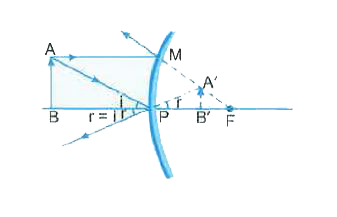 `rArr""(1)/(u)+(1)/(v)=(1)/(f)`, which is the mirror formula. As for a convex mirror f is `+ve` and u is `-ve`, hence `(1)/(v)=(1)/(f)-(1)/((-u))=(1)/(f)+(1)/(u)` It MEANS that `(1)/(v) gt (1)/(u)` or `|v| lt |u|` Thus, `m=(h.)/(h)=(|v|)/(|u)| lt 1` i.e., the image is diminished one. Moreover from above, it is clear that `(1)/(v) gt (1)/(f) or |v| lt |f|` Hence, the image is located between the pole and principle focus of convex mirror. |
|
| 15. |
A proton, a deuteron and an alpha-particle having the same kinetic energy are moving in circular trajectories in a constant magnetic field. If r_p, r_d and r_alpha denote respectively the radii of the trajectoriesof these particles then :- |
|
Answer» `r_alpha= r_d gt r_p` `r=(MV)/(Bq)=sqrt(2mK)/(Bq)` ( `because` Kinetic ENERGY , `K=1/2mv^2` ) For the same value of K and B , `r PROP sqrtm/q` `therefore r_p : r_d : r_alpha =sqrtm_p/q_p : sqrtm_d/q_d :sqrtm_alpha/q_alpha` `=sqrtm/e :sqrt(2m)/e : sqrt(4m)/(2e)=1:sqrt2:1` or `r_alpha = r_p lt r_d` |
|
| 16. |
Explain the reason why the Moon cannot retain its atmosphere. Take into account that during a lunar day its temperature rises above 100^@C. |
| Answer» Solution :At the TEMPERATURE of `100^@C` the root-mean-square velocity of the hydrogen molecules is `2.15 xx 10^3 m//s`. The escape velocity for the Moon is 2.4 km/s (see Problem 12.14). Naturally, the Moon.s gravitational field is UNABLE to RETAIN hydrogen. The root-mean-square VELOCITIES of molecules of other gases are several times smaller. But in ACCORDANCE with the Maxwell distribution there is always a considerable fraction of the molecules whose velocity is several times the average (see `xi` 25.2). Because of this Moon.s gravitational field is also unable to retain other gases, and they disperse in space. | |
| 17. |
The graph between sine of angle of refraction (sin r) in medium 2 and sin of angle of incidence (sin i) in medium 1 indicates that (tan 36^@ = 3/4) |
|
Answer» Total INTERNAL REFLECTION can take place |
|
| 18. |
Satellite revolving around the earth loses some energy due to collision. What would be the effect on its velocity and distance from the centre of the earth? |
|
Answer» VELOCITY INCREASES and DISTANCE DECREASES |
|
| 19. |
What we call the act of transmission of information? |
| Answer» SOLUTION :COMMUNICATION | |
| 20. |
Organelle without a cell membrane is |
|
Answer» ribosome |
|
| 21. |
In a certain region in a thin film 10 fringes are observed in the relfection of lambda=4200overset@A. How many fringes will be obeserved in the same region with lambda=6000overset@A? |
|
Answer» 3 |
|
| 22. |
The only partiallay filled subshell of a certain atom contains three electrons, the basic term of the atom having L=3. Using the Hund ruless, write the spectral symbol of the ground state of the given atom. |
|
Answer» Solution :With three electrons `S=(3)/(2)` and the spin part is TOTALLY symmetric. It is given that the basic TERM has `L= 3` so `L=3` is the state of highest orbital angular momentum. This is not possible with `p` elcetrons so we must have `d` electrons for which `L=3` for `3` electrons. For three `f,g` electrons `L gt 3`. Thus we have `3d` electrons. Then as in (6.120) the ground state is `.^(4)F_(3/2)` |
|
| 23. |
Nuclear reactions obey the law of conservation of |
|
Answer» MASS and energy |
|
| 24. |
Three electric charges q, q and - 2q are placed at the three corners of an equilateral triangle of side l. The magnitude of electric dipolemoment of the system of three particiles is : |
| Answer» ANSWER :C | |
| 25. |
An air -cored capacitor of plate area A and separation d has a capacity C . Two dielectric slabs are inserted between its plates in two different manners as shown . Calculate the capacitance in each case . |
|
Answer» Solution :(i) Let the charges on the are Q and -Q. Electric FIELD in free space is `E_(0)=(sigma)/(epsilon_(0))=(Q)/(Aepsilon_(0))` Electric field in first SLAB is `E_(1) =(E_(0))/(K_(1))=(Q)/(Aepsilon_(0)K_(1))` Electric field in second slab is `E_(2)=(E_(0))/(K_(2))= (Q)/(Aepsilon_(0)K_(2))` The POTENTIAL difference between the plates is `V = E_(0)(d-t_(1)-t_(2))+E_(1)t_(1)+E_(2)t_(2)` `implies V=E_(0)(d-t_(1)-t_(2)+(t_(1))/(K_(1))+(t_(2))/(K_(2)))"" ("As"E_(1)=(E_(0))/(K_(1)).E_(2)=(E_(0))/(K_(2)))` `:. V=(Q)/(Aepsilon_(0))(d-t_(1)-t_(2)+(t_(1))/(K_(1))+(t_(2))/(K_(2)))` `:.C=(epsilon_(0)A)/(d-t_(1)=t_(2)+(t_(1))/(K_(1))+(t_(2))/(K_(2)))` (ii) The capacitor can be CONSIDERED as TWO capacitors of capacitances `C_(1)` and `C_(2)` in parallel . 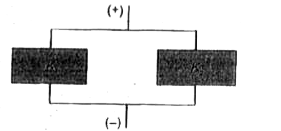 `implies C_(1)=K_(1) (epsilon_(0)A_(1))/(d). C_(2)=(K_(2)epsilon_(0)A_(2))/(d)` `implies ` Total capacitance `C= C_(1)+C_(2)` `implies C=((K_(1)A_(1)+K_(2)A_(2))epsilon_(0))/(d)` |
|
| 26. |
A lead ball dropped into a lake from a diving board 5 m above the water hits the water with certain velocity and then sinks to the bottom with the same constant velocity. If it reaches the bottom in 3s after it is dropped the depth of the lake is (g =10 ms^(-2)) |
| Answer» ANSWER :D | |
| 27. |
A resistance of 2Omega is connected across one gap of a metre-bridge (the length of the wire is 100 cm) and an unknown resistance, greater than 2Omega, is connected across the other gap. When these resistances are interchanged, the balance point shifts by 20 cm. Neglecting any corrections, the unknown resistance is |
|
Answer» Solution :REFER to the digram Apply the CONDITIONS of the balanced Wheatstone.s bridge for the two CASES. `(2)/(X)=(L)/(100-l)"……..(i)"` `(x)/(2)=(l+20)/(80-l)"……..(ii)"`  Equations (i) and (ii) give `x=3Omega` |
|
| 28. |
Three capacitors of capacitances 2 pF, 3 pF and 4 pF are connected in parallel. (a) What is the total capacitance of the combination ? (b) Determine the charge on each capacitor if the combination is connected to a 100 V supply. |
|
Answer» Solution :Here ` C_1 = 2 pF, C_2 = 3 pF, C_3 = 4 pF` (a) TOTAL capacitance of PARALLELCOMBINATION `C = C_1 + C_2 + C_3= 2 + 3 + 4 = 9 pF= 9 xx 10^(-12) F.` (b) In parallel combination potential difference across each CAPACITOR= V = 100V `:. Q_1= C_1 V = 2 xx 10^(-12)xx 100 = 2 xx 10^(-10) C` `Q_2= C_2 V= 3 xx 10^(-12) xx100 = 3 xx 10^(-10) C` and `Q_3= C_3 V = 4 xx 10^(-12) xx 100 = 4 xx 10^(-10) C`. |
|
| 29. |
The refractive index of a prism for monochromatic wave is sqrt(2) and its refracting angle is 60^(@). For minimum deviation the angle of incidence will be |
|
Answer» `30^(@)` |
|
| 30. |
A straight wire of length 30cm and mass 60 mg lies in a direction 30° east of north. The earth's magnetic field at this site is horizontal and has a magnitude of 0.8 G. The current must be passed through the wire so that it may float in air is (g = 10 m//s^2) |
|
Answer» `5 A` |
|
| 31. |
Two coils C_1 and C_2 are kept coaxially as shown the coil C_1is connected to a battery and the coil C_2is connected to a galvanometer. The deflection in galvanometer can be increased by |
|
Answer» INSERTING a soft iron ROD in coil `C_1` |
|
| 32. |
Two metal wires of identical dimensions are connected in series. If sigma_(1) and sigma_(2)are the conductivities of the metal wires respectively, the effective conductivity of the combination is |
|
Answer» `(sigma_(1) sigma_(2))/(sigma_(1) + sigma_(2))` Effective resistor R `R_(1) + R_(2) `....(1) But `R_(1) = (l)/(sigma_(1)A) and R_(2) = (l)/(sigma_(2)A)` `[ therefore R = (RHO l)/(A) and sigma = (1)/(gamma) ]` From EQ. (1) `(2l)/(sigma A) = (l)/(sigma_(1)A) + (l)/(sigma_(2)A) [ therefore R = (2l)/(sigma A)] ` `(2)/(sigma)= (1)/(sigma_(1)) + (1)/(sigma_(2)) = (sigma_(1) + sigma_(2))/(sigma_(1) sigma_(2))` , `therefore sigma = (2 sigma_(1) sigma_(2))/(sigma_(1) + sigma_(2))` 
|
|
| 33. |
(A) : The magnetic field in the open space inside and exterior to the toroid is zero. (R) : Field produced by a toroid could be derived using Amperes circuital law. |
|
Answer» Both 'A' and 'R' are true and 'R' is the CORRECT explanation of 'A'. |
|
| 34. |
The work function of a metal is2,5 xx (10^-19) J. (a) Find the threshold frequency for photoelectric emission. (b) If the metal is exposed to a light beam of frequency (6.0 xx 10^14) Hz, what will be the stopping potential ? |
|
Answer» Solution :GIVEN ` W_0 = 2.5 XX 10^(-19) J ` (a) we have `W_0 = hv_0` or ` V_0 = W_0 / H ` `=2.5 xx 10^(-19) / 6.063 xx10^(-34) ` `= 3.77 xx 10^(14) Hz` `=3.8 xx 10^(14) Hz` (B)` eV_0 = hv - W_0 ` or, V_0 = hv - W_0 / E ` ` = 6.63 xx 10^(-34) xx 6 xx 10^(14) - 2.5 xx 10^(-19) / 1.6 xx 10^(-19) ` `= 6.97 xx 10^(-19) - 2.5 xx 10^(-19) / 1.6 xx 10^(19) ` `0.91 V` |
|
| 35. |
Answer the following questions : (a) The angle subtended at the eye by an object is equal to the angle subtended at the eye by the virtual image produced by a magnifying glass. In what sense then does a magnifying glass provide angular magnification ? (b) In viewing through a magnifying glass, one usually positions one's eye very close to the lens. Does angular magnification change if the eye is moved back ? ( c) Magnifying power of a simple microscope is inversely proportional to the focal length of the lens. What then stops us from using a convex lens of smaller and smaller focal length and achieving greater and magnifying power ? (d) Why must both the objective and eye piece of a compound microscope have short focal lengths ? (e) When viewing through a compound microscope, our eyes should be positioned not on the eye piece, but a short distance away from itfor best viewing, why ? How much should be that short distance between the eye and eye piece ? |
|
Answer» Solution :(a) It is true that angular SIZE of image is equal to angular size of the object. By using magnifying glass, we keep the object FAR more CLOSER to the eye than at `25 cm`, its normal position WITHOUT use of glass. The closer object has larger angular size than the same object at `25 cm`. it is in thissense that angular magnification is achieved. (b) Yes, the angular magnification changes, if the eye is moved back. This is becasue angle subtended at the eye would be slightly less than the angle subtended at the lens. The effect is negligible when imafe is at much larger distance. ( c) Theoretically, it is true. However, when we decrease focal length, aberrations both spherical and chromatic become more pronounced. Further, it is difficult to grind lenses of very small focal lengths. (d) Angular magnification of eye piece is `(1 + (d)/(f_(e)))`. This increases as `f_(e)` decreases. Further, magnification of objective lens is `(v)/(u)`. As object lies close to focus of objectivelens `u = f_(0)`. To increases this magnification `(v//f_(0)), f_(0)` should be smaller. (e) The image of objective lens in eye piece is called 'eye ring'. All the rays from the object refracted by the objective go through the eye ring. Therefore, ideal position for our EYES for viewing is this eye ring only. When eye is too close to the eye piece, field of view reduces and eyes do not collect much of the light. The precise location of the eye ring would depend upon the separation between the objective and eye piece, and aslo on focal length of the eye piece, field of view reduece and eyes fo not collect much of the light. The precise location of the eye ring would depend upon the separation between the objective and eye piece, and also on focal length of the piece. |
|
| 36. |
Explain the current flow in a NPN transistor |
|
Answer» Solution :1. The conventional FLOW of current is based on the direction of the motion of holes. 2. In NPN TRANSISTOR, current enters from the base into the emitter |
|
| 37. |
In the figure shown S is the saurce of white light kept at a distance x_(0) frorn the plane of the slits. The source moves with a constant specd u towards the slits on the line perpendicular to the plane of the slits and passing through the slit S_(1). Find the instanteneous velocity (magnituce and direction). of the central maxima at time t having range 0 le t lt lt (x_(0)-d)/(u). Assume that D gt gt d. |
|
Answer» SOLUTION :`tan THETA=(d)/(2X) and y_(0)=D tan theta=D.(d)/(2x)` `v_0=(dy_(0))/(dt)=(-Dd)/(2x^2).dx/dt RIGHTARROW v_(0)=(Dd)/(2x^(2)). u""V_(0)=(Ddu)/(2(x_(0)-ut)^(2))("DOWNWARDS")` |
|
| 38. |
A train is moving due East and a car is moving due North, both with the same speed 30 km h^(-1). What is the observed speed and diredction of motion of car to the passsenger in the train ? |
|
Answer» EAST - NORTH |
|
| 39. |
A short bar magnet is placed horizontally along the magnetic N-S direction with its axis along the magnetic E-W direction.The resultant horizontal magnetic induction on its equator at a distance of 20 cm from centre is (B_(H)=4xx10^(-5)T) |
|
Answer» `4.5 Am^(2)` `4xx10^(-5)=(10^(-7)xx2xxM)/(27xx10^(-3))` `therefore M=5.4Am^(2)` |
|
| 40. |
When 3 mA and 5 mA currents are passed through two galvanometers P and Q, they give same deflection of 10 divisions. Hence |
|
Answer» <P>P is more SENSITIVE than Q. |
|
| 41. |
Using the following data .Mass hydrogen atom = 1.00783 u Mass of neutron = 1.00867 u Mass of nitrogen atom (._7N^(14)) 14.00307 u The calculated value of the binding energy of the nucleus of the nitrogen atom(._7 N^(14)) is close to |
|
Answer» 56 MeV |
|
| 42. |
A new system of units is evolved in which the values of mu_(0) and epsilon_(0) are 2 and 8 respectively. Then the speed of light in the system will be |
|
Answer» 0.25 `=(1)/(4)=0.25` |
|
| 43. |
A thermally insulated container is divided into two parts by a screen. In one part the pressure and temperature are P and T for an ideal gas filled. In the second part it is vacuum. If now a small hole is created in the screen, then the temperature of the gas will |
|
Answer» decrease |
|
| 44. |
If the earth had no atmosphere ...... . |
|
Answer» sky could be BRIGHT. |
|
| 45. |
A proton deutron and an alpha -particle having the same K.E. are moving in circular trajectories in a constant magnetic field. If r_(p), r_(d) and r_(a) denote respectively radius of the trajectories of these particles then |
|
Answer» <P>`r_(ALPHA)=r_(p)ltr_(d)` |
|
| 46. |
Statement I: Sky wave suffers total internal reflection in ionosphere, whereas space wave directly penetrates the ionosphere and advances towards higher altitude. Statement II: Frequency of sky wave is less than that of space wave. As frequency decreases, the refractive indices of the layers of ionosphere also go down below the refractive index of air. |
|
Answer» STATEMENT I is TRUE, statement II is true, statement II is a correct EXPLANATION for statement I. |
|
| 47. |
A radioactive nucleus ‘A’ undergoes a series of decays according to the following scheme : Aoverset(alpha)(to)A_(1)overset(beta)(to)A_(2)overset(alpha)(to)A_(3)overset(gamma)(to)A_(4) The mass number and atomic number of A are 180 and 72 respectively. What are these numbers for A_(4)? |
|
Answer» Solution :As per decay series, mass number and atomic numbers of various nuclei are : `" "_(72)^(180)A OVERSET(ALPHA)(to)" "_(70)^(176)A_(1)overset(beta^(-))(to)" "_(71)^(176)A_(2)overset(alpha)(to)" "_(69)^(172)A_(3)overset(gamma)(to)" "_(69)^(172)A_(4)^(*)` Therefore, mass number of `A_(4)` is 172 and its atomic number is 69. |
|
| 48. |
If the angle between the pass axis of polariser and the analyser is 45^(@), write the ratio of the intensities of original light and the transmitted light after passing through the analyser. |
| Answer» SOLUTION :If intensity of polarised LIGHT is `I_(1)` then intensity of transmitted light after PASSING through the analyser will be `I_(2)=I_(1)cos^(2)45^(@)=(I_(1))/(2)implies(I_(1))/(I_(2))=(2)/(1)`. | |
| 49. |
When a venturimeter is used in an inclined position, it will show |
|
Answer» a)Same reading |
|
| 50. |
At an airport, a person is made to walk through the doorway of a metal detector, for security reasons. If she/he is carrying anything made of metal, the metal detector emits a sound. On what principle does this detector work? |
| Answer» Solution :The metal detector works on the PRINCIPLE of resonance in ac circuits. When you walk through a metal detector, you are, in fact, WALKING through a coil of many turns. The coil is CONNECTED to a capacitor tuned so that the circuit is in resonance. When you walk through with metal in your pocket, the impedance of the circuit CHANGES - resulting in significant change in current in the circuit. This change in current is detected and the electronic circuitry CAUSES a sound to be emitted as an alarm. | |