

Saved Bookmarks
This section includes 7 InterviewSolutions, each offering curated multiple-choice questions to sharpen your Current Affairs knowledge and support exam preparation. Choose a topic below to get started.
| 1. |
Deutrium was discoveredin 1932byHarold Urey by measuring the small changein wavelength for a particulartransition in .^(1)H and .^(2)H. This isbecause, the wavelength of transition depend to a certainextent on thenuclear mass. If nuclear motion is takeninto account, then the electrons and nucleus revolve around their common centre of mass. Sucha system is equivalent to a single particle with a reduced mass mu,revolvingaround the nucleus at a distance equal tothe electron -nucleusseparation. Here mu = m_(e) M//(m_(e)+M), where M is the nuclear mass and m_(e) is the electronic mass. Estimatethe percentage difference in wavelength for the 1st line of the Lyman seriesin .^(1)H and .^(2)H. (mass of .^(1)H nucleus is 1.6725 xx 10^(-27) kg, mass of .^(2)H nucleus is 3.3374 xx 10^(-27) kg, Mass of electron = 9.109 xx 10^(-31) kg.) |
|
Answer» `2.7xx10^(-1)%`. We KNOW that `=1/lambda=R[1/n_f^2-1/n_i^2]` As `n_i` and `n_f`are fixed for by MASS series for hydrogen and deuterium. `lambda prop 1/R " " or " " lambda_D/lambda_H=R_H/R_D`..(i) `R_H=(m_e e^4)/(8 epsilon_0ch^3)=(mu_H e^4)/(8 epsilon_0 ch^3) IMPLIES R_D=(m_e e^4)/(8 epsilon_0ch^3)=(mu_H e^4)/(8 epsilon_0 ch^3)` `therefore R_H/R_D=mu_H/mu_D`...(ii) From equation (i) and (ii) `R_D/R_H=mu_H/mu_D`...(iii) Reduced mass of hydrogen , `mu_H=m_e/(1+m_e//M)=m_e(1-m_e/M)` Reduced mass of deuterium `mu_D=(2M.m_e)/(2M(1+m_e/(2M)))=m_e(1-m_e/(2M))` where M is mass of proton `mu_H/mu_D=(m_e(1-m_e/M))/(m_e(1-m_e/(2M)))=(1-m_e/M)(1-m_e/(2M))^(-1)` `=(1-m_e/M)(1+m_e/(2M))` `mu_H/mu_D=(1-m_e/(2M))` `mu_H/mu_D=(1-1/(2xx1840))=0.99973`...(iv) `(because M=1840 m_e)` From (iii) and (iv) `lambda_D/lambda_H=0.99973 , lambda_D=0.99973 lambda_H` Percentage difference in wavelength of Lyman series in `.^1H` (hydrogen ) and `.^2H` (deuterium) =`((lambda_H-lambda_D)/lambda_H)xx100` `=(1-0.99973 ) x 100 =0.027 %=2.7xx10^(-2)%` |
|
| 2. |
Red light of wavelength 5400 Å from a distant source modulated wave of 60% modulattion by using a condenser of capacity 250 pF in parallel with a load resistnce 100kOmega. Find the maximum modulated frequency which could be detected by it. |
|
Answer» 1.89 mm a=0.80 mm = `8 xx10^(-4)`m, D=1.4m `therefore` Distance between FIRST TWO dark bands on each side of CENTRAL maximum is the width of central maximum `=2x = (2lambdaD)/d = (2 xx 5.4 xx 10^(-7) xx 1.4)/(8 xx 10^(-4))` `=1.89 xx 10^(-3)` m =p1.89 m |
|
| 3. |
The diagram of a logic circuit is given below . The output F of the circuit is represented by : |
|
Answer» `W.(X+Y)` Output of lower OR gate = W + Y NET outputF = (W+X) (W+Y) `="WW" +WY + "XW" + "XY"` [Since WW = W] `=W(1+Y)+XW+XY""` [Since 1 + Y =1 ] `=W +XW +XY = W(1+X)+XY=W+XY` |
|
| 4. |
It was a celebration of South Africa's first........... government |
|
Answer» AUTOCRATIC, racial |
|
| 5. |
Two discs have same mass and thickness. Their materials are of densities rho_(1)andrho_(2). The ratio of their moment of inertia about central axis will be : |
|
Answer» `rho_(1):rho_(2)` `therefore (I_(1))/(I_(2))=(r_(1)^(2))/(r_(2)^(2))` ALSO if `.rho.` is the thickness `pir_(1)^(2)rho_(1)=pir_(2)^(2)rho_(2)` (masses EQUAL) `therefore (r_(1)^(2))/(r_(2)^(2))=(rho_(2))/(rho_(1))=(I_(1))/(I_(1))=(rho_(2))/(rho_(1))` |
|
| 6. |
Why are NAND and NOR gate called universal gate ? |
| Answer» Solution :Because by a SUITABLE combination of NAND or NOR GATES , we can BUILD up the basic gates OR , AND and NOT . | |
| 7. |
What happens, if the monochromatic light used in young's double slit experiment is replaced by white light? |
|
Answer» no fringes obtained |
|
| 8. |
A beam of light travelling in water strickes a glass plate, which is also immersed in water. When the angle of incidence is 51^@ , the reflected beam is found to be plane polarised. What is found to be polarised.What is the refractive index of glass if the refractive index of water is 4/3 ? [ tan 51^@ = 1.235] |
|
Answer» 1.646 |
|
| 9. |
Can the instantaneous power output of an a.c. source ever be negative ? Can the average power output be negative? |
| Answer» Solution : Instantaneous power OUTPUT of an a.c. SOURCE can be NEGATIVE but the average power output can NEVER be negative. | |
| 10. |
A proton falls freely under gravity of Earth.Its de-Broglie wavelength after 10s of its motion is ……….Neglect the forces other than gravitational force. (g=10 m//s^(2),m_(p)=1.67xx10^(-27)Kg,h=6.625xx10^(-34)Js) [similar as Oct. 2012,'15] |
|
Answer» <P> Solution :From `v=v_(0)+gt`v=gt `therefore`Momentum ,p=`m_(p)v=m_(p)gt` `therefore lambda=(h)/(p)=(h)/(m_(p)"gt")=(6.625xx10^(-34))/(1.67xx10^(-27)xx10xx10)` `therefore lambda=3.96xx10^(-9)m` |
|
| 11. |
In a single-slit diffraction experiment the angular width of central maxima is independent of _____. |
| Answer» SOLUTION :DISTANCE of SCREEN from the SLIT. | |
| 12. |
figure shows a neutral metallic sphere with a point charge +Q placed near its surface. Electrostatic equilibrium conditions exist on metallic sphere. Mark the correct statement : |
|
Answer» Net flux throughGaussian surface due to charge Q is zero |
|
| 13. |
At 1 atm pressure, 1 g of water having a volume of 1 cm^3 becomes 1671 cm^3 of steam when boiled. The heat of vaporization of water at 1 atm is 539 cal g^(-1) . What is the change in internal energy during the process? |
|
Answer» 539 cal Q=mL= 1 X 539 = 539 cal `THEREFORE` Work DONE W=P `(V_v- V_l)` `= 1.013xx10^5 XX(1671-1)xx10^(-6)` J `=169.2/4.18` cal = 40.5 cal `therefore` Change in INTERNAL energy U=539 cal - 40.5 cal = 498.5 cal |
|
| 14. |
The energy level diagram of an element is given below. Identify, by doing necessary calculations,-085 eV which transition corresponds to the emission of a spectral line of wavelength 102.7 mm. |
|
Answer» Solution :If the WAVELENGTH of the emitted SPECTRAL line be `lambda = 102.7 nm=102.7 xx 10^(-9) m`, the energy of emitted photon will be `E = (hc)/(lambda) = (6.626xx 10^(-34) xx 3xx 10^(-8))/(102.7 xx 10^(-9)J)` ` = (6.626xx 10^(-34) xx 3 xx 10^(8))/(102.7 xx 10^(-9)) J` ` = (6.626 xx 10^(-34) xx 3 xx 10^(8))/(102.7 xx 10^(-9) xx 1.602 xx 10^(-19)) eV = 12.08 eV` From the energylevel diagram , we findthata radiation photon of 102.7 nm can be emitted onlywhenan electron transitiontakes place from - 1.5 eV energyto- 13.6V energylevel becausethen . `E_(1) = E_(2) = - 1.5 - (-13.6) eV = + 12.1 eV` Hence, TRANSITION D REPRESENT emission of spectral line of wavelenght 102.7 nm . 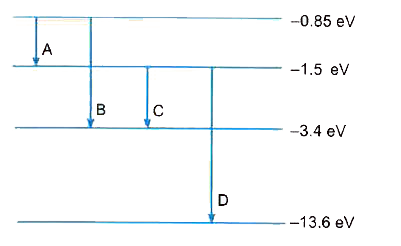
|
|
| 15. |
A particle of mass m is projected with speed u at angle theta with horizontal from ground. The work done by gravity on it during its upward motion is |
|
Answer» `(-m U^(2)SIN^(2)THETA)/(2)` |
|
| 16. |
Which relations are always correct in between the displacement (vecx) velocity (vecv) and acceleration (veca) for a simple harmonic motion ? |
|
Answer» `VECA*vecx LT0` |
|
| 17. |
A stone falls freely under gravity. It covers distance h_1, h_2, and h_3. In first 5 sec, next 5 sec and next 5 sec respectively. The relation between h_1,h_2, and h_3 is |
|
Answer» `h_1 = (h_1)/(3) = (h_3)/5` |
|
| 18. |
A modulating signal is a square wave as shown in figure. The carrier wave is given by c(t)=2 sin(8pit)"volt". (i) Sketch the amplitude modulated wave from (ii) What is the modulation index? |
|
Answer» Solution :(`i`) Amplitude of modulating signal from fig is `A_(m)=1` Amplitude of carrier wave from the EQUATION is `A_(C)=2` Then maximum amplitude of modulated wave is `A_(max)=A_(c)+A_(m)` `, A_(max)=2+1=3` and MINIMUM amplitude of modulated wave is `A_(min)=A_(c)-A_(m)` Then the sketch for amplitude modulated wave is as below. 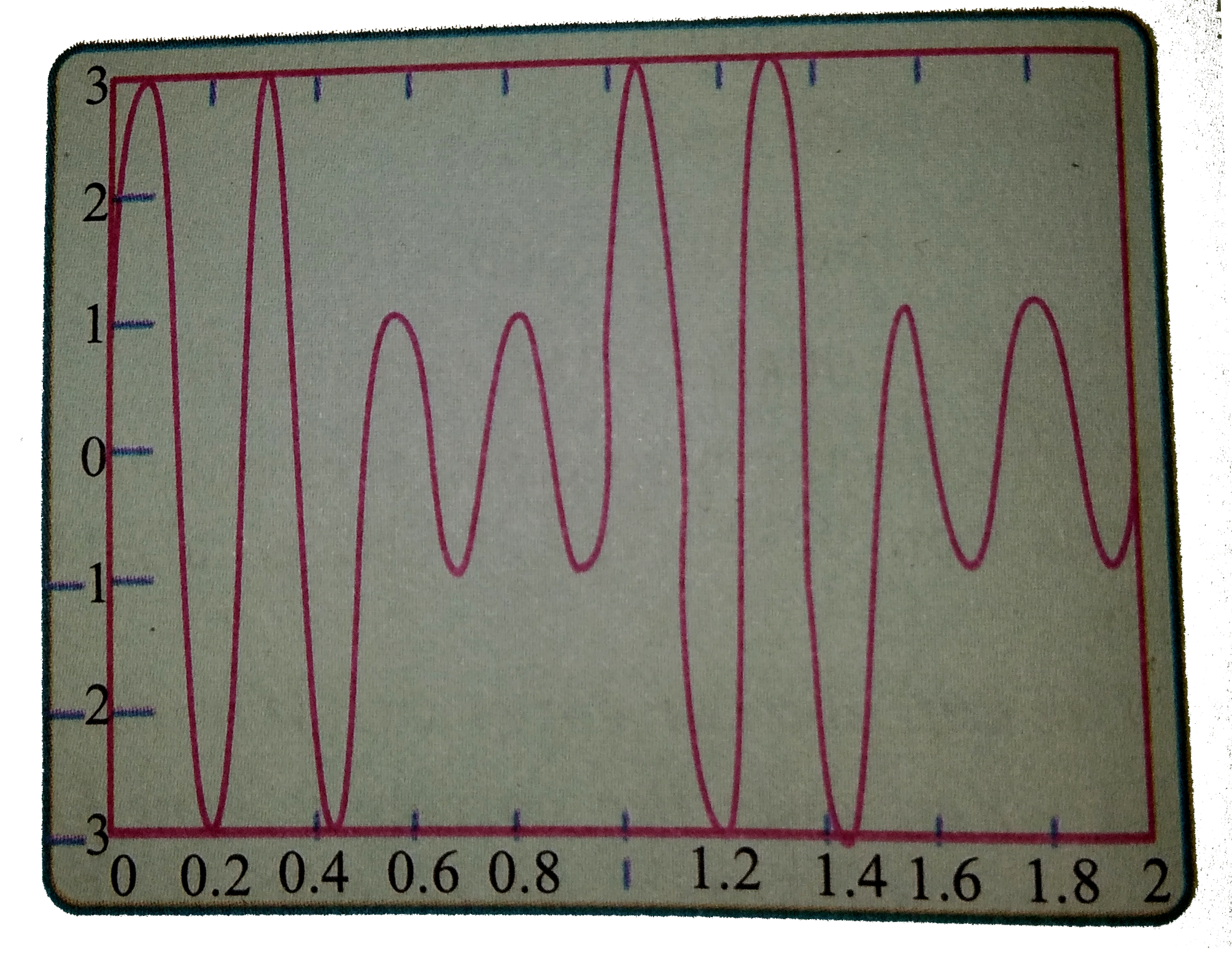 (`ii`) MODULATION index `MU=(A_(m))/(A_(c))=(1)/(2)=0.5` |
|
| 19. |
A streched string fixed at both ends has n nodes then the length of string in terms of wavelength is : |
|
Answer» `n (lambda)/(2)` `THEREFORE ` Length of STRING = ( n - 1) `(lambda)/(2)` Hence CORRECT choice is (c). |
|
| 20. |
A linear object of size 1.5 cm is placed at 10 cm from a lens of focal length 20 cm. The optic centre of lens and the object are displaced are displaced a distance Delta. Thed magnification of the image formed is m. (Take optic centre of origin). The coordinates of image of A and B are (x_(1),y_(1)) and (x_(2),y_(2)) respectively then |
|
Answer» `(x_(1),y_(1)) = (-20 CM, -2 cm)`  `1/v - 1/u = 1/f , 1/v = 1/20 - 1/10 = (-1)/(20) rArr v= - 20 cm` Magnification, `m = (v)/(u) = (-20)/(-10) = 2` Heightof image `= 1.5 xx 2 = 3 cm` The `y_(1)` coordinate of a point A on the image will be ` y_(1) = (-0.5) xx 2 = - 1 cm` The `y_(2)` coordinate of a point B on the image will be `y_(2) = 1 xx 2 = 2 cm` |
|
| 21. |
A plane longitudinal wave having angular frequency omega = 500 rad /sec is travelling in positive x-direction in a medium of density rho =1 kg/m and bulk modulus 4 xx 10^4 N//m^2 . The loudness at a point in the medium is observed to be 20 dB. Assuming at x = 0 initial phase of the medium particles to be zero, find the equation of the wave |
|
Answer» `y = 2 xx 10^(-9) SIN (500 t- (5X)/(2) )` |
|
| 22. |
All the magnetic materials lose their magnetic properties when |
|
Answer» dipped in water |
|
| 23. |
The potential difference across the terminals of a battery is 8.5V when a current of 5A flows through it from the negative terminal to the positive terminal. When a current of 4A flows throgh it in the opposite direction, the terminal potential difference of the battery is 10V. Find the emf and the enternal resistance of the battery. |
|
Answer» Solution :`E-5r=8.5V``RARR` (1) `E+4r=10V``rarr` (2) from (1) and (2),`r = 0.167 omrga` substitute in (2),we GET E = 9.3V` |
|
| 24. |
A digital signal : |
|
Answer» Is LESS reliable than ANALOG signal |
|
| 25. |
Four point charges q_(A) = 2mu C, q_(B)= -5mu C q_(C )= 2mu C and q_(D) = -5muC are located at the corners of a square ABCD of side 10cm. What is the force on the charge of 1mu C placed at the centre of the square. |
| Answer» Answer :A | |
| 26. |
In the arrangement shown in figure, coefficient of friction between two fixed points A & B which are at the same horizontal level. The inclination of the chain with the horizontal at both the points of support is theta. What is the tension of the chain at the mid point? |
|
Answer» 8 N |
|
| 27. |
The magnitude of the vector product of two vectors is sqrt(3) times their scalar product. The angle between the vectors is : |
|
Answer» `pi/2` `IMPLIES theta=60^@` or `pi/3` |
|
| 28. |
(a) Fig shows a capacitor made of two circular plates each of radius 12cm and separated by 5.0mm. The capacitor is being charged by an external source (not shownin the figure). The charging current is constant and equal to 0.15A. Use Ampere's law (modified to include displacement current as given in the text) and the symmetryin the problem to calculate magnetic field between the plates at a point (i) on the axis (ii) 6.5 cm from the axis (iii) 15cm from the axis. (b) At what distance from the axis is the magnetic field due to displacement current greatest? Obtain the maximum value of the field. |
|
Answer» Solution :Here, `R=0.12m,I=0.15A` `:.` Area of the plate, `A=piR^2=pixx(0.12)^2m^2` (a) Consider a loop of RADIUS r between the two circular plates, PLACED coaxially with them. Then area of the loop, `A'=pir^2` By SYMMETRY magnetic FIELD induction `vecB` is equal in magnitude and is tangentially to the CIRCLE at every point. In this. only displacement current `I_D` will cross the loop. Therefore, using Ampere's Maxwell law, we have `ointvecB.vec(dl)=mu_0I_D` `2pirB=mu_0xx`(current passing through the area A') `=mu_0I_D (pir^2)/(piR^2)` for `r lt R` `=mu_0I_D` for` r gt R` Thus, `B=(mu_0I_Dr^2)/(R^2 2pir)=(mu_0I_Dr)/(2piR^2)`....(i) (If` r lt R)` and `B=(mu_0I_D)/(2pir)`....(ii) (If `r gt R)` (i) On the axis, `r=0` Using (i), we get, `B=0` (ii) For a point 6.5cm from the axis, `r=6.5cm=6.5xx10^-2m`. Using (i), wehave, `B=(4pixx10^-7xx0.15xx6.5xx10^-2)/(2pixx(12xx10^-2)^2)` `=1.35xx10^-7T` (iii) For a point 15 cm from the axis, `r=15 cm=0.15m`. Using (ii), we have `B=(4pixx10^-7xx0.15)/(2pixx0.15)=2xx10^-7T` (b) From equation (i) and (ii) we note that B is maximum if `r=R=12cm=0.12m` `:. B_(max)=(mu_0I_D)/(2piR)=(4pixx10^-7xx0.15)/(2pixx0.12)` `=2.5xx10^-7T` |
|
| 29. |
A satellite is orbiting the Earth in a circular orbit of radius R. Which one of the following statement it is true? |
|
Answer» ANGULAR movement variesas `1/(sqrt(R ))` |
|
| 30. |
Two circular coils of mean radii 0.1 m and 0.5 m consisting of 5 turns and 10 turns respectively are arranged concentric to one another with their planes at right angles to each other. If a current of 2A is passed through each of them, calculate the magnitude of the resultant magnetic field at their common centre. |
|
Answer» Solution : Given : `r_(1)=0.10 m, r_(2)=0.05m, n_(1)=5, n_(2)=10, I=2A` We know that, B at the centre of the circular conductor carrying current `""B=mu_(0)/(4PI)(2pinI)/r""tesla` Hence, `""B_(1)=(10^(-7) times 2 times 3.142 times 5 times 2)/(0.10)` `""B_(1)=6.284 times 10^(-5)T` Similarly, `""B_(2)=(10^(-7) times 2 times 3.142 times 10 times 2)/(0.05)` `""B_(2)=25.136 times 10^(-5)T` Resultant field, `""B=sqrt(B_(1)^(2)+B_(2)^(2))` `""=10^(-5)sqrt((284)^(2)+(25.136)^(2))` `""=10^(-5)sqrt(39.489 times 631.818)` `""=10^(-5)sqrt(671.307)` `""=10^(-5) times 25.91` Resultant field at the centre = `2.591 times 10^(-4)T` `""alpha=tan^(-1)(B_(2)/B_(1))` `""=tan^(-1)((25.136 times 10^(-5))/(6.284 times 10^(-5)))` `""a=tan^(-1)(4) " w.r.t "B_(1)` i.e., `""a=75^(@)58^(') " w.r.t "B_(1)` The direction of the resultant is `75^(@)58^(')` w.r.t. the direction of `B_(1)` 
|
|
| 31. |
A nearly massless rod is pivoted at one end so that it can swing freely as a pendulum. Two masses 2m andm are attached to it at distance b and 3b respectively from the pivot. The rod is held horizontal and then released. The angular acceleration of the rod at the instant it is released is : |
|
Answer» Solution :Here torque DUE to two masses 2m and m is `tau=2mgxxb+mgxx3b` `=5mgb` M.I. of the two masses `I=2mb^(2)+9mb^(2)` `=11mb^(2)` Now `alpha=(tau)/(I)=(5mgb)/(11mb^(2))` `=(5g)/(11b)` |
|
| 32. |
Answer the following questions : (a) Long distance radio broadcasts use short - wave bands. Why ? |
| Answer» Solution :Long distance radio broadcast is not possible using long or medium wave BANDS because these waves, travelling as ground waves, can cover a maximum distance of about 200 km. When USED as sky waves the short waves pass through the LOWER portion of the atmosphere but are reflected back from ionosphere. In this way, short waves can TRAVEL very large distances ns. and can even travel round the whole earth. | |
| 33. |
For hydrogen C_P=3.4(cal)/(@_C),C_V=2.4(cal)/(@_C), R=8.3 J/k mole k. Calculate J. (M=2) |
|
Answer» 4.15 J/cal |
|
| 34. |
A generator supplies 100 V to the primary - coil of a transformer of 50 turns.If the secondary coil has 500 turns, then the secondary voltage is |
|
Answer» 100V |
|
| 35. |
A spherical water drop of radius R is split into 8 equal droplets. If T is the surface tension of water, what is the work done in the process? |
|
Answer» SOLUTION :For a water drop, W = `4piR^2 xx T` `4/3 piR^3 = 4/3 pir^3 xx 8` `therefore` r = r/2` CHANGE in AREA = `4pir^2 xx 8 - 4piR^2` dA = `4pi (8r^2 - R^2) = 4piR^2` `therefore` change in ENERGY = T dA = `4piR^2T` |
|
| 36. |
A batsman deflects a ball by an angle of 60^@ without changing its initial speed of 20 ms^(-1). What is the impulse imparted to the ball if its mass is 0.15 kg? |
| Answer» Answer :C | |
| 37. |
A ball is projected with 20sqrt2 m/s at angle 45^(@) with horizontal. The angular velocity of the particle at highest point ofits journey about point of projection is |
|
Answer» 0.1 rad/s |
|
| 38. |
The electric power transferred by a cell to an external resistance is maximum when the external resistance is equal to ...(r internal resistance) |
| Answer» ANSWER :C | |
| 39. |
From which region of the electromagnetic spectrum, the radiations useful for telecommunication are selected? |
|
Answer» INFRARED |
|
| 40. |
Minimum potential energy of dipole in uniform electric field is- |
| Answer» Answer :B | |
| 41. |
An athlete in the olympic games cover a distance of 100 m. in 10 s. His kinetic energy can be estimated to be in the the range. |
|
Answer» 200 J-500 J `V=(100)/(10)=10 m//s` `:. K.E.=1/2mv^2` If mass is 40 kg then,`K.E.=1/2xx40xx(10)^2=2000 J` If mass is 100 kg then,`K.E.=1/2xx100xx(10)^2=5000 J` |
|
| 42. |
An a.c. voltage source of variable angular frequency w and fixed amplitude V, is connected in series with a capacitance C and an electric bulb of resistance R (inductance zero). When a is increased. |
|
Answer» the bulb glows dimmer. |
|
| 43. |
In the above question, if plates P_1 and P_2 are connected by a thin conducting wire, then the amount of heat produced will be |
|
Answer» `Q^2/(Aepsilon_0)d` Heat produced `=DeltaH=U_(1)-U_(1)=(1)/(2)(Q^(2))/(epsilon_(0)A//d)-0` 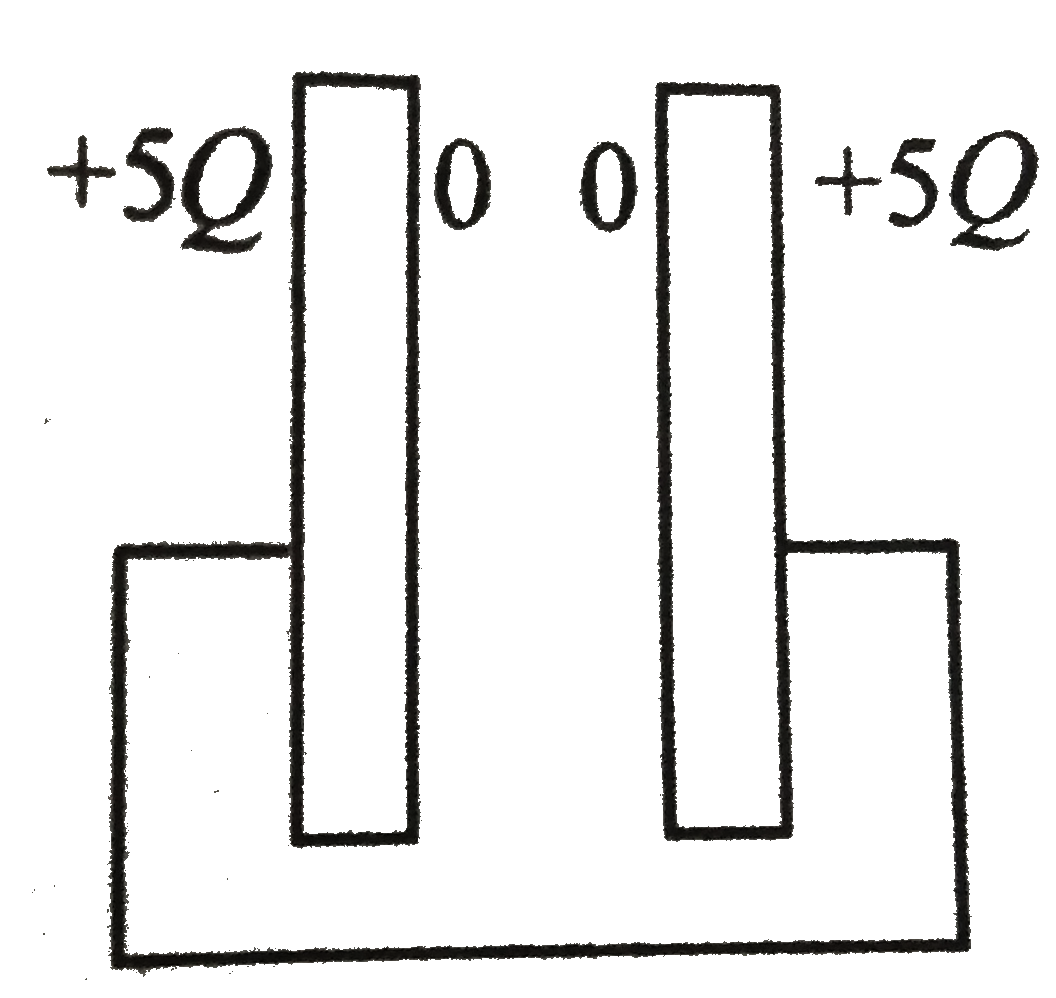
|
|
| 44. |
A magnet is dropped down an infinitely long vertical copper tube |
|
Answer» The MAGNET moves with continuously increasing velocity and ULTIMATELY acquires a constant terminal velocity. |
|
| 45. |
If the polarising angle for red light is 60^@, for a certain medium, then the polarising angle for the blue light for the same medium will be : |
|
Answer» `60^@` |
|
| 46. |
THEY DROVE OVER TO THE ………..AUTO DEALERS. |
|
Answer» SIKKA |
|
| 47. |
The diameter of the pupil of human eye is 2.5 mm. Assuming the wavelength of light used is 5000 Å. What must be the minimum distance between two point like objects to be seen clearly if they are at a distance of 5 m from the eye ? |
|
Answer» `1.22xx10^(-3)m` `=(1.22xx5xx10^(-7))/(25xx10^(-4))=1.22xx10^(-3)m` |
|
| 48. |
A point object lies insidea transpatent solid sphere of radius 20cmand of refractiveindex n = 2. When the object is viewed form airthroughthe nearestsurfaceit is seenat a distance 5 cm form the surface. Find theapparent distanceof objectwhen itsseen throughthe farthestcurved surface |
|
Answer» |
|
| 49. |
Bohr's radius is given by: |
|
Answer» `r_n=h/(2pimc` |
|
| 50. |
When a battery is connected to the resistance of 10Omega the current in the circuit is 0.12 A. The same battery gives 0.07A current with20Omega Calculate e.m.f. and internal resistance of the battery. |
|
Answer» Solution :We KNOW that `E=Ir+IR` `I_(1)R+I_(1)R_(1)=I_(2)r+I_(2)R_(2), r=(I_(2)R_(2)-I_(1)R_(1))/(I_(1)-I_(2))` `r=(0.07xx20-0.12xx10)/(0.12-0.07)=(1.4-1.2)/(0.05)=(0.2)/(0.05)=4Omega` `"INTERNAL resistance r"=4Omega,"e.m.fE"=Ir+IR` `0.12xx4+0.12xx10=0.48+1.2, E="1.68 volt."` |
|