

Saved Bookmarks
This section includes 7 InterviewSolutions, each offering curated multiple-choice questions to sharpen your Current Affairs knowledge and support exam preparation. Choose a topic below to get started.
| 1. |
Plutonium decays with half-life of 24000 yr. If plutonium is stored for 7200 yr, the fraction of it that remains is : |
|
Answer» `1//8` |
|
| 2. |
If objective and eyepiece lenses of a compound microscope are interchanged, it can work as a telescope. |
| Answer» Solution :FOCAL length and APERTURE of both LENSES of a microscope are small but OBJECTIVE of a telescope must have a large focal length and large aperture. | |
| 3. |
Calculate the total splitting Delta omega of the spectral line .^(3)D_(3) rarr .^(3)P_(2) in a weak magnetic field with inductionB= 3.4KG. |
|
Answer» Solution :For the TWO levels `E'+(0)=E_(0)-g'mu'_(B)M'_(Ƶ)B` `E_(0)=E_(0)0g mu_(B)M_(Ƶ)B` and HENCE the shift of the component is the value of `Delta OMEGA =(mu_(B)B)/( ħ)[g'M'_(Ƶ)-gM_(Ƶ)]` subject to the selection rule `Delta M_(Ƶ)=0, +- 1` For `(3)D_(3)` `g'1+(3xx4+1xx2-2xx3)/(2xx3xx4)= 1+(8)/(24)=(4)/(3)` For `.^(3)P_(2)`, `g=1+(2xx3+1xx2-1xx2)/(2xx2xx3)=(3)/(2)` Thus `Delta omega=(mu_(B)B)/( ħ)|(4)/(3)M'_(Ƶ)-(3)/(2)M_(Ƶ)|` For the different transition we have the following table `M_(Ƶ)g'-M_(Ƶ)g` `3 rarr 2 mu_(B)B 0 rarr1 -(3)/(2)mu_(B)B` `2 rarr2 -(1)/(3)mu_(B)B 0 rarr0 0` `2 rarr7//6mu_(B)B 0 rarr -1 3//2mu_(B)B` `1 rarr 2 -5//3mu_(B) B -1 rarr0 -4//3 mu_(B) B` `1 rarr1 -1//6mu_(B)B -1 rarr-1 1//6//6mu_(B)B` `1 rarr 0 4//3mu_(B)B -1 rarr -2 rarr 5//3mu_(B)B` `2 rarr -1rarr -7//6mu_(B)B` `-2 rarr-2 rarr 1//3mu_(B)B` `-3 rarr -2 rarr -mu_(B)B` There are 15 lines in all. The lines farthest out are `1 rarr 2` and `-1 rarr -2` The splitting between them is the total splitting. It is `Delta omega +(10)/(3) mu_(B) B//ħ` Substitution gives `Delta omega= 7.8xx10^(10) rad//sec`. |
|
| 4. |
A long straight wire is carrying a current of 25 A. A squre loop of side length 10 cm carrying a current of15 A, is placed 2 cm from the wire as shown in figure. The force on the loop is |
|
Answer» `3.1xx10^(-3)N` TOWARDS the WIRE |
|
| 5. |
If the minimum wavelength of Balmer series is lamda_(1) and the maximum wavelength of Lyman series is lamda_(2), then ...... |
|
Answer» `lamda_(2)=3lamda_(1)` `(1)/(lamda_(1))=R[(1)/(2^(2))-0]` `:.lamda_(1)=(4)/(R)"".........(1)` For maximum wavelength of Lyman series n = 2 `:.(1)/(lamda_(2))=R[(1)/(1^(1))-(1)/(2^(2))]=R[(1)/(1)-(1)/(4)]=R[(3)/(4)]` `:.lamda_(2)=(4)/(3R)""......(2)` `:.(lamda_(1))/(lamda_(2))=(4XX)/(R)xx(3R)/(4)=3"":.lamda_(1)=3lamda_(2)` |
|
| 6. |
Linear momentum of electron revolving in n^(th) orbit of atom p=(nh)/(2pir). If r=10^(-15)m is the radius of orbit then the linear momentum inground state will have ....... kgms^(-1). |
|
Answer» <P>10.54 `=((1)xx6.62xx10^(-34))/(2xx3.14xx10^(-15))` `=1.05414xx10^(-19)` `=1.054xx10^(-19)KGMS^(-1)` |
|
| 7. |
If electron in the atom is replaced by a particle (muon) having the same charge but mass about 200 times as that of the electron to form a muonic atom, how would : (i) the radius and (ii) the ground state energy of this be affected ? |
|
Answer» SOLUTION :A muonic atom is the atom in which a negatively CHARGED muon of mass about 200 `m_(e)`, revolves around a PROTON. In Bohr.s atomic model, `RPROP(1)/(m)` So, `(r_(mu))/(r_(e))=(m_(e))/(mmu)` or `(r_(mu))/(r_(e))=(1)/(200)` or `r_(mu)=(r_(e))/(200)` `:.` i.e., the radius reduces to `(1)/(200)` times. Again, in Bohr.s atomic model `Epropm` So, `(E_(mu))/(E_(e))=(m_(mu))/(m_(e))=(200)/(1)` or `E_(mu)=200E_(e)` i.e., the ground STATE energy increases by 200 times. |
|
| 8. |
Draw a plot showing the variation of resistivity of a (i)conductor and (ii) semiconductor, with the increse in temperature. |
Answer» SOLUTION :
|
|
| 9. |
A ball of superconducting material is dipped in liquid nitrogen and placed near a bar magnet. (i) In which direction will it move ? (ii) What will be the direction of it's magnetic moment ? |
|
Answer» Solution :We know that a superconducting material and nitrogen both are diamagnetic in nature. When a diamagnetic material is DIPPED in liquid nitrogen, it again BEHAVE as a diamagnetic material. When this diamagnetic material is placed near a bar magnet, it will be feebly magnetised opposite to the DIRECTION of magnetising field. Hence, (i) ball experiences repulsion and move AWAY from the magnet. (II) Its magnetic moment is from left to right and it is opposite to the direction of magnetic field. |
|
| 10. |
A dipolo is placed in the field of a point charge, the distance between the dipole and the field source being much greater than the dipole separation. Find the force acting on the dipole and the torque, if the dipole is arranged: perpendicular to the line of force. |
Answer» Solution :It is EVIDENT from Fig. 24.8a that in this case a force couple acts on the dipole. The resultant of the couple is ZERO. To obtain the torque, multiply the force by the dipole SEPARATION.
|
|
| 11. |
When two coherent monochromatic light beams of intensities 1 and 41 are superimposed, the ratio between maximum and minimum intensities in the resultant beam is |
| Answer» ANSWER :A | |
| 12. |
A thin semi-circular conducting ring (PQR) of radius r is falling with its plane vertical in a horizontal magnetic field B, as shown in the figure. The potential difference developed across the ring when its speed v, is |
|
Answer» <P>Zero |
|
| 13. |
In Young's double slit experiment, lamda=500nm, d = 1mm, D = 1m. Minimum distance from the central maximum for which intensity is half of the maximum intensity is |
|
Answer» `2.5xx10^(-4)m` |
|
| 14. |
Energy transfer takes place in mechanical wavebecause of |
|
Answer» the coupling through elastic forces between neighbouring oscillating PARTS of the medium |
|
| 15. |
Pick out the wrong statement : |
|
Answer» An electron at rest experiences no force in the magnetic field |
|
| 16. |
A n-type semiconductor has a large number of free electrons but still is electrically neutral. Explain. |
| Answer» Solution :An n-type semiconductor is obtained by doping a pentavalent IMPURITY ATOMS in GE or Si. The four electrons of pentavalent impurity take PART in covalent bonding and fifth electron is free. SINCE each atom of the semiconductor is electrically neutral, the n-type semiconductor is also netural. | |
| 17. |
Obtain an expression for magnetic Lorentz force? |
|
Answer» Solution :When an electric CHARGE q is moving with VELOCITY `vecv` in the magnetic field `vecB`, it EXPERIENCES a force , called magnetic force `vecF_(m) `. Aftercareful experiments , Lorentz deduced the force experienced by a moving charge in the magnetic field `vecF_(m) `. `vecF_(m) = q (vecv xx vecB)` ....(1) In magnitude , `F_(m)= q v B sin theta` .....(2) The equations (1) and equation (2) imply 1. `vecF_(m) ` is directly proportional to the magnetic field `vecB` 2. `vecF_(m) ` is directly proportional to the velocity `vecv` 3. `vecF_(m) ` is directly proportional to sine of the ANGLE between the velocity and magnetic field 4. `vecF_(m) `is directlyproportional to the magnitude of the charge q 5. The direction of `vecF_(m) ` isalways perpendicular to `vecv " and " vecB " as " vecF_(m) ` in the cross product of `vecv " and " vecB`  7. The direction of `vecF_(m) ` on negative charge is opposite to the direction of `vecF_(m) ` on positive charge provided other factors are identical as shown Figure. 8. If velocity `vecv ` of the charge q is along magnetic field `vecB " then, " vecF_(m) ` is zero. |
|
| 18. |
The impression of a three -dimensionalimage created by our two eyes is called ….. Fill in the blank. |
|
Answer» |
|
| 19. |
A plane light wave of wavelength lambda = 700nm falls normally on the base of a biprism made of glass (mu = 1.560) width refracting angle theta = 5^(@). A plate is placed behind the biprism and the space between them is filled with a liquid of refractive index (mu' = 1.500). Find the fringe width on a screen behind the biprism. |
|
Answer» |
|
| 20. |
Lasers can produce much higher pressure thana beam of light from a small lamp filament. Why? |
| Answer» SOLUTION :Laser BEAM is highly collimated compared to the LIGHT from ordinary lamp and can be FOCUSSED to a SPOT. | |
| 21. |
Mars rotates about its axis once every 88 642 s. A space-craft comes into the solar system and heads directlytoward Mars at a speed of 0.800c. What is the rotational period of Mars (in xx10^(3)s) according to the beings on the spaceship? |
|
Answer» |
|
| 22. |
Force required to move a mass of 1 kg at rest on a horizontal rough plane (μ = 0.1 and g = 9 .8 m//s^(2)) is |
|
Answer» `gt0.98N`  `f_(r) = μN =μ`MG`= 0.1 xx 1 xx 9.8 = 0.98` N (Assuming that the value ofμ= 0.1 is the coefficient of static FRICTION.), so F > 0.98 N. |
|
| 23. |
Advantages of optical fibre communication over two wire transmission line or co-axial cable transmission are |
|
Answer» LOW BAND width , low TRANSMISSION loss |
|
| 25. |
Renowned physicist Foucault (1819 - 1868) discovered that induced currents are produced in bulk pieces of conductors on subjecting them to changing magnetic flux. Flow pattern of these induced currents resemble swirling eddies in water and due to this reason these induced currents are called 'eddy currents'. If a freely suspended metal plate is allowed to swing like a simple pendulum between the pole pieces of a strong magnet, it is found that the motion is damped on account of setting up of eddy currents in the metal plate. Eddy currents are undesirable since they cause dissipation of electrical energy in the form of heat. Coils of transformers, electrical motors and other such devices are wound on a metallic core and in such devices a large amount of electrical energy is wasted during their operation due to eddy curents. However, eddy currents are used to advantage in certain applications like magnetic braking in trains, moving coil galvanometers, induction furnace, a.c. induction motors, electric power meters, inducto thermy devices etc. (a) What are eddy currents ? (b) Why are they termed so? (c) Briefly explain the mechanism of eddy currents. (d) What is electromagnetic damping ? (e) How is electromagnetic damping utilised in a moving coil galvanometer ? |
|
Answer» Solution :(a) Eddy currents are induced electric currents of large magnitude when magnetic flux of bulk conductors CONTINUOUSLY changes with time. (b) Flow pattern of these currents inside a conductor resembles with swirling eddies in water and so these are termed eddy currents. (c) When magnetic flux associated with a bulk conductor changes, phenomenon of electromagnetic INDUCTION causes an induced EMF. As a bulk conductor offer a number of closed paths within its body, eddy currents are set up in the conductor. (d) Electromagnetie damping in the damping caused for the motion of metallic conductors when subjected to a VARYING magnetic flux. (e) The coil of moving coil galvanometer is wound in a non-magnetic metallic frame. When the coil oscillates in the magnetic field, magnetic flux linked with this metallic frame changes and eddy currents are set up in it. These eddy currents OPPOSE the motion of coil and bring the coil to rest quickly. |
|
| 26. |
Use the mirror equation to show that (a) An object placed between f and 2f of a concave mirror produces a real image beyond 2f. (b) A convex mirror always produces a virtual image independent of the location of the object. (c ) An object placed between the pole and focus of a concave mirror produces a virtual and an enlarged image. |
|
Answer» SOLUTION :`(1)/( v) + ( 1)/( u ) = ( 1)/( f)` for CONCAVE mirror, `f lt 0 ` or f = - ve for convex mirror,` f gt 0 ` or `f = + ve ` For concave mirror `:` LET ` f = - c ` Also,Let `u = nf =- NC ` ` ( 1)/( v ) = ( 1)/( f) - ( 1)/( u ) = - ( 1)/ ( c ) + ( 1)/( nc ) = ( - n +1 )/( nc )` `:.` `v = ( nc)/((1-n))` (a) When object is betweeen f and 2f, we have`1 lt n lt 2 ` `:. ` v is -ve ` rArr `real image ( for n = 1 and n = 2 ), magnitude of v becomes `oo` and 2c, respectively `:.` Real image is formed beyong 2F . (b) For convex mirror `:` `f = + d , `Let u = -pd ( p can have any value ) `(1)/(v ) = ( 1)/( d) = ( 1)/( pd) = ((1+p))/( pd)` `v = ( pd)/( ( p+_1))` `:.`v is alsways `+ve` and always less than d. `:.` Convex mirror always produces a virtual imagebetween pole and focus. (c ) Object between pole and F we have `0 lt n lt 1`v is `+ve rArr` ( virtual image ) and `|v| gt c ` `:.` We GET a virtual, and an enlarged image. |
|
| 27. |
Statement I: Electric and magnetic fields satisfy the wave equation, which can be obtained from Maxwell's third and fourth equation (del^(2)E)/(del x^(2))=mu_(0) epsilon_(0)(del^(2)E)/(del t^(2)) and (del^(2)B)/(del x^(2))=mu_(0) epsilon_(0)(del^(2)E)/(del t^(2)) Statement II: The electric and magnetic fields of sinusoidal plane e.m. waves in the positive x-direction can be written as. E=E_(0) sin(kx - omega t) B=B_(0) sin(kx - omega t) |
|
Answer» STATEMENT I is TRUE, statement II is false. |
|
| 28. |
What two main changes in diffraction pattern of a single slit will you observe, when the monochromatic source of light replaced by a source of white light |
|
Answer» Solution :(i) In each diffraction ORDER, the diffracted image of the slit gets dispersedinto component colours of WHITE light. As FRINGE width a λ, ∴ redfringe with higher wavelength is wider than violet fringe with smallerwavelength. (ii) In higher order spectra, the DISPERSION is more and it causeoverlapping of DIFFERENT colours |
|
| 29. |
Through which modes of propagation the radio waves can be sent from one place to another ? |
|
Answer» GROUND wave propagation |
|
| 30. |
if sum_(n=1)^oo tan^(-1)(1/(7-5n+n^2))=pi/2 +tan^(-1)c , then c is equal to |
|
Answer» 2 `sum_(n=1)^oo[tan^(-1) (n-2)-tan^(-1)(n-3)]` `=pi/2-tan^(-1)(-2)=pi/2+"tan"^(-1)2=(API)/b + tan^(-1)C` a=1,b=2,c=2 |
|
| 31. |
when an atomic gas or vapour is excited at low pressure, by passing an electric current through it then |
|
Answer» emission spectrum is OBSERVED |
|
| 32. |
मर्करी है - |
|
Answer» ठोस |
|
| 33. |
A transverse sinusoidal wave is moving along a string in the opposite direction of an x axis with a speed of 70m/s. At t=0 the string particle at x=0 has a transverse displacement of 4.0 cm and is not moving. The maximum transverse speed of the string particle at x=0 is 16m/s. (a) What is the frequency of the wave? (b) What is the wavelength of the wave? If y(x,t)=y_(m) sin (kx pm omega t+phi) is the form of the wave equation, what are (c) y_(m), (d) k, (e) omega (f) phi, and (g) the correct of sign in front of omega? |
|
Answer» |
|
| 34. |
Assertion: A metallic shield in the form of a hollow shell may be built to block an electric field . Reason : In a hollow spherical shield, the electric field inside it is zero at every point. |
|
Answer» Both ASSERTION and Reason are true and Reason is the correct explanation of Assertion |
|
| 35. |
कापर है - |
|
Answer» धातु |
|
| 36. |
In the given circuit the effective capacity between A and B is |
|
Answer» `20 MU F` |
|
| 37. |
Find the mean path travelled by pions whose kinetic energy exceeds their rest energy eta= 1.2 time s. The mean lifetime of very slow pions is tau_(0)= 25.5 ns. |
|
Answer» Solution :Energy of poins is `(1+ETA)m_(0)c^(2)` so `(1+eta)m_(0)c^(2) = (m_(0)c^(2))/(sqrt(1-beta^(2)))` Hence `(1)/(sqrt(1-beta^(2)))=1+eta or beta =sqrt(eta(2+eta))/(1+eta)` Here `beta=(V)/(c )` of pion. Hence time dilation factor is `1+eta` and the distance traversed by the pion in its lifetime will be `(cbetatau_(0))/(sqrt(1-beta^(2)))=ctao_(0)sqrt(eta(2+eta))=15.0` metres on substituting the values of various quantities (Note The factor `(1)/(sqrt(1-beta^(2)))` can be looked at as a time dilation effect in the laboratory frame or as length contraction factor brought to outside in the PROPER frame of the pion. |
|
| 38. |
Imagine a system, that can keep the room temperature within a narrow range between 20^@C to 25^@C. The system includes a heat engine operating with variable power P = 3KT, where K is a constant coefficient, depending upon the thermal insulation of the room, the area of the walls and the thickness of the walls. T is temperature of the room in temperature drops lower than 20^@C, the engine turns on, when the temperature increase over 25^@C, the engine turns off, room looses energy at a rate of K(T - T_0), T_0 is the outdoor temperature. The heat capacity of the room is C. Given (T_0=10^@C, ln(3/2) =0.4 , ln(6/5)=0.18 , C/K=750 SI-unit) Suppose at t = 0, the engine turns off, after how much time interval, again, the engine will turn on |
|
Answer» 10 min |
|
| 39. |
Imagine a system, that can keep the room temperature within a narrow range between 20^@C to 25^@C. The system includes a heat engine operating with variable power P = 3KT, where K is a constant coefficient, depending upon the thermal insulation of the room, the area of the walls and the thickness of the walls. T is temperature of the room in temperature drops lower than 20^@C, the engine turns on, when the temperature increase over 25^@C, the engine turns off, room looses energy at a rate of K(T - T_0), T_0 is the outdoor temperature. The heat capacity of the room is C. Given (T_0=10^@C, ln(3/2) =0.4 , ln(6/5)=0.18 , C/K=750 SI-unit) Suppose at t = 0, the engine turns on, after how much time interval again, the engine will turn off |
|
Answer» 10 min |
|
| 40. |
Who is the author of this chapter: |
|
Answer» B.K Chauhan |
|
| 41. |
A 1.0 m long metallic rod is rotated with an angular frequency of 400 rad s_(1) about an axis normal to the rod passing through its one end. The other end of the rod is in contact with a circular metallic ring. A constant and uniform magnetic field of 0.5 T parallel to the axis exists everywhere. Calculate the emf developed between the centre and the ring. |
|
Answer» Solution :Here length of rod l=1.0 m, angular FREQUENCY `omega = 400 s^(-1)` and UNIFORM magnetic field B = 0.5T. `therefere` Induced EMF DEVELOPED `|varepsilon| =1/2 Bomegal^(2) = 0.5 xx 400 xx (1)^(2)/2=100V.` |
|
| 42. |
What conclusion can you draw from the follwing observation on a resistor made of alloy manganin ? |
|
Answer» SOLUTION :(1) ` R = (V)/(I) = (3.94)/(0.2) = 19.7 Omega` (2) `R = (V)/(I) = (7.87)/(0.4) = 19.67 Omega` (3) ` R = (V)/(I) = (11.8)/(0.6) = 19.66 Omega` (4) `R= (V)/(I)(15.7)/(0.8) = 19.62 Omega` `(5)R = (V)/(I)= (19.7)/(1.0) = 19.7 Omega ` `(6)R= (V)/(I) = (39.4)/(2.0) = 19.7 Omega` `(7) R= (V)/(I) = (59.2)/(3.0) = 19.7 Omega` `(8) R = (V)/(I) = (78.8)/(4.0) = 19.7 Omega` `(9) R= (V)/(I) = (98.5)/(5.0) = 19.72 Omega` (10) ` R = (V)/(I) = (118.5)/(6.0) = 19.75 Omega` (11) `R = (V)/(I)=(138.2 )/(7.0) = 19.74 Omega` (12) ` R = (V)/(I) = (158.0)/(8.0) = 19.75 Omega` From above calculations we can conclude that for GIVEN alloy, its resistance R = `(V)/(I) `remains constant and hence obeys Ohm.s law. |
|
| 43. |
Find the expression for the mutual inductance between a pair of coils and show that (M_12=M_21) . |
Answer» Solution :(i) When an electric current passing through a coil changes with time, an emf is induced in the neighbouring coil. This phenomenon is known as mutual induction and the emf is called mutually induced emf.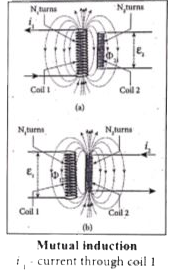 (ii) Consider two coils which are placed close to each other. If an electric current il is sent through coil 1, the magnetic field produced by it is also linked with coil 2 as shown in Figure (a). (iii) `M_(21)`, is the mutual inductance of the coil 2 with respect to coil 1. It is also called as coefficient of mutual induction. If `i_1 = 1A`, then `M_(21) = N_(2)phi_(21)`. (iv). THEREFORE, the mutual inductance M,, is defined as the flux linkage of the coil 2 when 1A current flows through coil 1. (v)When the current `i_1`, changes with time, an emf `epsi_(2)`, is induced in coil 2. From Faraday.s. law of electromagnetic induction, this mutually induced emf `epsi_(2)`, is given by `epsi_(2)= -(d(N_(2)phi_(21)))/(dt)= -(d(M_(21)i_(1)))/(dt)` `epsi_(2)=-M_(21) (di_(1))/(dt)` (or) `M_(21) = (-epsi_(2))/((di_1)/(dt))` (VI) The negative sign shows that the mutually induced emf always OPPOSES the change in current `i_(1)`, with respect to time. If `(di_(i))/(dt) =1` `As^(-1)`, then `M_(21) = - epsi_(2)`. (vii) Mutual inductance `M_(21)`, is also defined as the opposing emf induced in the coil 2 when the rate of change of current through the coil 1 is 1`As^(-1)`. (viii) Similarly, if an electric current `i_2`, through coil 2 changes with time, then emf `ę_1`, is induced in coil 1. Therefore, `M_(12)=(N_(1)phi_(12))/i_(2)"and "M_(12)= (-epsi_(1))/((di_(2))/(dt))` where `M_(12)` is the mutual inductance of the coil 1 with respect to coil 2. It can be shown that for a given pair of coils, the mutual inductance is same. i.e., `M_(21) = M_(12) = M` (ix) In general, the mutual induction between two coils depends on size, shape, the number of turns of the coils, their relative ORIENTATION and permeability of the medium. |
|
| 44. |
Equivalent capacitance between A and B in the figure is |
|
Answer» `20muF` 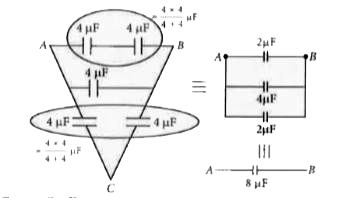 `rArrC_(AB)=8muF` |
|
| 45. |
The maximum refractive index of a prism which permits passage of the light, through it when the refract iii»auglc of the prism is 90°, is |
|
Answer» `SQRT(3)` |
|
| 46. |
In the Davisson and Germerexperiment, the velocity of electronof electrons emitted from the electron gun can be increased by |
|
Answer» DECREASING the POTENTIAL difference between the anode and FILAMENT |
|
| 47. |
A projectile fired with velocity u at right angle to theslope which is inclined at an angle theta with horizontal. The expression for R is |
|
Answer» `(2u^2)/(G) TAN THETA` |
|
| 48. |
For normal frequencies, the range of Q-factor is from, |
|
Answer» 1 to 10 |
|
| 49. |
The truth table of a logic gate is given below {:("Input","Output"),(A""B,Y),("00",1),("01",1),("10",1),("11",0):} The logic gate is |
|
Answer» OR GATE  `{:(A,B,Y),(0,0,1),(0,1,1),(1,0,1),(1,1,0):}` `:.` AND gate = A . B NAND gate `Y = BAR(A.B)` . |
|
| 50. |
The extension in a siring, obeying Hooke.s law is x. The speed of transverse wave in the stretched string is v. If the extension in the string is increased to 1.5x, the speed of transverse wave will be |
|
Answer» 1.22 v |
|