Saved Bookmarks
This section includes 7 InterviewSolutions, each offering curated multiple-choice questions to sharpen your Current Affairs knowledge and support exam preparation. Choose a topic below to get started.
| 1. |
Show that the potential difference across the LC combination is zero at the resonating frequency in series LCR circuit |
|
Answer» SOLUTION :P.d. acorss L is `IX_L` P.D. ACROSS C is `=IX_(C )` `rArr V= IX_( C)` at resonance `X_(L )= X_( C)` `rArr V=O`. |
|
| 2. |
A rectrangular coil 20cmxx20cm has 100 turns and carries a current of 1 A. It is placed in a uniform magnetic field B = 0.5T with the direction of magnetic field parallel to the plane of the coil. Find the magnitude of the torque required to hold this coil in this position. |
|
Answer» Zero `A=20xx20xx10^(-4)m,theta=90^(@)` DEFLECTING torque `|vectau|=NIABsintheta` `|vectau|=100xx1xx400xx10^(-4)xx5xx10^(-1)xxsin90^(@)` = 2 Nm |
|
| 3. |
Two cells of emf 2V and 4V and internal resistance 1Omega and 2Omega respectively are connected in parallel so as to send the current in the same direction through an external resistance of 10Omega. Find the potential difference across 10Omega resistor. |
Answer» Solution : `r_(2) = 2Omega` Applying KVL to mesh `E_(1)ABE_(1) "Equation" (1) rArr` `1I_(1) + 10( I_(1) + I_(2)) = 2"" 1I_(1) + 10(0.75) =2` `1I_(1)10I_(2) = 2 to (1)""1I_(1) = -7.5` APplying KVL to mesh `E_(2)ABE_(2)""11I_(1) = -5.5` `2I_(2) + 10(I_(1) + I_(2)) = 4""I_(1) = -0.5A` `10I_(1) + 10I_(2) = 2"""Potential drop across " 10Omega` `11I_(1) + 10I_(2) = 2""V = (I_(1) + I_(2))R` `10I_(1) + 12I_(2) = 4"" = (-0.5 + 0.75)10` `X^(LY)` eqn (1) by 10 and eqn (2) by 11 `"" = 0.25 xx 10` `110I_(1) + 100I_(2) = 20 "" V = 2.5V` `11OI_(1) + 132I_(2) = 44 ""` `110I_(1) + 132I_(2) = 44` `((-)(-)(-))/(-32I_(2) = -24)` `I_(2) = (24)/(32)` `I_(2)-0.75A` |
|
| 4. |
The maximum value of photoelectric current is called |
|
Answer» BASE current |
|
| 5. |
Radar waves are sent towards a moving aeroplane and the reflected waves are recived by radar . When aero |
|
Answer» SOUND waves |
|
| 6. |
Four initially uncharaged thin, large, plane idential metallic plates A,B,C and D are arranged parallel to each other as shown. Now plates A,B,C and D are given charges Q,2Q,3Q and 4Q respectively. Plates A and D are connected by a mtallic wire while plates B and C connected by other metallic wire then after Electrostatic equilibrium is reached. Total charge on plates after earthing plates A and B will be |
| Answer» ANSWER :A | |
| 7. |
A ray of light is incident at an angle of 60^@ on one face of prism which has an angle of 30^@. The ray emerging out of the prism makes an angle of 30° with the incident ray. Show that the emergent ray is perpendicular to the face through which it emerges and calculate the refractive index of the material of the prism. |
|
Answer» Solution :According to given PROBLEM, ` A = 30^@, i_1 = 60^@and delta= 30^@` and asin aprism` delta= (i_1+i_2)-A ` ` 30^@ = ( 60^@+i_2) - 30^@` ` i.e.,i_2 =0^@` so thetemergentray is perpendicular to the face from which it emerges. Now as `i_2 =0 ,r_2=0` But as ` r_1+r_2=A,r_1= A=30^@` soatfirstface,1xsin `60^@= musin30^@i.e.,mu= sqrt(3)` 
|
|
| 8. |
Two wires A and B are stretched by the same load . If the areas of cross - section of wire A is double that of B . then the stress in B is |
|
Answer» EQUAL to that on A GIVEN `A_(A)=2A_(B)` `("StressA")/("StressB")=A_(B)/(2A_(B))=1/2` `therefore` Stress B = 2 Stress (A) |
|
| 9. |
For sky wave propagation of 10 MHz signal, what should be the minimum electron density in ionosphere? |
|
Answer» `~10^(14)m^(-3)` `f_(c)=SQRT(N_(max))` Where `N` is electron density per `m^(3)` `:. N_(max)=(f_(c)^(2))/81=((10xx10^(6))^(2))/81` `=1.2xx10^(12) m^(-3)` |
|
| 10. |
If in a triangleABC, angle A is greatest, also given sinA + sinB + sinC le 1 then value of B + C is |
|
Answer» LESS than `30^@` `rArr` SIN B + sinC gt sinA `rArr` sinA+sin B + sinC gt 2 sinA `rArr` 2sinA lt 1 `rArr` sin A lt `1/2` But as given A is greatest angle `rArr A gt 150^@` `rArr B + C lt 30^@` |
|
| 11. |
..... is Ohm 's law for good conductor |
|
Answer» `V PROP R ` |
|
| 12. |
A total charge Q flows across a resistor R during a time interval T in shuch a way that the current vs. time graph for 0 to T is like the loop of a sin curve in the range 0 to pi . The total heat generated in the resistor is |
|
Answer» ` Q^(2)PI^(2)R//8T` |
|
| 13. |
The square of the resultant of two forces 4N and 3 N exceeds the square of the resultant of the two forces by 12 when they are mutually perpendicular. The angle between the vectors is |
|
Answer» `30^(@)` |
|
| 14. |
The refractive index of glass is 1.50 and the speed of light in air is 3xx10^(8)m//s. Calculate the speed of light in glass. |
|
Answer» `24.2Å` |
|
| 15. |
A : The resolving power of an electron microscope is higher than that of an optical microscope. R : The wavelength of electron is less than the wavelength of visible light. |
|
Answer» Both A and R are true and R is the CORRECT EXPLANATION of A |
|
| 16. |
Identical 50mu C charges are fixed on an x axis at x= + pm 2.0 m. A particle of charge q= 15 mu C is then released from rest at a point on the positive part of they axis. Due to the symmetry of the situation, the particle moves along the y axis and has kinetic energy 1.2 J as it passes through the pointx=0, y=4.0 m. (a) What is the kinetic energy of the particle as it passes through the origin? (b) At what negative value of y will the particle momentarily stop? |
| Answer» SOLUTION :(a) `4.9` J , (B) `-7.2` m | |
| 17. |
A hydrogen sample is prepared in a particular excited state A of quantum number, n_A = 3 . The ground state energy of hydrogen atom is - |E| . The photons of energy(|E|)/(12) are absorbed in the sample which results in the excitation of some electrons to excited state B of quantum number n_Bwhose value is |
|
Answer» 6 energy of HYDROGEN atom in GROUND state =- | E |and `n_A = 3` `therefore` Energy of electrons in excited state , `n_A` `(E )_(n_A) = (-|E|)/(n_A^2)` Energy of electron in excited state , `n_B` ` = (E )_(n_B) = (-(E ) )/(n_B^2)` When sample ABSORBS the photon of energy, ` (|E|)/(12)`, then its electrons REACHES from energy state `n_A ` to energy state `n_B` Hence , `(E )_(n_B) - (E )_(n_A) = (|E|)/(12)` `(-|E|)/(n_B^2) - { (-|E|)/(n_A^2) } = (|E|)/(12)` `(-1)/(n_B^2) + (1)/(n_A^2) = 1/12 rArr - (1)/(n_B^2) = 1/12 - (1)/(n_A^2)` ` =1/12 - 1/9 rArr - (1)/(n_B^2) = 1/12 - (1)/(n_A^2)` ` = 1/12 - 1/9 rArr - (1)/(n_B^2) = - 1/36` `rArr n_B^2 = 36 ` ` therefore n_B = 6` |
|
| 18. |
Passage : A 6V battery of negligible internal resistance is connected across a uniform resistive wire AB of length 100cm. The positive terminal of another battery of emf 4V and internal resistance 1Omega is joined to the point A as shown in figure. Take the potential at B to be zero. What are the potentials at points A and C, C is not touching the wire AB |
|
Answer» 6V, 2V |
|
| 19. |
Passage : A 6V battery of negligible internal resistance is connected across a uniform resistive wire AB of length 100cm. The positive terminal of another battery of emf 4V and internal resistance 1Omega is joined to the point A as shown in figure. Take the potential at B to be zero. At which point D of the wire AB, the potential is equal to the potential at C, C is not touching the wire AB |
| Answer» Answer :D | |
| 20. |
O_2 shows |
|
Answer» Paramagnetism |
|
| 21. |
Four charges Q, q, Q and q are placed at the corners A, B, C and D of a square ABCD. If the resultant electric force on the charge at the corner C is zero, find the value of Q/q. |
|
Answer» |
|
| 22. |
Light ray bends when it travels from one medium to another medium because ...... |
|
Answer» FREQUENCY CHANGES |
|
| 23. |
In Textual Example 3, what should the width of each slit be to obtain 10 maximam of the double slit pattern within the central maximum of the single slit pattern? |
|
Answer» SOLUTION :We WANT `atheta=LAMBDA, THETA=(lambda)/(a)` `10lamda/d=2lambda/a,a=d/5=0.2mm` |
|
| 24. |
Define moment of inertia. State its SI unit and dimensions. |
|
Answer» SOLUTION :Moment of inertia of a RIGID body about an axis of rotation is DEFINED as the sum of product of each point MASS and square of its perpenducular distance from the axis of rotation. The S.I. unit of moment of inertia is kg. `m^(2)`. The DIMENSION of moment of inertia is`[M^(1)L^(2)T^(0)]` |
|
| 25. |
There is one parallel plate capacitor of plate area A and separation between the paltes is d. There is no dielectric placed between the plates of capacitor. The capacitor is connected to a battery of potential difference V volt. While the battery remains connected, some external agent moves the plates apart very slowly to a new separation of 2d. Show and justify that there is no heat loss in the process. |
|
Answer» Solution :Initial CAPACITANCE of capacitor `C_(1)=(epsilon_(0)A)/(d)` Amount of energy stored in the capacitor in its initialstate `U_(1)=(1)/(2)((epsilon_(0)A)/(d))V^(2)"" …(i)` LET at ONE instant of time, the separation between the plates be x, then instantaneous capacitancebecomes: `C=(epsilon_(0)A)/(x)` Instantaneous amount of charge stored in the capacitor `Q=CV=(epsilon_(0)A)/(x)V` Electric force between the plates of the capacitor `F_("el") =(Q^(2))/(2epsilon_(0)A)=(((epsilon_(0)A)/(x)V)^(2))/(2epsilon_(0)A)=(1)/(2) (epsilon_(0)AV^(2))/(x^(2))` The same amount of force must be applied by the external agent in opposite direction so that the plates are moved slowly. An external agent applies force in the direction of displacement. Work done by the external agent can be written as follows for infinitesimally small displacement dx. `dW_("ext")=F_(el)dx=(1)/(2) (epsilon_(0)AV^(2))/(x^(2))dx` In the above equation we have used electric force `(F_(el))` because magnitude of force applied by external agent is same as electric force. Total work done by the external agent in moving the plates apart from separation of d to 2d can be calculated by integrating the above equation: `W_("ext") = int_(d)^(2d) (1)/(2) (epsilon_(0)AV^(2))/(x^(2))-dx=(1)/(2)epsilon_(0)AV^(2) int_(d)^(2d) x^(-2)dx` `W_("ext")=(1)/(2)epsilon_(0)AV^(2)[(-1)/(x)]_(d)^(2d)=(1)/(4)((epsilon_(0)A)/(d))V^(2)"" ...(ii)` Capacitance of the capacitor when separation between the plates becomes `2d, C_(2)=(epsilon_(0)A)/(2d)` Energy stored in the capacitor now `U_(2)=(1)/(2)((epsilon_(0)A)/(2d))V^(2)=(1)/(4)((epsilon_(0)A)/(d))V^(2)"" ...(iii)` Initial amount of charge stored in the capacitor `Q_(1)=C_(1)V=(epsilon_(0)A)/(d)V` Final amount of charge stored in the capacitor `Q_(2)=C_(2)V=(epsilon_(0)A)/(2d)V` We can understand that capacitance has decreased and HENCE stored charge has decreased. Charge from the capacitoris transferredto the battery. Work is done on the battery. Work done on the battery `W_(b)=(Q_(1)-Q_(2))V=(1)/(2)((epsilon_(0)A)/(d))V^(2)"" ...(iv)` Work done on the battery means, energy is supplied to the battery. Let H be the amount of heat LOSS in this process then we can write the following equation for energy. `U_(1)+W_("ext") =U_(2)+W_(b)+H""...(v)` We can now substitute from equation (i), (ii), (iii) and (iv) in equation (v) and get the following: `(1)/(2) ((epsilon_(A))/(d))V^(2)+(1)/(4)((epsilon_(A))/(d))V^(2)=(1)/(4)((epsilon_(A))/(d))V^(2)+(1)/(2)((epsilon_(A))/(d))V^(2)+H` `rArr H=0` |
|
| 26. |
An electron gun with its collector at a potential of 100 v fires out electrons in a spherical bulb containing hydrogen gas at low pressure (~10^(-2)" mm of Hg"). A magnetic field of 2.83 xx 10^(-4) T curves the path of the electrons in a circular orbit of radius 12.0 cm. (The path can be viewed because the gas ions in the path focus the beam by attracting electrons, and emitting light by electron capture, this method is known as the ‘fine beam tube’ method.) Determine e/m from the data. |
| Answer» SOLUTION :We have `eV=(MV^(2)//2) andR=(mv//eB)` which gives `(e//m=(2v//R^(2)B^(2))`, USING the given data `(e//m)=1.73xx10^(11)C kg^(-1)`. | |
| 27. |
Which of the following is conserved when light waves interfere : |
|
Answer» amplitude |
|
| 28. |
At what temperature would an intrinsic semiconductor behave like a perfect insulator? |
| Answer» Solution :At ABSOLUTE zero temperature i.e., at 0 K. | |
| 29. |
An electric dipole is placed at an angle of 30^@ with an electric field intensity 2 xx 10^5 NC. It experiences a torque equal to 4 N.m. The charge on the dipole, if the dipole length is 2cm, is |
|
Answer» `8mC` |
|
| 30. |
Explain that magniture of current which can melt a fuse wire is independent of its length. |
|
Answer» Solution :Assume that the fuse wire is a cylindrical object of radius r and length l. LET resistivity OFITS material be `rho`. RESISTANCE of the fuse wire can be written as `R=rho l/(pir^2)` Hence rate of heat generation `H=I^2R rArr H=I^2(rhol/(pir^2))` As the temperature of fuse wire increases its rate of radiation increases. Rate of radiation for temperature T can be written as `(DeltaU)/(Deltat)=e sigma(2pirl)T^4` In equation (ii) e is emissivity of the material `sigma` is the stefan-Boltzmann constant `2pirl` is the surface of fuse wire and T is the absolute temperature . Usually the size of fuse wireis small and wo can easily neglect the rate of absorption of heat . To attain a steady STATE temperature , the rate of electrical heating BECOMES equal tothe rate of radiation. `H=(DeltaU)/(Deltat)` `I^2rho l/(pir^2)=e sigma(2pirl)T^4` `rArr I^2rho=2 pi^2e sigmar^3T^4` |
|
| 31. |
Electric charge +q is iniformaly distributed over the entire volume of a sphere of radius r. Calculate the magnetic moment of the sphere if it spins about its diameter with angular speed omega . Compare this moment with its angular momentum, assuming that its mass is m. |
|
Answer» |
|
| 32. |
5 m^(3) of air with a relative humidity of 22% at 15^(@)C and 3 m^(3) of air with a relative humidity of 46% at 28^(@)C have been mixed together. The total volume of the mixture is 8m^(3). Find the relative humidity of the mixture. |
|
Answer» Solution :Pind first the mass of moisture in each volume of air, i.E. the absolute humidity of the volumes which are mixed. We have in 5 m of air `m_(1)=f_(1)V_(1)=rho_(1)^("sat")B_(1)V_(1)=12.8xx0.22xx5=14.1g` In `3m^(2)` of air `m_(2)=rho_(2)^("sat")B_(2)V_(2)=27.2xx0.46xx3=37.5g` Next find the absolute humidity of the mixture: `f=(m_(1)+m_(2))//(V_(1)+V_(2))=6.45g//m^(2)` To find the relative humidity we MUST find the temperature of the mixture. Neglecting the vapour mass we may write the equation of heat balance in the form `rho_(0)V_(1)e_(0)(t-15)=rho_(0)V_(2c_(0))(28-t)` where the subscripts O SHOW that the density and the specific heat refer to air. We have`t= 20^(@)C`. Now it is easy to compute the rolative bumidity. |
|
| 33. |
The radius of curvature ranges from 70 to 10 mm. What is the range of values of the magnitude of momenyum (p) if the magnitude of the charge is e ? |
|
Answer» `8exx10^(-2)kgm//sleple28exx10^(-3)kgm//s` |
|
| 34. |
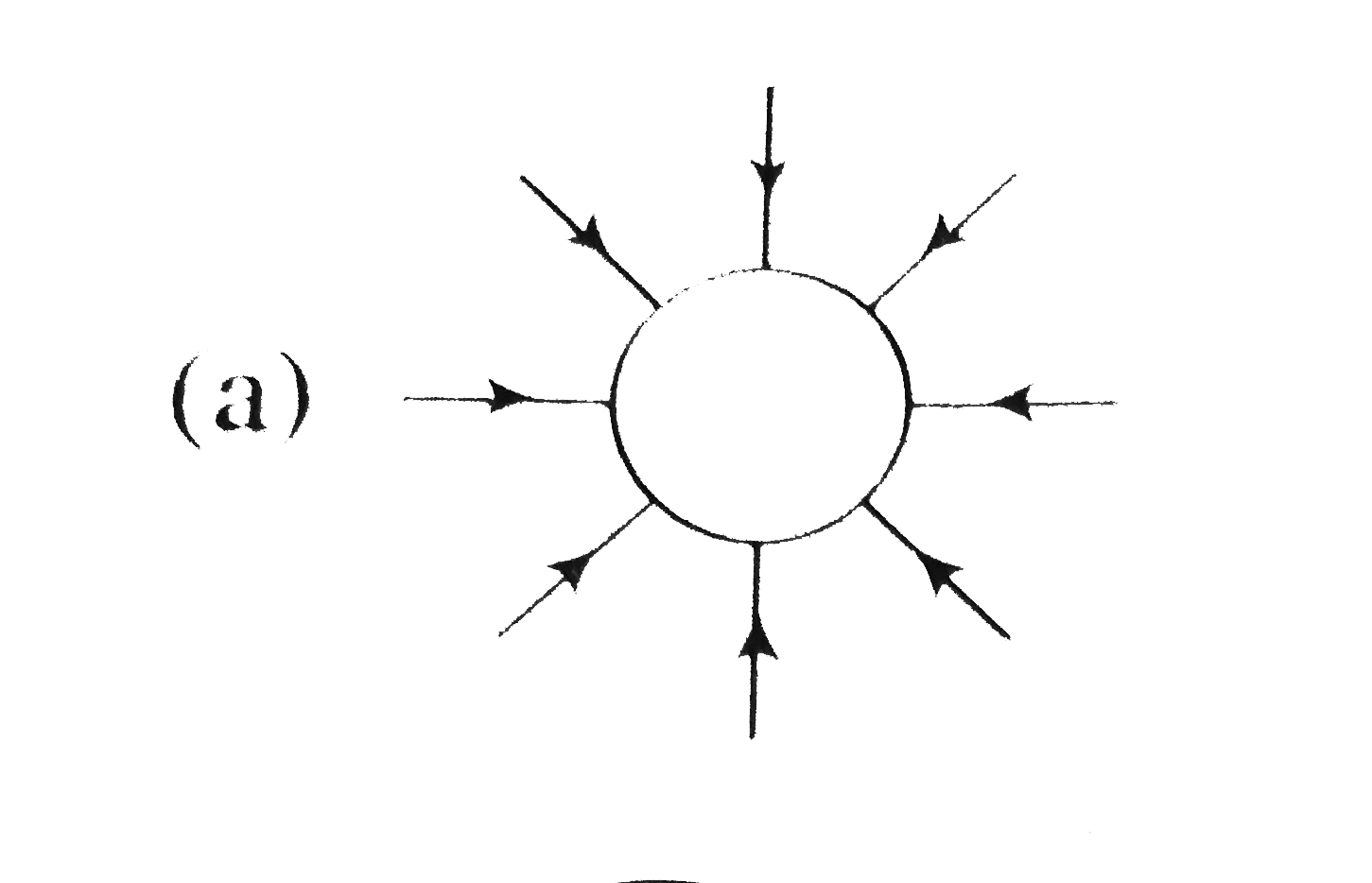
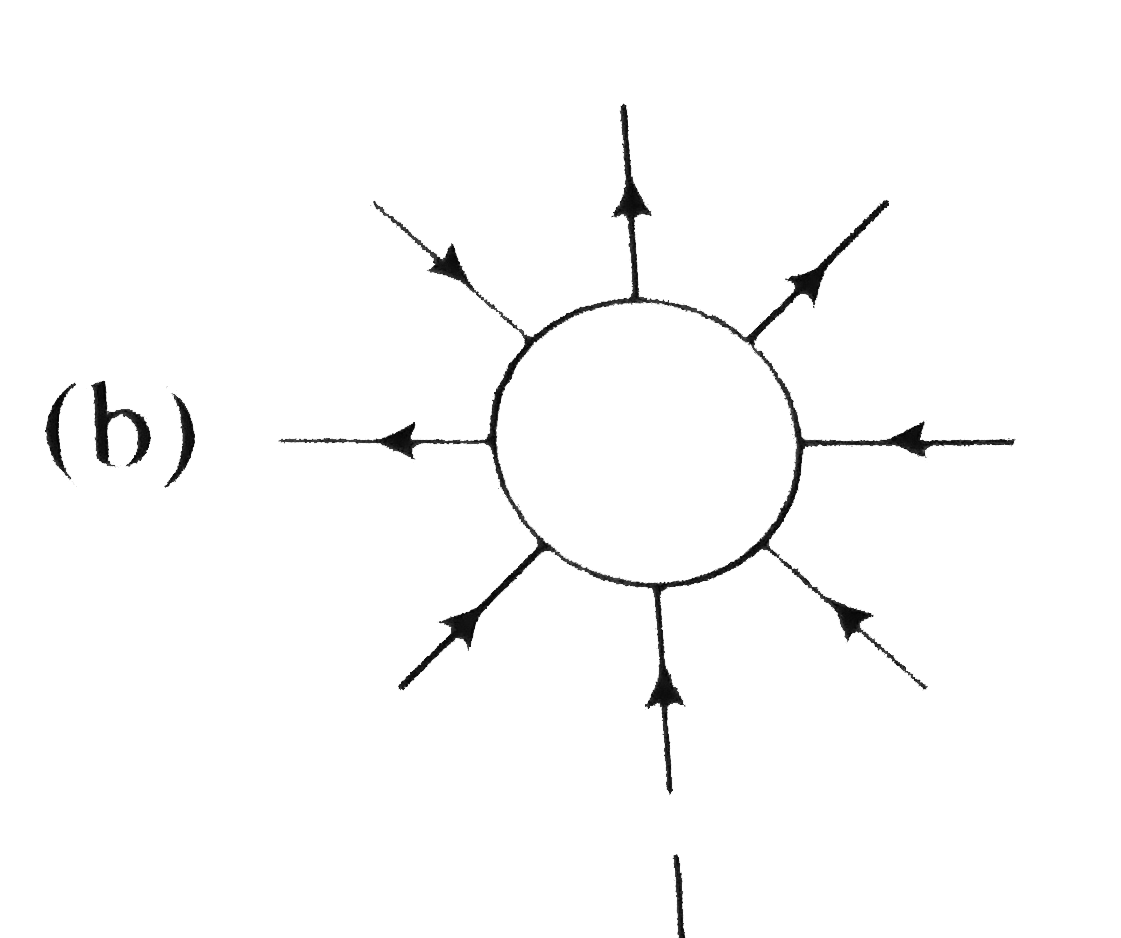
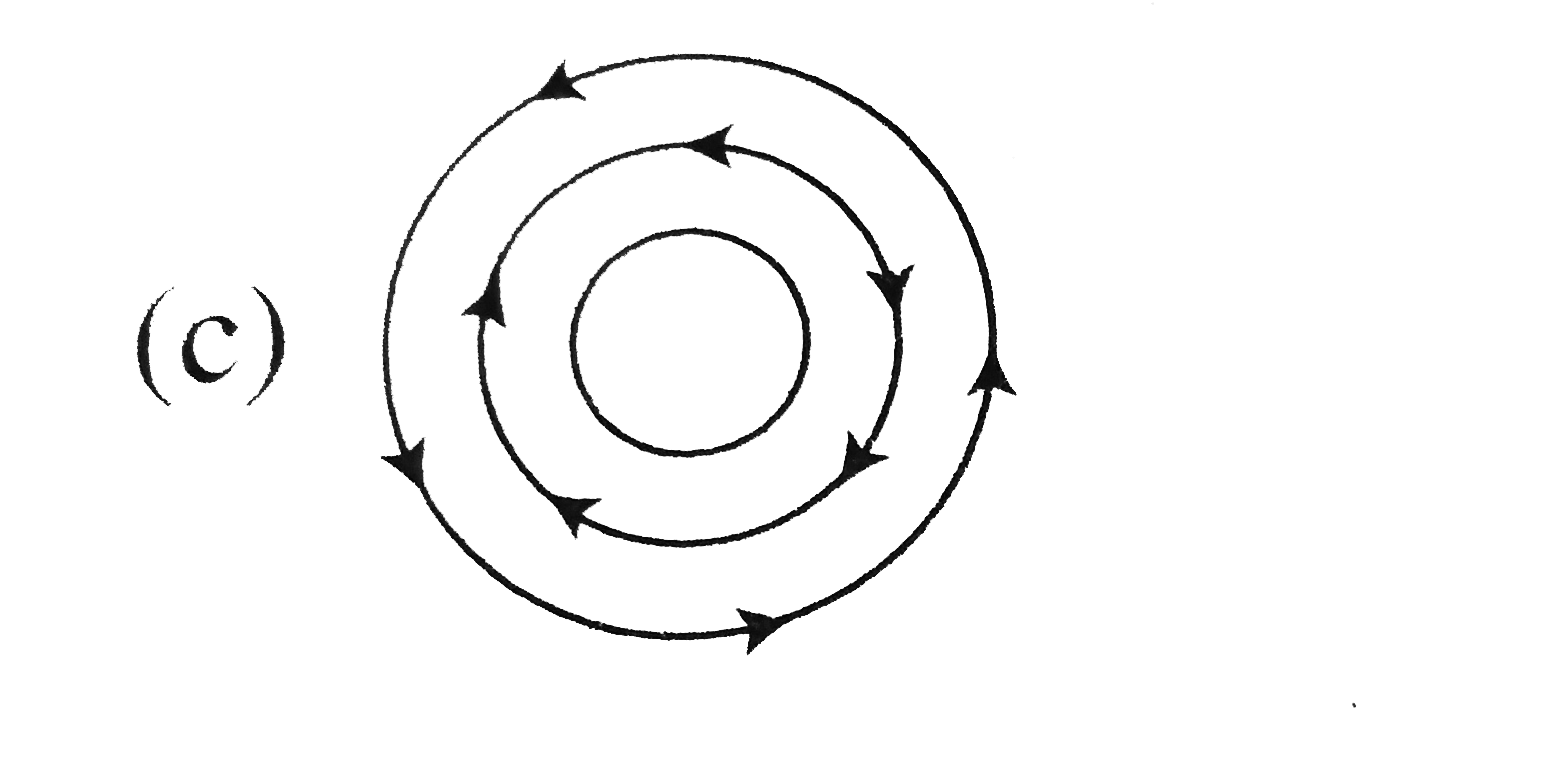
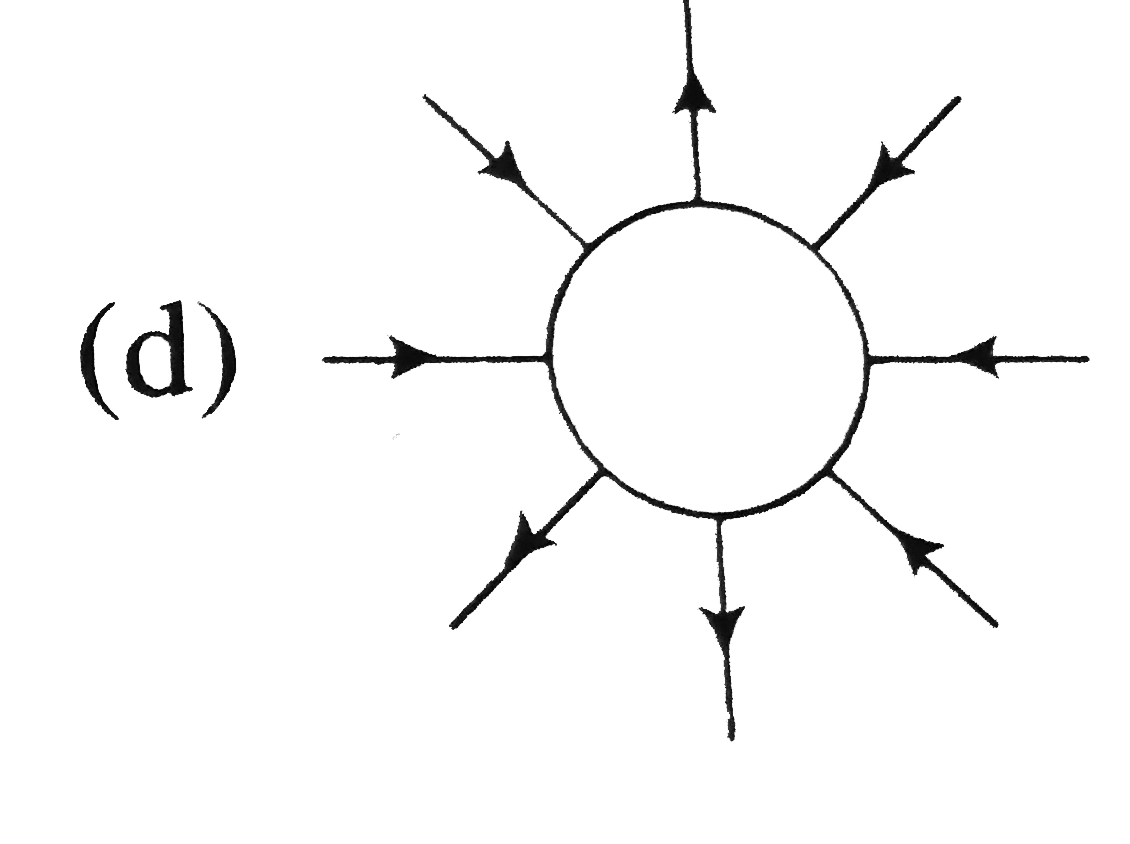
Which of the following figures correctly shows the top view sketch of the electric field lines for a uniformly charged hollow cylinder as shown in figure? |
|
Answer»
|
|
| 35. |
In an A.C. circuit, resistance = 12Omega and capacitance reactance = 9Omega are connected in series, then the value of impedance of a circuit will be .......... |
|
Answer» `15OMEGA` `|Z|=SQRT(R^2+X_C^2)=sqrt(12^2+9^2)=sqrt225=15Omega` |
|
| 36. |
The IUPAC name of is - |
|
Answer» 2-Chlorocarbonyl ethylbenzoate 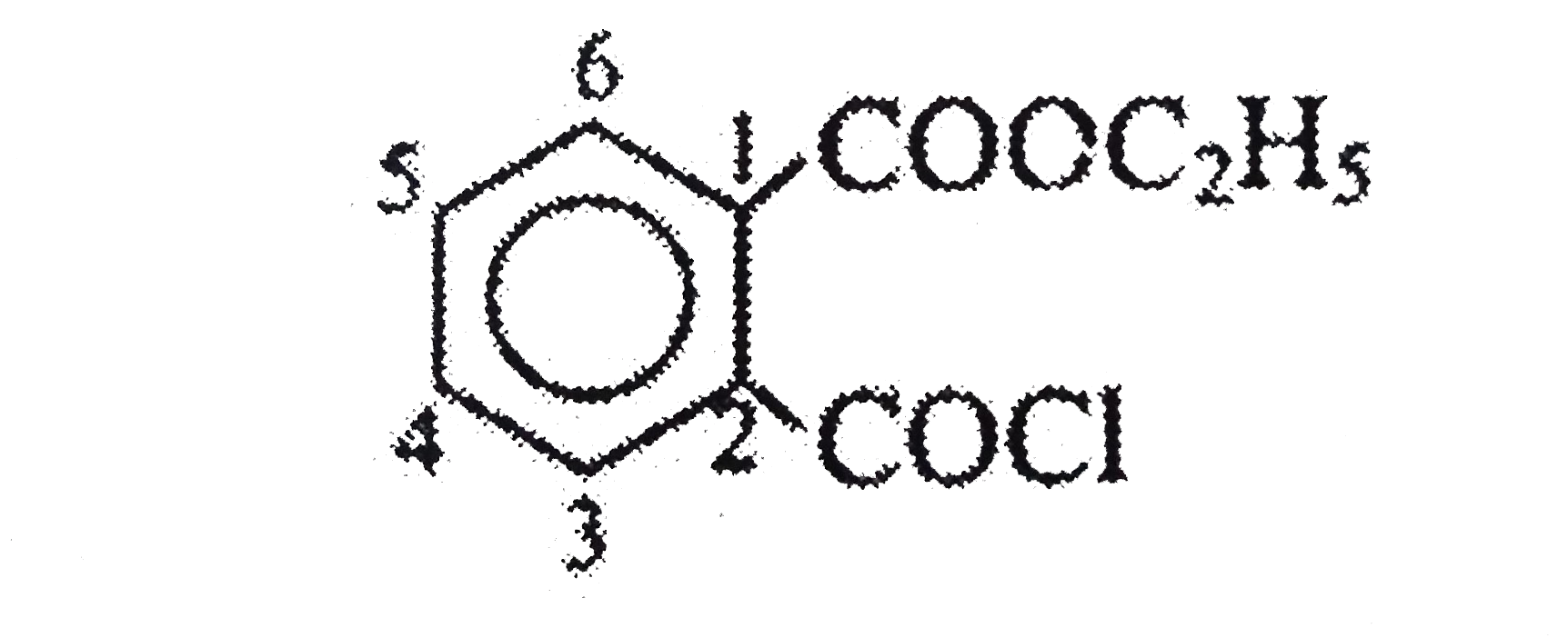 Ethyl 2 - chlorocarbonyl benzoate |
|
| 37. |
Electron is rotating in circular orbit with radius 5.2xx10^(-11)m and with linear speed 2xx10^(6)ms^(-1) in an hydrogen atom around the proton. Find the magnetic field produced at the centre of the orbit. |
|
Answer» Solution :1. `v=2xx10^(6)ms^(-1),r=5.2xx10^(-11)m` `e=1.6xx10^(-19)C` 2. FREQUENCY of ELECTRON in the orbit f (No. of rotations completed in 1 second) f = `v/(2pir)` 3. ELECTRIC current I = f.e = `v/(2pir)xxe` = `(2xx10^(6))/(2xx3.14xx5.2xx10^(-11))xx1.6xx10^(-19)` = `9.8xx10^(-4)A` 4. Magnetic field produced at the CENTRE of the circular orbit, `B=(mu_(0)I)/(2r)` `thereforeB=(4xx3.14xx10^(-7)xx9.8xx10^(-4))/(2xx5.2xx10^(-11))` `thereforeB=11.8T` |
|
| 38. |
The idea of displacement current was introduced by |
|
Answer» Hertz |
|
| 39. |
A lift has a mass of 6000 kg. The upward tension of the supporting cable is 3x10^8 N. Calculate the upward acceleration |
| Answer» Answer :A | |
| 40. |
What is the de-Broglie wavelength of (a) a bullet of mass 0.040 kg travelling at the speed of 1.0 km/s, (b) a ball of mass 0.060 kgmoving at a speed of 1.0 m/s, and (c) a dust particle of mass 1.0xx10^(-9)kg drifting with a speed of 2.2 m/s ? |
|
Answer» Solution :(a) Mass of bullet m=0.040 kg and speed v=1.0km/s=1000m/s `THEREFORE`de-Broglie WAVELENGTH `(h)/(mv)=(6.63xx10^(-34))/(0.040xx1000)=1.7xx10^(-35)m` (b) Mass of BALL `m=0.060kg and speed v=1.0m//s` `therefore lamda=(h)/(mv)=(6.63xx10^(-34))/(0.060xx1.0)=1.1xx10^(-32)m` (c) Mass of DUST particle `m=1.0xx10^(-9)kg and speed v=2.2m//s` `therefore lamda=(h)/(mv)=(6.63xx10^(-34))/(1.0xx10^(-9)xx2.2)=3.0xx10^(-25)m`. |
|
| 41. |
The length of a sonometer wire AB is 100 cm, where should the two bridges be placed from A to divide the wire in 3 segments whose fundamental frequencies are in the ratio of 1:2:6 |
| Answer» Answer :B | |
| 42. |
A point object O is placed at a distance of 30 cm from a convex lens of focal length 20 cm cut into two halves each of which is displaced by 0.05 cm as shown in figure. Find the position of the image. If more than one image is formed, find their number and distance between them. |
|
Answer» Solution :Considering each PART as separate LENS with u = -30 cm and f = 20 cm, from lens-formula. `(1)/(v )-(1)/(u ) =(1)/(f) ` we have `(1)/(v )-(1)/(-30) = (1)/(20) ` i.e., v = 60 cm  So each part will form a real image of the point object O at 60 cm from the lens as SHOWN in figure. As there are two pieces, two images are formed. Now in similar triangles `OI_1 I_2 and OL_1 L_2` `(I_1 I_2)/(L_1 L_2) = (OP)/(OQ)= ((u +v))/(u )` i.e.,` I_1 I_2 =(90)/(30)xx(2 xx 0.05 )= 0.3cm ` So the two images formed are 0.3 cm apart. |
|
| 43. |
Figure 10-83 is an overhead view of a spring lying on a frictionless surface and attached to a pivot at its right end. The spring has a relaxed length of l_(0)=1.00 and negligible mass. A small 0.100 kg disk is attached to the free end at the left. That disk is then given a velocity vecv_(0) of magnitude 11.0 m/s perpendicular to the spring's length. The disk and spring then move around the pivot. (a) When the stretching of the spring reaches its maximum value of 0.100l_(0), what is the speed of the disk? (b) What is the spring constant? |
| Answer» SOLUTION :(a) 10 m/s, (B) 210 N/m | |
| 44. |
यदि (39, 91) का महतम समापवर्तक (HCF) = 13, तो (39, 91) का लघुतम समापवर्तक (LCM) = |
|
Answer» 253 |
|
| 45. |
How will you define threshold frequency ? |
| Answer» SOLUTION :For a GIVEN surface, the EMISSION of PHOTOELECTRONS takes place only if the frequency of incidnet light is greater than a certain MINIMUM frequency called the threshold frequency. | |
| 46. |
Assertion:Diamond glitters brilliantly. Reason: Diamond does not absorb sunlight. |
|
Answer» If both ASSERTION and REASON are true and the reason is the correct EXPLANATION of the assertion |
|
| 47. |
Two charges q_1 and q_2 are placed 30 cm apart, as shown in the figure. A third charge q, is moved along the arc of a circle of radius 40 cm from C to D. The change in the potential energy of system is (kq_3)/(4piepsilon_0),then the value of k is |
|
Answer» `8q_2` |
|
| 48. |
(a) Define magnifying power of a telescope. (b) Write its expression. A small telescope has an objective lens of focal length 150 cm and an eye piece of focal length 5 cm. If this telescope is used to view a 100m high tower 3 x 10^(5)cm away , find the height of the final image when it is formed 25 cam away from the eye piece. |
|
Answer» Solution :(a) Magnifying power is the ratio of the angle subtended at the eye by the image to the angle subtended at the unaided eye by the object. Expression `:` `m = ( beta )/( alpha) = ( f_(0))/( f_(e ))` ` m = ( f_(0))/( f_(e )) = (1+ ( f_(e))/(D))` (b) USING ,the lens equation for objective lens , `:` `(1)/(f_(0))= ( 1)/( v_(0)) - ( 1)/( u_(0))` `RARR (1)/( 150) = ( 1)/( v_(0)) - ( 1)/( - 3 xx 10^(5))` `rArr (1)/(v_(0)) = ( 1)/( 150) - (1)/( - 3 xx 10^(5)) = ( 2000 - 1)/( 3 xx 10^(5))` `rArr v_(0) = ( - 3 xx 10^(5))/( 1999) cm` `~~ 150 cm` Hence, MAGNIFICATION due to the objective lens ` m_(0) = ( v_(0))/( u _(0) ) = ( 150 xx 0^(-2) m)/( 3000 m ) ` `~~ (10^(-2))/( 20) =0.05 xx 10^(-2)` Using lens FORMULA for eyepiece, `(1)/(f_(e )) = ( 1)/( v_(e )) - ( 1)/( u _(e ))` `rArr(1)/( 5) = ( 1)/( -25) - (1)/(u_(e ))` `rArr (1)/( u_(e )) = ( 1)/( -25) - ( 1)/( 5) = ( -1-5)/( 25)` `rArr u_(e ) = ( - 25)/( 6) cm` `:.` Magnification due to eyepiece,` m_(e ) = ( - 25)/(- (25)/(6)) = 6` Hence, total magnification`rArrm= m_(e ) xx m _(0)` `m = 6 xx 5 xx 10^9-4) \= 30 xx 10^(-4)` Hence, size of the final image `= 30 xx 10^(-4) xx 100 `m =30cm |
|
| 49. |
A current I, indicated by the crosses in fig. is established in a strip of copper of height h and width w. A uniform field of magnetic induction B is applied at right angles to the strip. What would the magnitude & direction of homogeneous electric field E have to be in order to counter balance the effect of the magnetic field? |
| Answer» SOLUTION :`2.8xx10^(-4)V//m` (down) | |