

Saved Bookmarks
This section includes 7 InterviewSolutions, each offering curated multiple-choice questions to sharpen your Current Affairs knowledge and support exam preparation. Choose a topic below to get started.
| 1. |
In youngs double slit experiment, distance between the slits is d and that between the slits and screen is D. Angle between principal axis of lens and perpendicular disector of S_(1) and S_(2) is 45^(@). The point source S is placed at the focus of lens and aperture of lens is much larger then d. Assuming only the reflected light from plane mirror M is incident on slits, distance of central maxima from O will be : |
|
Answer» D 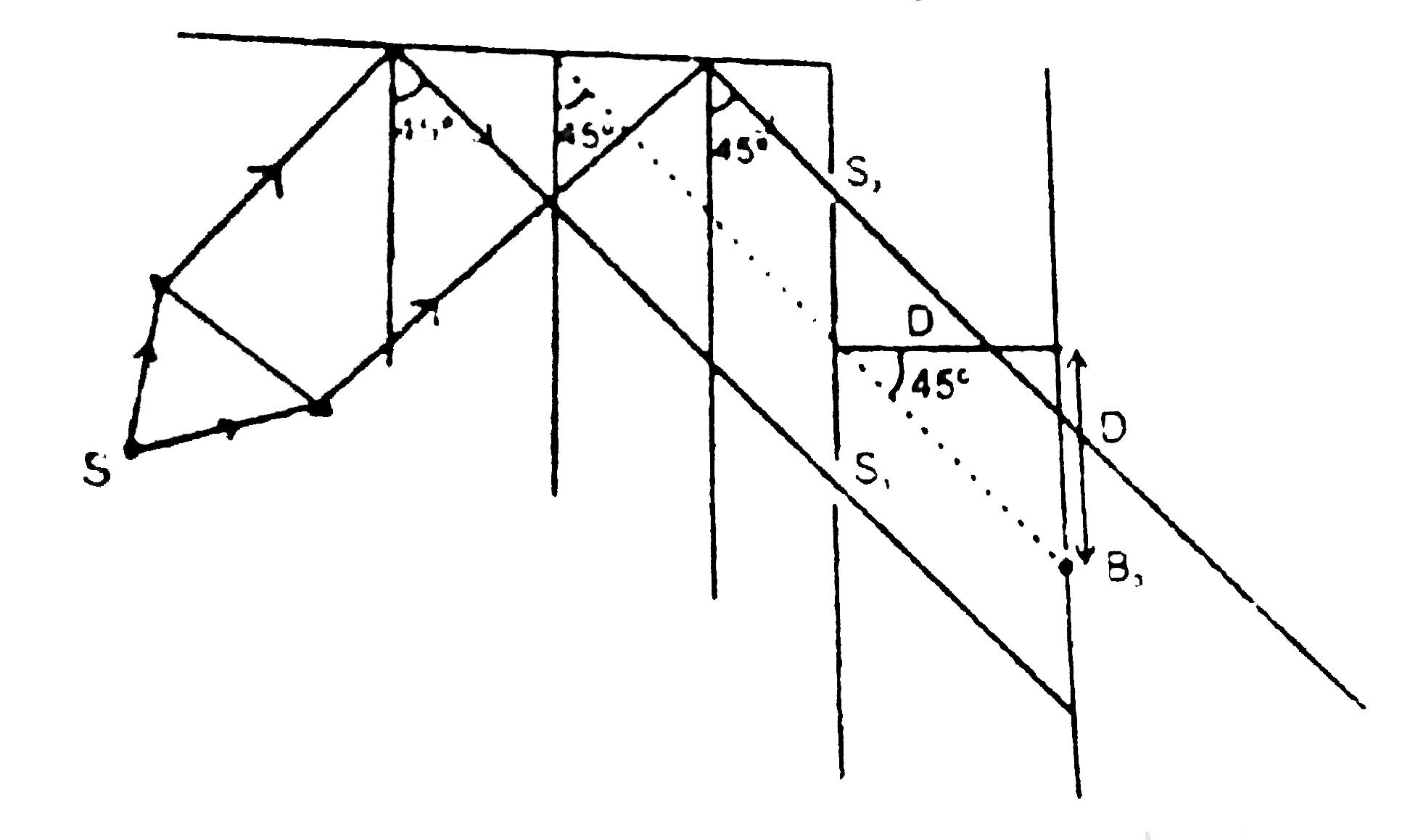 . .
|
|
| 2. |
A current I, indicated by the crosses in fig. is established in a strip of copper of height h and width w. A uniform field of magnetic induction B is applied at right angles to the strip. What is the voltage V necessary between two sides of the conductor in order to create this field E? |
| Answer» SOLUTION :`5.7xx10^(-6)V` (TOP+, BOTTOM-) | |
| 3. |
A short bar magnet of magnetic moment m=0.32 JT^(-1) is placed in a uniform magnetic field of 0.15 T. If the bar is free to rotate in the plane of the field, which orientation would correspond to its (a) stable and (b) unstable equilibrium ? What is the potential energy of the magnet in each case ? |
|
Answer» Solution :Here m =0.32 J `T^(-1) and B = 0.15 T` (a) Stable equilibrium orientation MEANS the MAGNET is SET parallel to the external magnetic field and in this position , the potential energy of the magnet is `U_1 = -vecm * vecB = - mcos 0^@ =- mB =-0.32 xx 0.15 = -4.8 xx 10^(-2) J. ` (b) UNSTABLE equilibrium orientation means the magnet is set anti-parallel to the external magnetic field i.e. `theta = pi` . In unstable equilibrium stable, the potential energy of the magnet will be `U_2 = -vecm * vecB = - m B cos pi = -0.32xx0.15 xx (-1) = + 4.8xx10^(-2) J`. |
|
| 4. |
Charge q_(1)is fixed andanotherpoint charge q_(2) is placedat a distance r_(0) from q_(1) on a frictionless horizontal surface. Find the velocity of q_(2) as a function of seperation r between them (treat as point charges and mass of q_(2) is m) |
Answer» Solution : When the seperationbetween the CHARGES is r, the force between them is `F=(1)/(4pi in_(0))(q_(1)q_(2))/( r^(2))` Accelerationof `q_(2) = (F)/(m)= (q_(1)q_(2))/( 4 pi in_(0) MR^(2))` `(DV)/(dt) = (dv)/(dt) ((dr)/(dt)) = (vdv)/(dr)` `rArr ( vdv)/(dr) = (q_(1)q_(2))/( 4 pi in_(0)mr^(2))` `int_(0)^(v) vdv=(q_(1)q_(2))/( 4pi in_(0) m) int_(r_(0)) ^( r)r^(-2) dr ` or`(v^(2))/(2) = (q_(1)q_(2))/( 4 pi in_(0) m ) |(-1)/(r ) |_(r_(0))^(r )` `rArr v = SQRT((q_(1)q_(2))/( 2pi in_(0) m) {(1)/(r_(0)) - (1)/(r )})` |
|
| 5. |
uniformly charged disc of radius R and total charge Q is rotating about its axis passing through the centre of diae and perpendicular to the plane of dise, with an angular velocity omega.Calculate its magnetic dipole moment. Also find the ratio of angular momentum to that with the calculated magnetic moment of the system. |
|
Answer» Solution :Consider a disc of radius R having centre at O. Given that, Q is the total charge on disc. Consider a small element of thickness dx at a distance x from the centre. DQ = Charge on this small element ` = Q/(pi R^(2)) xx 2pi x dx `  Magnetic moment `(d mu)` of mall element ` = 1/2 d q omegax^(2)` ` = 1/2 (Q/(piR^(2)) * 2pi xdx) omegax^(2)` ` dmu = (Qomega)/R^(2) x^(3) dx ` The total magnetic moment can be obtained by integrating between the limits 0 to R. `mu = intdmu = UNDERSET(0)overset(R)int (Qomega)/R^(2) x^(3) dx ` ` = (Qomega)/R^(2) [x^(4)/4]_(0)^(R) ` ` = 1/4 (Qomega)/R^(2) R^(4)` ` = 1/4 Q omegaR^(2)` ANGULAR momentum , ` L = I omega = (MR^(2))/(2) omega` ` "Magnetic moment"/"Angular momentum" = 1/4 (QomegaR^(2))/(MR^(2) omega) xx 2 ` ` = Q/(2M)` |
|
| 6. |
A bullet of mass 10 g is fired from a gun of mass 1 kg with recoil velocity of the gun = 5 m/s. The muzzle velocity will be |
|
Answer» 30 km/min |
|
| 7. |
If two inputs of a NAND gate are shorted, the resulting gate is |
|
Answer» an OR gate |
|
| 8. |
In the given network of capacitors, the equivalent capactiance between points A and B is |
| Answer» Answer :D | |
| 9. |
A current I, indicated by the crosses in fig. is established in a strip of copper of height h and width w. A uniform field of magnetic induction B is applied at right angles to the strip. If no electric field is applied form the outside the electrons will be pushed somewhat to one side & thereforce will give rise to a uniform electric field E_(H) across the conductor untill the force of this electrostatic field E_(H) balance the magnetic forces encountered in part (b). What will be magnitude and direction of the field E_(H)? Assume that n, the number of conduction electrons per unit volume, is 1.1xx10^(29)//m^(3) & that h=0.02 meter, w=0.1cm, i=50 amp, & B=2" webers//meter^(2). |
| Answer» SOLUTION :same as (C ) | |
| 10. |
The time period of the charged particle circulating at right angles to a uniform magnetic field does not depend upon the |
|
Answer» SPEED of the particle |
|
| 11. |
Under which of the following conditions will a convex mirror of focal length f produce an image that is erect diminished and virtual |
| Answer» Answer :D | |
| 12. |
Eight identical 1 volt cells are connected to make a ring as shown in the figure. An ideal voltmeter is connected as shown. What will be its reading ? |
|
Answer» |
|
| 13. |
A current I, indicated by the crosses in fig. is established in a strip of copper of height h and width w. A uniform field of magnetic induction B is applied at right angles to the strip. What are the magnitude and direction of the magnetic force F acting on the electrons? |
| Answer» SOLUTION :`4.5xx10^(-23)N` (down) | |
| 14. |
A current I, indicated by the crosses in fig. is established in a strip of copper of height h and width w. A uniform field of magnetic induction B is applied at right angles to the strip. Calculate the drift speed v_(d) for the electrons. |
| Answer» SOLUTION :`1.4xx10^(-4)m//s` | |
| 15. |
Consider an amplifier circuit in which a transistor is used in common-emitter mode. The load resistance 3kOmega. When, a signal of 30 mV is added to base emitter voltage, the base current is changed by 30muA and the collector current is changed by 3 mA. the power gain in this circuit will be |
|
Answer» 10000 ` R = 2 K OMEGA = 30000 Omega ` Input voltage , ` V_(i) = 30 mV ` Change in base current , ` Delta I_(B) = 3 mu A = 3 xx 10^(-5) A ` Change in collector current , ` DeltaI_(e) = 3 mA = 3xx 10^(-3)A ` Current gain in common emitter mode , ` beta = (Delta I_(c))/(DeltaI_(B)) = (3xx 10^(-3))/(3xx 10^(-5)) = 100` Input resistance , ` R_("in") = (V_(i))/(Delta I_(B)) = (30xx 10^(-3))/(3xx10^(-5) ) = 30000 Omega` ` therefore ` Power gain ` (P_(V)) = beta^(2) = (R)/(R_("in")) = 100^(2) xx (3000)/(1000) = 30000` Hence , the power gain in this circuit will be 30000. |
|
| 16. |
Focal length of convex lens for red, green and blue colour are f_r , f_g, and f_b respectively, so which of the following statements is true ? |
|
Answer» `f_r LT f_g` |
|
| 17. |
The relative magnetic permeability of ferromagnetic materials is of the order of |
|
Answer» 10 |
|
| 18. |
The initial gas pressure is 6 xx 10^6Pa and the volume 1 m^3. Expansion at constant temperature leads to its volume being increased two-fold. Using numerical methods calculate the work of expansion of the gas. Compare with the formula in xi 27.6 and estimate the error. |
|
Answer» Solution :Divide the change in volume into 10 equal PARTS so that `DeltaV = 0.1 m^3`. The element of work along a short path is `W_i- bar(p_i) DeltaV`. (Fig.) .Therefore the total work is `W = DeltaV (bar(p_1) + bar(p_2) +… + bar(p_10))`  write the data in the form of a table (Table) . It follows that hte work done by a gas expanding at constant temperature is `W = 0.1 xx 41.58 xx 10^5 = 4.16 xx 10^5 J` USING the FORMULA of `xi 27.6`, we have `= 2.3 xx 6 xx 0.301 xx 10^5 = 4.17 xx 10^5 J` The RELATIVE error in the numerical calculation is `epsilon = (0.001 xx 100%)/(4.17) = 0.24%`. 
|
|
| 19. |
What is quantization of charge ? What is the reason of quantization ? |
|
Answer» Solution :All the CHARGES found in nature are INTEGRAL multiples of a basic unit of CHARGE denoted by e. "This fact is called Quantisation". Thus charge q on a body is always given by q = ne where n is positive or negative integer. The quantisation of charge was first suggested by the experimental laws of electrolysis discovered by English experimentalist FARADAY. It was EXPERIMENTALLY demonstrated by Millikan in 1912. The main reason of quantisation is that when two bodies are rubbed, only integer no. of electrons are transferred from one body to another. |
|
| 20. |
A sermicircular ring of radius R carries a uniform linear charge of lamda. P is a point in the plane of the ring at a distance R from centre O. OP is perpendicular to AB. Find electric field intensity at point P. |
|
Answer» |
|
| 21. |
(a) Derive the relation asintheta=lamda for the first minimum of the diffraction pattern produced due to a single-slit of width 'a' using light of wavelength lamda. (b) State with reason, how the linear width of central maximum will be affected if (i) monochromatic yellow light is replaced with red light, and (ii) distance between the slit and the screen is increased. (c) using the monochromatic light of same wavelength in the experimental set-up of the diffraction pattern as well as in the interference pattern where the slit separation is 1mm, 10 interference fringes are found to be within the central maximum of the diffraction pattern. determine the width of the single-slit, if the screen is keptat the same distance from the slit in the two cases. |
|
Answer» |
|
| 22. |
The above graph shows frequency of an incident photon and maximum kinetic energy of a photoelectric effect a. What is the value of threshold frequency and threshold wave-length? b. What is the work function of the cathode in eV? c. Find the maximum kinetic energy, if the frequency of photon is 9xx10^(14)Hz. d. Also find the value of Planck's constant (h). |
|
Answer» Solution :a. `3xx10^(14)HZ, 10^(-6)m` B. 2eV C. `KE=hupsilon-phi_(0)=3.85eV =4EV` (0.4eV from GRAPH) d. From the graph, slope `=(4eV)/(9xx10^(14)), (h)/( e )= (4eV)/(9xx10^(14)), e=1.6xx10^(-19)C` `therefore h=(4xx1.6xx10^(-19))/(9xx10^(14))~~7xx10^(-34)Js` [Actual value of `h=6.63xx10^(-34)Js`] |
|
| 23. |
A speech signal of 3kHz is used to modulate .a carrier signal of frequency 1 MHz using amplitude modulation . The frequencies of the side bands will be |
|
Answer» 1.003 MHZ and 0.997 MHz |
|
| 24. |
The escape velocity on the surface of the earth is 11.2 km//s . If the mass and radius of a planet 4 and 2 times more than that of the earth, What is escape velocity from the planet. |
|
Answer» a)`11.2km//s` |
|
| 25. |
A solenoid of length 0.5 m has a radius of 1 cm and is made up of 500 turns, It carries a current of 5 A. What is the magnitude of magnetic field inside the solenoid? |
|
Answer» |
|
| 26. |
A carrier wave of amplitude A is used to modulate (amplitude) the signal.Modulated signal amplitude swings from 0.1 A to 1.9A,calculate modulation index. |
|
Answer» |
|
| 27. |
Referring to the previous Nutrition, find the displacement-time equation |
|
Answer» SOLUTION :`V=(dx)/(dt)` `x=overset(t)underset(0)intvdt`vdt. Put the obtained expression of v and integrate. |
|
| 28. |
The suceptibility of ferromagneitc substance is Alnico isperferred for making permanent magnet due ot its |
|
Answer» LARGE |
|
| 29. |
In a series LCR circuit connected to an a.c. source of variable frequency and voltageV = V_(m) sin omega t draw a plot showing the variation of current (I) with angular frequency (w) for two different values of resistance R_(1) and R_(2) (R_(1) gt R_(2)).Write the condition under which the phenomenon of resonance occurs. For which value of the resistance out of the two curves, a sharper resonance is produced ? Define Q-factor of the circuit and give its significance. |
|
Answer» Solution :A plot SHOWING variation of current (I) with angular frequency (`omega`) for two DIFFERENT values of resistances`R_(1)` and `R_(2)(R_(1) gt R_(2))` in a series LCR a.c. circuit is shown in the Fig. 7.33. Condition for resonance to occur is `X_(L) = X_(C)` `rArr` Angular frequency `omega_(0) =1/sqrt(LC)`.A sharper resonance is provided for smaller values of resistance. Thus, curve for resistance `R_(2)`is sharper than the curve for resistance `R_(1)` Q-factor of a resonant circuit is a measure of the "sharpness of resonance" and is defined as the RATIO of resonant angular frequency `omega_(0)`to the band width (`2 Deltaomega` ) of the circuit, where band width is the difference in angular frequencies`(omega_(0) + Deltaomega)` and `(omega_(0) -Deltaomega)` at which power is half the MAXIMUM power or current is `1/sqrt(2)` times the maximum current value at resonance. Mathematically, `Q = omega_(0)/(2.Deltaomega) = (omega_(0)L)/(R) = 1/(omega_(0)CR) = 1/R sqrt(LC)` 
|
|
| 30. |
Two concentric hollow conducting spheres of radius a and b (b gt a) contains charges Q_(a) and Q_(b) respectively. If they are connected by a conducting wire then find out following (i) Final charges on inner and outer spheres. (ii) Heat produced during the process. |
|
Answer» (II) `(KQ_(a)^(2))/2 [1/a-1/b]` |
|
| 31. |
An engine takes heat from a reservior and converts its 1//6 part into work. By decreasing temperature of sink by 62^(@)C, its efficiency becomes double. The temperatures of source and sink must be |
|
Answer» `90^(@)C, 37^(@)C` |
|
| 32. |
A body of mass 1 kg thrown with a velocity of 10m/s comes to rest ( momentarily) aftermoving up by 4 m. The work done by air drag in this process is ( Take g=10m//s^(2)) |
| Answer» Answer :B | |
| 33. |
An observer is moving with half the speed of light towards a stationary microwave source emitting waves at frequency 10 GHz. What is the frequency of the microwave measured by the observer ? (Speed of light =3xx10^(8)ms^(-1)) |
|
Answer» `17.3` GHz `=fxxx sqrt((1+(1)/(2))/(1-(1)/(2))) "" [ :. beta=(v)/(c)=(1)/(2)]` `=fsxxsqrt(((3)/(2))/((1)/2))` `=10 xx sqrt(3)` `=10xx1.73` `=17.3 GHz` |
|
| 34. |
A specially designed junction diode which can operate in the reverse breakdown voltage region is called ? |
|
Answer» |
|
| 35. |
In four situations, a rotating body has angular position theta(t) given by (a) theta=3t-4, (b) theta=-5t^(3)+4t^(2)+6, ( c) theta=2//t^(2)-4//t, and (d) theta=5t^(2)-3. To which situations do the angular equations of Table 10-1 apply? |
| Answer» SOLUTION :(a) and (d) `(a=d^(2)theta//dt^(2))` MUST be a CONSTANT. | |
| 36. |
The resistivity of indium arsenide arsenide is rho=2.5 xx10^(-3) Omega m and its Hall constant is C_(H)=10^(-2) m^(3)//c. Find the concentration and mobility of the charge carriers in this material. |
|
Answer» |
|
| 37. |
A wire has a resistance of 10Ω. It is stretched by 10% of its original length, what will be the new resistance? |
|
Answer» 10Ω |
|
| 38. |
The focal length of a convex mirror is obtained by using a convex lens. The following observation are recorded during the experiment- {:("object position",=5cm),("Image",=93.8cm),("Mirror",=63.3cm),("Bench error",=-0.1cm):} Then the focal length of mirror will be |
|
Answer» 7.5 cm |
|
| 39. |
A compound microscope has a magnification of 30. The focal length of its eyepiece is 5 cm. Assuming the final image to be formed at least distance of distinct vision, calculate the magnification produced by objective . |
|
Answer» Solution :DATA supplied ,, = - 30.= 5 CMD= 25 cm,` "" m = m_(0) xx m_(E), "" m_(e) = (1 + (D)/(f_(e)))` `therefore m = m (1 + (D)/(f_(e)))` `- 30 = m_(0) ( 1 + (25)/(5) ) = m_(o) xx 6 ` |
|
| 40. |
Two identical galvanometers are converted into an ammeter and a milliammeter. If the shunt, which has more resistance, the current passing through the coil will be |
|
Answer» less |
|
| 41. |
A potentiometer wire of length 10m and resistance 30 ohm is connected in series with a battery of emf 2.5V, internal resistance 5 ohm and external resistance R. If the fall of potential along the potentiometer wire is 50m V/m, the value of R in ohms is |
|
Answer» 115 |
|
| 42. |
A particle of mass 'm' and charge q is placed at rest in a uniform electric field E and then released. The K.E. attained by the particle after moving a distance y is |
|
Answer» `QEY^2` |
|
| 43. |
A horizontal overhead power line carries a current of 90 A in east to west direction. What is the magnitude and direction of the magnetic field due to the current 1.5 m below the line? |
| Answer» SOLUTION :`1.2 XX 10^(-5) T`, towards SOUTH | |
| 44. |
One type of transparent glass has refractive index 1.5. What is the speed of light through thi glass? |
| Answer» SOLUTION :t = d `[ 1 - (1)/(N) ] = 15 [ 1 - (1)/(1.5) ] ` = 5 CM. The answer is INDEPENDENT of the location of the SLAB. | |
| 45. |
The direction of induced emf during electro magnetic induction is given by ____ |
|
Answer» FARADAY's law |
|
| 46. |
A girl holds a book of mass m against a vertical wall with a horizontal force F using her finger so that the bookdoes not move. The frictional force on the book by the wall is – |
|
Answer» F and along the FINGER but pointing towards the girl |
|
| 47. |
A plate of thickness t made of material of refractive index mu is placed in front of one of the slits in a double slit experiment . What should be the minimum thickness t which will make the intensity at the centreof the fringe pattern zero ? |
|
Answer» `(MU - 1)(lambda)/(2)` |
|
| 48. |
de-Broglie wavelength associated with an electron accelerated through a potential difference V is lamda. What will be its wavelength when the accelerating potential is increased to 4 V? |
| Answer» Solution :As `lamdaprop(1)/(sqrtV)`, HENCE on increasing accelerating POTENTIAL from V to 4V, de-Broglie WAVELENGTH decreases from `lamda` to `(lamda)/(2)`. | |
| 49. |
In a double slit experiment using monochromatic light, the fringe patern shifts by a certain distance on the screen when a mica sheet of mu= 1.6 and thickness t = 1.964 mu m is introduced in the path of the one of the interfering waves.The mica sheet is then removed and the distance between the slits and the screen is doubled.It is found that the distance between successive max. or min. is now the same as the observed fringe shift upon introducing of the mica sheet. Calculate the wavelength of light used in experiement: |
|
Answer» `3246 Å` When D is DOUBLED, `beta = (lambda 2D)/(d)` Now FRINGE shift = fringe width, when D is doubled `therefore ((mu -1)t D)/(d) = (2 lambda D)/(d)` or `lambda = ((mu - 1)t)/(2) = 5892 Å`. |
|
| 50. |
The ratio of thermal consuctivities of two rods is 5:3. If the thermal resistances of the two rods of same lengths of the rod is : |
|
Answer» `5/3` Here `R_(1)=R_(2)""rArr""(l_(1))/(k_(1)A_(1))=(l_(2))/(k_(1)A_(2))`. As thickness is same `A_(1)=A_(2)`. `:.(l_(1))/(l_(2))=(k_(1))/(k_(2))=5//3` THUS CORRECT choice is (a). |
|