

Saved Bookmarks
This section includes 7 InterviewSolutions, each offering curated multiple-choice questions to sharpen your Current Affairs knowledge and support exam preparation. Choose a topic below to get started.
| 1. |
Classify the following substances into Dia, Para and Ferro magnetic materials: (i) Manganese, (ii) Bismuth, (iii) Cobalt, (iv) Oxygen, (v) Copper and (vi) Aluminium. |
|
Answer» SOLUTION :Bismuth - DIAMAGNETIC Cobalt - FERROMAGNETIC OXYGEN - paramagnetic Copper - Diamagnetic Aluminium - Paramagnetic |
|
| 2. |
Magnetic potential at a point due to a magnetic dipole is V = mu_0/(4pi) xx _____ |
| Answer» SOLUTION : `[(M COS THETA )/(r^2)]` | |
| 3. |
What is the approximate bandwidth and upper limit of operating frequency of a coaxial cable system ? |
| Answer» SOLUTION :BAND WIDTH = 750 MHZ. Upper limit of operating frequency is 18GHz. | |
| 4. |
A plane mirror is placed along positive x-axis facing towards positive y-axis. If the equation of a linear object is x = y, the equation of its image is |
|
Answer» X = y |
|
| 5. |
Pencil in a beaker filled with water seems broken due to : |
|
Answer» Reflection |
|
| 6. |
The maximum carrier swing allowed in frequency modulating is : |
|
Answer» 455 kHz |
|
| 8. |
The conditions required for the autogamy |
|
Answer» Bisexuality |
|
| 9. |
Three charges -q,+Q and -q are placed in a straight line as shown If the total potential energy of the system is zero, then the ratio (q)/(Q) is |
|
Answer» 2 |
|
| 10. |
For obtaining diffraction pattern, aperture of the slit should be of the order of |
|
Answer» `LAMBDA` |
|
| 11. |
A coil having N turns and area A is rotating in uniform magnetic field then at time t, the magnetic flux associated with the coil is given by phi=NAB cos omegat . In the first rotation at time t = . . s, the induced emf is obtained maximum. |
|
Answer» `T/2` `(dphi)/(dt)=-N AB omega SIN omegat ` `therefore -V=-N AB omega sin omegat` `therefore V=N AB omega sin omegat` …(1) If sin `omegat= 1 RARR V=V_m` `therefore V_m = NAB omega` `therefore` From EQ. (1) `V=V_m sin omegat` If `V=V_m` `1=sin omegat` `therefore omegat =pi/2` and `(3pi)/2` `therefore (2pi)/T xx t = pi/2` and `(2pi)/T xx t = (3pi)/2` `therefore t=T/4` and `t=(3T)/4` |
|
| 12. |
In one atom of As is added per 10^(3) atoms of Ge then the number of free electron in one mole of Ge will be …….. |
|
Answer» `10^(17)` 1 As atom per `10^(13)` Ge atom then, at `10^(23)` atoms of Ge? `N=(1xx10^(23))/(10^(13))=10^(10)` |
|
| 13. |
A convex mirror of focal length 10 cm forms an image which is half of the size of the object. The distance of the object from the mirror is |
|
Answer» 10cm |
|
| 14. |
Assertion: Microwave communication is preferred over optical communication. Reason: Information carrying capacity is directly proportional to bandwidth. |
|
Answer» |
|
| 15. |
The dimensions of (1)/(2)epsilon_(0)E^(2) (epsilon_(0)= permitivity of free space and E= electric field) are : |
|
Answer» `[ML^(2)T^(-1)]` `:.(1)/(2)in_(0)E^(2)represents=("Energy")/("Volume")` `=(ML^(2)T^(-2))/(L^(3))=[ML^(-1)T^(-2)]` Aliter.`epsilon_(0)=(1)/(4piF).(q_(1)q_(2))/(R^(2))` and `E=(F)/(q)` `:.(1)/(2)epsilon_(0)E^(2)=(1)/(8piF)(q_(1)q_(2))/(r^(2))xx(F^(2))/(q^(2))=(F)/(r^(2))=(MLT^(-2))/(L^(2))` `[ML^(-1)T^(-2)]` Hence the correct choice is `(b)`. |
|
| 16. |
A and B are two isotopes having mass numbers 14 and 16 respectively. If the atomic number of A is 7, then how many neutrons will be there in B? |
| Answer» SOLUTION :SINCE A and B are isotopes, the atomic NUMBER of B is 7. So the number of neutrons in B =16-7=9. | |
| 18. |
The maximum velocity of a particle executing simple harmonic motionwith an amplitude 7 mm is 4.4 m/s. The period of oscillation is : |
|
Answer» 0.01 s `implies T=(2pi r)/(V_("max."))=2xx(2)/(7)xx(7)/(1000)xx(1)/(4.4)=10^(-2)s` Thus correct CHOICE is (a). |
|
| 19. |
A screen is at a distance of 2m from a narrow slit illuminated with light of 600nm. The first minimum lies 5mm on either side of the central maximum. The width of slit is |
|
Answer» 0.024 mm |
|
| 20. |
Out of the two magnetic materials, 'A' has relative permeability slightly greater than unity while 'B' has less than unity. Identify the nature of the materials 'A' and 'B'. Will their susceptibilities be positive or negative ? |
|
Answer» SOLUTION :The MATERIAL A, whose relative permeability is SLIGHTLY greater than one, is a paramagnetic material. Its susceptibility is positive. The material B, whose relative permeability is slightly less than unity, is a diamagnetic material. Its susceptibility is negative. |
|
| 21. |
What are isotopes? Give one example. |
|
Answer» Solution :The ATOMS of same element having same atomic NUMBER but different mass number. For example, `""_(1)H^(1), ""_(1)H^(2), ""_(1)H^(3)` are isotopes of hydrogen. |
|
| 22. |
Crystal diffraction experiments can be performed using X-rays, or electrons accelerated through appropriate voltage. Which probe has greater energy? (For quantitative comparison, take the wavelength of the probe equal to 1 Å, which is of the order of inter-atomic spacing in the lattice) (m_(e) =9.11 × 10^(-31) kg). |
|
Answer» Solution :WAVELENGTH of photon of X-ray `lambda=1Å=10^(-10)m` `h=6.63xx10^(-34)JS,c=3xx10^(8)ms^(-1)` Energy of one photon, `E=hv=(hc)/(lambda)` `therefore E=(6.63xx10^(-34)xx3xx10^(8))/(10^(-10))` `therefore E=19.89xx10^(-16)J` `therefore E=(19.89xx10^(-16))/(1.6xx10^(-19))eV` `=12.43xx10^(3)eV~~12.4KeV` ........(1) `implies` For electron `lambda=1Å=10^(-10)m` `m=9.1xx10^(-31) kg` `therefore "momentum p"=(h)/(lambda)=(6.63x10^(-34))/(10^(-10))` `therefore p=6.63xx10^(-24)kg ms^(-1)` `implies` Kinetic energy of eleectron, `K=(p^(2))/(2m)` `therefore K=((6.63xx10^(-24))^(2))/(2xx9.1xx10^(-31))` `therefore K=2.4152xx10^(-17)J` `therefore K=(2.4152xx10^(-17))/(1.6xx10^(-19))` `therefore K=1.5-95xx10^(2)` `therefore K=150.9 eV` From equation (1) and (2) For equal (same) wavelength energy of photon is very ,arge compared to energy of electron. |
|
| 23. |
What is geomagnetic equator ? |
| Answer» SOLUTION :Geomagnetic equator is the locus of all those places on EARTH, where value of angle of DIP is ZERO. | |
| 24. |
A small spherical ball (obeying Stoke's law for viscous force) is thrown up vertically with a speed 20ms^(-1) and is received back by the thrower at the point of projection with a speed 10ms^(-1). Neglecting the buoyant force on the ball, assuming the speed of the ball during its flight to be never equal to its terminal speed and taking the acceleration due to gravity g=10ms^(-2), find the time of flight of the ball in seconds. |
|
Answer» |
|
| 25. |
The normal activity of living carbon-containing matter is found to be about 15 decays per minute for every gram of carbon. This activity arises from the small proportion of radioactive ""_(6)^(14)C present with the stable carbon isotope ""_(6)^(12)C . When the organism is dead, its interaction with the atmosphere (which maintains the above equilibrium activity) ceases and its activity begins to drop. From the known half-life (5730 years) of ""_(6)^(14)C, and the measured activity, the age of the specimen can be approximately estimated. This is the principle of ""_(6)^(14)C dating used in archaeology. Suppose a specimen from Mohenjodaro gives an activity of 9 decays per minute per gram of carbon. Estimate the approximate age of the Indus-Valley civilisation. |
| Answer» SOLUTION :4224 YEARS | |
| 26. |
(A) :Sky wave signals are used for long distance radio communication. These signals are in general, less stable than ground wave signals. (R) : The state of ionosphere varies from hour to hour, day to day and season to season |
|
Answer» Both 'A' and 'R' are true and 'R' is the correct EXPLANATION of 'A'. |
|
| 27. |
If temperature of the sun were to increase from T to 2T and its radius from R 2R,then ratio of the radiant energy received on earth to what was previously will be : |
|
Answer» 4 `:.E_(2)=64E_(1)`. Thus correct CHOICE is (b). |
|
| 28. |
A man first moves 3m due east, then 6m due north and finally 7m due west, then the magnitude of the resultant displacement is (in metre) |
|
Answer» `SQRT(16)` `:.|S|=sqrt(16+36)=sqrt(52)m` |
|
| 29. |
A light ray strikes a horizontal plane mirror and gets deviated by pi//3. By what angle should the mirror be tilted so that the reflected ray becomes vertical? |
|
Answer» `PI//6` |
|
| 30. |
If frequency of radiation incident on a photosensitive surface is doubled, the maximum kinetic energy of emitted photoelectrons also gets doubled. |
| Answer» Solution :False: If frequency of incident radiation is DOUBLED then the maximum KINETIC energy of EMITTED PHOTOELECTRONS is more than doubled. | |
| 31. |
The term phase in S.H.M |
|
Answer» is the angle measured in DEGREE only. |
|
| 32. |
A galvanometer has a resistance of 30Omega and a current of 2 mA is needed to give full scale deflection. What is the resistance needed and how is it to be connected to convert the galvanometer (i) into an ammeter of 0.3 A range and (ii) into a voltmeter of 0.2 V range? |
|
Answer» |
|
| 33. |
AB is a cylinder of length I m fitted with a thin flexible diaphragm Cat middle and two other thin flexible diapharigms A and B at the ends. The portions AC and BC maintain hydrogen and oxygen gases respectively. The diaphragms A and B are set into vibrations of the same frequency. What is the minimum frequency of these vibrations for which diaphragm Cisa node? Under the conditions of the experiment velocity of sound in hydrogen is 1100 m/s and oxygen 300 m/s |
|
Answer» Solution :As diaphragm C is a node, A and B will be antinodes (as in organ PIPE EITHER both ends are ANTINODE or one end node and the other antinode), i.e., each part will behave as a closed end organ pipe so that `f_(H)=(v_(H))/(4L_(H))=(1100)/(4xx0.5)=550 Hz and` `f_(0)=(v_(0))/(4L_(0))=(330)/(4xx0.5)=150Hz` As the two fundamental frequencies are different, the system will vibrate with a common FREQUENCY `f_(C)` such that `f_(C)=n_(H)f_(H)=n_(0)f_(0), "". (n_(H))/(n_(0))=(f_(0))/(f_(H))=(150)/(550)=(3)/(11)` Then the third harmonic of hydrogen and 11th harmonic of oxygen or 9 th harmonic of hydrogen and 33rd harmonic of oxygen will have same frequency. So the minimum common frequency. `f=3xx550 or 11xx150 Hz` (as 6th harmonic of H and 22nd of O will not exist.) |
|
| 34. |
If the temperature of a black body is doubled, the wavelength at which the spectral radiancy has its maximum is : |
|
Answer» doubled When T is coubled, `lamda_(m)` is halved. Correct choice is (c ). |
|
| 35. |
The intensity of a plane electromagnetic wave is 5W / m^(2) . It is incident on a perfectly reflecting surface. Find the radiation pressure: |
|
Answer» `3.33xx10^(-19) N//m^(2)` |
|
| 36. |
A convex mirror gives the image of an object 30 cm from it at the same point as plane mirror at a distance of 5.0 cm from the convex mirror and 25.0 cm from the object, Find the radius of curvature of convex mirror. |
|
Answer» 30 cm  u = - 30 cm v = 20 cm `therefore "" (1)/(F) = (1)/(v) + (1)/(u). F = 60 cm` R = 120 cm |
|
| 37. |
An aluminium ring B faces an electromagnet A. the current I through A can be altererd. Then which of the following statements is correct? |
|
Answer» If I DECREASES A will repel B |
|
| 38. |
A speech signal of 3 kHz is used to modulate a carrier signal of frequency 1 MHz, using amplitude modulation. The frequencies of the side bands will be |
|
Answer» 1.003 MHz and 0.997 MHz The frequencies of the side bands. ` =(v_(c)+v_(m))` and `(v_(c)-v_(m))=(1+0.003)` and `(1-0.003)` =1.003 MHz and 0.997 MHz. |
|
| 39. |
Give any two differences between a half-wave rectifier and a full-wave rectifier. |
Answer» SOLUTION :
|
|
| 40. |
At what frequency the emission of photo electron takes place ? |
| Answer» Solution :If takes PLACE only when the FREQUENCY of the incident RADIATION is above a CERTAIN CRITICAL value i.e. threshold frequency. | |
| 41. |
A parallel plate capacitor has smooth square plates of side ''a''. It is charged by a battery so that, the charge density becomes sigma. After charging, the battery is disconnected. Now a smooth dielectric slab of length a which can fill the space between the plates is introduced between the plates from one side between the plates. . |
|
Answer» The slab can EXECUTE `SHM` between the plates. |
|
| 42. |
A small metallic sphere with charge 0.1 muC is suspended by an insulating massless string in a region of electric field of strength 500 NC^(-1). Calculate the tension in the string if mass of the sphere is 0.8 grams and the electric field is directed in a downward direction. |
| Answer» SOLUTION :`7.89xx10^(-3)` N | |
| 43. |
If P is the pressure of gas then translational kinetic energy per unit volume of the gas is |
|
Answer» `(P)/(2)` THEREFORE tension in the WIRE `=T = (in_(0)bV^(2)(k-1))/(2d)` |
|
| 44. |
A point (sound generating) source of power 6.5 milli watts. is placed at the centre of the hollowcylinder of length 24cm and it's radius of cross-section 5cm. Then the power passing through the lateral surface of the cylinder in milli watts is |
|
Answer» |
|
| 45. |
Two identical metal plates are positively charged to Q_1" and " Q_2(Q_2 lt Q_1). If they are brough near each other to form a parallel plate capacitor of capacitance C, then what will be the potential differences between the plates? |
|
Answer» SOLUTION :Let the area of the metal plates be A and intensity of the electric fields at any point between the plates due to the FIRST and second metal plates be `E_1 " and "E_2` RESPECTIVELY. Electric field at any between the plates due to first plate, `E_1 = (Q_1)/(2A in_0)` Electric field at any point between the plates due to second plate, `E_2 = (Q_2)/(2A in_0)` So net electric field, `E = E_1 - E_2 = ((Q_1 - Q_2)/(2A in_0))""[" where "in_0 = " permittivity of free space "]` Again capacitance of parallel plate capacitor, `C= (in_0 A)/(d) [ d= " distance between the two plates "]` We know, POTENTIAL difference = net electric field `XX` distance `:. V = (E_1 - E_2)d = ((Q_1 -Q_2)/(2A in_0))d = ((Q_1 - Q_2)/(2))(d)/(A in_0)` Hence potential difference, `V = (Q_1 - Q_2)/(2C) [ :. C= (in_0 A)/(d)]`. |
|
| 46. |
On increasing the reverse bias to a large vahu in a p-n junction diode, current |
|
Answer» INCREASES SLOWLY |
|
| 47. |
A printed page is kept pressed by a transparent cube of edge t. The refractive index of the cube varies us mu (z) =1 + z /t, where x is the vertical distance from bottom of the cube. If viewed from top, then the printed letters appear to be shifted by an amount |
|
Answer» `(1-ln2) t ` 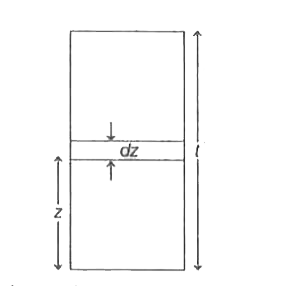 Condider an ELEMENTAL strip at a height z of thickness dz. Apparent height =`("Real height ")/(RI)= (d)/(mu(z))` `dh = (dz)/(1+ (z)/(t))` `dh = ((t)/(t +z))dz` `h INT _(0) ^(z) (t)/(t +z).dz` `h = [t ln (t + z) ]_(0)^(2) =t [ln (1+ t) - ln (t+ 0)]` `h = t ln ""(2t)/(t) = t ln 2` Shift, `Deltax, = t- t ln2` `implies Delta X = (1- ln 2) t ` |
|
| 48. |
The spectrum produced by white hot solids and liquids are called ? |
| Answer» SOLUTION :CONTINUOUS SPECTRUM | |
| 49. |
At the initial moment a particle's displacement is 4.3 cm and its velocity is -3.2 m/s. The particle's mass is 4 kg and its total energy 79.5 J Write down the equation. Here and below the units used are the SI units, i.e. the displacement amplitude is expressed in meters, the time in seconds, the frequency in hertz, the phase in radians. of the vibrations and find the distance travelled by the particle in 0.4 s. |
|
Answer» `s_(0)=Acosvarphi,v_(v)-Aomegasinvarphi, Wmomega^(2)A^(2)//2` giving `sinvarphi=-(v_(0))/(Aomega)=-v_(0)sqrt((m)/(2W))` Since `sinvarphigt0` and `cosvarphigt0`, it follows that the initial phase `varphi` lies in the INTERVAL `0ltvarphiltpi//2`. The circular frequency is `omega=-(v_(0))/(s_(0))cotvarphi`, the amplitude A `=sqrt(s_(0)^(2)+((v_(0))/(w))^a)`. The period of oscillations is 50 ms, so the time of 0.4 s spans 8 periods. During this time the particle will cover a distance equal to 32 amplitudes. |
|