

Saved Bookmarks
This section includes 7 InterviewSolutions, each offering curated multiple-choice questions to sharpen your Current Affairs knowledge and support exam preparation. Choose a topic below to get started.
| 1. |
Calculate the RMS velocity of molecules of a gas of which the ratio of two specific heats is 1.42 and velocity of sound in the gas is 500 m/s. |
|
Answer» 727 m/s `=sqrt((1.42)/(3))xxC_(rms)` `500=sqrt(0.47)C_(rms)` `C_(rms)=(500)/(sqrt(0.47))=727m//s`. |
|
| 3. |
Suppose an alpha particle accelerated by a potential of V volt is allowed to collide with a nucleus whose atomic number is Z, then the distance of closest approach of alpha particle to the nucleus is |
|
Answer» `14.4(Z)/(V)Å` |
|
| 4. |
A potentiometer having a wire 10 m long stretched on it, is connected to accumulator havig asteady voltage. A leclanche cell gives a null point at 750 cm. if the length of the potentiometer wire is increased by 100 cm, find the new position of the null point. |
|
Answer» |
|
| 5. |
Refractive index of glass is 1.6 and that water is 1.33. Angle of polarisation for ray light inciding on glass from water is ...... |
|
Answer» `49^(@)48'` `:.tan theta_(p)=(1.6)/(1.33)=1.2030` `:. theta=tan^(-1)(1.2030)` `=50^(@)16` |
|
| 6. |
For examples 15, find the total energy of the block at 0.05 m from the meanposition. Also,show that it issame as the P.E. Hint : Total energy =KE +PE at maximum displacement , KE=0 ,hence, total energy =PE |
|
Answer» Solution :TOTAL energy of the BLOCK at `x=0.05 m` `= KE +PE = ( -.375 + 0.125 ) J` `=0.5 J` We also know that at maximum displacement , `KE = 0` and hence, the total energy of the system `= P.E. ` The total energy of the system `=(1)/(2) xx 100 xx0.1 xx 0.1 J` `=0.5 J` which ISSAME as the sum of the TWO energies ata displacement of 0.05 m . This is in CONFORMITY with the principles of conservation of energy. |
|
| 7. |
यदि A और B दो अरिक्त समुच्चय है, तो A C B होगा यदि |
|
Answer» A तथा B में कोई भी उभयनिष्ठ अवयव नहीं है |
|
| 8. |
Two point charges +q_(1) and -q_(2) are placed at A and B respectvely. An electric line of force emerges from q_(1) making an angle alpha=60^(@) with line AB and terminates as -q_(2) making an angle of 90^(@) with line AB. (a). Find |(q_(1))/(q_(2))| ltbr. (b). Find the maximum value of angle alpha at which a line emitted from q_(1) terminates on charge q_(2). |
|
Answer» (b). `alpha_(max)=90^(@)` |
|
| 9. |
(a) Esttimate the average drift speed of conduction electrons in a copper wite of cross-secttonal area 1.0 xx 10 ^(-7)m^(2) carrying a current of 1.5A. Assume the each copper atom contrbutes roughly one conduction electron. The density of copper is 9.0 xx 10 ^(3)kg//m^(3), and its atomic mass is 63.5 u. (b) Compare the drift speed obyained above with, (1) thermal speeds of copper atoms at ordinary temperaturtes. (ii) speed of propagation of electric field along the conductor which causes the drift motion. |
|
Answer» Solution :(a) The direction of drift velocity of conduction electrons is opposite to the electric field direction, i.e., electrons drift in the direction of increasing potential. The drift speed `u _(d)` is given by `u _(d) =(l//n eA)` No, `e = 1.6 xx 10 ^(-19) C, A = 1.0 xx 10^(-7) m ^(2).I = 1. 5 A.` THe density of conduction electrons, n is equal to the number of atoms PER cubic meter (assuming one conduction enectron per Cu atom as is reasonable from its valence electron count of one). A cubic metre of copper has a mass of `9.0 xx 10 ^(3)Kg.` Since `6.0xx 10^(23)` copper atoms have a mass of `63.5g.` `n = (6.0 xx 10 ^(23))/(63.5) xx 9.0 xx 10 ^(6)` ` = 8.5 xx 10 ^(28) m^(-3)` which gives, `u _(d) = ( 1.5)/(8.5 xx 10 ^(28) xx.16 xx 10 ^(-19) xx 1.0 xx 10 ^(-7))` `=1.1 xx 10 ^(-3) ms ^(-2) =1.1 mm s ^(-1)` (b) (1) At a temperature T.the thermal speed of a copper atom of mass M is obyained from` [ lt (1//2) Mv ^(2)gt = (3//2) K _(B) T]` and is THUS typically of the order of `sqrt (k_(B) T//M).` where `k _(B)` is the BOLTZMANN constant. For copper at 300 K. this is about `2 xx 10 ^(2)` m/s. This figure indicates the random vibrattonal speeds of copper atoms in a conductor. Note that the drift speed of electrons is much smaller, about `10 ^(-5)` times the tpyical thermal speed at ordinary temperatures. (i) An electric field travelling along the conductor has a speed of an electronagetic wave, namely equal to `3.0 xx 10 ^(8) m s ^(-1)`The drift speed is, in comparison, extremely small, smaller by a factor of `10 ^(-11).` |
|
| 10. |
Area of a surface is 1256 m^(2). If 25 Js^(-1) radiant energy is incident on it at each second and absorbed completely, then findE_(rms) |
|
Answer» SOLUTION :`I=E_(0)CE_(rms)^(2)` `E_(rms)^(2)=(I)/(in_(0)C)=(0.02)/(8.85xx10^(-12)xx3xx10^(8))` = 7.5329 `THEREFORE E_(rms)=SQRT(7.5329)=2.7446~~2.74 Vm^(-1)` |
|
| 11. |
The upsilon~ u graph for a spherical mirror is a rectangular _______ |
| Answer» SOLUTION :HYPERBOLA | |
| 12. |
A rod of length l is rotated with angular speed omega about an axis passing through the centre of rod and perpendicular to its length. A uniform magnetic field B is applied parallel to the axis of rotation, Potential difference developed between the ends of the rod is |
|
Answer» `Bl(omega^(2))/(2)` |
|
| 13. |
A plane light wave with wavelength lambda = 0.50mu m falls normally on the face of a glass wedge with an angle Theta = 30^(@). On the opposite face of the wedge a transparent diffraction grating with period, d = 2.00 mu m is inscibed, whose lines are parallel to the wedge's edge. Find the angles that the direction of incident light froms with the directions to the principle Fraunhofer maxima of the zero and the first order. waht is the highest order of the spectrum? At what angle to the direction of incident light of the observed? |
|
Answer» Solution :The diffraction formula is easily obtaind on TAKING account of the fact that the optical PATH in the glass wedge acquires a factor `n`(refractive index). We get `d(n sin THETA -sin(Theta theta_(k))) = k lambda` Isnce `ngt0, Theta - theta_(0) gt Theta` and so `theta_(0)` must be nagative. we get, USING `Theta = 30^(@)` `(3)/(2) xx (1)/(2)=sin (30^(@) - theta_(0)) = sin48.6^(@)` Thus `theta_(0) =-18.6^(@)` Also for `k =1` `(3)/(4)-sin (30^(@) - theta_(+1)) = (lambda)/(d) = (0.5)/(2.0) = (1)/(4)` Thus `theta_(+1) = 0^(@)` We calaculate `theta_(k)` for varoius `k` by the above fromula. For `k =6`. `sin(theta_(k) - 30^(@)) = (3)/(4) rArr theta_(k) = 78.6^(@)` For `k = 7` `sin(theta_(k) - 30^(@)) =+ 1 rArr theta_(k) = 120^(@)` This is in ADMISSIBLE. Thus the highest order that can be observed is `k = 6` corresponding to`theta_(k) = 78.6^(@)` (for `k =7` the diffracted ray will be grazing the wedge). 
|
|
| 14. |
An electron falls from rest through a vertical distance h in a uniform and vertically upward directed electric field E. The direction of electric field is now reversed, keeping its magnitude the same. A proton is allowed to fall from rest in it through the same vertical distance h. The time of fall of the electron, in comparison to the time of fall of the proton is |
| Answer» Answer :A | |
| 15. |
Pick the correct statement the reverse current in p-n junction diode |
|
Answer» can be MAXIMUM and constant |
|
| 16. |
A physical quantity X is represented by x=(M^(x)L^(-y)T^(-z)). The maximum percentage errors in the measurement of M,L and T respectively are a%, b% and c%. The maximum percentage error in the measurement of X will be : |
|
Answer» `(ax+by-cz)` PER cent `:.(DeltaX)/(X)xx100=x((DeltaM)/(M)xx100)+y((DeltaL)/(L)xx100)` `+z((DELTAT)/(T)xx100)` ( Errors are ALWAYS added) `:.(DeltaX)/(X)xx100=(ax+by+cz)` per cent Hence correct CHOICE is `(c )`. |
|
| 17. |
In a moving coil galvanometer a radial magnetic field is obtained with concave magnetic poles, to have |
|
Answer» UNIFORM magnetic FIELD |
|
| 19. |
An air cored coil has a self-inductance of 0.1 H. A soft-iron core of relative permeability 100 is introduced and the number of turns is reduced to 1//10^(th). The value of self-inductance now is : |
|
Answer» SOLUTION :`L=0.1=(mu_(0)N^(2)A)/(l), L.(mu_(r )mu_(0)N_(1)^(2)A)/(l)`, `N_(1)=(N)/(10)` `THEREFORE(L.)/(0.1)=(1000xx mu_(0)(N//10)^(2)A.l)/(l xx mu_(0) N^(2)A)`or`L. = 1 H` |
|
| 20. |
Read the passage carefully and answer the followingquestions. Imagine a system, that can keep the room temperature within a narrow range between 20^(@)C to 25^(@)C. the system includes a heat engine operating with variable power P =KT, where K is a constant coefficient, depending upon the thermal insulation of the room, the area of the walls and the thickness of the walls. T is temperature of the room in degree, when the room temperature drops lower than 20^(@)C, the engine turns on,when the temperature increase over 25^(@)C, theengineturnsoff, room looses energy at a ate of K(T-T_(0) is the outdoor temperature. Thde heat capacity of the room is C. Given (T_(0)=10^(@)C,In((3)/(2))=0.4,In((6)/(5))=0.18,(C)/(K)=750SI-unit) Suppose at t = 0, the engine turns off, after how much time interval, again, the engine will turn on: |
|
Answer» 10 minute `(dT)/(dt) = -(K)?(C)(T-T_(0))` `rArr`` int_(25)^(20)(dT)/(T-10)=-(k)/( C ) int_(0)^(1) dt` `rArr`` In(10)/(15) = -(K)?(C)t` `rArr`` In (3)- In(2) = (K)/( C )t` `rArr`` t= 0.4 xx ( C ) /(k) = 5 MIN` When engine turns on `(dT)/(dt) =-( K )/( C ) (T-T_(0))+(P)/( C )` `rArr``- ( K)/( C ) [ -T+T_(0)+3T]` `rarr`` int_(20)^(25) (dT)/(21T +T_(0)) = (+Kt)/( C )` `rArr`` In((60)/(50)) = (K)/( C )t` `rArr``t=( C ) /(2K) In((6)/(5))` =1.125 min |
|
| 21. |
If 50 joule of work must be done to move an electric charge of 2 C from a point, where potential is V volt, the value of V is |
|
Answer» `+ 5 `V |
|
| 22. |
When a car of mass 1200 kg is moving with a velocity of 15 ms^(-1) on a rough horizontal road, its engine is switched off. How far does the car travel before it comes to rest if the coefficient of kinetic friction between the road and tyres of the car is 0.5? (g=10ms^(-2)) |
|
Answer» 21.6 m |
|
| 23. |
In an A.C. circuit, i_(rms) and i_(0) are related as |
|
Answer» `l_rms = PI l_(0)` |
|
| 24. |
An electron falls through a distance of 2 cm ir a uniform electric field of magnitude 6.0 xx 10^4 NC^(-1) figure (a). The direction of the field is reversed keeping its magnitude unchanged and a proton falls through the same distance figure (b). Compute the time of fall ir each case. Contrast the situation with that oi 'free fall under gravity'. m_(e) = 9.1 xx 10^(-31)kg, m_(p) = 1.7 xx 10^(-27) kg and e = 1.6 xx 10^(-19) C |
|
Answer» <P> |
|
| 25. |
Show how a current loop acts as a magnetic dipole. Derive an expression for its magnetic moment. |
|
Answer» Solution :Let us consider a circular wire carrying current which is flowing in anticlockwise direction as shown in the figure. This current loop ACTS as a magnetic dipole and lower FACE acts on S-pole and upper face acts as a N-pole. Let us find the magnetic dipole moment. Magnetic dipole moment (M) Let I be current flowing in the circular loop and A be area of the loop. It is found experimentally that the magnetic dipole moment M is (i) directly proportional to strength of current `i.e.""MpropI` (II) directly proportional to area A of the loop `i.e.""MpropA` 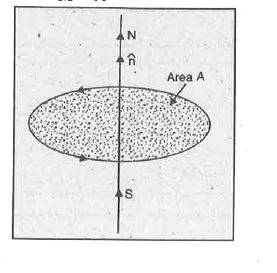 Combining these two parameters, we GET `MpropIA` or `M=kIA` If k = 1, then M = IA In vector FORM, `vecM=IAhatn` or `vecM=IvecA` |
|
| 26. |
A body projected from the top of a tower with a velocity u = 3i + 4j + 5k ms^(-1) . Where hatj and hatk are unit vectors along east, north and vertically upwards respectively. If the height of the tower is 30 m, horizontal range of the body on the ground is(g = 10ms^(-2)) |
|
Answer» 12 m |
|
| 27. |
Two insulating plates are both uniformly charged in such a way that the potential difference between them is (V_2 -V_1 )=20V.(i.e., plate 2 is at a higher potential). The plates are separated by d=0.1 m and can be treated infinitely large. An electron is released from rest on the inner surface of plate 1. Its speed when it hits plate 2 is |
|
Answer» `2.65 xx 10^6 m//s` |
|
| 28. |
A circular loop of area 1 cm^(2) carrying a current of 10A is placed in a magnetic field of 2 T i. The loop is in xy plane with current in clock wise direction. Find the torque on the loop |
|
Answer» Solution :`vectau=vecMxxvecB=(nivecAxxvecB)` `-[10xx10^(-4)(-HATK)]XX(2hatj)=2XX10^(-3)Nm(HATI)` |
|
| 29. |
A certain metallic surface is illuminated with monochromatic light of wavelength lambda.The stopping potentail for photelectric current for this light is 3V_(0).If the same surface is illuminated with light of wavelength 2lambda,the stopping potential is V_(0).The threshold wavelength for this surface for photoelectric effect is |
|
Answer» `4LAMBDA` `eV_(s)=E-phi` `THEREFORE V_(s)=(hc)/(lambda_(e))-(hc)/(lambda_(0)e)` `therefore 3V_(0)=(hc)/(lamdbae)-(hc)/(lambda_(o)e)`…..(1) and `therefore V_(o)=(hc)/(2lambdae)-(hc)/(lambda_(0)e)`…….(2) By multiplying EQ. (1) with (2) and then substracting from (1), `3V_(0)=(hc)/(lambdae)-(hc)/(lambda_(0)e)` `3V_(0)=(3hc)/(2lambdae)-(3hc)/(lambda_(0)e)` `(--+)/(0=-(hc)/(2lambdae)+(2hc)/(lambda_(0)e))` `0=-(hc)/(2lambdae)+(2hc)/(lambda_(0))` `therefore (2)/(lambda_(0))=(1)/(2lambda)` `therefore lambda_(0)=4lambda` |
|
| 30. |
Bulk modulus of water is 2.05 xx 10^9 N/m^2 What change of pressure will compress a given quantity of water by 0.5% ? |
|
Answer» a)`10^6 N/m^2` |
|
| 31. |
The resolving power of a telescope depends upon : |
|
Answer» the FOCAL LENGTH of the EYES lens |
|
| 32. |
The escape velocity from the surface of the planet of radius 2000km and acceleration due to gravity as 2.5m//s^2 is, |
|
Answer» a)`1.87xx10^3m//s` |
|
| 33. |
In the shown circuit involvinga resistor of resistance R Omega, capacitor of capacitance C farad and an ideal cell of emf E volts, the capacitor is initiallyuncharged and the key is in position 1. At t = 0 second the key is pushedto position 2 for t_(0) = RC seconds and then key is pushed back to position 1 for t_(0) = RCseconds. This process is repeatedagain and again. Assume the time taken to push key from position 1 to 2 and vice verse to be negligible. The current through theresistanceat t = 1.5 RC seconds is |
|
Answer» `(E)/(e^(2)R)(1-(1)/(e))` |
|
| 34. |
An electric dipole is placed at a distance x from centre O on the axis of a charged ring of R and charge Q uniformly distributed over it. (a) Find the net force acting on the dipole. (b) What is the work done in rotating the dipole through 180^@? |
|
Answer» `(DE)/(DX)=kQ[((R^2+x^2)^(3//2)-x.3/2(R^2+x^2)^(1//2)(2X))/((R^2+x^2)^3)]` or `(dE)/(dx)=kQ[(R^2+x^2-3x^2)/((R^2+x^2)^(5//2))]` or `dE=Q/(4piepsilon_0)[(R^2-2x^2)/((R^2+x^2)^(5//2))]dx` `:.|/_\E|=Q/(4piepsilon_0)[(R^2-2x^2)/((R^2+x^2)^(5//2))]/_\x` Her `/_\x=2a` `:. F=|q/_\E|=(Qqa)/(2piepsilon_0)[(R-2x^2)/((R^2+x^2)^(5//2))]` B. `W=U_f-U_i` `=-pEcos180^@+pEcos0^@=2pE` `2(q)(2a)[1/(4piepsilon_0 (Qx)/((R^2+x^2)^(3//2)))]` `=(aqQx)/(piepsilon(R^2+x^2)^(3//2)` |
|
| 35. |
The following figure shown a logic gate circuit with ttwo inputs A and B and the C are as shown below The logic circuit gate is |
|
Answer» AND gate |
|
| 36. |
The current through a wire depends on time as i=i_(0)+alphat, where i_(0)=10A and alpha=4A//s. Find the charge crossed through a section of the wire in 10 seconds. |
| Answer» Answer :C | |
| 37. |
A pendulum suspended to the ceining of a train has a period T when the train is at rest. If the train is accelerated uniformly, the period will : |
|
Answer» INCREASE |
|
| 38. |
Area of a surface is 1256 m^(2). If 25 Js^(-1) radiant energy is incident on it at each second and absorbed completely, then findB_(rms) |
|
Answer» Solution :`(E_(RMS))/(B_(rms))=C` `therefore B_(rms)=(E_(rms))/(C )=(2.74)/(3XX10^(8))xx10^(-8)` `=0.9133~~9.13xx10^(-9)T`. |
|
| 39. |
What happens if the galvanometer and cell are interchanged at the balance point of the bridge ? Would the galvanometer show any current ? |
|
Answer» Solution :In FIGURE (1), Wheatstone bridge is in the balanced condition and so galvanometer does not show any deflection because no CURRENT passes through it. In figure (2), also Wheatstone bridge is in the balanced condition and so galvanometer does not show any deflection because no current passes through it. 
|
|
| 40. |
A wire of length L, is hanging vertically from a rigid support. If a transverse wave pulse is generated at the free end of wire then which of the following statement is wrong |
|
Answer» Velocity at BOTTOM end is zero |
|
| 41. |
A grinding machine whose wheel has a radius of 1/piis rotating at 2.5 rev/sec. A tool to be shar-pened is held against the wheel with a force of 40N. If the coefficient of friction between the tool and wheel is 0.2, power required is |
|
Answer» 40 W |
|
| 42. |
A horizontal straight wire 10 m long extending from east to west is falling with a speed of 5.0ms^(-1) at right angles to the horizontal component of the earth's magnetic field, 0.30 xx 10^(4) Wbm^(-2). (a) What is the instantaneous value of the emf induced in the wire ? (b) What is the direction of the emf? (c) Which end of the wire is at the higher electrical potential ? |
|
Answer» Solution :Here l = 10 m, `v=5.0 m s^(-1)` and horizontal component of earth.s MAGNETIC field `B_(H) = 0.30 xx 10^(-4)Wb m^(2)` As `B_(H)`, I and v all the THREE are mutually perpendicular to each other HENCE instantaneous value of the emf induced in the wire has a magnitude `|varepsilon|B_(H).l.v=0.30 xx 10^(-4)xx10xx1.5xx10^(-3)V` (b) In accordance with Fleming.s right hand rule, the direction of induced emf is from west to east. (c) For the purpose of outer circuit the eastern end of the wire is at the HIGHER potential. |
|
| 43. |
Find the potential difference for which the error in the value of the momentum for the previous problem calculated using the nonrelativistic approximation does not exceed 5%. Do the calculations both for the electron and for the proton. |
|
Answer» <P> Solution :The RELATIVE error is`epsilon= (p_("rel")-p_("el"))/(p_("rel"))= 1-(csqrt(2qvarphim_(0)))/(SQRT(qvarphi(2E_(0)+qvarphi)))=1-sqrt((2E_(0))/(2E_(0)+qvarphi))` HENCE `varphi= (2E_(0))/(q).(2epsilon-epsilon^(2))/((1-epsilon)^(2))` Since `epsilon ltlt 1` we have `varphi= (4epsilonE_(0))/(q)` |
|
| 44. |
A non mono chromatic light is used in an experiment on photo electric effect. The stopping potential is related to the |
|
Answer» Mean wave length |
|
| 45. |
Eleven forces each equal to 5N act on a particle simultaneously. If each force makes an angle 30^(@) with the next one, the resultant of all forces is |
|
Answer» 15N |
|
| 46. |
A concave mirror of focal length 8 cm is placed on a table with its reflecting face turned upwards. The mirror contains a little amount of water inside it. At what distance from the pole of the mirrorshould a point object be placedon the axis of the mirror so that the object and its image coincide? Refractive index of water = (4)/(3) |
|
Answer» |
|
| 47. |
Earth's oceans are black with what? |
|
Answer» Oil |
|
| 48. |
A wire of resistance R = 100.0 Omega and length l = 50.0cm is put between the jaws of screw gauge Its reading is shown in Pitch of the scregauge is 0.5mm and there are 50 division on circular scale Find its resistivity in correct significant and maximum permissible error in p (resistivity) . |
|
Answer» SOLUTION :`R = (rhol)/(PID^(2)//4)` `rho=(Rpid^(2))/(4l)= ((1000.0)(3.14)(8.42xx10^(-3)))/(4(50.0xx10^-2))= 1.32Omega//m` Object thickness `= 8mm 42((1//2mm)/(50))` `=8.42mm` `(drho)/(rho)=(DR)/(R)+(2d(D))/(D)+(dl)/(l)=(0.1)/(100.0)+2xx(0.01)/(8.42)+(0.1)/(5.0)=0.00537(~~0.52%)`  . .
|
|
| 49. |
A circular coil of N turns and radius R carries a current I. It is unwound and rewound to makeanother coil of radius R/2, current I remaining the same. Calculate the ratio of the magnetic moments of the new coil and the original coil. |
|
Answer» Solution :We have : `N_(1).2piR = N_(2).2pi(R//2)` `therefore N_(2) = 2N_(1)` Magnetic MOMENT of a coil, M = NAI For the coil of radius .R. `M_(1) = N_(1)IA_(1) = N_(1)IPIR^(2)` For the coil of radius R/2 `M_(2) = N_(2)IA_(2) = 2N_(1)IpiR^(2)//4 = N_(1)I.piR^(2)//2` `rArr M_(2) : M_(1) = 1:2` |
|
| 50. |
A circular coil of n turns and area of crosssection A , carrying a current i, rests with its plane normal to an external magnetic field B. The coil is free to turn about an axis in its plane perpendicular to the field direction. If the moment of inertia of the coil about its axis of rotation is I, its frequency of oscillation about its stable equilibrium is given by |
|
Answer» `f=1/(2PI)((NIAB)/I)^(1//2)` |
|