

Saved Bookmarks
This section includes 7 InterviewSolutions, each offering curated multiple-choice questions to sharpen your Current Affairs knowledge and support exam preparation. Choose a topic below to get started.
| 1. |
A point object is placed on the axis of a convex lens at a distance greater than the focal length of lens. What is the rerfracted wavefront? |
Answer» SOLUTION :WAVEFRONT of light rays emitted from a point source is spheric convex. After being REFRACTED through the LENS the wavefront becomes spherical CONCAVE . This implies that after refraction through the lens light rays converge. 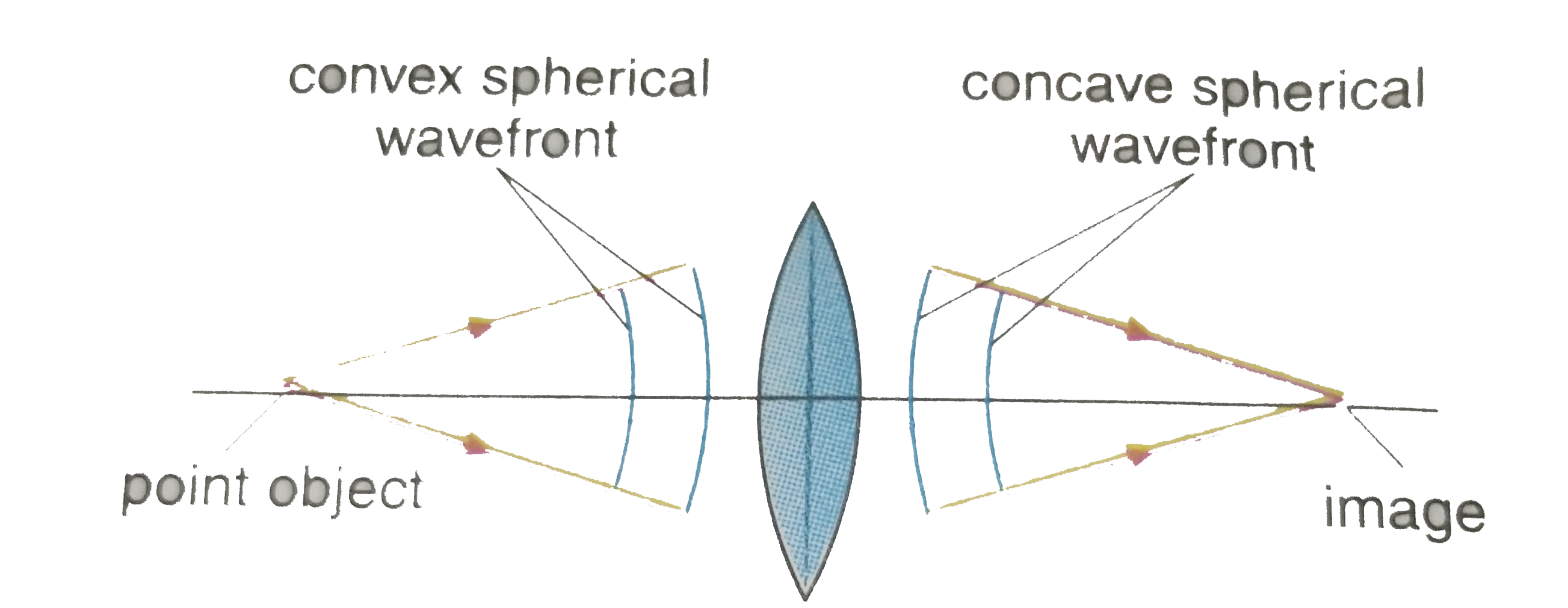
|
|
| 2. |
Calculate the Land'e g factor for atoms (a).^(6)F_(1//2),(b) .^(4)D_(1//2),(c ).^(5)F_(2),(d) .^(5)P_(1),(e ) .^(3)P_(0) |
|
Answer» Solution :(a)`.^(6)F_(1/2) Here S=(5)/(2), L=3, J=(1)/(2)` `G=1+((3)/(4)+(35)/(4)-12)/(2xx(3)/(4))=1+(38-48)/(6)=-(2)/(3)` (b) `.^(4)D_(1//2)`: HENCE `S=(3)/(2),L=2,J=(1)/(2)` `g=1+((3)/(4)+(15)/(4)-6)/(2xx(3)/(4))=1+(18-24)/(6)=-(2)/(3)` (c )`.^(5)F_(2)` Here `S=2, L=3, J=2` `g=1+(6+6-12)/(2xx6)=1` (d)`(5)P_(1)` Here `S=2,L=1,J=1` `g=1+(2+6-2)/(2xx2)=(5)/(2)` (e ) `.^(3)P_(0)`. For states with `J-0, L=S` the `g` gactor is indeterminate. |
|
| 3. |
मान लीजिए कि f:RrarrR,f(x)=x^4 द्वारा परिभाषित है। सही उत्तर चुनिए |
|
Answer» F एकैकी आच्छादक है। |
|
| 4. |
Explain why the reactance provided by a capacitor to an alternating current decreases with increasing frequency. |
|
Answer» Solution :A CAPACITOR does not allow flow of direct current (DC) through it as the RESISTANCE across the gap is infinite. When an alternating current (AC) is APPLIED across the capacitor plate the plate are alternately charged and discharged. The current through the capacitor is a result of this changing voltage (or charge). Thus, a capacitor will pass more current through it if the voltage is changing at a faster rate, MEANS if the frequency of supply is higher. This implies that the reactance offered by a capacitor is less with increasing frequency. Mathematically the reactance can be WRITTEN as, `X_C=1/(2pivC)` |
|
| 5. |
A stone, dropped from a certain height can reach the ground in 10 s. If it is stopped after 5 s of its fall and then allowed to fall again, find the time taken by it to reach the ground for the remaining distance. |
|
Answer» 5 sec `h=(1)/(2)xxgxx(10)^(2)=50 G` Distance covered in first fall of 5 s. `h=(1)/(2)xxgxx(5)^(2)=(25)/(2)g` `t^(2)=75` or `t=sqrt(75)=8.66s` |
|
| 6. |
What does it mean to have 'airs'? |
|
Answer» To be condescending |
|
| 7. |
The A.C. voltage and current in an L-C-R A.C. series circuit are given by the following expression V = 200 sqrt(2) cos ( 3000t - 55^(@) V, I = 10 sqrt(2) cos ( 3000 t - 10^(@) ) A. Calculate the impedance and the resistance of the above circuit. |
|
Answer» Solution :`delta_(1) = 10^(@), delta_(2) = 55^(@)` `:. delta = delta_(2) - delta_(1) = 55^(@) - 10^(@) = 45^(@)` `V_(m) = 200 sqrt(2) V, I_(m) = 10sqrt(2) A` here, `delta= 45^(@)` `:. tan delta = tan 45^(@)` `:. tan delta=1 ` Now for L-C-R- series circuit, `:. tan delta = ( omega l- (1)/( omega C ))/(R )` `:. 1= ( omega L - ( 1)/( omega C ))/( R )` `R = omega L - ( 1)/( omega C )`....(i ) and `| Z | = sqrt( R^(2) + ( omega L - ( 1)/( omega C))^(2)) ` `= sqrt( R^(2) + R^(2))`[ `:. ` From result (i) ] `| Z | = sqrt( 2).R`....(ii) and `|Z | ( V_(m))/( I_(m))` `:. | Z | ( 200 sqrt(2))/( 10sqrt(2))` `:. | Z | = 20 Omega`....(III) From equation (ii) and (iii) `:. 20 = sqrt( 2) xx R ` `:. 10 sqrt(2) = R ` `:. 10 xx 1.414 = R ` `:. R = 14.14 Omega` |
|
| 8. |
Show that ""_(92)^(238)U cannot spontaneosly emit a proton. Given : ""_(92)^(238)U=238.05079u, ""_(91)^(237)Pa=237.05121u, ""_(1)^(1)H=1.00783u |
|
Answer» Solution :The possible reaction is : `""_(92)^(238)U rarr ""_(91)^(237)Pa+""_(1)^(1)H` If the reaction takes place then Q - VALUE of the reaction is : Q- value `=[M_(U)-M)(Pa)-M_(H)]xxc^(2)` `[238.05079-237.05121-1.00783]uxxc^(2)` `=[-0.00825u]xx931.5(MeV)/(u)=-7.68MeV` As Q - value is `-ve`, the reaction is ENDOTHERMIC and NEEDS energy to be supplied. So, the reaction cannot take place spontaneously by itself. |
|
| 9. |
The energy of alpha particles emitted by .^(210)Po is 5.3 MeV. The half life of this alpha emitter is 138 days. (a) What mass of .^(210)Po is needed to power a thermoelectric cell of 1 W ouput if the efficiency of energy conservation is 8 percent? (b) What would be the power output after 1 year ? |
|
Answer» |
|
| 10. |
A uniformly charged conducting sphere of 2.4 m diameter has a surface charge density of 80.0muC//m^(2). a. Find the charge on the sphere. b. What is the total electric flux leaving the surface of the sphere? |
|
Answer» Solution :`R=(2.4)/(2)=1.2m""sigma=80muC m^(-2)=80 XX 10^(-6) Cm^(-2)` a. `sigma=q/(4pi r^(2), q=sigma xx 4pir^(2) =80 xx 10^(-6) xx 4 xx 3.14 xx (1.2)^(2)=1.45 xx 10^(-2)C=1.45mC` b. `phi=q/epsi_(0) =(1.45 xx 10^(-3))/(8.85 xx 10^(-12)) =1.64 xx 10^(6) NM^(2) C^(-2)` |
|
| 11. |
What are semiconductors? Name any two semiconductors. |
| Answer» Solution :A solid is a SEMICONDUCTOR if the energy GAP between the valence band and a CONDUCTION band is small (`0.1` to `1EV`) | |
| 12. |
The current in a 4.0 mH inductor vaires in time as shown in the figure. The corresponding graph of the self induced emf across the inductor over the time interval t=0 to t=12.0 ms is |
|
Answer»
|
|
| 13. |
Lenz force acting on a conducting rod moving in a magnetic field is ____ |
|
Answer» PROPORTIONAL to length. `F=BI l=B (epsilon/R)l = B((Bvl)/R)l` `therefore F=((B^2v)/R)l^2` `therefore F prop l^2` (`because` Remaining TERMS are constant) |
|
| 14. |
Using Kirchhoff's rules in the circuit showndetermine (a) the voltage drop across the unknown resistor R, and (b) the current I in the arm EF. |
|
Answer» Solution :(a) As per Kirchhoff.s first law CURRENT flowing through unknown resistor R is (I + 1) A. As per Kirchhoff.s second law for MESH ACDBA, we have - (I + 1)R – 1.2 + 3 = 0 or (I + 1)R=1 ... (i) ` therefore` VOLTAGE drop across R =V=(1+1)R=1 Volt (b) Again for mesh ECDFE, we have - (I + 1)R-I.3 + 5 =0 or (I + 1)R =5 - 3I...(ii) Comparing (i) and (ii), we get `5 - 3I= 1 RARR I = 4/3 A = 1.33 A` |
|
| 15. |
Arrange the following electromagnetic radiations in ascending order of their frequencies : (i) Microwave (ii) Radio wave (iv) Gamma rays (iii) X-rays Write two uses of any one of these. |
|
Answer» Solution :In ASCENDING order of their frequencies the clectromagnetic RADIATIONS are : Radio wave, Microwave, X-RAYS, GAMMA rays X-rays are used as a medical diagnostic tool and to study crystal structure. |
|
| 16. |
If the frequency of incident light falling on a photosensitive metal is doubled, the kinetic energy of the emitted photoelectron is |
|
Answer» unchanged |
|
| 17. |
A rectangular conducting loop consists of two wires on two opposite sides of length 1 joined together by rods of length d. The wires are each of the same material but with cross sections differing by a factor of 2. The thicker wire has a resistance R and the rods are of low resistance, which in turn are connected to a constant voltage source V_(0). The loop is placed in uniform a magnetic field vecB at 45^(@) to its plane. Find the torque exerted by the magnetic field on the loop about an axis through the centres of rods. |
Answer» Solution :1.   2. Resistance of thick wire be R and THIN wire be 2R. Cross section is different for both wire from factor q. MASS and length of both are same. 3. Torque and force on first wire is as shown below, `F_(1)=I_(1)lB=V_(0)/(2R)lB` `thereforetau_(1)=(F_(1))(d/(2sqrt2))=(V_(0)lB(d))/(2R2sqrt2)` 4. Torque and force on another wire can be calculated as, `F_(2)=I_(2)lB=V_(0)/(2R)lB` `thereforetau_(2)=F_(2)(d/(2sqrt2))` `thereforetau_(2)=(V_(0)lB)/(2R)(1/(2sqrt2))` 5. According to Ohm.s law, V = IR 6. Current `I_(1)=V_(1)/R_(1)=V_(0)/R""(becauseV_(1)=V_(2)=V_(0))` 7. Current `I_(2)=V_(2)/R_(2)=V_(0)/(2R)` 8. Force on first wire, `F_(1)=I_(1)lB(1/sqrt2)` = `V_(0)/R(lB)/sqrt2` `therefore` Torque on wire, `tau_(1)=F_(1)(d)` `tau_(1)=(V_(0)lB)/(sqrt2R)(d)` 9. Similarly, force and torque can be calculated for second wire are, `F_(2)=I_(2)lBsin45^(@)` = `V_(0)/(2R)(lB)/sqrt2` `thereforetau_(2)=F_(2)(d)` = `V_(0)/(2R)(lB)/sqrt2(d)` `tau_(2)=(V_(0)lB)/(2sqrt(2)R)(d)` 10. RESULTANT torque, `tau=tau_(1)-tau_(2)=(V_(0)lB)/(sqrt2R)d/2-(V_(0)lBd)/(2sqrt2Rxx2)` `thereforetau=1/(4sqrt2)(V_(0)lB)/R(d)=1/(4sqrt2)(V_(0)BA)/R` where ld = area A |
|
| 18. |
The frequency response curve (Fig. 15.2) for the filter circuit used for production of AM waves should be |
|
Answer» (`i`) FOLLOWED by (`ii`) |
|
| 19. |
The efficiency of a heat engine is 50% and the temperature of the sink is 500^@K. If the temperature of the source is kept constant and its efficiency is to be raised to 60%, then the required temperature of the sink should be |
|
Answer» 600 K |
|
| 20. |
The half life period of the radioactive ""_(15)P^(30)is |
|
Answer» 6.5 MINUTES |
|
| 21. |
A Rough inclined plane with inclination 30^(@) with the horizontal has a block of 1 kg being pushed up the plane by a force of 10 N acting parallel to the plane. If the coefficient of friction between the block and the plane is 0.1 and block is pushed through a distance of 10 m along then incline. What are the increases in the (1) potential energy and (ii) kinetic energy of the block ? |
|
Answer» 50 J: 41.3J `DeltaU=mgh` =`1xx10xx5` =50 J…(i) (`because(H)/(10)=sin 30^(@)` and h=5m) COD Also cceleration along the PLANE `a=("Force")/("mass")=([F-mg sin theta+mu mg cos theta])/(m)` =`([10-(10xx1/2+0.1xx10xx(SQRT3)/(2))])/(1)` =`[10-(5+0.5xx1.732)]` =`10-5.87=4.13 ms^(-2)` Applying `v^2-u^2=2 a S` We have `1/2mv^2-1/2mv^2=m a s` `:. DeltaE_k=m a s` =`1xx4.13xx10=41.3 J`...(ii) 
|
|
| 22. |
Biot Savart's law gives the quantitative description of____effects of electric current. |
| Answer» SOLUTION :MAGNETIC | |
| 23. |
The u-v curve in a concave mirror as shown in figure. Find the nature and position of the image, when an object is placed at 15 cm from the mirror. |
| Answer» SOLUTION :REAL, INVERTED, 30CM from the MIRROR | |
| 24. |
A bar magnet of moment of inertia 1 xx 10^(-2)Kgm^(2) vibrates in a magnetic field of induction 0.36 xx 10^(-4) Tesla. The time period of vibration is 10 s. Find the magnetic moment of the bar magnet. |
| Answer» SOLUTION :`110 Am^(2)` | |
| 25. |
The equation of a progressive wave isy = 4 sin (4pit - 0.04 x + pi/3)where x is in meter and t is in second. The velocity of the wave is |
|
Answer» `100 PI m//s` `y = 4 SIN(4pi t- 0.04 x + pi/3)` Compare it with the standard wave EQUTION `y =A sin(omega t - kx + phi)` we get, `omega = 4pi rad s^(-1), k= 0.04 rad m^(-1)` `therefore` Velocity of the wave, `v = omega/k = (4pi rad s^(-1))/(0.04 rad m^(-1)) = 100 pi ms^(-1)` |
|
| 26. |
A liquid having co-off of cubical expansion gamma is filled in the container having coefficient of linear expansion alpha. If on heating the liquid overflows, then which of the following relations is correct ? |
|
Answer» `gamma = 2 ALPHA` |
|
| 27. |
3 equal resistors connected in series across a source of emf together dissipate 10 Watts of power. If they are all connected in parallel to the same source of emf, the power dissipated is |
| Answer» ANSWER :D | |
| 28. |
A T.V. tower has a height 100m. By how much the height of the tower be increased to triple its covering range : |
| Answer» ANSWER :D | |
| 29. |
Consider the situation of the previous problem. The force on the central charge sue to the shell is |
|
Answer» rowards left |
|
| 30. |
Point out two distinct features observed experimentally in photolelectric effect which cannot be explained on the basis of wave theory of light. State how the 'photon picture' of light provides an explanation of these features. |
|
Answer» Solution :(i) For every metal there is a certain minimum frequency (threshold frequency) below which two photoelectrons are EMITTED, however, hight is the intensity of incident radiation. (ii) Photoelectric current in directly proportional to the intensity of incident radiation. (iii) The Photoelectric current becomes zero becomes zero at a certain value of negative potential (stopping potential) applied at the anode. (IV) The value of stopping potential increases with the frequency of incident radiation. (v) The maximum K.E. of photoelectrons is directly proportional to the frequency of incident radiation. (vi) The maximum K.E. of photoelectron is independent of the incident radiation. (viii) The photoelectric emission is an instantaneous process. The basic features of the PHOTON picture of e.m. radiation are as FOLLOWS : (i) Light is composed of discrete packets of energy called quanta or photons. (ii) Each photon carries an energy `E(-hv)` and momentum `p(=h//lambda)`, which depend on the frequecny v of the incident radiation and not on its intensity. (iii) Photoelectric emission from the metal surface occurs DUE to the absorption of a photon by an electron. |
|
| 31. |
A : When an unpolarised light is incident on a glass plate at Brewster angle, the reflected ray and refracted ray are matually perpendicular. R : The refractive index of glass is equal to sine of the angle of polarisation. |
|
Answer» Both A and R are TRUE and R is the CORRECT EXPLANATION of A |
|
| 32. |
In the circuit shown in Figure, switch S_(1) is kept closed and S_(2) open for a long time. Resistance R_(1) = 1000 R and R_(2) = 10^(-3) R. (a) Switch S_(1) is opened at time t = 0. Write the current and potential drop across R_(1) immediately after S_(1) is opened. What will be value of current after a long time? (b) Switch S_(2) is closed (S_(1) is already closed since long) at time t = 0. Write current and potential drop across R_(2) immediately after this operation. Write current through the inductor as a function of time. |
|
Answer» (b) AT `t = 0^(+): i_(0) = (E)/(R), V_(R_(2)) = 10^(-3) E`, `i=(1000E)/(R) [1-e^(-(Rt)/(1000L))]` |
|
| 33. |
A solenoid of length 50cm with 20 turns per centimetre and area of cross-section 40cm? completely surrounds another coaxial solenoid of the same length, area of cross-section 25cm^(2) with 25 turns per centimetre. Calculate the mutual inductance of the system. |
|
Answer» Solution :`l-50cm=(1)/(2)m` `N_(1)=20 xx 50=1000, A_(1)=40xx10^(-4) m^(2)` `N_(2)=25 xx 50=1250, A_(2)=25 xx 10^(-4) m^(2)` `M=(mu_(0)N_(1)N_(2)A_(2))/(l)=(4 pi xx 10?^(-7) xx 1000 xx 1250 xx 25 xx 10^(-4))/(1 // 2)H` `=7.9 xx 10^(-3)H=7.9` MH |
|
| 34. |
Name the part of the electromagnetic spectrum of wavelength 10^2 m and mention it's application. |
| Answer» SOLUTION :`GAMMA`-RAYS,RANGE `10^9` HZ to `10^23` Hz | |
| 35. |
A concave mirror of focal length 10 cm and a convex mirror of focal length 15 cm are placed facing each other 40 cm apart. A point object is placed between the mirrors, on their common axis and 15 cm from the concave mirror. Find the position and nature of the image poroduced by the successive reflections, first at concave mirror and then at conved mirror. |
|
Answer» 5 cm behing the convex mirror and is virtual |
|
| 36. |
Water is poured into a container that has a small leak. The mass m of the water is given as a function of time t by m=500t^(0.8)-3.00t+20.00, with tge0, m in grams, and t in seconds. (a) At what time is the water mass greatest, and (b) what is that greatest mass? In kilograms per minute, what is the rate of mass change at (c ) t = 3.00 s and (d) t = 5.00 s? |
| Answer» Solution :(a) 4.21 s, (b) 23.2 G, (C ) `1.27xx10^(-2)`, (c ) `-6.05xx10^(-3)kg//min` | |
| 37. |
The hysteresis loop of a soft iron piece has a much smaller area than that of a carbon steel plece. If the material is to go through repeated cycles of magnetisation, which piece will dissipate greater heat energy? |
| Answer» SOLUTION :(b) Heat loss PER one hysterisis cycle is equal to area ENCLOSED in the loop. Hence, carbon steel PIECE will DISSIPATE greater heat energy as it has greater area enclosed in its hysterisis loop (as per the statement). | |
| 38. |
Ratio of rate of radiation of heat of a body at 227^@C to that of the same body at 27^@C is |
| Answer» ANSWER :D | |
| 39. |
The current-frequency response curves are shown in figures above for three LCR circuits.a. What is Q-factor of the LCR circuit? b. Which of the curves in the above figures has highest Q value? C. Write an expression for the value. d. Can any of the curves shown in the figures represent current-frequency response of a parallel LCR circuit? |
|
Answer» Solution : a. The RATIO of inductive reactance to resistance is CALLED Q factor. b. The LAST ONE. (Figure at the right end) C. `(I omega)/(R ) or (1)/(C omega R) ` d. No |
|
| 40. |
A small circular loop of area 2.00 cm^(2) is placed in the plane of, and concentric with, a large circular loop of radius 1.00 m. The current in the large loop is changed at a constant rate from 50.0 A to -50.0 A (a change in direction) in a time of 1.00 s, starting at t= 0. What is the magnitude of the magnetic field B at the center of the small loop due to the current in the large loop at (a) t = 0, (b) t = 0.500 s, and ( c) t = 1.00 s? ( d) From t= 0 to t= 1.00 s, is vecB reversed? Because the inner loop is small, assume vecB is uniform over its area. (e) What emf is induced in the small loop at t = 0.500 s? |
| Answer» SOLUTION :(a) 31.4 μT, (B) 0, (c) 31.4 μT, {d) YES, (E) 12.6 nV | |
| 41. |
Order of magnitude of density of uranium nucleus is , [m = 1.67 x 10^(-27) kg] |
|
Answer» `10^20 "kgm"^(-3)` |
|
| 42. |
What is the basic conation for the proper function of transistor as an amplifier ? |
| Answer» Solution :A TRANSISTOR is almost always connected in CE arrangement. For its proper FUNCTION in this arrangement, base-emitter JUNCTION should always remain properly forwani bitted and collectro-emitter junction sKould remain properly REVERSE biased. | |
| 43. |
ax - by = a ^2+b^2 x +y = 2a Solve the above equations |
|
Answer» X= a - b.y = a - b |
|
| 44. |
{:("List-I","List - 2"),((a)"Second",(e)"carbon"-12),((b)"Mole",(f)"Platinum iridium"),((c)"Metre",(g)Cs - 133),((d)"Kilogram",(h)Kr-86):} |
|
Answer» a - E`""` B -G `""` c - h `"" `d - f |
|
| 45. |
The maximum wavelength of Brackett series of hydrogen atom is ...... [R=1.097xx10^(7)m-1] |
|
Answer» `35,890Å` `(1)/(lamda)=R[(1)/(4^(2))-(1)/(n^(2))]` For maximum wavelength we have to take n = 5 `:.(1)/(lamda_(max))=R[(1)/(4^(2))-(1)/(5^(2))]` `:.(1)/(lamda_(max))=R[(1)/(16)-(1)/(25)]` `:.(1)/(lamda_(max))=R[(25-16)/(25xx16)]=(Rxx9)/(25xx16)` `:.lamda_(max)=(25xx16)/(9R)=(400)/(9xx1.097xx10^(7))` `=40514xx10^(-10)m` `=40,400Å` (Approximate value) |
|
| 46. |
Apparent velocity of fish floating in tank A tank is filled with water up to a height of 15cm and a fish is floating inside at a depth of 10cm. The tank is now being drained so that the surface moves down with a velocity of 1cm/s. An observer is viewing the fish from a height of 10cm. (a) Find the apparent velocity of the fish as seen by the observer. Find the apparent velocity of the observer as seen by the fish. |
|
Answer» Solution :If the object moves with a velocity v inside the medium, its apparent velocity can be found by rate of change of apparent depth. Let us assume that `x_(m)=` depth of x with respect to surface. Then `(d_(app))/(n_("refracted"))=(d_("ACTUAL"))/(n_("incident"))` Here, the depth of image is changing because the depth of the object is changing with respect to surface. Differentiating both sides, we get `(V_(IS))/(n_(r ))=(V_(OS))/(n_(i))implies(V_(I)-V_(S))/(n_(r ))=(V_(O)-V_(S))/(n_(i))` where `V_(IS)` is the velocity of image with respect to the surface and `V_(OS)` is the object of image with respect to the surface. These refer to the velocities in the normal direction .In a direction parallel to the surface, the velocity of the image will be the same as the velocity of the object. Calculation : Assuming DOWNWARD direction to be positive, the velocity of the object (fish) is zero (fish is floating). Now `V_(S)=+1`cm/s. Therefore, `(V_(IS))/(n_(r ))=(V_(OS))/(n_(i))` `V_(IS)=(n_(r ))/(n_(i))V_(OS)=(1)/((4)/(3))xx(V_(O)-V_(S))-(3)/(4)m//s` `V_(IS)=V_(I)-V_(S)` `-(3)/(4)+1=V_(I)impliesV_(I)=(1)/(4)m//s` (34-5) Again `(V_(IS))/((4)/(3))=(V_(OS))/(1)=V_(S)xx(4)/(3)=(-4)/(3)m//s` `V_(I)-V_(S)=(4)/(3)` `V_(I)=1-(-4)/(3)=(-1)/(3)cm//s` Learn : The fish seems to be at a lesser depth than it actually is. So when depth of water DECREASES, the image of fish will approach its actual position. So, `V_(I)` should be downward in EQ. 34-5. A similar argument can be applied to Eq. 34-6 |
|
| 47. |
A small particle of mass m is fixed to the perimeter of a ring of same mass and radius r. The system comprising of particle and ring is placed on a horizontal plane. Friction is negligible on horizontal plane. Initially particle is at top most point, then the system is released from rest. Answer next two question when the particle is at the same height as the centre of ring aftr being released from top most point. Assume that the ring stays in vertical plane during its motion under consideration Mark the CORRECT option(s): |
|
Answer» Speed of centre of mass of system is `sqrt((gr)/(4))` 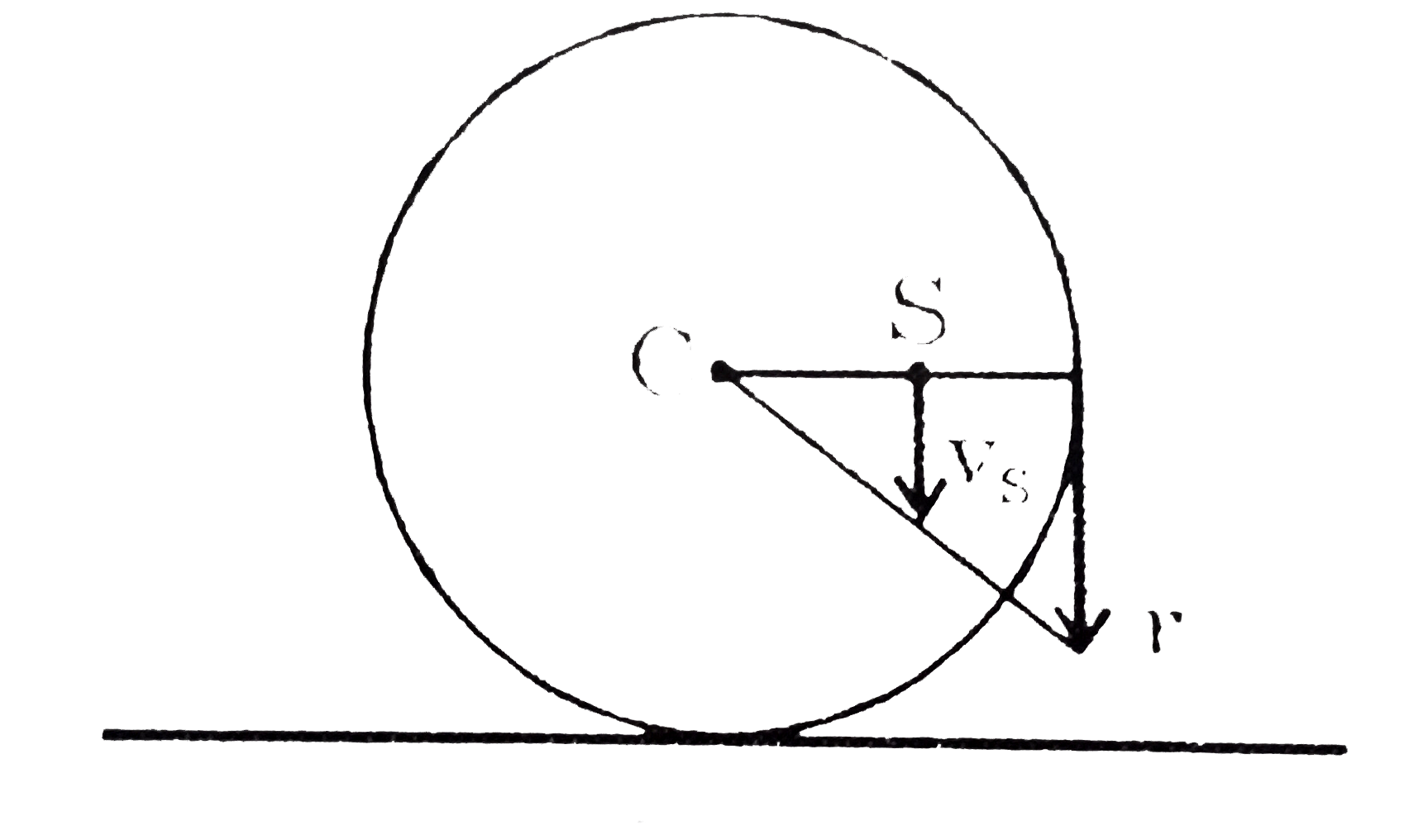 In the absence of horizontal external force centre of mass of system S falls vertically. Since mass of ring and PARTICLE are equal their motion about CM of system is SYMMETRICAL. At given instant centre of ring will be instantaneous centre From work ENERGY theorem `mgr=(1)/(2)mv_(1)^(2)+(1)/(2)mr^(2)omega^(2)` also `v_(1)=romega` thus `v_(1)=sqrt(gr)` `|VEC(a)_(C )|=|vec(a)_(1)|=(v_(rel)^(2))/((r//2))=(v_(1)//2)^(2)/(r//2)=(g)/(2)` `[v_(rel)=v_(1)-v_(S)=(v_(1))/(2)]` At the given instant acceleration of particle is equal to the centripetal acceleration of its rotaion about centre of mass. 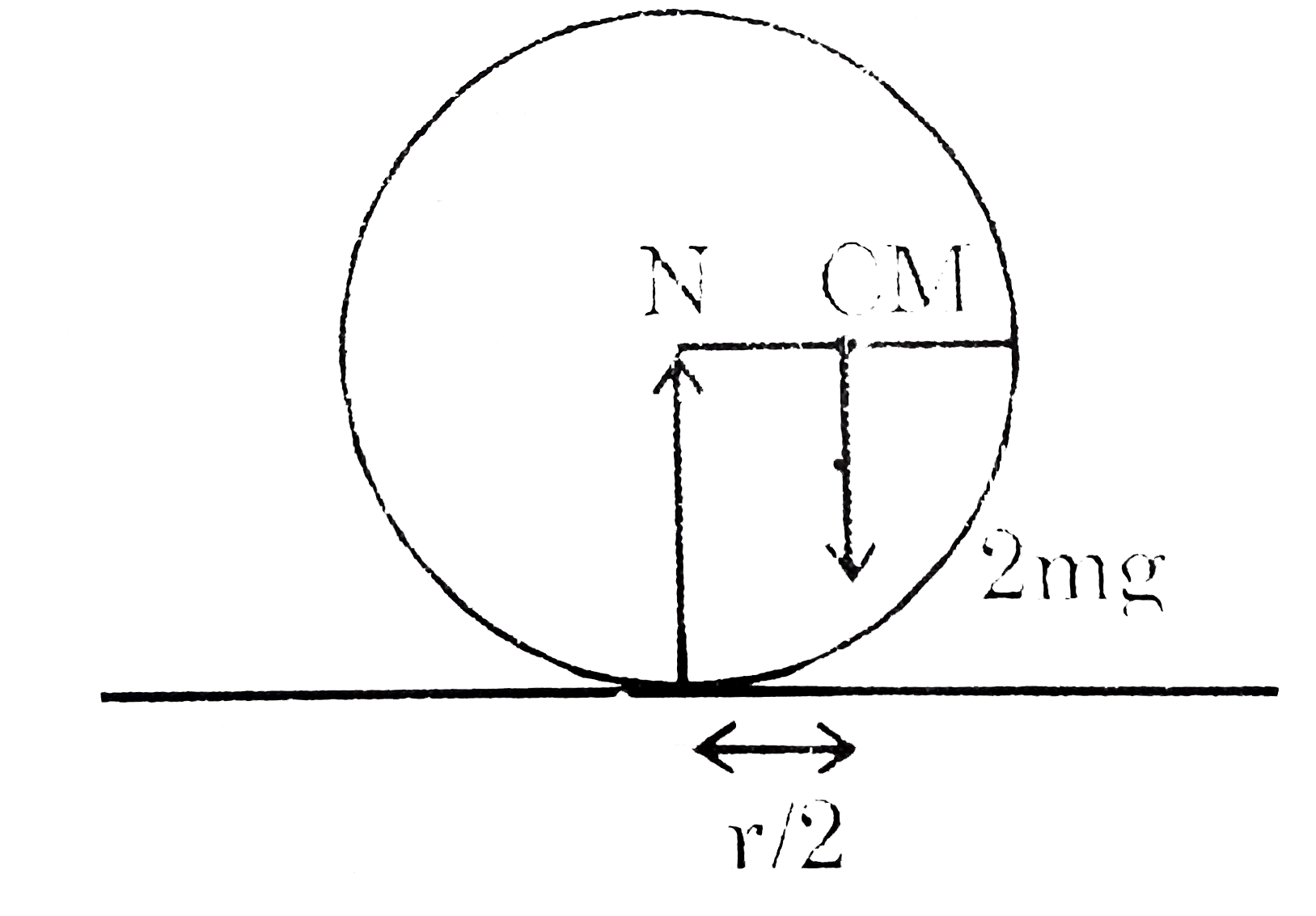 `N,(r)/(2)=(3)/(2) mr^(2)alpha "" ....(i)` `a_(s)=(r)/(2)alpha""...(ii)` `a_(s)=(2mg-N)/(2m)""...(iii)` Thus `N=(3)/(2)mg` |
|
| 48. |
A charge +q_(0) is fixed at a position in space. From a large distance another chaged particle of charge -q and mass m is thrown towards +q_(0) with an impact parameter L as shown. The initial speed of the projected particle is v. Find the distance of closet approach of the two particles. |
|
Answer» Solution :As -Q movestowards `+q_(0)` an attractiveforce acts on -q towards `+q_(0)`. No torque acts on -q relative to `+q_(0)`. In other WORDS angular MOMENTUM of -q must remain constant. When -q is closet to +q, it will be moving perpendicularly to the line joining the two charges as shown.  Let r be the closed seperation between the charges and `v_(c )` be the velocity of -q at the instant. From conservation of angular momentum, `mvL=mv_(c )r` From conservation of mechanical energy `(1)/(2) mv^(2)=(1)/(2)mv_(c )^(2)-(1)/(4pi in_(0)) (qq_(0))/(r )` On solving the above equation, we can get r. |
|
| 49. |
A proton enters a magnetic field of flux density 1.5 Wb/m^(2) with a spped of 2 xx 10^(7)m/s at angle of 30^(@) with the field. The force on the proton will be |
|
Answer» `0.24 xx 10^(-12)N` |
|


