

Saved Bookmarks
This section includes 7 InterviewSolutions, each offering curated multiple-choice questions to sharpen your Current Affairs knowledge and support exam preparation. Choose a topic below to get started.
| 1. |
Fountains usually seen in gardens are generated by a wide pipe with an enclosure at one end having many small holes. Consider one such fountain which is produced by a pipe of internal diameter ? Cm in which water flows at a rate 30 ms^(-1). The enclosure has 100 holes of diameter 0.5 cm The velocity of water coming out of the holes is ("in ms"^(-1)) |
|
Answer» `0.48` |
|
| 2. |
A stone falls from rest. The total distance covered by it in the last second of its motion is equal to the distance covered by it in the first three seconds of its motion. How long does the stone remain in air? |
|
Answer» 4 s `=0+(1)/(2)xx10xx9=45` `:.10n -5 5=45` or n=5 seconds |
|
| 3. |
A bright fringe is formed in front of one of the double slits. What will be the fringe width of the interference pattern? |
|
Answer» Solution :`BETA=(lambda D)/(d)` and `X=n beta` for `C.I.` Here, `x=(d)/(2) and n=1` or `lambda=(d^2)/(2D)` and the fringe width `beta=(lambda d)/(2)`. |
|
| 4. |
Estimate the number of mean lives clasped , when the number of atoms in a radioactive sample decrease to 5% of the original value. |
|
Answer» Solution : Let the required number of mean lives elapsed be .m., then `t = m lt TAU GT = m/lamda` and `N = 5% ` of `N_0 = 1/(20)N_0` But `N=N_0e^(-lamdat)` `:. N_(0)/(20) = N_(0)e^(-m)` or `e^(m) = 20 ` or , m = LN 20 = ln 2 + ln 10 = 0.693 + 2.303 `~~3` `:.` At the of about three average lives, the number of atoms (undecayed) would fail to 5% . |
|
| 5. |
The vibration in the air column of tanpura,violin,etc.are |
|
Answer» Forced |
|
| 6. |
A proton and a deuteron with the same initial kinetic energy enter a magnetic field in a direction perpendicular to the direction of the field.The ratio of the radii of the circular trajectories described by them is |
|
Answer» <P> Solution :Massofproton `=1 u`, mass of deuteron `=2u`Charge of proton `=E`, charge of deuteron `=e` `(r_(p))/(r_(d))=(m_(p))/(m_(d))=1/2` Trajectories of path is circular as GIVEN below : 
|
|
| 7. |
Unplarised light of intensity I is incident on a polarizer and the emerging light strikes a second polarizing filter with its axis at 45^(0)to that the first . Determine (a)the intensity of the emerging beam and(b) its state of polarization |
|
Answer» `(I)/(4)`and PARALLEL to second filter |
|
| 8. |
Resistance of 100 cm long potentiometer wire is 10Omega. It is connected with external resistanceR and a cell with emf2V and negligible internal resistance. While balancing 10 mV emf in the secondary circuit , null point is obtained at 40 cm . Findthis external resistance. |
|
Answer» Solution :If potential gradient existing on potentiometer wire is k then we have, `epsilon_(1) = kl_(1)` ` THEREFORE epsilon_(1)= ((epsilon rho )/(R + L rho + r) )l_(1) "" ` .... (1) RESISTANCE per unit length of a POTENTIOMETERWIRE, `rho = ("total resistance of potentionmeter wire")/("total length of potentiometer wire" ) ` `thereforerho= (10 Omega)/(100 xx 10^(-2) m) = 10 (Omega )/(m ) ` Placing GIVEN values in equation (1), `10 xx 10^(-3)= ( (2 xx 10)/(R + 10 + 0))(0.4)` `therefore 0.01 = (8)/(R + 10)` `therefore R + 10= 800` `therefore R = 790 Omega` |
|
| 9. |
For sodium light, the two yellow lines occur at lambda_(1) and lambda_(2) wavelengths. If the mean of these two is 6000Å and |lambda_(2)-lambda_(1)|=6Å, then the approximate energy difference between the two levels corresponding to lambda_(1) and lambda_(2) is |
| Answer» Answer :A | |
| 10. |
Ina uniform electric field |
|
Answer» all points are at the same POTENTIAL |
|
| 11. |
Two point charges q_A= 3muC and q_(B) = -3muC are located 20 cm apart in vacuum. a. What is the electric field at the midpoint O of the line AB joining the two charges? b. If a negative test charge of magnitude 1.5.xx 10^(-9) C is placed at this point, what is the force experienced by the test charge? |
Answer» Solution :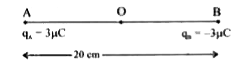 a. `E=E_(1)+E_(2)` `E_(t)=(9 xx 10^(9) q_(A))/((AO)^(2)) =(9 xx 10^(9) xx 3 xx 10^(-5))/((10 xx 10^(-2))^(2)) =27 xx 10^(5) "N/C ALONG OB"` `E_(2)=(9 xx 10^(9) q_(B))/((BO)^(2))=(9 xx 10^(9) xx 3 xx 10^(-6))/((10 xx 10^(-2))^(2)) =27 xx 10^(5)" N/C along OA"` `E=E_(1)+E_(2) =54 xx 10^(5) NC^(-1)" along OB"` b. `F_(1)=9 xx 10^(9) (q_(A)q)/((OA)^(2)) =(9 xx 10^(9) xx 3xx 10^(-6) xx 1.5 xx 10^(-9))/((10 xx 10^(-2))^(2)) =40.5 xx 10^(-4)N` `F_(2)=(9 xx 10^(9) xx 3 xx 10^(-6) xx 1.5 xx 10^(-9))/((10 xx 10^(-2))^(2)) =40.5 xx 10^(-6)N` `F=F_(1)+F_(2)=81 xx 10^(-4)" N along OA"` |
|
| 12. |
A sonometer wire is in unison with a tuning fork keeping the tension unchanged, the length of the wire between the bridges is doubled . Then the tuning fork will be still inresonance with the wire provided the wire vibrates in |
|
Answer» 4 segments `l_2 prop P_2` |
|
| 13. |
The air column in a pipe which is closed at one end will be in resonance with a vibrating tuning fork at a frequency 250 Hz. If the length of the air column is : |
|
Answer» SOLUTION :For resonance frequency of air COLUMN = frequency of tunning fork . `therefore (V)/(4l) = v "" rArr "" l = (V)/(4V)` l ` = (332)/(4 xx 250) = 0.53 m= 33 ` cm . Hence the correct choice is (a) . |
|
| 14. |
Consider a thin target (10^(-2)m square,10^(-3)m thickness) of sodium, which produces a photocurrent of 100 muA when a light of intensity 100W//m^(2)(lambda=660nm) falls on it. Find the probability that a photoelectron is produce when a photon strikes a sodium atom. [Take density of Na=0.97kg//m^(3), Avogadro's number =6xx10^(26)"atom"]. |
|
Answer» Solution :Here, `A=10^(-2)m sq=10^(-2)xx10^(-2)sq m=10^(-4)m^(2) , d=10^(-3)m, i=100xx10^(-6)A=10^(-4)A` Intensity, `I=100W//m^(2), lambda=600nm=600xx10^(-9)m` Probability=? , `rho_(Na)=0.97xxkg//m^(3)`, Avogadro's number `=6xx10^(26)kg` atom Volume of sodium TARGET `=Axxd=10^(-4)xx10^(-3)=10^(-7)m^(3)` We know that `6xx10^(26)` atoms of Na weighs=23g `:.` Volume of `6xx10^(26)`Na atoms `=23/0.97m^(3)` Volume occupied by one Na atom `=23/(0.97xx(6xx10^(26)))=3.95xx10^(-26)m^(3)` No. of Na atoms in the target `(n_(Na))=(10^(-7))/(3.95xx10^(-26))=2.53xx10^(18)` Let n be the number of photons falling per second on the target. Energy of each photon `=hc//lambda` Total energy falling per sec on target =`(nhc)/lambda=IA :. n=(IAlambda)/(hc)=(100xx10^(-4)xx(600xx10^(-9)))/((6.62xx10^(-34))xx(3xx10^(8)))=3.3xx10^(16)` Let P be the probability of EMISSION per atom per photon. The number of photoelectrons EMITTED per second `N=Pxxnxx(n_(Na))=Pxx(3.3xx10^(16))xx(2.53xx10^(18))` As per equation, `i=100 muA=100xx10^(-6)=10^(-4)A`, Current, `i=Ne :. 10^(-4)=Pxx(3.3xx10^(16))xx(2.53xx10^(18))xx(1.6xx10^(-19))` or `P=(10^(-4))/((3.3xx10^(16))xx(2.53xx10^(18))xx(1.6xx10^(-19)))=7.48xx10^(-21)` Thus the probability of emission by a single photon on a single atom is very MUCH less than 1. It is due to this reason, the absorption of two photons by an atom is negligible. |
|
| 15. |
A satellite is put into a circular orbit with the intention that it over a certain spot on the earths surface However the satellite's orbital radius is erroneously made 1.0km large for this to happen At what rate and direction does the point directtly below the satellite move across the earth surface ltbgt R =Radius of earth = 6400km r= radius of orbit of geostationary satellite = 42000km T= Time period of earth about its axis = 24hr . |
|
Answer» to the east along EQUATOR . |
|
| 16. |
There is an infintely long straight wire carrying a charge of liner density lamda=40muC//m Calculate the potential diffence between point 1 and 2 if point 2 is n=2 times fayher from the wire then point 1. |
|
Answer» |
|
| 17. |
A projectile of mass m is fired with velocity v from a point P at theta = 45°. Neglecting air friction, the magnitude of change of momentum between the leaving pt. P and arriving pt. Q is : |
|
Answer» `(MV)/sqrt(2)` `:. |Deltap_(y)|=2mvsintheta=2mvxx1/sqrt(2)=sqrt(2)mv` 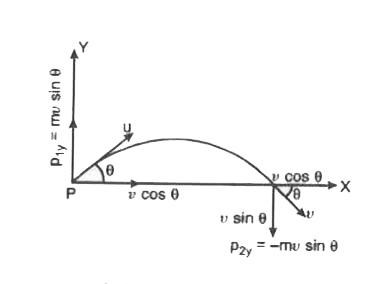
|
|
| 18. |
If the charge on an object is doubled then electric field becomes |
|
Answer» Half |
|
| 19. |
A positively charged sphere of mass m = 5kg is attached by a spring of force constant K = 10^(4) N/m. The sphere is tied with a thread so that spring is in its natural length. Another identical, negatively charged sphere is fixed with floor, vertically below the positively charged sphere as shown in fignre. If initial separation between sphere is r_(0) = 50cm and magnitnde ofcharge on each sphere is q = 100muC, calculate maximum elongation of spring when the thread is burnt. Take g= 10 m//s^(2) : |
|
Answer» |
|
| 20. |
The horizontal and vertical componentsof the earth's magnetic fieldat a placeare 30 and 40 SI units . The total intensity in SI Units is |
|
Answer» 70 |
|
| 21. |
Two blocks of masses m_(1) and m_(2) are connected to each other with the help of a spring. If pushing force F is given to the mass m_(1) providing accelerationa to it, then acceleration of m_(2) is |
|
Answer» `(m_(1)a-F)/(m_(2))` |
|
| 22. |
In the given circuit diagram when the current reaches steady state in the circuit,the charge on the capacitor of capacitance C will be |
|
Answer» CE  ltbrlt `therefore` Current in the circuit, `i=E/(r+r_2)` ltbrlt `therefore` Current in the circuit, `i=E/(r+r_2)`POTENTIAL difference across the capacitor, `V_(AD)=V_(AB)=ir_2=(Er_2)/(r+r_2)` Therefore, the charge stored in the capacitor C, `Q=CV_(AD)=CEr_2/(r+r_2)` |
|
| 23. |
The ratio between the first three orbits of hydrogen atom is |
|
Answer» `1 : 2 : 3` `n = 1, E_(1) = -13.6 (eV)/(atom)` `n = 2,E_(2) = -3.4 (eV)/(atom)` `n = 3, E_(3) = -1.51 (eV)/(atom)` The ratio of THREE orbits `E_(1) : E_(2) : E_(3) = 13.6 : 3.4 : 1.51` `= 1 : 4 : 9` |
|
| 24. |
A conducting slab of thickness 't' is introduced without touching between the plates of a parallel plate capacitor , separated by a distance 'd' ( t lt d). Derive an expression for the capacitance of the capacitor . |
|
Answer» SOLUTION :In the absence of conducting slab , CAPACITANCE of a parallel PLATE capacitor is given by `C = (epsi_(0) A)/(d)` When a conducting slab of thickness t (where `t lt d`) is introduced between the plates but without touching the plates , then the circuit FIELD in air `E_(0)= (sigma)/(in_(0))` but the electric field inside the conducting slab is zero . 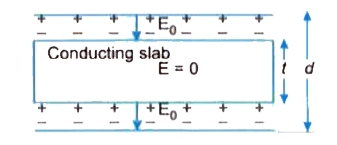 If potential DIFFERENCE between the plates of capacitor be V now , then clearly `V. = E_(0) (d - t) = (sigma)/(in_(0)) (d-t) = (Q)/(in_(0) A) (d-t)` `therefore` New capacitance `C. = (Q)/(V.) = (Q)/((Q(d-t))/(in_0A)) = (in_0A)/((d-t)) = (in_(0) A)/(d(1 - (t)/(d))) = (C)/(( 1- (t)/(d)))` |
|
| 25. |
It is necessary to use satellites for ling distance TV transmission. Why ? |
| Answer» SOLUTION :In order to send radio waves to a very LARGE distance, we have to keep its frequency very high. Now, radio waves with frequency greater than 30 MHz are found to be pentrating the ionosphere. i.e. they do not return to Earth after reflection. Moreover at this high frequency, ground wave propagation is also not possible (because of very large amount of energy gets ABSORBED in this CASE). Thus, for very long distance communication and for covering entire surface of earth, use of satellites is QUITE inevitable (compulsory). | |
| 26. |
V_(A) and V_(B) denot potentils of A and B then the equivalent resistance of A and B, then the equivalent resistance between A and B in the adjoining circuit is (ideal diode) |
|
Answer» `15 OMEGA "if" V_(A) gt V_(B)` |
|
| 27. |
Calculate the charge on each capacitors shown in figure below. |
|
Answer» |
|
| 28. |
A Cassegrain telescope uses two mirrors as shown in Fig. 9.30. Such a telescope is built with the mirrors 20mm apart. If the radius of curvature of the large mirror is 220mm and the small mirror is 140mm, where will the final image of an object at infinity be? |
| Answer» Solution :The image FORMED by the larger (concave) mirror acts as virtual object for the smaller (convex) mirror. Parallel RAYS coming from the object at INFINITY will focus at a distance of 110 mm from the larger mirror. The distance of virtual object for the smaller mirror `= (110 -20) = 90mm`. The focal LENGTH of smaller mirror is 70 mm. Using the mirror formula, image is formed at 315 mm from the smaller mirror. | |
| 29. |
Applying Bohr's theory, find the orbital velocity of the electron on an arbitrary energy level. Compare the orbital velocity on the lowest energy level with that of light. |
|
Answer» `(mv^(2))/r=e^(2)/(4piepsi_(0)r^(2))`, which gives `mv^(2)r=e^(2)/(4piepsi_(0))` The second equation stems from the rule of orbit quantization : mvr = NH. Dividing the first equation by the second, we obtain `v=1/n*e^(2)/(4piepsi_(0)h)` The maximum speed CORRESPONDS to the first (principal) energy level. Its ratio to the speed of light in a vacuum is the find structure constant : `alpha=v_(1)/c=e^(2)/(4piepsi_(0)ch)=7.3xx10^(-3)=1/137` |
|
| 30. |
A proton, a neutron, an electron and an alpha particle have some energy. Then their de-Broglie wavelengths compare as |
|
Answer» `lamda_(p)=lamda_(N) GT lamda_(e)gt lamda_(alpha)` As `m_(alpha) gt m_(n)=m_(p)gtm_(e)`. HENCE `lamda_(alpha)ltlamda_(p)=lamda_(n) lt lamda_(e)`. |
|
| 31. |
When monochromatic light travels from one medium to another its wavelength changes but frequency remains the same. Explain. |
|
Answer» Solution :Atoms (of the second medium) oscillate with the same (INCIDENT LIGHT) frequency and in turn, EMIT light of the same frequency. Alternatively, Frequency of light may be viewed as a property of the source and not of the medium. Alternatively, From Huygen.s principle, we FIND that `(v_(1))/(lambda_(1))=(v_(2))/(lambda_(2))=n`(Frequency) Hence frequency remains the same. |
|
| 32. |
A body weighs 90 kg on the surface of earth. How much will it weigh on the surface of Mars, whose mass is (1)/(9)th and radius (1)/(2) that of earth ? |
| Answer» Answer :A | |
| 33. |
A stone is dropped freely while another thrown vertically downward with an initial velocity of 4 m/s from the same point simultaneously. The distance of separation between them will become 30 m after a time of |
| Answer» ANSWER :D | |
| 34. |
A disc of radius R is rolling without sliding on a horizontal surface with a velocity of center of mass v and angular velocity omega in a uniform magnetic field B which is perpendicular to the plane of the disc as shown in Fig. 3.179. O is the center of the disc and P, Q, R, and S are the four points on the disc. Which of the following statements is true? |
|
Answer» (a) Due to translation, induced emf ACROSS `PS = Bvr` Due to rotaion, `emf= (Br^(2)omega)/(2)` Due to translation INDEED emf `= Bvr` where `r` is the SEPARATION. |
|
| 35. |
If the kinetic energy of a free particle is much less than its rest energy then its kinetic energy is proprotional to |
|
Answer» The magnitude of its MOMENTUM |
|
| 36. |
Arrange the folloowing in decreasing order effective capacitor between P and Q |
|
Answer» IV,III,II,I |
|
| 37. |
A heavy nucleus at rest breaks into two fragments which fly off with velocities in the ratio 27:1. The ratio of the radii of the fragments (assumed spherical) is |
|
Answer» `1:3` |
|
| 38. |
What is the meaning of hostility? |
|
Answer» FEELINGS against somebody |
|
| 39. |
Under what condition does the formation of rainbow occur ? |
| Answer» SOLUTION : Rainbow is a phenomenon due to combined effect of refraction, dispersion and total internal reflection of sunlight by tiny spherical WATER drops of RAIN suspended in air. | |
| 40. |
The pressure of a gas is changed at constant volume from 200 Nm^(-2) to 3000 Nm^(-2). If the initial temperature of the gas is 77^(@)C, what will be its final temperature? |
|
Answer» |
|
| 41. |
The instrument among the following which measures emf of a cell most accurately is: |
|
Answer» A voltmeter |
|
| 42. |
sqrtv versus z graph for characteristic X-rays is as shown in the figure. Match the following |
| Answer» SOLUTION :`(A)TOS`,`(B)tor`,`(c )toq`,`(D)TOP` | |
| 43. |
The ionization energy of a hydrogen like Bohr atom is 4 Rydberg. If the wavelength of radiation emitted when the electron jumps from the first excited state to the ground state is N-m and if the radius of the first orbit of this atom is r-m then the value of (N)/(r )=Pxx10^(2) then, value of P. (Bohr radius of hydrogen =5xx10^(11)m,1 Rydberg =2.2xx10^(16)J) |
|
Answer» `lambda=(hc)/(DeltaE)` (b) The energy of a hydrogen-like ion in ground state is `E=Z^(2)E_(0)` where `Z=` atomic number and `E_(0) = -13.6 eV`. Thus, `Z=2`. The radius of TH first orbit is `(a_(0))/(Z)` where `a_(0)=5xx10^(-11)m`. Thus, `r=(a_(0))/(Z)=2.5xx10^(-11)m` |
|
| 44. |
A circuit containing a 80 mH inductor and a 60muFcapacitor in series is connected to a 230 V, 50 Hz supply. The resistance of the circuit is negligible. a. Obtain the current amplitude and rms values.b. Obtain the rms values of potential drops across each element. c. What is the average power transferred to the inductor? d. What is the average power transferred to the capacitor? e. What is the total average power absorbed by the circuit? ['Average' implies "averaged over one cycle'.] |
|
Answer» Solution :`I_(max) = (V_(max) )/(sqrt(R^2 + (X_L - X_C)^2) ) "" R = 0, omega= 2pi xx 50 = 100 pi rad//s` `V_0 = 230 sqrt2 ,L = 80 xx 10^3 H, C = 60 xx 10^(-6) F "" therefore X_L = omega L = 25.14 Omega` `X_C = (1)/(omega C) = 53.03 Omega"" therefore I_(max) = 11.6AthereforeI_(max) = (I_(max) )/(sqrt2) = (11.6)/(sqrt2) = 8.24 A` b. `V_L = I_(rms) xx omega L = 207 V` `V_C = I_(rms) xx(1)/(omega C) = 437 V` c. `phi = pi/2` . so current lags VOLTAGE by `pi/2` `P_L= 0` d. `phi = pi/2` . so current leads voltage by `pi/2` `P_C = 0` e. Total average power absorbed = 0 |
|
| 45. |
If an athermous body absorbs 20% of the incident radiant energy then reflection coefficient of the body is |
|
Answer» a)0.2 |
|
| 46. |
Solar energy is mainly due to |
|
Answer» fission |
|
| 47. |
In YDSE the screen is aat a distance D from the plane of the slits and slits are illuminated by plane monochromatic light of wavelength lambda. P is a point on the screen at a distance y from the central maximum. If by some special arrangement the slits be moved symmetrically apart with relative volocity v, estimate the number of fringes crossing the point p per unit time. |
|
Answer» Solution :Let 1= distance between the slits `V= (d1)/(DT)" path diff "x=(y1)/(D)""(dx)/(dt)=(y)/(D)*(d1)/(dt)=(YV)/(D)` Since a change in optical path difference of `lambda` corresponds to one fringe, so the number of FRINGES crossing point P PER unit time is `(dx)/(dt)(1)/(lambda)= (yv)/(D)`. |
|
| 48. |
A monochromatic bean of light has wavelength of 5400 AU in water R.l. (4/3). What will be its wavelength when it is refracted in glass of R.l. (3/2) ? |
| Answer» Answer :B | |
| 49. |
A solid sphere of mass m and radius R is rolling without slipping on a rough horizontal surface with angular acceleration alpha. Centre of mass of sphere lies at a distance (R)/(sqrt(2)) from the centre of sphere. Find the normal force applied by sphere on the surface at an instant when line joining centre of mass of sphere and centre of sphere makes an angle 45^(@) with the vertical and angular velocity of sphere at this instant is omega. |
|
Answer» `mg+(mR)/(2)(alpha-omega^(2))`  Net acceleration of c.m in +y direction `(Ralpha)/(2)-(omega^(2)R)/(2)` `N-mg=ma_(cm,y)` `N=mg+(m)/(2)(alpha-omega^(2))R` |
|
| 50. |
For a transistor connected in common emitter mode , the voltage drop across the collector is 2 V and beta is 50 . Find base current if R_(C) is 2K . |
|
Answer» SOLUTION :DATA SUPPLIED , `V_(CE) = 2V , beta = 50` `R_(C) = 2 K = 2 xx 10^(3) Omega` `I_(C) = (V_(CE))/(R_(C)) = (2)/(2 xx 10^(3)) = 1 mA` `beta = (I_(C))/(I_(B))` `I_(B) = (I_(C))/(beta) = (10^(-3))/(50) = 20 MU A` |
|