

Saved Bookmarks
This section includes 7 InterviewSolutions, each offering curated multiple-choice questions to sharpen your Current Affairs knowledge and support exam preparation. Choose a topic below to get started.
| 1. |
The speed of sound in air at N.T.P. is330m/s. If air pressure becomes four times , then the speed of sound will be |
|
Answer» 165m/s |
|
| 2. |
A giant refracting telescope at an observatory has an objective lens of focal length 15cm.If an eye piece of focal length 1.0cm is used What is the angular magnification of the telescope ? |
|
Answer» Solution :(a) MICROWAVE, (b) Infrared, (c) X-rays Microwave are produced by special VACUUM tubes, like klystorms, magnetrons and gunn diodes. Infrared are produced by the vibrating molecules and atoms in hot BODIES. X-rays are produced by the bombardment of high energy electrons on a METAL target of high atomic weight (like tungston). |
|
| 3. |
A charge +Q is uniformly distributed over a thin ring of the radius R. The velocity of an electron at the moment when it passes through the centre O of the ring, if an electron was initially at rest at a point A which is very far always from the centre and on the axis of the ring is: |
|
Answer» `SQRT(((2KQe)/(MR)))` |
|
| 4. |
A moving coil galvanometer has 150 equal divisions. Its current sensitivity is 10 divisions per milli ampere and voltage sensitivity is 2 divisions per millivolt. In order that each division reads 1 volt, the resistance in ohms needed to be connected in series with the coil will be |
|
Answer» 99995 |
|
| 5. |
consider three charges q_(1),q_(2),q_(3)eachequal to q at the vertices of anequilateral triangleof side l what is the force on acharge Qplaced at the centroidof the triangle |
|
Answer» Solution :In thegiven equilateral triangle ABCof sides of length l if we draw a perpendicualre ADto the side BC AD=AC cos `30^(@) =sqrt(3)//2` l and the distanceAO of the centroid o from A is `(2/3)` AD=`(1/sqrt(3))` l by symmatry AO=BO=CO force `F_(1)` and Q due to chargeq at A=`(3)/(4piepsilon_(0))(Qq)/(l^(2))` along AO force `F_(2)` and Q due to chargeq at B=`(3)/(4piepsilon_(0))(Qq)/(l^(2))` along AO force `F_(3)` and Q due to chargeq at C=`(3)/(4piepsilon_(0))(Qq)/(l^(2))` along AO parallelogram law thereforethe toal force on Q =`(3)/(4piepsilon_(0))(Qq)/(4piepsilon_(0))(Qq)/(l^(2))(vecr-vecr)` =0 where `vecr` ISTHE unit vectoralong OA it is clear ALOS by symmetry that the three forces will SUM to zero considerwhat wouldhappen if the system was rotated through `60^(@)`about O |
|
| 6. |
A particle vibrates according to the law s=(1+cos^(2)t+sint)sin500t Expand this motion into its harmonic components and plot its spectrum. |
|
Answer» Solution :We have `1+cos^(2)t+sin^(4)t=1+(1)/(2)(1+cos2t)+(1)/(4)(1-cos2t)^(2)=(1)/(4)(4+2+2cos2t+1-2tcos^(4)2T` `=(1)/(4)[7+(1)/(2)(1+cos4t)]=(1)/(8)(15+cos4t)` Henec it follows `s=(1)/(8)+(15+cos4t)sin500t=` `=(15)/(8)sin500t+(1)/(8)sin500t.cos4t=` `=(15)/(8)sin500t+(1)/(16)sin504t+(1)/(16)sin496t` The spectrum is show in Fig 
|
|
| 7. |
An electron moves perpendicular to uniform magnetic field B, on a circle of radius r. Now, if magnetic field is made half of its initial value, what would be new radius of circular path ? |
|
Answer» `r/2` `(mv^(2))/r=Bqv` `thereforer=(mv)/(Bq)` `thereforerprop1/B""[becausem,V,q" are same"]` `thereforer_(2)/r_(1)=B_(1)/B_(2)=B/(B/2)` `thereforer_(2)/r=2` `thereforer_(2)=2r` |
|
| 8. |
Figure 15.16a shows a thin rod whose length L is 12.4cm and whose mass m is 135g, suspended at its midpoint from a larg wire. Its period T_(a) of angular SHM is measured to be 2.53s. An irregularly shaped object, which we call object X, is then hung from the same wire, as in Fig. 15.13b, and its period T_(b) is found to be 4.76s. What is the rotational inertia of object X about its suspension axis? |
|
Answer» Solution :The rotational inertai of either the rod or object X is related to the measured period by Eq. 15.39. Calculations: In Table 10-2e, the rotational inertia of a thin rod about a perpendicular axis through its mid point is given as `1//12mL^(2)`. Thus, we have, for the rod in Fig 15.16a, `I_(a) - (1)/(12) mL^(2) = ((1)/(12)) (0.135kg) (0.124m)^(2)` `= 1.73 xx 10^(-4) kg m^(2)` 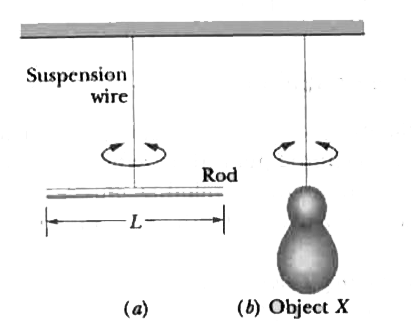 Now let us write Eq. 15.39 twice, once for the rod and once for object X: `T_(a) = 2pi sqrt((I_(a))/(k)) and T_(b) = 2pi sqrt((I_(b))/(k))` The constant k, which is a property of the WIRE, is the same FORBOTH figures, only the periods and the rotational inertias differ. Let us square each of these equations, divide the SECOND by the first, and SOLVE the resulting equation for `I_(b)`. The result is `I_(b) = I_(a) (T_(b)^(2))/(T_(a)^(2)) = (1.73 xx 10^(-4) kg.m^(2)) ((4.76s)^(2))/((2.53s)^(2))` `=6.12 xx 10^(-4) kg.m^(2)` |
|
| 9. |
A body of mass of 2 kg moving with velocity 4 ms^( -1) horizontally stops after 2 s. If the body is to be kept in motion at the same surface with 4 ms^(-1) force needed is : |
|
Answer» IN `:.F=ma=2xx-2=-4N` In order to keep the body MOVING with same speed Net FORCE should be zero i.e. `F. + (-4)= 0` `impliesF. = 4N`THUS we have to apply 4N force. HENCE the correct choice is (c). |
|
| 10. |
When an a.c. passes through the galvanometer, it shows no deflection , why ? |
| Answer» Solution :A moving COIL GALVANOMETER measures average VALUE of current, which is zero for a.c. over a CYCLE. So, galvanometer shows no deflection. | |
| 11. |
Two particles, carrying charges -q and +q and having equal masses m each, are fixed at the rod is clamped at an end and is placed in a uniform electric field E with the axis of the dipole along the electric field. The rod is slightly tlted and then released. Neglecting gravity find the time period of small oscillations. |
|
Answer» Solution :Consider the ROD to be a SIMPLE PENDULUM For simple pendulum ` T=2pisqrt(l/g) ` ` (l=length,g=accln) ` Now force experienced by the charges ` F=EQ ` Now, `accln =F/m=(Eq)/m ` Here,`length =a ` So, time periode ` T=2pisqrt((ma)/(qE))` |
|
| 12. |
Static electricity constant (1)/(4pi epsilon_(0) ) is similar to the megnetic constant. |
|
Answer» `(mu_0)/(4PI) ` |
|
| 13. |
A compound microscope has a magnification of 30. The focal length of eye piece is 5 cm.Assuming the final image to be at least distance of distinct vision, find the magnification. produced by the objective. |
|
Answer» Solution :Magnification of compound MICROSCOPE, M = 30 Least DISTANCE of distinct vision, D = 25 CM Now, M = `M_(o) xx M_(e)` `=M_(o)xx[1+(D)/(f_(e))]` `30=M_(o)xx[1+(25)/(5)]` `M_(o) = (30)/(6) = 5` |
|
| 14. |
The amplifiers X, Y and Z are connected in series. The voltage gain of X, Yand Z are connected in series. The voltage gain of X, Y and Z are 10, 20 and 40 respectively. If the input signal is 1 mV, then the output signal voltage is |
|
Answer» 4 V |
|
| 15. |
Two electric bulbs have their resistances in the ratio 2:3 . They are connected (a) first in series and then (b) in parallel across the same voltage . Find the ratio of powers consumed by each of the two bubls in the two combinations. |
|
Answer» SOLUTION :`(R_1)/(R_2) = 2/3` a) SERIES combination : power `R= i^2 R` `therefore (P_1)/(P_2) = (i^2 R_1)/(i^2 R_2)` `because ` CURRENT is same in series combination `therefore (P_1)/(P_2) = (R_1)/(R_2) = 2/3` `therefore P_1 : P_2= 2:3` B) Parallel combination `(P_1)/(P_2) = (i_1^2 R_1)/(i_2^2 R_2) = ((V^2)/(R_1^2)R_1)/(((V^2)/(R_2^2)) R_2)"" [ because V= iR]` `=(1//R_1)/(1/R_2) = (R_2)/(R_1) = 3/2 ` `therefore P_1 : P_2 = 3:2` |
|
| 16. |
For Q. 33, calculate how fast will the same truck move down the hill with same power. |
|
Answer» Solution :Force on the truck when it moves down the hill is `F'=mgsintheta-mu_(k)MG costheta` Power, `P=F''v'` CALCULATE v. Fdorce on the truck when it moves down the hill `F'=mgsintheta=mu_(k)mgcostheta` `=mg(sintheta-mu_(k))` (taking ` cos theta=1` as angle is very small) `=10^(2)((1)/(50)-0.2)` `=10^(5)((-9)/(50))=-18,000N` Negative sign signifies direction Power = F'V' `22xx10^(4)=18000v` `v=(220)/(18)=12.5ms^(-1)` `=12.2xx18/5=43.99` `=44kmh^(-1)` |
|
| 17. |
The colour sequence in a carbon resistor is yellow, blue and green. Its resistance is 46xx 10^5 Omega |
| Answer» SOLUTION :TRUE | |
| 18. |
Following are four different relation aboutdisplacement,velocity and acceleration for the motion of a particle in general.Choose the incorrect one (S). a) V_(av)=(1)/(2)[v(t_(1))+v(t_(2))] b)V_(av)=(r(t_(2))-r(t_(2)))/(t_(2)-t_(1)) c)r=(1)/(2)(v(t_(2))-v(t_(1))(t_(2)-t_(1)) d)a_(av)=(v(t_(2))-v(t_(1)))/(t_(2)-t_(1)) |
|
Answer» a and b |
|
| 19. |
The best material for making resistances in resistance box |
| Answer» ANSWER :D | |
| 20. |
The totalenergy of an electron in the firstexcited state of the hydrogenatom is about- 3.4 eV. (a) Whatis the kinetic energy of theelectron in this state ? (b) Whatis the potentialenergyof the electronin thisstate ? Whichof theanswers above would changeif the choice of thezero of potentialenergyis changed ? |
|
Answer» SOLUTION :It is given here that total energy of an ELECTRON in the firstexctiedstate of thehydrogen atom is` - 3.4 eV. Thus E = - 3.4 eV`. (a) `therefore ` K.E of theelectron in thisstate `K = - E + 3.4 eV.` (b) `therefore ` Poteintial energy of the electron in thisstate `U =2K = - 6.8e V` (c) kineticenergydoes not depend upon thechoice of zeroof potential energyand remains UNAFFECTED . However , VALUE of potential energyand,consequently, value of the total energy of electron dependsupon the choiceof zeropoteintialenergy . Hence, on changing zero of potentialenergyvalues ofLI andE will change. |
|
| 21. |
On screen there are two bright points at a distance I mm. These points are observed by the person whose eye is having diameter 3 mm from which maximum distance this person can observe them resolved ? |
Answer» Solution : Resolution power `=(1.22 LAMBDA)/(d)` and `sin theta~~=(y)/(D)` `:.(y)/(D)=(1.22 lambda)/(d)` `:. D=(yd)/(1.22lambda)=(10^(-3)xx3xx10^(-3))/(1.22xx5xx10^(-7))=(30)/(6.1)=5 m` |
|
| 22. |
Fats and lipids are stored in |
|
Answer» Aleuroplasts |
|
| 23. |
In Young.s double slit experiment the separation d between the slits is 2mm, the wavelength lambda of the light used is 5896 A^(0) and distance D between the screen and slits is 100 cm. It is found that the angular width of the fringes is 0.20^(0). To increase the fringe angular width to 0.21^(0) (with same lambda and D) the separation between the slits needs to be changed to |
|
Answer» `1.8mm` |
|
| 24. |
In the circuit diagram of zener diode as shown in figure, when the value of V_(0) is 8 volt, the current through zener diode is i_(1) and when V_(0) is 16 volt, the corresponding current is i_(2). Find the value of (i_(2)-i_(1)). (Zener breakdown voltage V_(2)=6V) |
| Answer» ANSWER :D | |
| 25. |
A ball of mass 0-2 kg is thrown vertically upwards by applying a force by hand. If the hand moves 0.2 m while applying the force and the ball goes upto 2 m height further, find the magnitude of the force. Consider g = 10 m//s^(2): |
|
Answer» 4 N `:. Fxx0.2=mgh` `F=(0.2xx10xx2)/(0.2)=20 N` |
|
| 26. |
In the following circuit the equivalent resistance between A and B is |
|
Answer» `(20)/(3)OMEGA` |
|
| 27. |
Ocean waves moving at a speed of 4.0 m/s are approaching a beach at an angle of 30^(@) to the normal, as shown in figure. Suppose the water depth changes abruptly at a certain distance from the beach and the wave speed there drops to 3.0 m/s. Close to the angle theta is : |
|
Answer» `SIN^(-1)(3//4)` |
|
| 28. |
Which of the following radiation will be most effective for electron emission from the surface of zinc ? Microwave, infrared, ultra violet. |
| Answer» SOLUTION :ULTRAVIOLET. | |
| 29. |
According to Raoult’s Law |
|
Answer» TOTAL Vapour PRESSURE is DIRECTLY PROPORTIONAL to mole fraction |
|
| 30. |
An object is placed between two parallel mirrors. Why do the distant image get fainter and fainter ? |
| Answer» Solution :The distant IMAGES are produced by multiple reflection at he parallel MIRRORS. At each reflection, DUE to absoption, a PART of the light is lost. So, the intensity decrease and HENCE the image gets fainter and fainter. | |
| 31. |
Figure given in the question is a cross-sectional view of a coaxial cable. The centre conductor. surrounded by a rubber layer, which is surrounded by an outer conductor, which is surround by another rubber layer. The current in the inner conductor is 1.0 A out of the page, and the current in the outer conductor is 3.0 A into the page. Determine the magnitude and direction of the magnetic field at points a and b. |
|
Answer» Solution :Applying Ampere's circular circuital law. `B_A=mu_0/(2PI) i_("in")/r` `=((2xx10^-7)(1))/10^-3` `=2xx10^-4T` This due to `(*)` current of `1A`. HENCE, MAGNETIC lines are circular and anti-clockwise. Hence, magnetic field is upwards. `B_b=mu_0/(2pi) i_("in")/r` `=((2xx10^-7)(3-1))/(3xx10^-3)` `=1.33xx10^-4T` This is due to net `(ox)` current. Hence, magnetic lines are clockwise. So, magnetic fied at `B` is downwards. |
|
| 32. |
Component of electric field of electromagnetic wave is as following :E_(x)=10^(2)sin(pi(9xx10^(14)t-3xx10^(6)z)),E_(y)=0, E_(z)=0, then intensity of wave is …. |
|
Answer» `13.3 Wm^(-2)` `I=c in_(0)E_(rms)^(2)` `=3xx10^(8)xx8.85xx10^(-12)xx(100)/(2) "" [because E_(rms)=(E_(m))/(SQRT(2))]` `therefore I=13.3Wm^(-2)` |
|
| 33. |
Find out the amount of the work done to separate the charges at infinite distance. |
|
Answer» Solution :Net P.E. of the SYSTEM `= (1)/( 4pi in _0) (q^(2) )/( L) [-4+2-8]` ` = ( (-10 )q^(2))/( 4pi in _0 l) ` ` therefore ` Work DONE `( 10 q^(2))/( 4pi in _0l ) = ( 5q^(2)) /( 2pi in _0l ) ` |
|
| 34. |
The potential energy of a dipole in a magnetic field is given by ? |
| Answer» SOLUTION :W = -MB `(COS theta_2 - cos theta_1)` | |
| 35. |
Assertion : Magnetic susceptibillity is a pure number. Reason: The value of magnetic susceptibility for vacuum is one. |
|
Answer» If both assertion and reason are true and reason is the correct explanation of assertion `X_(m)=(I)/(H)` It is a pure number, because I and H have the same UNIT. Its value for VACUUM is zero as there can be no magnetisation in vaccum. |
|
| 36. |
Which of the following is an "action verb"? |
|
Answer» Dark |
|
| 37. |
A current or 0.5 A produces a dcflccLion of 60° in a tangent galvanometer. The cunent that produces a deflection of 30° in the same galvanometer is |
|
Answer» `(0.5)2A` |
|
| 38. |
The angle of dip if dip needleoscillating invertical plane makes 40 oscillations per min in a magnetic meridian and 30 oscillations per minute in vertical plane at right angle to the magnetic meridian is |
|
Answer» `theta=sin^(-1)(0.5625)` B=Total EARTH's field intensity v= vertical component of B `T'/T=sqrt(B)/(V)rArr(T)^(2)/(t6(2)=B/V` but`V=BsinthetarArr(T')/(T^(2))=(1)/(SINTHETA)rArrsintheta=(T^(@))/(T'^(2))` `T=60/40=(3)/(2)S` Also, and `T'=60/30=2s` `thereforesintheta=0.5625 rArr=sin^(-1)(0.5625)` |
|
| 39. |
The percentage errors in quantities P, Q, R and S are 0.5%, 1%, 3% and 1.5% respectively in A = (P^2Q^2)/(sqrt(Rs)) the measurement of a physical quantity A = (P^2 Q^2)/(sqrt(Rs)) . The maximum percentage error in the value of A will be |
|
Answer» ` 6.0% ` |
|
| 41. |
The matter waves are |
|
Answer» LIGHT WAVES |
|
| 42. |
A 1 muF capacitor is placed n parallel with a 2 mu Fcapacitor across a 100 V supply. The total charge on the system is |
|
Answer» `(100)/(3) mu`C TOTAL charge , Q CV = `3xx 100 = 300 mu F ` |
|
| 43. |
Two lenses of focal lengths -20 cm and + 10 cm are conneceted to form a combination, their combinational power will be ...... D. |
|
Answer» -1 `therefore 1/F=(1)/(f_1)+(1)/(f_2)=(1)/(-20)+(1)/(10)` `therefore 1/F=(1)/(20) therefore F=20` cm Also,power P=`(100)/(F)=(100)/(20)=+5D` |
|
| 44. |
How will you induce an emf by changing the area enclosed by the coil? Induction of emf by changing the area of the coil: |
|
Answer» Solution :Consider a conductucing rod of length 1 moving with a velocity v towards left on a rectangular metallic framework as shown in Figure. The whole arrangement is placed in a uniform magnetic field `vec(B)` whose magnetic lines lines are perpendicular directed into the plane of the paper. ii. As the rod moves from AB to DC in a time date,the area enclosed by the loop and HENCE the magnetic flux through the loop decreases.  iii. The change in magnetic flux in time dt is `dPhi_(B)=Bxx"change in are"` `dPhi_(B)=Bxx"Area ABCD"` Blvdt Since area ABCD = l (vdt)``(or)(dPhi_(B))/(dt)=Blv` iv. As a result of change in flux, an emf is GENERATED in the loop. The magnitude of the induced emf is `epsilon=(dPhi_(B))/(dt)` `epsilon=Blv` v. This emf is called MOTIONAL emf. The direction of induced current is FOUND to be clockwise from Fleming's right hand rule. |
|
| 45. |
State the results obtained from a particle scattering experiment. Also draw a graph showing number of a particles scattered at different angles. |
|
Answer» SOLUTION :On the basis of experimental study of Rutherford.s d-particle scattering experiment following results were obtained : (i) A large number of a particles pass through the gold film undeviated or having a small deflection `(theta= 0^(@))`. (ii) As angle of deflection increases, the number of - particles moving in that direction rapidly DECREASES. However, some o-particles are scattered at large angles `(theta - 90^(@))` too. (iii) An EXTREMELY small number of c-particles about 1 in 8000) suffers a deflection greater than `90^(@)`(i.e., `180^(@)ge thetage 90^(@))` and is reflected back. The experimental plot of graph showing variation of number of `alpha`-particles detected versus the angle of - Scattering anglescattering `theta` is shown in FIG. 12.06. 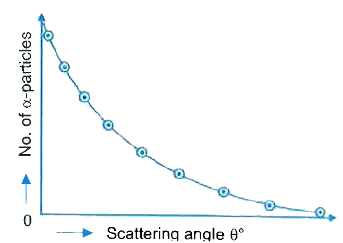
|
|
| 46. |
Photoelectric effect represent that ……….. |
|
Answer» electron has a wave nature |
|
| 47. |
A beam of light of wavelength 600nm from a distance source falls on a single slit 1mm wide and a resulting diffraction pattern is observed on a screen 2m away. The distance between the first dark frings on either side of central bright fringe is |
|
Answer» 1.2cm `=(2xx2xx600xx10^(-9))/(10^(-3))=2.4xx10^(-3)m=2.4mm.` (d) is the correct option. |
|
| 48. |
The magnetic moment of amagnet is unmericaly equal to couple acting acting on the magnet when the magnet is suspended |
|
Answer» At `45^@` to a MAGNETIC field |
|
| 49. |
What is mass energy equivalence ? |
|
Answer» Solution :The relation is E=mc^2 The relation shows that the ENERGY CONTENT of an object is EQUAL to it.s mass TIMES the SQUARE of the speed of light. |
|
| 50. |
Suppose that the particlein Question 1.33 is an electronprojected with velocity v_x =2.0 xx 10 ^(6) ms^(-1).IfE between the plates separated by 0.5 cm is 9.1 xx 10 ^(2) N//C,where will the electronstrike the upper plate ?(|e| =1.6 xx 10^(-19)C, m_e =9.1 xx 10 ^(-31) kg ) |
|
Answer» Solution :For electron particle ` q=|e| =1.60 xx 10 ^(-19)C and ` mass of electron`m_e= 9.1 xx 10 ^(-31)kg. ` Makeover , it is given that `v_x =2.0 xx 10 ^(6)MS ^(-1)and E= 9.1 xx 10 ^(2)N//C ` Letafter covering a distance L the electron STRIKES the UPPER plate after suffering a DEFLECTION `y=0.5 cm = 5XX 10 ^(-3)m. `Then from the relation ` "" y= (qEL^(2))/( 2mv_x^(2)) , ` we have ` L =v_x xx sqrt((2my)/(qE) )=(2xx10^(6)) xx sqrt((2xx9.1 xx10^(-31)xx 5xx 10 ^(-3))/( 1.60 xx10 ^(-19)xx 9.1 xx 10 ^(2)))=1.58 xx 10 ^(-2)m = 1. 6 ` cm. |
|