Saved Bookmarks
This section includes 7 InterviewSolutions, each offering curated multiple-choice questions to sharpen your Current Affairs knowledge and support exam preparation. Choose a topic below to get started.
| 1. |
A transistor oscillator using a resonant circuit with an inductor L (of negligible resistance and a capacitor C in series produce oscillation of frequency f. If L is doubled and C is changed to 4C, then what will be the resonance frequency ? |
|
Answer» `f/(2SQRT2)` `THEREFORE 2pif=1/sqrt(LC)` `therefore f=1/(2pisqrt(LC))`…(1) If we double the value of L and value of C is 4 C then, `f_0=1/(2pisqrt(2Lxx4C))` `=1/(2pixx2sqrt2xxsqrt(LC))` `f_0=1/(2sqrt2xx2pisqrt(LC))`..(2) `therefore (f_0)/f = 1/(2sqrt2)` `therefore f_0=f/(2sqrt2)` |
|
| 2. |
Interference fringe may be observed due to superposition of |
|
Answer» (i) and (II) |
|
| 3. |
A sound wave of frequency 100 Hz is travelling in air. The speed of sound in air is 350 m/s. What is the phase difference at a given instant between two points separated by a distance of 10.0 cm along the direction of propagation? |
| Answer» SOLUTION :`(2PI)/35` | |
| 4. |
Consider an n-p-n transitor with its base-emitter junction forward biased and collector base junction reverse biased. Which of the following statements are true? |
|
Answer» Electrons crossover from emitter to collector. In above case, small no. of electrons (nearly 5%), going from emitter to base, combine with theholes in base. Thus, option (C ) is ALSO correct. |
|
| 5. |
The SI standard of length is based on: |
|
Answer» the distance from the north pole to the equator along a meridian PASSING through Paris |
|
| 6. |
The magnetic field of a short magnetic at a distance of one metre on the axial line is 10^(-4)T . What is the field at a distance of 2m on the same line ? |
|
Answer» |
|
| 7. |
Explain the elementary idea of an oscillator with the help of a block diagram. |
|
Answer» Solution : An oscillator is an electronic circuit designed to convert dc power into ac power by feeding some of the output of an amplifier back as its input in phase. There must be an electrical connection or some KIND of link (e.g, inductive coupling) between output and input of the amplifier so that there is sufficient feedback. When the feedback VOLTAGE is in phase with the input, it is called positive feedback. Then, application of direct-voltage supply to the circuit is sufficient to start and maintain electrical oscillations at some (USUALLY) high frequency to which the system is resonant. A simple oscillator consists essentially of : (1) a frequency-determining network, such as a resonant tank circuit, which also works as feedback network (2) a transistor amplifier which is the active element. With positive feedback, the output current of the amplifier will be right phase to increase the alternating current in the resonant circuit. The oscillations then build up in amplitude until the powerosses in the circuit ure equal to the power that the amplifer can develop. The natural frequency of the oscillator is CLOSE to the resonant frequency of the resonant circuit 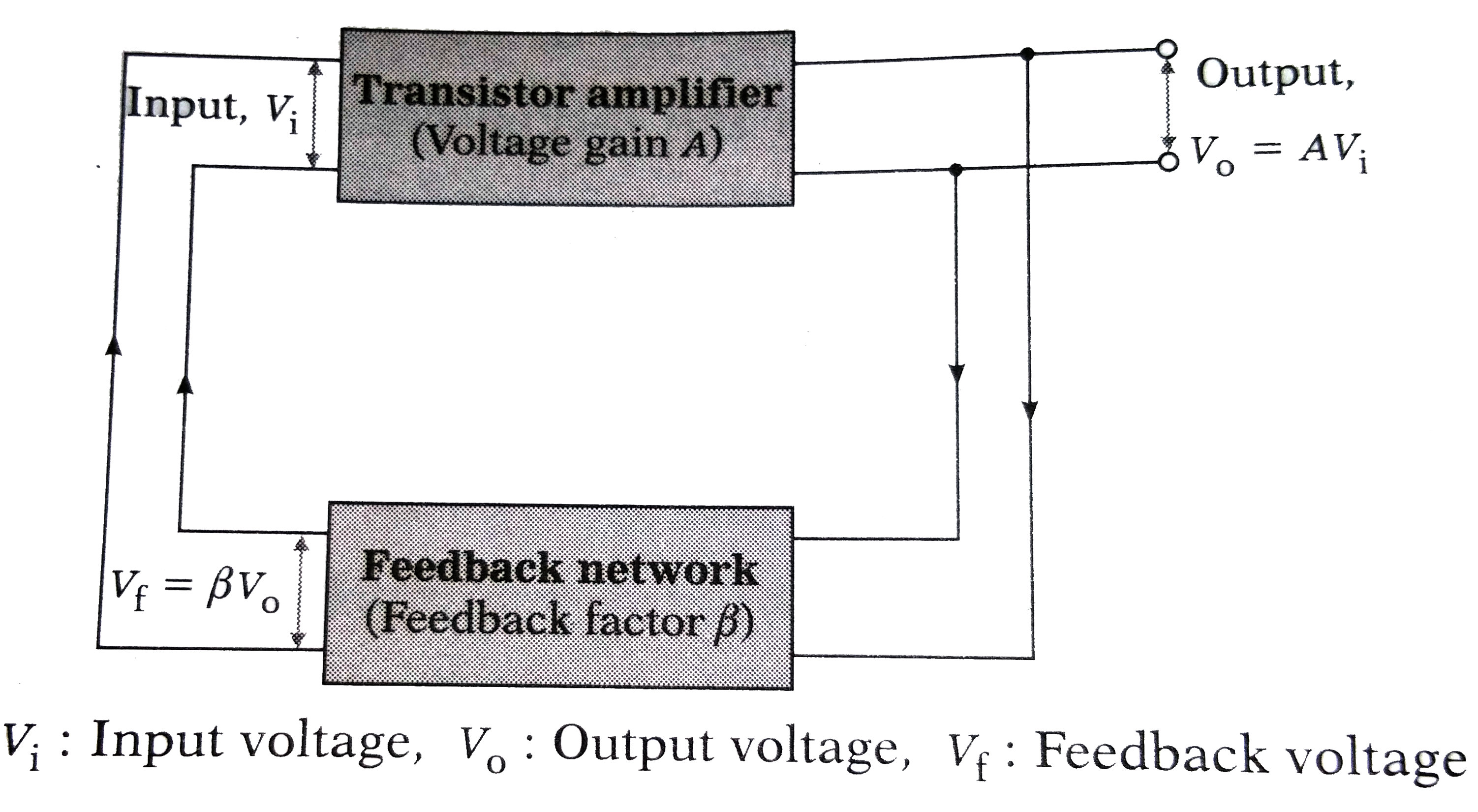 Supposehe voltage gain without feedback of the amplifier is`A=V_(o)/V_(i)` The feedback factor `beta` back to the input, `V_(i)=V_(f)+betaV_(o).` `therefore A=(V_o)/(V_1)=1/beta or Abeta=1` For `Abeta=1`, Barkhausen's criterion states that the phase shift of the feedback voltage will be zero or INTEGRAL multiple of `2pi` rad, i.e., there will be positive feedback The voltage gain with feedback, `A_f`, for the system is `A_(f)=A/(1-Abeta)` Thus, for the frequency for which `Abeta=1, A_(f)`, will be infinite, i.e., the circuit will operate without any external signal voltage, which means to circuit will oscillate at that frequency. |
|
| 8. |
An N-P-N transistor is being used in CE mode for which the current transfer ratio is alpha=(25)/(26). The input resistance is 1000Omega and amplitude of A.C. input voltage is 10 mV. The amplitude of the amplified output collector current is |
|
Answer» `25muA` |
|
| 9. |
A ray of light is coincident on the surface of a glass of refractive index 1.5, at the polarising angle .The angle of refraction of the ray will be : |
| Answer» Answer :B | |
| 10. |
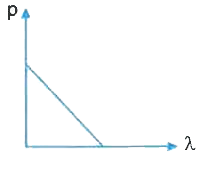
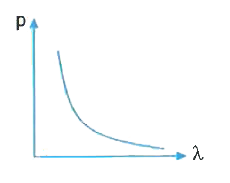
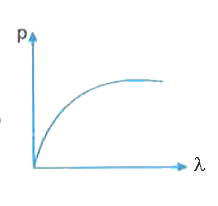
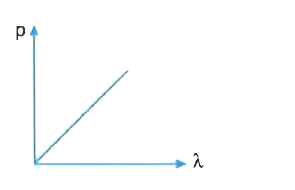
The graph showing the correct variation of linear momentum (p) of a charge particle with its de-Broglie wavelength ( lambda) is |
|
Answer»
|
|
| 11. |
the elastric field of an electromagnetic wave changes with the time as E=K(1+cosOmegat) cosomegat,where Omega=5xx10^(15)s_(-1), omegas^(-1) and K is constant . This radiation is incident on a sample of hydrogen atoms initially in ground state. assume that atom absorbs light as photons. Neglecting , what will be the energy of ejected electron from hydrogen . [the ionisation energy of hydrogen a tom =13.6eV and h=2pixx6.6xx10^(-16)eV-s] |
|
Answer» `0.7eV` |
|
| 12. |
State Kirchooff's laws in a network of conductors acrrying current . State which law obeys the priciple of conservation of energy . |
|
Answer» |
|
| 13. |
A : For interference fringes to be seen, the condition (s)/(S) lt (lambda)/(d) should be satisfied. Where .s. be the size of source slit, S is its distance from plane of two slits and .d. is the distance between two slits. R :In Y.D.S.E, if distance of source slit from the two slits (s) decreases, the interference pattern gets more sharp. |
|
Answer» Both A and R are TRUE and R is the correct EXPLANATION of A |
|
| 14. |
Calculate the limit of resolution of a microscope if an object of numerical aperture 0.12 is viewed by using light of wavelength 6 xx 10^(-7)m. |
|
Answer» |
|
| 15. |
Assuming the expressionfor theradiusof electronorbit ,the expression for thetotal energy of the electronin the stationaryorbit of hydrogen atom. |
|
Answer» Solution :Consideran electronof MASS m and charge -e revolving round the nucleusof an atomof atomic number Z in the `n^(th)` orbit of radius .r.. Let v be the velocityof the electron.The electronpossessespotential energy , because , it is in the electrostatic fieldof the nucleus . The electron alsopossesses kinetic energy by VIRTUE of its motion. Potentialenergyof the electronis given by, `E_p`=(POTENTIALAT a distance r from the nucleus )(-e) `=1/(4piepsilon_0)[(ZE)/r](-e)` `E_p=-(Ze^2)/(4piepsilon_0r)`...(1) kinetic energy of the electronis given by , `E_k=1/2 mv^2`...(2) From Bohr.s postulate, `(mv^2)/r=1/(4piepsilon_0)[(Ze^2)/r^2]` `therefore mv^2=(Ze^2)/(4piepsilon_0r)` Substituting this value of `mv^2` in equation (2) `E_k=1/2 ((Ze^2)/(4piepsilon_0r))`...(3) Total ENERGYOF the electronrevolvingin the `n^(th)`orbit is given by `E_n=E_p+E_k` `E_n=-(Ze^2)/(4piepsilon_0r)+1/2 ((Ze^2)/(4piepsilon_0r))` Using (1) and (2) `=(Ze^2)/(4piepsilon_0r)[(-1)/1+1/2]` `=(Ze^2)/ (4piepsilon_0r)[-1/2]` `therefore E_n=-(Ze^2)/(8piepsilon_0r)` |
|
| 16. |
The cross section of a cylindrical conductor is A. The resistivity of the material of the cylinder depends only on distance r from the axis of the conductor as rho=k/r^2 where k is a constant. Find the resistance per unit length of such a conductor. |
|
Answer» SOLUTION :Let US CONSIDER a THIN cylindrical pipe of unit length having radius r and thickness dr. The conductance of thinpipe is , `dY=(1dA)/(rho 1)`.......(1) when dA= cross area of cylindrical pipe.  Here, `dA=2pir d r` `therefore` From equation (1), `dY=1/rho.2pirdr` `becauserho=k/r^2so,dY=1/k.2pir^3dr` Therefore, electrical conductance of the whole conductor becomes, `Y=(2pi)/kint_0^ar^3dr` [a= radius of the whole conductor] `=(2pi)/ktimes[r^4/4]_0^a=(pia^4)/(2k)=A^2/(2pik)[becauseA=pia^2]` So, resistance`=1/Y=(2pik)/A^2` |
|
| 17. |
Mountain pull. A large mountain can slightly affect the direction of "down" as determined by a plumb line. Assume that we can model a mountain as a sphere of radius R = 1.80 km and density (mass per unit volume) 2.6 x 10^3 kg//m^3. Assume also that we hang a 0.50 m plumb line at a distance of 3R from the sphere's center and such that the sphere pulls horizontally on the lower end. How far would the lower end move toward the sphere? |
| Answer» SOLUTION :`7.4 XX 10^(-6)m` | |
| 18. |
A flexible track is fixed in two alternative arrangements, as shown in the figure. A toy car is released at rest and slides down the track air resistance can be ignored. The length of the track used is the same in each case and the height through which it falls from the bench to the floor is the same. codes: |
|
Answer» <P>`{:(P,Q,R,S),(1,4,2,3):}` |
|
| 19. |
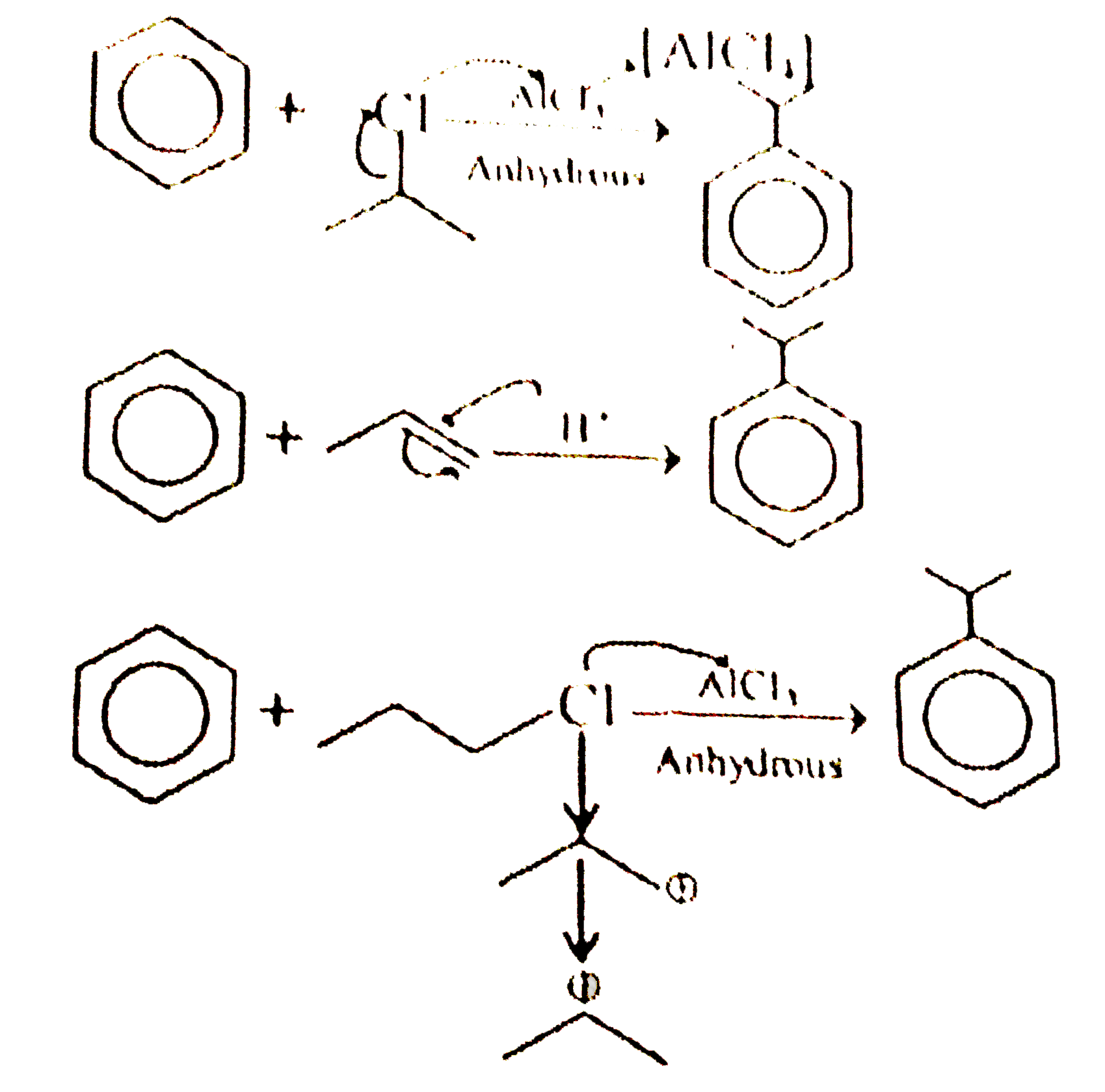
Cummen is prepeared by : |
|
Answer»
|
|
| 20. |
The magnifications for two positions of image of the same lens are 3 and 2, of a fix point object on a fix screen when the distance between the two positions of lens is 30 cm . The focal lengths of the lens is |
| Answer» Answer :A | |
| 21. |
An object is placed at a distance of 15cm from a convex lens of focal length 10 cm. On the other side of the lens, a convex mirror is placed at its focus such that the image formed by the combination coincides with the object itself. The focal length of the convex mirror is |
|
Answer» 20cm |
|
| 22. |
A Field of Fixed Charges in a Vacuum 24.1. Estimate the upper limit of the error made in calculating the force of interaction between charged spherical conductors with the aid of the Coulomb law. The radii of the spheres are ro, the distance between their centres is r. Carry out the calculations for r ge20 r_(0). |
Answer» Solution :It is evident from Fig. 24.1 for the CASE of charges of different SIGNS that the actual force of interaction of the charges is greater than it WOULD have been, if the charges were concentrated in the centres of the spheres, and less than if the charges were concontrated at the nearest points of the spheres:  `(q^(2))/(4pi epsi_(0)r^(2)) lt F lt (q^(2))/(4pi epsi_(0)(r-2r_(0))^(2))` The absolute error is less than the DIFFERENCE between the bounding values, the relative error being less than the ratio of this difference  to the minimum, force. Hence `epsi lt (F_(2)-F_(1))/(F_(1))=(r^(2)-(r-2r_(0))^(2))/((r-2r_(0))^(2))=(4r_(0)(r-r_(0)))/((r-2r_(0))^(2))` |
|
| 23. |
What type of materials can use to make an electromagnet ? |
| Answer» SOLUTION :PERMEABILITY of these materials will be high and RETENTIVITY MUST be LOW | |
| 24. |
The two slits are 1 mm apart from each other and illuminated with a light of wavelength 5 xx 10^(-7) m.If the distance of the screen is 1 m from the slits then the distance between third dark fringe andfifth bright fringe is |
|
Answer» `1.5 mm` `X_(5B) = (5lambdaD)/(d)`......(i) Distance of `3^(rd)` DARK fringe from central fringe, `X_(3D) = (( 2XX 3 - 1)lambdaD)/(2d) = 5/2 (lambdaD)/(d) ...(ii)` From (i) and (ii) required distance `X_(5B) - X_(3D) = (5 - 5/2)(lambdaD)/(d) = 5/2 XX (5 xx 10^(-7) xx 1)/(1 xx 10^(-3)) = 1.25 mm` |
|
| 26. |
Radius of curvature of first surface of double convex lens is three times that of the other. If focal length of the lens is 30 cm and refractive index of the lens is 3/2, then radius of curvature of the first surface is |
|
Answer» 20 cm |
|
| 27. |
If the magneticmonopole exists , then which of the Maxwell's equation to be modified ? |
|
Answer» `oint vecB. dvecA= (Q_("ENCLOSED"))/(epsi_0)` |
|
| 28. |
(a) A toroidal solenoid with an air core has an average radius of 0.15m, area of cross section 12 xx 10^(-4) m^(2) and 1200 turns. Obtain the self inductance of the toroid. Ignore field variation across the cross section of the toroid. (b) A second coil of 300 turns is wound closely on the toroid above. If the current in the primary coil is increased from zero to 2.0 A in 0.05s, obtain the induced emf in the secondary coil. |
|
Answer» Solution :(a) `B= mu_(0)n_(1)I = (mu_(0)N_(1)I)/(l)= (mu_(0)N_(1)I)/(2pi r)` Total magnetic flux, `phi_(B)= N_(1)BA = (mu_(0)N_(1)^(2)IA)/(2pi r)` But `phi_(B)= LI` `therefore L= (mu_(0)N_(1)^(2)A)/(2pi r)` `l= (4pi xx 10^(-7) xx 1200 xx 1200 xx 12 xx 10^(-4))/(2pi xx 0.15) H` `=2.3 xx 10^(-3) H= 2.3mH` (b) `|e| = (d)/(dt) (phi_(2)), " where" phi_(2)` is the total magnetic flux linked with the second coil. `|e| =(d)/(dt) (N_(2)BA) = (d)/(dt) [N_(2)(mu_(0)N_(1)I)/(2pi r)A]` or `|e| = (mu_(0)N_(1)N_(2)A)/(2pi r) (dI)/(dt)` or `|e| = (4pi xx 10^(-7) xx 1200 xx 300 xx 12 xx 10^(-4) xx 2)/(2pi xx 0.15 xx 0.05) V` =0.023V |
|
| 29. |
Assertion (A): Critical angle of light passing from glass to air is least for light of violet colour. (Reason( R)): Refractive index of glass is maximum for violet light. |
|
Answer» If both assertion and reason are TRUE and the reason is the CORRECT explanation of the assertion. |
|
| 30. |
Material used for preparing electromagnet should have high retentivity and high coercivity. |
| Answer» Solution :False - MATERIAL USED for preparing electromagnet should have HIGH permeability but low RETENTIVITY, low coercivity and small hysteresis loss. | |
| 31. |
Draw the graph showing variation of the value of the induced emf as a function of rate of change of current flowing through an ideal inductor. |
Answer» SOLUTION :
|
|
| 32. |
Nane three properties which are mutually perpendicular to each other in a plane polarised light wave. |
| Answer» Solution :ELECTRIC MAGNETIC fieldvector and direction of PROPAGATION of wave. | |
| 34. |
A coil of inductance 0.50 H and resistance 100Ω is connected to a 240 V, 50 Hz ac supply.What is the maximum current in the coil? |
|
Answer» Solution :`omega=2pif=2pitimes10^4rad.s^-1` `I_(max)=V_(max)/sqrt(R^2+omega^2L^2)=(240sqrt2)/(sqrt(100^2+4pi^2. 10^8 .5^2))=0.011A` `thereforephi=tan^-1{X_L/R}=tan^-1((2pifL)/R)` `=tan^-1 ""(2pitimes10^4times0.5)/100` `tan^-1(100pi)approxpi/2` `THEREFORE` Time interval=`phi.T/360=phi/(360f)` `=90/(360times10times10^3)=0.25times10^-4s` `I_(max)` is very SMALL. So it can be concluded that at high FREQUENCIES an inductance behaves as an OPEN circuit. |
|
| 35. |
Specific rotation of suguar solution is 0.5 deg m^(2)//kg.200 kgm^(-3) of impure sugar solution is taken in a sample polarimeter tube of length 20 cm and optical rotation is found to be 19^(@). The percentage of purity of sugar is |
|
Answer» `20%` `theta = 19^(@), l=20 cm`, `S_(lambda)=0.5 "deg"(m^(2))/(KG)=5 "deg"(cm^(2))/(g)` `rArr C=(theta)/(lS_(lambda))=(19^(@))/(20xx5)=0.19 g//cm^(3)=19%`. The concentration of the solution take `= 200 kg//m^(3)=0.2 g//cm^(3)=20%` `THEREFORE` The solution taken is 19 % pure `~= 20%` This is pure (with 1 % error). |
|
| 36. |
A car is moving with a constant speed of 60 km. h^(-1) on a straight road. Looking at the rear view mirror, the driver finds that the car following him is at a distance of 100 m and is approaching with a speed of 5 km. h^(-1). Inorder ofkeep track of thecar in the rear the driver begins to glance alternatively at the rear and side mirror of his car after every 2s till the other car overtakes. If the two cars were maintaining their speeds, which of the following statement is correct ? |
|
Answer» the speed of the car in the REAR is 65 km . `h^(-1)` |
|
| 38. |
Answer the following questions . a. The earth's magnetic field varies from point is space. Does it also change with time ? It so , on what time scate does it change appreciably ? b. The earth's core is known to contain iron. Yet geologists do not regard this as a source of the earth's magnetism why ? c. The charged currents in the outer conducting regions of the earth's core are thought to be responsible for earth's magnetism . What might be the ' battery ' (i.e., the source of energy) to sustain these currents ? d. The earth may have even reversed the direction of its field several times during its history of 4 to 5 billion years. How can geologists know about the earth's field in such distant past ? e. The earth's field departs from its dipole substantially at largedistances (greater than about 30,000 km)what agencies may be responsible for this distortion ? f. Interstellar space has an extremely weak magnetic field of the order of 10^(-12) T, Can such a weak field be of any significant consequence ? Explain. [Note : Exercise 2 is meant mainly to arouse your curiosity . Answers to some question above are tentative or unknown . Brief answers wherever possible are given at the end . For details , you should consult a good text on geomagnetism.] |
|
Answer» Solution :a. Yes Yearly variations or variations in few years . For appreciable change , it MAY take a few hundred years. b. MOLTEN iron is ferromagnetic C. Not sharply known, POSSIBLY the radioactivity in the interior core. d. From the magnetic properties of some rocks. e. the MOTION of ions in ionosphere. f. Even if the is weak, it has cosmological importance. The new particles created in interstellar space will be accelerated by this field . |
|
| 39. |
(a) Plot a graph for angle of deviation as a function of angle of incidence for a triangular prism. (b) Derive the relation for the refractive index of the prism in terms of the angle of minimum deviation and angle of prism. |
Answer» Solution :(a) 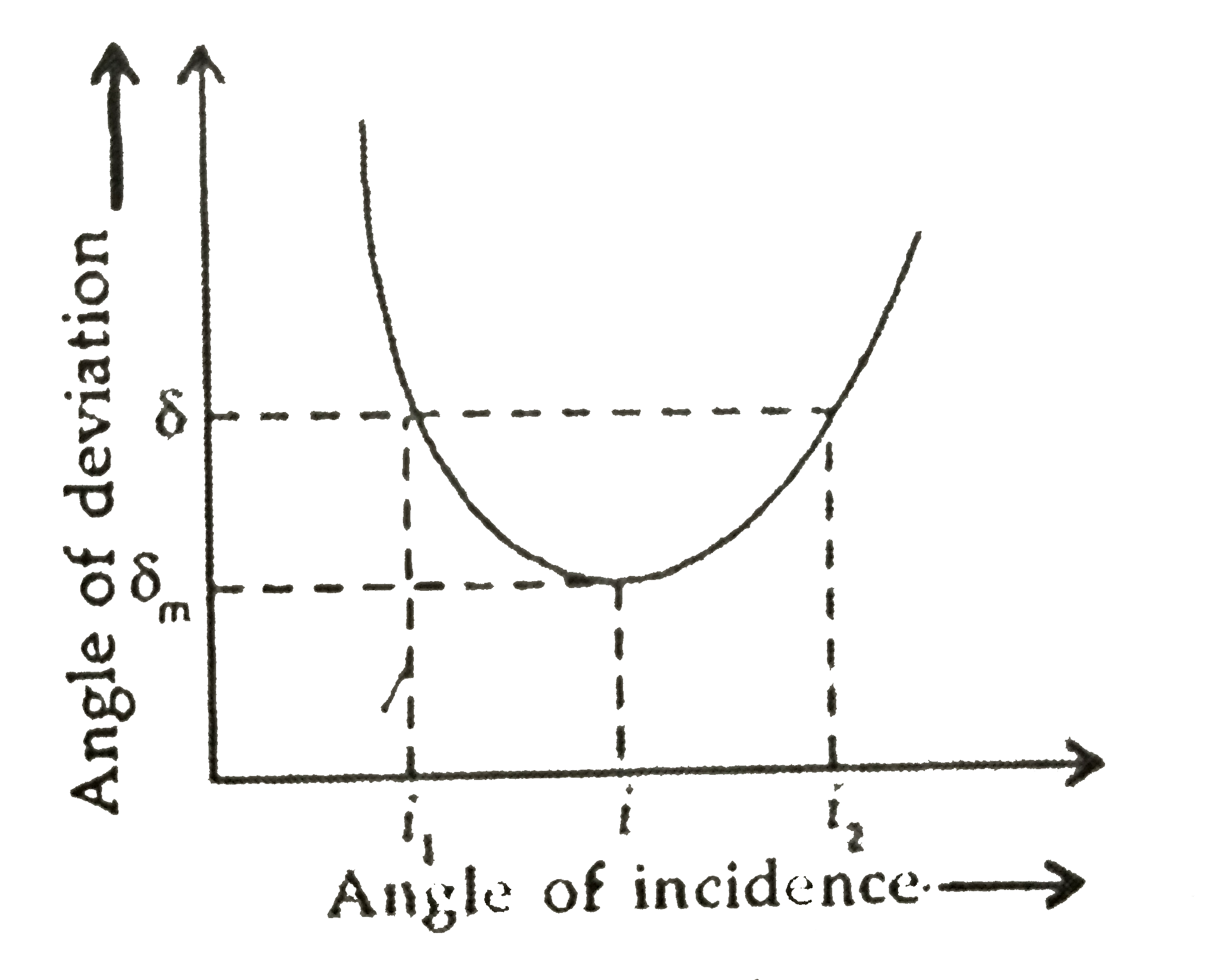 (b) A Ray PQ is incident on the face AB of prism at an angle I and refrected along QR at angle r. The angle between the EMERGENT ray RS and incident Ray PQ is called angle of deviation. `angleA+angleQNR=180^(@)"....(1)"` `-r+r'=angleQNR=180^(@)"....(2)"` from equation (1) and (2) `A=r+r'"....(3)"` `DELTA=angleMQR+angleMRQ"(exterior angle)"` `delta=(i+r)+(i'-r')` `delta=(i+i')-(r+r')"....(4)"` In the minimum deviation position (when `delta=delta_(m)`) `i=i',""r=r'""....(5)"` `"from (3) and (5)"r=A//2"....(6)"` `"from (4) and (5)" i=(A+delta_(m))/(2)"....(7)"` `mu=(sin i)/(sin r)"(according to SNELL's law)"` Substituting the value of i and r from equation (6) and (7) `mu=(sin i)/(sin r)=(sin""(A+(delta_(m))/(2)))/(sin""(A)/(2))` 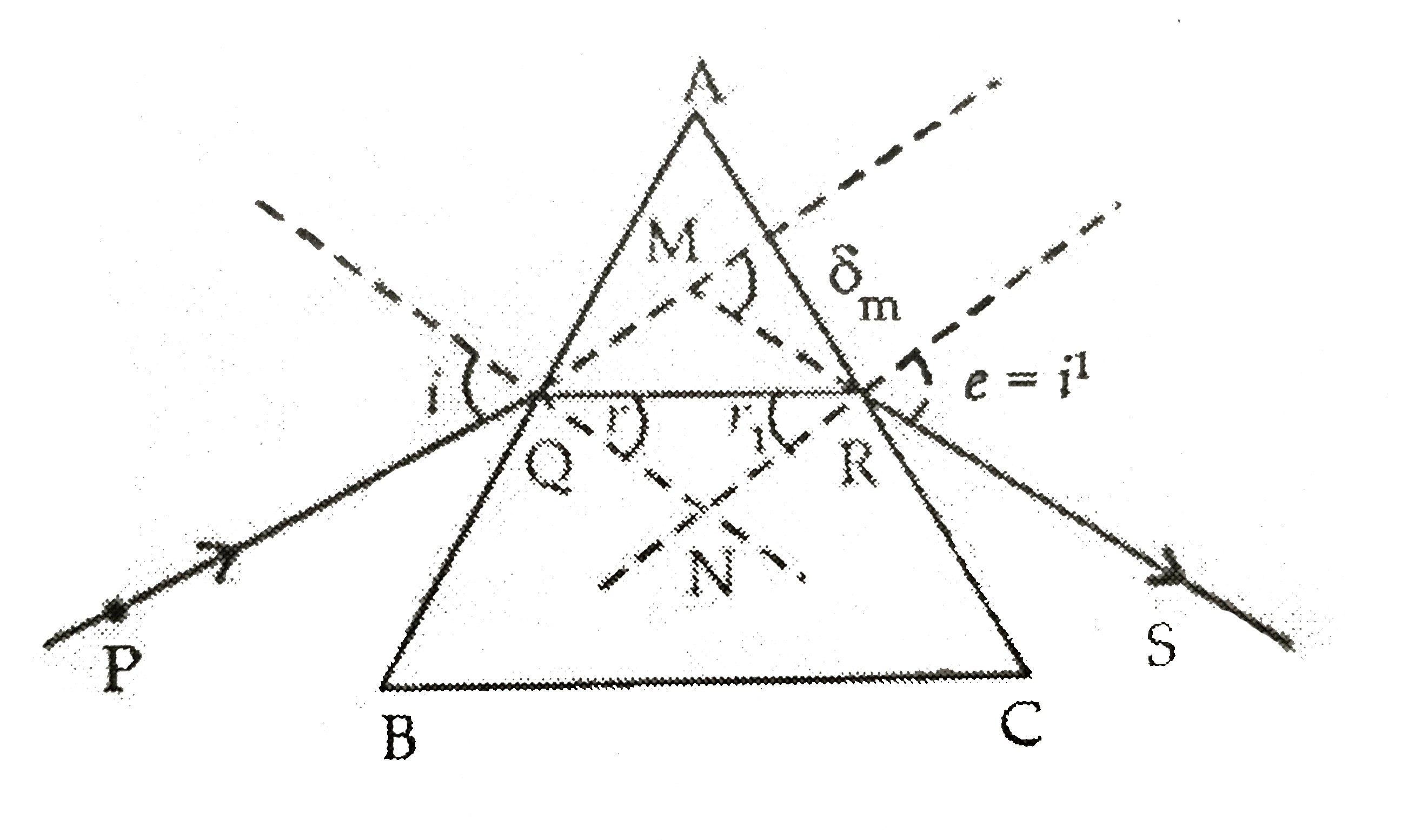
|
|
| 40. |
Set the following vectors in the increasing order of their magnitude. (a) 3hati + 4hatj, (b) 2hati + 4hatj + 6hatk ( c) 2hati + 2hatj + 2hatk, |
| Answer» Answer :B | |
| 41. |
Asexual reproduction is seen in members of Kingdom |
|
Answer» Monera |
|
| 42. |
Assertion A magnetic is dropped along the axis of a circular conducting loop as shown in figure. Then, acceleration of magnet is always less than g. Reason when magnet is above the loop, then it will repel the magnet and when it is below the loop, then it will attract the magnet. Reason When magnet is above the loop, then it will repel the magnet and when it is below the loop, then it will attract the magnet. |
|
Answer» If both Assertion and Reason are corrent and Reason is the corrent explanation of Assertion. |
|
| 43. |
(a) Derive an expression for the energy stored in a parallel plate capacitor of capacitance C when charged up to voltage V. How is this energy stored in the capacitor ? (b) A capacitor of capacitance 1 μF is charged by connecting a battery of negligible internal resistance and emf 10 V across it. Calculate the amount of charge supplied by the battery in charging the capacitor fully. |
|
Answer» `dW=(q/C).dq` Therefore, whole process of charging from Oto Q requires a work `W=int_(0)^(Q)(qdq)/C=1/C[(q^(2))/2]_(0)^(Q)=(Q^(2))/(2C)` This work done is stored as the electrostatic potential energy of the charged capacitor. Hence, potential energy of charged capacitor `u=(Q^(2))/(2C)` But Q = CV, where V be the potential difference between the plates of capacitor, hence `u=(Q^(2))/(2C)=1/2QV=1/2CV^(2)` This energy is stored within the DIELECTRIC of the capacitor in the form of electrostatic potential energy. (b) Here capacitance C =`1muF=1xx10^(-6)F` emf of battery E = 10 V and INTERNAL resistance of battery r= 0. Since r = 0, hence potential difference between the plates of capacitor, when it is FULLY charged is V = `epsi` = 10 V. `therefore` Charge supplied by the battery to the capacitor Q `=CV=(1xx10^(-6)F)xx10V` `=10xx10^(-6)C=10muC` 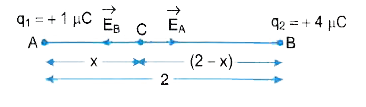
|
|
| 44. |
Point source of light is placed 4 m below water surface in the medium (water) havingrefractive index 5/3. A disc is placed on the water surface such that it blocks the light coming out of water completely so minimum diameter of disc = ........... |
Answer» Solution :`n=(1)/(sinC)` `thereforen=((r^2+h^2)^(1/2))/(r)` `(5/3)^2xxr^2=r^2+h^2` `therefore(25)/(9)xxr^2=r^2+h^2` `therefore25r^2=9r^2+9h^2` `therefore 16r^2=9h^2` `therefore 4r=3h` `thereforer=(3h)/(4)` `therefore r=(3xx4)/(4)` `therefore r=3`m `therefore` DIAMETER =6m |
|
| 45. |
Draw the circuit diagram of half wave rectifier, showing input and output voltages. |
|
Answer» Solution :p-n junction as half wave rectifier The circuit for using junction diode as half wave rectifier is as shown below in figure (a) .  During first half of a.c.one of the ends of SECONDARY SAY A ,becomes POSITIVE and diode OPERATES under forward bias and the current flows through load R. During second half, A becomes negative and diode operates under negative bias. Practically no current flows through the load. Thus half of the cycle of a.c. is rectified and we get UNIDIRECTIONAL current as shown in fig. (b). |
|
| 46. |
State the factors on which the fundamental frequency of air column in a pipe depends. |
| Answer» Solution :(i) Speed of SOUND in AIR (ii) LENGTH of the pipe (iii) DIAMETER of the pipe. | |
| 48. |
If the temperation of a gas is lowered to -273^@ C . Then it,s volume is |
|
Answer» Zero |
|
| 49. |
How long can an electric lamp of 100W be kept glowing by fusion of 2.0 kg of deuterium? Take the fusion reaction as ""_(1)^(2)H + ""_(1)^(2)H to ""_(2)^(3)He + n + 3.27 MeV. |
| Answer» SOLUTION :About `4.9 XX 10^4 y` | |