

Saved Bookmarks
This section includes 7 InterviewSolutions, each offering curated multiple-choice questions to sharpen your Current Affairs knowledge and support exam preparation. Choose a topic below to get started.
| 1. |
A galvanoment of resistance 25 Omega gives full scale deflection for a current of 10 mA. What resistance is to be connected in its series so that it can work as a voltmeter of range 10 V ? |
|
Answer» `10000 Omega` `:.` Series RESISTANCE `R = V/(I_g) - R_G = 100/(10^(-2)) - 25 = 9975 Omega` |
|
| 2. |
The speed of light in an isotropic medium depends on |
|
Answer» a. the nature of the source |
|
| 3. |
An electron and proton are possessing the same amount of kinetic energy. Which of the two has greater wavelength? |
|
Answer» Solution :`K=(1)/(2)mv^(2)=(p^(2))/(2M), LAMBDA=(h)/(p), p=(h)/(lambda), therefore K=(h^(2))/(2m lambda^(2))` KE of electron, `K_(e )=(h^(2))/(2m_(e )lambda_(e )^(2))` KE of proton, `K_(p)=(h^(2))/(2m_(p)lambda_(p)^(2))` Given, `K_( e)=K_(p)` `(h^(2))/(2m_(e )lambda_(e )^(2))=(h^(2))/(2m_(p)lambda_(p)^(2))` `(lambda_(e ))/(lambda_(p))=sqrt((m_(p))/(m_(e )))` `m_(p) GT m_(e )`, Hence, `lambda_(e ) gt lambda_(p)`. |
|
| 4. |
Under what conditions of electronic transition will the emitted light be monochromatic ? |
| Answer» SOLUTION :Only fixed two ORBITS are INVOLVED and THEREFORE single ENERGY evolve. | |
| 5. |
The photoelectrons emitted from the metallic surface have __ kinetic energies even when the incident photons have __ energy. |
| Answer» SOLUTION :DIFFERENT , same | |
| 6. |
What is the magnification of an object placed at the focus of a concave mirror? |
|
Answer» |
|
| 7. |
The machine gun fires 240 bullets//min. If the mass of each bullet is 10 g and the velocity of the bullet is 600 ms^(-1), the power (in kW) of the gun is |
|
Answer» 43200 Work done= Total kinetic energy of the bullets `n=1/2mv^(2)` n = 240, m = 10 g, v = 600 `ms^(-1)`(Given) `= 240x1/2 X10 x10^(-3)x(600)^(2)` |
|
| 8. |
The radionuclide ""^(11)C decays according to ""_(6)^(11)C to ""_(5)^(11) B + e^(+) + v, T_(1//2) = 20.3 min The maximum energy of the emitted positron is 0.960 MeV. Given the mass values: m ( ""_(6)^(11)C) = 11.011434 u and m (""_(6)^(11)B ) = 11.009305 u, calculate Q and compare it with the maximum energy of the positron emitted. |
|
Answer» Solution :`""_(6)^(11) C to ""_(5)^(11)B + e^(+) + v + Q` `Q = [m_N (""_(6)^(11)C) - m ""_(5)^(11)B - m_e] c^2` where the masses used are those of nuclei and not of atoms. If we use atomic masses, we have to add `6m_e` in case of `""_(6)^(11)C` and `5m_e` in case of `_""_(5)^(11)B`. Hence `Q = [m (""_(6)^(11)C) - m ""_(5)^(11)B - 2m ] c^2 ` (Note `m_e` has been doubled) Using given masses, `Q = 0.961 MEV` `Q = E_d+ E_e+ E_n` The DAUGHTER nucleus is too heavy COMPARED to `e^+` and v, so it carries negligible energy `(Ed ~~ 0)`. If the kinetic energy `(E_v)` carried by the neutrino is MINIMUM (i.e., zero), the positron carries maximum energy, and this is practically all energy Q, hence maximum `E_e ~~ Q`). |
|
| 9. |
A particle of mass 1kg is thrown vertically upward with speed 100 m/s. After 5 sec it explodes into two parts. One part of mass 400 g comes back with speed 25 m/s, what is the speed of the other part just after explosion? (g=10 m//s^2) |
|
Answer» 600 m/s UPWARD |
|
| 10. |
Why are convex mirrors used as side view mirrors in vehicles ? |
| Answer» Solution :Use of CONVEX mirror as a side view mirror in vehicles enhances the field of view of driver as he can now see CLEARLY the vehicles coming from behind a vehicles. | |
| 11. |
A particle of charge q and mass mmoves rectilinearly under the action of an electric field E = alpha-betax. Here, alpha and beta are positive constants and x is the distance from the point where the particle was initially at rest. Then, the |
|
Answer» motion of the particle is oscillatory `a=F/m = (qE)/m=q/m(alpha-betax)` ….(i) a=0 at x=`alpha/beta` i.e., force on the particle is ZERO at x= `alpha/beta` So, mean position of the particle is at x= `alpha/beta` `v(dv)/(DX)=q/m(alpha-betax)` `therefore int_0^v vdv=q/mint_0^x (alpha-betax)dx "" therefore v=sqrt((2qx)/m(alpha-beta/2x))` v=0 at x=0 and `x=(2ALPHA)/beta` So, the particle oscillates between x=0 and `x=(2alpha)/beta` with mean position at `x=alpha/beta` Maximum acceleration of the particle is at extreme position (at x=0 or `x=2alpha//beta` and `a_"max"=qalpha//m` [ from equation (i)] |
|
| 12. |
Binding energy per nucleon of ""_(8)^(16)O" is (given : mass of " ""_(8)^(16)O=16.000000 a.m.u.) |
|
Answer» 7.67MeV =0.13192 a.m.u. `rArr B.E.=0.13192 XX 931 MeV` B.E./nucleon `=(0.13192 xxx 931)/(16)=7.676MeV` |
|
| 13. |
Total electric flux coming out of a unit positive charge put in air is |
|
Answer» `in_0` |
|
| 14. |
In a torbulent flow, the velocity of liquid molecules in contact with the walls of the tube is |
|
Answer» a)Zero |
|
| 15. |
When a particle executing SHM oscillates with a frequency v, then the kinetic energy of the particle, |
|
Answer» CHANGES periodically with a frequency of U. |
|
| 16. |
The counting rate observed from the radioactive source at t= 0 second was 1600 counts/sec and t= 8 sec, it was 100 count/sec. The counting rate per sec at t =6 sec will be: |
|
Answer» 400 1ST CASE: when t=0, 1600/sec `=lambda N_(0)` 2nd case: when t=8sec. `(d N)/(dt)=lambda N_(0) e^(-8lambda)` `or 100 =lambda N_(0) e^(-8lambda) =1600 e^(-8 lambda)` `or 1/(16) =e^(-8lambda) or (1/2)^(4)=(e^(-2 lambda)^(4)` `e^(-2lambda)=1/2` 3rd case" t=6 sec `(d N)/(dt)=1600 e^(-6 lambda)=1600 (e^(-2lambda))^(3)` `=1600 xx (1/2)^(3)=1600 xx 1/8 =200//sec`. |
|
| 17. |
A circular conducting loop of radius r_(0) and having resistance per unit length lambda as shown in the figure is placed in a magnetic field B which is constant in space and time. The ends of the loop are crossed and pulled in opposite directions with a velocity v such that the loop always remains circular and the radius of the loop goes on decreasing, then |
|
Answer» radius of the loop changes with r as `r=r_(0)-(V t)/(pi)` `therefore (d)/(dt)(2pi r)=2v "" therefore (dr)/(dt)=(v)/(pi)` `therefore r=(r_(0)-(v)/(pi)t)` and `phi=B. pi r^(2)` `rArr epsilon = |(-d phi)/(dt)|=B. 2pi. r(dr)/(dt)` `therefore epsilon=2B pi(r_(0)-(v)/(pi)t)(v)/(pi)=2Bv (r_(0)-(v)/(pi)t)` `therefore I=(phi)/(R )=(2B br)/(lambda.2pi r)=(Bv)/(pi lambda)` |
|
| 18. |
A particle of mass m is moving with a uniform velocity v_(1). It is given an impulse such that its velocity becomes v_(2). The impulse is equal to |
|
Answer» `m[|v_(2)|-|v_(1)|]` |
|
| 19. |
Two equal electric currents are flowing perpendicular to each other as shown in the figure. AB and CD are perpendicular to each other and symmetrically placed with respect to the current flow. Where do we expect the resultant magnetic field to be zero. |
| Answer» Answer :A | |
| 20. |
The half -life of (238)/(92) U undergoing a decay is 4.5 xx 10^(9) years. Calculate the activity of 10 g same of (238)/(92) U. |
|
Answer» SOLUTION :It is given that `T_(1//2) = 4.5 xx10^(9)y= 4.5 xx10^(9)xx3.154 xx10^(7)s = 1.42xx10^(17)s` Number of atoms ( or NUCLIDES ) of `(238)/(92)U` present in 10 g sample `N= (10)/(238)xxN_(A)= (10)/(238)xxN_(A)=(10)/(238)xx6.023xx10^(23) = 2.53xx10^(22)` Activity of the sample R = `lambdaN = (0.693xx2.53xx10^(22))/(1.42xx10^(17))= 1.23xx10^(5)s^(-1)=1.23xx10^(5)` BQ |
|
| 21. |
A conducting wire of length l and mass m can slide without friction on two parallel rails and is connected to capacitance C. The whole system lies in a magnetic field B and a constant force F is applied to the rod. Then |
|
Answer» the rod MOVES with constant VELOCITY `therefore F-CB^(2)l^(2)a=ma rArr a=(F)/(m+B^(2)l^(2)C)` `rArr` emf increases `rArr` change increases |
|
| 22. |
Two pieces of wire A and B of the same material have their lengths in the ratio 1 : 2 and their diameters in the ratio 2 : 1 if they are stretched by same force. Their elongation will be in the ratio of : |
|
Answer» `1:8` `THEREFORE(Deltal_(1))/(Deltal_(2))=(L_(1))/(L_(2))XX((D_(2))/(D_(1)))^(2)` `=1/2xx(1/2)^(2)=1/8` Thus correct CHOICE is (a). |
|
| 23. |
What is the magnitude of the equatorial and axial fields due to a bar magnet of length 1.0 cm at a distance of 100 cm from its mid-point? The magnetic moment of the bar magnet is 0.314 Am^(2), |
| Answer» SOLUTION :`8 XX 10^(-7) T, 4 xx 10^(-7) T` | |
| 24. |
Consider a radioactive disintegration according to the equation A rarrB rarrC . Deacy constant of A and B is same and equal to lamda . Number of nuclei of A, B and Care N_00, 0 respectively at t = 0. Find (a) Number of nuclei of B as function of time t. (b) Time t at which the activity of B is maximum and the value of maximum activity of B. |
|
Answer» |
|
| 25. |
Two point charges +Q and +Q are separated by a certain distance. The resultant electric field is |
|
Answer» zero at the mid point of the LINE JOINING the CHARGES |
|
| 26. |
Distinguish between emf (E) and terminal voltage (V) of a cell having internal resistance 'r'. |
Answer» SOLUTION :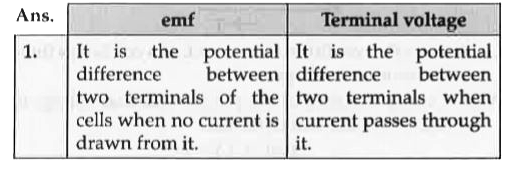 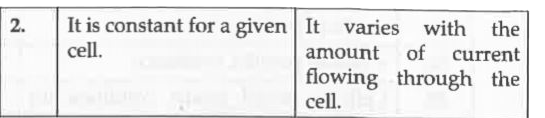
|
|
| 27. |
When the bulb of a constant volume air thermometer is immersed in ice, the mercury level in the open tube is 15 cm higher than the fixed index. When the bulb is immersed in boiling water the difference in the two levels increases to 48.3 cm. When the bulb is immersed in a hot liquid, the difference in levels decreases to 21 cm. What is the temperature of the hot liquid ? |
| Answer» SOLUTION :`18^(@)C` | |
| 28. |
What is the wavelengthof a photon of energy 3.3xx10^(-19)J? |
| Answer» Solution :`lambda=(HC)/(E )=((6.63xx10^(-34))xx(3xx10^(8)))/((3.3xx10^(-19)))=6.3xx10^(-7)m` | |
| 29. |
The dimension of (1)/2epsilon_0E^2 (epsilon_0-permittivity of free space, E electric field) is: |
|
Answer» `MLT^(-1)` |
|
| 30. |
Match list I with list II {:("List I","List II"),("a) Red dwarfs"," e ) Carbon nitrogen cycle"),("b) Stars having higher" ," f) Isotope of carbon"),(" temperatures",),("c) Blood circulation"," g) Proton - proton cycle"),(,"problems"),("d) Radio carbon dating","h) radio sodium"):} |
|
Answer» `a - e , B - G , c - h , d - F ` |
|
| 31. |
For a quantum particle in a box, the lowest energy quantum state has 1//2 of the particle de Broglie wave fitting in the box. The next highest state corresponds to |
|
Answer» `1//4` DE BROGLIE wavelength |
|
| 32. |
A transformer is used to light a 100 W and 110 V lamp from a 220 V mains. If the main current is 0.5 A, the efficiency of the transformer is approximately |
|
Answer» `50%` `therefore` Power input `=V_(p)I_(p) = 220 XX 0.5 = 110 W` `therefore` Efficiency of TRANSFORMER `=("output")/("input") = 100/110 xx 100% = 90%` (APPROX) |
|
| 33. |
Seven capacitors each of capacity 2 muF are to be so connected to have a total capacity (10//1) muF. Which will be the necessary figure as shown? |
|
Answer»
|
|
| 34. |
What is the voltage gain in a common base amplifier where input resistance is 3Omega and load resistance is 24Omega ? (Take alpha = 0.6 ) : |
|
Answer» `1.2 |
|
| 35. |
Explain briefly how the phenomenon of total internal reflection is used in fibre optics. |
Answer» Solution :Optical fibres CONSIST of MANY, long high quality composite glass/quartz fibres. Each fibre consists of a core of high refractive index and a cladding of lower refractive index. Optical fibre works on the principle of total internal Core (high N) reflection. When a light signal is INCIDENT on one end of the fibre at a small angle, the light passes inside, undergoes repeated total internal reflections along the fibre and finally comes out as shown in Fig. 9.56. The angle of incidence isCladding (low n) ALWAYS greater than the critical angle of the core material 9-56 with respect to the cladding. Even if the fibre is bent, the light signal can easily travel through along the fibre.
|
|
| 36. |
A : Universe is expanding R : There is red shift in the spectra of galaxies |
|
Answer» Both A and R are true and R is the CORRECT explanation of A |
|
| 37. |
ABCDEF is a regular hexagon with point O as centre. Find the value vec(AB)+vec(AC)+vec(AD)+vec(AE)=vec(AF). |
|
Answer» SOLUTION :From the diagram `(vecAB)=-(vecDE)(vec BC=-vec EF)` `vec(AB)+vec(AC)+vec(AD)+vec(AE)+(vecAF)` `cancel vec(AB)+(cancel vec(AB)+cancel vec(BC))+vec(AD)+(vec(AD)+cancel vec(DE))+(vec(AD)+cancel vec(DE)+cancel vec(EF))` `=3vec(AD)=3(2vec(AO))=6(vec(AO))` |
|
| 38. |
A capacitor is charged so that it has a stored potential energy U and then connected in series with an identical, uncharged capacitor and a resistance. Until the current in the circuit becomes negligible, the total heat wasted in the resistance is H. The ratio (H)/(U) is______. |
|
Answer» So, `U=(Q^(2))/(2C)` When the final steady state is achieved, both capacitors have charge Q/2. so, potential energy stored in any one capacitor, `U'=(((Q)/(2))^(2))/(2C)=(Q^(2))/(8C)`, so, heat washed in the resistance, `H=U-2U'=(Q^(2))/(4C)` |
|
| 39. |
What is meant by fading in communication system ? |
| Answer» Solution :FADING is variation in the strength of a SIGNAL at the receiver due to INTERFERENCE of WAVES. | |
| 40. |
In a meter bridge a 30Omega resistance is connected in the left gap and a pair of resistance p and Q in the gap . Measured from the left , the balance point is 37.5 cm When they the parallel. The values of P and Q (inOmega ) are |
|
Answer» `(40,10)` `(i_1+i_2) 12+ (i_2xx1)-10 = 0` `12i_1+13i_2= 10` Consider the loop ABCEFED `10 - (i_2xx1)+(i_1xx0.5)-6=0` `0.5i_1-i_2= -4` Solving equation (1) and (2, we GET, |
|
| 41. |
Both mass and charge are scalars and hence got the additive property. However, in adding charges it is not enough to just add the amounts of charges. Why? |
| Answer» Solution :UNLIKE mass charges are of TWO DIFFERENT kinds, POSITIVE and negative. | |
| 42. |
In the figure the wires AB and PQ carry constant current l_(1) and l_(2) respectively.PQ is of uniformly distributed mass m and length l.AB and PQ are both horizontal and kept in the same vertical plane.The PQ is in equilibrium at height h.Find (i) h in terms of I_(1),I_(2),l,m,g and other standard constants. (ii) If the wire PQ is displaced vertically by small distance prove that it performs SHM.Find its time period in terms of h and g. |
|
Answer» Solution :(i) Magnetic repulsive force balances the weight . `(mu_(0)I_(1)I_(2))/(2pih)l mg rArr h=(mu_(0)I_(1)I_(2)l)/(2pimg)` (ii) Let the wire be displaced DOWNWARD by distance `x(LT lt h)`. Magnetic force on it will INCREASES, so it goes back towards its equilibrium position.Hence it performs oscillations. `F_(res)=(mu_(0)I_(1)I_(2))/(2x(h-x))l-mg` `=(mgh)/(h-x)-mg=(mg(h-h+x))/(h-x)` `=(mg)/(h-x)~=(mg)/hx "for"xltlt h` `:.T=2pisqrt(m/(mg//h))=2pisqrt(h/g)` |
|
| 43. |
For a transistor, beta=50. Input resistance (R_i)=200Omega. Output resistance (R_0)=2000Omega.The voltage gain of the amplifier is |
|
Answer» 300 |
|
| 44. |
A charge 4muC is placed in an electric field of magnitude 8 N/C. Find the force on it. |
|
Answer» |
|
| 45. |
In a parallel plate capacitor with air between the plates, each plate has an area of 6 xx 10^(-3)m^(2)and the distance between the plates is 3 mm. Calculate the capacitance of the capacitor. If this capacitor is connected to a 100 V supply, what is the charge on each plate of the capacitor? |
| Answer» SOLUTION :18 pF, `1.8 xx 10^(-9)` C | |
| 46. |
A particle is projected from the ground with an initial speed of v at an angle of projection theta. The average velocity of the particle between its time of projection and time it reaches highest point of trajectory is (2013 E) |
|
Answer» `(v)/(2)sqrt(1+2cos^(2)THETA)` |
|
| 47. |
For a mypoic eye, the far point is to 250 cm. To correct this defect, the nature of the lens and its focal length will be: |
|
Answer» concave lens of 250 cm focal length `therefore f = - 250 cm` i.e., concave lens. |
|
| 48. |
A : Magnitude of mean velocity of the gas molecules is same as their mean speed. R : The only difference between mean velocity and mean speed is that mean velocity is a vector and mean speed is a scalar. |
|
Answer» If bothAssertion & Reason are true and the reason is the correct explanation of the ASSERTION, then Mark (1) |
|
| 49. |
If one takes into account finite mass of the proton, the correction to the binding energy of the hydrogen atom is approximately (mass of proton = 1.60 xx 10^(-27 )kg, mass of electron =9.10xx 10^(-31) kg)- |
|
Answer» `0.06%` |
|
| 50. |
What are the properties of an equipotential surface? |
|
Answer» Solution :PROPERTIES of equipotential surfaces (i)The work done to MOVE a charge q between any two POINTS A and B, `W=q(V_B-V_A)`.If the points A and B lie on the same equipotential SURFACE ,work done is zero because `V_A=V_B`. (ii)The electric field is normal to an equipotential surface.If it is not normal then there is a component of the field parallel to the surface.Then work MUST be done to move a charge between two points on the same surface.This is a contradiction ,.Therefore the field must always be normal to equipotential surface. |
|


