

Saved Bookmarks
This section includes 7 InterviewSolutions, each offering curated multiple-choice questions to sharpen your Current Affairs knowledge and support exam preparation. Choose a topic below to get started.
| 1. |
A solid cylinder is rolling down the inclined plane without slipping. Which of the following is correct? |
|
Answer» The friction FORCE is dissipative |
|
| 2. |
A converging lens of refractive index 1.5 is kept in a liquid medium having same refractive index. What would be the focal length of the lens in this medium ? |
| Answer» SOLUTION :INFINITE (or POWER is ZERO). | |
| 3. |
A permanet magnet |
|
Answer» attracts all SUBSTANCE |
|
| 4. |
What is the basic difference between an analog communication system and a digital communication system? |
Answer» SOLUTION :
|
|
| 5. |
One ampere contain _________ statampere and ________ab ampere |
| Answer» SOLUTION :`3xx10^9`,1/10 AB AMPERE | |
| 6. |
In a 3 dimensional space, two particles are moving with uniform speeds of 6 m//s and 8 m//s along two arbitrary curves. The speed of one particle, as observed by other can be : |
|
Answer» zero |
|
| 7. |
Two similar coils of radius R are lying concentrically with their planes at right angles to each other. The currents flowing in them are I and 2 I, respectively. The resultant magnetic field induction at the centre will be |
|
Answer» `(sqrt5mu_(0)I)/(2R)` |
|
| 8. |
Twelve identical wires each of resistance 6 Omega are joined to from a skeleton cube. Find the resistance between the current of the same edge of the cube |
|
Answer» |
|
| 9. |
In Young's double slit experiment if the widths of the slits are in the ratio 4 : 9, rstio of intensity of maxima to intensity of minima will be : |
|
Answer» `25 : 1` `therefore (a_(1)^(2))/(a_(2)^(2)) = 9/4" (a_(1))/(a_(2)) = 3/2 ` `a_(max) = a_(1) +a_(2) " a_(min) = a_(1) - a_(2)` `therefore (I_(max))/(I_(min)) = (a_(1) + a_(2))^(2)/(a_(1) - a_(2)) = 25/1` |
|
| 10. |
n transparent slabs of refractive index 1.5 each having thickness 1 cm, 2 cm, 3 cm……….n cm are arranged one over another. A point object is seen through this combination from top with perpendicular light. If the shift of the object by combination is5 cm. Then the value of n is . |
|
Answer» 0.5 |
|
| 11. |
In two different experiment X-rays are incident on sodium metal and then X-rays are incident on copper.In both case stoppin potential V_(0) is measured ,stopping potential …given [(phi_(0))_(na)lt(phi_(0))_(cu)] |
|
Answer» will be same in both case `phi_(NA)ltphi_(cu)` `therefore V_(0NA)gtV_(0CU)` |
|
| 12. |
Calculate the work done in taking a charge- 2 xx 10^(-9)C from A to B via C (in diagram ) |
|
Answer» 0.2 JOULE |
|
| 13. |
Let the XZ plane be the boundary between two transparent media. Medium 1 in Z ge 0 has a refractive index of sqrt2 and medium 2 with Z gt 0 has a refractive index of sqrt3. A ray of light in medium 1 given by the vector ,vec(A) = 6sqrt3hat(i) + 8 sqrt3hat(j) - 10hat(k) is incident on the plane of separation. The light of refraction in medium 2 is |
|
Answer» `45^(@)` |
|
| 14. |
An analyser is inclined to a polariser at an angle of 30^(@). The intensity of light emerging from the analyser is 1"/"nth of that is incident on the polariser. Then nis equal to |
| Answer» Answer :C | |
| 15. |
What is the direction of magnetic force ? |
| Answer» SOLUTION :PERPENDICULAR to PLANE `oversettoVxxoversettoB` | |
| 16. |
Distinguish between drift velocity and mobility. |
Answer» SOLUTION :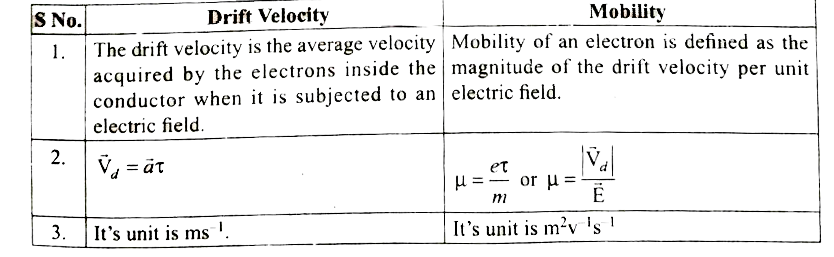
|
|
| 17. |
When the values of inductance and capacitance in an L−C circuit are 0.5 H and 8 μF respectively then current in the circuit is maximum. The angular frequency of alternating e.m.f. applied in the circuit will be |
|
Answer» |
|
| 18. |
Mention types of methods of charging the body. |
| Answer» SOLUTION :A body can be CHARGED in TWO WAYS : (1) With CONTACT (2) Without contact | |
| 19. |
The figure shows the energy level of certain atom. When the electron de excites from 3E to E, an electromagnetic wave of wavelength lambda is emitted. What is the wavelength of the electromagnetic wave emitted when the electron de excites from (5E)/(3) to E? .....................................3E ....................................5E // 2 .....................................E. |
|
Answer» `3lambda` `:.` hv = 3E - E `(hc)/(lambda)=2E` ...(i) When electron de excites from `(5E)/(3) to E` `(hc)/(lambda.)=(5E)/(3)-E=(2)/(3)E` ...(ii) Substituting the value of E from eqn. (i) in eqn. (ii), we get `(hc)/(lambda)=(2)/(3)((hc)/(lambda_(2)))` `implies lambda.=3lambda`. |
|
| 20. |
A thin glass prism placed in air produces minimum deviation of 4^(@) in a light ray. If the prism is immersed in water, what will be the minimum deviation produced by it ? Give .^(a)mu_(G) = 3//2 and .^(a)mu_(w) = 4//3. |
|
Answer» |
|
| 21. |
A plane mirror is suspended vertically at the center of a large thin-walled spherical flask filled with water. The diameter of the flask is 10 inches. An observer whose eye is 35 inches from the mirror as shown in figure tries to see an image of his own eye. What is distance of the image from the eye (in inches). The effect of the thin glass walls of the flask may be neglected. Take mu_(water)=4/3 |
|
Answer» `4/(3v)=1/15-1/30=1/30` `v=40"Rightarrow u=35"` `1/v-(4//3)/(+30)=(1-4//3)/(-5)` `1/v-6/90+4/90` `v=9"` DISTANCE from observer =21" 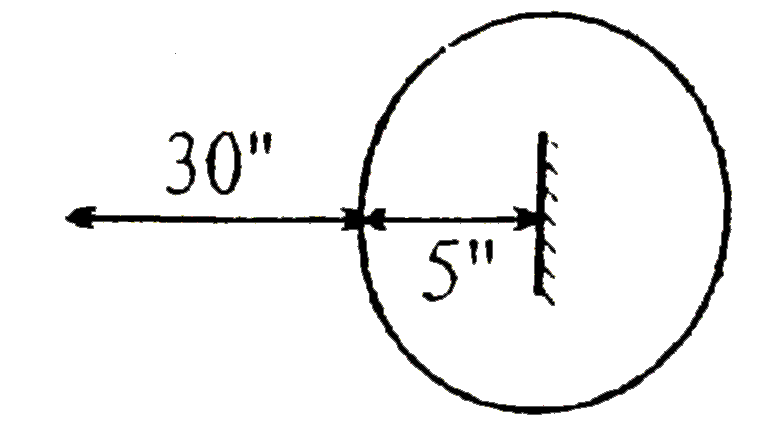
|
|
| 22. |
The value of barrier potential depends on : |
|
Answer» doping DENSITY |
|
| 23. |
An electric dipole when placed in a uniform electric field E will have minimum potential energy if the +ve direction of the dipole moment makes an angle with E: |
| Answer» ANSWER :A | |
| 24. |
Light from a point source lhlls on a small area placed perpendicular to the incident light. if the area is rotated about the incident: light by an angle of ~60^@, by what fraction will the illuminance change ? |
|
Answer» |
|
| 25. |
Figure shows electric field lines in which an electric dipole P is placed as shown. Which of the following statements is correct ? |
|
Answer» The dipole will not experience any FORCE. `therefore` Electric field `E_(infty)at - q gt` electric field `E_(+)` at +q Electric force, `F =QE` `therefore F prop E (therefore q)` are same `therefore F_(-)/F_(+) = E_(-)/E_(+)` But `E_(-) gt E_(+)` `therefore` Resultant force F will be in direction of `F_(-)`It means towards left. |
|
| 26. |
The time varying magnetic and electric fields |
|
Answer» They can be CREATED independently |
|
| 27. |
Delta"Q"=nCdTrepresents |
|
Answer» Change in amount of HEAT CONTAINED in a BODY as a result of temperature change |
|
| 28. |
"Magnetic force cannot do any work". Do you agree with this statement? Justify your answer. |
| Answer» SOLUTION :Yes, SINCE magnetic LORENTZ force acts perpendicular to the velocity and the magnetic FIELD, work done is zero. | |
| 29. |
Ozone layer above earth's atmosphere will: |
|
Answer» prevent infrared RADIATIONS from SUN REACHING earth |
|
| 30. |
The isotope ""^(235)U decays by alpha emission with a half life of 7.0xx10^(8)y. It also decays (rarely) by spontaneous fission, and if the alpha decay did not occur, its half life due to spontaneous fission alone would be 3.0xx10^(17)y. (a) At what rate do spontaneous fission decays occurs in 1.0 g of ""^(235)U? (b) How many ""^(235)U alpha decay events are there for every spontaneous fission event? |
|
Answer» |
|
| 31. |
Half-life period of radium is 1600 years. Its average life period is |
|
Answer» 3200 years |
|
| 32. |
A rocket is ejecting a mass m of gases per unit time with velocity V relative to the rocket, the thrust on the rocket is: |
|
Answer» mV Hence correct CHOICE is (a). |
|
| 33. |
The volume of 0.2 M H_2O_2 that will be completely oxidised by 10ml of 0.3M KMnO_4 solutioninfaintly alkaline medium |
|
Answer» SOLUTION :`M_1`=0.2 M, `V_1`=? `n_1=2 to ` for `H_2O_2` `M_2` =0.3 M , `V_2`=10 ml `n_2=3` (In slightlybasic MEDIUM `MnO_4^(-) to MnO_2` ) `M_1V_1n_1=M_2V_2n_2` `0.2xxv_1xx2=0.3xx10xx3` `V_1`=22.5 ml |
|
| 34. |
4 In an unbiased p-n junction, holes diffuse from the p-region to n-region because |
|
Answer» FREE electrons in the n-region ATTRACT them. |
|
| 35. |
Monichromatic light of wavelength 632.8 nm Is produced by a helium-neon laser.The power emitted is 9.42 mW. (b)How many photons per second,on the average ,arrive at a target irradiated by this beam ? (Assume the beam to have uniform cross-section which is less than the target area),and (c )How fast does a hydrogen atom have to travel in order to have the same moementum as that of the photon? |
|
Answer» SOLUTION :Here `lambda=632.8 nm=632.8xx10^(-9)m` `P=9.42 mW=9.42xx10^(-3)W` `h=6.63xx10^(-34)Js,c=3xx10^(8) ms^(-1)` (a)energy of each photon, `E=(hc)/(lambda)` `therefore E=(6.63xx10^(-34)xx3xx10^(8))/(632.8xx10^(-9))` `=0.031431xx10^(-17)J` `therefore E~~3.14xx10^(-19)J` `therefore` Momentum of each photon, `impliesp=(h)/(lambda)` `therefore p=(6.63xx10^(-34))/(632.8xx10^(-9))` `therefore p=0.010477xx10^(-25)` `therefore p~~1.05xx10^(-27) kg ms^(-1)` (b)Let no. of photon reaching to target envery SECOND =N P=(no. of photon N) `P=NExx("energy of each photon E")` `therefore N=(P)/(E)=(9.42xx10^(-3))/(3.14xx10^(-19))` `therefore N=3x10^(16)"photon//second"` (c )Momentum of hydrogen atom=momentum of photon, `therefore` mv=p `therefore v=(p)/(m)=(1.05xx10^(-27))/(1.67xx10^(-27))` `therefore v=0.62874 therefore v~~0.63 m^(-1)` |
|
| 36. |
A particle is released freely from a height H. At a certain height, its kinetic energy is two times of its potential energy. Then, the height and the speed of the particle at that instant are respectively (g = acceleration due to gravity) |
|
Answer» `H/3,sqrt((2gH)/3)` 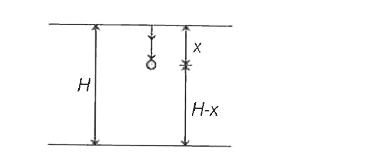 If particle FALLS by a distance X, then `KE=1/2mv^(2)=1/2m(2GX)=mgx` `PE=mg(H-x)` As, `KE=2(PE)rArrmgx=2mg(H-x)rArrx=(2H)/3` So, height of particle is `H-x=H/3`. Speed of particle at `H/3` distance = `sqrt(2g((2H)/3))=2sqrt((gH)/3)` |
|
| 37. |
What function of the rodioactive cobalt nuclei whose half-life is 71.3 days decays during a month? |
|
Answer» Solution :We CALCULATE `LAMBDA` first `lambda=(In2)/(T_(1//2))=9.722xx10^(-3)` per day Hence FRACTION DECAYING in a month `=1-e^(-lambda t)= 0.253` |
|
| 38. |
The nuclear reactor at Kaiga is a |
|
Answer» RESEARCH REACTOR |
|
| 39. |
Whentheconvex side of the plano - convex lens is silvered, it behaves like: |
|
Answer» CONCAVE mirror of focal length `(f)/(2)` and `f_(m) = (2)/(R_(m)) = (2)/(R )` Now `"" (1)/(F) = (2)/(f) + (1)/(f_(m)) = 2((mu-1)/(R)) + (2)/(R )` `(1)/(F) = (2mu)/(R) (+ve)` `THEREFORE "" F = (R )/(2mu)` Mirror is convex mirror of `F = (R )/(2mu)`. |
|
| 40. |
A narrow beam of thermal neutrons is attenuated eta= 360 time s after passing through a cadmium plate of thickness d= 0.50mm. Determine the effective corss-section of interaction of these neutrons with cadmium nuclei. |
|
Answer» Solution :We have the relation `(1)/(eta)=e^(-nsigma)` Here`(1)/(eta)=` attentution factor `n=` no. of `Cd` nuclei PER UNIT volume `SIGMA=` effective cross section `d=` thickness of the plate Now `n=(rhoN_(A))/(M)` `(RHO=` density, `M=` Molar weight of `Cd, N_(A)=` AVOGADRO number.) Thus `sigma=(M)/(rhoN_(A)d)In eta = 2.53kb` |
|
| 41. |
A magician during a show makes a glass lens with n = 1.47 disappear in a through of liquid. What is the refractive index of the liquid ? Couldthe liquid be water ? |
| Answer» SOLUTION :The refractive index of the liquid must be equal to 1.47 in ORDER to make the lens disappear. This means `n_(1) = n_(2)`. This gives `(1)/(f) = 0 or f rarr INFTY`. This lens in the liquid will act like a plane sheet of glass. No, the liquid is not WATER. It could be glycerine . | |
| 42. |
It is observed that for refraction through a prism angle of incidence i is exactly equal to the angle of deviation delta. The prism is in __________. |
| Answer» SOLUTION :MINIMUM DEVIATION POSITION | |
| 43. |
In an a.c. circuit an alternating voltage V = 200 sqrt(2) sin 100t volts is connected to a capacitor of capacitance 1 uF. The rms value of the current in the circuit is |
|
Answer» 20 mA `therefore` Value of rms current `I_(rms) = V_(rms)/X_( C) =200/10^(4) = 2 xx 10^(-2) A = 20 mA` |
|
| 44. |
A 120 V, 60 W lamp is to be operated on 220 V, 50 Hz supply mains. Calculate what value of pure inductance which would be required so that the lamp runs on correct value of power. |
|
Answer» |
|
| 45. |
It is now believed that protons and neutrons (which constitute nuclei of ordinary matter) are themselves built out of more elementary units called quarks. A proton and a neutron consist of three quarks each. Two types of quarks, the so called 'up' quark (denoted by u) of charge +2/3e and the down quark denoted by d) of charge (-1/3e), together with electrons build up ordinary matter. (Quarks of other types have also been found which give rise to different unusual varieties of matter.) Suggest a possible quark composition of a proton and neutron. |
|
Answer» Solution :Quark composition of PROTON : Suppose one proton is made up of `n_(1)`no. of up quark and `n_2` no. of down quark. Hence, Charge of one proton = `n_(1)`(charge of one up quark) +`n_2` (charge of one down quark) `therefore e=n_(1) ((2e)/3) + n_(2) (-e/2)`..........(1) But we are given that `n_(1) + n_(2) = 3` `therefore n_(2) =3-n_(1)`.............(2) From eqns. (1) and (2), `e = n_(1) (2e)/3 + (3-n_(1)) (-e/3)` `therefore e=(2n_(1)e)/3 - e + (n_(1)e)/3` `therefore n_(1)e = 2e` `therefore n_(1) -= 2`......(3) From eqns. (2) and (3) `n_(2) = 3-2`...........(4) `therefore n_(2) =1` Thus, one proton is made up of 2 up quarks and 1 down quark. Hence, quark composition of proton can be shown as "uud" where u = up quark and d = down quark. Quark composition of one neutron : Suppose one neutron is made up of `n_(1)`no. of up quarks and `n_2` no. of down quarks. Hence, Charge of one neutron = `n_(1)`(charge of one up quark) + `n_2` (charge of one down quark) `therefore O = n_(1) ((2e)/3) + n_(2) (-e/3)`...........(5) But we are given that `n_(1) + n_(2) =3` `therefore n_(2) = 3-n_(1)`........(6) From eqn. (5) and (6) `O = n_(1) ((2e)/3) + (3-n_(2)) (-e/3)` `therefore n_(1) =1`...........(7) From eqn. (6) and (7) `n_(2) = 3-1` `therefore n_(2) =2`...........(8) Thus, one neutron is made up of 1 up quark and 2 down quarks. Hence, quark composition of neutron can be shown as "udd". |
|
| 46. |
The solar radiation spectrum shows that maximum solar intensity is near to energy hv = 1.5 eV. Answer the following: (i) Why are SI and GaAs are preferred materials for solar cells. (ii) Why CdS or CdSe are preferred materials for solar cells. (iii) Why we do not use materials like PbS (Eg ~ 0.4 eV). |
|
Answer» Solution :(i) For photo-excitation, hv `gt` Eg. SI has Eg. ~ 1.1 EV and for GAAS, Eg. ~ 1.53 eV. GaAs is better than Si because of its relatively higher absorption coefficient. (ii) If we choose CdS or CdSe, we can use only the high energy component of the solar energy for photo-conversion and a significant part of energy will be of no use. (iii) The CONDITION `hv gt Eg`. is satisfied, but if we use Pbs, most of solar radiation will be absorbed on the top-layer of solar cell and will not reach in or near depletion region. |
|
| 47. |
Force of 2 kgf is applied at one end of the spring balance kept horizontal and an equal force of 2 kgf is applied at the other end in the opposite direction, Simultaneously. Then the reading on the spring balance is |
| Answer» Answer :A | |
| 48. |
A light source of wavelength 520nm emits 1.04 xx 10^(15)photons per second while the second source of 460nm produces 1.38 xx 10^(15) photons per second. Then the ratio of power of second source to that of first source is |
|
Answer» `1.00` `P_(1) = (1.04x 10^(5) xx 1240)/(520) = 2.48 xx 10^(15), P_(2) = (1.38 xx 10^(15) xx 1240)/(460) = 3.72 xx 10^(15)` `(P_(2))/(P_(1)) = (3.72 xx 10^(15))/(2.48 xx 10^(15))= 1.5` |
|
| 49. |
Non-relativistic protonsmoverectinearly in the region of space where thereare unifrommutually perpendicularelectric and magneticfieldswith E = 4.0 kV//m and B = 50 mT. The trajectory of the protons lies in the plates xz (Fig) and formsan anglevarphi = 30^(@) with the x axis. Findteh pithcof the helical trajectoryalongwhich theprotonswill moveafter the electricfield is swiched off. |
|
Answer» Solution :When the ELECTRIC field is swichted off, the path followed by theparticlewill be helical. And pitch, `Delta l = v_(|\|) T`, (where `v_(|\|)` is the velocity of the particle, parallel to `vec(B)`, and `T`, the time PERIOD of revolution.) `= v cos (90 - varphi) T = v sin varphi T` `= v sin varphi (2pi m)/(aB)` (as `T = (2pi)/(qB)`) ...(1) Now, when both the FIELDS were present , `qE = qvB sin (90 - varphi)`, as no net force was EFFECTIVE on the SYSTEM. or, `v = (E)/(B cos varphi)` ....(2) From (1) and (2), `Delta l =v (E)/(B) (2pi m)/(qB) tan varphi = 6 cm`. |
|