Saved Bookmarks
This section includes 7 InterviewSolutions, each offering curated multiple-choice questions to sharpen your Current Affairs knowledge and support exam preparation. Choose a topic below to get started.
| 2. |
Find the current flowing across three resistors 3 Omega, 5 Omega and 2 Omega, connected in parallel to a 15 V supply. Also find the effective resistance and total current drawn from the supply. |
Answer» SOLUTION :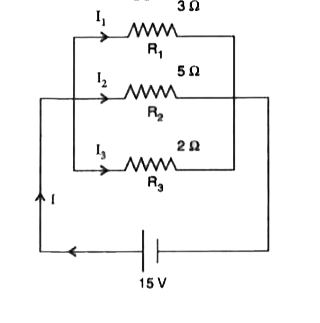 Effective resistance of PARALLEL combination `(1)/(R_(P)) = (1)/( R _(1)) + (1)/( R _(1)) + (1)/( R _(3))` `= 1/3 + 1/5 + 1/2` `R_(P) = 0.96 77 Omega` Current through `R _(1), I _(1) = (V)/( R _(1)) = (15)/(3) =5 A` Current through `R _(2), I _(2) = ( V)/(R _(2)) = (15)/( 5 ) = 3 A` Current through `R_(3), I _(3) = ( V)/( R _(3)) = (15)/(2) = 7.5 A` Total current `I = (V )/( R _(P)) = (15)/( 0.96 77) = (15)/( 0.96 77) = 15.5A` |
|
| 3. |
A 5 Omega resistor is connected in series with a parallel combination of n resistors of 6 Omega each. The equivalent resistance is 7 Omega. Find n. |
|
Answer» |
|
| 4. |
Twelve wires each of resistance 6Omega are connected to from a cube as shown in the adjoining figure. The current enters at a cornet A and leaves at erhe diagonally opposite corner G.Theequivalent resistance across the corners A and G is |
|
Answer» `12Omega` 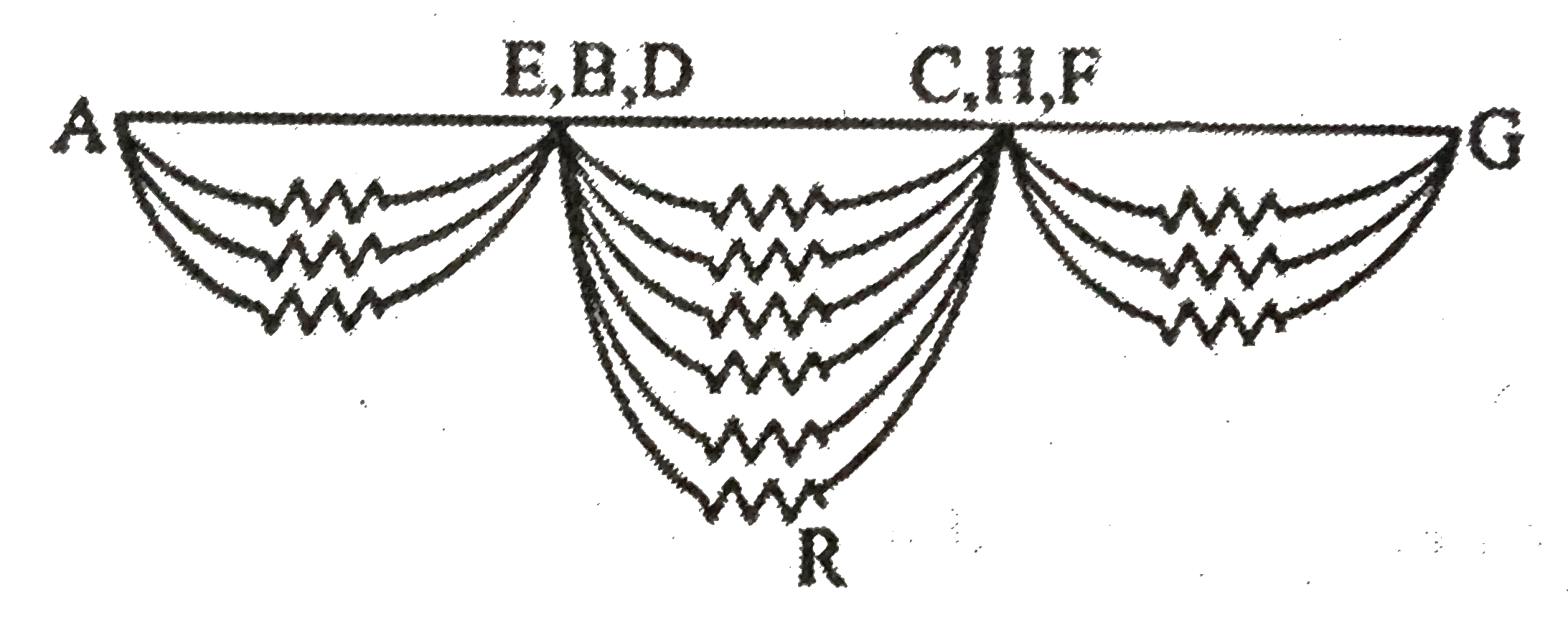 `R_(AG)=(R)/(3)+R/6+R/3=(5R)/(6)=5/6xx6Omega=5Omega` |
|
| 5. |
Consider a set of six infinite long staright parallel wires arranged perpendicular to the plane of parper in a hexagon as shown. The length of the each side of the hexagon is 3 cm. What is the magnitude and direction of the magnetic field at point P? |
|
Answer» `20 muT` Field at `P` due to `c` and `f`: 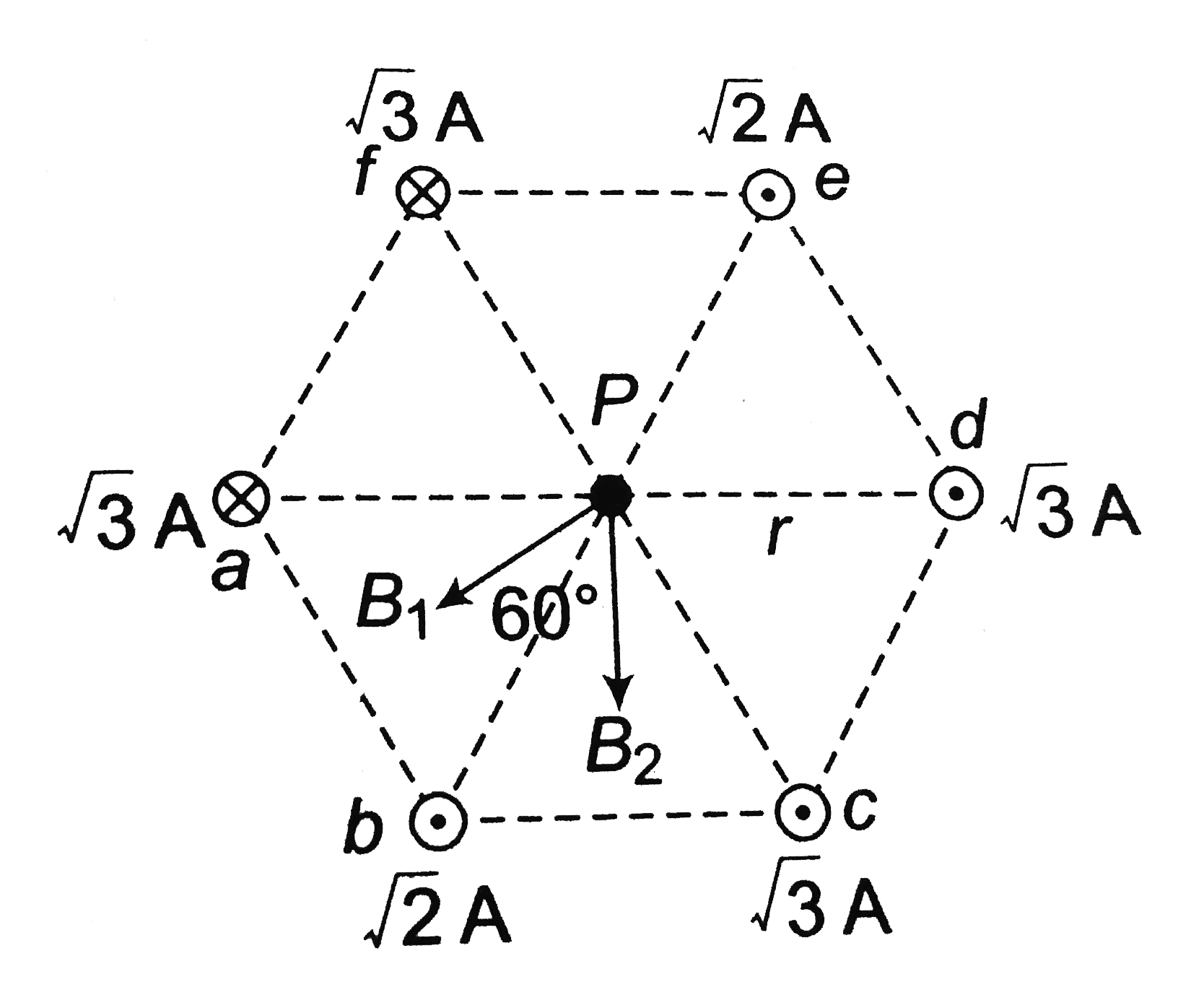 `B_(1)=2[(mu_(0)sqrt(3))/(2pir)]=(4xx10^(-7)sqrt(3))/(3xx10^(-2))=40/(sqrt(3)) muT` FIELDS at `P` due to `a` and `d`: `B_(2)=2[(mu_(0)sqrt(3))/(2pir)]=40/(sqrt(3)) muT` Net fields at `P`: `B=sqrt(B_(1)^(2)+B_(2)^(2)+2B_(1)B_(2)cos 60^(@))=40muT` |
|
| 6. |
Two parallel plane-polarized beams of light of equal intesity whose oscillation planes N_(1) and N_(2) from a small angle varphi between them (Fig.) fall on a Nicol prism. To equalize the intensities of the beams emerging behind the prism, its principle direction N must be aligned along the bisecting line A or B. find the value of the angle varphi at which the rotation of the Nicol prism through a small angle delta varphi lt lt varphi from the position A results in the fractional change of intensities of the beams DeltaI//I by the value eta = 100 times exceeding that resulting due to rotation through the same angle from the position B. |
|
Answer» Solution :If the principle direction `N` of the Nicol is along `A` or `B`, the intensity o flight transmitted is the same whether the LIGHT incident is one with oscillation plane `N_(1)` or one with `N_(2)`. If `N` MAKES an ANGLE `delta varphi` with `A` as shown then the fractional difference in intensity transmitted (when the light incident is `N_(1)` or `N_(2)`) is `((DeltaI)/(I))_(A) = (cos^(2)(90^(@) - (varphi)/(2)-delta varphi)-cos^(2)(90^(@) + (varphi)/(2)-delta varphi))/(cos^(2)(90^(@) -(varphi)/(2)))` `=(sin^(2)((varphi)/(2)+deltavarphi) - sin^(2)((varphi)/(2) - delta varphi))/(sin^(2)((varphi)/(2)))` `=(2sin((varphi)/(2)).2 cos((varphi)/(2))delta varphi)/(sin^(2)((varphi)/(2))) = 4cot((varphi)/(2))delta varphi` If `N` makes an angle `delta varphi(LT lt varphi)` with `B` then `((DeltaI)/(I))_(B) = (cos^(2)(varphi//2 - delta varphi) - cos^(2) (varphi//2 + delta varphi))/(cos^(@)varphi//2) = (2cos((varphi)/(2)).2sinvarphi//2 delta phi)/(cos^(@)varphi//2) = 4tanvarphi//2 delta varphi` Thus `eta = ((Delta I)/(I))_(A)//((DeltaI)/(I))_(B) = cot^(2)varphi//2` or `varphi = 2tan^(-1)(1)/(sqrt(eta))` This given `varphi = 11.4^(@)` for `eta = 100`. 
|
|
| 7. |
If the moment of a magnet is 0.4 A-m^(2) and force acting on each pole in a uniform magnetic field of induction 3.2 xx10^(-5) Wb//m^(2) is 5.12 xx 10^(-5) N, then find the distance between the poles of the magnet. |
|
Answer» Solution :Magnetic moment of the magnet , `M=0.4A-m^2` Magnetic field of induction , `B=3.2 xx 10^(-5)Wb // m^(2)` Force acting on the each pole of the bar magnet , `F= 5.12 xx 10^(-5)N` Pole STRENGTH of the magnet, `m=(F)/(B) = (5.12 xx 10^(-5))/(3.2 xx 10^(-5)) = 1.6 A-m` Distance BETWEENTHE poles of the magnet ( or ) length of the magnet , ` 2l = (M)/(m) = (0.4)/(1.6) = 0.25 m = 25 cm` |
|
| 8. |
An alternating source drives a series RLC circuit with an emf amplitude of 6.00 V, at a phase angle of +30.0^@. When the potential difference across the capacitor reaches its maximum positive value of +5.00 V, what is the potential difference across the inductor (sign included)? |
|
Answer» |
|
| 9. |
Which of the graphs shown below correctly represents the variation of magnetic field with distance r from a long current carrying conductor. |
|
Answer»
|
|
| 10. |
In an experiment on photoelectric effect the stopping potentail was measured to be V_(1) and V_(2) with incident light of wavelength lambda and (lambda)/(2) respectively.The relation between V_(1) and V_(2) is…. |
|
Answer» `V_(2)gt2V_(1)` `V_(2)=(2hc)/(elambda)-(phi)/(e )-(2hc)/(elambda)=V_(2)+(phi)/(e )`……(2) Equation (1) and (2) are same . `therefore V_(2)+(phi)/(e )=2V_(1)+(2phi)/(e )` `therefore V_(2)=2V_(1)+(phi)/(e)` `therefore V_(2)gt2V_(1)` |
|
| 11. |
On to a sphere of radius R//2 and density P_(2) with centre at C_(2) a second solid sphere is moulded with density p_(1) radius R and centre C_(1). Find the force experienced by a point mass m at point P at a distance y from the combination as shown. |
|
Answer» Solution :If we consider that a sphere of RADIUS `R` is PLACED with centre at `C_(1)` od density `rho_(1)` the force on the mass at `P` is `F_(1)=G((4//3)piR^(3)rho_(1)m)/((R+y)^(2))` towards the sphere. If we consider that a sphere of radius `R//2` is placed with centre at `C_(2)` of density `rho_(1)` the force on the mass at `P` is `F_(2)=G((4//3)pi(R//2)^(3)rho_(1)m)/((R//2+R+y)^(2))` towards the sphere. If we consider that a sphere of radius `R//2` is placed with centre at `C_(2)` of density `rho_(2)` the force on the mass in at `P` `F_(3)=(G(4//3)pi(R//2)^(3)rho_(2)m)/((R//2+R+y)^(2))` By the PRINCIPLE of superposition `F=F_(1)-F_(2)+F_(3)=(4)/(3)piR^(3)Gm[(rho_(1))/((R+y)^(2))+((rho_(2)-rho_(1))//8)/(((3R//2)+y)^(2))]` |
|
| 12. |
Two small equally charged identical conducting balls are suspended from long threads secured at one point. The charges and masses of the balls are such that they are in equilibrium when the distance between them is 10 cm (the length of the threads gt gt10" cm".) One of the balls is then discharged. How will the balls behave after this ? What will be the distance between the balls when equilibrium is restored ? |
| Answer» SOLUTION :`[10(1//4)^(1//3)"CM"]` | |
| 13. |
Two sound waves of frequencies 100Hz and 102Hz and having same amplitude 'A' are interfering. At a stationary detector, which can detect resultant amplitude greater than or equal to A. So, ina given time interval of 12 seconds, finds the total duration in which detector is active. |
|
Answer» `y_(2)=A sin omega_(2) t` `y_(1)=2A cos {((omega_(2)-omega_(1)))/2}{"sin"((omega_(2)+omega_(1)))/2 t}` Resultant amplitude `A_(r)=2A_(0)Icos(/_\omega)t//2I` `(/_\omega)t/2=(pi)/2impliest=1/4s` `(/_\omega)t/2=(pi)/3impliest=1/6s` In one cycle of INTENSITY of `1//2s` the detector remain idle for `2(1/4-1/2)s=1/6sec` `:.` In `1//2` sec cyclem active time is `(1/2-1/6)` `=1//3` sec `:.` In `12` sec INTERVAL, active time is `12xx((1//3))/((1//2))=8SEC` 
|
|
| 14. |
Who killed Mahesh? |
|
Answer» Tarakratna |
|
| 15. |
A point source of light, S is placed at a distance L in front of the centre of plane mirror of width dwhich is hanging vertically on a wall. A man walks in front of the mirror along a line parallel to themirror, at a distance 2L as shown below. The distance over which the man can see the image of the light source in the mirror is nd then value of n is : |
|
Answer» |
|
| 16. |
The resistance of a germanium junction diode whose V-I is shown in figure is (V_(k)=0.3 V) |
| Answer» Answer :B | |
| 17. |
A 60 kg man stands on an elevator floor The elevator is going up with constant acceleration of 1.96 m/s^2. Percentage change in the apparent weight of the person is |
|
Answer» 10 |
|
| 18. |
Briefly explain the elementary particles of nature. |
|
Answer» Solution :Elementary particles : An atom has a nucleus SURROUNDED by electrons and nuclei is made up ofprotons and neutrons. Till 1960s, it was thought thta protons, neutrons and electrons are fundamental BUILDING block of matter. In 1964, physicist Murray Gellman and George Zweig theoretically proposed that protons and neutrons are not fundamental particles: in fact they are made up of quarks.Thses quarks are now considered elementary particles of nature. Electrons are fundamental or elementary particles they are not made up of anything.  In the year 1968, the quarks were discovered experiemntally by Stanford Linear Accelerator Centre(SLAC) , USA. There are six quarks namely up, down, charm, strange, top and bottom and their antiparticles.All these uarks have fractional charges .For example, charge of up quark is `+2/3 e` and that of down quark is `-1/3 e`. According to quark model, proton is made up of TWO up quarks and one down quark and neutron is made up of one up quark and two down quarks. The study of elementary particles is called particle physics. |
|
| 19. |
A toroid of 5000 turns carries a current of 15A. Find the magnetic flux density inside the toroid at a point 25 cm from the centre of the toroidal circle. |
|
Answer» SOLUTION :Magnetic field B INSIDE a toroid: `B=mu_@/(2pi)xx(Ni)/r` `(2XX10^(-7)xx5000xx15)/(25xx10^(-2))=0.06T`. |
|
| 20. |
A wire has a length of 114 cm between two fixed ends. Where should two bridges be placed to divide the wire into three segments whose fundamental frequencies are in the ratio 1: 3:4 ? |
|
Answer» Solution :In case of a given wire under specific TENSION, fundamental frequency of vibration `f prop (1//L)`. So for having fundamental frequencies in the ratio of ` 1: 3 : 4`, the vibrating length should be in the ratio `1 : (1/3) : (1/4)`, i.e., `L_1 : L_2 : L_3 : : 12 : 4 : 3` COMMON factor is x, `12 x + 4x + 3X = 114 =` length of the string `19x = 114` or x = 6` `RARR L_1 = 12 xx 6 = 72 cm,L_2 cm,L_2 = 4 xx 6 = 24 cm, L_3 = 3 xx 6 = 18 cm` |
|
| 21. |
A body acted upon by a variable force F = 3 +0.5.x. Work done in moving the body from x=0 to x = 4m is: |
|
Answer» 8 J `=3int_(0)^(4)dx+0.5int_(0)^(4)XDX` `=3[x]_(0)^(4)+0.5[(X^(2))/(2)]_(0)^(4)=3(4-0)+0.5[(16)/(2)-0]` =16 J |
|
| 22. |
A body P is thrown vertically up with velocity 30 ms^(-1) and another body Q is thrown up along the same vertically line with the same velocity but 1 second later from the ground. When they meet (g = 10 ms-2) |
|
Answer» <P>P travels for 2.5 s |
|
| 23. |
If h is Planck's constant and lambda is the wavelength(h)/(lambda) has the dimensions of |
| Answer» Answer :B | |
| 24. |
The peak value of 220 volts of a.c. mains is ...... volt. |
|
Answer» 115.6 `=sqrt2xx220` `=1.414xx220` = 311.08 `THEREFORE V_m APPROX` 311 V |
|
| 25. |
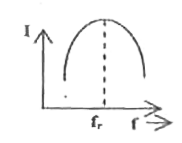
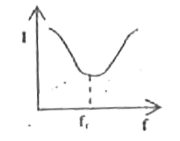
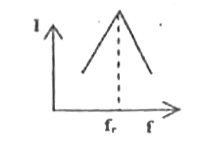
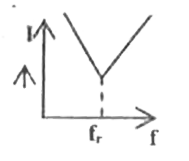
Consider the parallel resonant circuit shown in adjacent figure. One branch contains an inductor of inductance L and a small ohmic resistance R, whereas the other branch contains a capacitor of capacitance C. The circuit is fed by a source of alternating emfE= E_(o) e^(jomegat)=E_(o)sin omegatThe impedance of inductor branch, Z (1)= R + jomegaL The impendence of capacitor branch, Z(2) = (1//jomegaC) therefour Net impedance Z of the two parallel branches is given by(1)/(Z)=(1)/(Z_(1))+ (1)/)Z_(2)=(1)/(R+jomegaC=(R-jomegaL)/(jomegaL)(R-jomegaL)+jomegaC=(R)/(R^(2)+omega^(2)+L^(2))+jomega[C-(L)/(R^(2)+omegaL^(2))]The current flowing in the circuitI=(E)/(Z)=(E)[(R)/(R^(2)+omega^(2)L^(2))+jomega(C-(L)/(R^(2)+omega^(2)L^(2)))]For resonance to occur, the current must be in phase with the applied emf. For this, the reactive component of current should be zero, l.e.omega[C-(L)/(R^(2)+omega^(2)L^(2))]=0orC=(L)/(R^(2)+omega_(r)^(2)L^(2))(writing omega_(r)for omegaat resonance) This gives resonant angular frequencyomega_(r)=sqrt((1)/(LC)-R^(2)/(L^(2))) At parallel circuit resonance, theimpendence is maximum and current is minimum. Parallel resonant circuit is sometimes called the anti-resonance in order to distinguish from series resonanceQFind the impedance of AC circuit at resonance shown in the adjacent figure Which of the following graph shows correct relation beteen current I andfrequency f in a parallel AC circuit |
|
Answer»
|
|
| 26. |
Generally what is the material of needle electrodes? |
|
Answer» STAINLESS steel |
|
| 27. |
Two identicla short bar magnets each havingmagnetic momentof 10 am^(2) arearranged such that their axiallinesare perpendicularto ech otherand theircentres0.2 m the resultant magnetic inducito at a pointmidway betweeen themis |
|
Answer» `sqrt(2)xx10^(-7)` tesla  `B_(net)=sqrt(B_(a)^(2)+B_(e )^(2))` `=sqrt(5).(mu_(0))/(4pi).(M)/(d^(3))=sqrt(5)xx10^(-7)xx(10)/(0.1)^(3)=sqrt(5)xx10^(-3)` tesla |
|
| 28. |
Consider the parallel resonant circuit shown in adjacent figure. One branch contains an inductor of inductance L and a small ohmic resistance R, whereas the other branch contains a capacitor of capacitance C. The circuit is fed by a source of alternating emfE= E_(o) e^(jomegat)=E_(o)sin omegatThe impedance of inductor branch, Z (1)= R + jomegaL The impendence of capacitor branch, Z(2) = (1//jomegaC) therefour Net impedance Z of the two parallel branches is given by(1)/(Z)=(1)/(Z_(1))+ (1)/)Z_(2)=(1)/(R+jomegaC=(R-jomegaL)/(jomegaL)(R-jomegaL)+jomegaC=(R)/(R^(2)+omega^(2)+L^(2))+jomega[C-(L)/(R^(2)+omegaL^(2))]The current flowing in the circuitI=(E)/(Z)=(E)[(R)/(R^(2)+omega^(2)L^(2))+jomega(C-(L)/(R^(2)+omega^(2)L^(2)))]For resonance to occur, the current must be in phase with the applied emf. For this, the reactive component of current should be zero, l.e.omega[C-(L)/(R^(2)+omega^(2)L^(2))]=0orC=(L)/(R^(2)+omega_(r)^(2)L^(2))(writing omega_(r)for omegaat resonance) This gives resonant angular frequencyomega_(r)=sqrt((1)/(LC)-R^(2)/(L^(2))) At parallel circuit resonance, theimpendence is maximum and current is minimum. Parallel resonant circuit is sometimes called the anti-resonance in order to distinguish from series resonanceQFind the impedance of AC circuit at resonance shown in the adjacent figure A coil of inductance 100 muH and 60 Omega effective resistance is connected in parallel with a condenser of 100 pF. The resonant circuit so formed is excited from an alternating current source. The frequency of the source is varied until the maximum impendence of the circuit is obtained. The frequency of the generator at which this occurs is approximately |
|
Answer» `(10^(2)/(2pi) Hz` |
|
| 29. |
Consider the parallel resonant circuit shown in adjacent figure. One branch contains an inductor of inductance L and a small ohmic resistance R, whereas the other branch contains a capacitor of capacitance C. The circuit is fed by a source of alternating emfE= E_(o) e^(jomegat)=E_(o)sin omegatThe impedance of inductor branch, Z (1)= R + jomegaL The impendence of capacitor branch, Z(2) = (1//jomegaC) therefour Net impedance Z of the two parallel branches is given by(1)/(Z)=(1)/(Z_(1))+ (1)/)Z_(2)=(1)/(R+jomegaC=(R-jomegaL)/(jomegaL)(R-jomegaL)+jomegaC=(R)/(R^(2)+omega^(2)+L^(2))+jomega[C-(L)/(R^(2)+omegaL^(2))]The current flowing in the circuitI=(E)/(Z)=(E)[(R)/(R^(2)+omega^(2)L^(2))+jomega(C-(L)/(R^(2)+omega^(2)L^(2)))]For resonance to occur, the current must be in phase with the applied emf. For this, the reactive component of current should be zero, l.e.omega[C-(L)/(R^(2)+omega^(2)L^(2))]=0orC=(L)/(R^(2)+omega_(r)^(2)L^(2))(writing omega_(r)for omegaat resonance) This gives resonant angular frequencyomega_(r)=sqrt((1)/(LC)-R^(2)/(L^(2))) At parallel circuit resonance, theimpendence is maximum and current is minimum. Parallel resonant circuit is sometimes called the anti-resonance in order to distinguish from series resonanceQFind the impedance of AC circuit at resonance shown in the adjacent figure For an ac circuit, impendence is given by Z = 50 + jK(P^(2) - 4Q^(2), where K is a positive non-. zero constant. For resonance, which of the following expression is true |
| Answer» Answer :A | |
| 30. |
The peak voltage in the output of a half-wave diode rectifier fed with a sinusoidal signal without filter is 10V. What is the d.c.component of the output voltage ? |
|
Answer» `10/sqrt2V` |
|
| 31. |
A transformer has 1500 turns in the primary coil and 1125 turns in the secondary coil. If the voltage in the primary coil is 200 V, then the voltage in the secondary coil is |
| Answer» Answer :B | |
| 32. |
In a p-n junction diode, the current I can be expressed as I= I_(0) "exp" ((eV)/(2k_(B)T)-1) where I_(0)is called the reverse saturation current, V is the voltage across the diode and is positive for forward bias and negative for reverse bias, and I is the current through the diode, k_(B)is the Boltzmann constant (8.6 xx 10^(–5) eV//K) and T is the absolute temperature. If for a given diode I_(0) = 5 xx 10^(-12) A and T = 300 K, then (a) What will be the forward current at a forward voltage of 0.6 V? (b) What will be the increase in the current if the voltage across the diode is increased to 0.7 V? (c) What is the dynamic resistance? (d) What will be the current if reverse bias voltage changes from 1 V to 2 V? |
|
Answer» Solution :(a) 0.0629 A, (b) 2.97 A, ( c) 0.336 `OMEGA` (d) For both the voltages, the CURRENT I will be almost equal to `I_(0)`, showing almost infinite DYNAMIC RESISTANCE in the REVERSE bias. |
|
| 33. |
Consider the parallel resonant circuit shown in adjacent figure. One branch contains an inductor of inductance L and a small ohmic resistance R, whereas the other branch contains a capacitor of capacitance C. The circuit is fed by a source of alternating emfE= E_(o) e^(jomegat)=E_(o)sin omegatThe impedance of inductor branch, Z (1)= R + jomegaL The impendence of capacitor branch, Z(2) = (1//jomegaC) therefour Net impedance Z of the two parallel branches is given by(1)/(Z)=(1)/(Z_(1))+ (1)/)Z_(2)=(1)/(R+jomegaC=(R-jomegaL)/(jomegaL)(R-jomegaL)+jomegaC=(R)/(R^(2)+omega^(2)+L^(2))+jomega[C-(L)/(R^(2)+omegaL^(2))]The current flowing in the circuitI=(E)/(Z)=(E)[(R)/(R^(2)+omega^(2)L^(2))+jomega(C-(L)/(R^(2)+omega^(2)L^(2)))]For resonance to occur, the current must be in phase with the applied emf. For this, the reactive component of current should be zero, l.e.omega[C-(L)/(R^(2)+omega^(2)L^(2))]=0orC=(L)/(R^(2)+omega_(r)^(2)L^(2))(writing omega_(r)for omegaat resonance) This gives resonant angular frequencyomega_(r)=sqrt((1)/(LC)-R^(2)/(L^(2))) At parallel circuit resonance, theimpendence is maximum and current is minimum. Parallel resonant circuit is sometimes called the anti-resonance in order to distinguish from series resonanceQFind the impedance of AC circuit at resonance shown in the adjacent figure Find the impedance of AC circuit at resonance shown in the adjacent figure |
|
Answer» `100sqrt2Omega` |
|
| 34. |
An air bubble is seen inside a solid sphere of glass (n = 1.5) of 4.0 cm diameter at a distance of 1.0 cm from the surface of the sphere (on seeing along the diameter). Determine the real position of the bubble inside the sphere from that surface. |
| Answer» SOLUTION :`1.2 CM` | |
| 35. |
The distance between a node the next antinode is |
|
Answer» 0.01 m |
|
| 36. |
When the photons of energy hV fall on a Photosensitive metallic surface of work function hV_0, electrons are emitted from the surface. The most energetic electrons coming out of the surface have KE equal to |
|
Answer» HV |
|
| 37. |
Consider the parallel resonant circuit shown in adjacent figure. One branch contains an inductor of inductance L and a small ohmic resistance R, whereas the other branch contains a capacitor of capacitance C. The circuit is fed by a source of alternating emfE= E_(o) e^(jomegat)=E_(o)sin omegatThe impedance of inductor branch, Z (1)= R + jomegaL The impendence of capacitor branch, Z(2) = (1//jomegaC) therefour Net impedance Z of the two parallel branches is given by(1)/(Z)=(1)/(Z_(1))+ (1)/)Z_(2)=(1)/(R+jomegaC=(R-jomegaL)/(jomegaL)(R-jomegaL)+jomegaC=(R)/(R^(2)+omega^(2)+L^(2))+jomega[C-(L)/(R^(2)+omegaL^(2))]The current flowing in the circuitI=(E)/(Z)=(E)[(R)/(R^(2)+omega^(2)L^(2))+jomega(C-(L)/(R^(2)+omega^(2)L^(2)))]For resonance to occur, the current must be in phase with the applied emf. For this, the reactive component of current should be zero, l.e.omega[C-(L)/(R^(2)+omega^(2)L^(2))]=0orC=(L)/(R^(2)+omega_(r)^(2)L^(2))(writing omega_(r)for omegaat resonance) This gives resonant angular frequencyomega_(r)=sqrt((1)/(LC)-R^(2)/(L^(2))) At parallel circuit resonance, theimpendence is maximum and current is minimum. Parallel resonant circuit is sometimes called the anti-resonance in order to distinguish from series resonanceQFind the impedance of AC circuit at resonance shown in the adjacent figure The reactance of the circuit in the adjacent figure is 20 Omega. Find the value of I_(rms) |
| Answer» Answer :A | |
| 38. |
Which one of the following platinum complex is used in cancer chemotherapy ? |
|
Answer» `CIS-[PtCl_(2)(NH_(3))_(2)]` |
|
| 39. |
Which configuration is widely used in circuits ? |
|
Answer» Solution :POTENTIAL energy of the configuration arises due to the potential energy of one DIPOLE (say, Q) in the magnetic field due to other (P) `Bp=(mu_0)/(4PI)(m_p)/(r^3)` (on the normal BISECTOR ) `B_p=(mu_02)/(4pi)(m_p)/r^3` (on the axis where mp is the magnetic moment of the dipole P. Equilibrium is stable when `m_Q` is parallel to `B_p` and when it is anti - parallel to `B_p` . For instance for configuration `Q_3` for which Q is along the perpendicular bisector of the dipole P, the magnetic moment of Q is parallel to the magnetic field at the position 3. Hence `Q_3` is stable THUS, a. `PQ_1 and PQ_2""`b. (i) `PQ_3,PQ_6` (stable), (ii) `PQ_5,PQ_4` (unstable) c. `PQ_6` |
|
| 40. |
There is a vacuum photocell whose one electrode is made of cesium and the other of copper. Find the maximum velocity of photoelectrons approaching the copper electrode when the cesium electrode is subjected to electromagnetic radiation of wavelength 0.22 mu m and the electrodes are shorted outside the cell. |
|
Answer» Solution :A simple APPLICATION of Einstein's EQUATION `(1)/(2)mv_(max)^(2) = hv-hv_(0) = (2pi cancelh c)/(lambda) -A_(cs)` givens incorrect result in this case because the photoelectrons emitted by the Cesium electroded are retarded by the small electric field that ecists between the cesium electrode and the copper electrode even in the absence of external emf. This small electric field is CAUSED by the contact potential difference whose magnitude equals the difference of work functions `(1)/(e) (A_(cu)-A_(cs))`volts. Its physical origin is explained below: The maximum velocity of the photoelectrons reaching the copper electrode is then `(1)/(2)mv_(m)^(2) = (1)/(2)mv_(0)^(2) - (A_(cu)-A_(cs)) = (2picancelh c)/(lambda) - A_(cu)` Here `v_(0)` is the maximum velocity of the photoelectrons immediately after emission. Putting the VALUES we get, on using `A_(cu) = 4.47eV, lambda = 0.22mu m`, `v_(m) = 6.41 XX 10^(5) m//s` The origin of contact potential difference is the following. Inside the metals free electrons can be through of as a Fermi gas which occupy enegry levels upto a maximum called the Fermi enegry `E_(P)`. The work function `a` measures the depth of the Fermi level.  When two metals `1*2` are in contact, electrons flow one to the other till theri Fermi levels are the same. This require the appearanceof contact potential difference of `A_(1)-A_(2)` between the two metals externally. |
|
| 41. |
A and B are two identical point sized metal spheres each holding the same charge q. These two are separated by certain distance and the mutual electrostatic force between them is F. if a third identical uncharged sphere 'C' is touched with A and kept exactly at the midpoint of line joining A and B, what is the resulting force on C and its direction ? |
Answer» SOLUTION :Force between two charges  `F = K (q^2)/(r^2)`[where `K = 1/(4 pi epsilon_0)`] when third identical uncharged sphere touched with A and placed at the mid POINT of AB, then  `F_("net") = F_1 - F_2` `= K CDOT ((q^2//4))/(r^2//4) - K((q^2//2))/(r^2//4) = (Kq^2)/(r^2) - 2cdot (Kq^2)/(r^2) = F - 2F` `F_("net") = -F` i.e., RESULTANT force is F towards A. |
|
| 42. |
The smallest resistance obtained by connecting 50 resistance of 1/4 ohm each is |
|
Answer» `(50/4) OMEGA` |
|
| 43. |
A transistor is being used as a common emitter amplifier What is the value of phase difference if any, between the collector-emitter voltage and the input signal ? |
| Answer» Solution :The phase DIFFERENCE between `V_cE` and the INPUT signal voltage is `180^@`[But the phase difference between the input signal CURRENT and the collector cuirent is zero.] | |
| 44. |
The expression for the A.C. supply voltage of 234V and frequency of 50Hz in our house is .... |
|
Answer» V=165 sin `(100 pit)` `therefore V_m =sqrt2V_"rms"` =1.414 x 234 =331 V `therefore omega=2pif` `=2pixx50` `=100pi` rad/s . `therefore` The equation for VOLTAGE supply `V=V_m sin (omegat)` `therefore V=331 sin (100pit)` |
|
| 45. |
What is meant by line of sight distance in communication system ? |
| Answer» SOLUTION :Distance between transmitting ANTENNA and receiving antenna at which they can be seen by each other DIRECTLY is known as line of sight distance. | |
| 46. |
Prove Snell's law of refraction by using Huygens's concept of plane wavefronts. |
Answer» SOLUTION : Distance `AE=v_2 tau,tau-` time taken for optical path Distance `BC=v_1 tau,i_1-` angle of incidence in medium (1) From the right angled `Delta ABC, sin i=(BC)/(AC)` And from the right angled `Delta AEC,sin r=(AE)/(AC)` Hence, `(sini)/(sinr)=(BC)/(AE)=(v_1 tau)/(v_2 tau)` or `(sin i)/(sin r)=(v_1)/(v_2)""...(1)` By definition, absolute R.I of a medium w.r. to air/vacuum `=n= (c )/(v)` for medium (1) `=n_1-(c )/(v_1)` for medium `(2)=n_1=(c )/(v_2)` so that, `(v_1)/(v_2)=(n_2)/(n_1)""...(2)` USING (2) in (1) we GET `(sin i)/(sin r)=(n_2)/(n_1)` where,`n_2 gt n_1`. or `n_1 sin i=n_2 sin r.................(3)` i.e. R.I. of medium (1) times since of angle in the medium (1) = R.I of medium (2) times SINE of angle in the medium 2. This expression (3) is known as the Snell's law. The ratio `(n_1)/(n_1)` can be WRITTEN as `n_2` (R.I. of medium (2) w.r.t medium (1)). Note : From (1) , `n_2=(sin i_1)/(sin i_2)=(v_1)/(v_2)=(lambda_1)/(lambda_2)` i.e. `v_1 sin i_2=v_2 sin i_1,lambda_2 sin i_2 =lambda_1 sin i_2 and sin i_1=n_2 sin i_2` |
|
| 47. |
A square with side b and rectangle with side b and 2b are cut out from two plates of equal thickness with densities of 3.5 g//cm^(3) and 2 g//cm^(3) , the square being cut out of the heavier material . The square and the rectangle are fastened together in the form of the letter L and placed upside down on the bottom of an empty vessel . Will the object be stable if the vessel is filled with water ? |
Answer» Solution :` <br> Initially , `W_(1) = 2 b^(2) (2) = 4b^(2)` <br> `W_(2) = 3.5 b^(2)` <br> First we need to find exact location of normal . Normal must develop from ground exactly at the point where center of gravity exactly at the point where center of gravity of whole system (rectangle and square) is located . In this case it is somewhere on left side of line AB as shown in Fig . <br> Now we can say that whole systemis in rotational equilibrium . <br> <img src=) When we start liquid gradually normal force DECREASES (Fig) according to the followingequation `F_(b) + F_(N) = F_(C) = (W_(1) + W_(2))` where `F_(b)` is buoyant force on rectangular body . 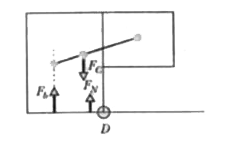
|
|
| 48. |
A conducting sphere of radius R is given a charge Q. The electric potential and the electric field at the centre of the sphere respectively are |
|
Answer» ZERO and `Q/(4piepsilon_(0)R^(2))` Electric field E =0 |
|
| 49. |
Figure 6-47 shows three crates being pushed over a concrete floor by a horizontal force F of magnitude 425 N. The masses of the crates are m_(1) = 30.0 kg, m_(2)=10.0 kg, and m_(3) = 20.0 kgThe coefficient of kinetic friction between the floor and each of the crates is 0.700. (a) What is the magnitude F_(32) of the force on crate 3 from crate 2? (b) If the crates then slide onto a polished floor, where the coefficient of kinetic friction is less than 0.700, is magnitude F_(32) more than, less than, or the same as it was when the coefficient was 0.700? |
| Answer» SOLUTION :`(a)F_(32)=m_(3)(a+mu_(K)g)=142N,` (B) The answer here is the same as in part (b) | |