

Saved Bookmarks
This section includes 7 InterviewSolutions, each offering curated multiple-choice questions to sharpen your Current Affairs knowledge and support exam preparation. Choose a topic below to get started.
| 1. |
Consider the plane S formed by the dipole axis and the axis of earth. Let P be point on the magnetic equator and in S. Let Q be the point of intersection of the geographical and magnetic equators. Obtain the declination and dip angles at P and Q. |
Answer» Solution :Let point P is in the plane S, needle is in north, so the declination is ZERO.  Since point P LIES in plane S formed by the dipole axis and the axis of the EARTH, declination is zero. Since point Q lies on the magnetic equator ANGLE of dip is zero. It is 11.3° tilted with its axis of the earth so declination between P and Q is 11.3°. |
|
| 2. |
A 2.5 kg mass moving at a speed of 15 ms^(-1) collides with 5 kg object at rest. They stick together, find the velocity of combined object: |
| Answer» Answer :b | |
| 3. |
In a wire of circular form has 4A current is following to have a magnetic induction as 1μT , at its centre. The radius of circle should be approximately |
|
Answer» 2.5 m |
|
| 4. |
A true test of magnetism is ....... |
|
Answer» only ATTRACTION |
|
| 5. |
Given vecA=(2hati-hatj+3hatk) and vecB=3hati-3hatj-2hatk find the unit vector of(vecA+vecB). |
|
Answer» SOLUTION :`(vecA+vecB)=(2hati-hatj+3hatk)+(3hati-2hatj-2hatk)=5hati-3hatj+hatk=vecC(SAY) therefore C=[5^2+(-3)+1]^(1/2)=sqrt35` unit VECTOR `hatC=vecC//C=5hati-3hatj+hatk//sqrt35` |
|
| 6. |
The r.m.s. speed of the molecules of a gas at 100^(@)C is v. The temperature at which the r.m.s. speed will be sqrt(3)v is |
|
Answer» `546^(@)C` `v_(rms)=sqrt((3RT)/(M))orv_(rms)propsqrt(T)therefore (v_(rms_(1)))/(v_(rms_(2)))=sqrt((T_(1))/(T_(2)))` Here, `v_(rms_(1))=v,v_(rms_(2))=sqrt(3)v` and `T_(1)=100^(@)C=100+273=373K` `therefore ((v)/(sqrt(3)v))^(2)=((373)/(T_(2)))or(1)/(3)=(373)/(T_(2))` `implies T_(2)=3xx373=1119K` `T_(2)=1119-273=846^(@)C`. |
|
| 7. |
Current I_(0) flows through solenoid of length L having N number of turns, when it is connetex to DC emf. Ifcharged particle is projected along the axis of solenoid with a speed v_(0), then the force on the charged particle in the solenoid: |
|
Answer» BECOMES zero |
|
| 8. |
What are sky waves ? |
| Answer» SOLUTION :The radio waves emitted from the transmitter antenna reach the receiving antenna after refraction by the IONOSPHERE of earth ATMOSPHERE. This MODE of propagation is KNOWN as sky wave propagation.\ | |
| 9. |
The angle of contact between ordinary water and ordinary glass is |
| Answer» ANSWER :A | |
| 10. |
In the above problem, end correction is |
|
Answer» 1CM |
|
| 11. |
A p-n photodiode is made of a material with a band gap of 2.0 eV. The minimum frequency of the radiation that can be absorbed by the materialis nearly …… |
|
Answer» `10xx10^(14)HZ` `E_(G)=2.0eV=2xx1.6xx10^(-19)J` `=hf` `f=(Eg)/(h)=(2xx1.6xx10^(-19))/(6.62xx10^(-34))` `=0.4833xx10^(15)S^(-1)` `=4.833xx10^(14)Hz=5xx10^(14)Hz` |
|
| 12. |
In the following figure, how many coulombs of charge pass through the meter X when the switch S is closed. |
|
Answer» Solution :Data supplied, `C_(1)=C_(2)=C_(3)=20muF =20 XX 10^(-6)F, V=460V` `C=C_(1)+C_(2)+C_(3)=60 xx 10^(-6)F` Charge `Q=CV=60 xx 10^(-6) xx 460=27.6mC` |
|
| 13. |
Calculate the value of Bohr's radius. Given that mass of electron = 9.11 xx 10^(-31) kg, Planck's constant h=6.63 xx 10^(-34) J s and electronic charge is 1.60 xx 10^(-19) C. |
|
Answer» Solution :GIVEN that for electrones `e= 1.60 xx 10^(-19) C, m_(c) =9.11 xx 10^(-31)`KG and `h=6.63 xx 10^(-34)` J s. In ground state in an hydrogen atom the electron is in state n =1. Hence, RADIUS of electron orbit (ie. Bohr.s radius) is `a_(0) =( in_(0) h^(2))/( pi m e^(2)) .(1)^(2) = (8.85xx 10^(-12) xx (6.63 xx 10^(-34))^(2))/(3.14 xx 9.11 xx 10^(-31) xx (1.60 xx 10^(-19))^(2)) = 5.3 xx10^(-11) m` |
|
| 14. |
In a moving coil galvanometer the deflection theta is related to current I as |
|
Answer» `I ALPHA tan theta` |
|
| 15. |
The susceptibility of a magnetic material is -1.6xx 10^(-5). Identify the type of the magnetic material and write its two properties. |
| Answer» SOLUTION :The GIVEN MAGNETIC MATERIAL is a DIAMAGNETIC material. | |
| 16. |
A sample of an element is 10.38g. If half- life of element is 3.8 days, then after 19 days, how much quantity of element remains ? |
|
Answer» 0.151 g |
|
| 17. |
Assertion:Nuclear force between neutron-neutron, proton-neutron and proton-proton is approximately the same Reason : The nuclear force does not depend on the electric charge |
|
Answer» If both assertion and reason are TRUE and reason is the correct explanation of assertion . |
|
| 18. |
STATEMENT-1: A series combination of cells is used when their internal resistance is much smaller than the external resistance. Because STATEMENT-2: It follows from the relation = nE/(R + nR), where the symbols have their standard meaning. |
|
Answer» Statement-1 is TRUE , Statement-2 is True , Statement-2 is a CORRECT EXPLANATION for Statement-1. |
|
| 19. |
70 calories of heat are required to raise the temperature of 2 moles of an ideal gas at constant pressure from 30^(@) to 35^(@). The amount of heat required in calories to raise the temperature of the same gas through the same range (30^(@)C" to "35^(@)C) at constant volume is : |
|
Answer» 30 |
|
| 20. |
In question number 45, what will be the electric field at O if the charge q at A is replaced by -q? |
|
Answer» `(Q)/(4piepsilon_(0)r^(2))` ALONG OB |
|
| 21. |
A solid sphere of mass M and radius R having moment of inertia I about its diameter is recast into a solid disc of radius r and thickness t. The moment of inertia of the disc about an axis about the edge and perpendicular to the plane is I. Then the radius r of the disc is given by : |
|
Answer» `r=SQRT((2)/(15))R` Moment of inertia of disc about an AXIS PASSING through its EDGE and perpendicular to its plane. `I=I_(CM)+Mr^(2)=(Mr^(2))/(2)+Mr^(2)=(3)/(2)Mr^(2)` `implies (2)/(5)MR^(2)=(3)/(2)Mr^(2)orr=(2)/(sqrt(15))R`. |
|
| 22. |
Complex compound [Cr(NCS)(NH_(3))_(5)][ZnCl_(4)]will be - |
|
Answer» diamaganetic and shows LINKAGE isomerism `Cr^(+3) =[Ar] 4s^(0)3D^(3)` It has 3 unpaired `e^(-)` Green coloured and shows co-ordination isomerism |
|
| 23. |
A stationary hydrogen atom in the first excited state emits a photon. If the mass of the hydrogen atom is m and its ionization energy is E, then the recoil velocity acquired by the atom is [speed of light = c] |
|
Answer» `[SQRT((3E)/(2m)+c^(2))]-c` |
|
| 24. |
What was it that the nation needed to be liberated from? |
|
Answer» poverty |
|
| 25. |
In the configuration as shown +q charge is placed at origin and Q and Q are placed at distance a and a_(0) respectively from origin. If net electrostatic force on charge (+q) is along negative y-axis and theta=theta_(2)//2, then (Q//Q) is equal to: |
|
Answer» `(a_(0)^(2))/(a^(2))` |
|
| 26. |
A dielectric slab of length l, width b, thickness d and dielectric constant K fills the space inside a parallel plate capacitor. At t = 0, the slab begins to be pulled out slowly with speed y. At time t, the capacity of the capacitor is |
|
Answer» `(epsilon_0b)/d[KL-(K-1)VT]` |
|
| 27. |
In example (7), find the tension T at time I developed in the loop as a result of induced current. |
| Answer» SOLUTION :`T= (B_(0)^(2)PI r^(3))/(R) t` | |
| 28. |
What is resistivity ? Write its unit. On what factors do resistivity depend? (AU India - 2011) |
|
Answer» SOLUTION :`rArr` At given temperatur resistance of material, `R = rho (l)/(A)` `therefore rho = (RA)/(l) ` `rho` = resistivity of conductor `rArr` Definition : Resistance of conductor having unit length and unit cross-section area is called resistivity or specific resistance. `rArr` Value ofresistivity depend on type of material of conductor, TEMPERATURE and PRESSURE. `rArr` It does not depend on dimension of conductor.11 `rArr` Unit = `Omega` m(Ohm. m) and dimensional formula `= M^(1) L^(3) T^(-3) A^(-2)`. |
|
| 29. |
Lights of two different frequencies, whose photons have energies 1 eV and 2.5 eV respectively, successively illuminate a metal whose work function is 0.5 eV. The ratio of the maximum speeds of the emitted electrons will be |
|
Answer» `1:5` Thus, `E_(1)=(1-0.5)=0.5eV and` `E_(2)=(2.5-0.5)` `=2EV` `:.(E_(1))/(E_(2))=(v_(1)^(2))/(v_(2)^(2))=(0.5)/(2)=(1)/(4) or (v_(1))/(v_(2))=(1)/(2)` |
|
| 30. |
How are each of the following quantities of a SHM affected by doubling the amplitude ? Maximum velocity |
| Answer» SOLUTION :`V_("MAX") = A OMEGA rArr` Maximum VELOCITY also doubles on doubling the amplitude | |
| 31. |
A spherical conducting shell of inner radius r_(1) and outer radius r_(2) has a charge Q. a. A charge 'q' is placed at the centre of the shell. What is the surface charge density on the inner and outer of the shell? b. Is the electric field inside a cavity (with not charge) zero, even if the shell is not spherical, but has any irregular shape? Explain. |
Answer» Solution :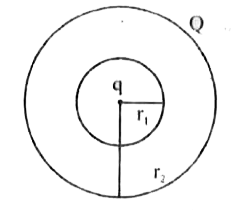 a. `(-Q)/(4PI r_(1)^(2)), (Q+q)/(4pi r_(2)^(2))` b. Yes. By GAUSS law |
|
| 32. |
A rectangular block is heated from 0^@ to 100^@C . The percentage increase in its length is 0.10%. Then percentage increase in its volume ? |
| Answer» Answer :C | |
| 34. |
The maximum range of ground or surface wave propagation depends on |
|
Answer» the FREQUENCY of the RADIOWAVES only |
|
| 35. |
In potentiometer , a long uniform wire is used to ..............potential gradient along the wire . |
|
Answer» |
|
| 36. |
Momentum of an electron, when a potential difference of 500 volt is applied across the electrodes of CRT in SI units is : |
|
Answer» `1.6xx10^(-19)` Now `eV=(1)/(2)mv^(2)` `:. V^(2)=(2EV)/(m) rArr v= sqrt((2eV)/(m))` `:. P=m sqrt((2eV)/(m))= sqrt(2meV)==1*2xx10^-(-23)` SI units |
|
| 37. |
A stone of mass 0.5 kg is attached to a string of length 2 m and is whirled in a horizontal circle. If the string can with stand a tension of 9N, the maximum velocity with which the stone can be whirled is |
|
Answer» `6 ms^(-1)` |
|
| 38. |
int_1^3 (x^2+1)dx |
|
Answer» `30/3` |
|
| 39. |
(A) : For long distance transmission of radio waves, short wave bands are used. (R) : Short waves are reflected from ionosphere. |
|
Answer» Both 'A' and 'R' are TRUE and 'R' is the correct EXPLANATION of 'A'. |
|
| 40. |
A car travelling at a speed of 8 m/s towards a large wall horns a sound of frequency 130 Hz if theperson stands behind the car such that the car receding from him approaches the wall the no. of beats heard by him per second is (velocity of speed in air 340 m/s) |
| Answer» | |
| 41. |
A closely wound solenoid 80 cm long has 5 layers of windings of 400 turns each. The diameter of the solenoid is 1.8 cm. If the current carried is 8.0 A , estimate the magnitude of vecB inside the solenoid near its centre. |
|
Answer» Solution :As the solenoid has 5 LAYERS of WINDINGS of 400 turns each, it means `N = 5 XX 400 = 2000`. Further `l = 80 cm = 0.8 m and l = 8.0 A` `:.` Magnitude of `vecB` inside the solenoid near the CENTRE `B = mu_0 n I = mu_0 N/l I = (4 pi xx 10^(-7) xx 2000 xx 8)/(0.8) = 2.5 xx 10^(-2) T`. |
|
| 42. |
A man of mass 50kg is running on a plank of mass 150 kg with a speed of 8m/s relative to the plank as shown [both are initially at rest and the velocity of the mas w.r.t ground any how remains constant), Plank is placed on smooth horizontal surface. The man, while running whistles with frequency f_0 . A detector (D) placed on plank detects frequency. The man jumps off with same velocity from point D and slides on the smooth horizontal surface (Assume mu=0 between plank and horizontal surface]. The speed of sound in still medium is 330 m/s(##AKS_AO_PHY_V02_P3_C01_E02_160_Q01.png" width="80%"> The frequency of sound detected by detector D, after man jumps of the plank |
|
Answer» `(332)/(324)f_0` |
|
| 43. |
A perfect gas at 27^(@)C is heated at constant pressure so as to double its volume. The increase in temperature of the gas will be: |
|
Answer» `600^(@)C` `V prop T` Here `(V_(1))/(V_(2))=(T_(1))/(T_(2))"…..(i)"` Accoring to qestion, `V_(1)=V" then "V_(2)=2V and T_(1)=300 K` `therefore (1)/(2) =(300)/(T_(2))` `T_(2)=600 K` `T_(2)=327^(@)C` So, `Delta T=327 -27 =300^(@)C` So, correct choice is (d). |
|
| 44. |
State Huygen's principle for the propagation of light and prove the laws of refraction of light on its basis. |
|
Answer» Solution :Huygen.s Principle. Huygens principle helps to find the new position and shape of wavefront at any INSTANT of time, if the wavelength of earlier time is known. It is based on the following two assumptions : 1. All the particles on a wavefront can be regarded as point sources of new disturbance called the secondary wavelets which travel out with the same velocity as that of the ORIGINAL waves, provided the medium is the same. 2. A surface tangential to the secondary wavelets gives the position and shape of the new wavefront. Laws of refraction Let XY be a plane refracting surface separating two media of refractive index `mu_1 and mu_2` respectively. Let the velocity of light in medium of refractive index `mu_1` be `v_1` and that in medium of refractive index `mu_2 be v_2`. (It is assumed that `mu_2 gt mu_1` and hence `v_1 gt v_2`). FIRST law of refraction Let a plane wavefront AB incident on XY at an angle i. According to Huygens principle each point on the wavefront becomes a source of secondary wavelets and Time taken by wavelets from B to C = time taken by Wavelets from A to D. 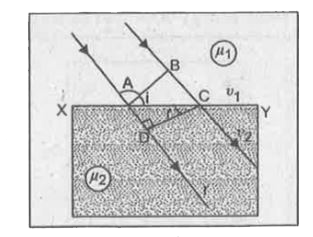 i.e., `t = (BC)/v_1 = (AD)/v_2` `or (BC)/(AD) = v_1/(v_2)`...(i) Inrt. `angle DeltaABC` `(BC)/(AC) = sin i` `or BC = AC sini` `or BC = AC sin i` ...(ii) Similarly, in rt. `angle DeltaADC` `AD = AC sin r`...(iii) From (ii) and (iii), we have `(BC)/(AD) = (sin i)/ (sin r)`...(iv) From (i) and (iii),we have `(sin i)/(SINR) = v_1/v_2 = ""^1mu_2` This is first law of refraction and is called Snell.s law. Second law of refraction. Since the incident ray, refracted ray and the normal, all lie on the same plane XY at the point of incidence. This proves second law of refraction. |
|
| 45. |
A galvanometer of resistance 30 Omegais shunted by a 30 Omega resistor. What part of the main current flows through the meter ? |
| Answer» SOLUTION :`1//11^(TH)` PARTOF CURRENT | |
| 46. |
An engine pulls a train over 5 km of distance by applying a force of 5xx10^6 Newton. Calculate the work done by it . |
|
Answer» SOLUTION :`W=Fs, F=5xx10^6 N,s=5 KM W=5xx10^6Nxx5000m=2.5xx10^10 N.m 2.5xx10^10` JOULE. |
|
| 47. |
A 12.5 eV electron beam is used to bombard gaseous hydrogen at room temperature. Upto which energy. Level the hydrogen atoms would be excited ? Calculate the wavelengths of the first memeber of Lyman and first member of Balmer series. |
|
Answer» Solution :Here, `DeltaE`= 12.5 eV Energy of an electron in the nth orbit of hydrogen atom is `EN = -13.6/n^2`eV For ground state n = 1, `E_1=-13.6/1^2eV=-13.6` eV For first excited state n = 2, `E_2=-(13.6)/2^2`eV=-3.4 eV For SECOND excited state n = 3, `E_3=-13.6/3^2`eV=-1.51 eV Energy required to excite hydrogen atoms from ground state to the second excited state `=E_("final")-E_("initial")` = –151 –(–13.6) = 12.09 eV Thus hydrogen atoms would be excited upto third energy level (n = 3). For LYMAN SERIES, `1/lambda=R(1/(n^2f)-2/(n_i^2))` `1/lambda=1.097xx10^7(1/1^2-1/2^2)` `1/lambda=1.097xx10^7xx3/4` `1/lambda=0.82275xx=10^7 m^(-1)` `lambda=122xx10^(-9)`m =122 nm For Balmer series `1/lambda=1.097xx10^7(1/2^2-1/3^3)` `1/lambda=1.097xx10^7xx5/36` `1/lambda=0.15236xx10^7` `lambda`=656.3 nm |
|
| 48. |
Which one of the following does not experiencestrong nuclear force? |
|
Answer» LEPTONS |
|
| 49. |
(a) From Eq. what is the ratio of the photon energies due to K_(alpha) transitions in two atoms whose atomic numbers and Z and Z? (b) What is this ratio for uranium and aluminum? (c ) For uranium and lithium? |
| Answer» SOLUTION :(a) 57.5, (B) `2.07xx10^(3)` | |