

Saved Bookmarks
This section includes 7 InterviewSolutions, each offering curated multiple-choice questions to sharpen your Current Affairs knowledge and support exam preparation. Choose a topic below to get started.
| 1. |
Two boats are heading away from shore. Boat 1 heads due north at a speed of 3.00 m/s relative to the shore. Relative to Boat 1, Boat 2 is moving 30.0^(@) north of east at a speed of 1.60 m/s. A passenger on Boat 2 walks due east across the deck at a speed of 1.20 m/s relative to Boat 2. What is the speed of the passenger relative to the shore? |
|
Answer» 4.60 m/s |
|
| 2. |
A charged particle is placed at the centre of two thin concentric spherical charged shells, made of non-conducting material. Figure A shows cross-section of the arrangement. Figure B gives the net flux phi through a Gaussian sphere centered on the particle, as a function of the radius r of the sphere. (a) Find charge on the central particle and shell A. (b) In which range of the finite values of r, is the electric field zero? |
|
Answer» (B). No where |
|
| 3. |
Two uniformly long charged wires with linear densities lambda and 3lambda are placed along X and Y axis respectively. Determined the slope of electric field at any point on the l ine y=sqrt3x |
|
Answer» `3sqrt(3)` |
|
| 4. |
If 13.6 eV energy is required to lonize the hydrogen atom, then the energy required to remove an electron from n =2 is |
|
Answer» 10.2 eV |
|
| 5. |
The space between the plates of a parallel plate capacitor is filled with a 'dielectric whose dielectric constant' varies with distance as per the relation :K(x)= K_0 +lamda x ( lamda= a constant). The capacitance C, of this capacitor, would be related to its 'vacuum capacitance C_0 as per the relation |
|
Answer» `C=(LAMDA)/( d. In( 1+k_0lamda d))C_0` |
|
| 6. |
Maximum lateral displacement of a ray of light incident on a slab of thickness t is |
| Answer» ANSWER :D | |
| 7. |
A parallel plate capacitor of capacity C_0is charged to a potential V_0 (I ) The energy stored in the capacitor when the battery is disconnected and the plate separation is doubled is E_1 (ii) The energy stored in the capacitor when the charging battery is kept connected and the separation between the capacitor plates is doubled is E_2 Then E_1 //E_2 |
| Answer» ANSWER :A | |
| 8. |
(A): Higher is the accuracy of measurement,if instrument have smaller least count. (R): Smaller the percentage error, higher is the accuracy of measurement. |
|
Answer» Both (A) and (R) are TRUE and (R) is the correct EXPLANATION of (A) |
|
| 9. |
A resistance of ROmega draws current from a potentiometer as shown in Fig. The potentiometer has a total resistance R_0 Omega. A voltage Vis supplied to the potentiometer. Derive an expression for the voltage across R when the sliding contact is in the middle of the potentiometer. |
|
Answer» Solution :When the sliding contact is in the middle of the potentiometer, total effective resistance `R_(eff)`of potentiometer is SUM of PARALLEL combination of `(R_0)/(2)`and R, and`(R_0)/(2)` ` therefore R_(eff) = ( (R_0 . R)/(2))/( (R_0)/(2) + R) + (R_0)/(2)= (R_0)/(2) [ ( R)/((R_0)/(2) + R) + 1 ] = (R_0 (2R + (R_0)/(2) ))/(2((R_0)/(2) + R) ) ` ` therefore `current in the circuit `I = (V)/(R_(eff)) = (V.2 ( (R_0)/(2) + R) )/(R_0 (2R + (R_0)/(2)) )` ` therefore ` VOLTAGE across R , `V_(eff) = I. ( (R_0 .R)/(2))/((R_0)/(2) + R)= (IR_0R)/(2((R_0)/(2) + R) ) = (V.2 ( (R_0)/(2) + R) )/(R_0 (2R + (R_0)/(2) ) ) xx (R_0 R)/(2 ((R_0)/(2) + R) ) = (V.R )/((2R + (R_0)/(2)) )` |
|
| 10. |
A resistance coil market is found to have a true resistance of 3.115 Omega at 300 K. Calculate the temperature at which marking is corrent .Temperature coefficient of resistance of the material of is 4.2xx 10^(-3).^(@)C^(-1) |
|
Answer» `R_(27) = R_(0)(1+ ALPHA xx 27)` `R_(27) = R_(0)(1+ alpha xx 27)`……(i) `:. 3.115 = R_(0) (1+ 4.3 xx 10^(-3) xx27)` ....(i) and `3 = R_(0)(1+ 4.2 xx 10^(-3) xx t)`…..(ii) `:. (3)/(3.115) = (1 + 4.2 xx 10^(-3) xx t)/(1+ 4.2 xx 10^(-3) xx 27)` On SOLVING we GET `t = 17.21^(@)C` `= 17.21 xx 275 = 290.2K` |
|
| 11. |
A capacitor has square plates each of side .a. making an angle small theta , the capacitance is given by: |
|
Answer» `C=(epsilon_0a^2)/d[1-(thetaa)/(2D)]` |
|
| 12. |
Polar Molecular Solids |
|
Answer» A. Are GOOD CONDUCTOR of electricity |
|
| 13. |
What is the ratio of critical speeds of two satellites If the ratio of their periods is 8:1 |
| Answer» Answer :A | |
| 14. |
When the steady state is reached by keeping switch in position-1 then swich 'S' is transferred from position 1 to 2. Then |
|
Answer» Charge on `3F` capacitor is `30C` after `S` is transferred from positiojn 1 to 2 |
|
| 15. |
A thin uniform rod of length 2l is acted upon a constant torque. The angular velocity changes from zero to omega in time t. The value of torque is : |
|
Answer» `(ML^(2)OMEGA)/(t)` `alpha=(omega-0)/(t)=(omega)/(t)` Now `tau=Ixxalpha=(1)/(3)(Ml^(2)omega)/(t)` |
|
| 16. |
Starting from rest a wooden block moves with a velocity of 25ms^(-1) along a rough ground and comes to rest. Calculate the distance travelled by the wooden block on the rough surface of coefficient of friction 0.25. |
| Answer» ANSWER :D | |
| 17. |
Two identical nuclei A and B of the same radioactive element undergo beta decay. A emits a beta-particle and changes to A. B emits a beta-particle and then a gamma-photon immediately afterwards, and changes to B.. |
|
Answer» A. and B. have the same ATOMIC number and mass number |
|
| 18. |
If vec(A)=2hati + 3hatj and vec(B)=hati + hatj, then the vector component of vec(A) in the direction of vec(B) is : |
|
Answer» `(hati + HATJ)` `ACOSTHETA=((Acostheta)B)/B` `=(ABcostheta)/B=(vec(A).vec(B))/B=(vec(A)vec(B))/B(vec(B)/B)` `=5/sqrt(2)(hati+hatj)/sqrt(2)=2.5(hati+hatj)` |
|
| 19. |
A particle of charge q and mass m moves rectilinearly under the action of an electric field E= alpha- beta x. Here, alpha and beta are positive constants and x is the distance from the point where the particle was initially at rest. Then: (1) the motion of the particle is oscillatory withamplitude (alpha)/(beta) (2) the mean position of the particles is at x= (alpha)/(beta) (3) the maximum acceleration of the particle is (q alpha)/(m) (4) All 1, 2 and 3 |
|
Answer» SOLUTION :`a= (F)/(m) = (qE)/(m) = (q)/(m) (alpha - beta X)` …(1) a= 0 at `x = (alpha)/(beta)` i.e., force on the particle is zero at `x= (alpha)/(beta)`, So, mean POSITION of particle is at `x= (alpha)/(beta)` Eq (1) can be WRITTEN as `v.(dv)/(dx) = (q)/(m) (alpha - beta x)` `therefore v dv = (q)/(m) int_(0)^(x) (alpha - beta x) dx` `therefore v= sqrt((2qx)/(m)(alpha-(beta)/(2)x))` v=0 at x = 0 and `x = (2 alpha)/(beta)` so, the particle will oscillate between x = 0 to `x= (2 alpha)/(beta)` with mean position at `x =(alpha)/(beta)`. Therefore, amplitude of particle is `(alpha)/(beta)`. Maximum acceleration of particle is at extreme positions (at x= 0 or x= `2 alpha//beta`) and `a_("max") = q alpha//m` (from Eq.(1)) |
|
| 20. |
Sketch a basic AND circuit with twodiodes and explain its operation.Explain how doping increases the conductivity in semiconductors ? |
|
Answer» Solution :AND gate `:` It has two input terminals and one out terminal. If both the inputs are low ( or ) one of the inputs is low. `implies ` The out is low in an AND gate. If both the inputs are high `implies` The output of the gate is high. Note `:` If A and B are the inputs of the gate and the output is 'Q' then 'Q' is a logical function of A and B. 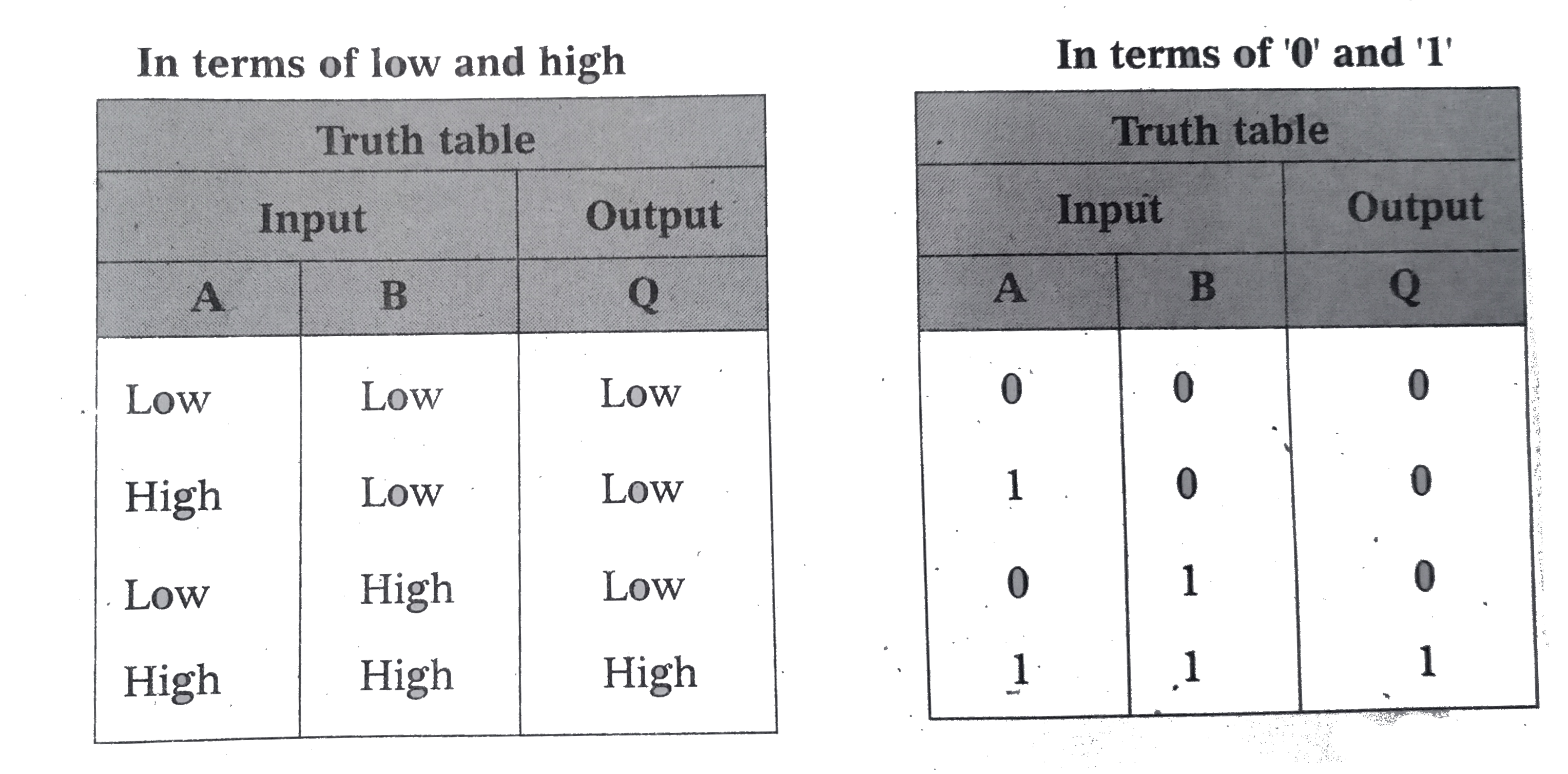 The logicalfunction AND is represented by the symbol dot so thatthe output , Q= A.B andthe circuit symbol used for the logic gate AND is shown in Figure. The logic function ANDis similart o the multiplication. 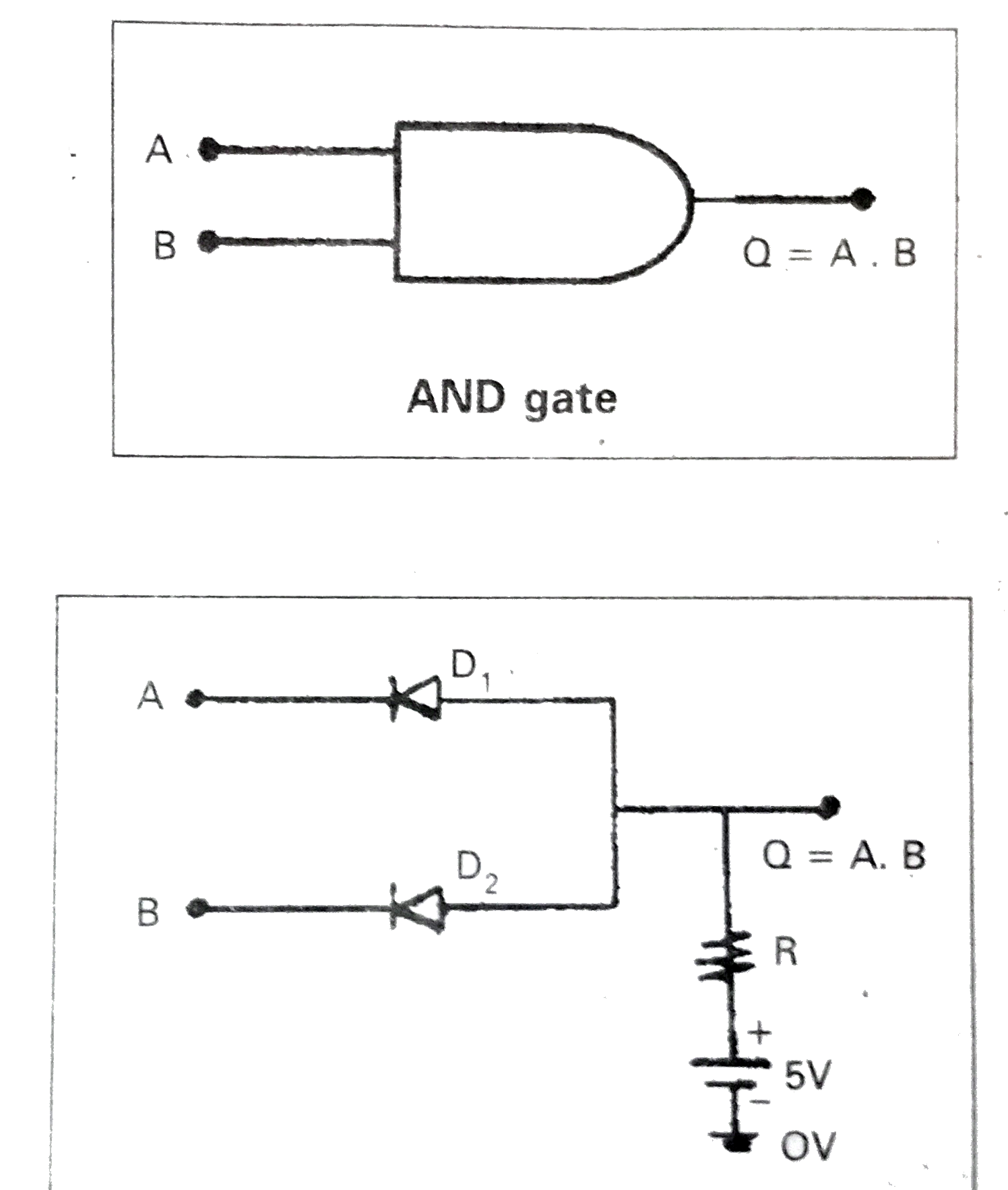 Implementaion of AND gate using diodes `:` Let `D_(1)` and `D_(2)` represents two diodes. A potential of 5V represents the logical value 1 and a potential of 0V represents the logical value zero ( 0 ). When A = 0 , B = 0 both the diodes `D_(1)` and `D_(2)`are forward -biased and they behavelike closed switches. Hence, the output Q is same as that A or B ( equal to zero ) . When A = 0 or B =0, `D_(1)` or `D_2)` is forward-biased and Q is zero. When A=1 and B =1 both the diodes are reverse -biasedandthey behave like open switches. There is no current through the resistance Rmaking the potential at Q equal to 5V i.e., Q= 1 . The output is same as that of an AND gate. Doping INCREASES the conductivity in Semiconductors `:` If a pentavalent impurity ( Arsenic )is added to a pure tetravalent semiconductorit is called n-type semiconductor . Arsenic has 5 valence electrons, but only 4 electrons are needed to form covalent bonds with the adjacent Germanium atoms. The fifth electron isvery loosely BOUND and become a free electron. Therefore excess electronsare available for conduction and conductivity of semiconductor increases. Similarly when a trivalent impurity Indium is added topute Germanium it is called p-typesemi-conductor. In this excess holes in ADDITION to those formed due to THERMAL energy are available for condcution in the valenece band and the conductivity of semicondcutor increases. |
|
| 21. |
The slope of i_p-V_g curve is 2 mA/V and slope of i_p-V_p curve is 0.25 mA/V . If anode resistance is 12KOmega what amplification the triode value would produce across the load resistance ? |
|
Answer» 12 `r_p=1/(0.25xx10^(-3))=4000Omega=4xx10^3Omega` Now `mu=r_pxxgm = 4 xx10^3 xx2 xx 10^(-3)=8` and voltage amplification = `(muR_L)/(r_p+R_L)` `=(8xx10^3xx12)/(4xx10^3+12xx10^3)=6` |
|
| 22. |
The refractive index of glass is 1.520 for red light and 1.525 for blue light. Let delta_(1) anddelta_(2) angles of minimum deviation for red and blue light respectively in a prism of this glass, then |
|
Answer» `delta_(1)`. Can be less than or greater than `delta_(2)` DEPENDING upon the values of `delta_(1) and delta_(2)` As. `mu_(R) lt mu_(B) "" therefore delta_(1) lt delta_(2)` |
|
| 23. |
Define electric potential due to a pointcharge and arrive at the expression for the electric potentialat a point due to a point charge. |
|
Answer» <P> Solution :The electric potentialat a pointdue to a givenpoint charge may be measured by finding the AMOUNT of work required to bringa unit positivetest charge , from a pointat infinityto that POINT inside a fieldregion.Let .P. be a point at infinity . Let A,B and C be points inside the field . Let BC =dx. Let the displacementbe .dx.and .+1C. is broughtcloserby .dx.in a directionopposite to the directionof electric field . Amountwork DONE =-Fdx For .+1C.of charges , F=E and dW=dV where .dV.is electric potentialdefinedas `dV=(dW)/(q_0)` where `q_0=+1C` of testcharge. Electric field intensity at`C=(1/(4piepsilon_0))(q/x^2)` . 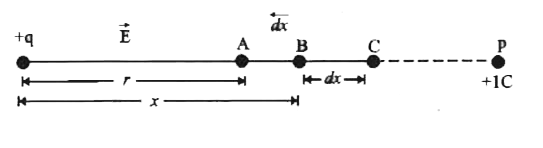 Hence , dV=-Edx. Electric potentialat .A. `V_A=int_oo^r dV=-int_oo^r (1/(4piepsilon_0))(q/x^2)dx` i.e., `V_A=-(1/(4piepsilon_0))q((-1)/x)_oo^r` i.e.,`V_A=(1/(4piepsilon_0))q[1/r-1/oo]` i.e., `V_A=(1/(4piepsilon_0))(q/r)` Hence, electric potentialat a point is inverselyproportionalto the distanceof thatpoint . |
|
| 24. |
A: Transperency of glass decreases if its surface becomes rough.R : Glass of rough surface absorbs more light. |
|
Answer» Both assertion and REASON are true and the reason is CORRECT EXPLANATION of the assertion. |
|
| 25. |
Choose the correct statement for conservative force. |
|
Answer» A force always oriented TOWARDS a COMMON point is aconservative force |
|
| 26. |
The conducting rod shown in Fig. 30-37 has length Land is being pulled along horizontal, frictionless conducting rails at a constant velocity vecv. The rails are connected at one end with a metal strip. A uniform magnetic field vecB, directed out of the page, fills the region in which the rod moves. Assume that L = 10 cm, v = 5.0 m/s, and B = 1.2 T. What are the (a) magnitude and (b) direction (up or down the page) of the emf induced in the rod? What are the (c) size and (d) direction of the current in the conducting loop? Assume that the resistance of the rod is 0.40 Omega and that the resistance of the rails and metal strip is negligibly small. (e) At what rate is thermal energy being generated in the rod? (f) What external force on the rod is needed to maintain vecv? (g) At what rate does this force do work on the rod? |
| Answer» Solution :(a) 0.60, (B) up, ( c) 1.5 A, ( d) clockwise, ( E) 0.90 W, (f) 0.18 N, (G) 0.90 W | |
| 27. |
Paragraph: A subatomic particle X spontaneouslydecays into two particles, A and B, each of rest energy 1.40xx10^(2)MeV. The particles fly off in opposite directions, each with speed 0.827c relative to an inertial reference frame S. Use energy conservation to determine the rest energy of particle X. |
|
Answer» 206 MEV |
|
| 28. |
Paragraph: A subatomic particle X spontaneouslydecays into two particles, A and B, each of rest energy 1.40xx10^(2)MeV. The particles fly off in opposite directions, each with speed 0.827c relative to an inertial reference frame S. Which expression gives the momentum of particle A (relative to frame S)? |
|
Answer» 109 MeV/c |
|
| 29. |
Paragraph: A subatomic particle X spontaneouslydecays into two particles, A and B, each of rest energy 1.40xx10^(2)MeV. The particles fly off in opposite directions, each with speed 0.827c relative to an inertial reference frame S. Which one of the following statements concerning particle X is true? |
|
Answer» Momentum conservation requires that it was moving in FRAME S. |
|
| 30. |
Paragraph: A subatomic particle X spontaneouslydecays into two particles, A and B, each of rest energy 1.40xx10^(2)MeV. The particles fly off in opposite directions, each with speed 0.827c relative to an inertial reference frame S. Determine the kinetic energy of particle B (relative to frame S). |
|
Answer» 109 MEV |
|
| 31. |
A long conductor having charge q, with charge density lambda is moving with a velocity 2v parallel to its own axis. The convectional current I due to motion of conductor is |
|
Answer» `I=lambdav//2` |
|
| 32. |
Paragraph: A subatomic particle X spontaneouslydecays into two particles, A and B, each of rest energy 1.40xx10^(2)MeV. The particles fly off in opposite directions, each with speed 0.827c relative to an inertial reference frame S. Determine the total energy of particle A. |
|
Answer» 109 MEV |
|
| 33. |
What is wattless current? |
| Answer» SOLUTION :Current FLOWING in a circuit WITHOUT any net dissipation of power, is CALLED WATTLESS current. | |
| 34. |
What are reflecting type of telescope ? Explain the advantages and disadvantages of reflecting telescopes as compared to refracting telescope and also give the solution. |
|
Answer» Solution :For the problems in making of lens of high resolution and large magnification modern telescopes use a concave MIRROR rather than a lens for the objective. Telescopes with mirror objective are called reflecting telescopes. Advantages : 1) There is no chromatic aberration in a mirror. 2) If a PARABOLIC reflecting surface is chosen, spherical aberration is also removed. 3) Mechanical support is much less of a problem since a mirror weighs much less than a lens of equivalent optical quality and can be supported over its entire back surface, not just over its rim. Disadvantages : The objective mirror focuses light inside the telescope tube. One must have an eyepiece and the observer right there. Obstructing some light (depending on the size of the observer cage). This is what is done in the very large 200 inch (~ 5.08 m) diameters Mt. Palomar telescope, California. The VIEWER sits near the focal point of the mirror in a small cage. Another solution to the problem is to deflect the light being FOCUSSED by another mirror. |
|
| 35. |
A ray of light travelling in air has wavelength lambda, frequency f, velocity v and intensity I . If this ray enters, water, then those parameters are lambda,f , v and I . Which relation is correct from the following ? |
| Answer» Answer :A | |
| 37. |
The surface tension of a liquid is 5 N/m. If a film is held on a ring of area 0.02 m^2 its surface energy is about |
| Answer» Answer :C | |
| 38. |
In the circuit shown, each resistor has a resistance R_(X) which depends on the voltage V_(X) across it. For V_(X) le 1 V,R_(X) =1 Omega and for V_(X) gt 1 V, R_(X) = 2 Omega The emf (V) of the source, changes with time (t) after the switch is closed at t=0. The variation of V with time is depicted in the graph. Plot the variation of ammeter reading with time. |
|
Answer» |
|
| 39. |
A condenser of capacity C is charged to a potential difference of V_(1). The plates of the condenser are then connected to an ideal inductor of inductance L. The current through the inductor when the potential differece across the condenser reduces to V_(2) is |
|
Answer» `((C(V_(1)-V_(2))^(2))/(L))^(1//2)` |
|
| 40. |
In Young's double slit experiment, the slits are 2 mm apart and are illuminated with a mixture of two wavelength lamda_0 = 750 nm and lamda = 900 nm. What is the minimum distance from the common central bright fringe on ascreen 2 m from the slits where a bright fringe from one interference pattern coincides with a bright fringe from the other? |
|
Answer» Solution :`n_(1)lambda_(1) = n_(2)lambda_(2)` `(n_(1))/(n_(2))=(lambda_(2))/(lambda_(1))=(900)/(750)` D = 2m d = 2 MM THUS, WEHAVE `(n_(1))/(n_(2)) = (6)/(5)` `5^(th) and 6^(th)` fringes will coincide RESPECTIVELY. The minimum distance is given as `X_(min)=(n_(2)lambda_(2)D)/(d)=(5xx900xx10^(9)xx2)/(2xx10^(-3))` `= 4500 xx 10^(-6) = 4.5 xx 10^(-3) m` `X_(min) = 4.5 mm` |
|
| 41. |
What would be the greatest length of a steel wire, which when fixed at one end can hang freely without breaking? Density of steel = 7800(kg)/m^3 Breaking stress of steel = 7.8 xx 10^8 N/M^2,g = 10m/s^2 |
|
Answer» Solution :Breaking STRESS = `(MG)/A = (ALDg)/A = Ldg` `therefore L = "Breaking dtress"/(DG) = (7.8 XX 10^8)/(7.8 xx 10^3 xx 10)` `10^4 m = 10km`. |
|
| 42. |
A rigid uniform rod of mass M and length L is placed along the Y-axis on a smooth horizontal surface with its centre at the origin. Two particles , each of mas m ( = M //12)hits simultaneously , at the two ends with equal speed v as shown in the figure. The collision is completely inelastic. (i)Find the angular velocity of the system after the collision. (ii)Two particles of mass 2m and m are placed respectively at ( L//2, 0) and ( - L//2, 0). Calculate the time when the rod hits these particles. |
|
Answer» |
|
| 43. |
In the ultra-relativistic case the momentum of a particle accelerated by a potential difference varphi is found with the aid of the formula p= evarphi//c, this value being expressed in units of MeV//c, where c is the velocity of light in a vacuum. Express this unit in the SI system. Find out for what poten tial differences the use of this formula leads to an error of less than 5%. Do the calculations both for the electron and the proton. |
|
Answer» Solution :The relative error is `EPSILON= (p_("rel")-evarphi//c)/(p_("rel"))= 1-sqrt((evarphi)/(2E_(0)+evarphi))` hence `varphi= (2E_(0))/(E).((1-e)^(2))/(2epsilon-epsilon^(2))= (E_(0))/(epsilone)` |
|
| 44. |
A simple pendulum attached to the roof of a lift has a time period of 2s in a stationary lift. If the lift is allowed to fall freely the frequency of oscillations of pendulum will be |
|
Answer» zero |
|
| 45. |
Distinguish between .dia. and .ferro. magnetic materials. |
Answer» SOLUTION : 
|
|
| 47. |
There are various ways to produce the electromagnetic radiations. In the given table, Column I shows lhe process to form electromagnelic radiation. Column II shows the range of wavelength of the generated electromagnetic radiation and Column III shows the range of frequency of the generated electromagnetic radiation. {:("Column I","Column II" ,"Column III"),((I) "Excitation and ejection of core atomic electrons",(i) "Wavelengths in the range of 400-700 nanometers " (nm) or 4.00xx10^(-7) to 7.00xx10^(-7)m" ",(J) "Frequencies of about" 8xx10^(14) to 3xx10^(16) "cycles per second or hertz "(Hz)),((II)"Excitation of molecular and atomic valence electrons" ,(ii) "Wavelength from 100 nm to 400 nm",(K)"Frequency range of roughly 430-750 terahertz THz"),((III) "Molecular vibration plasma oscillation " ,(iii)"Wavelength ranging from "0.01 to 10 "nanometers" ,(L)"Frequency range of approximately 430 THz down to 300 GHz"),((IV) "Molecular electron excitation " ,(iv)"Wavelengths up to 1050 nm",(M) "Frequencies in the range 30 petahertz to 30 exahertz "):} Wha t are the characte,istics of infrared range of light? |
|
Answer» (I) (II) (J) |
|
| 48. |
There are various ways to produce the electromagnetic radiations. In the given table, Column I shows lhe process to form electromagnelic radiation. Column II shows the range of wavelength of the generated electromagnetic radiation and Column III shows the range of frequency of the generated electromagnetic radiation. {:("Column I","Column II" ,"Column III"),((I) "Excitation and ejection of core atomic electrons",(i) "Wavelengths in the range of 400-700 nanometers " (nm) or 4.00xx10^(-7) to 7.00xx10^(-7)m" ",(J) "Frequencies of about" 8xx10^(14) to 3xx10^(16) "cycles per second or hertz "(Hz)),((II)"Excitation of molecular and atomic valence electrons" ,(ii) "Wavelength from 100 nm to 400 nm",(K)"Frequency range of roughly 430-750 terahertz THz"),((III) "Molecular vibration plasma oscillation " ,(iii)"Wavelength ranging from "0.01 to 10 "nanometers" ,(L)"Frequency range of approximately 430 THz down to 300 GHz"),((IV) "Molecular electron excitation " ,(iv)"Wavelengths up to 1050 nm",(M) "Frequencies in the range 30 petahertz to 30 exahertz "):} (1) What are the characteristics of ultraviolet range of light? |
| Answer» Answer :D | |
| 49. |
There are various ways to produce the electromagnetic radiations. In the given table, Column I shows lhe process to form electromagnelic radiation. Column II shows the range of wavelength of the generated electromagnetic radiation and Column III shows the range of frequency of the generated electromagnetic radiation. {:("Column I","Column II" ,"Column III"),((I) "Excitation and ejection of core atomic electrons",(i) "Wavelengths in the range of 400-700 nanometers " (nm) or 4.00xx10^(-7) to 7.00xx10^(-7)m" ",(J) "Frequencies of about" 8xx10^(14) to 3xx10^(16) "cycles per second or hertz "(Hz)),((II)"Excitation of molecular and atomic valence electrons" ,(ii) "Wavelength from 100 nm to 400 nm",(K)"Frequency range of roughly 430-750 terahertz THz"),((III) "Molecular vibration plasma oscillation " ,(iii)"Wavelength ranging from "0.01 to 10 "nanometers" ,(L)"Frequency range of approximately 430 THz down to 300 GHz"),((IV) "Molecular electron excitation " ,(iv)"Wavelengths up to 1050 nm",(M) "Frequencies in the range 30 petahertz to 30 exahertz "):} What are the characteristics of visible range of light? |
|
Answer» (II) (ii) (J) |
|
| 50. |
A current element of 2 milliampere meter is at the corner. A of a unit cube ABCDEFGH, the element being along AB. Calculate the field at the remaining seven corners of the cube (figure 1.5). |
|
Answer» |
|


