

Saved Bookmarks
This section includes 7 InterviewSolutions, each offering curated multiple-choice questions to sharpen your Current Affairs knowledge and support exam preparation. Choose a topic below to get started.
| 1. |
The position of a transverse wave travelling in medium along X-axis is shown in figure at time t = 0. Speed of wave is v= 200 m/s. FindFrequency of the wave. |
| Answer» SOLUTION :`10^3Hz` | |
| 2. |
A 600 pF capacitor is charged by a 200 V supply. Calculate the electrostatic energystored in it.It is then disconnectedfrom the supplyand is connected in parallel to another uncharged600 pF capacitor . What is the energystored in the combination? |
|
Answer» Solution :Given : - `V_1`=2000 V `C_1=C_2`=600 PF When the 600 pF capacitor is CONNECTED to 200 V ,charge on thecapacitor is `Q=CV=600xx10^(-12)xx200=12xx10^(-8)` C Energy stored initially in the capacitor `U=1/2CV^2=1/2(600xx10^(-12))(200)^2` `U=12xx10^(-6)` j When the SECOND uncharged capacitor is connected in parallel to the first ,charge gets distributedamong them. Capacitors are having equal capacitances , hence Charges in each capacitor in the same =`Q_1=Q/2` `Q_1=6xx10^(-8)C` Now , energy stored in each capacitor `U_t=1/2 Q_1^2/C=1/2((6xx10^(-8))^2)/((600xx10^(-12)))=3xx10^(-6) J` `therefore` Total energy of the combination = `6xx10^(-6)`J |
|
| 3. |
If the refractive index of glass is sqrt3, then its polarising angle will be : |
| Answer» ANSWER :C | |
| 4. |
The ratio of kinetic energies of an electron and a proton which are accelerated from rest by a potential difference of 10 volt is: |
|
Answer» `(1)/(1840)` |
|
| 5. |
A cell of emf ‘E’ and internal resistance ‘r’ is connected across a variable load resistor R. Draw the terminal voltage V versus (i) R and (ii) the current l. It is found that whenR=4 Omega, the current is 1 A and when R is increased to 9 Omega, the current reduce to 0.5 A. Find the values of the emf E and internal resistance r. |
Answer» Solution :(i)For large impact parameter, almost all alpha particles go nearly undeviated and have small deflection. This shows that the mass of the atom is concentrated in a small volume in the form of nucleus and gives an idea of size of nucleus.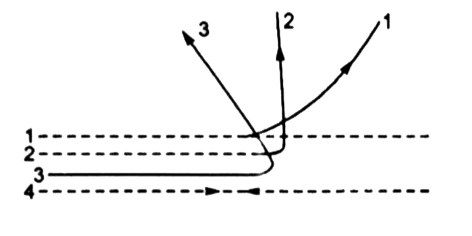 (ii)An alpha particle having small impact parameter suffers large scattering and in case of head-on-collision, the alpha particle rebounds back. The radius (size) R of nucleus is RELATED to its mass NUMBER (A) as `R=R_(0)A^(1//3)` If m is the average mass of a nucleon, then mass of nucleus = mA, where A is mass number Volume of nucleus `=(4)/(3)PI R^(3)=(4)/(3)pi (R_(0)A^(1//3))=(4)/(3)pi R_(0)^(3)A` Density of nucleus `rho_(N) = ("mass")/("volume")=(mA)/((4)/(3)pi R_(0)^(3)A)=(m)/((4)/(3)pi R_(0)^(3))=(3M)/(4pi R_(0)^(3))` Clearly nuclear density`rho_(N)` is independent of mass number A. OR 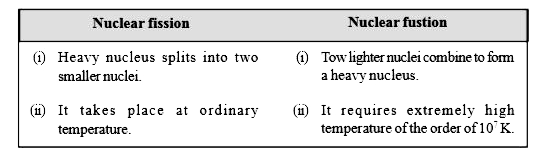 In both the process, mass of nucleus PARTICIPATING in the reaction is greater than mass of the product nuclei. This difference in mass `(Delta m)` is converted into energy and released. Mass defect`= Delta m` Energy released `=Delta m xx 931 MeV` `._(1)^(2)H+._(1)^(3)H rarr ._(3)^(4)He+n` `Delta m = (+2.014102 + 3.016049-1.008665)u` `=0.018883 u` Energy released `= Delta m xx 931.5 MeV = 0.018883xx931 MeV` `= 17.59 MeV` |
|
| 6. |
Angular dispersion delta_v-delta_r is given by_____ |
| Answer» SOLUTION :`(mu_v-mu_r)A` | |
| 7. |
A particle of mass m is executing S.H.M. about a point with amplitude 10 cm. Its maximum velocity is 100 cm s^(-1). Its velocity will be 50 cm s^(-1) at a distance : |
|
Answer» 5 CM `100=10.oemgaimpliesomega=10" rad"//"s"`. Now `v^(2)=OMEGA^(2)(r^(2)-y^(2))`. `:.""2500=100(100-y^(2))` `y^(2)=100-25=75` `y=5sqrt(3)` cm. Aliter. We can use the formula that at `y=(sqrt(3))/(2)r` `v=(v_("max"))/(2)` `:.""y=(sqrt(3))/(2)xx10=5sqrt(3)" cm"`. So the correct choice is ( c ). |
|
| 8. |
The speed of sound in oxygen (O_(2)) at a certain temperature is 460 ms^(-1). The speed of sound in helium (He) at the same temperature will be assumed both gases to be ideal |
| Answer» Answer :A | |
| 9. |
Compare are drift speed obtained above with (i) thermal speeds of copper atoms at ordinary temperatures (ii) speeds of propagation of electric field along the conductor which causes the drift motion. |
|
Answer» Solution :(i) At a temperature T,the thermal SPEED of a copper atom of mass M is obtained from `[ lt (1//2) M upsilon^(2) gt = (3//2) K_(B) T]` and is thus typically of the order of `sqrt(k_(B) T//M)`, where `K_(B)` is the Boltzmann constant. For copper at 300 K, this is about `2 xx 10^(2)` m//s. This figure indicates the random vibrational speed of copper atoms is a CONDUCTION. NOTE that the drift speed of electrons is much smaller, about `10^(-5)` times the TYPICAL thermal speed at ordinary temperatures. (ii) An electiric field travelling along the CONDUCTOR has a speed of an electromagnetic wave, namely equall to `3.0 xx 10^(8) m s^(-1)` The drift speed is in comparison, extremely small, smallar by a factor of `10^(-11)` |
|
| 10. |
The process in which radiation is deflected by particles in medium through which they pass is called_____ |
| Answer» SOLUTION :SCATTERING | |
| 11. |
Radiation of wavelength lambda is incident on a photocell.The fastest emitted electron has speed v.If wavelength is changed to (3lambda)/(4) the speed of the fastest emitted electron will be |
|
Answer» `gtv((4)/(3))^((1)/(2))` `=(hc)/(lambda)-phi_(0)` `therefore (hc)/(lambda)=K_(max)+phi_(0)` For FIRST case, `(hc)/(lambda)=(1)/(2)mv^(2)+phi_(0)` For firat case, `(hc)/(lambda)=(1)/(2)mv^(2)+phi_(0)` ……(1) For SECOND case, `(1)/(2)mv_(1)^(2)=(hc)/(lambda_(1))-phi_(0)` `(1)/(2)mv_(1)^(2)=(4hc)/(3lambda)-phi_(0)[because lambda-(1)=(3lambda)/(4)]` `therefore (1)/(2)mv_(1)^(2)=(4)/(3)((1)/(2)mv^(2)+phi_(0))-phi_(0)` [ `because` From result (1)] `therefore (1)/(2)mv_(1)^(2)=(2)/(3)mv^(2)+(4)/(3)phi_(0)-phi_(0)` `therefore (1)/(2)mv_(1)^(2)=(2)/(3)mv^(2)+(phi_(0))/(3)` `therefore v_(1)^(2)=(4)/(3)v^(2)+(2)/(3)(phi_(0))/(m)` `therefore v_(1)=sqrt((4)/(3)v^(2))+sqrt((2)/(3)(phi_(0))/(m)) (2)/(3)[(phi_(0))/(m)="constant"]` `therefore v_(1)sqrt((4)/(3))v+"constant" therefore gt v((4)/(3))^((1)/(2))` |
|
| 12. |
What is the ratio of the charges |(q_(1))/(q_(2))| for the following electric field line pattern ? |
|
Answer» `1/5` |
|
| 13. |
In the figure given below, P and Q are two equally intense coherent sources emitting radiations of wavelength 20 m. The separation between P and Q is 5.0 metre and phase of P is ahead of the phase of Q by 90^(@), A, B and C are three distant points of observation, equidistant from the mid point of PQ.The intensity of radiation at A, B, and C will bear the ratio : |
|
Answer» ` 0 : 1 : 4` 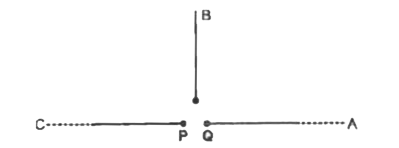 Path difference PQ = 5m = `(lambda)/(4)` So PHASE difference = `lambda /4 xx (2 pi)/(lambda) = (pi)/(2)`. Initial phase at P is `(pi)/(2)` so, phase difference between P and Q w.r.t A is zero. Net phase difference between P and Q w.r.t B = `(pi)/(2)`. Net phase difference between P and Q w.r.t `C = (pi)/(2)`. `THEREFORE I_(A) = I + I + 2 sqrt I.Icos 0^(@) = 4 I` `I_(B) = I + I + 2 sqrt I.I cos 90^(@) = 2I` `I_(C) = I + I + 2 sqrt I.Icos 180^(@) = 0` `therefore Ratio I_(A) : I_(B) : I_(C) :: 2 : 1 : 0` |
|
| 14. |
A small mass m is moved slowly from the surface of the earth to a height h above the surface. The work done (by an external agent) in doing this is |
|
Answer» mgh, for all VALUES of h `=-GM m((1)/(R )-(1)/(R+h))=gR^(2)m[(h)/(R(R+h))]=(mgRh)/(R+h)` For `h lt lt R`, W=mgh, For h=R, `W=(mgR)/(2)` |
|
| 15. |
An aquarium is filled with water. The lateral wall of the aquarium is 40 cm long and 30 cm high. Given g=10ms^(-2) and rho_(H_(2)O)=1g//cm^(3), the force on lateral wall of aquarium is : |
| Answer» Answer :C | |
| 16. |
A vessel contains an ideal gas at 27^@ C and pressure 200 kPa. The volume of the gas is 8.0 L. The molecules of the gas collide with the walls of the vessel and exert a pressure. The gas is allowed to leak till the pressure falls to 150 kPa and the temperature remains the same. The diameter of the ideal gas molecule is 300 pm. The average distance traveled by the molecule between collisions is termed as the mean free path. The mean free path of a gas molecule varies directly proportional to the temperature and inversely proportional to the pressure. Take, R = 8.3 J/mol K and N_A = 6.02 xx10^(23)/mol. The number of moles of the gas in the vessel before the gas was leaked is |
|
Answer» 0.64 |
|
| 17. |
A vessel contains an ideal gas at 27^@ C and pressure 200 kPa. The volume of the gas is 8.0 L. The molecules of the gas collide with the walls of the vessel and exert a pressure. The gas is allowed to leak till the pressure falls to 150 kPa and the temperature remains the same. The diameter of the ideal gas molecule is 300 pm. The average distance traveled by the molecule between collisions is termed as the mean free path. The mean free path of a gas molecule varies directly proportional to the temperature and inversely proportional to the pressure. Take, R = 8.3 J/mol K and N_A = 6.02 xx10^(23)/mol. The amount of gas leaked is |
|
Answer» 0.64 MOL |
|
| 18. |
A vessel contains an ideal gas at 27^@ C and pressure 200 kPa. The volume of the gas is 8.0 L. The molecules of the gas collide with the walls of the vessel and exert a pressure. The gas is allowed to leak till the pressure falls to 150 kPa and the temperature remains the same. The diameter of the ideal gas molecule is 300 pm. The average distance traveled by the molecule between collisions is termed as the mean free path. The mean free path of a gas molecule varies directly proportional to the temperature and inversely proportional to the pressure. Take, R = 8.3 J/mol K and N_A = 6.02 xx10^(23)/mol. the averagetranslationkineticenergyof themoleculesof the gasis |
|
Answer» `2.07 xx 10^(-19 ) J` |
|
| 19. |
The following configuration of gate is equivalent to : |
|
Answer» NAND Output of NAND gate = `BAR(A.B)` `:.` Output Y from AND gate ` = (A+B) .bar(A.B)` `=(A+B) .(bar(A)+barB)` `= AbarA+BbarB+AbarB+BbarA` `=0+0+AbarB+BbarA` `=AbarB+BbarA` This is expression of XOR gate. |
|
| 20. |
A slit 5 cm wide is irradiated normally with microwaves of wavelength 1.0 cm. Then the angular instead of central maximum on either side of incident light is nearly |
|
Answer» 1/5 radian |
|
| 21. |
The deflection of a galvanometer falls to 1/10th when a resistance of 5Omega is connected in parallel with it. If an additional resistance of 2Omega is cont)ected in parallel to the galvanometer, the deflection is |
|
Answer» `1/6th` |
|
| 22. |
A perons witha normal near point (25cm) uses a compound microscope consisting of an objective lens of focal length 8.0 mm and an eye-lense of focal length 2.5 cm. A small objective placed at a distance of 9.0 mm in front of the objective lens produces an image, which is then magnified by the eye-lens to produce a virtual image at the near point. Assume that the eye is placed close to the eye-piece. The magnifying power of the microscope is |
|
Answer» 34 |
|
| 23. |
A perons witha normal near point (25cm) uses a compound microscope consisting of an objective lens of focal length 8.0 mm and an eye-lense of focal length 2.5 cm. A small objective placed at a distance of 9.0 mm in front of the objective lens produces an image, which is then magnified by the eye-lens to produce a virtual image at the near point. Assume that the eye is placed close to the eye-piece. The distance between the objective and the eye-lens is |
|
Answer» 7.20 CM |
|
| 24. |
Suppose a ._(88)^(226)Ra nucleus at rest and in ground state undergoes alpha- decay to a ._(86)^(222)Rn nucleus in its excited state. The kinetic energy of the emitted alpha particle is found to be 4.44 MeV. ._(86)^(222)Rn nucleus then goes to its ground state by gamma-decay. The energy of the emitted gamma photon is ___keV. [Given: atomic mass of ._(88)^(222)Ra = 226.005u. atomic mass of222/86Rn = 222.000u, atomic mass of alpha particle = 4.000 u, 1 u =931 MeV//c^2, c is speed of the light]. |
|
Answer» |
|
| 25. |
A nucleus at rest splits into two nuclear parts having radii in the ratio 1 : 2. Their velocities are in the ratio |
|
Answer» SOLUTION :`m_(1)V_(1)= m_(2)V_(2)` `A_(1)V_(1)= A_(2)V_(2)` `m alpha A` `(V_(1))/(V_(2))= (A_(2))/(A_(1)) rArr (V_(1))/(V_(2))= ((R_(2))/(R_(1)))^(3)= ((2)/(1))^(3) = (8)/(1) (R_(1))/(R_(2)) = ((A_(1))/(A_(2)))^((1)/(3)) rArr ((R_(1))/(R_(2)))^(3)= (A_(1))/(A_(2))` |
|
| 26. |
Explain Doppler effect in, light. Distinguish between red shift and blue shift. |
|
Answer» Solution :Dopper effect in light: The change in the apparent frequency of light, due to relative motion between source of light and observer. This phenomenon is called Doppler effect. The apparent frequency of light increases when the distance between observer and source of light is DECREASING and the apparent frequency of light decreases, if the distance between source of light and observer increasing. Doppler shift can be expressed as `(Deltav)/(v)=(-upsilon_("radical"))/(c)` Applications of Doppler effect in light: (i) It is used in measuring the speed of a star and speed of galaxies. (ii) Measuring the speed of ROTATION of the sun. Red shift: The apparent increase in wave length in the middle of the visible REGION of the spectrum moves towards the red END of the spectrum is called red shift, Blue shift : When waves are received from a source moving towards the observer, there is an apparent decrease in wave length, this is called blue shift. |
|
| 27. |
A standing wave is maintained in a homogeneous string of cross-sectional area s and density rho . It is formed by the superposition of two waves travelling in opposite directions given by the equation y_1 = a sin (omega t - kx) " and "y_2 = 2a sin (omeg t + kx).The total mechanical energy confined between the sections corresponding to the adjacent antinodes is |
|
Answer» `(3PI s rho omega^2 a^2)/(2K)` |
|
| 28. |
No. of images obtained by combination of two plane mirrors kept perpendicular to each other is ...... |
|
Answer» 2 =`(360^@)/(90^@)-1`=4-1=3 |
|
| 29. |
A typical solar cell develops a voltage of about |
|
Answer» 5 V |
|
| 30. |
The binding energy of an artificial satellite of mass 1000 kg orbiting at a height of 3600 km above the earth’s surface is |
|
Answer» `2.9xx10^10erg` |
|
| 31. |
A particle executes S.H.M. has time period pi/4 sec and amplitde 7 cm, maximum velocity is, |
| Answer» Answer :B | |
| 32. |
In the circuit shows in Fig. the initail current through the inductor at t = 0 is I_(0). After a time t = L//R, the switch is quickly shifted to position 2. a. Plot a graph showing the variation of current with time. b. Calculate the value of current in the inductor at t = (3)/(2) (L)/(R ). |
|
Answer» Solution :a. Shifting the position of switch increases the resistance of the circuit. This decreases the value of time CONSTANT. Consequently, the rate of decreases of current increases. The variation of current with tomes is shows in Fig b.The equations of the CURVES are `i = I_(0)e^(-Rt//L)` (for `0 le t le L//R)` 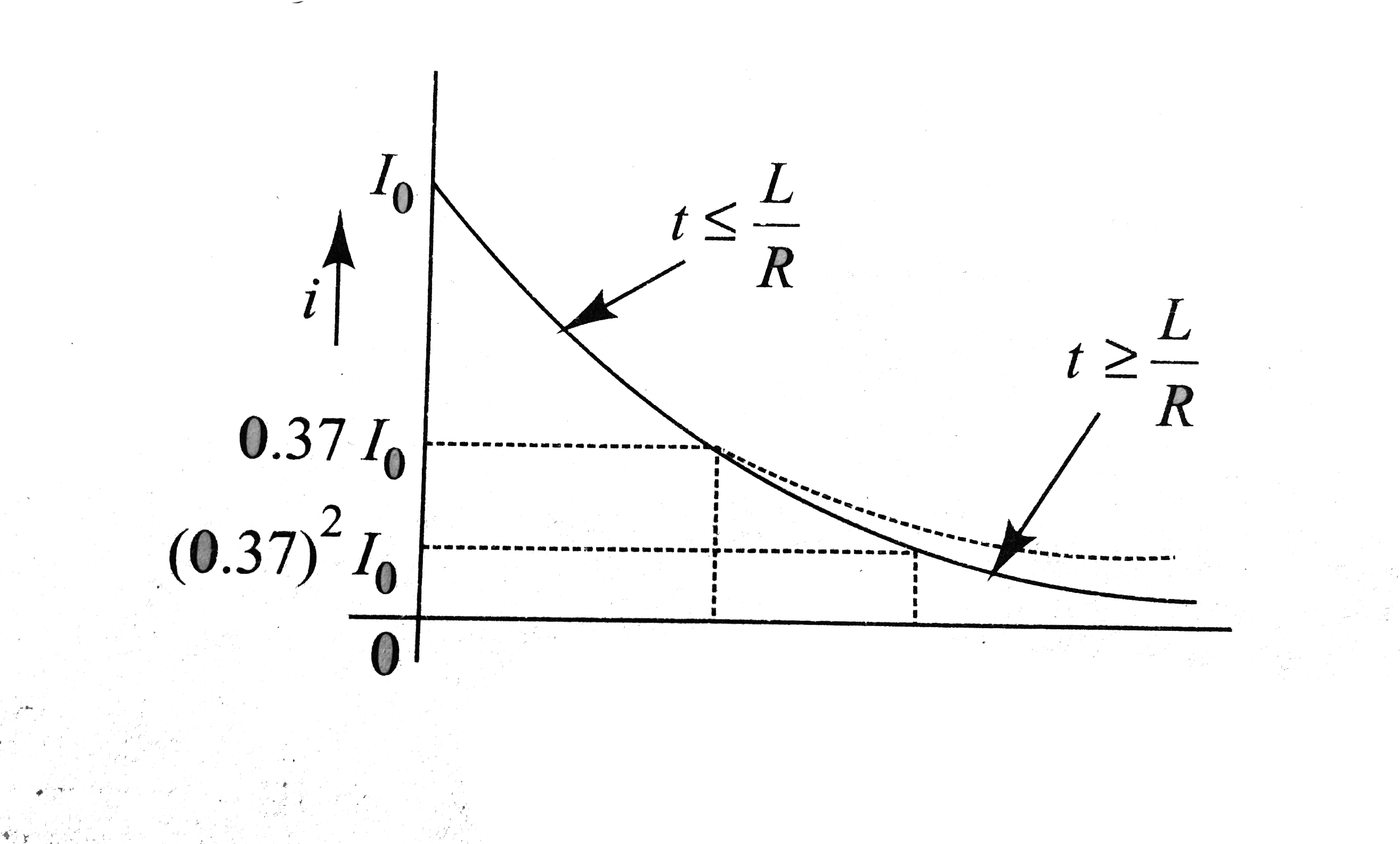 For `(R )/(L) le t le oo` and `i = (0.37) I_(0)e^((-2R)/(L)(t-(L)/(R ))` At `t = (3)/(2) (L)/(R )`, HENCE `i = (0.37) I_(0) e^((-2R)/(L)((3L)/(2R) - (L)/(R)))` or `i = (0.37)^(2) I_(0)` |
|
| 33. |
In a large building, there are 15 bulbs of 40W, 5 bulbs of 100W, 5 fans of 80W and 1 heater of 1kW. The voltage of the electric mains is 220 V. The minimum capacity of the main fuse of the building will be |
|
Answer» 8A |
|
| 34. |
The wavelenght of light from sodium sourcein vacuum is 5893Å. What are its (a) wavelenght, (b) speed and ( c) frequency when this light travels in water which has a refractive index of 1.33. |
|
Answer» Solution :Therefractive index of VACUUM, `n_(1) = 1` The wavelenght in vaccum, `lambda_(1) = 5893 Å` The speed in vacuum, `c = 3 XX 10^(8) ms^(-1)` The refractive index of water`n_(2) = 1.33` The wavelenght of light in water, `lambda_(2)` The speedof light in water, `v_(2)` (a) Theequation relating the wavelenght and refractive index is, `(lambda_(1))/(lambda_(2)) = (n_(2))/(n_(1))` Rewriting, `lambda_(2) = (n_(1))/(n_(2)) xx lambda_(1)` Substituting thevalues, `lambda_(2) = (1)/(1.33) xx 5893 Å = 4431Å RARR lambda_(2) = 4431Å` (b) The equation relating the speed and refractive index is, `(v_(1))/(v_(2)) = (n_(1))/(n_(2))` Rewriting, `v_(2) = (n_(1))/(n_(2)) xx v_(1)` Substituting the values, `v_(2) = (1)/(1.33) xx 3 xx 10^(8) = 2.256 xx 10^(8)` `v_(2) = 2.256 xx 10^(8) ms^(-1)` ( c)Frequency of light in vacuum is, `v_(1) = (c )/(lambda_(1))` Substituting the values, `v_(1) = (3 xx 10^(8))/(5893 xx 10^(-10)) = 5.091 xx 10^(14) Hz` Frequency of light in water is, `v_(2) = (v)/(lambda_(2))` Substituting the values, `v_(2)=(2.256xxx10^(8)ms^(-1))/(4431xx10^(-10))=5.091xx10^(14)Hz` The results shown that the frequency REMAINS smae in all media. |
|
| 35. |
The physical quantity having the dimensions [M^(-1)L^(-3)T^(3)A^(2)] is |
|
Answer» resistance |
|
| 36. |
Whom we call insulators ? |
| Answer» Solution :The solids which have low (= ZERO) CONDUCTIVITY if are called INSULATORS? Ex. Rubber, Wood, Stone ETC. | |
| 37. |
In non-uniform magnetic field in certain direction, current loop is placed |
|
Answer» net force and net torque on LOOP is zero. |
|
| 38. |
An object is placed at the focus of a concave lens. Where will its image be formed ? |
| Answer» SOLUTION :A virtual and erect image is FORMED exactly between optical CENTRE and the principal focus on that very side of the concave LENS | |
| 39. |
Direction : The questions 60 and 61 are based on following paragraph : An X-ray tube operated at a D.C, voltage of 40 kV produces heat at the target at the rate of 720 W. If 0.5% of the energy of the incident electron is converted into X-ray radiation, then (sp. charge is 1.8xx10^(11)C//kg). The velocity of the incident electron is |
|
Answer» `1.2xx10^(8)m//s` `:.v=SQRT(2V((e)/(m)))= sqrt(2xx40,000xx1.8xx10^(11))` `=1.2xx10^(8)m//sec` |
|
| 40. |
A wire of resistance 20 Omega is bent in the form of a circle. Then the effective resistance between the ends of the diameter is……. |
|
Answer» `5 OMEGA` 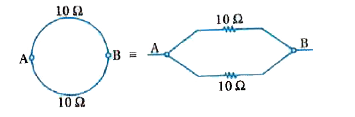 `R_(AB)=(10 TIMES 10)/(10+10)=100/20=5 Omega` |
|
| 41. |
At the corners A,B,C of a square ABCD, charges 10 mC, -20mC are placed. The electric intensity at the centre of the square to become zero, the charge to be placed at the corner Dis |
|
Answer» `-20 MC` |
|
| 42. |
For ..... mirror, height of image is always ...... than height of object. |
|
Answer» convex, LESS `therefore1/v-1/u=1/f` f is positive for convex MIRROR. `THEREFORE 1/v gt 1/u``therefore v lt u` Now,m=`|-v/u| lt 1` `therefore h. lt h` |
|
| 43. |
Which of the following is the most precise device for measuring length (i) a vernier calipers with 20 divisions on the sliding scale (ii) a screw gauge of pitch Imm and 100 divisions on the circular scale (iii) an optical instrument that can measure length to within a wavelength of light? |
|
Answer» Vernier CALIPERS |
|
| 44. |
The current passing through 20Omegaresistance in the circuit arrangement shown here will be |
|
Answer» 0.1A |
|
| 45. |
The pH of blood stream is maintained by a proper balance of H_(2)CO_(3) and NaHCO_(3) concentration. What volume of 5 M NaHCO_(3) solution should be mixed with a 10 mL sample of blood which is 2 M in H_(2)CO_(3) in order to maintain its pH ? [pk_(a)" for "H_(2)CO_(3)=6.1][10^(1.3)=19.9] |
|
Answer» Solution :`pH=pK_(a)+log.((HCO_(3)^-))/((H_(2)CO_(3)))` Let V mL of `NaHCO_(3)` is required moles of `H_(2)CO_(3)` `=2xx0.01=0.02` Let V mL of `NaHCO_(3)` is required moles of `Na_(2)CO_(3)` `=5xxV=5V`ltBrgt `thereforepH=pKa+log((5V)/(0.02))` 7.4=6.1+log`((5V)/(0.02))` ltBrgt `rArr v=79ml` |
|
| 46. |
A prism is made of glass of unknown refractive index. A parallel beam of light is incident on a face of the prism. The angle of minimum deviation is measured to be 40^(@). What is the refractive index of the materal of the prism? The refracting angle of the prism is 60^(@). If the prism is placed in water (refractive index 1.33), predict the new angle of minimum deviation of parallel beam of light. |
|
Answer» Solution :Here, `angleA = 60^(@)` and `angleD_(m) = 40^(@)` `therefore` Refractive index of glass prism `n_(g) =(sin(A+D_(m))/2)/(sinA/2) =(sin(60 + 40)/2)^(@)/(sin(60/2)^(@)) = (sin 50^(@))/(sin 30^(@)) = 0.7660/0.5000 = 1.53` When prism is placed in water `(n_(W) = 1.33)`, then `n_(GW) = 1.53/1.33 = 1.15` `RARR sin(30^(@) + D_(m)^(.)/2) = 1.15 xx 0.5000 = 0.5750` or `(30 + D_(m)^(.)/2) = sin^(-1) (0.5750) = 35.1^(@)` or `D_(m)^(.) = 2 xx 5.1 = 10.2^(@) = 10^(@)` |
|
| 47. |
(A): (1)/(sqrt(2))hati+(1)/(sqrt(2))hatjis a unit vector (R) : The component vectors of a unit vector need not be unit vectors. |
|
Answer» Both (A) and (R) are TRUE and (R) is the correct explanation of (A) |
|
| 48. |
In which frequency range, space waves are normally propagated ? |
|
Answer» HF |
|
| 49. |
A 10 V storage battery of negligibleinternal resistance is connected across a 50Omega resistor. How much heat energy is produced in the resistor in 1 hour |
| Answer» ANSWER :A | |
| 50. |
The acceleration a' in ms-2 of a particle is given by a = 3t^2 +2t+2, where is the time. If the particle starts with a velocity v = 2 m s-at i=0 then velocity at the end of 2 sec is: |
|
Answer» 12`m s^(-1)` `=u+int_(0)^(t)(3T^(2)+2T+2)dt` `=u+[(3t^(3))/(3)+(2t^(2))/(2)+2t]_(0)^(2)=2+8+4+4` =18`ms^(-1)` |
|