Saved Bookmarks
This section includes 7 InterviewSolutions, each offering curated multiple-choice questions to sharpen your Current Affairs knowledge and support exam preparation. Choose a topic below to get started.
| 1. |
Two point charges of 10^(-8)C and -10^(-8)C are placed 0*1 m apart. Calculate electric field intensity at A, B and C shown in Fig. |
|
Answer» Solution :The charges `+ 10^(-8)C and -10^(-8)C and -10^(-8)C` are held at P and Q respectively, `PQ = 0*1m` Also, `PA = PB = 0*05 m` `QA = 0*05 and CP = CQ = 0*1m` At A, fieldintensity due to charge `q_(1)` `= (1)/(4pi in_(0)) (q_(1)xx1)/(AP^(2))` , along PA `= (9xx10^(9)x10^(-8))/((0*05)^(2)) = 36000 N//C` FIELD intensity due to charge `q_(2)` `= (9xx10^(9)x10^(-8))/((0*05)^(2))` along `AQ = 36000 N//C` `:.` Net field intensity at `A = 36000 + 36000` `= 72000 N//C = 7*2xx10^(4) N//C` along AQ At B. Field intensity due to charge `q_(1)` `= (1)/(4pi in_(0)) (q_(1)xx1)/(PB^(2))` along PB producd `(9xx10^(9)xx10^(-8))/((0*05)^(2)) = 4000 N//C` `:.` Net field intensity at `B = 36000 - 4000` `= 32000 N//c` `3*2xx10^(4) N//C` , along PB produced At C, Field intensity due to charge`q_(1)` , `E_(1) = (1)/(4pi in_(0)) (q)/(PC^(2))` , along PC. `E_(1) = (9xx10^(9)xx10^(-8))/((0-1)^(2)) = 9xx10^(3) N//C` Field intensity due to charge `q_(2)` `E_(2) = (1)/(4pi in_(0))(q_(2))/(QC^(2))` along CQ, `E_(2) = (9xx10^(9)xx10^(-8))/((0*1)^(2))= 9xx10^(3) N//C` Both, `E_(1) and E_(2)` are equal in magnitude, acting at `60^(@)` to CR parallel to BA. `:.` Resulant intensity at R `= E_(1) cos 60^(@) + E_(2) cos 60^(@) = 2 E_(1) cos 60^(@)` `= 2xx9xx10^(3)xx(1)/(2) = 9xx10^(3) N//C.` It is represented by CR parallel to BA. Thecomponentsof `vec(E_(1))` and `vec(E_(2))` in directions `_|_` to CR cancel out. |
|
| 2. |
Optical fibre. communication is generally preferred over general communication system because |
|
Answer» it is more EFFICIENT |
|
| 3. |
Two idential poit charges are placed at a separation of L.P ispoint on the line joining the charges at a distance x from any one charge. The field at P is E. E is potted against x for values of x from close to zero to slightly less than L. Which of the following best represends the resulting curve ? |
|
Answer»
|
|
| 4. |
A body is projected vertically up with velocity98 ms^(-1) .After 2s if the acceleration due to gravity of earth disappears,the velocity of the body at the end of next 3 s is |
|
Answer» `49 MS^(-1)` |
|
| 5. |
The shortest wavelength in the Lyman series is 911.6Å. Then the longest wavelength in Lyman series is ...... |
|
Answer» `1215Å` `:.(1)/(lamda_(min))=R[(1)/(1^(2))-(1)/(oo^(2))]` `:.(1)/(lamda_(min))=R""......(1)` `[:.(1)/(oo^(2))=0]` For maximum wavelength n = 2, `(1)/(lamda_(min))=R[(1)/(l^(2))-(1)/(2^(2))]` `=R[(1)/(l)-(1)/(4)]` `(1)/(lamda_(max))=(3R)/(4)""......(2)` `:.(lamda_(max))/(lamda_(min))=(R)/((3R)/(4))` Taking RATIO of equation (1) and (2), `:.lamda_(max)=(4)/(3)xxlamda_(min)` `=(4)/(3)xx911.6Å` `=4xx303.9=1215.6Å` `:.lamda_(max)=1215Å` (Taking near by value in integer) |
|
| 6. |
Dimensional formula of the product of the two physical quantities P and Q is ML^(2)T^(-2) , the dimesional formula of P//Q is MT^(-2) . P and Q respectively are |
|
Answer» Force, VELOCITY |
|
| 7. |
The depletion layer is due to: |
|
Answer» Electrons |
|
| 8. |
In the above experiment, spherical balls of different radii r but of same material are chosen and dropped freely inside a vertical tube. If the time t is recorded for each ball to fall a fixed distance s after attaining a constant terminal speed then the correct graph from the observation is: |
|
Answer»
|
|
| 9. |
A narrow beam of monochromatic light of wavelength lamda emitted from a source of power P is propogating in the positive x-direction. After being reflected from a perfectly reflecting plane mirror of area vector vecA=A(-hati-hatj), the beam falls on a metal plate of surface area A[vecA is along outward normal at mirror]. the force exerted by light beam on the mirror is vecF and Deltavecp is change in momentum of each photon then [cis speed of light in vacuum] |
|
Answer» `DeltavecF=(P)/(C)(hati+hatj),DELTAVECP=(H)/(LAMDA)(-hati-hatj)` |
|
| 10. |
The radiusof earth is about6400km and that of Marsis 3200 km . The massof the earthis about10 timesthe massof Mars . An objectweighs200 Non te surfaceof Earth.Its weighton the surfaceof mars will be. |
|
Answer» 8 N |
|
| 11. |
What does depths of oppression create? |
|
Answer» oppressed |
|
| 13. |
Consider the D-T reaction (deuterium-tritium fusion) " "_(1)^(2)H + " "_(1)^(3)H to " "_(2)^(4)He + n (a) Calculate the energy released in MeV in this reaction from the data: m(" "_(1)^(2)H) = 2.014102 u, m(" "_(1)^(3)H) = 3.016049 u (b) Consider the radius of both deuterium and tritium to be approximately 2.0 fm. What is the kinetic energy needed to overcome the coulomb repulsion between the two nuclei ? To what temperature must the gas be heated to initiate the reaction ? (Hint: Kinetic energy required for one fusion event = average thermal kinetic energy available with the interacting particles = 2(3kT/2), k = Boltzman’s constant, T = absolute temperature.) |
|
Answer» Solution :(a) The process is `" "_(1)^(2)H + " "_(1)^(3)H to " "_(2)^(4)He + " "_(0)^(1)N + Q` `therefore Q = m[ " "_(1)^(2)H+" "_(1)^(3)H -" "_(2)^(4)He - " "_(0)^(1)n ] XX 931.5 MeV = (2.014102 + 3.016049 - 4.002603 - 1.008665) xx 931.5 MeV = 0.018878 xx 931.5 MeV = 17.59 MeV`. (b) The nuclei must be brought together against the forces of repulsion. The material must be in the form of gas at high temperature. The average K.E. of a nucleus is `1/2mv^(2)=3/2k_(B)T or mv^(2)=3k_(B)T` The two nuclei before meeting have a K.E. equal to 3kg T. If they approach each other within a distance r then their P.E. `U=1/(4piepsilon_(0)).(Z_(1)Z_(2)e^(2))/r=9xx10^(9)xx(1xx1(1.6xx10^(-19))^(2))/(2xx1.5xx10^(-15)=7.68Jxx10^(-14)J` `therefore 3k_(B)T=7.68xx10^(-14) IMPLIES T=(7.68xx10^(-14))/(3xx1.38xx10^(-23))=1.85xx10^(9)K`. |
|
| 14. |
An annular metal disc has a mass of 10 kg, inner radius of 4 m, and outer radius of 8m. It is rotating about it's axis passing through centre and perpendicular to the plane. If rotational energy at any instant of this disc is 800 J, how fast (in rpm) it is rotating? |
|
Answer» The rotational kinetic energy is `k = 1/2 OMEGA^(2)`. We slove this for the angular speed: `omega= sqrt((2K)/(I)) = sqrt((4K)/(M(R_(1)^(2)+R_(2)^(2)))) = 2 rad//sec`. |
|
| 15. |
The electric field at a point on equatorial ofa dipole and directionof the dipole moment |
|
Answer» Will be parallel |
|
| 16. |
The intensity of centralfringein the interference pattern produced by two identical slits is I. When one of the slits is closed then the slits is closed then the intensity at the same points is I_(0) .The realtionbetween I and I_(0) is |
|
Answer» `I=4I_(0)` |
|
| 17. |
A circular disc is placed in front of a narrow source. When the point of observation is 2 m from the disc, then it covers first HPZ. The intensity at this point is I . When the point of observation is 25 cm from the disc then intensity will be |
|
Answer» `((R_(6))/(R_(2)))^(2)I` |
|
| 18. |
64 small droplets of the same size are charged to 10V each. They coalesce to form a bigger drop. Potential of the bigger drop is |
|
Answer» 160V |
|
| 19. |
If the potential difference applied to the tube is doubled and the separation between the filament and the target is also doubled, the cut off wavelength will |
|
Answer» REMAIN UNCHANGED |
|
| 20. |
विद्युत क्षेत्र की तीव्रता का मात्रक हैं - |
|
Answer» जुल /कुलॉम |
|
| 21. |
A galvanometer of resistance 95Omega , shunted by a resistance of 5 ohm gives a deflection of 50 divisions when joined in series with a resistance of 20 kOmega and a 2 volt accumulator. What is the current sensitivity of the galvanometer (in div / muA )? |
Answer» Solution : In accordance with given problem, the situation is depicted by the CIRCUIT diagram in fig. As here `20 KOMEGA` is much greater than the resistance of shunted galvanometer ( < 5`Omega` ), the current in the circuit will be `I=2/(20xx10^(3))=10^(-4)A=100muA` and as this current PRODUCES DEFLECTION of 50 divisions in the galvanometer `CS=(theta)/I=(50"div")/(100muA)=1/2("div")/(MUA)` |
|
| 22. |
Calculate the thickness of a quarter-wave plate of quartx for sodium light. Given mu_(0)=1.54425 and mu_(E)=1.55336. |
|
Answer» |
|
| 23. |
Write the condition of n^(th) order maximum in diffraction. |
|
Answer» SOLUTION :(i) Angular width of central maximum GIVEN but `2theta=(2lamda)/(d)impliestheta=(lamda)/(d)""....(1)` For first LIGHT, `theta_(1)=(lamda_(1))/(d)` and for second light, `theta_(2)=(lamda_(2))/(d)` `:.(theta_(2))/(theta_(1))=(lamda_(2))/(lamda_(1))""......(2)` But `theta_(2)` is 30% less that of `theta_(1)` That is, `theta_(2)=7-%` of `theta_(1)` `:.(theta_(2))/(theta_(1))=0.7` From equation (2), `(lamda_(2))/(lamda_(1))=0.7` `:.lamda_(2)=0.7xx6000Å=4200Å` That is, wavelength in a liquid is `4200Å`. Wavelength in air `lamda_(1)=6000Å` Wavelength in a liquid `lamda_(2)=4200Å` (ii) Now refractive INDEX of liquid, `n=(lamda_(1))/(lamda_(2))` `=(6000)/(4200)` `:.n=1.43` |
|
| 24. |
A copper disc of radius 10 cm placed with its plane normal to a uniform magnetic field completes 1200 rotations per minute. If induced emf between the centre and the edge of the disc is 6.284 mV, Find the intensity of the magnitude field. Take pi=3.142 |
|
Answer» |
|
| 25. |
Energy equivalent of one atomic mass unit is |
|
Answer» 931eV |
|
| 26. |
A thin rod of length 'b' is suspended horizontally using ideal strings tied to both ends of the rod. The length of the strings is 'a'. The rod is given an initial angular speed omega its central axis. Let deltay be the upwards displacement of rod's centre in a small time interval deltatt and deltaF be th total increment in the tension forces just after the rod was given the angular speed. |
|
Answer» `delay=(b^(2))/(8a)(OMEGA delta t)^(2)` and `theta_(a)=(bphi)/2` `IMPLIES deltay=a/2((bphi)/2)^(2)=(b^(2))/(8a)phi^(2)` `impliesdeltay=(b^(2))/(8a)(omega delta t)^(2)` acc. of rod's CENTRE `=(b^(2))/(4a)omega^(2)` `implies delta F=(mb^(2))/(4a) omega^(2)` 
|
|
| 27. |
A point moving along the x- direction starts from rest at x=0 and comes to rest at x=1 after 1 s. Its acceleration at any point is denoted by alpha . Which of the following is not correct ? |
|
Answer» `alpha` must change sign during the motion. |
|
| 28. |
Arrange visible rays, infrared rays, X - rays and microwaves in ascending order of their frequency |
| Answer» Solution :MICROWAVES `RIGHTARROW` infrared `rightarrow` VISIBLE RAYS `rightarrow` X - rays. | |
| 29. |
9 kg solution is poured into a glass U-tube as shown in the figure below. The tube's inner diameter is 2 sqrt((pi)/(5)) m and the solution oscillates freely up and down about its positon of equilibrium (x - 0). The period of oscillation in seconds is (1 m^(3) of solution has a mass mu = 900 kg, g = 10 m // s^(2) ignor friction and surface tension effects |
|
Answer» 0 `:.` RADIUS of tube (r ) `= sqrt((pi)/(5)) m` mass of solution (U) =9 kg we know that, `:'` mass (u) = d.v `:.U = d pi r^(2) L` or ,K `9 xx 900 xx pi xx (sqrt((pi)/(5)))^(2) L` or `9 = 900 xx (pi^(2))/(5) xx L` or, `L = (5)/(100 pi^(2))` Now, `T = 2 pi sqrt((L)/(2g))` Form eq (i) `T = 2 pi sqrt((5)/(200 pi^(2) xx 10))` or, `T = 2 xx sqrt((1)/(400)) = (2)/(20)` or T = 0.1 s |
|
| 30. |
A point object moves in + x-direction with v= 1 m/s along the principal axis of the concave mirror of focal length f=10 m. When the mirror moves with a velocity V_(m)=-hati m/s and the object is at a distance of p=15 m, the speed of the image is - |
|
Answer» `-8hatim//s` `or- OVERSET(-)v_(om//p^(2))=overset(-)V_(im//q^(2))` `oroverset(-)v_(im)=-((q)/(p))^(2)" "overset(-)V_("om")` If p=15, `(1)/(q)=(1)/(f)-(1)/(p)=(1)/(10)-(1)/(15)` `or q=30 m. Then, q//p=30//15=2.Hence` `overset(-)v_("im")=-(2)^(2)V_("om")` or `overset(-)V_(i)=overset(-)V_("im")+overset(-)V_("m")=-(2)^(2)" "overset(-)V_("om")+overset(-)V_("m")` `-4[(hati)-(-hati)]+(hati)=-9(hati)m//s` |
|
| 31. |
The intrinsic semi conductor behaves as insulatorat |
| Answer» ANSWER :D | |
| 32. |
A battery of emf epsilon_0 = 5V and internal resistance 5 Omega is connected across a long uniform wire AB of length 1m and resistance per unit length5 Omegam^(-1). Two cells of epsilon_1 = 1 V and epsilon_2 = 2V are connected as shown in the figure. |
|
Answer» the null point is at A. For null point, current flows in the loop CD only. 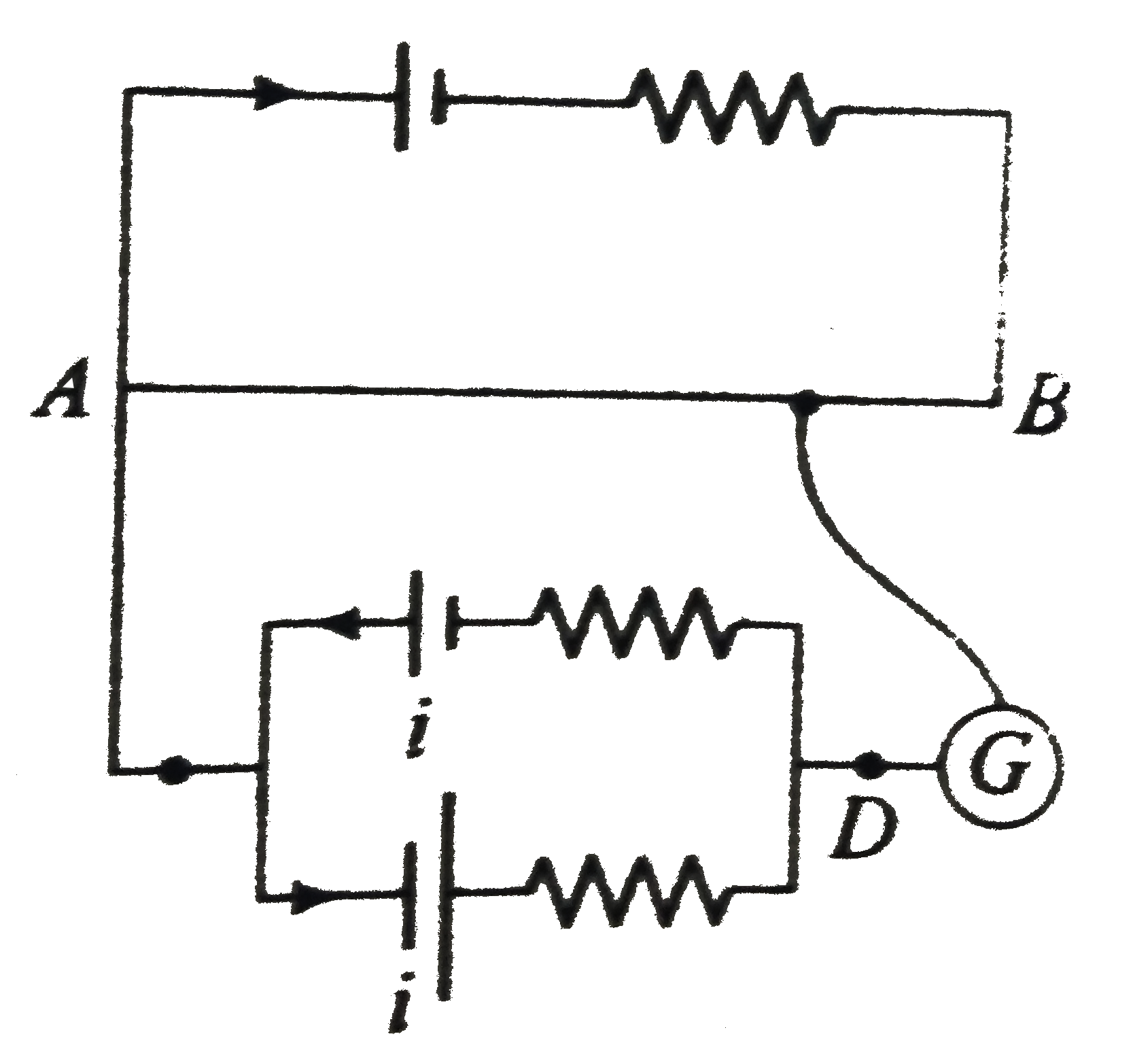 `i = (3V)/(2OMEGA + 1Omega) = 1A` `V_(CD) = 1V - 1(1) = 0` Therefore, OPTION (a) is correct. That is, `V_(A) gt V_(B)`. When jockey touches B, current from A to B increases the PD across the secondary CIRCUIT. Therefore, option(b) is correct. |
|
| 34. |
If the value of potential is an a.c, circuit is 10 V. Then what is the peak value of potential ? |
|
Answer» `10/sqrt2` `=sqrt2xx10` `THEREFORE V_m=10sqrt2`V |
|
| 35. |
Myopia is corrected by using a |
|
Answer» CYLINDRICAL lens |
|
| 36. |
Electrical force is acting between two charge kept in vacuum. A copper plate is placed between the charges, the force now is |
|
Answer» more |
|
| 37. |
If By mistake Battey is connected between B and C Galvanometer is connected across A and C then . |
|
Answer» We cannot GET balanced point |
|
| 38. |
The displacement-time graph of a moving particle is shown below. The instantaneous velocity of the particle is negative at the point |
|
Answer» C |
|
| 39. |
A solid sphere rolls down a parabolic path , whose vertical dimension is given by y = kx^(2) and base of the parabola is at x = 0 . During the fall the sphere does not slip, but beyond the base the climb is frictionless. If the sphere falls through a height h, the height above the base that it would climb is |
| Answer» ANSWER :D | |
| 40. |
Solubility of Solid in liquid ……………….. with increase in pressure |
|
Answer» INCREASE |
|
| 41. |
दर्शाये गये दीर्घवृत्त का क्षेत्रफल ज्ञात कीजिए |
| Answer» Answer :A | |
| 42. |
Which of the following gates corresponds to the truth table given below : {:(A,B,Y),(1,1,0),(1,0,1),(0,1,1),(0,0,1):} |
|
Answer» NAND |
|
| 43. |
One way to attack a satellite in Earth orbit is to launch a swarm of pellets in the same orbit as the satellite but in the opposite direction. Suppose a satellite in a circular orbit 500 km above Earth's surface collides with a pellet having mass 5.0 g. (a) What is the kinetic energy of the pellet in the reference frame of the satellite just before the collision? (b) What is the ratio of this kinetic energy to the kinetic energy of a 5.0 g bullet from a modern army rifle with a muzzle speed of 950 m/s? |
| Answer» SOLUTION :(a) `~~5.8 XX 10^5 J,` (B) `~~ 2.6 xx 10^2` | |
| 44. |
Area of indicator diagram of a Carnot cycle represents… by the angine/cycle. |
|
Answer» The amount of heat ABSORBED |
|
| 45. |
An electron is revolving around a nucleus of hydrogen atom in the first orbit. The radius of this orbit is 0.53 A. Choose the correct option(s) |
|
Answer» The RADIUS of the first orbit of hydrogen-like atom `He^(+)` is `1.06 Å` |
|
| 46. |
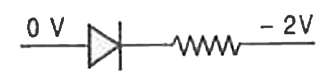
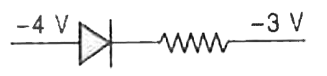
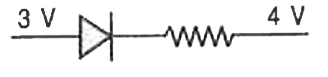
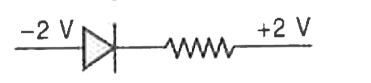
The forward biased diode is : |
|
Answer» <P> |
|
| 47. |
Derive the expression for the resultant displacement and amplitude when two waves having the same amplitudeand a phase differenceof phi superpose. |
|
Answer» Solution :Consider TWO WAVES having the same AMPLITUDE a and a phasedifference of `phi`. Let the displacement produced by source `S_1` be by `y_1` = a cos wt and by `S_2` be the `y_2=a cos (wt + phi)` The RESULTANT displacement `y=y_1+y_2` `y=a cos wt + a cos (wt + phi)` Using the formula , cos A + cos B = 2cos `((A+B)/2)cos ((A-B)/2)` `y=a[cos wt + cos (wt + phi)]=2A cos ((wt+wt+phi)/2)cos ((wt-wt+phi)/2)` `y=2a cos ((2wt+phi)/2) cos (phi/2)=2acos phi/2 cos ((2wt+phi)/2)` The amplitude of the resultantdisplacement is = `2a cos phi/2` |
|
| 48. |
A body of mass 10 kg is moving with a velocity of 100 m/s. Find the magnitude of the force required to stop it in 10 seconds. How much distance will it move through before coming to rest ? |
| Answer» Answer :A | |
| 49. |
An inductor of reactance 1 Omegaand a resistor of 2 Omegaare connected in series to the terminals of a 6 V (rms) a.c. source. The power dissipated in the circuit is |
|
Answer» 8 W `therefore Z = sqrt(R^(2) + X_(L)^(2)) = sqrt((2)^(2) + (1)^(2)) = sqrt(5) Omega` `I_(rms) = V_(rms)/Z = 6/sqrt(5)A` and `cos phi = R/Z = 2/sqrt(5)` `therefore 6 xx 6/sqrt(5) xx 2/sqrt(5) = 14.4`W |
|