

Saved Bookmarks
This section includes 7 InterviewSolutions, each offering curated multiple-choice questions to sharpen your Current Affairs knowledge and support exam preparation. Choose a topic below to get started.
| 1. |
If the focal length of objective lens is increased then magnifying power of |
|
Answer» MICROSCOPE will INCREASE but that of TELESCOPE decrease |
|
| 2. |
If ratio of concentration of electrons to that of holes in a semiconductor is 7/5 and the ratio of currents is 7/4 , what is the ratio of their drift velocities ? |
|
Answer» `4/7` `v_e/v_h=I_e/I_hxxn_h/n_e=7/4xx5/7=5/4` |
|
| 3. |
A wooden box is placed on the back part of a lorry moving with an acceleration of 6ms^(-2), if mu = 0.5, the acceleration of the box relative to lorry is |
|
Answer» `1.1 ms^(-2)` |
|
| 4. |
Using the Bohr model, (a) calculate the speed of the electrons in a hydrogen atom in n =1, 2, and 3 level and (b) calculate the orbital period in each of these levels. |
| Answer» SOLUTION :(a) `2.18xx10^(6)m//s, 1.09xx10^(6)m//s, 7.27xx10^(6)m//s`, (B)`1.53xx10^(-16)s, 1.22xx10^(-15)s, 4.13xx10^(-15)s` | |
| 5. |
Find out the atomic number of the element which gives X-ray of minimum wavelength 0.252 nm of K series (R=1.09737xx10^(7)m^(-1)) |
|
Answer» 2 For the minimum wavelength we have to take `n=oo` `:. (1)/(lambda_(min))=R(Z-1)^(2)[1-0]` `:.(1)/(lambda_(min))=R(Z-1)^(2)` `:.[Z-1]^(2)=(1)/(R lambda_(min))=(1)/(1.097xx10^(7)xx252xx10^(-12))` `:.[Z-1]^(2)=(10^(5))/(1.097xx252)=0.0036174xx10^(5)` `:.[Z-1]^(2)=361.74` `Z-1=19.02=19` `:.Z=19+1=20` |
|
| 6. |
Light of wavelength 5000^(@)A falls on a sensitive plate with photo electric work function 1.9eV. The kinetic energy of the photo electrons emitted will be |
|
Answer» 0.58 EV |
|
| 7. |
Identify the correct statement among the following. |
|
Answer» CYCLOTRON frequency is dependent on speed of the CHARGED particle |
|
| 8. |
Annihilation of 1g of matter theoretically yield energy of the order of [c=3×10^8 ms^(-1)] |
|
Answer» `10^10eV` |
|
| 9. |
A block kept on a rough surface starts sliding when the inclination of thesurface is theta with respect to the horizontal . The coefficient of static friction between the block and the surface is |
|
Answer» `sin theta` So correct choice is (b). |
|
| 10. |
X-rays are not used for radar purposes, because they are not : |
|
Answer» REFLECTED by TARGET |
|
| 11. |
In the junction transistor voltage amplifier circuit of figure, if R_(1)=100kOmega,R_(2)=1kOmega,V_(C C)=6.0V and V_(BE)=0.6V current gain=60 |
|
Answer» `I_(B)=54muA` |
|
| 12. |
State another two important property of gamma rays. |
| Answer» SOLUTION :They can PRODUCE fluorescence in some SUBSTANCE like,zinc sulphide,BARIUM platicyanide etc. | |
| 13. |
(a) If BCD is in the plane of AB and DE, find the magnetic induction at centre O due to a current i in the conductors. (b) The loop is made of same wire and uniform in cross-section. Find magnetic field at O. |
Answer» Solution :(a) 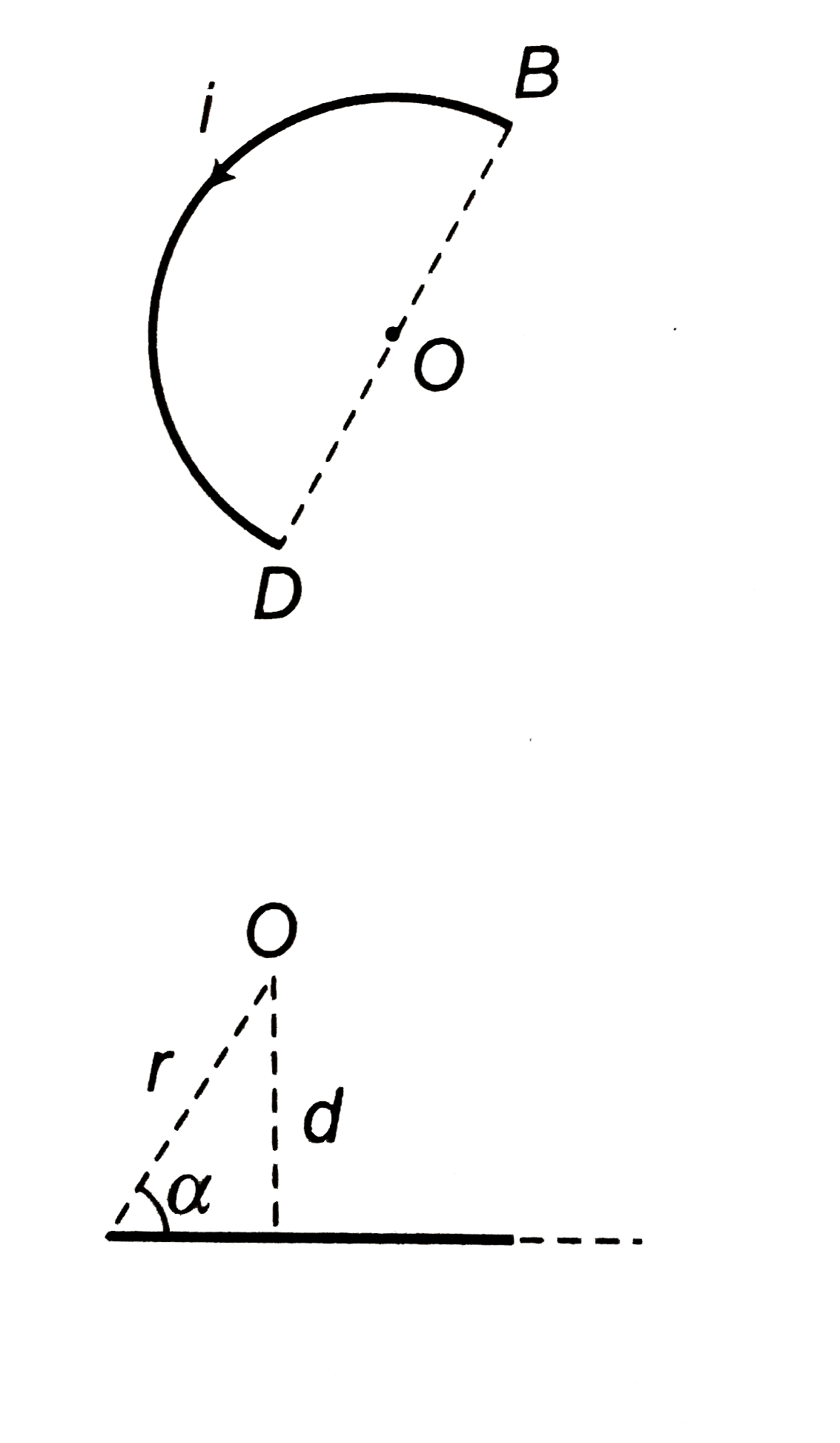 `d=R sin alpha` `theta_(1)=(pi-alpha),theta_(2) to 0` `B_(1)=(mu_(0)i)/(4pid)(costheta_(1)+cos theta_(2))` `=(mu_(0)i)/(4pirsin alpha)[cos(pi-a)+cos0]` `=(mu_(0)i)/(4pir sin alpha) (1-cos alpha), o.` 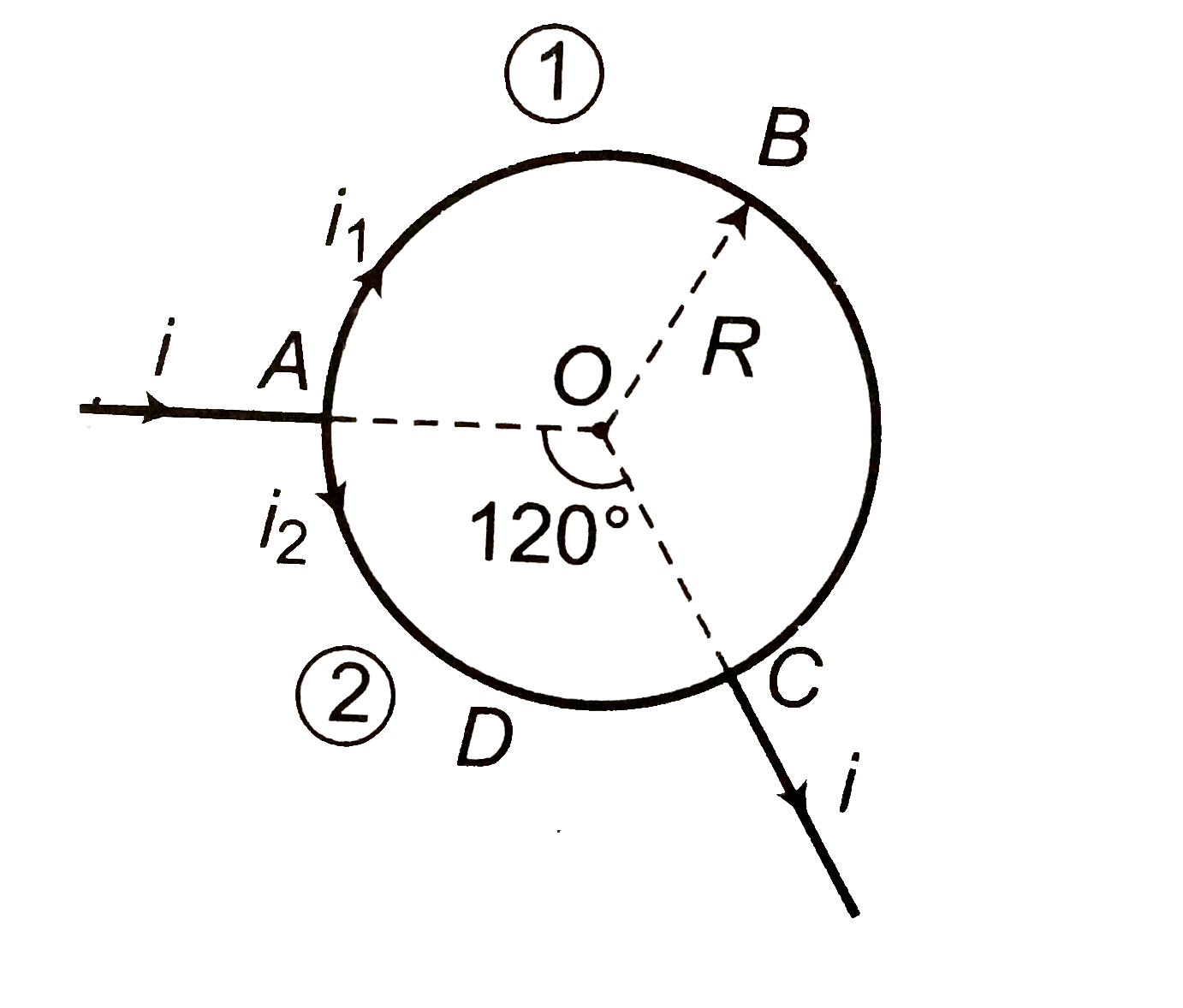 `B_(2)=(mu_(0)i)/(4r), o.`  `d=rsin alpha` `theta_(1)=alpha,theta_(2)to0` `B_(3)=(mu_(0)i)/(4pir sin alpha)(cos alpha+cos0)` `=(mu_(0)i)/(4pir sin alpha)(1+cos alpha), o.` `B_(O)=B_(1)+B_(3)+B_(2)=(mu_(0)i)/(2pir sin alpha)+(mu_(0)i)/(4r), o.` (b)  Length of `ABC=2` (length of `ADC`) `R_(ABC)=R_(1)=2R_(0),R_(ADC)=R_(2)=R_(0)` `i_(1)=(R_(2))/(R_(1)+R_(2))i=(R_(0))/(2R_(0)+R_(0))i=i/3` `i_(2)=i-i_(1)=(2i)/3` `B_(1)=(mu_(0)i_(1))/(2R).(240^(@))/(360^(@))=(mu_(0)i_(1))/(3R)=(mu_(0)i)/(9R), ox` `B_(2)=(mu_(0)i_(2))/(2R).(120^(@))/(360^(@))=(mu_(0)i_(1))/(6R) (mu_(0)i)/(9R), o.` `B_(O)=B_(1)-B_(2)=0` |
|
| 14. |
During your study in a junior school you were told that light travels in a straight line. But now you know that light travels as a wave and it can bend around objects. In optical region light has a wavelength of about half a micrometre. If it encounters an obstacle of about this size, it may bend around it and can be seen on the other side. however, if the obstacle is much larger, light will not be able to bend to that extent and will not be seen on other side. This is a general property of waves and can be seen in sound waves too. the sound wave of our spech has a wavelength of about 50 cm-1m. if it meets an obstacle of the size of a few metres, it bends around it and reaches points behind the obstacle. but when it comes, across a larger obstacle of a few hundred metres, such as a hillock, most of it is reflected back and is heard as an echo. Q. What is diffraction of light ? |
| Answer» Solution :Diffraction of LIGHT is the phenomenon of BENDING of light around EDGES of small SIZED obstacles and apertures (slits) and penetration of light even in the region of GEOMETRICAL shadow. | |
| 15. |
Consider a uniformly charged spherical shell. Two cones having same semi vertical angle, and their common apex at P, intercept the shell. The intercepts have area DeltaS1 and DeltaS2. For a cone of very small angle, DeltaS1 and DeltaS2 will be very small and charge on them can be regarded as point charge for the purpose of writing electric field at point P. Prove that the charge on DeltaS1 and DeltaS2 produce equal and opposite field at P. Hence, argue that field at all points inside the uniformly charged spherical shell is zero. |
| Answer» | |
| 16. |
शुक्रजनक नलिकाएँ किसमें होती है ?: |
|
Answer» वृक्क |
|
| 18. |
Assertion :- A thin aluminum disc, spinning freely about a central pivot, is quickly brought to rest when placed between the poles of a strong U-shaped magnet. Reason :- A current induced in a disc rotating in a magnetic field produces a torque which tends to oppose the disc's motion. |
|
Answer» If the Assertion & Reason are TRUE& the Reason is a CORRECT explanation of the Assertion . |
|
| 19. |
The dispersive powers of flint glass and crown glass are 0.053 and 0.034 respectively and their mean refractive indices are 1.68 and 1.53 for white light .Calculate the angle of the flint glass prism required to form an achromatic combination with a crown glass prism of refracting anlge 4^@ . |
|
Answer» `2^@` |
|
| 20. |
In the figure shown W1 represent the cross section of an infinitely long wire carrying current I1 into the plane of the fig. AB is a line of length L and the wire W1 is symmetrically located with respect to the line. The line integral int_(A)^(B) vec(B).vec(d)l. d l along the line from A to B is equal to – a_(0) where a_(0) is a positive number. Another long wire W2 is placed symmetrically with respect to AB (see fig) and the value of int_(A)^(B) vec(B).vec(d)l becomes zero. Consider a line DC to the right of W2. The line is parallel to AB and has same length. The two wires fall on perpendicular bisector of both lines. If int_C^D vec(B).vec(d)=2a_(0) with both wires W1 and W2 present, calculate the ratio of current I_(2) /I_(1) in the two wires. |
|
Answer» |
|
| 21. |
A body of mass 1 kg initially at rest explodes and breaks into three segments of masses in the ratio 1:1:3. The two pieces of equal mass fly off perpendicular to each other, with a speed of 15 m/s each. The speed of the heavier fragment is |
|
Answer» `5 SQRT 2m//s` |
|
| 22. |
(A) : A linear solenoid carrying current is equivalent to a bar magnet. (R) : The magnetic field lines of both are same. |
|
Answer» Both 'A' and 'R' are true and 'R' is the CORRECT EXPLANATION of 'A'. |
|
| 23. |
Define modulation index. Draw a plot of veriation of amplitude vs. omega for an amplitude modulated wave. |
|
Answer» Solution :If the EQUATION for this carrier wave is `V = V_(0) sin OMEGA t`, and that of the data signal is V = `V_(0) sin Omega t`, then the equation for the AMPLITUDE modulated wave would be, `V_(m) = V_(0)( 1 + beta sin omega t) sin Omega t` Here, modulation index, `beta = k(v_(0))/(V_(0))`, k is a dimensionless CONSTANT The veriation of the amplitude of this wave with the angular frequency `omega` of the data signal is shown in FIG. 1.18. 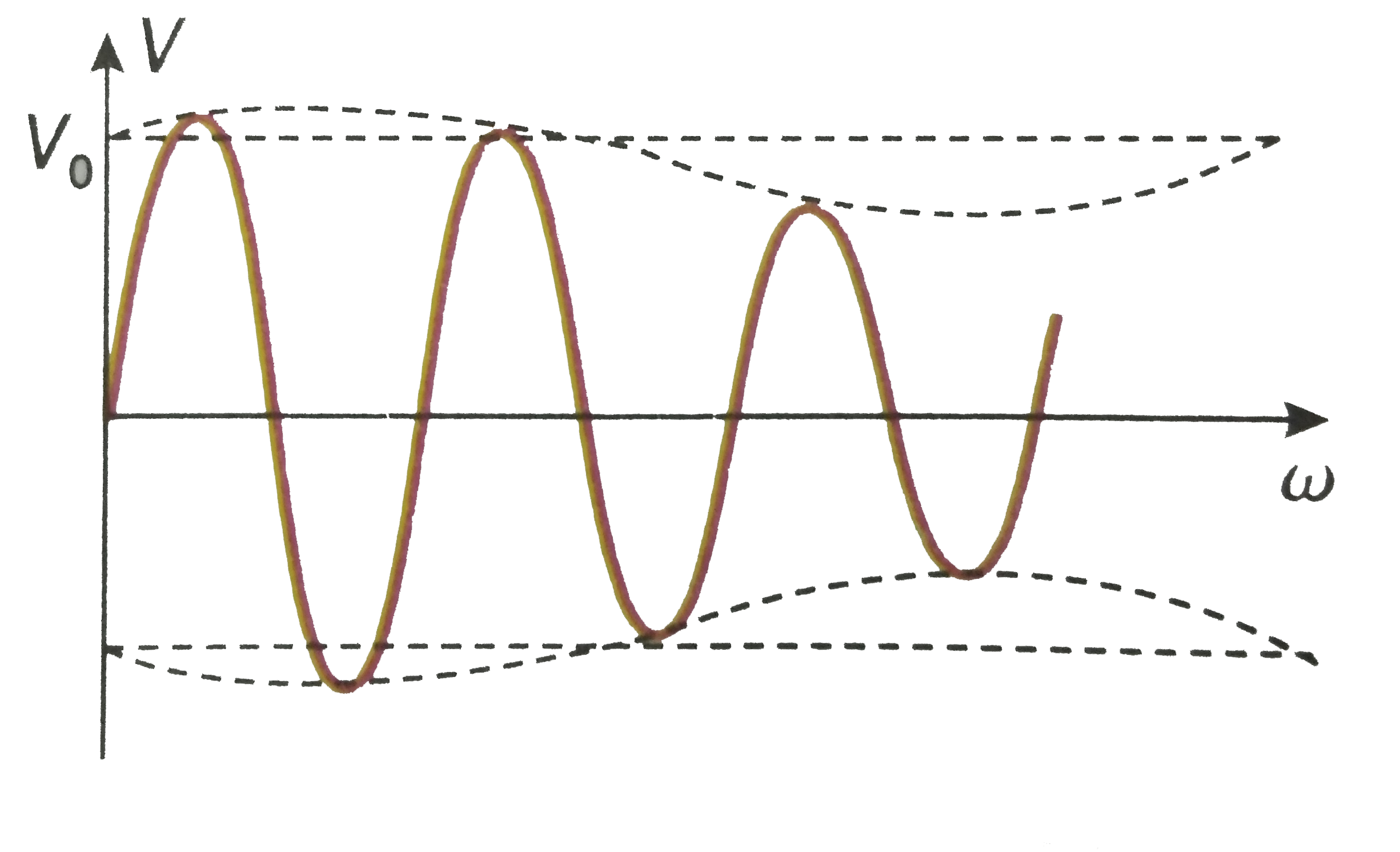
|
|
| 24. |
What is diffraction of light? |
| Answer» Solution :The phenomenon of bending of light around the SHARP edge of an obstacle and its encroachment into the REGION of GEOMETRICAL SHADOW is KNOWN as diffraction of light. | |
| 25. |
A man slides down on a telegraphic pole with an acceleration equal to one-fourth of acceleration due to gravity. The frictional force between man and pole is equal to in terms of man's weight w |
| Answer» ANSWER :C | |
| 26. |
A metal sphere A of radius a is charged to potential V .what will be its potential if it is enclosed by a spherical conducting shell B of radius b and the two are connected by a wire |
|
Answer» `a/B""V` |
|
| 27. |
Find the magnetic field at the centre P of square of side shown in figure. |
| Answer» SOLUTION :`((2sqrt(2)-1)mu_0i)/(PI a)` | |
| 28. |
The current I in the circuit shown is |
Answer» Solution :Givencircultcan beredrawn asshownin FIGURE herefirsttwocellsare inparallelso netemf `epsi_(eq) = ( sumepsi/r 2/1 + 2/2 )/(sum 1/r1/1 +1/2) =2V` currentin thecircuit ,` I= (2 +2)/( 1+2) =4/3=1.33A ` |
|
| 29. |
Two bar magnets placed together in a vibration magnetometer take 3 seconds for 1 vibration. If one magnet is reversed, the combination takes 4 seconds for 1 vibration. Find the ratio of their magnetic moments. |
|
Answer» Solution :GIVEN that,`T_1 = 3S and T_2 = 4s ` `(M_1)/(M_2) = (T_2^(2) + T_1^(2))/(T_2^(2)-T_1^(2))=(4^(2) + 3^(2))//(4^(2) - 3^(2)) = (16+9)/(16-9) = (25)/(7)` ` or (M_1)/(M_2)=3.57` |
|
| 30. |
(A): An induced current develop in a conductor moved in a direction parallel to the magnetic field. (R): An induced current is developed when the number of magnetic lines of force associated with conductor is changed. |
|
Answer» Both .A. and .R. are TRUE and .R. is the CORRECT EXPLANATION of .A. |
|
| 31. |
An insect trapped in a circular groove of radius 12 cm moves along the groove steadily and completes 7 revolutions in 100 s. (a) What is the angular speed, and the linear speed of the motion ? (b) Is the acceleration vector a constant vector ? What is its magnitude ? |
|
Answer» Solution :This is an EXAMPLE of uniform CIRCULAR motion. Here R=12 CM the ANGULAR speed `omega` is given by `omega=2pi //T=2pixx7//100=0.44` rad/s |
|
| 32. |
For a telescope to have large resolving power, then the |
|
Answer» FOCAL LENGTH of its OBJECTIVE should be large |
|
| 33. |
Dimensions of resistance in an electrical circuit, in terms of dimension of mass M, oflength L., of time T and current I, would be |
|
Answer» `ML^(2) T^(-3) I^(-2)` |
|
| 34. |
The half-lives of radioactive nuclides that emit alpha-rays very formmicrosecond to billion years. What is the reason for this large variation in the life of alpha emitters? |
| Answer» Solution :The radioactive decay is governed by the law of mass action. There is absolutely no way to predict WHETHER any given nucleus in a radioactive sample will be among the small number of NUCLEI that decay during the next moment. All nuclei have the same probability of disintegration. Therefore, half lives of radioactive nuclides that emite `alpha` particle MAY be in microseconds. HOWEVER, half lives for alpha decay of most of the alpha UNSTABLE nuclei are very long. This has been explaind in terms to tunnelling of nucleus. | |
| 35. |
In the figure shown, the currents through the series resistance and load resistance are respectively |
|
Answer» 9MA, 14mA |
|
| 36. |
A proton and an electron have same kinetic energy. Which one has smaller de-Broglie wavelength ? |
|
Answer» SOLUTION :Electron. As `LAMBDA PROP (1)/(sqrtm)` (for same KINETIC energy). |
|
| 37. |
How is a battery connected to a junction dioide in (i) forward and (ii) reverse bias ? |
|
Answer» Solution :(i) In p-n JUNCTION diode,if p-side is CONNECTED to positive terminal of a celland n-side to negative terminal,it is called forward BIAS. (II) In a p-n junction diode, p-side is connected to negativeterminal of a celland n-side to positive terminal, it is called reverse bias. 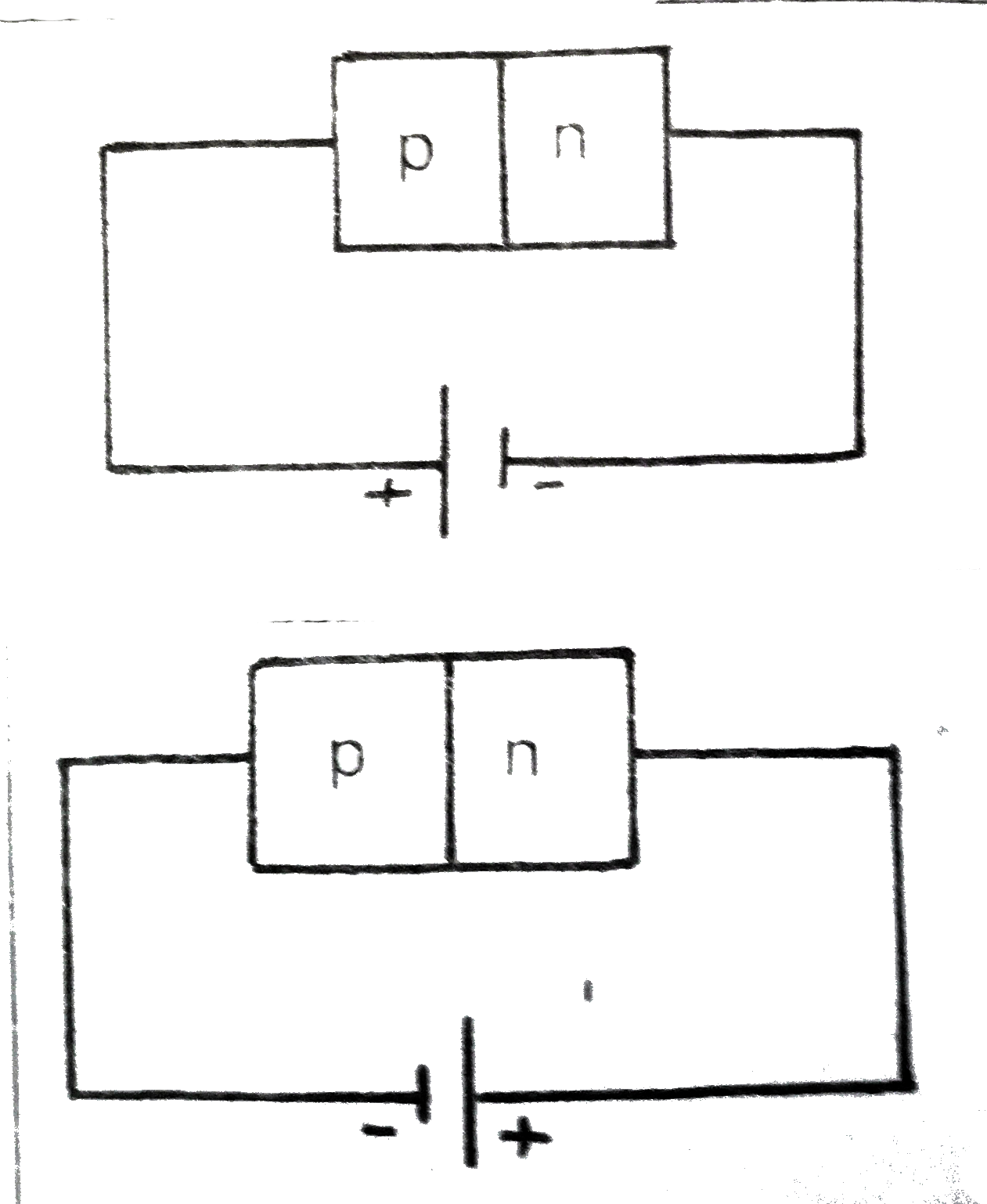
|
|
| 38. |
In Young's double slit experiment, two slits are made 5 mm apart and the screen is palced 2m away . What is the fringe separation when light of wavelength 500 nm is used ? |
|
Answer» 0.002 m m `= (500 XX 10^(-9) xx2)/(5 xx 10^(-3))` `= 200 xx 10^(-6) = 2 xx 10^(-4) = 0.2 m m ` |
|
| 39. |
There are two coils A and B separated by some distance. If a current of 2 A flows through A, a magnetic flux of 10^(-2) Wb passes through B (no current through B). If no current passes through A and a current of 1 A passes through B, what is the flux through A ? |
|
Answer» Solution :As PER question initially `I_(A) = 2 A, I_(B) = 0 and phi_(B) = 10^(-2)` Wb. As per relation `phi_(B) = Ml_(A)`, we have `M = (phi_(B))/I_(A) = 10^(-2)/2 =xx 10^(-3)H` Finally `l._(A) = 0, I._(B) = 1 A`. Hence, magnetic flux passing through A will be `phi._(A) = MI._(B) = (5 xx 10^(3)) xx 1 = 5 xx 10^(-3)Wb.` |
|
| 40. |
The gap between the plates of a parallel plate capacitor of area A and distance between plates d, is filled with a dielectric whose relative permittivity varies linearly from epsi_1 at one plate toepsi_2 at the other. The capacitance of capacitor is: |
|
Answer» `( epsi_0( epsi_2 - epsi_1)A)/([d In (epsi_2 // epsi_1)])` |
|
| 41. |
In Fig. 26.23, a battery of potential differenc V= 12 V is connected to a resistive strip of resistance R=4.0 Omega. When an electron moves through the strip from one end to the other, (a) in which direction in the figure does the electron move, (b) how much work is done on the electron by the electric field in the strip, and (c) how much energy is transferred to the thermal energy of the strip by the electron? |
|
Answer» |
|
| 42. |
A gas undergoes an isothermal change , it's specific heat in the process is |
|
Answer» 0 |
|
| 43. |
Kinetic energy of each electron in a beam of television picture tube is 12.0 keV. The electrons are emitted horizontally from geomagnetic south to geomagnetic north. The vertial componenet of earths magneticfield points down and has a magnitude 55.0 mu T.(a) In which direction will the electrons deflect ? (b) How far will the beam deflect in moving 20.00 cm through the television tube ? |
Answer» Solution :`(a)` Figure shows the electron traveling north. The magnetic field points inward. From right hand rule `vec(V)xxvec(B)` vector is toward west. Since electron is negative, the force on it is toward EAST.  `(b)` The electron speed can be determined from kinetic energy. `K=(1)/(2)m upsilon^(2), ""upsilon=sqrt((2K)/(m))` `=sqrt((2(12.0xx10^(3))(1.60xx10^(-19)))/(9.11xx10^(-31))` `=6.49xx10^(7)m//s` The magnetic force on the electron is `F_(B)e upsilon B sin theta` where `theta` is angle betweent he electron velocity an the magnetic field. In this case, velocity `upsilon` and magnetic field B are perpendicular, `theta =90^(@)`. The magnetic force provides centripital force for circular MOTION, THEREFORE, `e upsilonB=(m upsilon^(2))/(R)` `R=(m upsilon)/(eB)=(9.11xx10^(-31)xx6.49xx10^(7))/(1.6xx10^(-19)xx(55xx10^(-6)))=6.72m` Let the arc traced by the electron beam subtend an angle `theta` at the centre, l be the length of the ube, and d the deflection. From figure, `l=Rsin theta` `d=R-R cos theta ` or `R cos theta =R-d` On squaring and adding these two equation, we have `R^(2)=(R-d)^(2)+l^(2)` or `d^(2)-2Rd+l^(2)=0` On SOLVING the above quadratic equation, we get `d=R+-sqrt(R^(2)-l^(2))` The plus sign corresponds to angle `180^(@)-theta` and minus sign corresponds to out case. For `llt lt R,""(R^(2)-l^(2))^(1//2)~=R R-(1)/(2)(l^(2))/(R)` Hence `d=(1)/(2)(l^(2))/(R)=(1)/(2)xx((0.200)^(2))/(6.72)=0.00298m`. |
|
| 44. |
Obtain the equation of magnification of combination of lenses. |
Answer» Solution :Suppose `m_1`, and `m_2`, MAGNIFICATION o combination of two LENSES are as shown in figure As shown in the figure for CONVEX lens L, object distance = OP = U image distance = PI. = v. and PI = v Similarly, for convex lens `I_2` object distance = PI.= v. image distance = PI = v From the figure, For lens `L_1` magnification, `m_1 = (v.)/(u)` ... (1) For lens `L_2` magnification, `m_2 = (v)/(v.)` ... (2) Now magnification for the lens combination, `m=v/u` `therefore v/u=(v)/(v.)xx(v.)/(u)` `therefore m=m_2xxm_1` If a combination consists of more than two lenses, `therefore m = m_1 xx m_2 xx m_3 .......... xx m_n` |
|
| 45. |
In a quark model of elementary particles a neutron is made of one up quarksis made of one up quarks [ charge (2)/(3) e ] and two down quarks [ charges -(1)/(3) e ]. Assume that they have a triangle configuration with slde length of the order of 10^(-15) m. Calculate electrosatic potential energy of neutron and compare it with it, mass 939 MeV. |
|
Answer» Solution :Electrostatic potential energy `U= (kq_(1)q_(2))/(R)` The system of three charges is as below `r = 10^(-15) ` m `q_(u)` = up QUARKS =`(2)/(3)` e 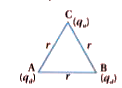 qd = down quarks = `-(1)/(3)` e Electrostatic potential energy `U = k ((qdqd)/(r)+(quqd)/(r)+(quqd)/(r))` `U=k[((-(1)/(3)e)(-(1)/3e))/(r)+(((2)/3e)(-(1)/(3)e))/(r)+(((2)/(3)e)(-(1)/(3)e))/(r)]` `U=(k)/(r)[(1)/(9)e^(2)-(2)/(9)e^(2)-(2)/(9)e^(2)]` `= (ke^(2))/(9r)xx(-3)` `=(9xx 10^(9)xx(1.6xx10^(-19))^(2)xx(-3))/(9xx10^(-15))` `=-7.68xx10^(-14)`J `: U=(-7.69xx10^(14))/(-1.6xx10^(-19))eV` `:.U= 4.8xx10^(5)` eV `= 0.48xx10^(6) eV= 0.48` Me V The ratio of potential energy of neutron to its mass is `(U)/(m) = (0.48xx10^(6))/(939xx10^(6))` `=0.00051112` `5.11xx10^(-4) m_(0)C^(2))` |
|
| 46. |
State Kirchhoff's rules of current distribution in an electrical network. Using these rules determine the value of the current I_1in the electric circuit of Fig. |
| Answer» SOLUTION :`-1.2 A` | |
| 47. |
(A): Sky wave signal are used for long distance radio communication. These signals are in general, less stable than ground wave signals. (R): The state of ionosphere varies from hour to hour, day to day and season to season. |
|
Answer» Assertion and REASON are true and reason is the CORRECT explanation of assertion |
|
| 48. |
A parachutist drops freely from an aeroplane for 8s before the parachute opens out. Then he descends with a net retardation of 2 ms^(-2)reaching the ground with a velocity of 6 ms^(-1). The height from which he bails out of the aeroplane is (g = 10 ms^(-2)) |
|
Answer» `1929 m ` |
|
| 49. |
According to Bohr's theory, the angular speed (Omega) of electron related to n as: |
|
Answer» `omegaprop1/n` |
|
| 50. |
Two identical nuclei A and B of the same radioactive element undergo betadecay. A emits a beta - particle and changes to A.B emits a beta -particle and then a gamma -photon immediately afterwards, and changes to B.. |
|
Answer» A and B. have the same ATOMIC number and MASS number |
|