Saved Bookmarks
This section includes 7 InterviewSolutions, each offering curated multiple-choice questions to sharpen your Current Affairs knowledge and support exam preparation. Choose a topic below to get started.
| 1. |
In Young.s double slit experiment the phase difference between the waves reaching the central fringe and fourth bright fringe will be |
| Answer» ANSWER :D | |
| 2. |
What is Doppler effect ? Obtain an expression for the apparentfrequencyof sound heard when the observer is in motionwith respectto a source at rest. |
|
Answer» SOLUTION :Doppler Shift `:` Due to the relative MOTION, when the source comes closer to listener, the apparentfrequency is GREATER thanactual frequency and source away from listener, the apparentfrequencyis less than actualfrequency . So the difference in apparent and actual frequencies is known as Doppler shift. Expression for the apparent frequenyheard by a moving observer `:` Case (1) `:` Whenobserver is moving towards source `:` Let `' upsilon_(0)'`be velocityof listener 'O' , moving towards the stationary source 's' as shown in figure. So observer will receive more number of waves in each second. The distance travelled by observer in one second `= upsilon_(0)` The number of extra waves received by the observer`= (upsilon_(0))/(lambda)` We known `v = v lambdaimplies lambda = ( upsilon)/(v)` Where `upsilon` = Velocity of sound v =Frequency of sound 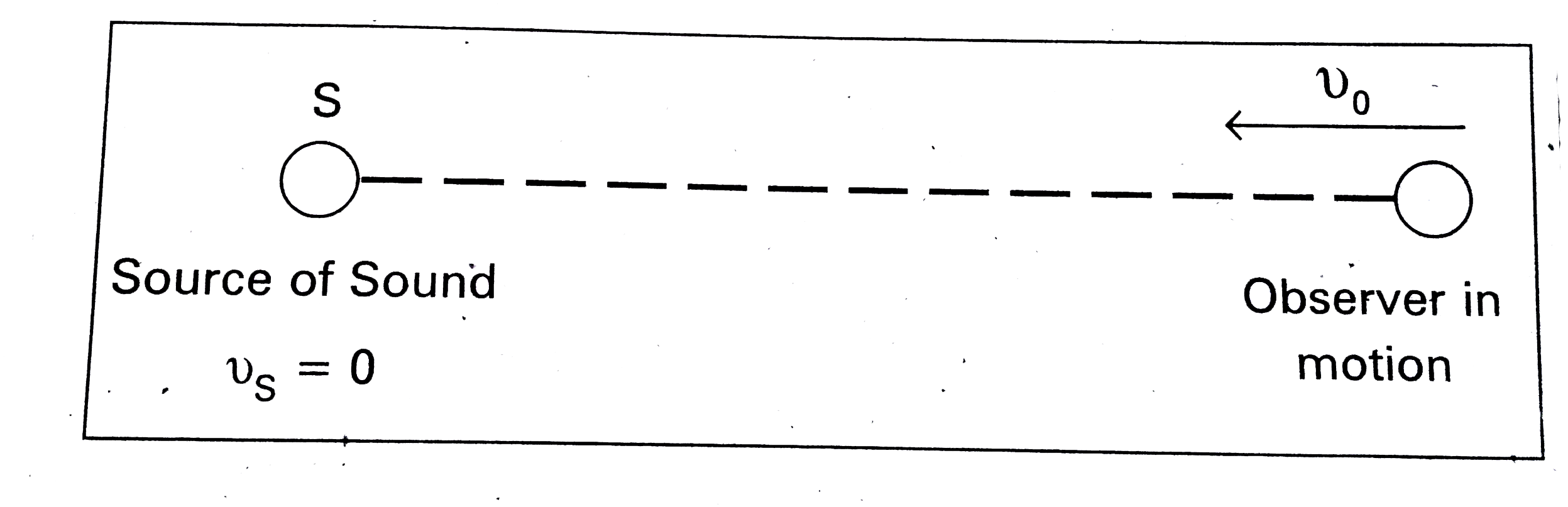 If 'v' is apparent frequency heard by him then `v' = v+ ( upsilon_(0))/(lambda) = v+ ( upsilon_(0).v)/(upsilon)``[:' lambda = ( upsilon)/( v)]` ` v' = v [ 1+ ( upsilon_(0))/(v)]` `v' = v [ ( upsilon+ upsilon_(0))/(upsilon)]` 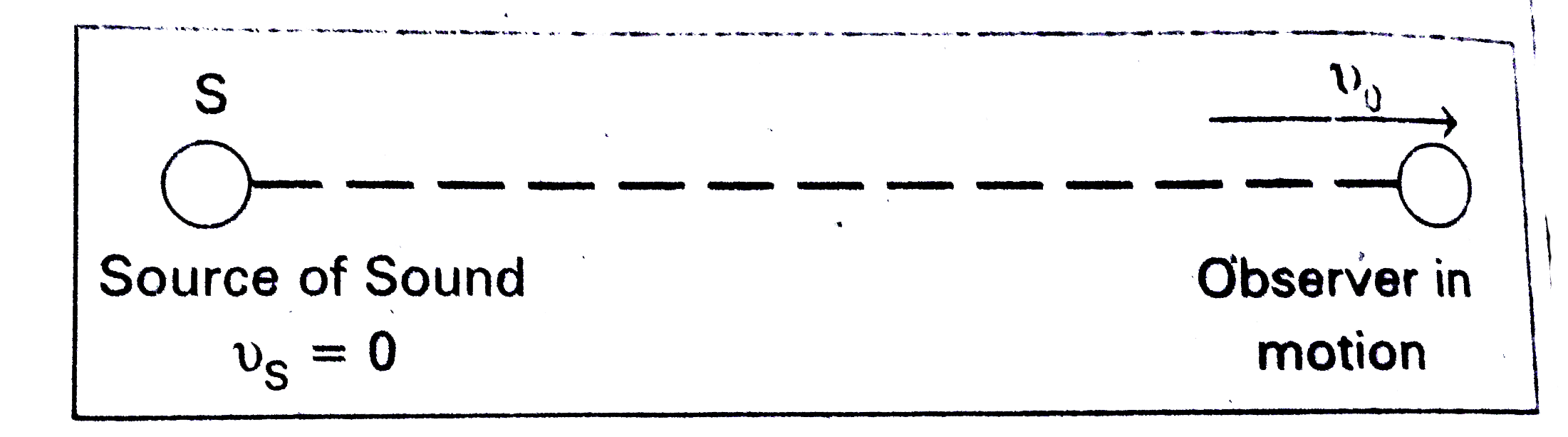 Therefore the apparent frequency is greater than actual frequency . Case (2) `:` When ovserveris moving away from REST source`:` If the observer is moving away from the stationary source then he loses the number or waves `(( v_(0))/(lambda))` `:.` Apparent frequency `v' =v- (upsilon_(0))/( lambda) = v - ( upsilon_(0).v)/( v)` `v' = [ ( v-v_(0))/(v)].v ` Hence the apparent frequency is less than actual frequency. |
|
| 3. |
Two convex lenses 1 and 2 having focal lengths 25 cm and 30 cm are kept in contact such that they have the same principle axis, focal length of this combination motion is ...... |
|
Answer» 1.36  `1/f=(1)/(f_1)+(1)/(f_2)` `THEREFORE f= (f_1f_2)/(f_1+f_2)` `=((25)(30))/(25+30)=(750)/(55)" "thereforef=13.6` |
|
| 4. |
Arrange the vectors subtractions so that their magnitudes are in decreasing order. If the two vectors vecAand vecBare acting at an angle (|vecA| gt |vecB|) a) 60°b) 90°c) 180°d) 120° |
| Answer» Answer :C | |
| 5. |
What is a non magnetic material? |
| Answer» Solution :A NON magnetic SUBSTANCE is that which is not affected even by STRONG magnetic FIELD. | |
| 6. |
A 1.0 m long metallic rod is rotated with an angular frequency of 400 rad s^(-1) about an axis normal to the rod passing through its one end. The other end of the rod is in contact with a circular metallic ring. A constant and uniform magnetic field of 0.5 T parallel to the axis exists everywhere. Calculate the emf developed between the centre and the ring. |
| Answer» Solution :`varepsilon=(BLV)/(2)=(BL^(2).OMEGA)/(2) [because v=lomega]=(0.5xx1xx1xx400)/(2)=100V` | |
| 7. |
(a) Depict the equipotential surfaces for a system of two identical positive point charges placed a distance 'd' apart. (ii) Deduce the expression for the potential energy of a system of two point charges q_1 and q_2 brought from infinity of the points vecr_1 and vecr_2 respectively in the presence of external electric field vecE. |
|
Answer» Solution :(a) Equoipotential surfaces of two identical postive POINT charges placed at a distance 'd' apart. (b) (a) Let ` vecE` be the external field. ` therefore` Work done one ` q_2` against the external field ` =q_2.V(r_2)` Work done on `q_2` against the filed due to ` q_1=(1)/(4 pi epsilon_0) .(q_1q_2)/(r_12)=(q_1q_2)/(4pi epsilon _0r_12)` where `r_12` is the distance between `q_1 and q_2`. By the SUPER position principle for fields, we add up the work on `q_2` against the two fields (`vecE` and that due to`q_1`). Therefore, work done in bringing `q_2` to `vecr_2`. `=q_2.V(vecr_2)+(q_1q_2)/(4piepsilon_0r_12)` Thus, the POTENTIAL energy of the SYSTEM = the total work done in assembling the configuration. `=q_1.V(vecr_1)+q_2+(q_1q_2)/(4piepsilon_0 r_12)`. 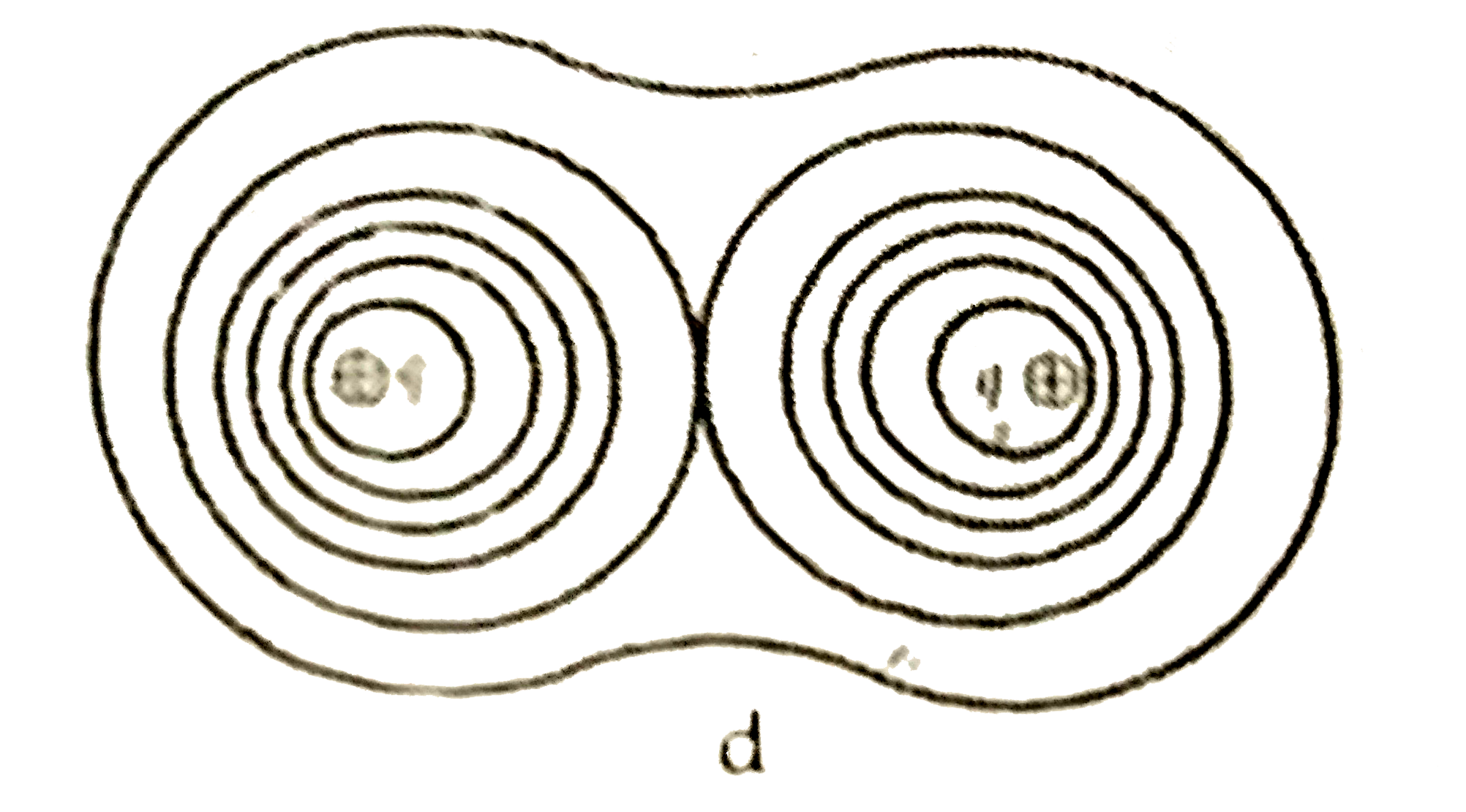
|
|
| 8. |
A 200 turn coil of radius 2 cm is placed coil axially within a long solenoid of 3 cm radius. If the turns density of the solenoid is 90 turns per cm, then calculate mutual inductance of the coil. |
|
Answer» Solution :Number of turns of the solenoid `N_(2)=200` Radius of the solenoid, r=2cm `=2 X 10^(-2)m` Area of the solenoid, `A=pi r^(2)=3.14 xx (2 xx 10^(-2))^(2=1.256 xx 10^(-3) m^(2)` Turn density of long solenoid PER CM, `N_(1)=90 xx 10^(2)` Mutual inductance of the coil, `M=(mu_(0)N_(1)N_(2)A)/(l)=(4pi xx 10^(-7) x 90 xx 10^(2) xx 200 xx 1.256 xx 10^(-3))/(1)` |
|
| 9. |
Draw magnetic field lines when (a) (i) diamagnetic ,(ii) paramagnetic substance is placed in an external magnetic field. Which magnetic property distinguishes this behaviour of the field lines due to the two substances ? |
|
Answer» Solution :(i) BEHAVIOUR of MAGNETIC FIELD lines when a DIAMAGNETIC substance is placed in an external field. (ii) Behaviour of magnetic field lines when a paramagnetic is placed in an external field. Magnetic suscepilibility distinguishes this behaviour of the field lines due to diamagnetic and paramagnetic substances. 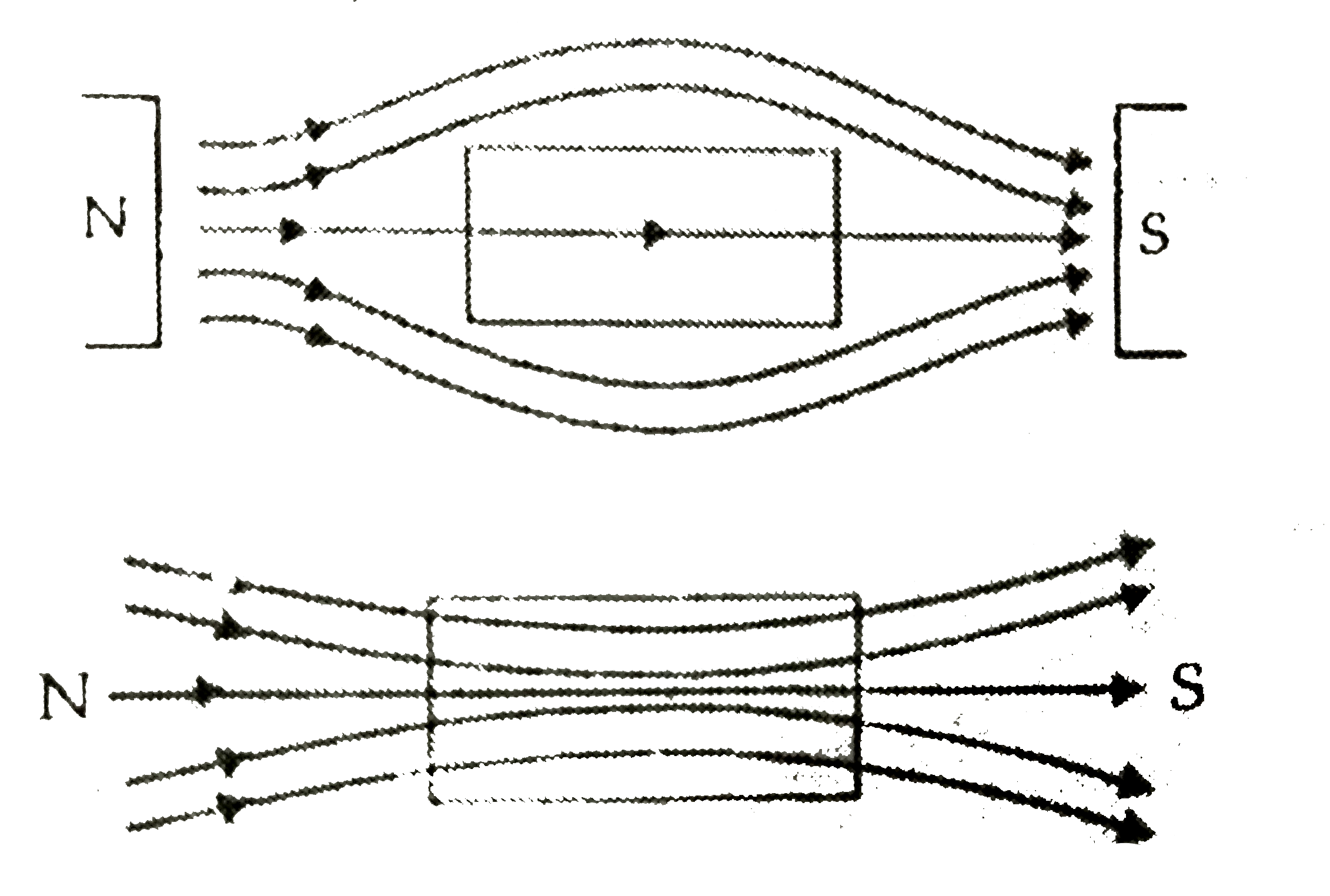
|
|
| 10. |
Modulation factor determines |
|
Answer» Only the STRENGTH of the TRANSMITTED signal |
|
| 11. |
The output transducer of the communication system converts the radio signals into________________ |
| Answer» Solution :Sound | |
| 12. |
The current through an inductive circuit of inductance 4mH is i = 12 cos 300t ampere. Calculate : (ii) Peak voltage across the inductor. |
| Answer» Solution :(ii) PEAK Voltage `V_(0) = i_(0) X_(L) = 12xx 1.2 = 14.4` VOLT. | |
| 13. |
A point source of light is placed 4 cm below the surface of water of refractive index 5/3. The minimum diameter of a disc which should be placed over the source, on the surface of water to cut - off all light coming out of water is |
|
Answer» infnite |
|
| 14. |
The equivalent quantity of mass in electricity is |
|
Answer» CHARGE |
|
| 15. |
Two identical circular coils, P and Q each of radius R, carrying currents 1 A and sqrt(3) A respectively, are placed concentrically are perpendicualr to each other lying in the XY and YZ planes. Find the magnitude and direction of the net magnetic field at the centre of the coils. |
|
Answer» Solution :As per question, `R_P = R_Q = R, I_P = I and I_Q = sqrt(3)I` Magnitude of MAGNETIC field at common centre O due to current flowing in coil P is : `B_P = (mu_0 I_P)/(2 R_P) = (mu_0 I)/(2R)` DIRECTION of `B_P` is PERPENDICULAR to the plane of coil P as SHOWN. Similarly magnitude of magnetic field due to current flowing in coil Q is : `B_Q = (mu_0 I_Q)/(2 R_Q) = (mu_0 (sqrt(3)I))/(2R)` and its direction is perpendicular to the plane of coil Q (or along the plane of coil P). `:.` Magnitude of resultant field `B = sqrt(B_(P)^(2) + B_(Q)^2) = sqrt(((mu_0I)/(2R))^(2) + ((mu_0sqrt(3)I)/(2R))^(2)) = (mu_0 I)/(R )` The resultant magnetic field subtends an angle `beta` from direction of `B_Q`, where `tan beta = (B_P)/(B_Q) = 1/(sqrt(3)) implies beta = tan^(-1) ((1)/(sqrt(-3))) = 30^@` 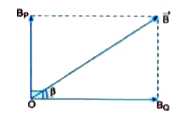
|
|
| 16. |
Draw the circuit diagram of a half wave rectifier and explain its working. |
Answer» Solution :The half wave rectifier circuit. The circuit consists of a transformer, a p-n junction diode and a RESISTOR. In a half wave rectifier circuit, either a POSITIVE half or the negative half of the AC input is passed through while the other half is blocked. Only one half of the input wave reaches the output. Therefore, it is CALLED half wave rectifier. Here, a p-n junction diode acts as a rectifying diode. 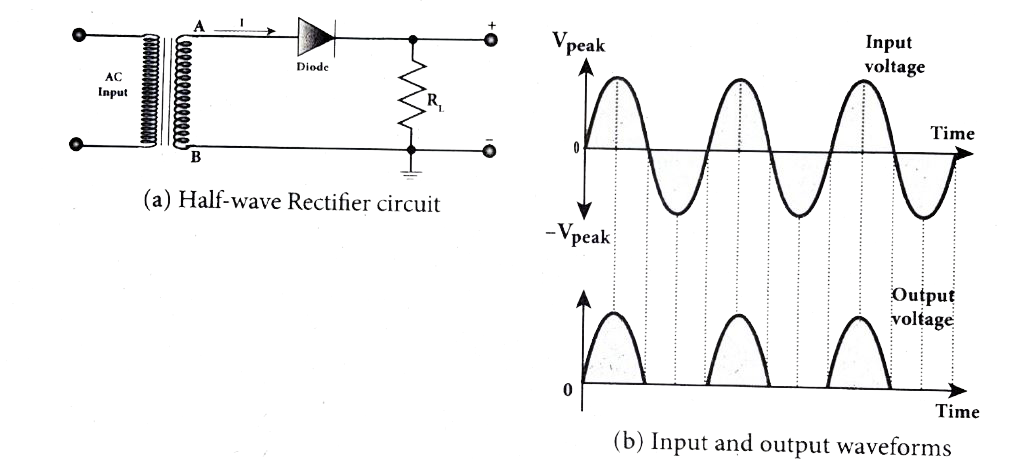 During the positive half cycle: When the positive half cycle of the ac input signal passes through the circuit, terminal A becomes positive with respect to terminal B. The diode is forward biased and hence it conducts. The current flows through the load resistor `R_L` and the AC voltage developed across `R_L` constitutes the output voltage `V_0` and the waveform of the diode current. During the negative half cycle: When the negative half cycle of the ac input signal passes through the circuit, terminal A is negative with respect to terminal B. Now the diode is REVERSE biased and does not conduct and hence no current passes through `R_L`. The reverse saturation current in a diode is negligible. Since there is no voltage DROP across `R_L` the negative half cycle of ac supply is suppressed at the output. The output of the half wave rectifier is not a steady de voltage but a pulsating wave. This pulsating voltage is not sufficient for electronic equipments. A constant or a steady voltage is required which can be obtained with the help of filter circuits and voltage regulator circuits. Efficiency `(eta)` is the ratio of the output dc power to the ac input power supplied to the circuit. Its value for half wave rectifier is 40.6 % |
|
| 17. |
A monochromatic bean of light initially travelling in air has wavelength of ……….. The wave is refracted in a medium of refractive index 1.5. The wavelength and frequency of the wave in the second medium respectively are: |
|
Answer» 6000 AU and `3.3 xx 10^14 Hz` |
|
| 18. |
Calculate the shortest and longest wavelength of Balmer series of hydrogen atom. Given R=1.097 xx 10^(7)m^(-1). |
|
Answer» Solution :Shortest wavelength(HIGHEST frequency) is for the last line in the series. For last line in the BALMER.s series,`n_(1)=2,n_(2)=00` We have `(1)/(LAMBDA)=R((1)/(n_(1)^(2))-(1)/(n_(2)^(2)))` `(1)/(lambda)=1.097xx10^(7)[(1)/(2)^(2)-(1)/(00)]` `=1.097xx10^(7)((1)/(4))` `lambda=(4)/(1.097xx10)^(7)=3.646xx10^(-7)` Longest wavelength (smallest frequency) is for the first line in the series. For first line in the Balmer series, `n_(1) = 2, n_(2) =3`. we have `(1)/(lambda)=R((1)/(n_(1)^(2))-(1)/(n_(2)^(2)))=1.097xx10^(7)((1)/(2^(2))-(1)/(3^(2)))` `=1.097xx10^(7)((1)/(4)-(1)/(9))` `=1.097xx10^(7)((9-4)/(36))` `lambda=(1)/(0.1523xx10^(7))` `lambda=6.566xx10^(-7)` `lambda=6566A^(@)` |
|
| 19. |
The transverse nature of light is shown by |
|
Answer» INTERFERENCE of light |
|
| 20. |
Two equal negative charges -q are fixed at points (o,a) and (o,-a). A positive charge is released from rest at the point (2a,0) on the x-axis. What type of oscillations does the charge Q execute ? |
Answer» Solution : LET X be the small displacement of charge Q. Now hy finding the net force on Q and then its acceleration .a.. `a = 2kQ q (x)/(m(x^2 + 1^2)^3//2)` We can find that `a prop -x` not valid. Therefore charge Q will execute oscillations but not SHM. |
|
| 21. |
Which of the following are thermions? |
|
Answer» PROTONS |
|
| 22. |
A circular loop of area 20 cm ^2 is placed on x-y plane. Containing uniform magnetic field of induction vecB=0.4 hati+0.3 hatj Tesla then the magnetic flux linked with the coil is ? |
|
Answer» SOLUTION :`vecB=0.4hati+0.3hatjT` `vecA=20xx10^(-4)hatkm^2` `phi=vecB.vecA` `=(0.4hati+0.3hatj).(20xx10^(-4)HATK)` `=(0.4hati+0.3hatj)(0hati+0hatj+20xx10^(-4)hatk)` `=0+0+0=0` `therefore`flux LINKED with the COIL is zero. |
|
| 23. |
Which of the following depends on the choice of inertial reference frame ? |
|
Answer» Momentum |
|
| 24. |
Doesthe cutoffwavelengthlamda_(min)of the continousx- rayspectrumincrese decreaseor remainthe sameif you(a)increasethe kineticenergyof theelectrons thatstrikethe xray target(b )allowthe electronstostrikea thinfoilratherthana thickblockof thetargetmaterial,(c )changethe targetto anelementofhigheratomicnumber ? |
| Answer» SOLUTION :(a)DECREASE (B)and (C )REMAINS the same | |
| 25. |
Under what condition is the force acting on a charge moving through a uniform magnetic field is maximum? |
| Answer» SOLUTION :When it MOVES PERPENDICULAR to the MAGNETIC FIELD. | |
| 26. |
A car is fitted with a convex side - view mirror of focal length 20 cm. A second car 2.8 m behind the first car is overtaking the first car at relative speed of 15 m/s. The speed of the image of the second car as seen in the mirror of the first one is : |
|
Answer» `(1)/(15)m//s` `-(1)/(v^(2))(DV)/(DT)-(1)/(u^(2))(du)/(dt)=0` `rArr(dv)/(dt)=(v^(2))/(u^(2))((du)/(dt))` f = 20 cm `(1)/(v) + (1)/(-280) = (1)/(20) rArrv = (280)/(15)cm` `THEREFORE (dv)/(dt)=-((280)/(15xx280))^(2)xx15=(1)/(15)ms^(-1).` |
|
| 27. |
Electrostatic potential at some point in the clecLric field means ...... of unit ...... charge at that point. |
|
Answer» NEGATIVE, electrostatic potential ENERGY |
|
| 28. |
The direction of magnetic field lines close to a straight conductor carrying current will be |
|
Answer» along the LENGTH of the conductor |
|
| 29. |
एक कार 72 किमी/घण्टा की चाल से गति कर रही है। ब्रेक लगाने से 4 सेकण्ड में विरामावस्था में आ जाती है। त्वरण की गणना कीजिए (m/s^2 में)| |
|
Answer» 5 |
|
| 30. |
A light emitting diode (LED) has a voltage drop of 2 V across it and passes a current of 10 mA when it operates with a 6 V battery through a limiting resistor R. The value of R is |
|
Answer» 40 `k Omega` |
|
| 31. |
Answer the following questions: a. In a single slit diffraction experiment, the width of the slit is made double the original width. How does this affect the size and intensity of the cenral diffraction band? b. In what way is diffraction from each slit related to the interference pattern in a double slit experiment? c. When a tiny circular obstacle is placed in the path of light from a distant source, a bright spot is seen at the centre of the shadow of the obstacle. Explain why. d. Two students are separated by a 7m partition wall in a room 10 m high. If both light and sound waves can bend around obstacles, howare the students unable to see each other even though they can converse easily. e.Ray optics is based on the assumption that the light travels in a straight lin. Diffraction effects (observed when light propagates through small apertures/slits a or around small obstacles) disprove this assumption. Yet the ray options assumptioni is so commonly used in understanding location and several other properties of images in optical instruments. What is the justification? |
|
Answer» Solution :a. The size reduces by half according to the relation size `~(LAMDA)/d`. Intensity increases four fold. b.The intensity of interference fringes ina double slit arrangement is modulated by the diffraction pattern of each slit. c. Waves diffracted from the edge of the circular obstacle interfere constructively at the centre of the shadow producing a bright spot. d. `lamda` of light is `~10^(-7)` m while that of sound is 0.3 m (for v=1 kHz). Diffraction becomes APPRECIABLE when size of the DIFFRACTING body is comparable to wavelength. The screen is too large to OBSERVE diffraction of light. Hence the answer. e. Justification based on what is explained in (d). Typical sizes of apertures involved in ordinary optical instruments are much larger than the wavelength of ligth. |
|
| 32. |
In PNP transistors, the direction of conventional current , when emitter - base junction is forward - biased is form ………… . |
|
Answer» BASE to EMITTER |
|
| 33. |
Dopper's effect is sound in addition of relative velocity between source and observer, also depends while source and observer or both are moving. Doppler effecct in light depennd only on the relative velocity of source and observer. The reason of this is |
|
Answer» EINSTEIN mass-energy relation |
|
| 35. |
Find the Q-value and the kinetic energy of the emitted a-particle in the a-decay of (a) ""_(88)^(226)Ra and (b) (86)^(220)Rn. Given m (""_(88)^(226)Ra) = 226.02540 u, "" m (""_(86)^(222)Rn) = 222.01750 u, m (""_(86)^(220)Rn) = 220.01137u, "" m(""_(84)^(216) Po) = 216.00186u. |
| Answer» SOLUTION :(a) `Q = 4.93 MEV, E_a = 4.85 MeV (B) Q = 6.41 MeV, E_a = 6.29 MeV` | |
| 36. |
In the following circuit the value of current i through the battery just after switch S is closed is |
|
Answer» 3A |
|
| 37. |
Which of the following neighbouring countries has better performance in terms of human development rank than India ? |
|
Answer» Bhutan |
|
| 38. |
The magnetic induction at the centre of asolenoid is B. If the length of the solenoid is reduced to half and the same wire is wound in two layers the new magnetic induction is |
|
Answer» B |
|
| 39. |
(A): A series combination of cells is used when their internal resistance is much smaller than external resistance. (R ) When cells are connected is series the current through external resistance is I=(nE)/(R+nr) |
|
Answer» Both 'A' and 'R' are true and 'R' is the CORRECT EXPLANATION of 'A' |
|
| 40. |
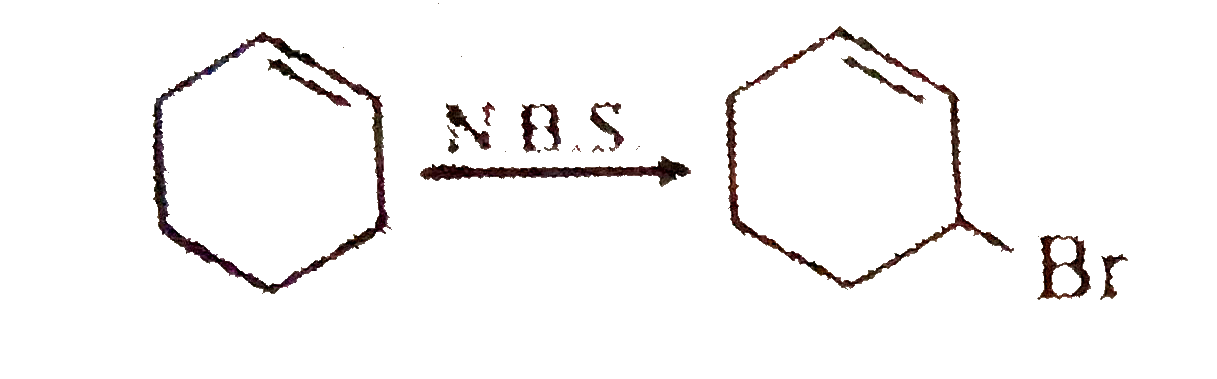
Identify (Z) in the following transformation |
|
Answer»
|
|
| 41. |
A galvanometer may be converted into ammeter or a voltmeter .In which of following cases the resistance of the device so obtaind will be the largest ? |
|
Answer» AMMETER of range 1 A |
|
| 42. |
Assertion: Always |(dvecv)/(dt)|=d/(dt)|vecv| , where vecv has its usual meaning. (Reason): Acceleration is rate of change of velocity. |
|
Answer» Both (ASSERTION) and (REASON) are TRUE and (Reason) is the CORRECT EXPLANATION of (Assertion) |
|
| 43. |
A parallel - plate capacitor, filled with a dielectric of dielectric constant k, is charged to a potential V_(0). It is now disconnected from the cell and the slab is removed. If it now discharges, with time constant tau, through a resistance, then find time after which the potential difference across it will be V_(0)? |
|
Answer» Solution :When the slab is REMOVED, the potential difference across CAPACITOR increases to `kV_(0)` `CV_(0)=kCV_(0)e^(-(t)/(tau))` as `q_(0)=KCV_(0)` `(1)/(k)=e^(-(t)/(tau)) IMPLIES k=e^((t)/(tau))` `:. ln k=(1)/(tau) implies t= tau LNK` |
|
| 44. |
A stone is thrown vertically up from a bridge with velocity 3 ms^(-1) .If it strikes the water under the bridge after 2s,the bridge is at a height of |
|
Answer» 26 m |
|
| 45. |
Both question a and b refer to the sustem of charges as shown in the figure. A spherical shell of conducting material. A point charge+Q is place at the centre of the spherical shell and a total charge -q is placed on the shell. A Charge -q id distributed on the surfaces as . (b) Assume that the elctrostatic potential is zero at an infinite distance from the spherical shell . The electrostatic potential at a distanceR (a lt R lt b) from the centre of the shell is . |
|
Answer» `0` 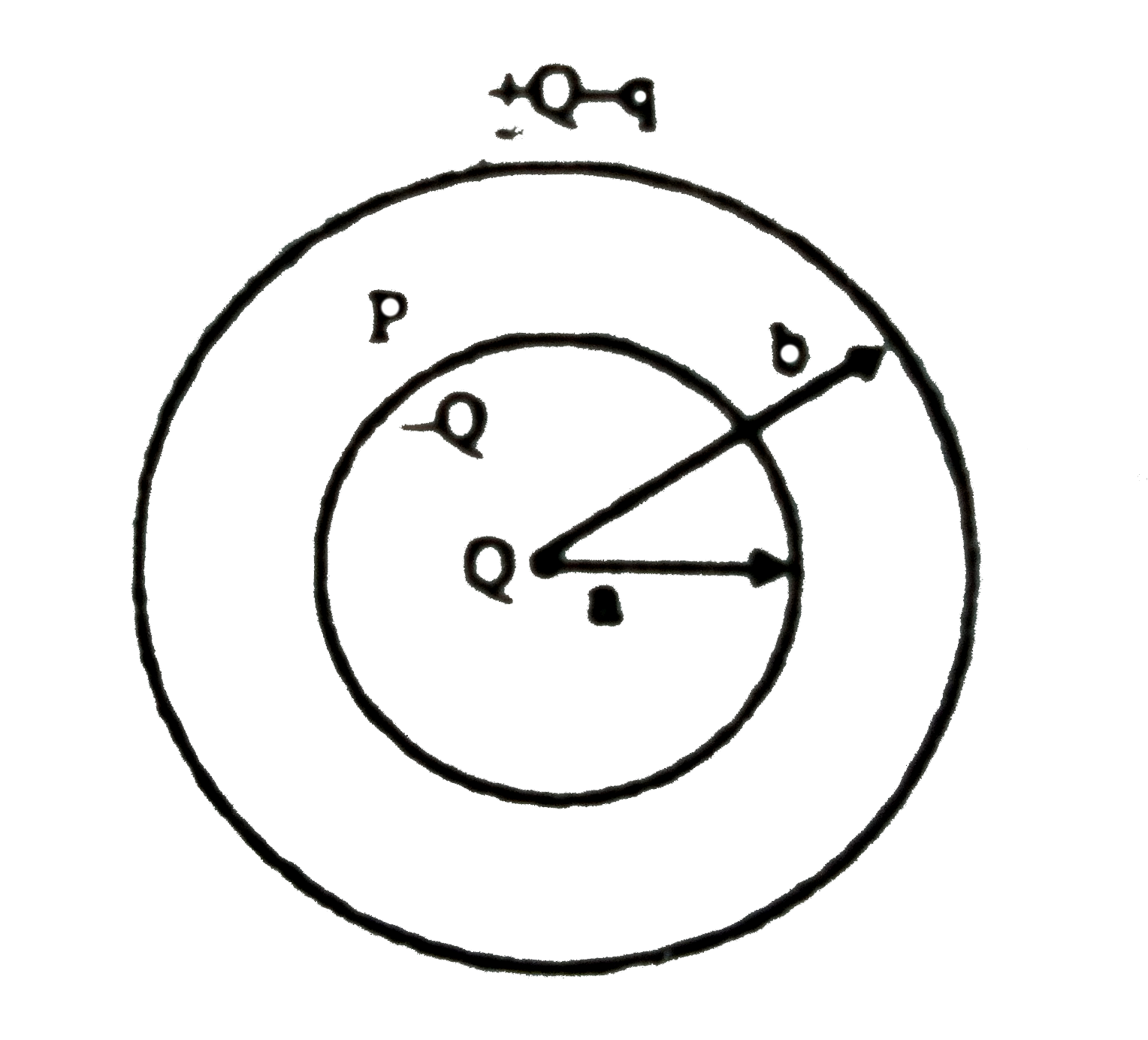 ` V_p = (KQ)/R - (KQ)/R + (K(Q-q))/b = (K(Q-q))/b` |
|
| 46. |
The point of an elliptical orbit closest to the Sun is called the perihelion, and the point most distant from it is called aphelion (Fig). Denoting the distance from the perihelion to the Sun by r_0and the velocity of the planet at the perihelion by v_0 , find the radius of curvature of the orbit at the perihelion and at the aphelion, the distance from the aphelion to the Sun, and the velocity of the planet at the aphelion. Prove that the motion of a planet in an elliptical orbit is only possible, if its total energy is negative. |
|
Answer» potential energy `U_0 = - gammamM//r_0` To find the radius of curvature in the perhelion apply Newton.s second LAW `(mv_0^2)/R_0=(gammamM)/r_0^2` form which `R_0=(mv_0^2r_0^2)/(gammaMm)=-(2r_0K_0)/U_0` The radius of curvature at the aphelion is the same as in the perihelion since the ellipse is a symmetrical figure. We have, according to Newton.s second law, `(mv_a^2)/R_0=(gammamM)/r_a^2` The total mechanical energy of the planet, according to the law of conservation of energy is `W=(mv_0^2)/(2)-(gammamM)/r_0=(mv_a^2)/2-(gammamM)/r_a` Eliminating the VELOCITY we obtain `(gammamMR_0)/(2r_0^2)-(gammamM)/r_0=(gammamMR_0)/(2r_a^2)-(gammamM)/r_a` Cancelling out `gammam` we obtain a quadratic equation `r_a^2(2r_(0)-R_0)-2r_ar_0^2+R_0r_0^2=0` The first root of the equation is `r_a = r_0`This means that in this case the ellipse reduces to a circle of radius ro. In this case the radius of curvature is also `R_0 = r_0` , and, consequently, the orbital velocity is `r_(a)=(r_0R_0)/(2r_0-R_0)=-(r_0K_0)/W` Since the DISTANCE from the aphelion to the Sun is a positive quantity we must have `Wlt0` . This means that a planet can move in an elliptical orbit only if the sum of its kinetic and potential energies (i.e. its total mechanical energy) is negative. In particular in the case of a CIRCULAR orbit, `W = - (gammamM)/(2r_0)` |
|
| 47. |
A circular disc X of radius R is made from an iron plate of thickness t, and another disc Y of radius 4R is made from an iron plate of thickness (t)/(4). Then the relation between the moment of inertia I_(X) and I_(Y) is : |
|
Answer» `I_(Y)=64I_(X)` M.I. of X is `I_(X)=(1)/(2)m_(1)R_(1)^(2).I_(X)=(1)/(2)piR^(2)rhot.R^(2).=(1)/(2)piR^(4)rhot""...(i)` `I_(Y)=(1)/(2)pi(4R^(2))xx(t)/(4)rho(4R)^(2)` `=32piR^(4)rhot.""...(II)` `(I_(X))/(I_(Y))=(1)/(64)orI_(Y)=64I_(X)`. |
|
| 48. |
If I_c is collector current , I_b in the base current and I_e is emitter current then current gain alpha is given as : |
|
Answer» `ALPHA =I_b/I_c` |
|
| 50. |
An electric dipole is prepared by taking two electric charges of 2 xx 10^(-8)C separated by distance 2 mm. This dipole is kept near a line charge distribution having density 4 xx 10^(-4)C/m in such a way that the negative electric charge of the dipole is at a distance 2 cm from the wire as shown in the figure. Calculate the force acting on the dipole. [Take k=1/(4piepsilon_(0)) = 9 xx 10^(9) Nm^(2)C^(-2)] |
|
Answer» Solution :`k = 9 xx 10^(9) Nm^(2)C^(2)` `lambda = 4 xx 10^(-4) C//m` `q = 2 xx 10^(-8)` C `r_(+) = 2.2 cm = 2.2 xx 10^(-2)` m `r_(infty) = 2 cm = 2 xx 10^(-2)` m The electric field intensity at some point r from continuous line CHARGE distribution having DENSITY X is given by the formula, `E = lambda/(2piepsilon_(0)).l/r = (2klambda)/r` `VECF = (-2klambdaqhati)/r_(-)` and `vecF_(+) = (2klambdaqhati)/r_(+) (therefore F = Eq)` `therefore` Resultant force, `vecF = vecF_(+) + vecF_(-) = 2klambda q[1/r_(+) - 1/r_(-)]hati` `therefore vecF = 2 xx 9 xx 10^(9) xx 4 xx 10^(-4) xx 2 xx 10^(-6)` `vecF = 144 xx 10^(-1) [-0.04545] hati` `therefore vecF = -0.6545 hati N` |
|