

Saved Bookmarks
This section includes 7 InterviewSolutions, each offering curated multiple-choice questions to sharpen your Current Affairs knowledge and support exam preparation. Choose a topic below to get started.
| 1. |
In a common emitter configuration a transistor has beta = 50 and input resistance1 k Omega. If the peak value of a.c. input is 0.01 V , then the peak value of collector current is |
|
Answer» `0.01 MU A ` |
|
| 2. |
The magnetic field between the plates of a capacitor when r gt R is given by (where r is the distance from the axis of plates and R is the radius of each plate of capacitor: |
|
Answer» `(mu_0I_Dr)/(2piR^2)` |
|
| 3. |
On the basis of your understanding of the following paragraphand the related studied concepts. An equipotential surface is a surface with a constant value of electric potential at all points on the surface. The component of electric field parallel to an equipotential surface is zero, as the potential does not change in this direction. Thus, the electric field is perpendicular to the equipotential surface at each point of the surface. Further, say the direction of electric field electrical potential gradually fall with distance. If electric potential at origin point O be 100 V, then for electric field specified in part (b), draw equipotential surfaces corresponding to potentials 80 V, 60 V and 40 V respectively. |
|
Answer» Solution :As `E = 1000 hatiV m^(-1)`, so distance Ar between points having potentials `V_0 = 100 V and V_1 = 80 V` is `Delta r = (x_1 = 0) = (V_0-V_1)/E = (100-80)/(1000)` `= 0.02m = 2.0m` `rArr x_1 = 2.0 m` Similarly potential `V_2= 60 V and V_3 = 40 V` corresponds to POSITIONS `x_2 = 4.0 cm and x_3 = 6.0 cm` respectively. Equipotential surfaces CORRESPONDING to these potentials are drawn here. 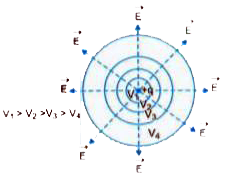
|
|
| 4. |
Distinguish between unpolarised light and linearly polarised light. How does one get linearly polarised light with the help of a polaroid ? |
Answer» Solution :An unpolarised LIGHT consists of many independent waves, whose planes of vibration are randomly oriented about the direction of PROPAGATION as shown in FIG. 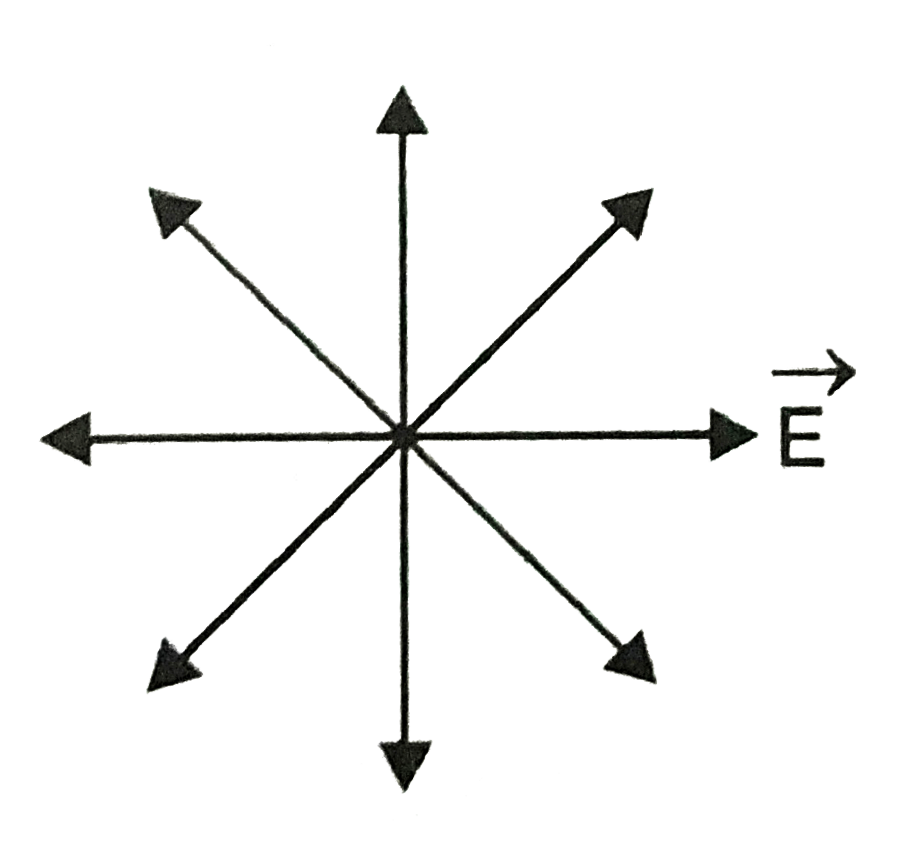 Light is generally represented by electric field vector `VEC(E)`, called light vector. Linearly polarised light is that in which vibrations of electric field are confined in one direction in a plane perpendicularto the direction of propagation of light. when unpolarised light is passed THORUGH a tounmaline crystal cut with its face parallel to the crystallographic axis, only those vibrations of light pass through the crystal, which are parallel to the axis. All other vibrations are absorbed and we get linearly polarised light. |
|
| 5. |
Two bodies A and B having masses in the ratio of 3:1 possess the same kinetic energy, The ratio of linear momentum of Bto A is |
|
Answer» `1:3` |
|
| 6. |
A: Electromagnetic spectrum has a Balmer series in the visible region. R:(1)/(lambda)=R[(1)/(2^(2))-(1)/(n^(2))] where n=3,4,5,... |
|
Answer» Both ASSERTION and REASON are TRUE and the reason is CORRECT EXPLANATION of the assertion. |
|
| 7. |
What did they do to slow down the boat in the storm? |
|
Answer» Stopped sailing |
|
| 8. |
A convex mirror and convex lens of radius of curvature 20 cm are placed on same axis with 30 cm separation. A point-like object is placed at 20 cm from convex lens and its image by this combination is obtained at object. What will be focal length of convex lens ? |
Answer» Solution : `rArr`Here, RADIUS of curvature of convex lens `= O_2 C` = 20 CM Object DISTANCE OP = u = -25 cm Image distance OC = v = 30 + 20 = 50 cm `rArr` Lens formula `1/f= 1/v - 1/u = 1/50 + 1/25` `therefore1/f = (1+2)/(50) = 3/(50)` `thereforef = (50)/(3) = 16.67 cm ` |
|
| 9. |
A syringe is filled with water up to volume 20cm^(3). The area of cross-section of the cylinder is5cm^(2). The syringe is held vertically and its 90gm piston is pushed upward by external agent with constant speed. A water beam coming out of the small nozzle (hole area 1mm^(2)). Neglecting friction and viscous nature of water, find the work done by the agent [in 10^(-2)] in fully emptying the syringe. (take g=10 m//s^(2)) |
|
Answer» MASS of water `=20gm` By work energy theorem `W_("ext")=/_\U_("piston")+/_\U_("water")+KE_("water")=8xx10^(-2)`JOULE |
|
| 10. |
The magnetic moment of a gadolinium atom is 7.95 muB (Ho is the Bohr magneton). Gadolinium crystallizes in a face-centered cubic lattice with lattice constant of 3.2 Å. Find the saturation magnetization. Take into account that an elementary cell of a face-centered lattice contains four atoms. |
|
Answer» |
|
| 11. |
What was Jambaji's mother and father's name? |
|
Answer» Thakur LOHA and Jamuna Devi |
|
| 12. |
What is forward bias and reverse bias ? |
Answer» Solution :When the positive terminal of the battery is connected to p side of junction and negative terminal connected to N side of junction such a connection is known as forward as forward bias as shown in FIGURE (a).  The applied VOLTAGE mostly drops ACROSS the depletion region and the voltage drop across the p-side and n-side of the junction is negligible. This is because the resistance of the depletion region is very high due to no charges presents in this region. The direction of the applied voltage (V) is opposite to the built-in potential `(V_(0))` as a result the depletion layer widthdecreases and the barrier height is reduced due to V > > `V_(0)`. This is shown in figure (c ).  The effective barrier height under forward bias is `V_(0)-V`. If the external battery is not connected to the p-n junction then the effective depletion barrier.s height `V_(0)` is shown as 1 in figure (c ). When the applied voltage is low, the height of effective barrier potential shows by 2 and the applied voltage is large the height of effective barrier potential shows by 3. If we increase the applied voltage, the barrier height will be reduced and more number of carriers will have the required energy, so the current increases. Due to the applied voltage, electrons from n-side cross the depletion region and REACH p-side where they are minority carriers. Similarly, holes from p-side cross the junction and reach the n-side where they are minority carriers. The process under forward bias is known as minority carrier injection. At the junction boundary, on each side, the minority carrier concentration increases compared to the locations far from the junction. Due to the concentration gradient, the injected electrons on p-side diffuse from the junction edge of p-side to the other end of p-side, similarly the injected holes on n-side diffuse from the junctionedge of n-side to the other end of n-side. This motion of charged carriers on either side give rise to current. The total diode forward current is sum of hole diffusion current and conventional current due to electron diffusion. The magnitude of this current is usually in mA. Forward bias junction has low resistance and external battery voltage is 1.5 V. |
|
| 13. |
Magnification at least distance of distinct vision of a simple microscope of focal length 5 cm is : |
|
Answer» 2 |
|
| 14. |
Which of the following is not a unit of length ? |
|
Answer» radian |
|
| 15. |
Let R be set of points inside a rectangle of sides a and b(a,b>1) with two sides along the positive direction of x-axis and y-axis |
|
Answer» `R={(X,Y):0leXlea,0leYleb}` |
|
| 16. |
A : Diffraction determines the limitations of the concept of light rays. R : A beam of width alpha starts to spread out due to diffraction after it has travelled a diatance (2alpha^(@)"/"lambda). |
|
Answer» Both A and R are TRUE and R is the correct EXPLANATION of A |
|
| 17. |
If the radius of a circle increasing from 5 cm to 5.1 cm, then find the increase area. |
|
Answer» a)4 hrs |
|
| 18. |
A current I=I_0sin(omegat+pi/2) flow in a ciruit when an alternating voltage V=V_0SIN(omegat) is applied across it. The power consumed in the circuit is |
|
Answer» `1/2V_0I_0` |
|
| 19. |
Assertion (A) A spherical equipotential surface is not possible for a point charge.Reason (R ) A spherical equipotential surface is possible inside a spherical capacitor. |
|
Answer» If both ASSERTION and REASON are TRUE and Reason is CORRECT EXPLANATION of Assertion. |
|
| 20. |
The first four spectral lines in the Lyman series of a H-atom are 2 = 1218 Å, 1028 Å, 974.3 Å and 951.4 Å. If instead of Hydrogen, we consider Deuterium, calculate the shift in the wavelength of these lines. |
|
Answer» Solution :Formula of Rydberg.s constant is `R=(me^(4))/(8 epsi_(0)^(2)h^(2)c)` While deriving above formula, nucleus was assumed theoretically to have infinite mass (as compared to mass of electrons) so that it can be considered STATIONARY at the centre of atom. But we know, in practice, all the NUCLEI have some definite masses. Hence Rydberg.s constant does not remain same for the atoms of different elements. Practically we find that Rydberg.s constant varies slightly for atoms of different elements. Under these circumstances, Rydberg.s constant is defined as under. `R=(mue^(4))/(8epsi_(0)^(2)h^(3)c) ...(1)` where `mu`= reduced mass of an electron `mu=(Mm_(e))/(M+m_(e))` where `m_(e)`= mass of electron M=mass of nucleus of atom. Note : Here, nucleus and electron become a binary system, in which both of them revolve around their common centre of mass. Such a system of two particles can be replaced by a Mme single particle of mass `(Mm_(e))/(M+m_(e))` at a DISTANCEFROM above common centre of mass. Such a mass is CALLED "reduced mass" of electron and it is shown by symbol `mu`. (Its SI UNIT is also kg). Now, in formula `(1)/(lambda)=R((1)/(m^(2))-(1)/(n^(2)))`taking m = 1 for Lyman series and for its four spectral lines taking n=2,3,4,5, since here for a given spectral line, term `((1)/(m^(2))-(1)/(n^(2)))` remains contant. Thus `(1)/(lambda) prop R` `or R prop (1)/(lambda)` But `R prop mu` [ From equation (1)] `:. mu prop (1)/(lambda)` `:. (mu_(h))/(mu_(d))=(lambda_(d))/(lambda_(h))` (where h for hydrogen d for deuterium) `:. lambda_(d)=((mu_(h))/(mu_(d)))lambda_(h)....(3)` `rArr` Reduced mass of electron in H-atom (from equation (2)) `mu_(h)=(Mm_(e))/(M+m_(e))` (Where M= mas of nucleus in H-atom =Mass of one proton `=1.67xx10^(-27)kg)` `:. mu_(h)=(Mm_(e))/(M(1+(m_(e))/(M)))=(m_(e))/(1+(m_(e))/(m))=m_(e)(1+(m_(e))/(M))^(-1)` `:. mu_(h)=m_(e)(1-(M_(e))/(M))...(4)` (According to binomial theorem) Similarly, reduced mass of electron in deuteriun atom `mu_(d)=(2Mm_(e))/(2M+m_(e))` (where 2M= mass of nucleus of deuterium atom `m_(p)+m_(n)=2m_(p)=2xx1067xx10^(-27)kg)` `:.mu_(d)=(2Mm_(e))/(2M(1+(m_(e))/(2M)))` `:.mu_(d)=(m_(e))/(2M(1+(m_(e))/(2M)))....(5)` From equation (3),(4),(5) `lambda_(d)=(1-(m_(e))/(M))(1+(m_(e))/(2M))lambda_(h).....(6)` Now, in above equation , `(1-(m_(e))/(M))(1+(m_(e))/(2M))=(1-(9.1xx10^(-31))/(1.67xx10^(-27)))xx(1+(9.1xx10^(-31))/(2xx1.67xx10^(-31)))` `=(1-0.005449)(1+0.002724)` `(0.9994551)(1.0002724)` `=0.9997274...(7)` From equation (6) and (7), `lambda_(d)=0.9997274 lambda_(h) ....(8)` When we substitute four values of `lambda_(h)` in equation (8), corresponding values of `lambda_(d)` are obtained as follows: 
|
|
| 21. |
एक कोशिकाय यूकैरियोटिक जीव है : |
|
Answer» प्रोटिस्टा |
|
| 22. |
A proton enters a magnetic field of flux density 1.5 T with a velocity of 20 xx 10^(7)ms^(-1) at an angle of 30° with the field. The force on the proton is [e_(p)=1.6xx10^(-19)C] |
|
Answer» `2.4xx10^(-10)N` |
|
| 23. |
Read the following two statements. (A) Emf can be induced by changing magnetic field. (B) Emf must be induced when a conductor is moved inside magnetic field. |
|
Answer» Both A and B are true. |
|
| 24. |
Three identical capacitors A, B and C are charged to the same potential and then made to discharge through three resistances R_A, R_B and R_C, where R_A gt R_B gt R_C .Their potential differences (V) are plotted against time t, giving the curves 1, 2 and 3. Find the correlations between A, B, C and 1, 2, 3. |
|
Answer» Only a is CORRECT |
|
| 25. |
Wave nature of light is verified by the phenomenon of |
|
Answer» RECTILINEAR PROPAGATION of light |
|
| 26. |
Observer S reports that an event occurred on the x axis of his reference frame at x=3.00xx10^(8)m at time t = 1.50 s. ObserverS' and her frame are moving in the positive direction of the x axis at a speed of 0.400c. Further, x = x' = 0 at t = t' = 0. What are the (a) spatial and (b) temporal coordinate of the event according to S'? If S' were, instead, moving in the negative direction of the x axis, what would be the (c ) spatial and (d) temporal coordinate of the event according to S' ? |
|
Answer» |
|
| 27. |
A particle is dropped under gravity from rest from a height h (g = 9.8m/s^2) and it travels and it travels a distance of 9h/25 in the last second the height is |
|
Answer» 100m |
|
| 28. |
An object is released from rest. The time it takes to fall through a distance h and the speed of the object as it falls through this distance are measured with a pendulum clock. The entire apparatus is taken on the Moon and the experiment is repeated. Then, |
|
Answer» the MEASURED times are same. |
|
| 29. |
Wat is the charge acquired by a body when one million electrons are transferred to it. |
|
Answer» `-1.6 XX 10^(-13)C` |
|
| 30. |
The resistivity of a typical insulator (e.g., amber) is greater than that of a metal by a factor of the order of (10^(22)//10^3) |
| Answer» SOLUTION :`10^(22)` | |
| 31. |
If L is the inductance, C is the capacitance and R is the resistance, thenRsqrt((C)/(L))has the dimension |
|
Answer» `MLT^(-2)I^(-2)` |
|
| 32. |
Two insulating plates arc both uniformly charged in such a way that the potential difference between them is V_(2) - V_(1) = 20V (i.e. plate 2 is at a higher potential). The plate are separated by d = 0.1m and can be treated as infinitely large. An electron is released from rest on the inner surface of plate 1. What is its speed when it hits plate 2 ? (e = 1.6xx10^(-19) C m_(e)= 9.11xx10^(-31) kg ) |
|
Answer» `1.87xx10^(6) `m /s If v is velocity of electron when it hits the other plate 2, then `(1)/(2) MV^(2)= e(V_(2)-V_(1))` `=sqrt((2e(V_(2)-V_(1)))/(m))` `:. v= sqrt((2xx1.6xx10^(-19)xx20)/(9.11xx10^(-31)))` `:. v = 2.65 xx10^(6) ms^(-1)` 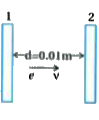
|
|
| 33. |
What do you understand by principle of superposition ? |
Answer» Solution :The principle of superposition STATES that when number of charges are interacting the total force on the given CHARGE is the vector sum of the individual forces exerted onthe given charge by all the other charges `vecF_(2)=vecF_(21)+vecF_(23)+....+vecF_(2N)` i.e , `vecF_(2)=(1)/(4piepsilon_(0))((q_(2)q_(1))/(r_(21)^(2))hat(r)_(12)+(q_(2)q_(3))/(r_(23)^(2))hat(r)_(32)+....+(q_(2)q_(n))/(r_(2n)^(2))hat(r)_(n2))` |
|
| 34. |
A concave lens of focal length f produces an image (1/x) of the size of the object, the distance of the object from the lens is |
|
Answer» `(X-1)F` |
|
| 35. |
A tank is filled with water of density 1 g cm^(-3)and oil of density 0.9 g cm^(-3). The height of the water layer is 100 cm and of the oil layer is 400 cm. If g = 980 cm s^(-2), then the velocity of efflux from an opening in the bottom of the tank is |
|
Answer» `SQRT(920 xx980) " cm s"^(-1)` |
|
| 36. |
Statement -I : Sound waves cannot propagate through vecuum but ligth can . Satement -II : Sound waves cannot be polarised but light can be polarised. |
|
Answer» Statement -I is TRUE, Statement -II is true and |
|
| 37. |
For the same value of angle of incidence, the angles of refraction in three media A,B and C are 15^(@),25^(@) and 35^(@) respectively. In which medium would the velocityof light be minimum ? |
| Answer» SOLUTION :VELOCITY of LIGHT would be minimum in MEDIUM .A.. | |
| 38. |
The mass of 1.2 cm^(3)of a certain sub- stance is 5.74g. caleulate its density with due regard to significant figures. |
|
Answer» SOLUTION :Mass m =5.74 g, volume v, = 1.2 `cm^(3)` density d=`(m)/(v)= (5.74g)/(1.2cm^(3))` 5.74 has significant DIGITS and 1.2 has two significant digits . No need for rounding off. `:. D = (5.74)/(1.2)= 4.783333.` This is to be rounded off to two significant digits . The density of the GIVEN SUBSTANCE is 4.783 = `4.8 g cm^(-3)` |
|
| 39. |
A small ball is thrown from the edge of one bank of a river of width 100m to just reach the bank. The ball was thrown in the vertical plane (which is also perpendicular to the banks) at an angle 37^(@) to the horizonatal. Taking the starting the point as the origin O, verection as positeve y-axis and horizonrtal line passing through the point O and perpenducular to the bank as x-axis find: (a) Equation of trahectory of the image formed by the water surface (water surface is at the level y=0) (b) instantaneous velocity of the image formed due to refraction. [Use g=10 m//s^(2),R.I. of water =4//3] |
|
Answer» `therefore` apparent trajectory or image of the trahectory will have `'x'` unchanged but `'y'` multipled by a factor of `R.I.=4//3` `therefore` Equation is `y'=(4)/(3)y=(4)/(3)xtan 37^(@)(a-(x)/(100))` or `y=(x(x^(2))/(100))` `(u^(2)sin(2xx37^(@)))/(G)=100 rArru=25sqrt(5/3)` (b) Similarly `'x'` COMPONENT of velocity will remain unchanged, but the `'y'` component of velocity will be multiplied by a factor of `R.I.=4//3` or at any time `'t'`. `v(t)_(image)=u cos 37^(@)i+(4)/(3)(u sin 37^(@)-gt)j=25sqrt(5/3)xx(4)/(5)i+(4)/(3)[25sqrt(5/3)xx(3)/(5)-10t]j` `v(t)_("image")=20sqrt(5/3)i+20[sqrt(5/3)-(2)/(3)t]j` |
|
| 40. |
When an electric dipole is subjected to an uniform electric field ,what will happen? |
| Answer» SOLUTION :The DIPOLE will EXPERIENCE a TORQUE | |
| 41. |
If in an experiment for determination of velocity of sound by resonance tube method using a tuning fork of 512 Hz, first resonance was observed at 30.7 cm and second was obtained at 63.2 cm, then maximum possible error in velocity of sound is |
|
Answer» 204.8 CM/sec 2nd resonance, `63.2 = (3lambda)/4 + C`.........(ii) Substracting (i) from (ii), we GET `63.2 - 30.7 = lambda/2` or `lambda = (65.0 +- 0.1)` cm. Maximum error in measurnment of length using metric SCALE would be 1 mm. `v = lambdav =(65.0 +- 0.1) xx 512 `cm/sec. `=33280 +- 51.2` cm/sec Hence, maximum error in velocity `= 51.2` cm/sec. |
|
| 42. |
A transformer is used to light a 100 W and 110 V lamp from a 220 V mains. If the main current is 0.5 amp, the efficiency of the transformer is approximately |
|
Answer» `50%` Voltage across PRIMARY `V_(P)=220 V` CURRENT in the primary `I_(P)=0.5 A` Efficiency of a TRANSFORMER, `eta = ("Output power")/("Input power")xx100` `=(P)/(V_(P)I_(P))xx100=(100)/(220xx0.5)xx100=90%` |
|
| 43. |
Which of the following are the properties of a plane polarized light ? |
|
Answer» ELECTRIC field vectors lie in one PLANE |
|
| 44. |
The table records the mass and speed of an object travelling at constant velocity on a frictionless track, as performed by a student conducting a physics lab exercise. In her analysis, the student had to state the trial in which the object had the greatest momentum and the trial in which it had the greatest kinetic energy. which of the following gives the correct answer? |
|
Answer» Greatest Momentum-Trial 1, Greatest Kinetic Energy-Trial 3 |
|
| 45. |
A cosmic by A moves to the Sun with velocity v_0 (when far from the Sun) and aiming parameter l the arm of the vector v_0 relative to the centre of the Sun (figure). Find the minimum distance by which this body will get to the Sun. |
|
Answer» Solution :At the minimum separation with the Sun, the cosmic body's velocity is perpendicular to its POSITION vector relative to the Sun. If `r_(min)` be the SOUGHT minimum distance, from conservation of angular momentum about the Sun (C). `mv_0l=mvr_(min)` or, `v=(v_0l)/(r_(min))` (1) From conservation of mechanical energy of the system (sun + cosmic body), `1/2mv_0^2=-(gammam_sm)/(r_(min))+1/2mv^2` So `v_0^2/2=-(gammam_s)/(r_(min))+(v_0^2)/(2r_(min)^2)` (using 1) or, `v_0^2r_(min)^2+2gammam_sr_(min)-v_0^2l^2=0` So, `r_(min)=(-2gammam_s+-SQRT(4gamma^2m^2+4v_0^2v_0^2l^2))/(2v_0^2)=(-gammam_s+-sqrt(gamma^2m_s^2+v_0^4l^2))/(v_0^2)` Hence, taking positive ROOT `r_(min)=(gammam_s//v_0^2)[sqrt(1+(lv_0^2//gammam_s)^2)-1]` |
|
| 46. |
PQR is a right angled prism with other angles as 60^(@) and 30^(@). Refractive index of prism is 1.5. PQ has a thin layer of liquid. Light falls normally on the face PR . For total internal reflection, maximum refractive index of liquid is |
|
Answer» 1.4 |
|
| 47. |
A body of mass m is thrown straight up with velocity v_0. Find the velocity v^' with which the body comes down if the air drag equals kv^3, where k is a constant and v is the velocity of the body. |
|
Answer» Solution :While going upward, from Newton's second law in VERTICAL direction: `m(vdv)/(ds)-(mg+kv^2)` or `(vdv)/((g+(kv^2)/(m)))=-ds` At the maximum height h, the speed `v=0`, so `underset(v_0)overset(0)INT(vdv)/(g+(kv^2//m))=-underset(0)overset(h)intds` INTEGRATING and solving, we get `h=(m)/(2k)1n(1+(kv_0^2)/(mg))` (1) When the body falls DOWNWARD, the net force acting on the body in downward direction equals `(mg-kv^2)`, Hence net acceleration, in downward direction, according to second law of motion `(vdv)/(ds)=g-(kv^2)/(m)` or, `(vdv)/(g-(kv^2)/(m))=ds` Thus `underset(0)overset(v^')int(vdv)/(g-kv^2//m)=underset(0)overset(h)intds` Integrating and putting the VALUE of h from (1), we get, `v^'=v_0//sqrt(1+kv_0^2//mg)` |
|
| 48. |
What is the change in the collector current , in a transistor of a.c. current gain 150, for a 100 mu A change in base current ? |
|
Answer» Solution :Data supplied , `BETA = 150` `Delta I_(B) = 100 XX 10^(-6) A` `beta= (Delta I_(C))/(Delta I_(B))` `DeltaI_(C) = beta xx Delta I_(B) = 150 xx 100 xx 10^(-6) = 0.015 A` |
|
| 49. |
What do you mean by the charge independent nature of nuclear force ? |
|
Answer» i.e. `p-p~~n-n~~n-p`. |
|
| 50. |
How did Coulomb find the law of value of electric force between two point charges ? |
|
Answer» Solution :`rArr` Coulomb supposed the charge on a metallic sphere is q. If the sphere is put in contact with an identical uncharged sphere, the charge wil! spread over the two spheres. By symmetry the charge on each sphere will be `q/2`. `rArr` Repeating this process we can GET charges `q/2` and `q/4` ETC. `rArr` pheres are obtained with pairs of electric charges of `q/2, q/4, q/8`,..............by repeating this proccs. Coulomb varied the distance for a fixed pair of charges and measured the force for different separations. Then he gave relation `F prop 1/r^(2)`.......(1) He then varied the charges in pairs, KEEPING the distance fixed for each pair. Comparing FORCES. for different pairs of charges at different distances, Coulomb gave the relation. `F prop q_(1)q_(2)`.........(2) Thus, the electric force between two electric charges, `F prop (q_(1)q_(2))/r^(2)` `therefore F = k.(q_(1)q_(2))/r^(2)`, where k is coulombian constant. |
|