

Saved Bookmarks
This section includes 7 InterviewSolutions, each offering curated multiple-choice questions to sharpen your Current Affairs knowledge and support exam preparation. Choose a topic below to get started.
| 1. |
The position of a particle at time t is given by the equation X(t)=(V_(0))/(A)(1-e^(At)) V_(0) = constant and A gt 0 |
|
Answer» `M^(0)LT^(0) "and " T^(-1)` |
|
| 2. |
If the velocity of sound wave is 330 m/s and wavelength of the wave length of the wave 0.5m, frequency of the wave is |
|
Answer» 660Hz |
|
| 3. |
Derive the expression for the average power disspated in a series LCR circuit for an ac source of a voltage, v=v_(m)sinomegat, carrying a current, i=i_(m)sin(omegat+phi). Hence, define the them ''Wattless current''. State under what condition it can be realized in a circuit. |
|
Answer» Solution :`V=V_(m)sinomegat` `I=I_(m)sin(omegat+phi)` The instantaneous power is given by `P=VI=V_(m)I_(m)sinomegatsin(omegat+phi)` `=(V_(m)I_(m))/(2)=[2sinomegatsin(omegat+phi)]` `=(V_(m)I_(m))/(2)[cosphi-cos(2omegat+phi)]` The second term inside bracked is time dependent so, its AVERAGE over a cycle is zero. So, 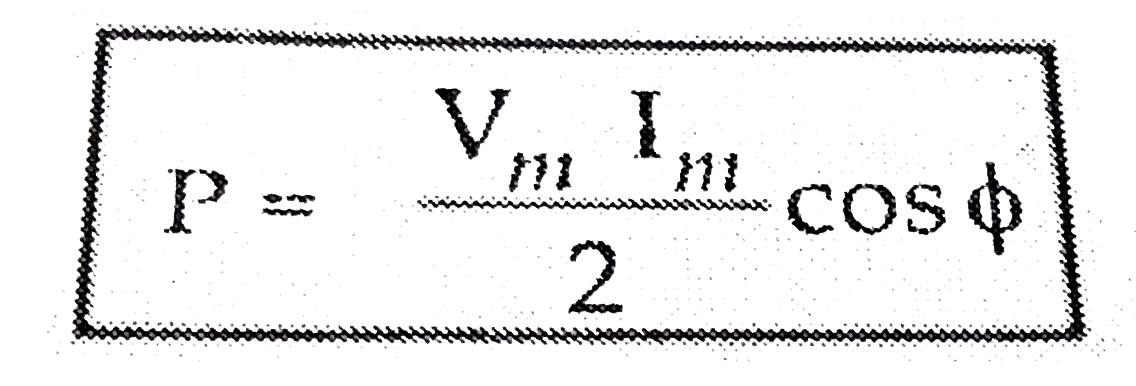 Wattless currecnt : The current in a.c. CIRCUIT is said to be wattless if the average power CONSUMED in the cuicuite is zero. For example, when SECONDARY of the TRANSFORMER is open the current in the primary is almost wattless. |
|
| 4. |
A mass of 1kg attached to one end of a string is first lifted up with acceleration 4.9m//s^2 and then lowered with same acceleration. What is the ratio of tension in string in two cases |
|
Answer» Solution :When MASS is lifted up with ACCELERATION `4.9 m//s^(2) , T_(1) =m(9.8 + 4.9)` When mass is LOWERED with same acceleration, `T_(2) =m(9.8 - 4.9)` `therefore T_(1)/T_(2) = 14.7/4.9 = 3:1` |
|
| 5. |
The angle of incidence at which reflected light is totally polarized for reflection from air to glass (refractive index n), is : |
|
Answer» `tan^-1`(N) |
|
| 6. |
Blue light is deviated more while undergoing refraction through a prism as compared to red light |
|
Answer» |
|
| 7. |
A uniform disc of mass 100 kg and radius 2 m is rotating at 1 rad/s about a perpendicular axis passing through its centre of the disk suddenly jumps to a point which is 1 m from the centre of the disc. The final angular velocity of the boy (in rad/s) is |
|
Answer» 0.77 So, `I_(1) omega_(1) = I _(2)2 omega_(2)` `rArr ((1)/(2)M_(disc)xxR_(disc)^(2)) omega_(1) = ((1)/(2)M_(disc)R_(disc)^(2)+M_(boy)R_(boy)^(2))omega_(2)` `rArr ((1)/(2)xx100xx2^(2))xx1=((1)/(2)xx100xx2^(2)+60xx1^(2))xxomega_(2)` `rArr omega_(2)= (200)/(200+60) = 0.77 " rad"-s^(-1)` |
|
| 8. |
For a standard single slit diffraction arrangement with slit width b and wavelength of light used lambda |
|
Answer» The SECONDARY maxima falls half way between consecutive MINIMA |
|
| 9. |
Can plane and convex mirrors produce real images? Give an explanation to your answer. |
| Answer» Solution :The rays of LIGHT converging to a POINT behind the plane MIRROR or convex mirror are REFLECTED to a point in front of the mirror on a screen. In other words, a plane or convex mirror can produce a real image if the object is virtual. | |
| 10. |
What is the meaning of "fright"? |
|
Answer» Happy |
|
| 11. |
An ammeter of range 100 mA has a resistance of 2ohm .What resistance should be connected in series with it to use it as a voltmeter of range 1 volt? |
|
Answer» `8OMEGA` |
|
| 12. |
What is point charge ? |
|
Answer» Solution :If the sizes of CHARGED bodies are very SMALL .< COMPARED to the distances between them the are called point CHARGES. All the charge content of the BODY is assumed t be concentrated at one point in space. |
|
| 13. |
ताप में वृद्धि होने पर वाष्प दाब |
|
Answer» समान रहेगा |
|
| 14. |
A pop-gun consists of a cylindrical barrel 3cm2 in cross-section closed at one end by a cork and havinga well fitting piston at the other. If the piston is pushed slowly in, the cord is finally ejected, giving a pop, the frequency of which is found to be 512Hz. Assuming that the initial distance between the cork and the piston was 25cm and there is no leakage of air, If the force required to eject the cork is 0.75 x xkg-wt. Find the value of x. Atmospheric pressure = 1kg wt//cm^2, v = 340 m/s. |
|
Answer» |
|
| 15. |
क्या निम्नलिखित समुच्चय समान हैं?A = {x:x शब्द WOLF का एक अक्षर है} B = {x:x शब्द FOLLOW का का एक अक्षर है}c= {x:x शब्द FLOW का एक अक्षरहै} |
| Answer» ANSWER :D | |
| 16. |
Determine the value of thede Broglie wavelength associated with the electron orbiting in the ground state of hydrogen atom ( Given E n = - (13.6)eV and Bohr radius r_(0) = 0.53Å). How will the de Broglie wavelength change when it is the first excited state? |
|
Answer» Solution :In ground state, the kinetic energy of the electron is `K = -E = ( + 13.6eV)/( 1^(2)) = 13.6 xx 1.6 xx 10^(-19) J` DE Broglie wavelength, `lambda = ( h )/( p ) = ( h )/( sqrt(2mK))` `lambda_(1)= ( 6.63 xx 10^(-34))/(sqrt( 2 xx 9.1 xx 10^(-31) xx 2.18 xx 10^(-18)))` `= 9.33 xx 10^(-9)= 0.33nm` Kinetic energy in the FIRST EXCITED state ( n = 2 ) `K = - E = + ( 13.6)/( 2^(2)) eV = + 3.4 eV` `= 3.4 xx 1.6 xx 10^(-19) J` `= 0.54 xx 10^(-18) J` de Broglie wavelength, `lambda_(2) = ( h)/( sqrt(2mK))` `= ( 6.63 xx 10^(-34))/( sqrt( 2 xx 9.1 xx 10^(-31) xx 0.544 xx 10^(-15)))` `= 2 xx 0.33 nm =0.66nm` |
|
| 17. |
The magnetic susceptibility of a paramagneticmatrial 73^(@)c is 0.075 and its valueat 173^(@)will be |
|
Answer» 0.003 `X_(m_(1))/(X_(m_(2))=(T_(2))/(T_(1))=(100)/(200)=1/2` |
|
| 18. |
Answer the following questions . a. Why does a paramagnetic sample display greater magnetisation (for the same magnetising field) when cooled ? b. Why is diamagnetism , in contrast , almost independent of temperature ? c. If a toroid uses bismuth for its core, will the the field in the core be (slightly ) greater or (slightly ) less than when the core is empty ? d. Is the permeability of a ferromagnetic material independent of the magnetic field ? If not, is it more for lower or higher fields ? e. Magnetic field lines are always nearly normal to the surface of ferreomgnet at every point . (This fact is analogous to the static electric field lines being normal to the surface of conductor at every point). Why ? f. Would the maximum possible magnetisation of paramagnetic sample be of the same order of magnitude as the magnetisation of ferromagnet ? |
|
Answer» Solution :a. The susceptibility X increases. b. The induced magnetic moment of electrons oppose the external field. c. Bismuth being DIAMAGNETIC , field will be SLIGHTLY less than the field in its absence. d. No. it is greater for lower fields. e. `MU` for ferromagnetic is very largc. The lines of FORCE on the surface area and by repulsion take normal shape. f. Yes. But only under extremely high magnetising field . |
|
| 19. |
A source is moving across a circle given by the equation x^2 + y^2 = R^2, with constant speed v=(330 pi)/(6sqrt(3)) m//s, in anti-clockwise sense. A detector is at rest at point (2R, 0) w.r.t the centre of the circle. If the frequency emitted by the source is f and the speed of sound, C = 330m/s. Then: |
|
Answer» The POSITION of the source when the detector records the maximum frequency `(+SQRT(3)/2 R, -R/2)` |
|
| 20. |
A student measured the length of a rod wrote it as 3.50 cm. Which instrument did he use to measure it ? |
|
Answer» A screw gauge having `50` divisions in the circular SCALE and pitch as `1` mm. Hence `(c )` is the correct choice. |
|
| 21. |
The principle section of a glass prism is an isosceles triangle ABC with AB = AC, the face AC issilvered. A ray of light is incident normally on the face AB and after two reflections, it emerges from the base BC perpendicular to the base. Angle of BAC of the prism is |
| Answer» ANSWER :B | |
| 22. |
Two identical coils, each with self inductance L, are connected in series and kept very close. Turns wound in these coils have opposite sense of winding. Then resultant inductance of this connection is ...... |
|
Answer» `L^2` `epsilon_(AC)=-epsilon + epsilon =0` `therefore -L_(ac)(dI)/(dt)=0` `therefore L_(ac)=0 (because (dI)/(dt) NE 0)` |
|
| 23. |
Explain, using a laballed diagram, the principal and working of a moviong coil galvnometer. What is the function of (i) unifrom radial magnetic field (ii) soft iron core ? Define the terms (i) current sensitivity and (ii) voltage sensitively of a galvanmeter. why does increasing the current sensitivity notneessarily increases voltage sensitivity ? OR (a) Write, using Biot-Savart law, the expression for the magnetic field vecB due to an element vecdl carrying current I at a distance vecr from it in a vector form. Hence ,derive the expression for the magnetic field due to a current carring loop of radius R at a point P distant x from its centre along the axis of the loop. (b) Explain how Biot- Savart law enables one to express the Ampere,s cicuital law in the integral from , vizointvecB, vec(dl) = mu_(0)I Where I is total current passing through the surface. |
|
Answer» Solution :(i) Current sensitivity : The current sensitivity of galvanometer is defined as the amount of deflection produced in the galvanomter when unit current is PASSED through it. ` I = C/(NBA) phi amp` Thus, current sensitivity ` I_(s) =phi/I or , I_(s) = (NBA)/C = 1/k` The reciprocal of current sensitivity is known as figure of merit of the galvanometer . it is defined as the current which will produce deflection of one scale division. Method of Increasing current sensitivity : from above, the current sensitivity is proportional to ` (NBA)/C` Thus, the sensitivitymay be increased be increased in the following ways- (i) By increasing the Number of Turns ` N to ` but N cannot be increased indenfinitely magnets ofthe resistance of instrument . (ii) By incresing the Field` B to ` this is achieved by using powerful permanet magnets of cobalt-steel and by putting a soft-iron core which CONCENTRATES the lines of FORCE. Voltage sensitively : The voltage sensitivity of a gavanometer is defined as the amount of deflection produced in the galvenometer when a unit voltage is applied across the two terminals of the galvanometer. Voltage sensitivity = `phi/V` This value is independent of number of term N as its effect is cancelled out by the corresponding increase int he resistance of the galvanometer `C_(1)` . The unit of voltage sensitivity is division`V^(-1)` (a) According to Biot-Savart law,the magnetic field due to a current element `vec(dl)` at eh observeation point whose position vector ` vecr ` is given by ` vec(dB) = (mu_(0)I)/(4pi) . (vec(dl)xxvecr)/r^(3) , " where " mu_(0)`is the permeability of free space. Consider a circular LOOP of wire of radius r carrying a current I. Consider a current element di of the loop. The direaction of dl is along the tangent so ` dl bot r` , from Biot - Savart law, magnetic field at the centre O due to this current element is ` dB= (,mu_(0)I)/(4pi) (dlsin90^(@))/r^(2) = (mu_(0)I)/(4pi) (dl)/r^(2)` The magnetic field due to all such current elements will point into the plane of paper at the centre O. Hence the total magneic field at the centre O is . 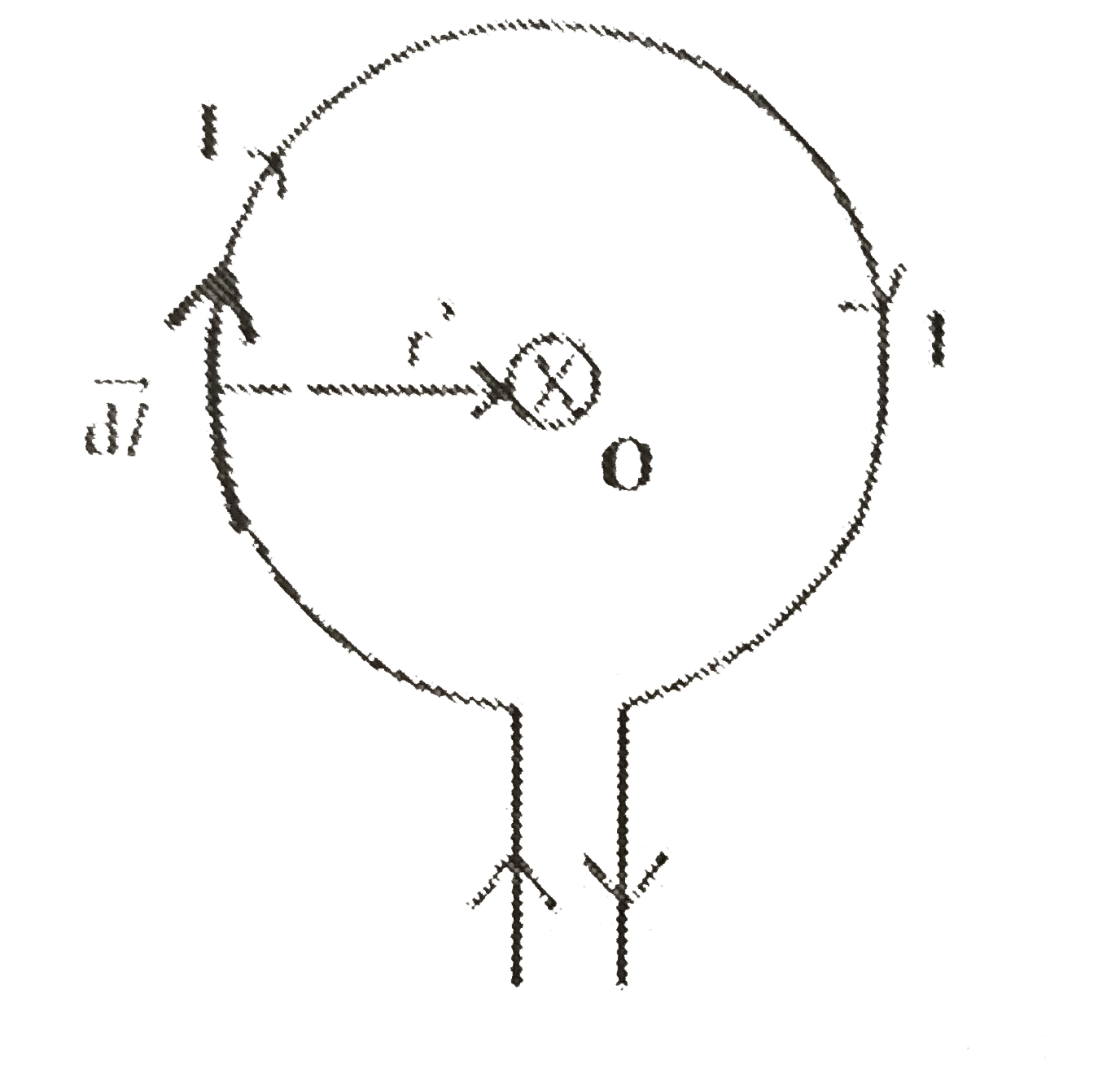 `b=intdB=int(mu_(0)Idl)/(4pir^(2)) intdl=(mu_(0)I)/(4pir^(2)).l=(mu_(0)I)/(4pir^(2)) .2pir or B=(mu_(0)I)/(2r)` For a coilof N turns, `B=(mu_(0)NI)/(2r)` (b) Ampere's ciruital law gives relationship between line intergral of magnetic field `vecB` and total current I producing magnetic field. |
|
| 24. |
Moving with the same velocity, which of the following has the longest de-Broglie wavelength ? |
|
Answer» `BETA`-PARTICLE As `beta`-particle (an ELECTRON) has the SMALLEST MASS, so it has the longest de-Broglie wavelength. |
|
| 25. |
"Science is not just a collection of laws, a catalogue of unrelated facts . It is a creation of human mind: with its freely invented ideas and concepts." Who made these remarks? |
|
Answer» Newton |
|
| 27. |
A metal sphere of radius 10 cm is given a charge of 12 muC. The force acting on unit area of its surface is |
|
Answer» `5.15xx10^(2) N//m^(2)` |
|
| 28. |
A neutron with kinetic energy T=2m_0c^2, where m_0 is its rest mass, strikes another, stationary, neutron. Determine: (a) the combined kinetic energy overset~T of both neutrons in the frame of their centre of inertia and the momentum overset~p of each neutron in that frame, (b) the velocity of the centre of inertia of this system of particles. Instruction. Make use of the invariant E^2-p^2c^2 remaining constant on transition from one inertial reference frame to another (E is the total energy of the system, p is its composite momentum). |
|
Answer» Solution :(B) & (a) In the CM FRAME, the total momentum is zero. Thus `V/c=(cp_(1x))/(E_1+E_2)=(sqrt(T(T+2m_0c^2)))/(T+2m_0c^2)=sqrt((T)/(T+2m_0c^2))` where we have used the result of problem Then `(1)/(sqrt(1-V^2//c^2))=(1)/(sqrt(1-(T)/(T+2m_0c^2)))=sqrt((T+2m_0c^2)/(2m_0c^2))` Total ENERGY in the CM frame is `(2m_0c^2)/(sqrt(1-V^2//c^2))=2m_0c^2sqrt((T+2m_0c^2)/(2m_0c^2))=sqrt(2m_0c^2(T+2m_0c^2))=overset~T+2m_0c^2` So `overset~T=2m_0c^2(sqrt(1+(T)/(2m_0c^2))-1)` Also `2sqrt(c^2overset~p^2+m_0^2c^4)=sqrt(2m_0c^2(T+2m_0c^2)), 4c^2overset~p^2=2m_0c^2T`, or `overset~p=sqrt(1/2m_0T)` |
|
| 29. |
A horizontal telegraph wire 0.5 km long runing east and west in a part of a circuit whose resistance is 2.5 Omega. The wire falls to g = 10.0 m//s^(2) and B=2xx10^(-5) weber/m^(2) then the current induced in the circuit is |
|
Answer» 0.7 AMP Here`df=BxxA=(2xx10^(-5))xx(0.5xx10^(+3)xx5)` dt = time taken by the wire to FALL at GROUND `=(2h//g)^(1//2)=(10//10)^(1//2)=1` sec. `therefore i=(1)/(2.5)[((2xx10^(-5))xx(0.5xx10^(3)xx5))/(1)]=0.02` amp. |
|
| 31. |
An electric dipole is placed in a uniform electric field vecE withits dipole moment vecp parallel to the field . Find (i)the work done in turningthe dipole till its dipole moment points in the direction opposite to vecE. (ii)The orientation of the dipole for which the torque acting on it become the maximum. |
|
Answer» Solution :We have `W=int_(theta_(1))^(theta_(2))taud theta` `thereforeW=int_(0)^(PI)pEsinthetad theta` `=pE[-COSTHETA]` `=-2pE` (ii)`thereforetau =PESIN theta`for `theta=(pi)/(2),TAU`ismaximum Alternatively , 
|
|
| 32. |
A certain dipole has opposite charges of 2xx10^(-5) separated by a distance of 0.2mm. It is placed in a uniform electric field of 10^(3)Vm^(-1). (i) find the torque, the field exerts on the dipole when the dipole is at 60^(@) with respect to the field. (ii) find the work, it would take to rotate the dipole to this position starting with the dipole aligned parallel to the field |
|
Answer» |
|
| 33. |
How much current deos a 60-watt lightbulb draw if it operates at a voltage of 120 volts? |
|
Answer» 0.25 amp `I=(P)/(V)=(60W)/(120V)=0.5A`. |
|
| 34. |
(A) : The maximum possible error in a reading is taken as least count of the measuring instrument. (R) : Error in a measurement cannot begreater than least count of the measu- ring instrument. |
|
Answer» Both (A) and (R) are TRUE and (R) is the correct EXPLANATION of (A) |
|
| 35. |
How high must be the kinetic energy of a proton striking another, stationary, proton for their combined kinetic energy in the frame of the centre of inertia to be equal to the total kinetic energy of two protons moving toward each other with individual kinetic energies T=25.0 GeV? |
|
Answer» Solution :Let `T^'=` KINETIC ENERGY of a proton striking another stationary particle of the same rest mass. Then, COMBINED kinetic energy in the CM FRAME `=2m_0c^2(sqrt(1+(T^')/(2m_0c^2)-1))=2T`, `((T)/(m_0c^2)+1)^2=(T^')/(2m_0c^2)` `(T^')/(2m_0c^2)=(T(2m_0c^2+T))/(m_0^2c^4)`, `T^'=(2T(T+2m_0c^2))/(m_0c^2)` |
|
| 36. |
Which of the folloiwng exhibits dichroism |
|
Answer» quartz |
|
| 37. |
Light travels from air into glass slab of thickness 50 cm and refractive index 1.5. (i) What is the speed of light in glass? (ii) What is the time taken by the light to travel through the glass slab? (iii) What is the optical path of the glass slab? |
|
Answer» Solution :GIVE: thickness of glass slab, d = 50 cm = 0.5 m, refractive index, n = 1.5 refractive index, `n = (c )/(v)` SPEED of light in glass is, `v = (c )/(n) = (3 xx 10^(8))/(1.5) = 2 xx 10^(8) MS^(-1)` Time taken by light to travel through slab is, `t = (d)/(v) = (0.5)/(2 xx 10^(8)) = 2.5 xx 10^(-7) s` optical path, d. = nd = `1.5 xx 0.5 = 0.75 m = 75 cm` LIght woul have travelled 25 cm more (75 cm - 50 cm)in vacuum by the same time had there been a glass slab. |
|
| 38. |
When monochromatic light of frequency f_(1) incident on photosensitive surface ,stopping potential obtained is V_(1).When same surface is incident with monochromatic light of frequency f_(2) is incident on same surface ,stopping potential will become...... |
|
Answer» `V_(1)+(h)/(E )(f_(2)-f_(1))` `e(V_(2)-V_(1))=h(f_(2)-f_(1))` `therefore V_(2)-V_(1)=(h)/(e )(f_(2)-f_(1))` `therefore V_(2)=V_(1)+(h)/(e )+(h)/(e )(f_(2)-f_(1))` |
|
| 39. |
Define the term "threshold frequency", in the context of photoelectric emission. |
| Answer» Solution :Threshold frequency of a material is the MINIMUM frequency of INCIDENT radiation needed to CAUSE PHOTOELECTRIC emission from the SURFACE of that material. | |
| 40. |
Morning sun is not as hot as the mid-day sun because |
|
Answer» sun is COOLER in the morning |
|
| 41. |
Water of volume 2 litre in a container is heated with a coil of 1 kW at 27^(@)C. The lid of the container is open and energy dissipates at the rate of 160 J/s. In how much time, temperature will rise from 27^(@)C" to "77^(@)C ? [Given specific heat of water is 4 cdot 2 kJ/kg]: |
|
Answer» 8 min 20 s `1000 t =mc DELTA T+160 t` `1000 t=2xx 4 cdot 2xx10^(3)xx(77-27)+160 t` `rArr t=500 s=8` min 20 sec. `therefore` CORRECT choice is (a). |
|
| 42. |
perisperm is found in- |
|
Answer» BLACK pepper |
|
| 43. |
Nitrogen gas is filled in an isolated container. If alpha fraction of moles dissociates without exchange of any energy, then the fractional change in its temperature is |
|
Answer» `(- ALPHA )/(5 + alpha)` |
|
| 44. |
A photographic camera with a lens of focal length 5 cm is used for capturing images. The vertical length of the film used is 24 mm in which image of a 1.68 m tall man is to be captured. Find the minimum distance (in m) of the man from the lens such that his complete image can be obtained. |
|
Answer» |
|
| 45. |
A straight wire carrying a current of 5 A is bent into a semicircular arc of radius 2 cm as shown in the fig. Find the magnitude and direction of the magnetic field at the centre of the arc. |
|
Answer» Solution :Here current `I = 5 A`, radius of semi circular arc `R = 2 CM = 0.02 m`. The magnetic field due to long straight wire is zero because the centre point of the arc lies on the extended line of wire itself. And field due to semi circular `arc B = 1/2 [(mu_0 I)/(2R)] = (mu_0 I)/(4 R) = ((4 pi XX 10^(-7)) xx 5)/(4 xx 0.02) = 7.85 xx 10^(-5) T`. As per right hand THUMB rule, the magnetic field `vecB` points PERPENDICULAR to plane directed into the paper. |
|
| 46. |
Light incident normally on a plane mirror attached to a galanometer coil retraces backwards as shown in figure . A current in the coil produces a deflection of 3.5^(@) of the mirror. What is te displacement of the reflected spot of light on a screen placed 1.5 m away ? |
|
Answer» SOLUTION :The reflected rays get DEFLECTED by twice the angle of ROTATION of the mirror. `(d)/(1.5) = tan 7^(@) "" THEREFORE d = 18.4 ` CM |
|
| 47. |
1 g of a a radioactive sustains disintegrate at the rate of 3.7 xx 10^10/sec. The atomic mass of the substance is 226. Calculate its mean life |
|
Answer» `7.2xx10^10` SEC |
|
| 48. |
In question number 3, which of the two receivers picks up the larger signal when D is turned off? |
|
Answer» `R_(1)` `R_(1)` picks up `y=a" COS"wt` ` :. LT I_(R_(1))GT =(1)/(2)a^(2)` `R_(2)` picks up `y=3a" cos"wt` ` :. lt I_(R_(2))gt =(9)/(2)a^(2)` Thus `R_(2)` picks up larger signal compared to `R_(1)`. |
|
| 49. |
Convex lens having focal length f, and concave lens having focal length f2 are placed in contact. Out of conditions given below, which condition supports this combination to behave like concave lens ? |
|
Answer» `f_1=f_2` For CONCAVE lens `f_2` is NEGATIVE. `therefore1/f=1/f_1-1/f_2` If `f_2 lt f_1`,f will be negative and COMBINATION BEHAVES as concave lens. |
|
| 50. |
The substance which are repelled by a magnet are termed as _____. |
| Answer» SOLUTION :DIAMAGNETIC | |