Saved Bookmarks
This section includes 7 InterviewSolutions, each offering curated multiple-choice questions to sharpen your Current Affairs knowledge and support exam preparation. Choose a topic below to get started.
| 1. |
एक विमा में निबिड़ संकुल में c.n. कितना है |
|
Answer» 2 |
|
| 2. |
Which radiation is prevented by ozone layer from reaching earth? |
| Answer» SOLUTION :ULTRAVIOLET | |
| 3. |
In the above question angular velocity of the system after the particle sticks to the cylinder |
|
Answer» 0.3 rad `s^(-1)` `L+mvR=(I+MR^(2))omega` `THEREFORE omega=(L+mvR)/((I+mR^(2)))` `=(0.12+0.5xx5xx0.2)/(((1)/(2)MR^(2)+MR^(2)))` `=(0.12+0.5)/((1)/(2)xx2+0.5)xx0.4` `=(0.62)/(1.5xx.04)=(0.62)/(0.06)` `=10.33" rad "s^(-1)` |
|
| 4. |
Two circular concentric loops of radii r_(1)=20cm, r_(2)=30 cm are placed in the X-Y plane as shown in the figure. A current I= 7 A is flowing through them. The magnetic moment of this loop system is |
|
Answer» `+0.4hatk(Am^(2))` |
|
| 5. |
Two polaroids are kept with theirtransmission axes inclined at30^(@). Unpolarised light of intensity I falls on the first polaroid. Find out the intensity of light emerging from the second polaroid. |
|
Answer» Solution :As the intensity of the unpolarised light falling on the first polaroid is I, the intensity of POLARIZED light EMERGING will be, `I_(0) = ((1)/(2))`. Let I. be the intensity of light emerging from the SECOND polaroid. Malus. law, `I. = I_(0) cos^(2) theta` Substituting, `I.=((1)/(2))cos^(2)(30^(@))=((1)/(2))((sqrt(3))/(2))^(2)=1(3)/(8)` `1.=((3)/(8))I` 
|
|
| 6. |
In a discharge tube, which contains argon at low pressure, V potential difference is applied between two of its electrodes. Ionisation energy of argon atom is 15.6 eV. Separation between electrodes is 4.0 xx 10^(-2) m and average distance that electron travels between two successive collisions with argon atoms is 8 xx 10^(-5)m. Estimate the minimum value of V such that collision of electron may cause ionisation of argon atoms. |
|
Answer» Solution :Electric field between the plates can be WRITTEN as follows : E=V/d , where `d(=4.0xx10^(-2)m)` is separationbetween the plates. If `lambda(=8xx10^(-5)m)` is distance between two successive collisions then ENERGY ACQUIRED by the electron can be written as follows : Energy acquired by electron before collision `=eElambda=eVlambda//d` This energy must be equal to 15.6 eV to cause ionisation of argon atom. `(eVlambda)/d=15.6xxe` `V=(15.6xxd)/lambda=(15.6xx4xx10^(-2))/(8xx10^5)` `=7.8xx10^3` V = 7.8 KV |
|
| 7. |
A car is moving with maximum speed on a curved banked road. The statement is /are correct |
|
Answer» only A |
|
| 8. |
From a tower of height H a particle is thrown vertically upwards with a speed U. The time taken by the particle, to hit the ground, is n times that taken by it to reach the highest point of its path. |
|
Answer» `2gH = N u^2(n - 2)` |
|
| 9. |
A 100 W sodium lamp radiates radiates energy uniformly in all directions. The lamp is located at the centre of a large sphere that absorbs all the sodium light which is incident on it. The wavelength of the sodium light is 589 nm. At what rate are the photons delivered to the sphere ? |
|
Answer» `3XX10^(20)` Photons/Sec |
|
| 10. |
The phenomenon of splitting up of a polychromatic beam of light into constituent colors when passed through_____ is called_____ |
| Answer» SOLUTION :PRISM, DISPERSION | |
| 11. |
In the case of Fresnel zones a) the phase difference between the waves spreading from consecutive zones and reaching a point on the screen is 180^(0) b) the path diffrence between the waves spreading from alternate zones and reaching a point on the screen is lambda c) the area of the zone increases with the increase of obliquity d) the area of each zone is proportional to the product of the wavelength and the distance of the given point from the zone |
|
Answer» only a, B and C are true |
|
| 12. |
Calculate the back e.m.f of a 10H, 200 Omegacoil 100 ms after a 100Vd.c supply is connected to it. |
|
Answer» Solution :The value of current at 100 ms after the SWITCH is CLOSED is `I = I_0 [ 1-e^((-1)/(T_0)) ] ` , here , `I_0=100/200 =0.5` amp `tau_0 = L/R = 10/200 = 0.05 sec , t = 0.1 sec` `I = 0.5 (1-e^(0.1//0.05)) = 0.5 (1-e^(-2)) = 0.4325A` now `E = IR + L (dI)/(dt) ,or 100 = 0.4325 xx200 + L (dI)/(dt)` back emf = `L (dI)/(dt)= 100 - 0.4325 XX 200 = 13.5V` |
|
| 15. |
An elastic cord having an upstretched length l, force constant k and mass per unit length m_(@) is stretched arouond the drum of radius (2pirgtl) Determine the speed of the cord, due to rotation of te drum, which will allow the cord to loosen its contact with the drum. Express value of (v^(2))/11 (in m^(2)//s^(2)) ( for the given data m_(0)=40g//cm, k=100N/m, pi=22/7, l=400cm, r=70cm) |
|
Answer» `2T"sin" ((d theta)/2)=(dm)(v^(2))/R` or `T(2pi)=m (v^(2))/R` `(k/_\x)2pi(m_(@)l)(v^(2))/R` `v=(sqrt(k(/_\x)2piR)/(m_(@)l))` & `/_\x=(2pir-I)` 
|
|
| 16. |
When a high current is passed through a moving coil galvanometer, it will get destroyed. How? |
| Answer» SOLUTION :High CURRENT will PRODUCE large amount of HEAT. This heat will destroy COILS in the galvanometer. | |
| 17. |
Two large conducting spheres carrying charges Q_1 and Q_2 are brought close to each other. Isthe magnitude of electrostatic force between them exactly given by Q_1Q_2//4pi epsi_0 r^2, where r is the distance between their centres ? |
|
Answer» Solution :The Coulomb.s law is valid for point charges only. When the spheres are BROUGHT closer to each other, the interaction between the SPHERE will render non-uniformities in charge distribution and RELATION `F = (Q_1 Q_2)/(4pi epsi_0 r^2)` no longer HOLDS. |
|
| 18. |
If polarised light of intensity I passes through a polaroid whose pass axis makes an angle theta from the vibration axis of polarised light, the intensity of emergent light is I'=Icostheta. |
| Answer» SOLUTION :FALSE-`I=Icos^(2)THETA` | |
| 19. |
A ray of light PQ is incident on the face of an isosceles glass prism kept on a horizontal table [Fig. 2.89].If for the ray PQ the prism is at the position of minimum deviation then |
|
Answer» `ALPHA = BETA` |
|
| 20. |
What is the average value of the A.C. voltage over one complete cycle ? |
|
Answer» `(2V_"max")/pi` |
|
| 21. |
In symmetic charge configurations,the electric field can be easily calculated using Gauess's law.According to Gauss's law.The electric flux through any closedspherical surface enclosing a and q is give by |
|
Answer» `qepsilon_0` |
|
| 22. |
Which one of the relation is correct between time period and number of orbits while an electron is revolving in a orbit |
|
Answer» `n^(2)` |
|
| 23. |
If one mole of a monoatomic gas (gamma=(5)/(3)) is mixed with one mole of a diatomic gas (gamma=(7)/(5)) the value of r for the mixture is |
|
Answer» `1.40` |
|
| 24. |
Discuss the intensity of transmitted light when a polaroid sheet is rotated between two crossed plaroids? |
|
Answer» <P> Solution :Let `I_(0)` be the intensity of polarised light after passing through the first polariser `P_1`. Then the intensity of light after passing through second polariser `P_2` will be`I= I_(0) cos^(2) theta`, where `theta` is the angle between pass axes of `P_(1)" and "P_(2)`. Since `P_(1)" and "P_(3)` are crossed the angle between the pass axes of `P_(2)" and "P_(3)` will be `(pi"/"2- theta)`. Hence the intensity of light imerging from `P_(3)` will be `I= I_(0) cos^(2) ((pi)/(2)-theta)= I_(0) cos^(2) theta sin^(2) theta= (I_(0)"/"4) sin^(2) 2theta` THEREFORE, the transmitted intensity will be MAXIMUM when `theta= pi"/"4`. |
|
| 25. |
How does the sign of the phase angle o, by which the supply voltage leads the current in an LCR series circuit, change as the supply frequency is gradually increased from very low to very high values ? |
| Answer» Solution :For very low frequencies `X_(C) gt X_(L)`and sign of phase ANGLE is --ve. As frequency of supply VOLTAGE is increased, VALUE of o becomes less negative till at RESONANT frequency value of phase angle `phi`is ZERO. For frequencies higher than resonant frequency `X_(L) gt X_(C)`and `phi`is +ve whose value goes on increasing with frequency. | |
| 26. |
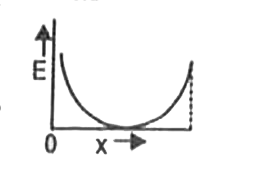
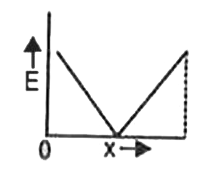
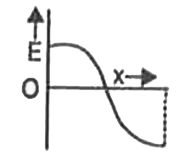
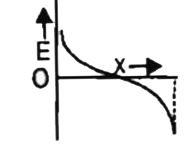
Two identical point charges are placed at a separation of l . P is a point on the line joining the charges, at a distance x from any one charge. The field at P is E.E is plotted against x for values of x from close to zero to slightly less than l . Which of the following best represents the resulting curve ? |
|
Answer»
|
|
| 27. |
In the above question the dipolemoment of each is |
| Answer» ANSWER :C | |
| 28. |
The potential energy of a particle varies with position X according to the relationU(x) = [(X^3/3)-(3X^2/2)-2X]then |
|
Answer» The POINT x = 1 is point of STABLE equilibrium |
|
| 29. |
A moving coil galvanometer of resistance 50 ohms gives a full scale deflection when a current it to a velotmeter of range 10 volt, the resistance required to be placed in series is : |
|
Answer» 2000 ohm |
|
| 30. |
A wire is stretched by2xx10^(-2)m due to the force of 10 N. Then the amount of work done to stretchthe wire to a displacement of 4xx10^(-2)m is |
|
Answer» Solution :`W_(1) =(1)/(2) Fl=(1)/(2)xx10 xx 2 xx 10^(-2) =0.1J` `(W_(2))/(W_(1))=((l_(2))/(l_(1)))^(2)=((4xx10^(-2))/(2XX10^(-2)))^(2)=4` `W_(2)=4W_(1)` `=4xx0.1=0.4J`. |
|
| 31. |
The period of oscillation of a simple pendulum is T=2pisqrt(L/(g)) . L is about 10 cm and is known to 1 mm accurancy. The period of oscillation is about 0.5 second. The time of 100 oscillation is measured with a wrist watch of 1 s resolution. What is the accurancy in the determination of g ? |
|
Answer» `3%` In TERMS of percentage, `(Deltag)/(g)xx100=(DeltaL)/(L)xx100+2xx(DeltaT)/(T)xx100` Percentage error in `L=100xx(DeltaL)/(L)=100xx(0.1)/(10)=1%` Percentage error in `T=100xx(DeltaT)/(T)=100xx(1)/(50)=2%` Percentage error in `g=100(Deltag)/(g)=1%+2xx2%=5%` `(c )` is CORRECT. |
|
| 32. |
Sketch the electric field lines for a uniformly charged hollow cylinder shown in figure. |
Answer» Solution :The ELECTRIC field lines are PRODUCED from positive charge and go to INFINITE distance which is SHOWN in figure. 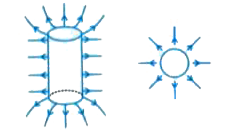
|
|
| 33. |
What does a modem represent ? |
| Answer» Solution :A modem represents modulation and demodulation. During TRANSMISSION, it ACTS as MODULATOR and during RECEIVING, it acts as demodulator. | |
| 34. |
A 30 kg crate is moved along a horizontal floor by a warehouse worker who's pulling on it with a rope that makes a 60^(@) angle with the horizontal. The tension in the rope is 200 N and the crate slides a distance of 10 m. how much work is done on the crate by the worker? |
Answer» Solution :The figure below shows that `F_(T) and d` are not parallel. It's only the COMPONENT of the force acting along the DIRECTION of motion, `F_(T) costheta`, that does any work.  ltBrgt THEREFORE `W=(F_(T)costheta)d=(200N*cos60^(@))(10M)=1,000J` ltBrgt THEREFORE `W=(F_(T)costheta)d=(200N*cos60^(@))(10M)=1,000J`
|
|
| 35. |
A TV tower has a height of 75m. What is the maximum distance upto which this TV transmission can be received ? (Radius of the earth = 64 xx 10^(6)m) |
|
Answer» 30.98 KM |
|
| 36. |
A neutron , an electron and an alpha particle moving with equal velocities, enter a uniform magnetic field going into the plane of the paper as shown in fig. Trace their paths in the field and justify your answer. |
|
Answer» Solution :The paths of an `alpha-` particle, neutron and an electron moving with equal velocities, in a uniform magnetic field `vecB` going into the plane of the PAPER have been depicted in the fig. (i) The positively charged alpha- particle describes a circular path of radius `r_(alpha)` in hte plain of paper in an anticlockwise direction under the magnetic force where `r_(alpha) = (m_(alpha) v)/(q_(alpha) B)`. (II) The neutron, being a chargeless particle, EXPERIENCE no force due to magnetic field and travels with a constant VELOCITY along a straight path. (iii) The negatively charged electron describes a circular path of radius, `r_(e) = (m_e v)/(eB)` in the clockwise diretions under the magnetic force. As `m_e < < m_(alpha) `, hence `r_(e) < < r_(alpha)`. |
|
| 37. |
A point charge Q is placed inside a conducting spherical shell of inner radius 3R and outer radius 5R at a distance R from the centre of the shell. The electric potential at the centre of the shell will be |
|
Answer» `(1)/(4piepsilon_(0)).(Q)/(R)` |
|
| 38. |
A plane electromagnetic wave is incident on a material surface. The wave delivers momentum p and energy E, then : |
|
Answer» <P>`p NE 0, E ne 0` |
|
| 39. |
A coil of area A is placed in the X-Y plane. A uniform magnetic field B_0hati established. The emf induced in the coil is ____ |
|
Answer» clockwise `phi=AB cos 90^@` `therefore phi=0` `therefore` INDUCED emf `epsilon=0` |
|
| 40. |
The threshold wavelength for emission of photoelectrons from a metal surface is 6xx10^(-7) m. What is the work function of the material of the metal surface ? |
|
Answer» `6.66xx10^(-19)J` |
|
| 41. |
How will you measure the internal resistance of a cell by potentiometer? |
|
Answer» Solution :To measure the internal resistance of a cell, the circuit connections are made as shown in Figure. The END of the potentiometer wire is connected to the POSITIVE terminal of the battery B and the NEGATIVE terminal of the battery is connected to the end D through a key `K_1`. This forms the primary circuit. (ii) The positive terminal of the cell & whose internal resistance is to be determined is also connected to the end of the wire. The negative terminal of the cell `xi` is connected to a jockey through a galvanometer and a high resistance. 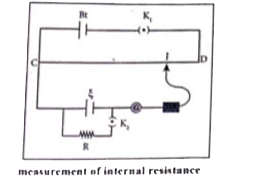 (iii) A resistance box R and key `K_2`, are connected across the cell `xi`. With `K_2`, open, the balancing point J is obtained and the balancing length `C_1`, = `1_1`, is measured. Since the cell is in open circuit, its emf is `xi =I_i "...(1)"` (iv) A SUITABLE resistance (say, `10 Omega`) is included in the resistance box and key K2 is closed. Let r be the internal resistance of the cell. The current passing through the cell and the resistance R is given by `I = xi /(R+r)` The potential difference a across R is `V = (xi R)/(R+r)` (v) When this potential difference is balanced on the potentiometer wire, let `l_1`, be the balancing length Then `(xi R)/(R+r) prop l_2"...(2)"` From equations (1) and (2) `(R+r)/R = l_2/l_2` `+r/R= l_2/l_2` `r = R[(l_1 l_2)/l_2]` `:."r = R" [(l_1 - l_2)/l_2]` (vi) Substituting the values of the R, `I_1`, and `l_1`, the internal resistance of the cell is determined. The experiment can be REPEATED for different values of R. It is found that the internal resistance of the cell is not constant but increases with increase of external resistance connected across its terminals. |
|
| 42. |
A black plane surface at a constant high temperature T_h, is parallel to another black plane surface at constant lower temperature T_l. Between the plates is vacuum. In order to reduce the heat flow due to radiation, a heat shield consisting of two thin black plates, thermally isolated from each other, it placed between the warm and the cold surfaces and parallel to these. After some time stationary conditions are obtained. By what factor neta is the stationary heat flow reduced due to the presence of the heat shield? Neglect end effects due to the finite size of the surfaces. |
Answer» Solution :`(DH)/(dt)=A sigma(Th^(4)-T_(L)^(4))` 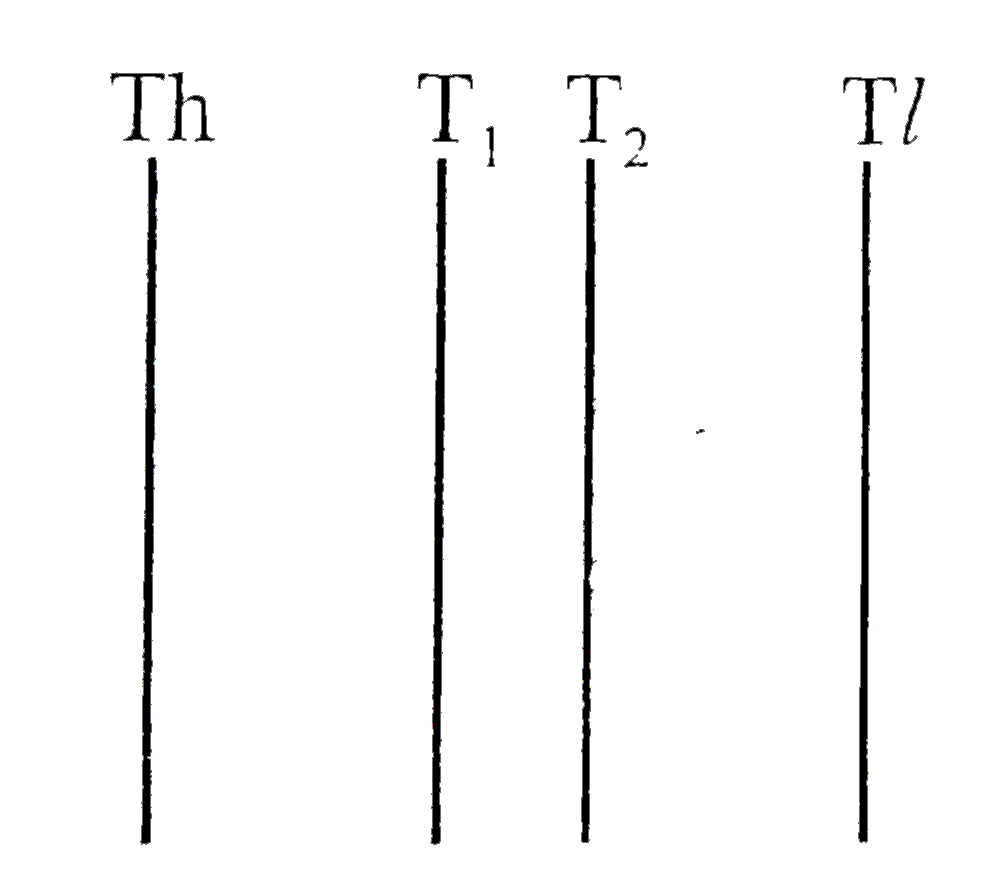 `(dh)/(dt)=A sigma(T_(H)^(4)-T_(1)^(4))=A sigma(T_(1)^(4)-T_(2)^(4))` `=Asigma(T_(2)^(4)-T_(l)^(4))` `T_(h)^(4)-T_(1)^(4)=T_(1)^(4)-T_(2)^(4)=T_(2)^(4)-T_(1)^(4)=C` `T_(2)^(4)=C+T_(l)^(4)` `T_(l)^(4)=T_(2)^(4)+C=2C+T_(l)^(4)` `T_(h)^(4)-(2C+T_(l)^(4))=C` `T_(h)^(4)-T_(l)^(4)=3C ` `(dH')/(dt)=A sigmaC=(dH)/(3dt)` |
|
| 43. |
A car accelerates from rest at a constant rate alpha for some time, after which it decelerates at a constant rate beta and comes to rest . If the total time elapsed is t, then the maximum velocity acquired by the car is |
|
Answer» `((ALPHA^2 + BETA^2)/(alpha beta))t` |
|
| 44. |
A plane light wave with wavelength lambda = 0.65 mum falls normally on a large glass plate whose opposite side has a longrectangular recess 0.60mm wide. Using Fig. find the depth H of the recess at which the diffraction pattern on the screen 77 cm away from the plate has the maximum illuminance at its centre. |
|
Answer» Solution :Let `a = `width of the reccess and `v = (a)/(2) sqrt((2)/(b lambda)) = (a)/(sqrt(2b lambda)) = (0.6)/(sqrt(2 XX 0.77 xx 0.65)) ~= 0.60` be the paremeter along Cornu's spiral corresponding to the half-width of the resecc. The amplitude of the diffracted wave is given by `_(~)const [E^(i delta) underset(-v)overset(v)int e^(-i pi u^(2)//2) du + underset(v)overset(oo)int e^(-i pi u^(2)//2) du + underset(-oo)overset(v)int e^(-i pi u^(2)/(2) du)]` where `delta = (2pi)/(lambda) (n - 1) H` is the extra phase due to the recess. (Actually an extra phase `e^(-i delta)` appears outside the recess. When we take it out and obsord it in the constant we GET the expression written). Thus the amplitude is  `~ const [(C(v) - iS(v))e^(i delta) + ((1)/(2) - C(v)) - i ((1)/(2)-S(v))]` From the cornu's spiral, the corrdinates corresponding to the parameter `v = 0.60` are `C(v) = 0.57, S(v) = 0.13` so the intensity at `o` is proportional to `|[(0.57 - 0.13i)e^(i delta) - 0.07 - i0.37]|^(2)` `= (0.57^(2) + 0.13)^(2) + 0.07^(2) + 0.37^(2)` `+ (0.57 - 0.13i) (-0.07 + 0.37 i)e^(i delta)` `+ (0.57 + 0.13i)(-0.07 - i0.37i)e^(-i delta)` We write `0.57 bar(+) 0.13i = 0.585e^(bar(+)ialpha) alpha = 12.8^(@)` `-0.07 +- 0.37i = 0.377 e^(+-i beta) beta = 100.7^(@)` Thus the CROSS term is `2 xx 0.585 xx 0.377 cos (delta + 88^(@))` `= 2 xx 0.585 xx 0.377 cos (delta + (pi)/(2))` For maximum intensity `delta+(pi)/(2) = 2k'pi, k' = 1, 2, 3, 4, .............` `=2(k + 1) pi, k = 0,1,2,3,.........` or `delta = 2kpi + (3pi)/(2)` so `h = (lambda)/(n - 1) (k + (3)/(4))` |
|
| 45. |
If net external force acting on the system is zero then |
|
Answer» Velocity of the individual particle of the system will REMAIN constant |
|
| 46. |
Figure shows a circuit having a coil of resistance R = 2.5 Omega and inductance L connected to a conducting rod of radius 10 cm with its center at P. Assume that friction and gravity are absent and a constant uniform magnatic field of 5 T exists as shown in figure. At t = 0, the circuit is switched on and simultaneously a time-varying external torque is applied on the rod so that it rotates about P with a constant angular velocity 40 rad s^(-1). Find the magnitude of this torque (in mNm) when current reaches half of its maximum value. Neglect the self inductance of the loop formed by the circuit. |
|
Answer» MAXIMUM current: `i_(0) = (B omegal^(2))/(2R)` Torque about the hinge `P` is `tau = underset(0) overset(l) int i(dx)Bx rArr tau = (1)/(2) iBl^(2)` Putting `i= i_(0)//2`, we GET: `tau = (B^(2)Omega l^(4))/(8R) = 5mNm` |
|
| 47. |
The space between the plates of a parallel plate air capacitor is filled with an isotropic dielectric medium of which dielectric constant varies in the direction perpendicular to the plates according to the relation given as k=k_(1)[1+"sin"(pi)/dx] Where d is the separation, between the plates and k_(1) is a constant. The area of the plates is A. Determine the capacitance of the capacitor. |
|
Answer» |
|
| 48. |
A magnetised needle in a uniform field experience a force as well as a torque. |
| Answer» Solution :False- A magnetised NEEDLE in a UNIFORM magnetic field experiences a torque but does not experience a FORCE. | |
| 49. |
Match List - I (Fundamental Experiment) with List - II (its conclusion) and select the correct option from the choices given below the list : {:(,"List-I",,"List-II"),((A),"Franc-Hertz Experiment.",(i),"Particle nature of light"),((B),"Photo-electric",(ii),"Discrete energy levels of atom"),((C),"Davison-Germer Experiment.",(iii),"Wave nature of electron"),(,,(iv),"Structure of atom"):} |
|
Answer» (A) (i) (B) -(iv) ( C)-(iii) (B) Photo electric experiment is associated with particle nature of light and Davison-Germer experiment is assocated with have nature of electron. |
|
| 50. |
A small town with a demand of 800 KW of electric power at 220V is situated 15km away from an electric plant generating power at 440 V. The resistance of the two line wires carrying power is 0.5Omega//km. The twon gets power from the lines through a 4000 - 220 V step down transformer at a substation in the town. a) Estimate the line power loss in hte form of heat b) How much power must the plant supply, assuming there is negligible power loss due to leakage? c) Characterize the step up transformer at the plant |
Answer» Solution : POWER requirement of the twon is given by EI, where E is the voltage at the RECEIVING end of the line and I is the line current. Here `P=800xx1000W,E=4000V` then `I=(P)/(E)=(800xx1000)/(4000)=200A` (i) Line power loss `=I^(2)R=(200)^(2)xx(2xx15xx0.5)` `=600,000W=600kW` (ii) TOTAL power delivered by power plant `=800+600=1400kW` (iii) Voltage at sending end of line `="Receiving end line voltage "+" voltage drop in line"` `=4000+(IR)=4000+200(2xx15xx0.5)` `=4000+3000=7000V` `therefore"Step up transformer of "(7000V)/(440V)" is required"` |
|