

Saved Bookmarks
This section includes 7 InterviewSolutions, each offering curated multiple-choice questions to sharpen your Current Affairs knowledge and support exam preparation. Choose a topic below to get started.
| 1. |
Assertion Path of a charged particle in uniform magnetic field cannot be a parabola, if no other forces (other than magnetic force) are acting on the particle. Reason For parabolic path, a constant acceleration is required. |
|
Answer» If both Assertion and REASON are true and Reason is the correct EXPLANATIONOF Assertion. |
|
| 2. |
(a) Give one use of electromagnetic radiations obtained in nuclear disintegrations. (b) Give one example each to illustrate the situation where there is (i) displacement current but no conduction current, and (ii) only conduction current but no displacement current. |
|
Answer» SOLUTION :(a) Gamma-rays obtained in nuclear disintegration are used as radiations for treatment of cancer. (B) When we CONSIDER a CAPACITOR joined to an a.c. source then (i) between the plates of capacitor only displacement current is present but there is no conduction current, and (i) in the connecting wires only conduction current FLOWS but there is no displacement current. |
|
| 3. |
Two identical plano-convex lenses L_(1)(mu_(1)-1.4) and L_(2)(mu_(2)-1.5) of radii of curvature R=20cm are placed as shown in Figure. Q. Findthe position of the image of theparallel beam of light relative to the commonprincipal axis. |
|
Answer» `100//7cm` `(1)/(f_(1))=(mu-1)((1)/(R)-(1)/(oo))rArrf_(1)=50cm` `(1)/(f_(2))=(mu-1)[(1)/(oo)-(-(1)/(R))]rArrf_(2)=40cm` The equivalent focal LENGTH F of the combination is given by `(1)/(f)=(1)/(f_(1))+(1)/(f_(2))rArrf=(200)/(9)CM` Hence, the image of the parallel beam is formed on the common principal axis at a distance of 22.22cm from the combination on the right side. b. Image formed by `L_(1)` is at a distance of 50cm behind the lens. This image lies on the principal axis of `L_(1)` and will act as an object for `L_(2)` For `L_(2)`, object distance, `u=+50cm` `f_(2)=+40cm` `(1)/(UPSILON)-(1)/(u)=(1)/(f)rArrmu=(200)/(9) cm` Magnification caused by `L_(2), m=(upsilon)/(u)=(4)/(9)` For `L_(2)` object `I_(1)` is at a distance of 4.5mm above its principal axis. Hence, distance of image `I_(2)` of the object (virtual) `I_(1)` is at a distance `(4//9)xx4.5=2mm` above the principal axis of `L_(2)` `[:. "height of image" `=mxx` "height of object" ]` Hence, final image is at a distance of 22.22cm behind the combination at a distance of 2.5mm below the principal axis of `L_(1)`. 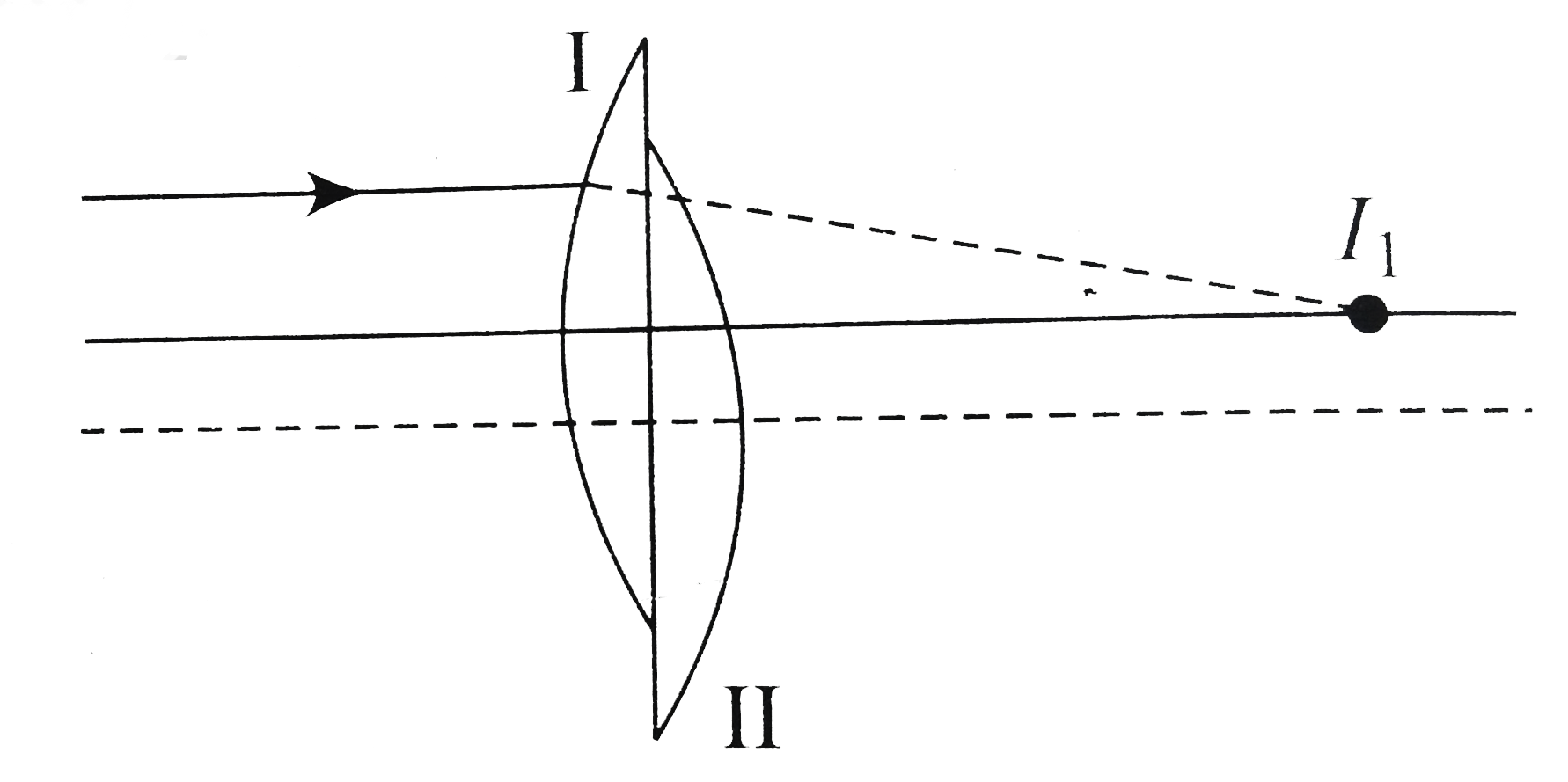
|
|
| 4. |
Two horizontal forces vec(F)_(1) and vec(F)_(2) act on a 4.0 kg disk that slides over frictionless ice, on which an xy coordinate system over frictionless ice, on which an xy coordinate system is laid out. Force vec(F)_(1) is in the positive direction of the x axis and has a magnitude of 7.0 N. Force vec(F)_(2) has a magnitude of 9.0 N. Figure 5-39 gives the x component v_(x) of the velocity of the disk as a function of time t during the sliding. What is the angle between the constant directions of forces vec(F)_(1) and vec(F)_(2) ? |
| Answer» SOLUTION :`56^(@)` | |
| 5. |
For the myopic eye, the defect is cured by |
|
Answer» CONVEX LENS |
|
| 6. |
A very simplified schematic of the rain drainage system for a home is shown in Fig. Rain falling on the slanted roof runs off into gutters around the roof edge, it then drains through downspouts (only one is shown) into a main drainage pipe M below the basement, which carries the water to an even larger pipe below the street. In Fig. a floor drain in the basement is also connected to drainage pipe M. Suppose the following apply: (1) the downspouts have height h_(1) = 11 m, (2) the floor drain has height h_(2) = 1.2 m, (3) pipe M has radius 2.0 cm, (4) the house has side width w = 40 m and front length L = 70 m, (5) all the water striking the roof goes through pipe M, (6) the initial speed of the water in a downspout is negligible, and (7) the wind speed is negligible (the rain falls vertically). At what rainfall rate, in centimeters per hour, will water from pipe M reach the height of the floor drain and threaten to flood the basement? |
| Answer» SOLUTION :`~~ 2.2` cm/h | |
| 8. |
Electromagnetic waves transport |
|
Answer» MOMENTUM and charge. |
|
| 9. |
What is value of absolute permittivity in free space ? |
| Answer» SOLUTION :epsilon_0 = 8.85 XX 10^(-12)C^2N^(-1)m^2 | |
| 10. |
A filmof water isformedbetween two straight parallel wires of length 10 cm with separation of 0.5 cm . The work done to increase the separation by 0.1 cm is (S.T=0.070 N/m) |
|
Answer» `14xx10^(-6)` J |
|
| 11. |
The relation between refractive index and wavelength of light is given by _____'s formula given by n= |
| Answer» SOLUTION :`n=A+B/lambda^2+C/lambda^4` | |
| 12. |
Match list-I with list-II |
|
Answer» a-e,b-g,C-h,d-f |
|
| 13. |
A charge q is placed at (1,2,1) and another charge -q is placed at (0,1,0) suchthat they form an electric dipole . There exists a uniformelectric field vecE =(2hati +3hatj). the torque experienced by the dipole is - |
|
Answer» `Q"("-3hati+2hatj+hatk")"` 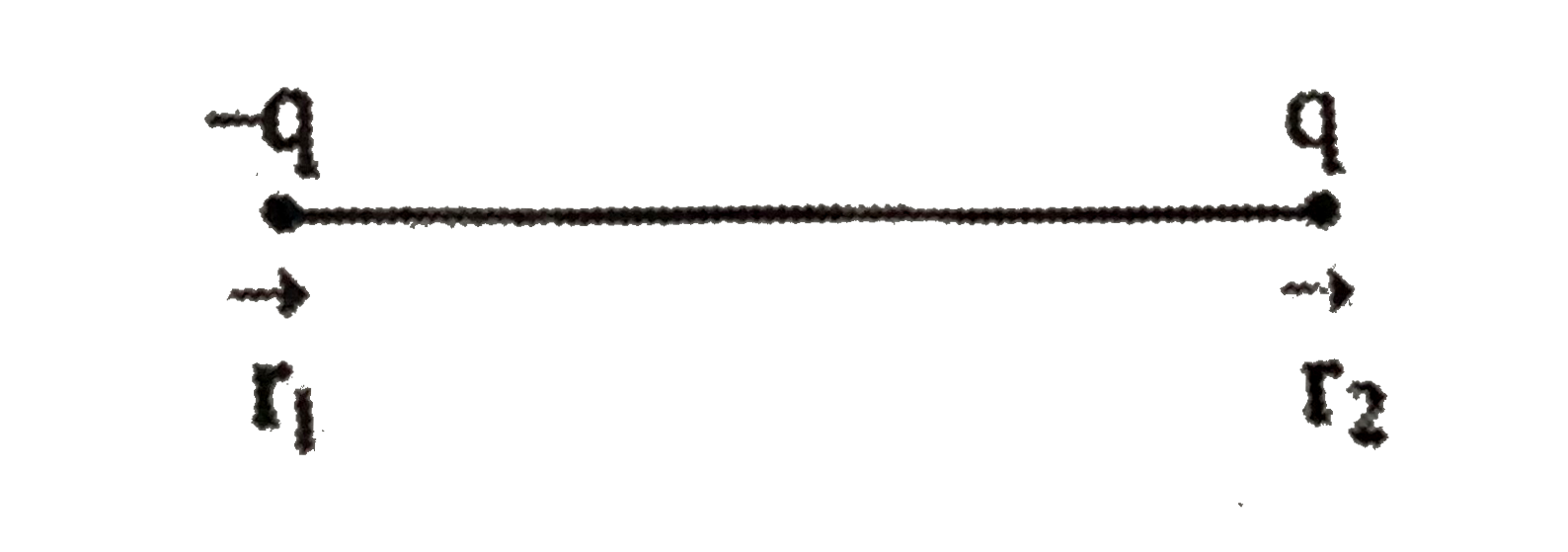 `vec(r12)=vec(R2) -vec(R1)` `vectau = vecPxxvecE` |
|
| 14. |
When a ray of light is incident on a glass slab at an angle of 60^(@), the angle between the reflected and refracted rays is 90^(@). The refractive index of glass is : |
| Answer» Answer :B | |
| 15. |
A ball is released from the top a tower of height h meter. It takes T second to reach the ground. What is the position of the ball in T/3 seconds. |
|
Answer» `-h/9` meters from the ground |
|
| 16. |
Which of the following is example of Solid Solutions |
|
Answer» OXYGEN DISSOLVED in water |
|
| 17. |
The refractive index of an equilateral prism is 'sq.root 3' . What is its angle of minimum deviation? |
|
Answer» 30° |
|
| 18. |
Two long straight wires with equal cross-sectional radii a area located parallel to each other in air at large distance b from each other. Find the capacitance per unit length of the wires. [Hint: Take charge to be uniformly distributed. Consider the field at any point and hence find the p.d. between the wires.] |
|
Answer» |
|
| 19. |
A magnet is moving towards a coil with a uniform speed v as shown in the figure. State the direction of the induced current in the resistor R. |
| Answer» SOLUTION :From X to Y. | |
| 21. |
When a given amount of water is heated from 2^(@) C to 8^(@)C its volume varies with temperature according to the curve ________ . |
|
Answer»
|
|
| 22. |
An electron is moving in an orbit of radius R with a time period T as shown in the figure. The magnetic moment produced may be given by |e| represents the magnitude of the election charge. |
|
Answer» `vecm = (2PI|e|vecA)/T` Charges crossing a point per second `= ev = e(2pi)/T` `therefore` Magnetic moment `(2pi)/T|e|overlineA` As the ELECTRON is flowing is the anticlockwise DIRECTION, the CUMENT is flowing in the clockwise direction. `therefore overlinew = - (2pi)/T|e|overlineA` |
|
| 23. |
An amplitude modulated wave is as shown in figure. Calculate (i) the percentage modulation, (ii) peak carrier voltage and , (iii) peak value of information voltage. |
|
Answer» 30V,20V 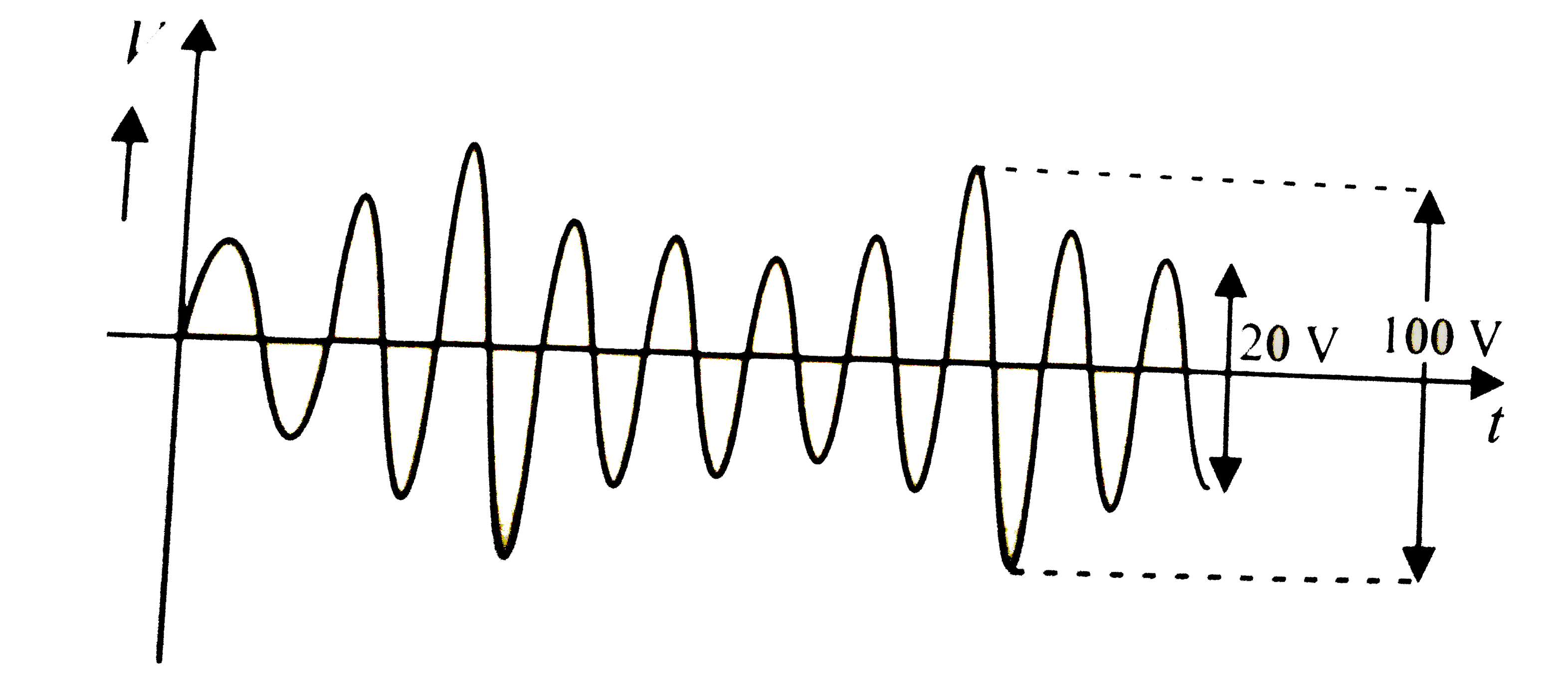 From figure. `V_("max")=(100)/(2)=50VrArrV_("MIN")=(20)/(2)=10V` Peak carrier VOLTAGE, `V _(c)=(V_(max")+V_("min"))/(2)=(50+10)/(2)=30V` Modulation index, `MU=(V_("max"))/(V_("min"))(-V_("min"))/(+V_("min"))=(50-10)/( 50+10)=(40)/(60)=(2)/(3)` Peakinformation voltage, `v_(m)=muV_(c)=(2)/(3)xx30=20V ` |
|
| 24. |
An arrangement is shown in figure. If all the surfaces are smooth and system is released from rest then the relation between accelerations of blocks P(a_p) and Q(a_Q) will be |
|
Answer» `a_p = a_Q` |
|
| 25. |
The surface energy density("in"c/m^2)of the earth is about : |
|
Answer» `10^(-19)` |
|
| 26. |
Two conducting wires X and Y of same diameter but different materials are joined in seriesacross a battery. If the number density of electrons in X is twice that in Y, find the ratio of drift velocity of electrons in the two wires. |
|
Answer» Solution :Here `n_X=2n_Y` and `A_X= A_Y = A (say)` In a SERIES CIRCUIT the electric current flowing through the entire circuit is EXACTLY same, HENCE `I = n_X Ae (v_d)_x = n_Y A e(v_d)_Y` `rArr((v_d)_X)/((v_d)_Y) = (n_Y)/(n_X) = (n_Y)/(2n_Y) = 1/2 ` |
|
| 27. |
At the corners A, B, C of a square ABCD, charges 10mC, -20 m C and 10mC are placed. The electric intensity at the centre of the square to become zero, the charge to be placed at the corner D is |
| Answer» ANSWER :A | |
| 28. |
Two capacitors, having equal capacitance C, are having same charges q on each plate. They are connected across a resistor R as shown in the figure. What is the total heat generated in the resistor upto the instant when the steady state has reached |
|
Answer» `q^(2)//2C` `q_(1)=CV, q_(2) = CV` where v is the potential difference between the plates. Also from charge conservation `q_(1) +q_(2) = 0` implies` V = 0` Thus, final energy stored in the capacitors`(1)/(2)CV^(2)+(1)/(2)CV^(2)=0` Initial energy stored =`(q^(2))/(2C)+q^(2)/(2C)=(q^(2))/(C)` Thus, heat developed in the RESISTOR = `q^(2)//C` |
|
| 29. |
In Young's double slit experiment the distance between two sources is 0.1 mm. The distance of the screen from the source is 20 cm. Wavelength for light used is 5460Å. Find the angular position of the first dark fringe. |
| Answer» SOLUTION :`0.16^@` | |
| 30. |
Three identical charges of q each are placed at the three verticess of an equilateral triangle ABC of side a, Electrostatic force experienced by a point charge q_0 situated at the centroid G of triangle is ___________ |
|
Answer» |
|
| 31. |
Whichof thefollowing spectral series in hydrogenatom gives spectral lineof wavelenght486 nm ? |
|
Answer» Lyman |
|
| 32. |
(I) The fringe width is inversely proportional to the distance between the two slits. (II) In Young's experiment, the fringe widthfor dark fringes is different from that for white fringes. (III) In Young's experiment, the width of each slit is about 0.05 mm. (IV). In Young's experiment, the double slit S_1 and S_2are separated by a distance of about 0.3 mm. |
|
Answer» I and II only. |
|
| 33. |
0.014 g of nitrogen is enclosed in a vessel at a temperature of 27^(@)C. How much heat (in J) approximately has to be transferred to the gas to double the rms velocity of its molecules? |
|
Answer» 930 or `T_(2)=4T_(1) therefore DeltaT=T_(2)-T_(1)=3T_(1)=3xx(273+27)=900K` The heat REQUIRED, `Q=muC_(V)DeltaT` `=[(14)/(28)]XX(5)/(2)xx(8.31xx900)/(1000)=9.315J~=9J` |
|
| 34. |
Statement-I: Pressure and temperature are the examples of intensive variable. Statement-II : The variable which depend upon the mass or size of the system are called intensive variable |
|
Answer» STATEMENT-I is TRUE, statement-II is true and So, correct CHOICE is (c ). |
|
| 35. |
An electric dipole is plced at an angle of 30^(@) to a nonuniform electric field. The dipole will experience |
|
Answer» a translational force only in the DIRECTION of the field |
|
| 36. |
If the forward bias voltage of a junction diode is increased from 0.8 V to 2V, the current increases by 4 mA. The forward resistance of the diode is |
|
Answer» `100OMEGA` |
|
| 37. |
Stress applied to the wire is equal to its Young's modulus. What is the change in length of the wire in terms of his original length |
| Answer» ANSWER :A | |
| 38. |
The tank in fig discharge water at constant rate for all water levels above the air inlet R The height above datum to which water would rise in the manometer tubes M and N respectively are _______&________ |
Answer» 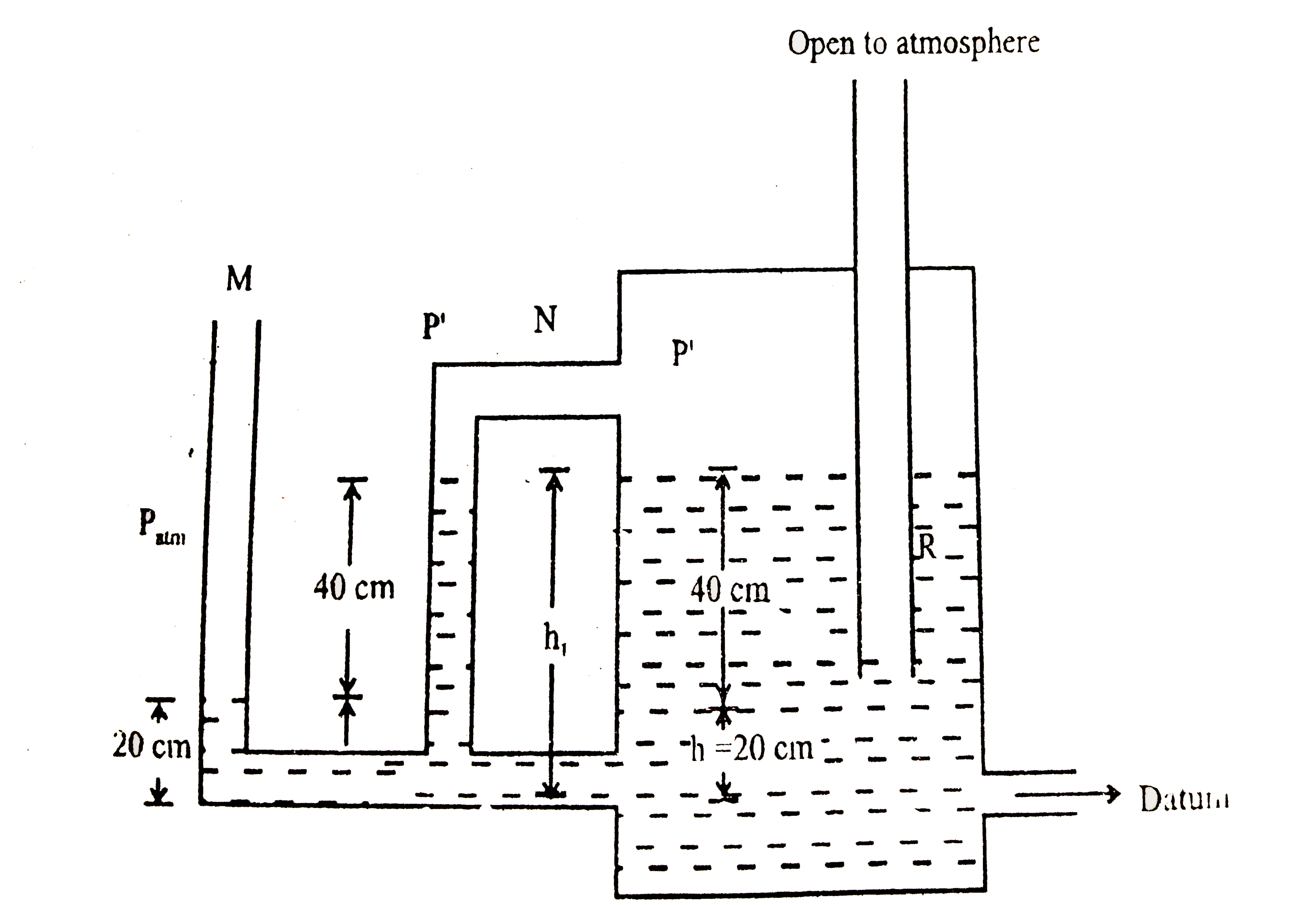 Pressure at Datum `=P_(ATM)+hrhog ""…….(1)` reading of manometer `(M)` pressure difference between Datum and atmosphere `=hrhog` HEIGHT of water in manometer `(M) = 20CM` of water since discharge rate is constant means pressure at Datum remain constant reading of manometer `(N)=` Pressure difference atmosphere and between above water level `P_(atm)-P"".......(2)` `=40` Pressure at datum `P^(')+hrhog""........(3)` From (1) and (3) ,` P_(atm)+hrhog=p^(')H^(')rhogimpliesP_(atm)-P'=(h^(')-h)rhog=40cm` of water Height of water in `N=60cm` |
|
| 39. |
A magnetic needle is arranged at the centre of a current carrying coil having 50 turns with radius of coil 20cm arranged along magnetic meridian. When a current of 0.5mA is allowed to pass through the coil the deflection is observed to be 30°. Find the horizontal component of earth's magnetic field |
|
Answer» Solution :`B=B_(H)TANTHETA(mu_(0)NI)/(2rtantheta)=B_(H)` `B_(H)=(4pixx10^(-7)xx50xx5xx10^(-4)xxsqrt3)/(2XX2(10^(-1))(1))` `=25sqrt3pixx10^(-7)T=1.36xx10^(-7)T` |
|
| 40. |
Two electrons are moving with non-relativistic speeds perpendicular to each other. If corresponding de Broglie wavelengths are lamda_1 and lamda_2 , their de Broglie wavelength in the frame of reference attached to their centre of mass is: |
|
Answer» `lamda_(CM) = lamda_1 = lamda_2` velocity of CENTRE of mass `V_(cm)= (h)/(2m lamda_1) hati + (h)/(2m lamda_2) hatj (because p = mv)` velocity of 1st particle about centre of mass `V_(1CM) = (h)/(2m lamda_1) hati - (h)/(2m lamda_2) hatj` `lamda_(cm) = (h)/(sqrt( (h^2)/(4 lamda_1^2) + (h^2)/(4lamda_2^2) )) = (2lamda_1 lamda_2)/(sqrt(lamda_1^2 + lamda_2^2) ) ( becauselamda = h/p)` |
|
| 41. |
In the last question, the electric field in vertical direction is switched off and a field of same strength(E_0) is switched on in horizontal direction. Find the horizontal velocity of the ball during the n^(th) collision. Also calculate the time interval between n^(th) and (n + 1)^(th) collision |
|
Answer» |
|
| 42. |
You are standing on the Bridge watching the boats in the river. You sec a motorboat directly below you, traveling perpendicular to the bridge at a speed of 3 m/s. A person on the boat throws a baseball at an initial speed of v_(0) and at angle of 37^(@) from the vertical (Note : both v_(0) and the angle are with respect to the boat). find the value of v_(0) (in m/s) necessary for the ball to travel straight up towards you. |
|
Answer» |
|
| 43. |
Assertion : An electron and proton enters a magnetic field with equal velocities, then, the force experienced by the proton will be more than electron. Reason : The mass of proton is 1837 times more than electron. |
|
Answer» If both ASSERTION and REASON are TRUE and the reason is the CORRECTEXPLANATION of the assertion. |
|
| 44. |
A disk of mass m is connected to two springs of stiffness k_(1) and k_(2) as shown in the figure. Find the angular frequency of the system for small oscillation. Disc can roll on the surface without slipping |
| Answer» SOLUTION :`SQRT((2(k_(1) + 4k_(2)))/(3M))` | |
| 45. |
How can a moving coil galvanometer be converted into a voltmeter? Explain with a diagram. |
|
Answer» Solution :To CONVERT a GALVANOMETER into a voltmeter, a high resistance is CONNECTED in series with the coil. The galvanometer with this modification is called a voltmeter. The value of the high resistance R to be connected in series with the coil depends on the maximum potential DIFFERENCE to be measured. If `I_g` be the current for a full scale deflection then, `V=I_g(G+R)` G is the resistance of the galvanometer . `therefore R=V/I_g-G ,I_g PROP V` 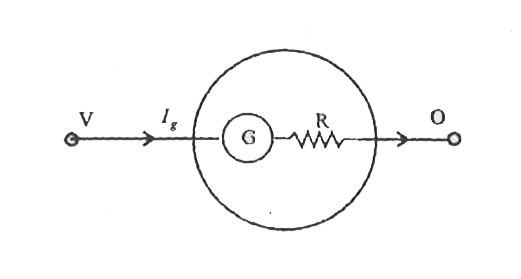 Since G and R are constants, the scale can be graduated to read potential differences directly.A voltmeter is used for measurement of potential difference. It should be connected in parallel in a circuit |
|
| 46. |
Two similar metal spheres are suspended by silk threads from the same point. When the spheres are given equal charges of 2muC, the distance between them becomes 6cm. If length of each thread is 5 cm, find the mass of any one sphere (g=10m//s^(2)) |
|
Answer» |
|
| 47. |
The modulation index mu in Amplitude modulating, value is |
| Answer» Answer :D | |
| 48. |
Electric potential at origin is zero. Field in that space is 10hati+10hatjNC^(-1). Find electric potential at (1, 1). |
|
Answer» |
|
| 49. |
A person looks at himself in a silvered ball of diameter 64 cm from a distance of 2.7m. Find the position and nature of the image. |
| Answer» SOLUTION :At a DISTANCE of about 15 cm behind the reflecting surface, virtual, ERECT and diminished with m=+ (1/18) | |
| 50. |
For a monatomic ideal gas undergoing an adiabatic change, the relation between temperature and volume is T V^(x)= constant where x is: |
|
Answer» Solution :For an adiabatic change `TV^(gamma-1)=` const. Comparing it with `TV^(X)=` const. We get `x=gamma-1 and gamma=(5)/(3) therefore x =(5)/(3)-1=(2)/(3)` So correct CHOICE is (c ). |
|


