

Saved Bookmarks
This section includes 7 InterviewSolutions, each offering curated multiple-choice questions to sharpen your Current Affairs knowledge and support exam preparation. Choose a topic below to get started.
| 1. |
Find the charge on the capacitor in the following circuit. |
|
Answer» `12muC` `therefore` Current in the circuit is `I=(12)/(6+2)=(12)/(8)=(3)/(2)A` Potential DIFFERENCE ACROSS `2muF` is same as across `6Omega` resistance. `thereforeq=CV=2xx(3)/(2)xx6=18muC` |
|
| 2. |
The maximum number of possible interference maxima for slit-separation equal to twice the wavelength in Young's double-slit experiment is |
|
Answer» infinite `d SIN theta=(lambda)/(d)=(nlambda)/(2lambda)"" [ :. D=2lambda]` `:. sin teta=(n)/(2)` but RANGE of `sin theta` is(-1,1) `:. Sin theta le1` `:. n le2` `:.` Possible values of `n=-2,1,0,1,2` Hence, a central maximum on the screen with two sides of the FIRST order and two of the second order respectively gives a total of five bright fringes. |
|
| 3. |
(a) Draw the circuit diagram for studying the characteristics of a transistor in common emitter configuration. Explain briefly and show how input and output characteristics are drawn. (b) The figure shows input weve forms A and Bto a logic gate . Draw the output waveform for an OR gate . Write the truth table for this logic gate and draw the output waveform for an OR gate . Write truth table for this logic gate and draw its logic symbol. |
|
Answer» SOLUTION : (a) See Q . 30 (a) , Set-I OUTSIDE Delhi -2010. (b) 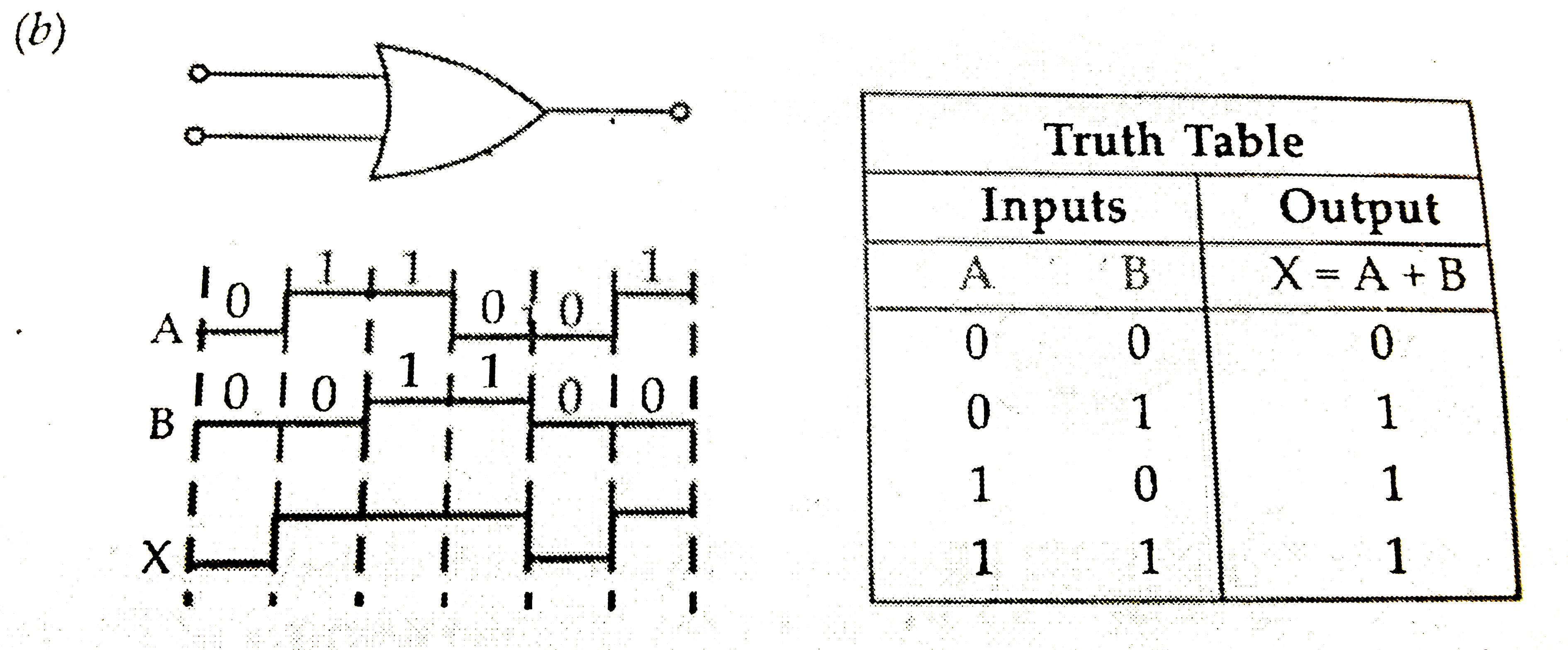 . .
|
|
| 4. |
At what distance from a long straight wire carrying an electric current of 15 ampere is the magnetic induction 6xx10^(-5) (Wb)//m^2. |
|
Answer» Solution :For a long straight CONDUCTOR CARRYING a current i ampere, B at a distance R from the wire is given by `B=(mu_@i)/(2pir)` `r=(mu_@i)/(2piB)=(4pixx10^(-7)xx15)/(2pixx6xx10^(-5))=5xx10^(-2) m`. |
|
| 5. |
4 eV is the energy of the incident photon and the work function is 2 eV. The stopping potential will be |
|
Answer» 2V `therefore""V_(0) = (2eV)/(e) = 2V` |
|
| 6. |
Which one is unstable among the following |
| Answer» Answer :D | |
| 7. |
A projectile has initially the same horizontal velocity as it would acquire if it had moved from rest with uniform acceleration of 3ms^(-2) for 0.5 minutes. If the maximum height reached by it is 80m then the angle of projection is [g=10ms^(-2)] |
|
Answer» `TAN^(-1) (3)` |
|
| 8. |
M.I of uniform disca about an axis passing through its centre and perpendicular to its plane is 10kgm^2.Find its M.I. about the diameter. |
|
Answer» 5 `kgm^2` |
|
| 9. |
How we reduce chromatic aberration ? |
| Answer» Solution :An achromatic COMBINATION of a crown glass CONVEX lens and a flint glass COMBINED. | |
| 10. |
Plot a graph between |E| and r for the cause r lt R and r gt R. |
Answer» SOLUTION :`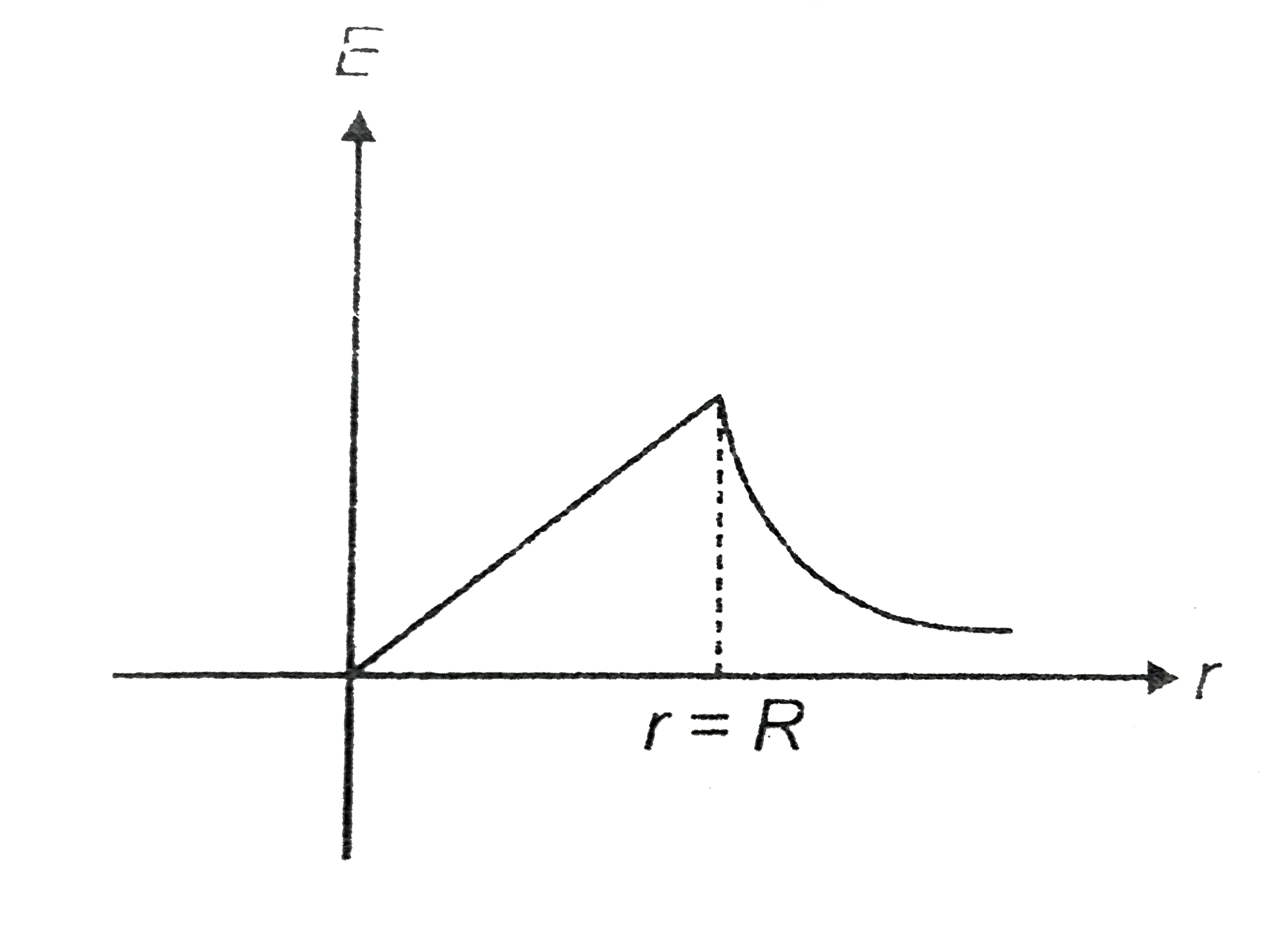 ` `
|
|
| 11. |
Calculate the half life and mean life of Radium -226 of activity 1Ci, Given the mass of Radium - 226 is 1 gram and 226 gram of radium consists of 6.023xx10^23 atoms. |
|
Answer» Solution :ACTIVITY of 1 gram of radium is `A=3.7xx10^10` distingration PER second [i.e., `1Ci=3.7xx10^10` disintegration per second] No. of ATOMS in 1 gram of radium is `N=(6.023xx10^23)/226=2.665xx10^21` Using `A=lambdaN` `lambda=A/N=(3.7xx10^10)/(2.665xx10^21)=1.388xx10^(-11)` per second Half - life of radium is `T=0.693/lambda=0.693/(1.388xx10^(-11))` `T=0.499xx10^11` second `=4.99xx10^10` second Mean - Life , `tau=1/lambda=1/(1.388xx10^(-11))` `=0.720xx10^11` second `tau=7.20xx10^10` second. |
|
| 12. |
Interference is possible in .... |
|
Answer» LIGHT WAVES only |
|
| 13. |
Relative permeability of a material mu_r = 0.5. Identify the nature of the magnetic material and write its relation to magnetic susceptibility. |
|
Answer» Solution :The MATERIAL is a DIAMAGNETIC material and its magnetic susceptibility `X= mu_r -1 = 0.5 -1 = 0.5` |
|
| 14. |
Are the field lines a reality ? |
| Answer» SOLUTION :The electric field LINES are PURELY geometrical CONSTRUCTIONS, which are USED two represent electric field graphically. In other words, the electric field lines themselves are imaginary, but the electric field they represent is real | |
| 15. |
A transistor oscillator is (i) An amplifier with positive feedback (ii) Anamplifier with reduced gain (iii) The one in which DC supply energy is converted into AC output energy. Then |
|
Answer» All (i), (II) and (III) are CORRECT |
|
| 16. |
Shows a diagonal symmetric arrangement of capacitors and a battery. . Identify the correct statements. |
|
Answer» Both the `4 MUF`capacitorscarry equal charges in opposite sense. 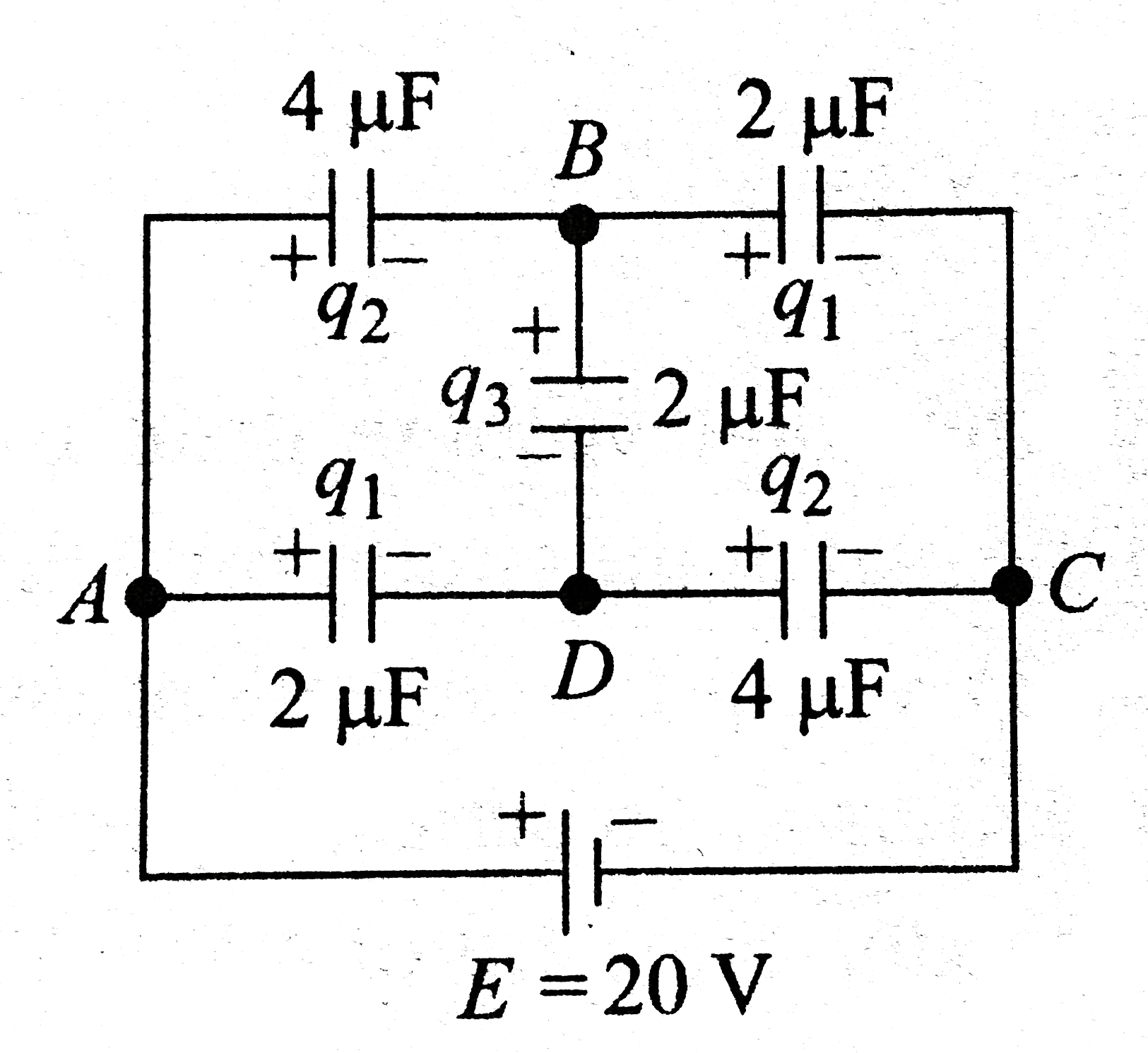 . . Now `V_(A)-V_(B)ltV_(A)-V_(D)rArrV_(B)gtV_(D)` Now if `2muF` is connected between `B` and `D`, charge will flow from `B` and `D` and Finally `V_(B)gtV_(D)`. `V_(A)=20 V`. At junction `B`, `q_(2)=q_(1)+q_(3)` or `(V_(A)-V_(B))=(V_(B)-V_(D))2+(V_(B)-V_(C))2` or `4(V_(A)-V_(B))+2(V_(D)-V_(B))=2V_B` At junction D: `q_(2)=q_(1)+q_(3)` or `4(V_(D)-V_(C))=2(V_(A)-V_(D))+2(V_(B)-V_(D))` or `2(V_(A)-V_(D))+2(V_(B)-V_(D))=4V_(D)`. |
|
| 17. |
Six molecules have speeds 2 units, 5 units, 3 units, 6 units, 3 units and 5 units respectively. The rms speed is |
|
Answer» 3 UNITS `=sqrt((4+25+9+36+9+25)/(6))` `=sqrt((108)/(6))=4.242` units |
|
| 18. |
A beam of light consisting of red, green and blue colours is incident on a right angled prism. The refractive indices of the material of the prism for end, green and blue lights are 1.39 , 1.44 and 1.47 respectively. Will the prim separate the colours? |
|
Answer» Solution :Let the critical ANGLES for red, green and blue lights be `theta_(r), theta_(g), theta_(b)` respectively. `so, "" sintheta_(r) = (1)/(0.39) or, sintheta_(r) = 0.719 or, theta_(r) = 46^(@)` `"Again," " " sintheta_(g), = (1)/(1.44) or, sintheta_(g) = 0.694 or, theta_(g) = 44^(@)` `and sintheta_(b) = (1)/(1.47) or, sintheta_(b) = 0.680 or, theta_(b) = 42.9^(@)`  |
|
| 19. |
At what distance from a long straight wire carrying an electric current of 15 ampere is the magnetic induction 6xx10^-5 (Wb)//m^2. |
|
Answer» Solution :For a LONG straight CONDUCTOR carrying a current i AMPERE, B at a distance r from the wire is given by `B=(mu_@i)/(2pir)` `r=(mu_@i)/(2piB)=(4pixx10^(-7)xx15)/(2pixx6xx10^(-5))=5XX10^(-2) m`. |
|
| 20. |
Charges on identical spheres A and B are equal. When the separation between them is 1 m, the repulsion between them is 80 N. Now, another identical and uncharged sphere C is brought in contact with A and then separated. Then, C is brought in contact with B and then separated. What will be the new force between A and B ? |
| Answer» SOLUTION :30 N, REPULSION | |
| 21. |
A : In Young.s double slit experiment, the fringes become indistinct if one of the slits is covered with cellophane paper. R : The cellophane paper decrease the wavelength of light. |
|
Answer» Both A and R are true and R is the CORRECT explanation of A |
|
| 23. |
A hollow charged conductor has a tiny hole cut into its surface. Show that the electric field in the hold is (sigma)/(2pi epsilon_(0))hatnwhere hatnis the unit vector in the outward normal direction, and a is the surface charge density near the hole. |
|
Answer» Solution :As shown in figure, ASSUME that the hole on the CONDUCTING surface is filled by conductor. According to Gauss.s law, at A on surface, `oint vecE.dvecS =q/epsilon_(0)` `EdS cos0^(@) = (sigmadS)/epsilon_(0)[therefore sigma = q/(ds)]` `therefore E.dS = (sigmadS)/(epsilon_(0))` `therefore vecE = sigma/(epsilon_(0)).hatn` Which is electric field outside the conductor. Above electric field can be written as, `vecE = vecE_(1) + vecE_(2)`..........(2) where `vecE_(1)` = electric field at point `P_0` just outside the conductor (adjacent to point P on the surface) due to CHARGE at point P and `vecE_(2)`=electric field at point P (or at `P_0`) flue to remaining charges on the given charged hollow conductor. When hollow charged conductor does not have any hole at point P on the surface we have `vecE_(1)`and `E_2` POINTING along `hatn`and so from equation (2), we can write, `E = E_(1) + E_(2) = sigma/(epsilon_(0))`...........(3) Now consider point `P_(p)` , adjacent to point P and just INSIDE the conductor in figure (a), where resultant electric field `vecE` is `vec0`. Hence, `vecE = vecE_(1) + vecE_(2) = vec0` `therefore vecE_(1) = - vecE_(2)` `therefore vecE_(1) = E_(2)` (Taking magnitude).......(4) From eqn. (3) and (4) `2E_(2) = sigma/(epsilon_(0))` `therefore E_(2) = sigma/(2epsilon_(0))`..........(5) Now, when we have a hole at point P electric field at point P,- in the hole due to remaining charges will be, `E_(2) = sigma/(2epsilon_(0))hatn`.............(6) |
|
| 24. |
In the given figure a capacitor of plate area A is charged upto charge q. The mass of each plate is m, The lower plate is rigidly fixed. The value of m, if the system remains in equilibrium is |
|
Answer» `m_2 +(q^2)/( in_0Ag)` |
|
| 25. |
Two bodies of masses 10^(3) kg and 10^(5) kg are separated by 1 km. At what distance from the smaller the intensity of gravitation will be zero ? |
| Answer» Answer :C | |
| 26. |
The electric potential at a point is zero. Does it mean that there are no chaises close to the point ? |
| Answer» SOLUTION :No. Suppose there are a NUMBER of positive and negative charges near the point, It is possible that the net potential at the point due to all these charges is zero. Another POSSIBILITY is that there are TWO equal and OPPOSITE charges situated at equal distances from the point. In this case also electric potential is zero. | |
| 27. |
Write the characteristics of equipotential surface. |
|
Answer» Solution :If the electric potential along every point of any imaginary surface in an electric field is the same, then such a surface is called an equipotential surface. (1) The electric potential of a single charge Q to distance r is, `V= (kq)/(r) :. V prop (1)/(r)` This SHOWS that V is a constant if r is constant. Hence surface passing through points having same r obtain as spherical and its radius is r and q is the electric charge on the centre as shown in below figure. 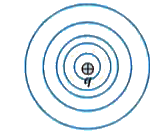 ore than one equipotential surfaces can be drawn for different radius. early the field lines at every point is normal to the equipotential surface passing through that point. he electric field lines for a single charge q are radial lines starting from or cnding at the charge are depending on whether q is positive or negative which is shown in this figure. 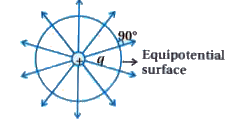 (2) Equipotential surfaces for a dipole is asshown in below figure. 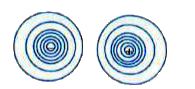 (3) Equipotential surfaces for two identicz positive or negative charges as shown i below figure. 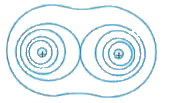 (4) For a uniform electric field E, along the -AXIS the equipotential surfaces are planes normal to the x-axis, means plane PARALLE! to the y-z planes as shown in below figure. 
|
|
| 28. |
Find the aperture angle of a cone in which all the stars located in the semi-sphere for a observer on the Earth will be visible if one moves relative to the Earth with relativistic velocity V differing by 1.0% from the velocity of light. Make use of the formula of the foregoing problem. |
|
Answer» Solution :The statement of the problem is not quite PROPERLY worked and is in fact misleading. The correct situation is described below. We consider for simplicity, stars in the `x-z` plane. Then the previous formula is applicable, and we have `cos theta' = (cos theta - BETA)/(1-beta cos theta) = (cos theta - 0.99)/(1-0.9 cos theta)` The distribution of `theta'` is given in the diagram below The light that appears to come from the forward quadrant in the frame `K(theta =- pi` to `theta =- pi//2)` is compressend into an ANGLE of magnitude `+81^(@)` in the forward DIRECTION while the remaining stars are spread out. The THREE dimensional distribution can also be found out from the three dimensional generalization of the formula in the previous problems. 
|
|
| 29. |
The optical path of a monochromatic light is the same if it goes through 2.00 cm of glass or x cm of ruby. If the refractive index of glass is 1.510 and that of rby is 1.760 find the value of x. |
|
Answer» 1.716 cm |
|
| 30. |
A rectangular block of refractive index mu is placed on a printed page lying on a horizontal surface. Find the minimum value of mu so that the letters on the page is not visible from any of the vertical sides. |
| Answer» SOLUTION :`mugtsqrt(2)` | |
| 31. |
A 70 kg man stands spring balance in a lift that is going down with a constant speed of 10 m//s. If the lift is brought to rest in 10 m by a constant raterdation, then what does the scale read during this period ? Take g = 10 m//s^(2) |
|
Answer» 70 kg |
|
| 32. |
A stone projected vertically up with velocity v from the top of a tower reaches the ground with velocity 2v.The height of the tower is |
| Answer» Answer :B | |
| 33. |
For the given circuit, terminal potential differences of cells are around |
|
Answer» 15V,10V |
|
| 34. |
An astronomical telescope has a large aperture to, |
|
Answer» reduce sphericalaberration |
|
| 35. |
What is the maximum height of a stone thrown vertically upwards if its velocity is halved in 2 second ? |
|
Answer» 20 m `h=(u^(2))/(2G)` ALSO v=u+at `u/2=u-gxx2` =`u-10xx2` or u=40 `MS^(-1)` `:. H=(40xx40)/(2XX10)=80 m` |
|
| 36. |
एक प्रोटॉन तथा एक इलेक्ट्रॉन एकसमान विद्युत क्षेत्र में स्थित है: |
|
Answer» उन पर लगने वाले वैद्युत बल बराबर होंगे। |
|
| 37. |
In Young.s double slit experiment, the 10th bright fringe is at a distance x from the central fringe. Then a) the 10th dark fringe ia at a distance of 19x"/"20 from the central fringe b) the 10th dark fringe is at a distance of 21x"/"20 from the central fringe. c) the 5th dark fringe is at a distance of x"/"2 from the central fringe. d) the 5th dark fringe is at a distance of 9x"/"20 from the central fringe. |
| Answer» Answer :C | |
| 38. |
A parallel plate capacitor of capacity 100mu F is charged by a battery of 50 volts. The battery remains connected and if the plates of the capacitor are separated so that the distance between them becomes double the original distance, the additional energy given by the battery to the capacitor in joules is |
|
Answer» `62.5 XX 10^(-3)` |
|
| 39. |
A wire witha resistance p perunitlength is bent in the fromof the letterA of vertical angle 2alpha . Thereis a magnetic fieldB perpendicularinto the plane of theletter . Calculatethecurrentflowing in the loop when the cross-piece cutmovesdown at aconstant speedv . Assume that it maintains contact with the sides as itmovesdown . |
|
Answer» |
|
| 40. |
Figureshows an equiconvex lens (of refractive index 1.50) in contact with a liquid layer on top of a plane mirror. A small needle with its tip on the principal axis is moved along the axis until its inverted image is found at the position of the needle. The distance of the needle from the lens is measured to be 45.0 cm. The liquid is removed and the experiment is repeated. The new distance is measured to be 30.0 cm. What is the refractive index of the liquid ? |
|
Answer» Solution :`rArr` Suppose, FOCAL length of convex lens `f_1 = 30` cm and focal length of plano CONCAVE lens of LIQUID `f_2` and focal length of combination F = 45.0 cm `rArr` Focal length of combination, `1/F = 1/f_1 + 1/f_2` `therefore 1/(f_2) = 1/F - 1/f_1` `therefore1/(f_2) = 1/45 -1 /30 = (2-3)/(90) = - (1)/(90)` `thereforef_2 = -90 cm` `rArr` For glass lens, suppose `R_1 = R, R_2 = - R` `(1)/(f_1) = (mu -1) [ (1)/(R_1) - (1)/(R_2)]` `(1)/(30) = [(3)/(2) -1][1/R - (1)/(-R)]` `1/30 = 1/2 XX 2/R` `therefore R = 30 cm ` `rArr`For lens of liquid, `f_2 =- 90 cm , R_1 = -R = - 30 cm ` and `R_2 = oo` `therefore` Lens maker.s formula, `1/(f_2 ) = (mu_l-1)[(1)/(R_1) - (1)/(R_2)]` `(1)/(-90) = (mu_l -1)[1/-R - 1/oo]` `1/(-90) = (mu_1 -1) [ 1/-R][because 1/oo = 0]` `therefore (1)/(-90) = (mu_1 -1)[1/-30]` `therefore mu_l -1 = 1/3` `therefore mu_l = 4/3 = 1.33` |
|
| 41. |
In Stern's experiment (1920) silver atoms emitted by a heated filament passed through a slit and were deposited on the cooled wall of an outer cylinder (Fig.). When the system was rotated at high speed there was a deflection of the slit's image. The apparatus was first rotated in one direction and then in the opposite direction, and the distance between the deflected images was measured. Find this distance if the radius of the internal cylinder is 2.0 cm and of the external one 8.0 cm. The speed of rotation is 2700 r.p.m. and the filament temperature 960^@C. Estimate the errors of measurement, if the width of the slit is 0.5 mm. |
|
Answer» `sqrt((3RT)/(M)) = sqrt((3 xx 8.3 xx 10^3 xx 1233)/(108)) = 532 m//s` Hence `l = 2 omega r_2 (r_2 - r_1) sqrt(v)` To assess the error, calculate the width of the undisplaced image of the slit: `a/b = (r_2)/(r_1),` whence `a = (l.r_2)/(r_1) = (0.5 xx 8)/(2) = 2 mm` The broadening of the displaced images is still greater because of the Maxwell DISTRIBUTION of the molecular velocities. Hence the error in measurement is `DELTA ge 2a//2 = a`, the relative error being `epsilon = - Delta/l ge a/l = (2 xx 100%)/(5) = 40%` This shows that the Stern experiment could produce only qualitative data on the molecular velocities. |
|
| 42. |
Two particles are projected in air with speed u at angles theta_(1)and theta_(2)(both acute) to the horizontal, respectively. If the height reached by the first particle is greater than that of the second, then which one of the following is correct? |
|
Answer» `theta_(1) GT theta_(2)` |
|
| 43. |
The amplitudes of two coherent waves are vector quanti- ties. In the given table, Column I shows the phase differ ence between two coherent waves, Column II shows the path difference between them and Column III shows their resultant amplitudes. When is E_(R) maximum? |
| Answer» Solution :(III) (ii) (J) | |
| 44. |
What is high in a telescope ? |
| Answer» SOLUTION :HIGH MAGNIFYING POWER | |
| 45. |
The amplitudes of two coherent waves are vector quanti- ties. In the given table, Column I shows the phase differ ence between two coherent waves, Column II shows the path difference between them and Column III shows their resultant amplitudes. When is the phasor diagram at primary maxima? |
|
Answer» (I) (III) (M) |
|
| 46. |
Out of the fourchoicesgiven in Q. No. 6-9 above, choose the correct choice,if the gun points in a direction oppositeto the direction of motion of the tank. |
|
Answer» The SOUND arrives at the TARGET LATER than the bullet |
|
| 47. |
The sunlight reaches us as white light and not as its compounts because |
|
Answer» a)AIR medium is dispersive |
|
| 48. |
Discuss the process of nuclear fission |
|
Answer» Solution :(i) The process of breaking up of the nucleus of a heavier atom into two smaller nuclei with the release of a large amount of energy is called nuclear fission. (ii) The fission is accompanied by the release of neutrons. The energy that is released in the nuclear fission is of many orders of magnitude greater than the energy released in chemcial reactions. (iii) URANIUM undergoes fission reaction in 90 DIFFERENT ways. The most COMMON fission reactions of `""_(92)^(235)U` nuclei are shown here. `""_(92)^(235)U+""_(0)^(1)nto""_(92)^(236)Uto""_(56)^(141)Ba+""_(36)^(92)Kr+3""_(0)^(1)n+Q` `""_(92)^(235)U+""_(0)^(1)nto""_(92)^(236)Uto""_(54)^(140)Xe+""_(38)^(94)Sr+2""_(0)^(1)n+Q` (iv) Here Q is energy released during the decay of each uranium nuclei. When the slow neutron is absobed by the uranium nuclei, the MASS number increases by one and goes to an excited state `""_(92)^(235)U`. (v) But this excited state does not last longer than `10^(-12)s` and decay into two daughter nuclei along with 2 or 3 neutrons. From each reaction, on an average, 2.5 neutrons are emitted. |
|
| 49. |
A screen is placed 90 cm from an object. The image of the object on the screen is formed by a convex lens at two different locations separated by 20 cm. Determine the focal length of the lens. |
|
Answer» Solution :We can obtain two different positions of a convex lens to form the IMAGE of a GIVEN point object at another fixed point provided that values of u and v are interchanged in two positions. Therefore, as shown in Fig. 9.07, we have as shown in Fig, we have `Ol = 90 cm = |u|+ |v| =x+20 +x = 2x + 20` `rArr x= 35 cm` Hence, `u_(1) = -35 cm` and `v_(1) = +55 cm` 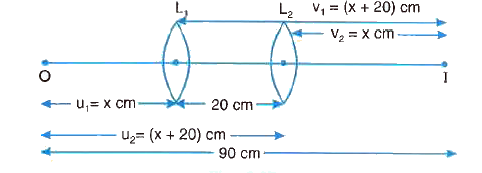 `therefore 1/f =1/v_(1) -1/u_(1) = 1/55 -1/(-35)` `=1/55 + 1/35 =(7+11)/385 = 18/385` or `f=385/18 = 21.4` cm |
|
| 50. |
What will be the maximum coulomb force that can act on the electron due to the nucleus in Bohr model of hydrogen atom? |
| Answer» Solution :The MAXIMUM force is EXPERIENCED when the ELECTRON is in the first orbit.Then SEPRATION between electron and the NUCLEUS is 0.53`a^@` | |