Saved Bookmarks
This section includes 7 InterviewSolutions, each offering curated multiple-choice questions to sharpen your Current Affairs knowledge and support exam preparation. Choose a topic below to get started.
| 1. |
In the circuit shown in the figure R_(1) = R_(2) = 5 Omega, C_(1) = C_(2) = 2 mu f and epsilon_(1) = epsilon_(2) = 5 V. Switch S_(1) is kept closed for a long time. Now switch S_(2) is also closed. Immediately after S_(1) is closed, find (a) current through R_(1) (b) current through R_(2) |
|
Answer» (B) ZERO |
|
| 2. |
Assertion: In the measurement of physical quantities direct and indirect methods are used. Reason : The accuracy and precision of measuring instruments along with errors in measurements should be taken into account, while expressing the result. |
|
Answer» Assertionis CORRECT, REASON is correct, reason is a correct explanation for ASSERTION. |
|
| 3. |
If a thin spherical shell of radius r and charge q is kept inside a thick spherical shell of inner radius 2r, outer radius 3r, and total charge 2q. (a) Find the charge distribution on each surface. (b) Find the self-energy of eachcharge distribution. (c) Find the total electrostatic energy stored in the system. |
| Answer» SOLUTION :(a) `0, q, -q, 3q,` (B) `0, (kq^2)/(2 R) , (kq^2)/( 4 R), ( 3kq^2)/(2 R),` (c ) `(7q^2)/(16 PI epsilon_(0) R)` | |
| 4. |
Force of friction is a |
|
Answer» always OPPOSES MOTION |
|
| 5. |
A block of wood floats with 1//4 of its volume under water. What is he density of wood? (Density of water =1000 kg //m^(3)) |
|
Answer» `750 kg//m^(3)` The DIPPED PORTION of he piece is `V(V_(0))/(4)` `:.` For EQUILIBRIUM of wood piece, `mg=rhoVg` or `sigma C_(0)g=(rhoC_(0))/(4)g` `:.Sigma =(rho)/(4)=("DENSITY of water")/(4)` `=(1000)/(4)=250 kg//m^(3)` 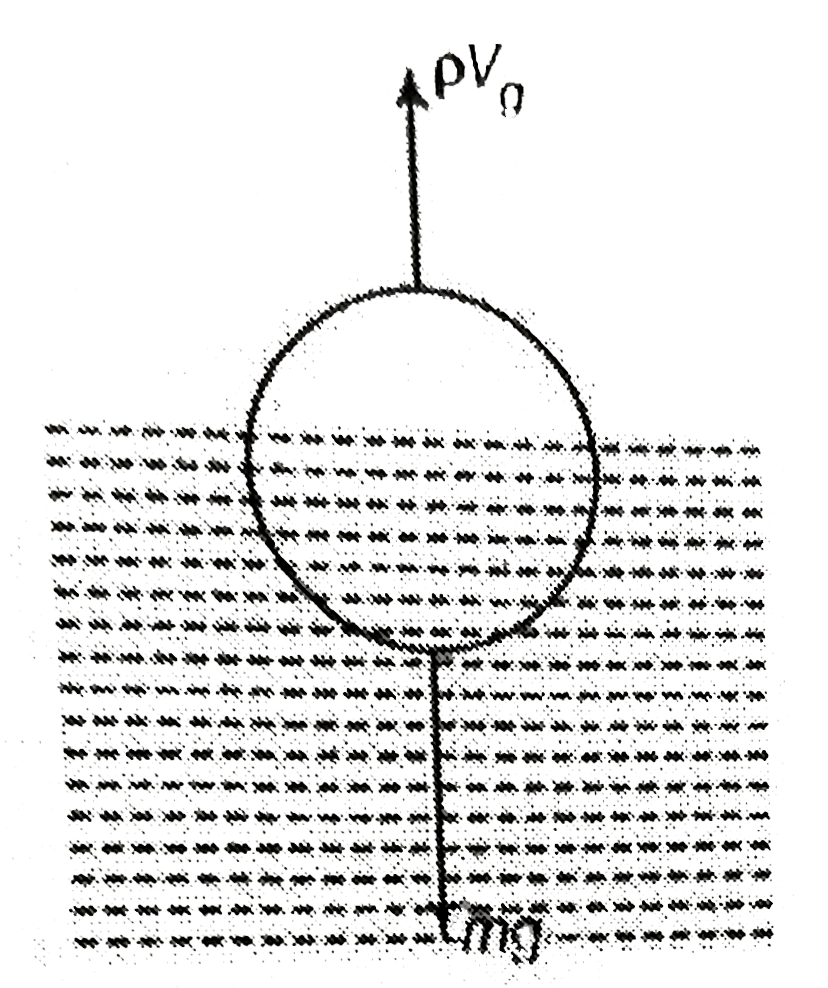
|
|
| 6. |
In a compound microscope, both the objective and eyepiece are of short focal lengths. Why? |
|
Answer» Solution :The magnifying POWER of compound microscope is `m=L/(f_o) (1+D/f_e) Lto`length of microscope TUBE m will be GREATER if the FOCAL LENGTHS of objective `f_0` and that of eyepiece `f_e` are short. |
|
| 7. |
Graph shown in figure is the relation between photo current (i) versus incident voltage (V). Maximum energy of electron emitted will be … |
|
Answer» 2 eV `therefore` ENERGY `K_(max)=eV_(0)` |
|
| 8. |
A body is revolving with uniform speed of 2 m/s in a circle of radius 1 m. The trangential acceleration is: |
|
Answer» `2 m/s^2` |
|
| 9. |
Viva la France' became an emotional evidence of M. Hamel's? |
|
Answer» SADNESS and patriotism. |
|
| 10. |
A particle A is moving along a straight line with velocity 3 m/s and another particle B has a velocity 5 m/s at an angle 30^@ to the path of A. The velocity of B relative to A is |
|
Answer» 5 mts/s |
|
| 11. |
The work funciton of a substance is 4.0 eV. The longest wavelength of light that can cause photoelectron emission from this substance is approximately |
|
Answer» 540 NM |
|
| 12. |
A cell can be balanced against 110 cm and 100 cm of potentiometer wire respectively when in open circuit and shorted through a resistance of 10Omega. Find the internal resistance of the cell. |
|
Answer» |
|
| 13. |
The displacement of a particle is represented by following equation: s=3t^(3) +7t^(2) +5t +8 where is in metre and in second the acceleration of particle at s is |
|
Answer» 18 `ms^(-2)` Differentiating it TWICE w.r.t,.t. we get `(DS)/(dt)=9T^(2)+14t+5` `(d^(2)s)/(dt^(2))=18t+14` This PUTTING t=1 and `(d^(2)s)/(dt^(2))=a` a=(18+14)=32 `ms^(-2)` |
|
| 14. |
In deriving the single slit diffraction pattern, it was stated that the intensity is zero at angles of nlambda//a. Justify this by suitable dividing the slit to bring out the cancellation. |
| Answer» Solution :Divide the SIGNAL slit into n smaller slits of width `a' =a/n` Each of the smaller slits sends ZERO intensity in the DIRECTION 0. The COMBINATION gives zero intensity as well. | |
| 15. |
(A) : The small ozone layer on top of the stratosphere is crucial for human survival. (R) It absorbs ultraviolet radiations from the sun and prevents it from reaching the earth's surface and causing damage to life. |
|
Answer» Both 'A' and 'R' are TRUE and 'R' is the CORRECT EXPLANATION of 'A'. |
|
| 16. |
The amplification factor of a triode is 20 . Its plate resistance is 10kOmega . Its mutual conductance is : |
| Answer» Answer :D | |
| 17. |
A spherical conducting shell of inner radius r_1 and outer radius r_2 has a charge Q. (a) A charge q is placed at the centre of the shell. What is the surface charge density on the innerand outer surfaces of the shell ? |
|
Answer» SOLUTION :When charge Q is GIVEN to spherical conducting shell, whole of it SPREADS UNIFORMLY on the outersurface of shell. On placing a charge +q at the centre of the shell, a charge -q is induced on the inner surface of shell and in TURN charge +q is induced on its outer surface. `:.` Surface charge density of inner surface of the shell `sigma_("inner") = (-q)/(4pi r_1^2)` and surface charge density of outer surface of the shell `sigma_("outer") = ((Q + q))/(4pi r_2^2)` 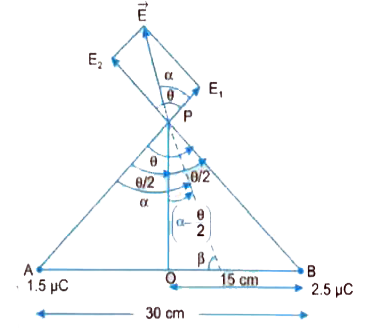
|
|
| 18. |
Explain electrostatic potential energy in electric field due to an artangement of electric charge. |
|
Answer» Solution :Consider the field `vecE` due to a charge Q placed at the origin. We bring a test charge g from a point R to a point P against the repulsive force on it due to the charge Q. (This will happen if Q and q are like charges).  Let us take both Q and q as positive. The test charge q is so small that it does not disturb the original configuration. In bringing the charge q from R to P we apply an external force `F_(ext)^(VEC)` and repulsive electric forceon charge q is `F_(E)^(vec)` . This means there is no net force [Means`F_(ext)^(vec)= -F_(E)^(vec)` ] means it is brought with slow constant speed and it has no acceleration. In this situation, work done by the external force is the negative of the work done by the electric Torce and gets tully stored in the lorm ot potential energy ot the charge q. If the external force is removed on REACHING the electric force will take the charge away from the stored energy at P is used to provide kinetic energy to the charge in such a way thatthe sum of the kinetic and potential energies iscosnserved . The work done by external forces in moving a charge q trom R to P is, `WRP=int_(R)^(P)F_(ext)^(vec).vec(d)r` and work done by electric force `W_(RP) = - int_(R)^(P)vec(F)_(E).vec(d)r` This work done is gets stored as potential energy of charge q , `:. U = int_(R)^(P) vec(F)_(ext).vec(d)r` |
|
| 19. |
Null points are obtained on the axial line , when the north pole of the bar magnet is pointing towards geographical south . Why ? |
| Answer» Solution :Because earth.s FIELD (MAGNETIC ) lines are directed from to NORTH . The null points cannot be on the EQUATORIAL LINE where the two fields are parallel. | |
| 20. |
AB is a cylinder of length 1m fitted with a thin flexible diaphragm C at middle and two other thinflexible diaphragms A and B at the ends. the portions AC and BC contain hydrogen and oxygen gases respectively. The diaphragms A and B are set into vibrations of the same frequency. The minimum frequency of these vibrations for which for diaphragm C is a node is 1.65 xx 10^yHz (Under the conditions of the experiment velocity of sound in hydrogen is 1100 m/s and in oxygen 300 m/s). Then y |
|
Answer» |
|
| 21. |
The barrel of a gun and a target lie along the same horizontal. If the target is released and the gun is fired at the same time, the bullet will always hit the target whatever be the distance between the gun and the target. |
|
Answer» |
|
| 22. |
An artificial satellite revolves it’s orbit around the earth without using any fuel. But an aeroplane requires fuel to fly off at a certain height, Why so ? |
| Answer» Solution :It is given that `V_0=1//2V_e SQRT((GM)/(R+h)=1//2sqrt((2GM)/R)THEREFORE(GM)/(R+h)=^1//4 (2GM)/R=(GM)/(2R)therefore 2R=R+h` | |
| 23. |
What is principal focus ? |
| Answer» Solution :The rays after REFLECTION either CONVERGES to or DIVERGES from a common point is principal focus. | |
| 24. |
Figure shows four situations in which particles of charge +q or -q are fixed in place. In each the particles on the x-axis are equidistant from the y-axis. The particle on the y-axis experiences an electrostatic force F from each of these two particle. (a) Are the magnitudes F of those force the same or different? (b ) Is the magnitude of the net force on the particle on the y-axis. equal to grater than, or less than 2F? (c ) Do the x-components of the two forces add or cancel? (d) Do the y-components of the force add or cancel? (e ) Is the direction of the net forcce on the middle particle that of the canceling components or the adding components? (f) What is the direction of the net force on the middle particle ? , , |
Answer» SOLUTION :  , , (a) It is clear from the diagram that the FORCE `F(F_(1)or F_(2))` in CASE (i) , (ii) ,(iii) and (iv) will be same. (b) LESS than 2F (c ) Cancel in situations (i) and (ii) and ADD in situations (iii) and (iv) (d) Add in situations (i) and (ii) and cancel in situations (iii) and (iv) (e ) Obvuously, the direction of net force will be that of adding components. (f) (i) +y, (ii) -y, (iii) +x, (iv) -x |
|
| 25. |
Regarding Prompt neutrons |
|
Answer» They are highly energetic |
|
| 26. |
Define magnetic dipolemoment. |
|
Answer» SOLUTION :The magnetic DIPOLE moment is defined as the PRODUCT of its pole STRENGTH and magnetic length. `vecP = q_(m)vecd` |
|
| 27. |
(A): Angular momentum and Plank's constant are dimensionally similar but they are not identical physical quantities (R ) : Dimensionally simillar quantities need not be identical |
|
Answer» Both (A) and (R) are true and (R) is the CORRECT EXPLANATION of (A) |
|
| 28. |
How willyou defineQ - factor ? |
|
Answer» SOLUTION :It isdefineas the ratio of voltageacross L or Cto the appliedvoltage . Q- FACTOR` = ("Voltageacross L or C")/("Appliedvoltage")` |
|
| 29. |
Considerthe followingsequence of reactions . which of thefollowingstatements is correctabout thestereoochenicalcoursesof thefirst and seccondreactions respectively ? |
|
Answer» bothoccurwithinversion of CONFIGURATION 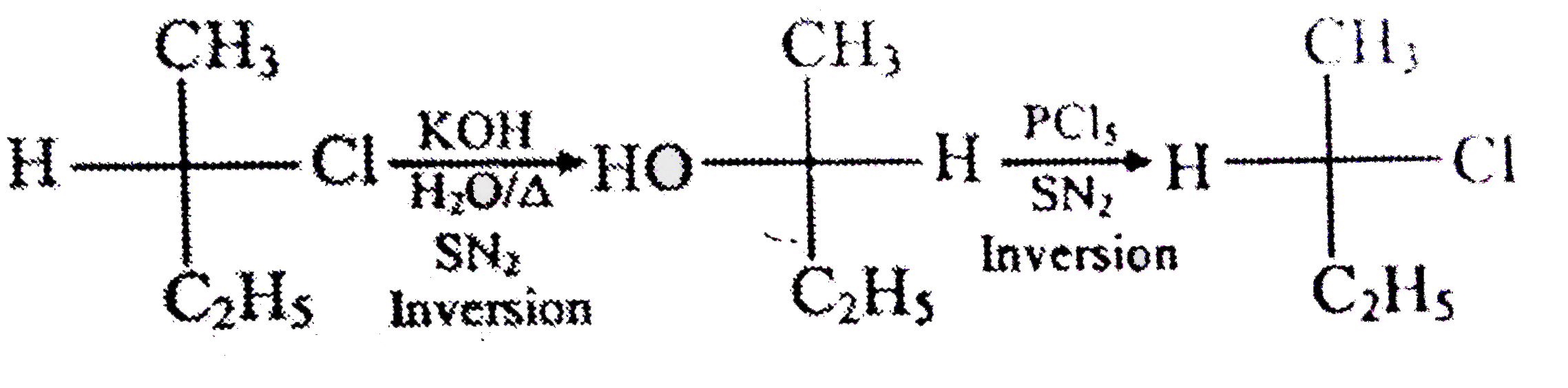
|
|
| 30. |
In the given circuit, with steady current, the potential drop across the capacitor must be |
|
Answer» SOLUTION :Apply Kirchhoff.s law to the closed mesh ACDFA, `2V-I(2R)-I(R )-V=0` or `V=3IR or I=(V )/(3R )` APPLYING Kirchhoff.s law of the mesh ABEFA, `V+V_(C )-IR-V=0` or `V_(C )=IR=((V)/(3R))R=(V)/(3)` `THEREFORE"Potential difference across capacitor "V_(C )=(V )/(3)` |
|
| 31. |
What happens to the width of depletion layer of a p-n junction when it is () forward biased, (i) reverse biased ? |
|
Answer» SOLUTION :(i) The WIDTH of depletion LAYER of a p-n junction decreases when the junction is forward biased. (ii) The width of depletion layer of a p-n junction INCREASES when the junction is reverse biased. |
|
| 32. |
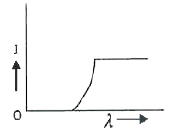
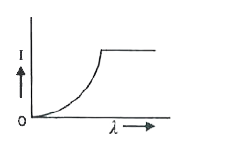
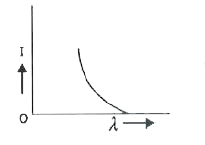
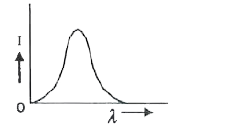
The anode voltage of a photocell is kept fixed. The wavelength lamda of the light falling on the cathode is gradually changed. The plate current I of the photocell varies as follows: |
|
Answer»
|
|
| 33. |
Explain the reflection of plane wavefront from concave mirror. |
Answer» Solution : These depicts the parallel incident of rays and reflection on the incoming concave mirror and the rays focus near the FOCAL point F. The wavefront XY of incident RAY and wavefront X.Y. of reflected ray are also shown in figure. Here point b corresponding to the reflected rays is left BEHIND relation to a and C. Because the rays at the pole 0 of the mirror have taken less distances than the rays reflecting from the edge of the mirror. THUS it is little late reflection occur at O and hence point b remains behind the other points on the reflected wavefront. Similarly, reflection of wavefront can be explained by concave lens and convex mirror. |
|
| 34. |
Angular momentum(L) is one of the following? |
|
Answer» `I^2omega^2` |
|
| 35. |
Suppose the loop in Exercise 6.4 is stationary but the current feeding the electromagnet that produces the magnetic field is gradually reduced so that the field decreases from its initial value of 0.3 T at the rate of 0.02 T s^(-1). If the cut is joined and the loop has a resistance of 1.6 Omega, how much power is dissipated by the loop as heat? What is the source of this power? |
|
Answer» Solution :Induced EMF =`8 xx 2 xx 10^(-4) xx 0.02 = 3.2 xx 10^(-5) V` Induced current `= 2 xx 10^(-5) A` Power loss = `6.4 xx 10^(-10) W` Source of this power is the external agent RESPONSIBLE for changing the magnetic field with time. |
|
| 36. |
Five charges,q each are placedof the corners of a regular pentagon of side 'a' Fig. (a) (i)What will be the electric field at 0, the centerof the pentagon ? (ii) What will be the electricfield at 0 if the charge from one of the corners (say A) is removed ? (iii) What will be the electric fieldat 0 if the charge q at A is replacedby-q ? (b) How would your answerto (a) be affectedif pentagon is replaced by n-sided regular polygon with chargeq at each q at each of its corners ? |
|
Answer» SOLUTION :(a) (i) In fig, the electric field at 0, the center of pentagon wouldbe zero. (ii) When charge q from corner A is REMOVED , electricfield at 0 WOULD be `E_(1) = (q xx 1)/(4pi in_(0) R^(2))` along OA. (III) If charge q at A is replacedby `-q`, it is equivanlent to addingcharge `-2q` at A. Therefore, electric field at 0 would be `E_(2) = (2q)/(4pi in_(0) r^(2))` along OA. (b) When pentagon is replacedby n sides regular polygon withcharge q at each of its corners, the electricfieldat 0 would continuebe to zero. |
|
| 37. |
In which situation a body can roll |
|
Answer» a SMOOTH horizontal surface |
|
| 38. |
A: Bohr had to postulate that the electrons in stationary orbit around the nucleus do not radiate. R: According to classical physics all moving electrons radiate. |
|
Answer» Both assertion and reason are true and the reason is correct explanation of the assertion. ACCORDING to classical physics, all moving charged particle radiate electromagnetic radiation.So moving ELECTRONS will also radiate energy. If we see the atomic structure we find that electrons revolve around the nucleus in some particular ORBITS. This is one of Bohr.s postitulates. The postulate is on the fact that if the moving electrons radiate thereby losing energy they have got a chance to finally FALL back into the nucleus and the ATOM will be collapsed. |
|
| 39. |
Consider an electron in the nth orbit of a hydrogen atom in the Bohr's model. In terms of de-Broglie wavelength of that electron the circumference of the orbit is given as . |
|
Answer» `0.259 n lambda` |
|
| 40. |
A ray of light is incident on a prism at an angle 50^(@) and angle of prism is 60^(@)and RI 1.5. Calculate the angle of total deviation (for non symmetric refraction). |
|
Answer» Solution :`A=60^(@), n=1.5, i_(1)=50^(@)` Applying Snell.slaw, `n=(sin i_(1))/(sin r_(1))` `sin r_(1)= (sin50^(@))/(1.5) = (0.7660)/(1.5) = 0.5106` `r_(1)= sin^(-1) 0.5106` `r_(1)=30^(@)42.` But, `A=r_(1)+r_(2)` `r_(2)=A-r_(1)=59^(@)60. - 30^(@)42.=29^(@)18.` Also,`n=(sin i_(2))/(sin r_(2))` `1.5=(sin i_(2))/(sin29^(@) 18.)` `sin i_(2)= 1.5xx0.4894=0.7341` `i_(2)=sin^(-1)(0.7341)=47^(@)14.` `THEREFORE d=i_(1)+i_(2)-A=50+47^(@)14. 60^(@)=37^(@)14.` |
|
| 41. |
A circular aperture of diameter 1.2xx10^(-3) m is illuminated by plane waves of monochromatic light and the emergent light is allowed to fall on a screen. As the screen is moved gradually towards the aperture it is found that when the screen is at 0.3 m , a dark spot apperas at the centre of the patch of light. find the wavelength of light. |
| Answer» SOLUTION :6000 Å | |
| 42. |
A series LCR circuit is connected to an a.c. source of variable frequency. Drow a suitable phasor diagram deduce the expressions for the amplitude of the current and phase angle. |
Answer» Solution : From the phasor diagram `vec(V) = SQRT((V_(RM))^(2) + (V_(CM) - V_(LM))^(2))` `V_(m) = sqrt([R^(2) + (X_(C) - X_(L))^(2)])` `I_(m) = (V_(m))/(sqrt([R^(2) + (X_(C) - X_(L))^(2)])` From the figure `tan phi = (V_(Cm) - V_(Lm))/(V_(Rm))` `= (I_(m)(X_(C) - X_(L)))/(I_(m)R)` `:. phi = tan^(-) ((X_(C) - X_(L))/(R ))` |
|
| 43. |
A charged particle is projected at a very high speed perpendicular to a uniform magnetic field . The particle will |
|
Answer» move along a circle |
|
| 44. |
The instrument used by doctors for endoscopy work on the principle of |
|
Answer» total INTERNAL reflection |
|
| 45. |
If f denotes the degree of freedom of a gas, the ratio of two specific heats (C_(P))/(C_(V)) is given by |
|
Answer» <P>`(1)/(f)+1` |
|
| 46. |
Show that the tangential component of electrostatic field is continuous from one side of charged surface to another. [Hint : use the fact that work done by electrostatic field on a closed – loop is zero.] |
|
Answer» Solution :The tangential component of electrostatic FIELD is continuous from one side of a charged surface to another, we USE that the work done by electrostatic field on a closed – loop is zero. Let ABA be a charged surface in the field of a point charge q lying at origin. Let`r_A andr_B` be its positive vectors at points A and B RESPECTIVELY. Let E be electric field at point P, thus Eis the tangential component of electric field E. `therefore E.dl=(E cos theta) dl` To prove that Eis continuous from one to another side of the charge surface, we have to find the value of`int _(ABA) E.dl` If it comes to be zero then we say that tangential component of E is continuous ` therefore int_A ^B E.dl=1/(4 pi e_0) q.(1/r_A-1/r_B) and int _B ^A E.dl =1/(4 pi e_0) q. (1/r_B-1/r_A)` `int _(ABA) E.dl =int _A ^B E.dl+ int _B ^ A E.dl=1/(4 pi e_0).q. (1/r_A-1/r_B+1/r_B-1/r_A)=0` HENCE PROVED |
|
| 47. |
A galvanometer having 50 divisions provided with a variable shunt S is used to measure the current when connected in series with a resistance of 90 Omega and a battery of internal resistance 10 Omega. It is observed that when the shunt resistances are 10 Oemga and 50 Omega, the deflections are, respectively, 9 and 30 divisions. What is the resistance of the galvanometer |
| Answer» SOLUTION :`233Omega` | |
| 48. |
A circular coil expands radially in a region of magnetic field and no electromotive force is produced in the coil. This can be because |
|
Answer» the magnetic field is constant. |
|
| 49. |
One end of a long rope is tied to a fixed vertical pole. The rope is stretched horizontally with a tension 8 N. Let us consider the length of the rope to be along X-axis. A sample harmonic oscillator at x = 0 generates a transverse wave of frequency 100 Hz and amplitude 2 cm along the rope. Mass of a unit length of the rope is 20 gm/m. Ignoring the effect of gravity, answer the following questions: Wavelength of the wave is |
|
Answer» 50 cm |
|
| 50. |
A magnetic needle kept on horizontal surface oscillates in Earth's magnetic field. If the temperature of this needle is raised beyond the Curie temperature of the material of the needle, then ........ . |
|
Answer» the PERIODIC time of oscillation will decrease. |
|