

Saved Bookmarks
This section includes 7 InterviewSolutions, each offering curated multiple-choice questions to sharpen your Current Affairs knowledge and support exam preparation. Choose a topic below to get started.
| 1. |
One end of a long rope is tied to a fixed vertical pole. The rope is stretched horizontally with a tension 8 N. Let us consider the length of the rope to be along X-axis. A sample harmonic oscillator at x = 0 generates a transverse wave of frequency 100 Hz and amplitude 2 cm along the rope. Mass of a unit length of the rope is 20 gm/m. Ignoring the effect of gravity, answer the following questions: Assuming that the oscillator has its maximum negative displacement at t = 0, wave equation (function) for the wave can be expressed as |
|
Answer» `y = (0.02m) COS[8pi (rad // m) x - 100 pi (rad // s) t]` |
|
| 2. |
A photocell employs photoelectric effect to convert |
|
Answer» Change in the frequency of light into a change in the electric current. |
|
| 3. |
One end of a long rope is tied to a fixed vertical pole. The rope is stretched horizontally with a tension 8 N. Let us consider the length of the rope to be along X-axis. A sample harmonic oscillator at x = 0 generates a transverse wave of frequency 100 Hz and amplitude 2 cm along the rope. Mass of a unit length of the rope is 20 gm/m. Ignoring the effect of gravity, answer the following questions: Tension in the given rope remaining the same, if a simple harmonic oscillator of frequency 200 Hz is used instead of the earlier oscillator of frequency 100 Hz, then |
|
Answer» speed of TRANSVERSE waves in the rope will be DOUBLED, wavelength will not CHANGE |
|
| 4. |
(i) What characteristic property of nuclear force explains the constancy of binding energy per nucleon (BE/A) in the range of mass number ‘A’ lying 30 lt A lt 170? (ii) Show that the density of nucleus over a wide range of nuclei is constant-independent of mass number A. |
|
Answer» Solution :(i) Constancy of binding energy per nucleon in the RANGE of mass number ‘A’ ranging from 30 to 170 can be EXPLAINED on the basis of short ranged nature of NUCLEAR force. Inside a sufficiently large nucleon a particular nucleon is under the INFLUENCE of only some of its neighbours which come within the range of the nuclear force. If a nucleon can have a maximum of p neighbours within the range of nuclear force, its binding energy would be proportional to p or the binding energy of the nucleon will be pk where k is a constant having the dimensions of energy. Thus, it is clear that the binding energy per nucleon is a constant and EQUAL to pk. |
|
| 5. |
What's radioactivity ? |
| Answer» SOLUTION :The process of spontaneous disintegration of the nuclei of heavy elements with the emission of certain types of radiations is known as NATURAL radioactivity. The elements WHOSE nuclei SPONTANEOUSLY disintegrate are called radioactive elements. Ex. Uranium, RADIUM. | |
| 6. |
One end of a long rope is tied to a fixed vertical pole. The rope is stretched horizontally with a tension 8 N. Let us consider the length of the rope to be along X-axis. A sample harmonic oscillator at x = 0 generates a transverse wave of frequency 100 Hz and amplitude 2 cm along the rope. Mass of a unit length of the rope is 20 gm/m. Ignoring the effect of gravity, answer the following questions: Which of the following is correct ? |
|
Answer» The wave PROPAGATES with a fixed and any particle of the medium vibrates with the same fixed speed |
|
| 7. |
A current of 4A is flowing through a circular coil of radius 20 cm containing 200 turns. Find the magnetic flux density at the centre of the coil. |
| Answer» SOLUTION :`251.3 XX 10^(-5) Wb//m^2` | |
| 8. |
Name the electromagnetic waves in the wavelength range 10 nm to 10^(-3) nm. How are these waves generated ? Write their two uses. |
|
Answer» Solution :Electromagnetic waves in the wavelength range 10 nm to `10^(-3)` nm `(or 10^(-8) m" to "10^(-12) m)` are known as X-rays. X-rays are generated in an X-ray TUBE when electrons emitted by the cathode plate of X-ray tube after gaining high energy are bombarded on the target plate of tube. X-rays are used (i) as a DIAGNOSTIC TOOL in medical field, (ii) in scientific research to STUDY atomic structure and CRYSTAL structure, (ii) in industry and by custom department for anti-smuggling operations. |
|
| 9. |
One end of a long rope is tied to a fixed vertical pole. The rope is stretched horizontally with a tension 8 N. Let us consider the length of the rope to be along X-axis. A sample harmonic oscillator at x = 0 generates a transverse wave of frequency 100 Hz and amplitude 2 cm along the rope. Mass of a unit length of the rope is 20 gm/m. Ignoring the effect of gravity, answer the following questions: Maximum magnitude of transverse acceleration of any point on the rope will be nearly |
|
Answer» `7888 m//s^(2)` |
|
| 10. |
Is the fission of iron(""_(26)Fe^(56)) into (""_(13)Al^(28)) as given below possible? ""_(26)Fe^(56)to ""_(13)Al^(28)+""_(13)Al^(28)+Q Given mass of ""_(26)Fe^(56)=55.934940 and ""_(13)Al^(28)=27.98191 U |
| Answer» Solution :SINCE Q VALUE comes out negative, so this fission is not POSSIBLE | |
| 11. |
The resultant of two forces acting at an angle of 150° 10 kgwt, and is perpendicular to one of the forces. The magnitude of smaller force is |
| Answer» Answer :A | |
| 12. |
Determine the electrostatic potential energy of a system consisting of two charges 7 muC and - 2 muC(and with no external field) placed at (-9 cm, 0, 0) and (9 cm, 0, 0) respectively. |
|
Answer» Solution :The ELECTROSTATIC potential energy of TWO CHARGES `q_(1) q_(2)` at distance r, WHERER=(9,0,0) - (-9,0,0)CM r=18 cm = 0.18 m `U= (kq_(1)q_(2))/(r)` `= (9xx10^(9)xx7xx10^(-6)xx(-2)xx10^(-6))/(0.18)` `:. U = -0.7 J` |
|
| 13. |
Type insulated light rods of length l and 2l are placed in xy plane such their mid point is origin and they are free to rotate in xy plane about z-axis. Two + q charges are fixed at two ends of bigger rod and two - q charges are fixed at two ends of smaller rod. Electric field a point (a, 0, 0) is E. Now if a gt gt t then |
|
Answer» `E alpha (1)/(a^(2))` |
|
| 14. |
Type insulated light rods of length l and 2l are placed in xy plane such their mid point is origin and they are free to rotate in xy plane about z-axis. Two + q charges are fixed at two ends of bigger rod and two - q charges are fixed at two ends of smaller rod. Work done to rotate smaller rod through 180^(@) about z-axis |
|
Answer» 0 |
|
| 15. |
बहुपद p(x) का आलेख नीचे दिया गया है ,प्रत्येक स्थिति मे शून्यानको की संख्या ज्ञात कीजिए ? |
|
Answer» 0 |
|
| 16. |
Type insulated light rods of length l and 2l are placed in xy plane such their mid point is origin and they are free to rotate in xy plane about z-axis. Two + q charges are fixed at two ends of bigger rod and two - q charges are fixed at two ends of smaller rod. What is electric dipolement of system ? |
| Answer» Answer :D | |
| 17. |
The radiowaves of frequency 300MHz to 300MHz belongs to |
|
Answer» high FREQUENCY BAND |
|
| 18. |
A boat is being rowed in a river. Air is also blowing. Direction of velocity vectors of boat, water and air in ground frame are as shown in diagram. |
|
Answer» <P> |
|
| 19. |
A match ignites within in an oxygen-filled cylinder that has a movable piston. The piston is moved so quickly that no heat escapes. What kind of change is demonstrated in this process? |
|
Answer» An isobaric change |
|
| 20. |
When monochromatic source is kept at distance of 0.2 m from photocell,cutoff voltage obtained is 0.6 V and saturation current is 18 mA.Noe if source is kept at distance of 0.6 m……. |
|
Answer» Stopping POTENTIAL will be 0.2 V When distance is CHARGED to 0.6 m (3 times) `1prop (1)/(d^(2))` `therefore (I_(2))/(I_(1))=(d_(1)^(2))/(d_(2)^(2))` `therefore (I_(2))/(I)=((0.2)^(2))/((0.6)^(2))=(1)/(9)` `therefore I_(2)=(I)/(9)=(18)/(9)=2mA` |
|
| 21. |
The basic principle underlying the hall effect is the Lorentz force. Whenk an electron moves along a direction perpendicular to an applied magnetic field. It exeriences a force acting normal to both the directions and moves in response to this force and the force exerted by the internal electric field. For an - n-type bar shaped semiconductor, the carries are predominatly electrons of bulk density n. We assume that the constant current I flows along the x-axis from left to right in the presence of a magnetic field toward the negative z-axis resulting in an excess surface electrical charge on the sides of the sample. this charge results in the hall voltage a potential drop across the two sides of the sample Thre transverse voltage is the hall voltage V_(H) and its magnitude is equal to IB/qnD, where I is the current B is the magnetic field, d is the sample thickness and q is the elementary charge. A silver ribbon lies as shown in the adjacent figure (z_(1) = 11.8 mm and = 0.23 mm) carrying a current of 120 A in the x -direction inunifrom magnetic field B = 0.95 T. If electron density is 5.85 xx 10^(28)//m^(3) then magnitude of the drift velocity of electron is |
|
Answer» 2.35 mm/s |
|
| 22. |
What kind of magnetic field is produced due to a current carrying straight conductor ? |
| Answer» Solution :Magnetic FIELD lines are concentric circles LYING in a plane perpendicular to the STRAIGHT conductor.The CENTRES of CIRCULAR magnetic lines of force lie on the conductor. | |
| 23. |
Demonstrate that the angle theta between the propegation direction of light and the x axis transfroms on transition from the reference frame K to K' according to the formula cos theta' = (cos theta - beta)/(1-beta cos theta), where beta = V//c and V is the velocity of the frame K'with respect to the frame K. the x and x' axes of the reference frames coincide. |
|
Answer» SOLUTION :We consider the invariance of the plane of a wave moving in the `x-y` plane. We write `omega't' - k'_(x)chi' - k'_(y)y' = omegat - k_(x)chi - k_(y)y` From Lorcntz transformations, `L.H.S.` `= omega' gamma (t-(vx)/(c^(2))) -k'_(x)(x-vt) gamma - k'_(y)y` so EQUATING `omega = gamma (omega' +v k'_(x))` `k_(x) = gamma (k'_(x)+(v omega')/(c^(2)))` and `k_(y) = k'_(y)` `omega' = gamma (omega - vk_(x))` so inverting `k'_(x) = gamma (k_(x) -(v omega)/(c^(2)))` `k'_(y) = k_(y)` `k'_(x) = k' costheta', k_(x) = k cos theta` weiting `k'_(y) = k' sin theta', k_(y) = k sin theta` we get on using `ck' = omega', ck = omega` `cos theta' = (cos theta - beta)/(1-beta costheta)` where `beta = (v)/(c)` and the primed frame is moving with velocity `v` in the `x-`direction w.r.t. the unprimed frame. For small `beta lt lt 1`, the situation is as SHOWN. We see that `theta' =- beta` Then `theta' =- ((pi)/(2)+sin^(-1)beta)` This is exactly what we get from ELEMENTARY nonrelativistic law of addition of VELOCITIES, 
|
|
| 24. |
The basic principle underlying the hall effect is the Lorentz force. Whenk an electron moves along a direction perpendicular to an applied magnetic field. It exeriences a force acting normal to both the directions and moves in response to this force and the force exerted by the internal electric field. For an - n-type bar shaped semiconductor, the carries are predominatly electrons of bulk density n. We assume that the constant current I flows along the x-axis from left to right in the presence of a magnetic field toward the negative z-axis resulting in an excess surface electrical charge on the sides of the sample. this charge results in the hall voltage a potential drop across the two sides of the sample Thre transverse voltage is the hall voltage V_(H) and its magnitude is equal to IB/qnD, where I is the current B is the magnetic field, d is the sample thickness and q is the elementary charge. A silver ribbon lies as shown in the adjacent figure (z_(1) = 11.8 mm and = 0.23 mm) carrying a current of 120 A in the x -direction inunifrom magnetic field B = 0.95 T. If electron density is 5.85 xx 10^(28)//m^(3) then What is the magnitude and direction of electric field ? |
|
Answer» `4.5 xx 10^(-3)` V/m in + Z DIR |
|
| 25. |
What excess pressure should a pump set up in an oil pipeline, if the distance between the pumping stations is 50 km? What is the pump's power? The pipeline should be assumed smooth, and the data of Problem 19.1 should be used. |
|
Answer» `Re = (rho vd)/(eta) = (8 xx 10^2 xx 0.8 xx 1.1)/(10^(-2)) = 7 xx 10^4` This is much greater than 2320, and therefore the hydraulic friction coefficient should be determined from the EMPIRICAL formula `lambda = (0.316)/(root(4)(Re)) = 1.94 xx 10^(-2) ~~ 0.02` This enables us to find the pressure drop in the section using formula (30.32) To find the power, use formula `P = Fv= Delta p Sv`. NOTE that this calculation was made for an IDEALLY smooth pipe, in a real pipe the required pressure drop, and consequently the pump power, is substantially greater. |
|
| 26. |
Two point charges -2muC and +3muC are kept r distance apart. The +3muC charge is displaced such that the force of attraction between both the charges is now tripled. Calculate the final distance between both the charges. |
| Answer» SOLUTION :`r/sqrt3` | |
| 27. |
When an electron falls from a higher energy to a lower energy level, the difference in the energies appears in the form of electromagnetic radiation. Why cannot it be emitted as other forms of energy? |
| Answer» SOLUTION :Due to fall of electron from HIGHER to LOWER energy level, the difference in energy is emitted in the form of ELECTROMAGNETIC radiation only because ELECTRONS can interact only electromagnetically, | |
| 28. |
(A) : Soft iron is used as a core of transformer. (R): Area of hysteresis loop for soft iron is small. |
|
Answer» Both 'A' and 'R' are true and 'R' is the correct EXPLANATION of 'A'. |
|
| 29. |
Assertion If high pressur is applied on a radioactive substance rate of radioactivity is a nuclear process. |
|
Answer» If both Assertion and Reason are true and Reason is the CORRECT explanation of Assertion. |
|
| 30. |
1000 व्यक्तियों के एक समूह में 600 व्यक्ति हिंदी बोलते है तथा 450 अंग्रेजी बोलते है। उन व्यक्तियों की संख्या ज्ञात कीजिए जो हिंदी तो बोलते है परन्तु अंग्रेजी नहीं |
|
Answer» 450 |
|
| 31. |
A square surface of side L in the plane of the paper is placed in a uniform electric field E acting along the same. Plane at an anglethetawith the horizontal side of the square as shown in. The electric flux linked to the surface is |
|
Answer» ` EL^(2) sin THETA ` |
|
| 32. |
The relation between the polarising angle (i_p) and the refraction index (n) of the medium is given by : |
|
Answer» N SIN `i_p` = 1 |
|
| 33. |
What is the meaning of 'delirious'? |
|
Answer» To THINK of your family |
|
| 34. |
The coercivity of a small magnet where the ferromagnet gets demagnetised is 3 xx 10^(3) A//m. The current required to be passed in a solenoid of length 10 cm and number of turns 100, so that the magnet gets demagnetised when placed inside the solenoid is |
|
Answer» 30 mA The coercivity of `3 xx 10^(3) A//m` of the MAGNET implies that a magnetic field of intensity `H = 3 xx 10^(3) A//m` should be APPLIED in opposite direction to demagnetise the magnet. For a solenoid, `B = mu_(0)H` but `B = mu_(0)H` `therefore H = ni` In this case , `N = (1000)/(10cm)= (100)/(10xx10^(-2)m) = 1000 "turns"//m` `:. i = H/n = (3 xx10^(3))/(1000) = 3A` |
|
| 35. |
The radius of motion of a charged particle orbiting in a magnetic field is |
|
Answer» `(MV)/(BQ)` |
|
| 36. |
Heavy water is used as a moderator in a nuclear reactor. Give reason. |
| Answer» SOLUTION :Heavy WATER does not have a TENDENCY to absorb neutrons. It shows down the first MOVING neutrons. | |
| 37. |
ls the motion of a charge across junction momentumconserving ? Why or why not ? |
|
Answer» SOLUTION :When ELECTRON moves normal to uniform electric field E, it has definite drift VELOCITY. Drift velocity is given by, `v_(d) = (Ee tau)/(m) ` Also due to charge accumulate momentarily at JUNCTION it produce additional electric field which affect drift velocity. Hence, once charge leaves junction momentum is not conserved. |
|
| 38. |
A ray of light is incident at the glass-water interface at an angle i. It merges finallyparallel to the surface of water. Then, the value of mu_(g) would be |
|
Answer» Solution :Applying Snell's law at glass-water surface, `._(G)^(omega)mu=(sinr)/(sini)=(._(g)mu)/(._(omega)mu)`(i) Applying Snell's law at water-air surface, `._(g)^(omega)mu=(sin90^(@))/(sinr)=(._(g)mu)/(._(omega)mu)` From (i) and (ii), `(._(g)mu)/(._(omega)mu)=(3)/(4sini)rArr (3xx_(g)mu)/(4sini)rArr _gmu=(1)/(sini)` |
|
| 39. |
In a liquid medium of dielectric constant K and of specific gravity 2, two identically charged spheres are suspended from a fixed point by threads of equal lengths. The angle between them is 90^@. In another medium of unknown dielectric constant K^1, and specific gravity 4, the angle between them becomes 120^@. If density of material of spheres is 8 gm/cc then find K^1 |
|
Answer» Solution :`F = W tan theta` i) `1/(4 pi epsilon_0) (q^2)/(K(2l^2)) =mg (1 - 2/8) Tan 45^@` ii) `1/(4 pi epsilon_0) (q^2)/(K^1 (3l^2)) = mg (1 - 4/8) Tan 60^@` i/ii gives `K^1 = K/(sqrt(3))` |
|
| 40. |
The length of a wire is cut to half what will be the effect on the maximum load which it can bear? |
| Answer» SOLUTION :There will be no EFFECT. | |
| 41. |
What is the path difference between the two waves the crest of the wave falls on the trough of the other? |
| Answer» SOLUTION :`DELTA=(2n+1)(LAMDA)/2` | |
| 42. |
Who was afraid to fly high in the SKY? |
|
Answer» BIG kite |
|
| 44. |
In the given electric field vecE = [alpha(d+x)hati + E_0hatj] NC^(-1), where alpha = 1NC^(-1) hypothetical closed surface is taken as shown in figure . The total charge enclosed within the close surface is |
|
Answer» `(abcepsilon_0)/2` `phi_(CDEF)=-beE_(0)` unit `phi_(ABEF)=bcE_(0)+cint_(0)^(a)(d+x)dy` `=+bcE_(0)+acd+cint_(o)^(b)XDX` [Since `(x)/(b)+(y)/(a)=1` or `(dx)/(b)=(-dy)/(a)`] 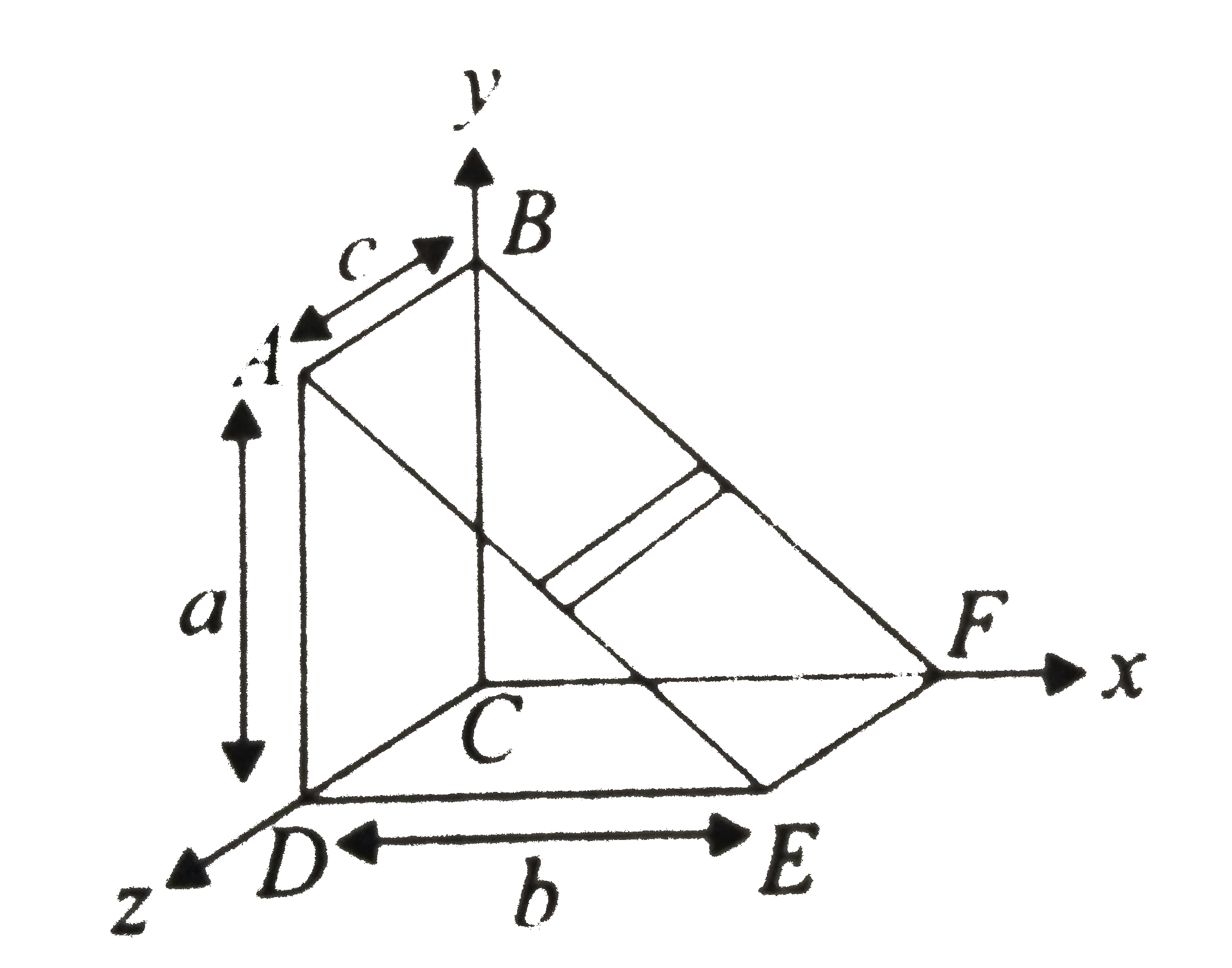 `=[+bcE_(0)+acd+(ACB)/(2)]` unit USING Gauss's law, we GET `phi_(set)=(q_("in"))/(epsilon_(0))` or `q_("in")=(abcepsilon_(0))/(2)` |
|
| 45. |
The density of argon is 1.6 kg m^(-3)at 27^(@)Candat apressureof 75cmof mercury . Whatis the massof theargonin anelectricbulbof volume100 cm ^(3)if the pressureinside is 75cmof mercury whenthe averagetemperatureof the gas is 150^(@)C ? |
| Answer» SOLUTION :`[1.135 XX 10^(-4) KG`] | |
| 46. |
What is Greenhouse effect and its contribution towards the surface temperature of earth ? |
|
Answer» Solution :Green house effect : Temperature of the earth increases due to the radiation emitted by the earth is TRAPPED by atmospheric gases like `CO_(2), CH_(4), N_(2)`, Chlorofluoro carbons ETC is called green house efiect. i) Radiation from the sun enters the atmosphere and heat the objects on the earth.These heated objects emit infrared rays. II) These rays are reflected back to Earth’s surface and trapped in the Earth's atmosphere. Due to this temperature of the earth increases. iii) The layers of carbon dioxide `(CO_(2))` and low lying clouds prevent infrared rays to escape Earth’s atmosphere. iv) Since day-by-day the amount of carbondioxide in the atmosphere increases, more infrared rays are entrapped in the atmosphere. v) Hence the temperature of the Earth's surface increases day by day. |
|
| 47. |
Given R_H =1.097 xx 10^7 m^(-1)findthe longest and shortest wavelengthlimitof Pashenseriesfor longest wavelengthn_i =3 andn_f = 4forshortestwavelengthn_i =3 andn_f= oo( infinity) |
|
Answer» Solution :`vec(UPSILON ) = (1)/( lamda ) = R_H[(1)/(n_(i)^(2))-(1)/(n_(f)^(2))]` ` (1)/(lamda_("long"))=R_H[1/(3^2) - (1)/(4^2)]` ` thereforelamda_("long")=( 16xx 9 )/( 7R_H)=( 16xx 9 )/( 7 XX 1.097 xx 10^7 ) = 10752Å` ` (1 )/( lamda_("short")) = R_H = [1/9 - 1/oo ]= (R_H)/(9)` ` lamda_("short")= (9)/( R_H ) = (9)/( 1.097 xx 10^7 ) = 8204 A` |
|
| 48. |
An electron with kinetic energy 2.5 keV moving along the positive direction of an x axis enters a region in which a uniform electric field of magnitude 10 kV//m is in the negative direction of the y-axis. A uniform magnetic field vecB is to be set up to keep the electron moving along the x-axis , and the direction vecB of is to be chosen to minimize the required magnitude of vecB. In unit-vector notation, what vecB should be set up? |
|
Answer» |
|
| 49. |
The basic principle underlying the hall effect is the Lorentz force. Whenk an electron moves along a direction perpendicular to an applied magnetic field. It exeriences a force acting normal to both the directions and moves in response to this force and the force exerted by the internal electric field. For an - n-type bar shaped semiconductor, the carries are predominatly electrons of bulk density n. We assume that the constant current I flows along the x-axis from left to right in the presence of a magnetic field toward the negative z-axis resulting in an excess surface electrical charge on the sides of the sample. this charge results in the hall voltage a potential drop across the two sides of the sample Thre transverse voltage is the hall voltage V_(H) and its magnitude is equal to IB/qnD, where I is the current B is the magnetic field, d is the sample thickness and q is the elementary charge. A silver ribbon lies as shown in the adjacent figure (z_(1) = 11.8 mm and = 0.23 mm) carrying a current of 120 A in the x -direction inunifrom magnetic field B = 0.95 T. If electron density is 5.85 xx 10^(28)//m^(3) then What is the value of hall emf? |
| Answer» Answer :B | |
| 50. |
When a body is projected in air in any direction, the body is called a _____ motion. |
|
Answer» |
|