

Saved Bookmarks
This section includes 7 InterviewSolutions, each offering curated multiple-choice questions to sharpen your Current Affairs knowledge and support exam preparation. Choose a topic below to get started.
| 1. |
In the circuit shown, after the switch is shifted to position 2 the heat generated in 50 Omega resistance is 6 J. find the emf (V) of the cell. |
|
Answer» |
|
| 2. |
Name two factors on which the self-inductance of an air-core coil depends. |
| Answer» SOLUTION :NUMBER of TURNS in the COIL and its radius.s | |
| 3. |
Find the equivalent capacitance between P and Q in the circuit shown in the figure: |
| Answer» ANSWER :A | |
| 4. |
The image of a candle formed by a concave mirror is cast on a screen. What will happen if the mirror is covered partly? |
|
Answer» |
|
| 5. |
In the circuit shown in figure. A is a sliding contact which can move over a smooth rod PQ. Resistance per unit length of the rod PQis 1 ohm//m. Initially slider is just left to the point P and circuit is in the steady state. At t=0 slider starts moving with constant velocity v = 5 m//sec. towards right. Current in the circuit at t=2 sec. is |
|
Answer» 1 AMP |
|
| 6. |
Two long parallel conducting rails are placed in a uniform magnetic field. On one side, the rails are connected with a resistance R. Two rods MN and M'N' each having resistance r are placed as showing in Fig. Now on the rods MN and M'N' forces are applied such that the rods move with constant velocity v. (ii). If in the previous problem resistance of values R_(1) and R_(2) are connected on both ends as shown in Fig. current I, flowing through resistance R_(1) is given by |
|
Answer» (a) `(BlR_(2)(v_(1)r_(2) - v_(2)r_(1)))/(R_(1)R_(2)(r_(1) + r_(2)) + r_(2)r_(1)(R_(1) + R_(2)))` 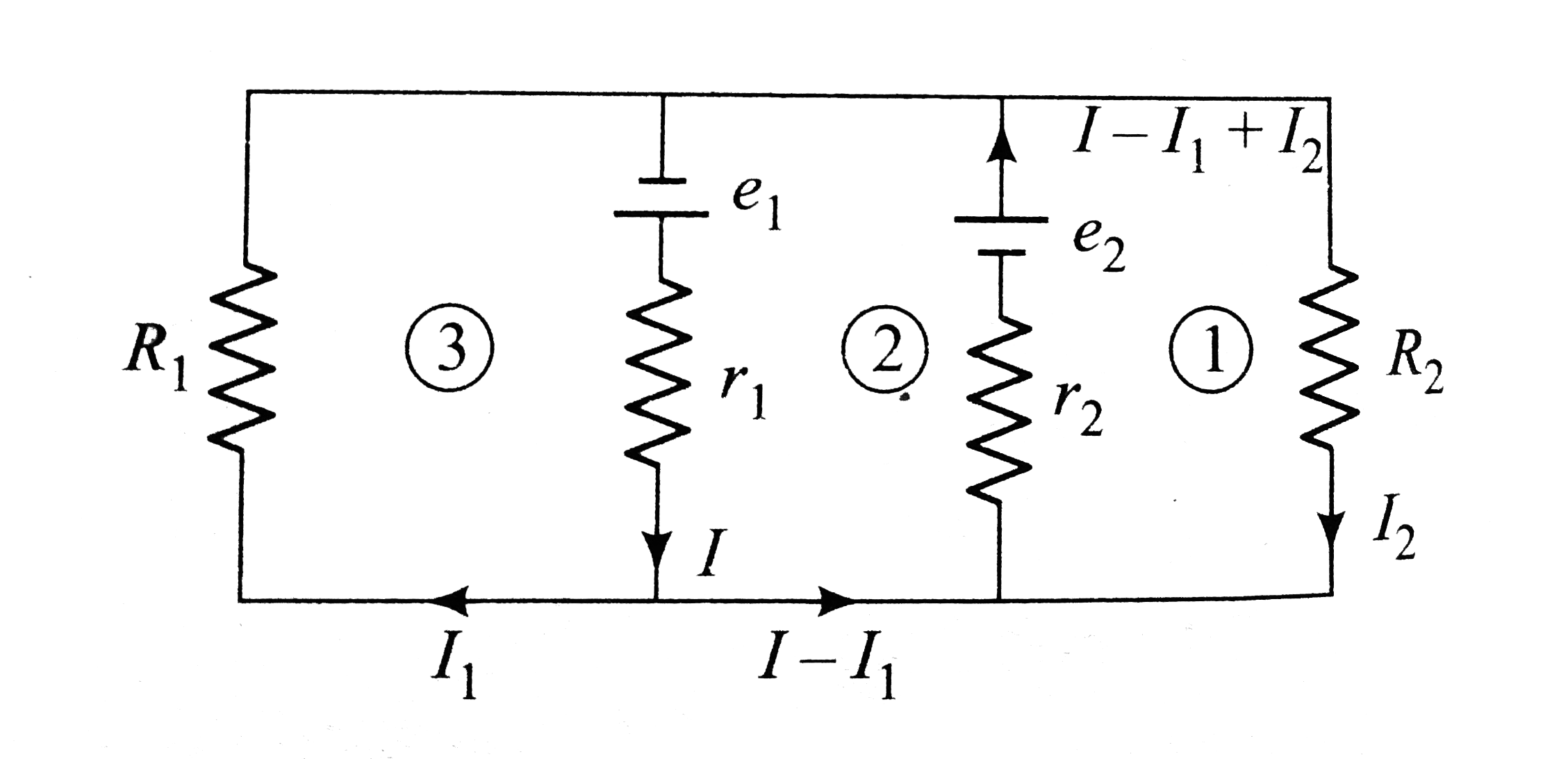 `I = (e)/(R + (r//2)) = (Blv)/(R + (r//2))` Case II ` -(I_(1) - I')R - I_(1)r + e = 0` For loop (1)(i) `r(I-(1) + U') = 2e` For loop (2)(ii) Solve to GET, `I_(1) = I' = (e)/(R )` Hence current in 'R' is zero. ltbr (ii). `e_(1) = Blv_(1), e_(2) = Blv_(2)` For (1) `rarr` `e_(2) = (I - I_(1) + I_(2))r_(2) + I_(2)R_(2)` For (2) `rarr` `e_(1) + e_(2) = (I - I_(1) + I_(2))r_(2) + Ir_(1)` For (3) `rarr` `e_(1) = Ir_(1) + I_(1)R_(1)` Solve to get `I_(1) = (BlR_(2)(v_(2)r_(2) - v_(2)r_(1)))/(r_(1)R_(2)(r_(1) + r_(2)) + r_(2)r_(1)(R_(1) + R_(2)))` |
|
| 7. |
Two metals A and B have work function 4 eV and 10 eV respectively. Which metal has higherthershold wavelength ? |
| Answer» SOLUTION :`omega_0` = h`v_0 = (HC)/lambda_0` i.e., `lambda_0 prop 1/omega_0` So, metal A with LOWER function has higher threshold WAVELENGTH. | |
| 8. |
Determine the electric field strength vector if the potential of this field depends on X, coordinates as V = 10 axy |
|
Answer» 10 a `(y hat(i) + X hat(J))` |
|
| 9. |
Calorie is defined as the amount of heat required to raise temperature of 1 g of water by 1^(@)C and it is defined under which of the following conditions ? |
|
Answer» From `14 cdot 5^(@)C" to "15 cdot 5^(@)C" at "760` mm of Hg So, correct choice is (a). |
|
| 10. |
The displacement of a particle after time 't' is given by x=(k)/(b^(2))(1-e^(-bt)) , where b is a constant. What is the acceleration of the particle |
|
Answer» `ke^(-bt)` `F_("NET")=d_(2)vg-d_(1)vg` `a=((d_(2)-d_(1))vg)/(d_(1)v)` `implies a=((d_(2)-d_(1))/(d_(1)))g` `implies v_(F)=sqrt(2gh)-at` `O=sqrt(2gh)-((d_(2)-d_(1))/(d_(1)))g timplies t=(sqrt(2gh))/(g)(d_(1))/((d_(2)-d_(1)))=sqrt((2H)/(g))((d_(1))/(d_(2)-d_(1)))` 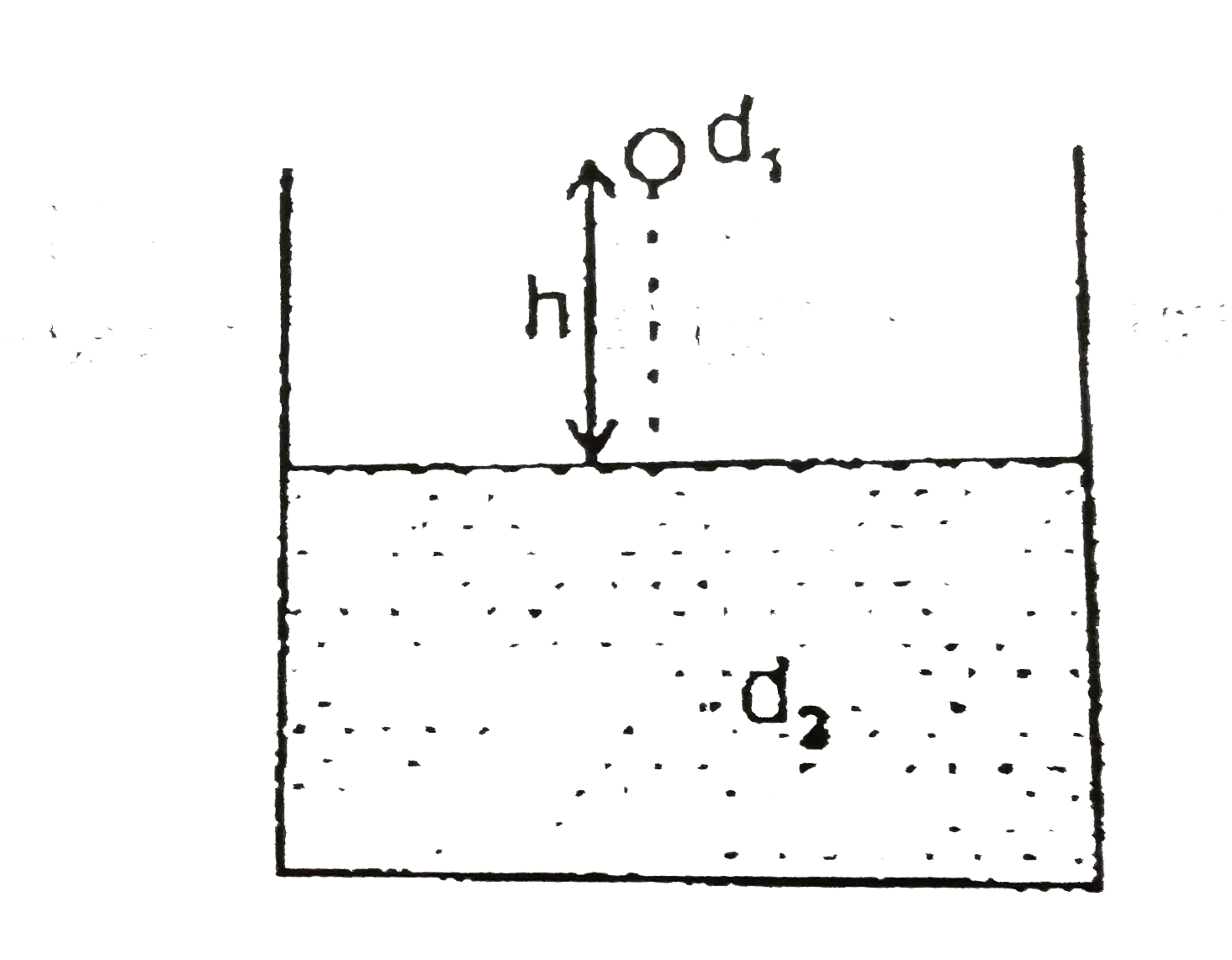
|
|
| 11. |
(A): All natural radioactive elements are ultimately converted to lead. (R) : All the elements above lead are unstable. |
|
Answer» Both .A. and .R. are true and .R. is the correct EXPLANATION of .A. |
|
| 12. |
What is the magnitude and direction of the magnetic field at point A ? |
|
Answer» `3.3xx10^(-5)` T, CLOCKWISE |
|
| 13. |
Find the position of centre of mass of the quarter solid sphere from 'C' in which mass per unit volume is given as rho(r )=rho_(0)(1-(r )/(R )), where r is radial distance from centre and R is radius of solid quarter sphere |
|
Answer» `(3)/(10)R` `=((1)/(2)((R^(4))/(4)-(R^(5))/(5R)))/(((R^(3))/(3)-(R^(4))/(4R)))=(12)/(2).(R )/(20)=(3)/(10)R` Position of C.M. from C `=((3sqrt(2))/(10)R)` 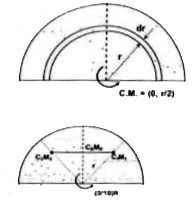
|
|
| 14. |
What wa assume about the energy of light radiations in particle nature of light ? |
| Answer» Solution :Energy of the radiation is not CONTINUOUS but it is distributed in QUANTAS ( Packet of energy) KNOWN as photons. | |
| 15. |
A lamp consumes only 25% of the peak power in an ac circuit. The phase difference between the applied voltage and the current is |
|
Answer» a) `pi/6` |
|
| 16. |
Modulation is the process of superposing |
|
Answer» LOW FREQUENCY AUDIO SIGNAL on highl frequency RADIO waves |
|
| 17. |
A man of mass m climbs a rope of I length L suspended below a balloon of mass M. The balloon is stationary with respect to ground (a) if the man begins to climb up the rope at a speed vnl (relative to rope) in what direction and with what speed (relative to ground) will the balloon move ? (b) How much has the balloon descended when the man reached the balloon by climbing the rope ? |
|
Answer» Solution :(a) Given that initially the system is at rest, so initial momentum of the system is zero. In the claiming of the ROPE there is no external force. Therefore final momentum of the system should also be zero. 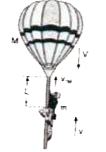 `mvecv + MvecV =0` [as (m+n) = finite] i.e., `MvecV =-mvecv`.....(1) Furthermore here it is given that `vecv_(m) = vecv - vecV`.....(2) Substituting the value ofy from Eqn. (20 in (1) we get `MvecV =-m(vecv_(m) + vecV)` or `vecV =-(mvecv_(rel))/(m+M)`.... (3) This is the desired RESULT and from this it is clear that the direction of MOTION of balloon is opposite to that of CLIMBING `(vecv_("rel"))` vertically down. |
|
| 18. |
What is the meaning of "Over-cast"? |
|
Answer» COVERED with BLUE hue |
|
| 19. |
The terminology of different parts of the electromagnetic spectrum is given in the text. Use the formula E=hv. (for energy of a quantum of radiation : photon) and obtain the photon energy in units of eV for different parts of the electromagnetic spectrum. In what way are the different scales of photon energies that you obtain related to the sources of electromagneticradiation? |
|
Answer» Solution :Photon energy `("for"lambda-1m)=(hc)/(lambda)J=(hc)/(lambdaxx1.6xx10^(-9))eV` `=(6.63xx10^(-34)xx3xx10^(8))/(1xx1.6xx10^(-19))eV=1.24xx10^(-6)eV.` Photon energy for other wavelength in the figure for electromagnetic SPECTRUM can be obtained by MULTIPLYING approximate powers of ten. Energy of a photon that a source indicates the spacings of the relevant energy levels of hte source. For example, `lambda=10^(-12)m (gamma-" rays")` CORRESPONDS to photon energy `=1.24xx10^(6)eV=1.24MeV.` This implies that energy levels (transition between which gives visible radiation) are typically spaced by a few eV. |
|
| 20. |
(A) : When A.C. circuit contain resistor only, its power is maximum. (R) : Power of AC circuit is independent of phase angle. |
|
Answer» Both 'A' and 'R' are TRUE and 'R' is the correct EXPLANATION of 'A'. |
|
| 21. |
Find the force of interaction of two dipoles , if the two dipole moments are parallel to each other and placed at a distance x apart |
|
Answer» `(3p_1p_2)/(4piepsilon_0x^4)` |
|
| 22. |
For a wave described by, y = A sin(omega t -kx),considerthe following points (i) x =0,(ii) x =pi/(4k) For aparticle at each ofthese.points at t = 0, describe whether the particle is moving or not and in what direction and describe whether the particle is speeding up, slowing down or instantaneously not accelerating. |
|
Answer» Solution :`y =A sin(omegat -kx),` Particle velocity `v_p (X,t) =(delta y)/(delta t) = omegaA cos (ometat -kx)` and particle acceleration `a_p (x,t) = (delta^2y)/(deltat^2) =- OMEGA^2 A sin(omegat -kx)` i) `t =0 ,x=0 :v_p =+omegaA and a_p =0` i.e., particle is moving upwards but its acceleration is zero. II) At `t =0,x = PI/(4k), V_p =(A omega)/(sqrt2)`, upward and `a_p =(omega^2A)/sqrt2` upward |
|
| 23. |
Which of the following quantities has the same dimensions as the gravitational constant ? |
|
Answer» `((velocity)^(2))/("MASS per unit length")` Gravitational CONSTANT. |
|
| 24. |
Suppose a cyclotron is operated to accelerate protons with a magnetic field of strength 1 T. Calculate the frequency in which the electric field between two Dees could be reversed . |
|
Answer» Solution :Magnetic field B = 1 T Mass of the PROTON , `m_(T) = 1.67 xx 10^(-27)` kg Charge of the proton, `Q -1.60 xx 10^(-19)`C f = `(qB)/(2 pi m_(p)) = ((1.60 xx 10^(-19)) (1))/( 2(3.14)(1.67 xx 10^(-27)) ) ` = 15.3`xx 10^(6) ` Hz = 15.3 MHz |
|
| 25. |
Direction of magnetic field at equatorial point is _____. |
| Answer» SOLUTION :Anti-parallel to M ] | |
| 26. |
A good absorber is a |
|
Answer» POOR REFLECTOR and transmitter |
|
| 27. |
The radius R_h and massM_h of a block hole are related by R_h = 2GM_h//c^2, where c is the speed of light. Assume that the gravitational acceleration a_g of an object at a distance r_o = 1.001R_h from the center of a block hole is given by (it is, for large block holes). (a) In terms of M_h increases ? (b) Does a_g" at "r_o increase or decease as M_hincreases ? (b) Does a_g" at " r_o increase or decrease as M_h increase ? (c) What is a_g" at "r_o for a very large black hole whose mass is 1.55 xx 10^12 times the solar mass of 1.99 xx 10^30 kg ? (d) If an astronaut of height 1.66 m is at r_o with her feet down, what is the difference in gravitational acceleration between her head the difference in gravitaional acceleration between her head and feet ? (e) Is the tendency to stretch the astronaut severe ? |
| Answer» Solution :(a) `(3.02 xx 10^43 KG" " m//s^2)M_h,`(b) `a_g` decreases as `M_h` increases, (c ) `a_g = 9.82 m//s^2,` (d) `7.10 xx 10^(-15) m//s^2`, (e ) The minsule RESULT of the previous PART implies that, in this case,any EFFECTS due to the differences of gravitational forces on the body are NEGLIGIBLE. | |
| 28. |
Two point charges of +2 mu C and +6 muC repel each other with a force of 12N. If each is given an additional charge of -4 mu C, what will be the new force? |
|
Answer» `8N` (ATTRACTIVE) |
|
| 29. |
A pieceof copperanda pieceofgermaniumarecooledfromtemperatureto 80 K.Thenwhichoneof thefollowingis correct? |
|
Answer» each of these DECREASES |
|
| 31. |
A thin convex lens made from crown glass (mu = (3)/(2)) has focal length f. When it is measured in two different liquids having refractive indices (4)/(3) and (5)/(3), it has t he focal length f_(1) and f_(2) respectively. The correct relation between the focal lenghts is : |
|
Answer» `f_(1) and f_(2)` both become negative `(1)/(f) = (mu - 1) ((1)/(R_(1))-(1)/(R_(2)))` `(1)/(f) = ((3)/(2)-1)((1)/(R_(1))-(1)/(R_(2)))` `THEREFORE (1)/(f)=(1)/(2)((1)/(X))rArrf=2x,((1)/(x)=(1)/(R_(1))-(1)/(R_(2)))` `(1)/(f_(1))=((3//2)/(4//3)-1)((1)/(x))rArr(1)/(f_(1))=(1)/(8X)=(1)/(4f)rArrf_(1)=4f` `rArr(1)/(f_(2))=((3//2)/(5//3)-1)((1)/(x))=rArrf_(2)=-ve` |
|
| 32. |
Figure shows an electric line of force which curves along a circular are. The magnitude of electric field intensity is same at all points on this curve and is equal to E. If potential at A is V them the potential at B is : |
|
Answer» `V-ERtheta` |
|
| 33. |
A cubical tank of water of volume 1m^(3) is kept at a constant temperature of 65^(@)C by 1 KW heater. At time t = 0, the heater is switched off. Find the time taken by the tank to cool down to 50^(@)C, given the temperature of the room is steady at 15^(@)C. Density of water = 10^(3) kg m^(-3) and specific heat of water = 1.0 cal g^(-1)^(@)C^(-1). (Do not assume average temperature during cooling). Take 1 KW= 240 cal s^(-1). |
|
Answer» |
|
| 34. |
The element used for radioactive carbon dating for more than 56000 yr is : |
|
Answer» C-14 |
|
| 35. |
A coil in the shape of an equilateral triangle of side 1 is suspended between the pole pieces of a permanent magnet such that B is in plane of the coil. If due to a current i in the triangle a torque tau acts on it, the side 1 of the triangle is |
|
Answer» `2/(SQRT3)(tau/(Bi))` |
|
| 36. |
In Fig 27-52, circuit section AB absorbs energy at a rate of 50W when current i=2.0A through it is in the indicated direction. Resistance R=2.0 Omega, (a) What is the potential difference between A and B? Emf device X lacks internal resistance. (b) What is its emf? (c) is pont B connected the positive terminal of X or to the negative terminat? |
|
Answer» |
|
| 37. |
When an a.c. source is connected to an ideal inductor, show that the average power supplied by the source over a complete cycle is zero. |
|
Answer» Solution :Let an alternating voltage `V = V_(m) sin omega t`is applied ACROSS an IDEAL inductor, then current in the CIRCUIT is given by `I = I_(m) sin (omega t -pi/2)` `therefore` Average POWER for one complex cycle of circuit will be `P_(av) = 1/T int_(0)^(T) V I dt = 1/T int_(0)^(T) V_(m) sin omegat, I_(m) sin (omega t -pi/2) dt =(V_(m)I_(m))/T int_(0)^(T) sin omegat(-cos omega t)dt` `(V_(m)I_(m))/(4 omega T) [1-1] =0` |
|
| 38. |
The Rutherford alpha - particleexperimentshows that most ofthe alpha - particlepass through almostunscattered whilesome are scattered though large angles. Whatinformation does it gives about the structure of theatom ? |
|
Answer» ATOM is hollow. |
|
| 39. |
Some of the funniest videos on the web involve motorists sliding uncontrollably on icy roads. Here let's compare the typical stopping distances for a car sliding to a stop from an initial speed of 10.0 m/s on a dry horizontal road, an icy horizontal road, and (everyone's favorite) an icy hill. (a) How far does the car take to slide to a stop on a horizontal road (Fig.6-4a) if the coefficient of kinetic friction is mu_(k)=0.60, which is typical of regular tires on dry pavement? Let's neglect any effect of the air on the car, assume that the wheels lock up and the tires slide, and extend an x axis in the car's direction of motion. |
|
Answer» SOLUTION :The car accelerates (its speed decreases) because a horizontal frictional force acts againts the motion, in the negative direction of the x axis. (2) The frictional force is a kinetic frictional force with a magnitude of the given by Eq. 6-2 `(f_(k)=mu_(k)F_(N))`, in which `F_(N)` is the magnitude of the normal force on the car from the road. (3) We can relate the frictional force to the resulting ACCELERATION by writing Newton.s second law `(F_("net.x"=ma_(x)))` for motion along the road. Calculations: Figure 6-4b shows the free-body diagram for the car. The normal force is upward, the gravitational force is downward, and the frictional force is horizontal. Because the frictional force is the only force with an x component, Newton.s second law written for motion along the x axis becomes `-f_(k)=ma_(x)`  Figure 6-4 (a) A car sliding to the right and finally stopping. A free-body diagram for the car on (b) the same horizontal road and (c) a haill. Substituting `f_(k)=mu_(k)F_(N)` gives us `-mu_(k)F_(N)=ma_(x)`. Form Fig. 6-4b we SEE that the upward normal force balances the downward gravitational force, so in Eq. 6-9 let.s replace magnitude `F_(N)` with magnitude mg. Then we can cancel m (the stopping distance is thus independent of the car.s mass- the car can be heavy or light, it does not matter). Solving for `a_(x)` we find `a_(x)=-mu_(k)g`. Because this acceleration is constant, we can use the constant-acceleration equation of Table 2-1. The easiest choice for finding the sliding distance `x-x_(0)` is Eq. 2-16 `(v^(2)=v_(0)^(2)+2ax-x_(0))`, which gives us `x-x_(0)=(v^(2)-v_(0)^(2))/(2a_(x))` Substituting from Eq. 6-10 we then have `x-x_(0)=(v^(2)-v_(0)^(2))/(-2mu_(k)g)` Inserting the INITIAL speed `v_(0)=10.0` m/s, the final speed v=0, and the coefficient of kinetic friction `mu_(k)=0.60`, we find that the car.s stopping distance is `x-x_(0)=8.50m~~8.5m` (b) What is the stopping distance if the road is covered with ice with `mu_(k)=0.10`? Calculation: Our solution is perfectly fine through Eq. 6-12 but now we substitute this new `mu_(k)`, finding `x-x_(0)=51`m. Thus, a much longer clear path would be needed to avoid the car hitting something along the way. (c) Now let.s have the car sliding down an icy hill with an inclination of `theta=5.00^(@)` (a mild incline, nothing like the hills of San Francisco). The free-body diagram shown in Fig. 6-4c like the ramp in Sample Problem 5.06 except, to be consistent with Fig. 6-4b, the positive direction of the x axis is down the ramp. What now is the stopping distance? Calculations: Switching from Fig. 6-4b. to c involves two major changes. (1) Now a component of the gravitational force is along the tilted x axis, PULLING the car down the hill. From Sample Problem 5.06 and Fig 5-23, that down-the-hill component is mg `sintheta`, which is in the positive direction of the x axis in Fig. 6-4c. (2) The normal force (still perpendicular to the road) now balances only a component of the gravitational force, not the full force. From Sample Problem 5.04 (see Fig. 5-23i), we write that balance as `F_(N)=mgcostheta`. In spite of these changes, we still want to write Newton.s second law `(F_("net.x")=ma_(x))` for the motion along the (now tilted) x axis. We have `-f_(k)+mgsintheta=ma_(x)` `-mu_(k)F_(N)+mgsintheta=ma_(x)`, `-mu_(k)mgcostheta+mgsintheta=ma`, Solving for the acceleration and substituting the given data now give us `a_(x)=-mu_(k)gcostheta+gsintheta` `=-(0.10)(9.8m//s^(2))cos5.00^(@)+(9.8m//s^(2))sin5.00^(@)` `=-0.122m//s^(2)`. Substituting this result into Eq. 6-11 gives us the stopping distance down the hill: `x-x_(0)=409m~~400m` which is about 1/4 mile. Such icy hills separate people who can do this calculation (and thus know to stay home) from people who cannot (and thus end up in web videos). |
|
| 40. |
A police inspector is chasing a thief who is running away in a car with a speed 3m/s. The speed of police jeep is 12 m/s. Then the speed of image of police jeep as seen by thief in the rear view mirror when the police jeep is at a distance of 30 m is (value of focal length of the rear view mirror is 15 m) |
|
Answer» 2m/s |
|
| 41. |
A series LCR circuit with L = 0.12 H, C = 480 pF, R = 23 Omega is connected to a 230 V variable frequency supply. For which frequencies of the source is the power transferred to the circuit half power at resonant frequency ? What is the current amplitude at these frequencies ? |
|
Answer» Solution :Inductance `L = 0.12 H`, Capacitance `C = 480 NF = 480xx10^(-9)F` Resistance `R = 23 Omega` The rms value of voltage VRMS = 230 V Power transferred to the circuit is half the power at RESONANT frequency. `Delta omega=(R )/(2L)=(23)/(2xx0.12)=95.83` rad/s `Delta V=(Delta W)/(2pi)=15.2Hz` The FREQUENCIES at which power transferred is half `V=V_(0)pm Delta V=663.48 pm 15.26` So, frequencies are 448.3Hz and 678.2Hz, the maximum current `I=(I_(0))/(sqrt(2))=(14.14)/(sqrt(2))=10A` |
|
| 42. |
An electron of charge e enters a magnetic field B with a velocity v and moves in a circular path of diameter d in the field. When the electron completes one semi-circular path, the work done by the field |
|
Answer» zero |
|
| 43. |
As per Rayleigh's law the intensity of scattered light (I) depends on its wavelength (lambda) as per relation _________. |
| Answer» Solution :`l prop (1)/(LAMBDA^(5))` | |
| 44. |
The energy of a photon (in eV) is related to the wavelength (in Å) by : |
|
Answer» `E=(1.24)/LAMDA` |
|
| 45. |
If the proportion of impurity increases in semiconductor in p-n junction then depletion region ………. |
|
Answer» WIDTH increase |
|
| 46. |
A man is travelling at 10.8 kmph in a topless car on a rainy day. He holds an umbrella at an angle of 37^@with the vertical to protect himself from rain which is falling vertically downwards. What is the velocity of the rain drop ? |
| Answer» SOLUTION :`4 MS s^(-1)` | |
| 47. |
Select incorrectstatement : |
|
Answer» Centralmetal in Vitamine `B_(12)` is `CO^(+3)` `Cu^(+2) = [Ar] 4s^(0) 3d^(9)` 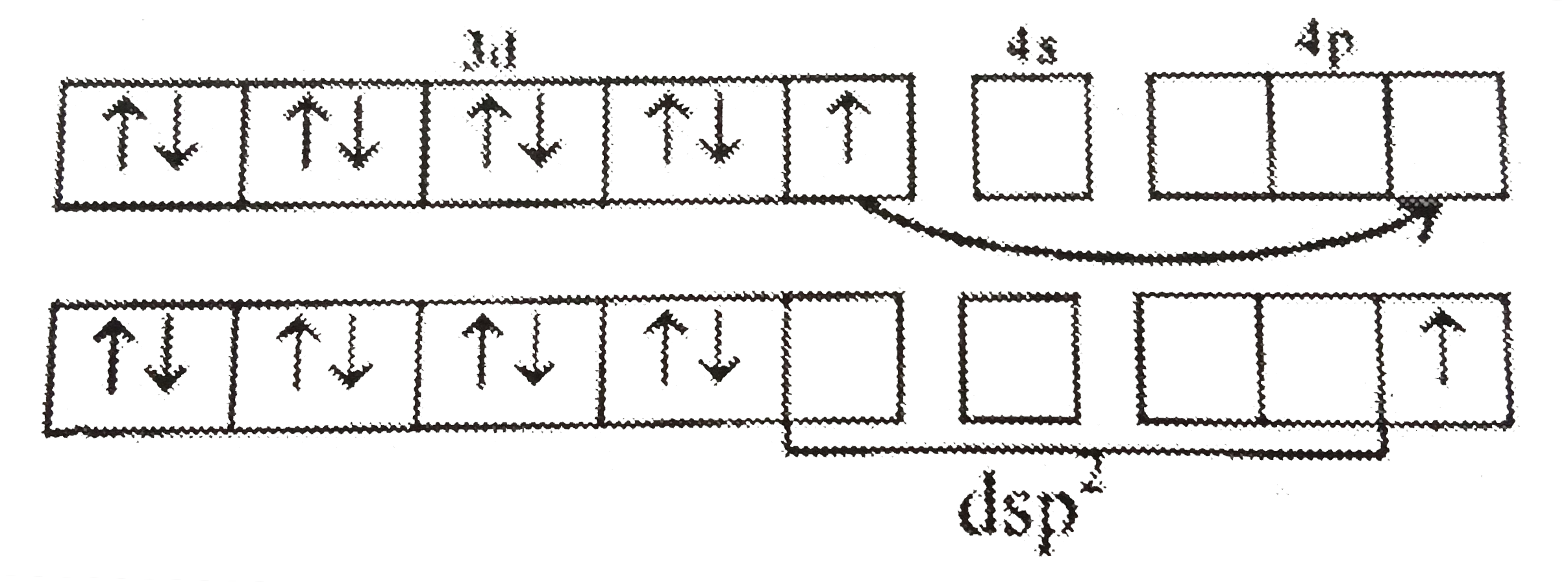
|
|
| 48. |
The ratio isotope ._(29)^(64)Cu can decay through positron emission and electron capture. In both the processes neutrino (v) is emitted. Calculate the difference in maximum possible kinetic energy of emitted neutrinos in the two processess. |
|
Answer» |
|
| 49. |
A lift ascends with a constant acceleration of 4 m s^(-2) then with a constant velocity v and finally stops under a constant retardation of 4 m s^(-2). If the total height ascended be 20 m and the total time taken is 6 s then the time during which the lift was movitng with a vclocity nu is |
|
Answer» 2a `nu=u +atimplies nu=0+4t` `t_(1)` is the TIME for which lift ascends with constant velocity Total time `= 2t+t_(1)=6s` Area under velocity - time GRAPH gives the displacement `(1)/(2) (2t+2t_(1))4t =20` `(t+t_(1))t=5` PUTTING value of `t_(1)=6-2t` from (i ) in (ii) `(t+6-2t) t=5` (6-t) t=5 `t^(2)-6t+5=0` (t-1)(t-5) =0 t=1 s or t=5 s , since t=5 s is not possble So, `t_(1)=4 s` 
|
|
| 50. |
Assume that the two light waves, of wavelength 515 nm in air, are initially out of phase by pi rad. The indexes of refraction of the media are n_(1)=1.45 and n_(2)= 1.75. What are the (a) smallest and (b) second smallest value of L that will put the waves exactly in phase once they pass through the two media? |
| Answer» SOLUTION :(a) 0.858 `MU m`, (B) 2.58 `mu m` | |