

Saved Bookmarks
This section includes 7 InterviewSolutions, each offering curated multiple-choice questions to sharpen your Current Affairs knowledge and support exam preparation. Choose a topic below to get started.
| 1. |
A lamp radiates power Po uniformly in all directions, the amplitude of electric field strength E_(0)at a distance r from it is |
|
Answer» `E_(0)=(P_(0))/(2piepsilon_(0)cr^(2))` |
|
| 2. |
The escape velocity of a sphere of mass m is given by (G=Universal gravitational constant,M=Mass of the earth and R_(e )=Radius of the earth) |
|
Answer» `sqrt((2GMm)/(R_(e ))` Therefore in order to take a body from the earth.s surface to infinity, the work required is `(GMm_(e )m)/(R_(e ))`. Hence it is evident that if we throw a body of mass m with such a velocity that its kinetic energy is `(GM_(e )m)/(R_(e ))`, then it will move outside the gravitational field of earth. Hence, `(1)/(2)mv_(e )^(2)=(GM_(e )m)/(R_(e ))" or ", v_(e )=sqrt((2GM_(e ))/(R_(e )))`. |
|
| 3. |
Two particlemove in a unifrom gravitational field withan acceleration"g". Atthe initial momentthe paricleswere locatedat onepointand movedwithvelcoities u_(1) = 3.0 ms^(-1) and u_(2) = 4.0 ms^(-1) horizontally in opposite directions. Find the distancebetweenthe patricles at the momentwhentheirtheir velocityvectors become mutually perpendicular . |
Answer» SOLUTION :`t= sqrt((u_(1)u_(2))/g), x=(u_(1) + u_(2))t` 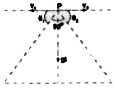 =0.48 m |
|
| 4. |
(A): At any instant, if the current through an inductor is zero, then the induced emf will also be zero. (R): In one time constant, the current flows to 37 percent of its maximum value in series LR circuit. |
|
Answer» Both A and R are TRUE and R is the CORRECT explanation |
|
| 5. |
Assum that an electric field vecE = 30 x^(2) hati exists in space. Then the potential difference V_(A) - V_(0), where V_(0) the potential at the origin and V_(A) the potential at x = 2 m is : |
|
Answer» `-80 ` J `:. Int_(V_(0))^(V_(A))dV = - int_(0)^(2) 30 X^(2) dx ` `=-[(30x^(3))/(3)]_(0)^(2)=-[(30xx8)/(3)]` `:. V_(A)-V_(0)=- 80 ` `:. V_(A)-0 =-80 J` `:. V_(A)=- 80 J` |
|
| 6. |
A lorry and a car moving with the same kinetic energy are bought to rest by the application of brakes which provide equal retarding forces. Which of the two will come to rest in a shorter distance ? |
|
Answer» The car |
|
| 7. |
If the magnitude of velocity in the previous question is decreasing with time, what is the direction of f angular acceleration (oversetrightarrow(alpha))? |
|
Answer» east |
|
| 8. |
An H_2 atom and Li^(++) ion are both in the second excited state. If l_(H) and l_(Li) are their respective angular momemtum and E_H and E_(Li) are their energies then : |
|
Answer» `l_(H) GT l_(LI) & E_(H) gt E_(Li)` |
|
| 9. |
An electric dipole of dipole moment p is placed in a uniform electric field E. Initially the dipole is aligned parallel to the field. The dipole is now rotated so that it becomes antiparallel to the field. Work required to be done on the dipole by an external agency is |
|
Answer» – 2pE |
|
| 10. |
Two media each of refractive index 1.5 with plane parallel boundaries are separated by 100 cm. A convex lens of focal length 60 cm is placed midway between them with its principal axis normal to the boundaries. A luminous point object O is placed in one medium on the lens at a distance 125 cm from it. Find the position of its image formed as a result of refraction through the system. |
|
Answer» `(n_(2))/(v)-(n_(1))/(u)=(n_(2)-n_(1))/(R), (1)/(v)-(1.5)/((-75))=(1-1.5)/(infty)=0` `(1)/(v)=-(1.5)/(75)v=-50 cm` `u'=-50-50=-100 cm` Object for second refraction. `(1)/(v)-(1)/(u)=(1)/(F)` `(1)/(v)-(1)/(100)=(1)/(60)(1)/(v)=(1)/(60)-(1)/(100)` `v=6xx25=150 cm` `v=150 cm` `|||^(rd)` Refraction `u=150-50=100` `(n_(2))/(v)-(n_(1))/(u)=(n_(2)-n_(1))/(R),(1.5)/(v)-(1)/(100)=0rArr(1.5)/(v) =(1)/(100)` `v=150 cm` from LAST surface `v=150 cm` so from lens `=50+150=200 cm` 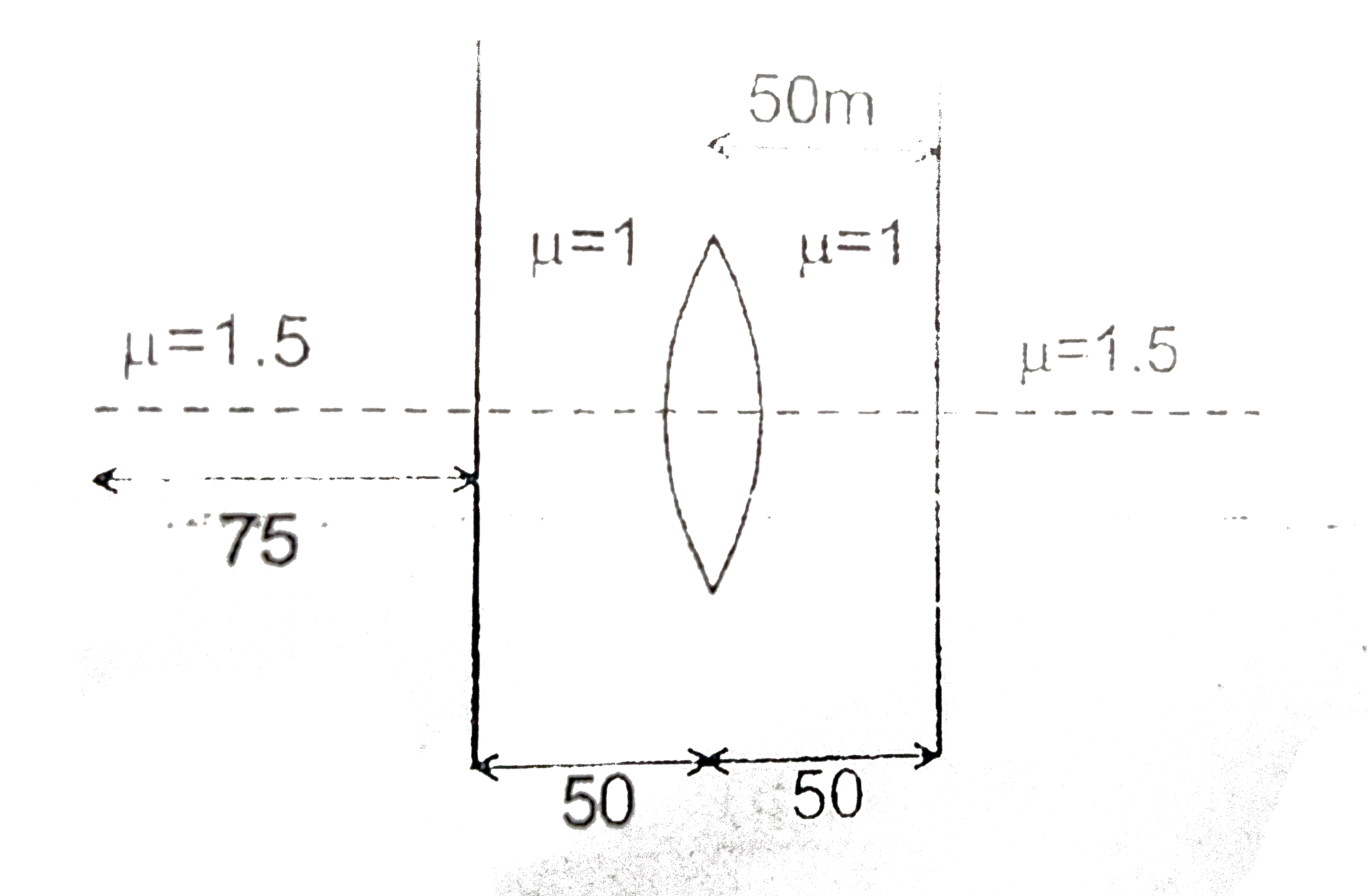
|
|
| 11. |
Self induction is called the inertia of electricity.why? |
| Answer» SOLUTION :Self INDUCTION of a coil is the property by VIRTUE of which the coil OPPOSES the flux change. So it is CALLED so. | |
| 12. |
Define Electric flux. |
| Answer» Solution :ELECTRIC FLUX through an AREA is the productof MAGNITUDE of area and the component of electric field VECTOR normal to it . | |
| 14. |
Draw the circuit diagram of a Wheatstone bridge. Derive the balancing condition for the same. Name a device which works on the principle of Wheatstone bridge. |
|
Answer» Solution :This networkis used to determine the VALUE of an `R_1,R_2 ,R_3` and `R_4` connected in the form of a quadrilaterial . A cell of emf E is connected between A and `C_1` whilea galvanometer of resistance G is connected between B and C. If the resistances are adjusted such that the current through the galvanometer is zero, the NETWORK is said to be in a balanced condition. Using Kirchhoff.s law At node B, `rArr I_2= I_g+ I_4` or `I_4=I_2-I_g` At node D , `rArr I_1 +I_g =I_3` an `I_3=I_1 + I_g` Apply in a Kirchhoff.s voltage law for the loop ABDA, `I_2R_2 + I_gG-I_1R_1=0` ......(1) Apply in a Kirchhoff.s voltage law for the loopBCDB, `I_4R_4-I_3R_3-I_gG=0` Substiuting for `I_4` and `I_3` in then EQUATIONWE get , `(I_2-I_g)R_4-(I_1+I_g)R_3-I_gG=0` `I_2R_4-I_gR_4-I_1R_3 -I_gR_3-I_gG=0` ...(2) When the network is balanced the current through the galvanometer is zero i.e.,`I_g=0` Apply Ig=0 to the equations (1) and (2) we get `I_2R_2-I_1R_1=0` or `I_2R_2=I_1R_1` ....(3) `I_2R_4 -I_1R_3=0` or `I_2R_4=I_1R_3` ...(4) DIVIDING the equation (3) by (4) , equation `(cancelI_2R_2)/(cancelI_2R_4)=(cancelI_1R_1)/(cancelI_1R_3)` `R_2/R_4=R_1/R_3` A practical device using this principal is the meter bridge . 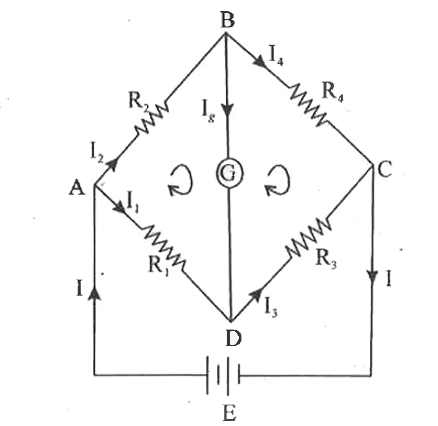
|
|
| 15. |
There are 50 turns per cm length in a very long solenoid. It carries a current of 2.5A. The magnetic field at its centre on the axis is ______ T. |
|
Answer» `5pixx10^(-3)` `thereforeB=500pixx10^(-5)T" "thereforeB=5pixx10^(-3)T` |
|
| 16. |
If a lens of focal lenth 20 cm, made of glass of refractive index 1.5, is placed in a liquid of refractiven index 1.25, the focal length of the lens becomes _______. |
| Answer» Solution :Hint : `SIN i_(c)=(n_(w))/(n_(g))=((4)/(3))/((5)/(3))=(4)/(5)` | |
| 17. |
What happens when a convex lens is surrounded by a medium of smaller refractive index and larger refractive index? |
| Answer» Solution :When a CONVEX lens is SURROUNDED by a medium of smaller REFRACTIVE index, it will be a converging lens. When convex lens is surrounded by a medium of LARGER refractive index it will be a diverging lens. | |
| 18. |
A metallic wire with tension T and at temperature 30^@C vibrates with its fundamental frequency of 1 KHz. The same wire the same tension but al 10^@C temperature vibrates with a fundamental frequency of 1,001 KHz. Find the coefficient of linear expansion of the wire. |
| Answer» SOLUTION :`1 XX 10^(-4)//^@C` | |
| 19. |
If the electron jumps to the ground state from the third excited state in hydrogen atom, calculate the wavelength of corresponding emitted photon in eV. Rydberg's constant =1.097xx210^(7)m^(-1), c=3xx10^(8)m s^(-1)=6.62xx10^(-34)Js |
|
Answer» Solution :`R=1.097xx10^(7)m^(-1)` `c=3xx10^(8)m s^(-1)` `h=6.62xx10^(-34)Js` `n_(i)=4` [ Third excited state =3+1] `n_(f)=1` `(1)/(lambda)=R[(1)/(n_(f)^(2))-(1)/(n_(i)^(2))]` `=1.097xx10^(7)[(1)/((1)^(2))-(1)/((4)^(2))]` `=1.097xx10^(7)[(15)/(16)]` `lambda=(16xx10^(-7))/(1.097xx15)` `lambda=9.72xx10^(-8)m` `E=(HC)/(lambda)=(6.62xx10^(-34)xxx3xx10^(8))/(9.72xx10^(-8))` `=2.04xx10^(-18)J` `=(2.04xx10^(-18))/(1.6xx10^(-19))eV` `:.E=1.277eV`s |
|
| 20. |
If two thin lenses are kept coaxially together, then their power is proportonal (R_(1),R_(2) "being the radii of curved surfaces") to |
|
Answer» `R_(1) + R_(2)` |
|
| 21. |
In the given circuit the potential difference across the capacitor is 12V in steady state. Each resistor have 3Omega resistance. The emf of the ideal battery is |
|
Answer» `15V` In STEADY current will not flow from the capacitor. If emf of BATTERY is `v_(0)`, then potential difference between `A` and `B` `V_(A)-V_(B)=(0.4v_(0))/5=12Vimpliesv_(0)=15V` 
|
|
| 22. |
In terms of Bohr radius a, the radius of the second Bohr orbit of a hydrogen atom is given by ………… |
|
Answer» `4a_(0)` `:.(r_(2))/(r_(1))=((2)^(2))/((1)^(2))` `(r_(2))/(a_(0))=4` `:.r_(2)=4a_(0)` |
|
| 23. |
Explain the concept of satellite communication? Write its applications. |
Answer» Solution :The satellite communication is a MODE of communication of signal between transmitte and receiver via satellite. The message signal from the Earth station is transmitted to the satellite on BOARD via an uplink (frequency band 6 GHz), amplified by a transponder and the retransmitted to another earth station via a downlink (frequency band 4GHz) The high-frequency radio wave signals travel in a straight frequency radio wave signals travel in a straight line line of sight) may come across tall buildings or mountains or even encounter the s or mountains or even encounter the curvature of the earth. A communication e felays and amplifies such radio signals via transponder to reach distant and far oil places using uplinks and downlinks. It is also called as a radio repeater in sky. The applications are found to be in all fields and are discussed below. Applications Satellites are classified into different types based on their applications. Some satellites are discussed below. (i) Weather Satellites: They are used to monitor the weather and climate of Earth. By measuring cloud mass, these satellites enable us to predict rain and dangerous storms LIKE hurricanes, cyclones etc. (ii) Communication satellites: They are used to transmit television, radio, internet signals etc. Multiple satellites are used for long distances. (iii) Navigation satellites: These are employed to determine the GEOGRAPHIC location of ships,AIRCRAFTS or any other object. |
|
| 24. |
The gas between two long coaxial cylindrical surfaces is filled with a homogeneous isotropic substance. The radii of the surfaces are r_(1) = 5.00 cm and r_(2) = 7.00 cm. In the steady state the temperatures of the inner and outer surfaces are T_(1) =290 K and =320 K respectively. Find the temperature of a coaxial surface ofradius r. |
|
Answer» |
|
| 25. |
If the electric field associated with a radiation of frequency 10 MHz is E=10 sin (kx - omega t) mV/mthen its energy density is …. J m^(-3).[epsilon_(0) = 8.85xx10^(-12)C^(2)N^(-1)m^(-2)] |
|
Answer» `4.425xx10^(-16)` `therefore E_(rms)^(2)=(E_(m)^(2))/(2)` `rho=epsilon_(0)E_(rms)^(2)` `therefore rho =(8.85xx10^(-12)xx100xx10^(-6))/(2)` `=4.425xx10^(-16)` |
|
| 26. |
The current flowing in a wire fluctuates sinusoidally as shown in the diagram. The root mean square valuie of the current is |
|
Answer» `i_(0)((1)/(2)+1)^(2)` |
|
| 27. |
For transmitting audio signal properly |
|
Answer» it is first superimposed on HIGH FREQUENCY CARRIER wave |
|
| 28. |
ParticleA isrelased form a pointP ona smooth inclined planeinclined atan anglealpha withthe horizontal. Atthe same instant anotherparticle B is projectedwith initial velocity u makingan angle beta with thehorizontal. |
| Answer» SOLUTION :`ALPHA + BETA = (PI)/(2)` | |
| 29. |
Assertion: If a dielectric is charged by induction then induced charge q may be less than inducing charge q. Reason:For metals, dielectric constant is infinity. |
|
Answer» Both Assertion and Reason are TRUE and Reason is the CORRECT explanation of Assertion |
|
| 30. |
If vac A*vec B =vec A xx vac B the resultant vector of vec A and vec B is |
|
Answer» `SQRT(A^(2)+B^(2)+sqrt(2)AB)` |
|
| 31. |
What happens to the energy of the photon incidenting on metal surface? |
| Answer» Solution :ONE PART of the energyof the photon is used in ejecting out the electrons from the METAL SURFACE and the remaining part of the energyof the photon is used to impart K.E to the emitted electrons. | |
| 32. |
In peddler's view, what does the world look like? |
|
Answer» A Rat |
|
| 33. |
An electron is accelerated in the direction of the electric filed. What will happen to its acceleration over a period of time? |
|
Answer» |
|
| 34. |
In the above question find the acceleration of both the block whenF =18 N |
|
Answer» SOLUTION :SINCE `F lt 30` both the blocks will move together F.B.D. `a = ( 18)/( 6) = 3 m//s^(2)` 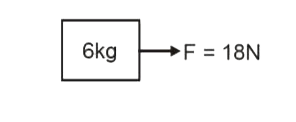
|
|
| 35. |
A particle is projected horizontally with a velocity 10m/s. What will be the ratio of: de-Broglie wavelengths of the particle, when the velocity vector makes an angle 30^(@) and 60^(@) with the horizontal |
|
Answer» `SQRT3:1` |
|
| 36. |
A hydrogen atom is in p state. For this, values of j are |
|
Answer» `+1/2,+3/4` |
|
| 37. |
What is the main difference between a Galilean telescopeand a simple terrestrialtelescope ? |
| Answer» Solution :To make FINAL image erect with respect to object , Galileantelescope only has twolenses - one is CONVEX and another oneis CONCAVE. For the same reason asimple terrestrialtelescopehas three convex LENSES. | |
| 38. |
Which of the following undergoes sublimation |
|
Answer» Camphor |
|
| 39. |
Two liquids of same volume take 324s and 810s respectively in cooling from 60^(@)C to 50^(@)C in identical circumstances. If the ratio of specific heats of these liquids is 3 : 4 , then the ratio of their densities will be – (Water equivalent of calorimeter is negligible) |
|
Answer» `(3)/(4)` |
|
| 40. |
The wave length of the sound produced by a source is 0.8m. If the source moves towards the stationary listener at 32 ms^(-1) what is the apparent wave length of sound if the velocity of sound is 320 ms^(-1) |
|
Answer» 0.32m |
|
| 41. |
A message signal of frequency omega_(m) is superposed on a carrier wave of frequency omega_(c ) to get an amplitude modulated wave (AM). The frequency of the AM wave will be |
|
Answer» `omega_(m)` |
|
| 42. |
f(x)= x/ x^2 +1,AA XvarepsilonRद्वारा परिभाषित फलनf:RrarrR है - |
|
Answer» एकैकी तथा आच्छादक है। |
|
| 43. |
A conducting sphere of radius R is cut into two equal halves which are held pressed together by a stiff spring inside the sphere. (a) Find the change in tension in the spring if the sphere is given a charge Q. (b) Find the change in tension in the spring corresponding to the maximum charge that can be placed on the sphere if dielectric breakdown strength of air surrounding the sphere isE_0. |
|
Answer» (B). `F=(piepsilon_(0)E_(0)^(2)R^(2))/(2)` |
|
| 44. |
The nuclear mass of ""_(26)^(56)"Fe"is 55.85 amu. Calculate itsnuclear density. |
|
Answer» Solution :Here `M_(Fe) = 55.85 amu = 55.85 xx 1.66 xx 10^(-27)` KG ` = 9.27 xx 10^(-26)` kg Nuclear RADIUS = `R_(0)A^(1/3) = 1.1 xx 10^(-15) xx(56)^(1/3) m` `rho_(nu)` = (Nuclear Mass)/(Nuclear Volume) =`(M_(Fe))/4/3 pi R^(3)` ` = (9.27 xx 10^(-26))/(4/3 xx 3.14 xx1.1 xx 10^(-15) xx 56)` ` (9.27 xx 10^(-26))/(4/3 xx 3.14 xx(1.1 xx 10^(-15))^(3) xx 56)` ` = (9.27 xx 10^(-26))/(283.688 xx 10^(-45) xx 1.1) = (9.27 xx 10^(+19))/(312.057)` `rho_(nu) = 2.9 xx 10^(17) kg m^(-3)` |
|
| 45. |
The instantaneous value of current in an A.C. circuit is I=2sin(100pit+pi/3)A. The current will be maximum for the first time at …….. |
|
Answer» `t=1/100s` If I=2A becomes equal to MAXIMUM value of current then, `I=sin (100pit+pi/3)` `THEREFORE pi/2 = 100pit + pi/3` `therefore 100t=1/2-1/3` `therefore 100t=1/6` `therefore t=1/600s` |
|
| 46. |
If the period of oscillation of mass m suspended from a spring is 2 s, then the period of mass 4 m will be |
|
Answer» 1s |
|
| 47. |
a. Determine the electrostatic potential energy of a system consisting of two charges 7 muC and -2muC (and with no external field) placed at (-9 cm, 0,0) and (9 cm, 0, 0) respectively. b. How much work is required to separate the two charges infinitely away from each other? c. Suppose that the same system of charges is now placed in an external electric field E=A (1/r^(2)) , A =9 xx 10^(5) Cm^(-2). What would the electrostatic energy of the configuration be? |
|
Answer» Solution :a. `U=(1)/(4PI epsi_(0)) (q_(1)q_(2))/(r)=9 XX 10^(9) xx (7 xx (-2) xx 10^(-12))/(0.18) =-0.7 J` B. `W=U_(2)-U_(1)=0-U=0 (-0.7)=0.7J` b. `W=U_(2)-U_(1)=0-U=0-(0.7)=0.7J` c. Energy of interaction of the two charges with the external ELECTRIC field. `q_(1) V(r_(1))+q_(2)V(r_(2))=A 7/(0.09) +A (-2)/(0.09)` Net electrostatic energy is : `q_(1) V(r_(1))+q_(2) V(r_(2))+(q_(1)q_(2))/(4pi epsi_(0) r_(12)) =A (7)/(0.09) +A (-2)/(0.09) -0.7 =70-20-0.7=49.3J` |
|
| 48. |
What is stream line flow and turbulent flow? |
| Answer» Solution :A STREAM line flow is such that if an imaginary line drawn in such way that the tangentbat any point REPRESENT the DIRECTION of fluid velocity at that point. Beyond critical velocity the RESISTANCE to the flow increase tremendously and the flow of the speed becoms zigzag or sinuous in nature. this unsteady flow is turbulent flow. | |
| 49. |
At what speed should a source of sound moves so that observer find that apparent frequency equal to half of the original frequecy ? |
|
Answer» `(v)/(2)` `U_(s) ` = V Hence the CORRECT CHOICE is (d) . |
|
| 50. |
A photon and a proton have the same de-Broglie wavelength lamda. Prove that the energy of the photon is (2mlamdac//h) times the kinetic energy of the proton. |
|
Answer» Solution :We KNOW that, energy ofa photon of WAVELENGTH `lamda," "E_("photon")=hv=(hc)/(lamda)`. . (i) and KINETIC energy of a proton is `K_("proton")=(1)/(2)mv^(2)` If de-Broglie wavelength of proton be `lamda`, then `lamda=(h)/(mv) or v=(h)/(mlamda)` `therefore K_("proton")=(1)/(2)m((h)/(mlamda))^(2)=(h^(2))/(2mlamda^(2))` . . (ii) Dividing (i) by (ii), we have `(E_("photon"))/(K_("proton"))=(hc//lamda)/(h^(2)//2mlamda^(2))=(hc)/(lamda)XX(2mlamda^(2))/(h^(2))=(2mlamdac)/(h)` or `E_("photon")=(2mlamdac)/(h)*K_("proton")`. |
|