

Saved Bookmarks
This section includes 7 InterviewSolutions, each offering curated multiple-choice questions to sharpen your Current Affairs knowledge and support exam preparation. Choose a topic below to get started.
| 1. |
(A): Solid angle is a dimensionless quantity and it is a supplementary quantity (R): All supplementary quantities are dimensionless |
|
Answer» Both (A) and (R) are TRUE and (R) is the correct explanation of (A) |
|
| 2. |
Electric potential at 5 can distance from centre of shell of 14 cm radius is 10 V, then potentiaJ at IO cm djstance from centre will be ...... . |
| Answer» ANSWER :A | |
| 3. |
Two monochomatic beams of A& B of equal intensity I, hit a screen. The number of photons hitting the screen by beam A is twice that by beam B. Then what about their frequencies? |
|
Answer» Solution :GIVEN `I_1=I_2=I` and `n1=2n_2 ` Where `n_1` & `n_2` are the numbers of photons falling PER second of beam A & B respectively. Energy of incident photon of beam A is hV. Energy of incident photon of beam is `hV_2` As `I=n_1 hV1=n_2hV_2`or `V_1/V_2=n_2/n_1=n_2/(2n_2)=1/2 `i.e, `V_2=2V_1` |
|
| 4. |
A solenoid has core of a material with relative permeability 500 and its windings carry a current of 1 A. The number of turns of the solenoid is 500 per metre. The magnetization of the material is nearly |
|
Answer» `2.5 XX 10^(3) A m^(-1)` |
|
| 5. |
How much heat is required to raise the temperature of a 0.04 kg stainless steel spoon from 20^(@)C to 50^(@)C if the specific heat of stainless steel is 0.50kJ//kg*""^(@)C ? |
|
Answer» 200J `Q=(0.04kg)(0.50kJ//kg*""^(@)C)(50^(@)C-20^(@)C)=0.6kJ=600J` |
|
| 6. |
We know that electric field is discontinuous across the surface of a charged conductor . Is electric potential also discontinuous there ? |
| Answer» SOLUTION :No ELECTRIC POTENTIAL is CONTINUOUS. | |
| 8. |
An alpha particle is situated in an electric field of 10^(6)N//C. The force exerted or it is |
|
Answer» `6.4 xx 10^(-3)N` |
|
| 9. |
Polarisation of light takes place due to many processes. Which of the following will not cause polarisation ? |
|
Answer» Reflection |
|
| 10. |
What is the energy state corresponding to n = 1, which has lowest value ? |
| Answer» SOLUTION :GROUND STATE | |
| 11. |
A parallelbeamof lightof intensityI_0is incidentona coatedglassplate. IF25%of theincidentlightis reflected fromthe uppersurfaceand 50 %oflight if reflectedfrom theglassplate, theratioofmaximumtominimumintensityin theinterferenceregionof thereflectedlightis |
|
Answer» `((1/2+sqrt((3)/(8)))/(1/2-sqrt((3)/(8))))^2` ` (##ARH_5Y_SP_17_E01_014_S01.png" width="80%"> ` I_1=(I_0)/(4) impliesI_2 = (3)/(8) I_0` Weknowthat , ` (I_("max"))/(I_("min "))=((sqrt((I_1))+ sqrt(I_2))^2)/(( sqrt(I_1 )-sqrt(I_2))^2)=((1/2+sqrt(3/8))/( 1/2-sqrt(3/8)))^2` |
|
| 12. |
When an oscillator completes 100 oscillations its amplitude reduces to (1)/(3) of its initial value. What will be its amplitude, when it completes 200 oscillations ? |
|
Answer» `(1)/(8)` where r is damping factor. Time for 100 OSCILLATIONS `=(100)/(v)` `:.""(r_(0))/(3)=r_(0)e^(-gamma(100)/(v))""…(i)` and `""r.=r_(0)e^(-gamma(100)/(v))""...(ii)` DIVIDING (ii) by (i) `:.""(3R.)/(r_(0))=(e^(-(200gamma)/(v)))/(e^(-(100gamma)/(v)))=e^(-(100gamma)/(v))` `:.""r.=(1)/(3)r_(0)e^(-(100gamma)/(v))` `r.=(1)/(3)r_(0)((1)/(3))""["Using eqn. (i)"]` `:.""r.=(r_(0))/(9)` Correct choice is (d). |
|
| 14. |
Figure shows a metal rod PQ resting on the smooth rails AB and positioned between the poles of a permanent magnet. The rails, the rod and the magnetic field are in three mutually perpendicular directions. A galvonometer G connects the rails through a switch K. Length of rod = 15 cm, B = 0.50 T, resistance of the closed loop containing the rod = 9.0mOmega. Assume the field to be uniform. a. Suppose K is open and the rod is moved with a speed of 12cms^(-1) in the direction shown. Give the polarity and magnitude of the induced emf. b. Is there an excess charge built up at the ends of the rods when K is open? What if K is closed? c. With K open and the rod moving uniformly, there is no net force on the electrons in the rod PQ eventhough they do experience magnetic force due to the motion of the rod. Explain. d. What is the retarding force on the rod when K is closed? e. How much power is required (by an external agent) to keep the rod moving at the same speed (=12cms^(-1)) when K is closed? How much power is required when K is open? f. How much power is dissipated as heat in the closed circuit? What is the source of this power? g. What is the induced emf in the moving rod if the magnetic field is parallel to the rails instead of being perpendicular? |
|
Answer» Solution :a. `varepsilon=Blv=0.5xx15xx10^(-2)xx12xx10^(-2)=9.0mV` P is the positive end and Q the negative end. [The conductor moves towards this end) b. YES. On closing K, current flows but the excess charge is maintained as LONG as the CHANGE continues. c. Magnetic force on the charge is cancelled by the ELECTRIC force set up due to the excess charge of opposite signs at the ends of the rod. d. `F=BIl=75xx10^(-3)N` e. Power = `E.v=9xx10^(-3)W`. No power is expended when K is open (no current) f. `I^(2)R=9.0xx10^(-3)W`. Source of power is supplied by the external agent. g. Zero. No change of flux. |
|
| 15. |
What are advantages of FM transmission? |
| Answer» Solution :(i) FM reception is quite immune to noise as compared to AM reception. (ii) It GIVES HIGH fidelity reception due to LARGE number of SIDE bands. (iii) The EFFICIENCY of FM transmission is high. | |
| 16. |
A micro-ammeter has a resistance of 100Omega and a full scale range of 50muA. It can be used as a volmeter or as a higher range ammeter provided resistance is added to it. Pick the correct range and resistance combinations : |
|
Answer» 50 V RANGE and `10 k Omega` resistance in series |
|
| 17. |
A lift is going up with an acceleration 4g. A man is inside the lift and his mass is 'm'. What will be the reaction of the floor on the man? |
| Answer» SOLUTION :R=mg+4mg =5MG. | |
| 18. |
What are the Earth magnetic elements defined ? And which are they ? |
|
Answer» Solution :To OBTAIN the complete information about the EARTH.s magnetic FIELD and its value and its direction at any place on the surface of the Earth three magnetic elements are DEFINED. They are : (1) Magnetic declination : (D) (2) Magnetic dip angle : (I) (3) Two components of Earth.s magnetic field. (a) Horizontal component `H_E` and (b) VERTICAL component `Z_E`. |
|
| 19. |
In the circuit shown in the following figure some potential difference is applied between A and B . IF C is joined to D, |
|
Answer» No CHARGE will FLOW between C and D |
|
| 20. |
The self inductance L of a solenoid of length l and area of cross-section A, with a fixed number of turns N increases as |
|
Answer» I and A INCREASE. `L=mu_r mu_0 n^2 Al = mu_r mu_0 (N/l)^2 Al [ because n=N/l]` `L=(mu_r mu_0 N^2A)/l` [`mu_r , mu_0`, N=constant] From EQUATION it is clear that, `L prop A/l` So to increase L , A should be INCREASED while l should be DECREASED. |
|
| 21. |
A parallel plate capacitor with air as dielectric is charged to a potential .v. using a battery . Removing the battery. The charged capacitor is then connected across an identical of both the capacitor is |
|
Answer» V VOLTS |
|
| 22. |
When an electron falls from a higher energy to a lower energy level, the difference in the energies appears in the form of electromagnetic radiation. Why cannot it be emitted as other forms of energy ? |
|
Answer» Solution :Because such electron comes in an orbit, closer to nucleus, its speed gets increased. i.e., it gets ACCELERATED. Here electron (which is a charged PARTICLE) performs an accelerated MOTION, during which energy associated with periodically oscillating ELECTRIC and magnetic fields, gets emitted in the form of radiation. |
|
| 23. |
A circular current loop of magnetic moment M is in an arbitrary orientation in an external magnetic field B. The work done to rotate the loop by 30^(@) about an axis perpendicular to its plane is |
| Answer» Answer :A | |
| 24. |
If the unit of length is doubled, unit of time is . halved and unit of force is quadrupled, the unit of power would change by the factor |
|
Answer» `1//4` |
|
| 25. |
AB is a cylinder of length 1 m fitled with an inflexible diaphragm C at middle and two other thin flexible diapharogms A and B at the ends. The portions AC and BC maintain hydrogen and oxygen gases respectively. The diaphragms A and B are sel into vibrations of the same frequency. What is the minimum frequency of these vibralions for which diaphragm C is a node? Under the conditions of the experiment velocity of sound in hydrogen is 1100 m/s and oxygen 300 m/s. |
|
Answer» Solution :As diaphragm C is a node, A and B wm be antinodes (as is an organ pipe, either both ends are antlnode orone end node and the other antinode), i.e., each PART will behave as a closed end organ pipe that `f_H = v_H/(4L_H) =1100/(4 xx 0.5) = 550 Hz` and `f_0 =v_0/(4L_0) = 300/(4 xx 0.5) =150 Hz` As the two fundamental frequencies are different,the system will vibrate with a common FREQUENCY `f_C` such that `f_C =n_Hf_H` `n_0 f_0 rArr n_H/n_0 = f_0/f_H = 150/550 =3/11` Then the third harmonic of hydrogen and `11^(th)` harmonic of oxygen or `9^(th)` harmonic or hydrogen and 33rd harmonic of oxygen will have same frequency. So the minimum common frequency. `f = 3 xx 550 or 11 xx 150 Hz = 1650 Hz` (as `6^(th)` harmonic of H and `22^(nd)` of O will not EXIST.) |
|
| 26. |
A block of mass m_1 = 150 kg is at rest on a very long frictionless table, one end of which is terminated in a wall. Another block of mass m_2 is placed between the first block and the wall, and set in motion towards m_1 with constant speed u_2. Assuming that all collisions are completely clas tia find the value of m_2 (in kg) for which both blocks move with the same velocity after m_2 has collided once with m_1 and once with the wall. (The wall has effectively infinite mass.) |
|
Answer» |
|
| 27. |
The distance of final image from AB as observed by observer is P is |
|
Answer» 2cm `I_(2) implies` Image formed when rays passes through second slab By USING `(mu_(2))/(v) = (mu_(1))/(u) = (mu_(2) - mu_(1))/(R)` _E01_019_S01.png)
|
|
| 28. |
In the circuit shown in figure initially the switch is opened. The switch is closed now. The charge that will flow in direction 2 is |
|
Answer» `-(C_(2)^(2)epsilon)/(C_1 + C_2)` 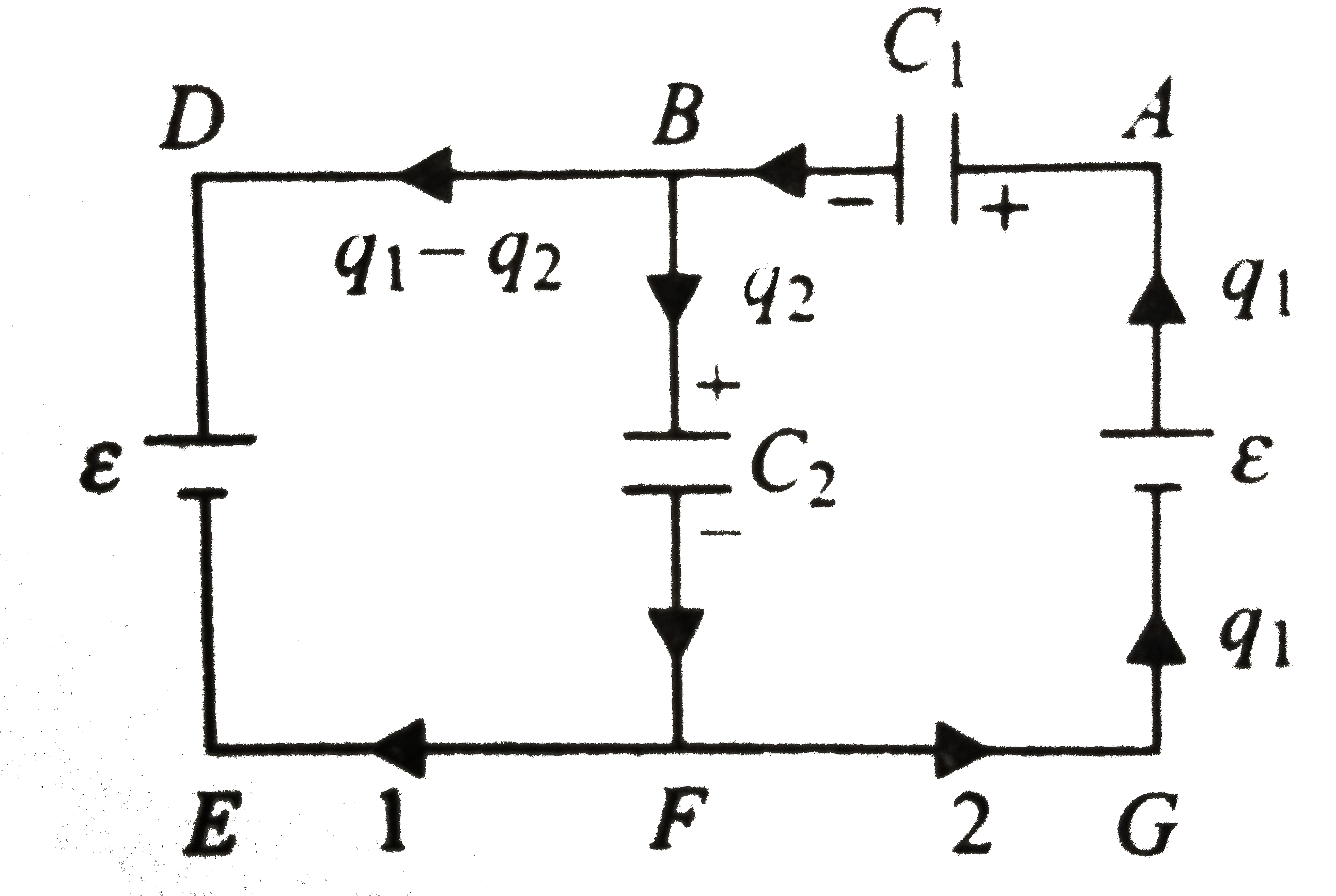 Charge on capacitors `C_(1)` and `C_(2)` before closing the switch S is `q_(0)=((C_(1)C_(2))/(C_(1)+C_(2)))epsilon` After closing S, charge in `C_(2)` (FINAL charge) is `q_(2)=C_(2)epsilon` In loop `ABBDEFGA,epsilon=0` or `q_(1)=0` ltbr. final charge on `C_(1),q_(1)=0` to make final charge in `C_(1)` the charge HENCE charge flown TOWARDS direction 2 is `triangle q_(2)=-((C_(1)C_(2))/(C_(1)+C_(2)))epsilon` To make charge on capacitor `C_(2)` to final VALUE `q_(2)` the charge flow into capacitor is `TRIANGLEQ=C_(2)epsilon-(C_(1)C_(2))/(C_(1)+C_(2))epsilong=C_(2)epsilon[1-(C_(1))/(C_(1)+C_(2))]` `triangleq_(B)=(C_(2)^(2)epsilon)/(C_(1)+C_(2))` ltbr. at junction F, `triangleq_(1)=triangleq-triangleq_(2)=(C_(2)epsilon)/(C_(1)+C_(2))[C_(2)+C_(1)]=C_(2)epsilon` Alternative method: fig in loop `ABDEG,-((q_(0)+triangleq_(1)))/(C_(1))-epsilon+epsilon=0` or `triangleq_(1)=-q_(0)=-(C_(1)C_(2)epsilon)/(C_(1)+C_(2))` in loop BFEDB, `-((q_(0)+triangleq_(1)))/(C_(2))+epsilon=0` or `triangleq=C_(2)epsilon-q_(0)` At junction F `triangleq_(2)=triangleq_(1)-triangle_(q)=-q_(0)-(C_(2)epsilon-q_(0))=-C_(2)epsilon` Hence charge flow in the direction of `(1) is -(C_(1)C_(2)epsilon)/(C_(1)+C_(2))` (2). is `C_(2)epsilon` |
|
| 29. |
Which of the following wave can not be produced by charges accelerating in AC circuits having an inductor and capacitor? |
|
Answer» RADIO wave |
|
| 30. |
Image produced by a simple microscope is seen at a distance of _____ vision. |
| Answer» SOLUTION :DISTINCT | |
| 31. |
In the circuit shown in figure initially the switch is opened. The switch is closed now. The charge that will flow in direction 1 is |
|
Answer» `-(C_(2)^(2)epsilon)/(C_1 + C_2)` 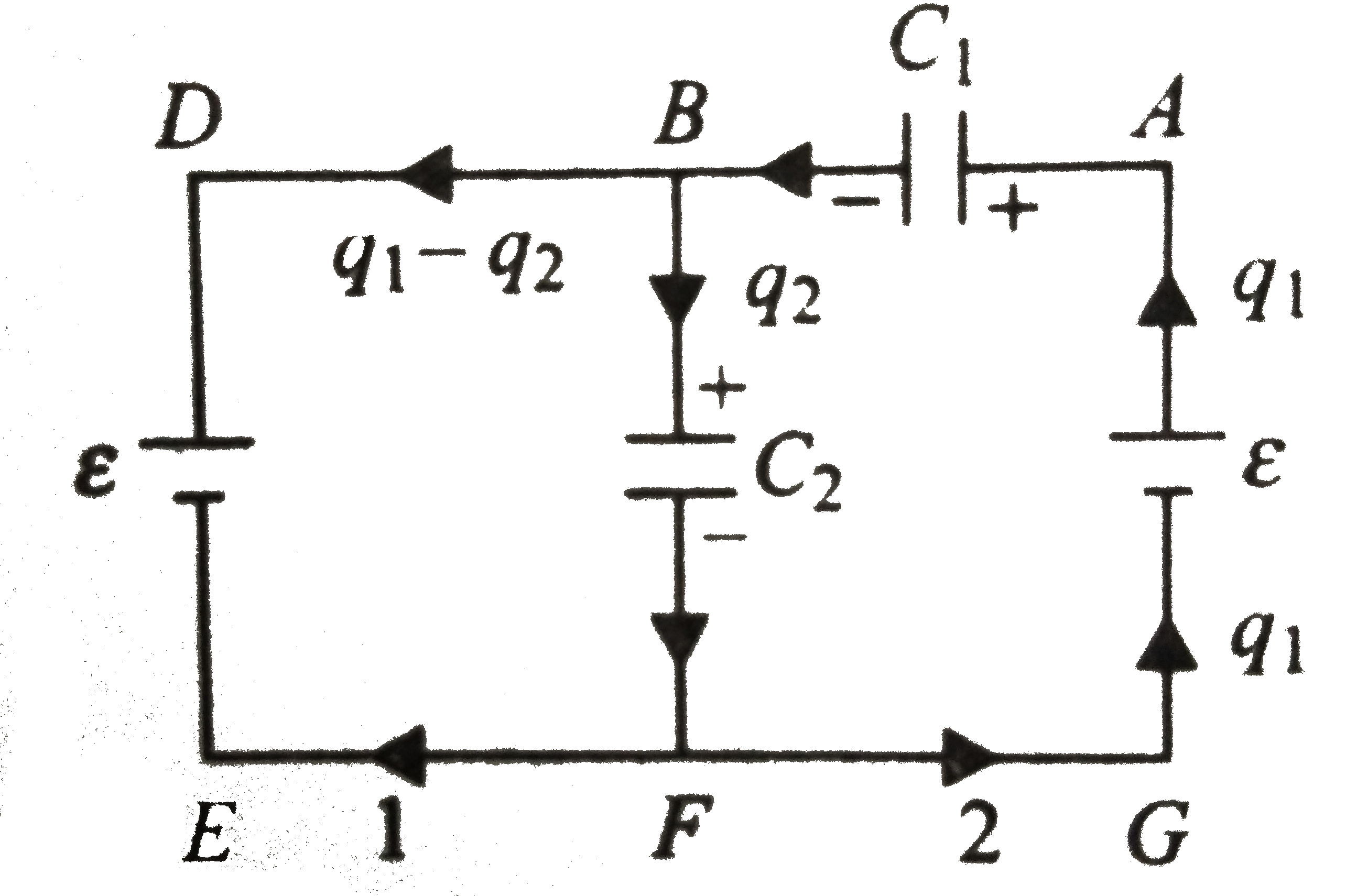 Charge on capacitors `C_(1)` and `C_(2)` before closing the SWITCH S is `q_(0)=((C_(1)C_(2))/(C_(1)+C_(2)))epsilon` After closing S, charge in `C_(2)` (final charge) is `q_(2)=C_(2)epsilon` In loop `ABBDEFGA,epsilon=0` or `q_(1)=0` ltbr. final charge on `C_(1),q_(1)=0` to make final charge in `C_(1)` the charge hence charge flown towards direction 2 is `triangleq_(2)=-((C_(1)C_(2))/(C_(1)+C_(2)))epsilon` To make charge on capacitor `C_(2)` to final VALUE `q_(2)` the charge flow into capacitor is `triangleq=C_(2)epsilon-(C_(1)C_(2))/(C_(1)+C_(2))epsilong=C_(2)epsilon[1-(C_(1))/(C_(1)+C_(2))]` `triangleq_(B)=(C_(2)^(2)epsilon)/(C_(1)+C_(2))` ltbr. at junction F, `triangleq_(1)=triangleq-triangleq_(2)=(C_(2)epsilon)/(C_(1)+C_(2))[C_(2)+C_(1)]=C_(2)epsilon` Alternative method: fig in loop `ABDEG,-((q_(0)+triangleq_(1)))/(C_(1))-epsilon+epsilon=0` or `tringleq_(1)=-q_(0)=-(C_(1)C_(2)epsilon)/(C_(1)+C_(2))` in loop BFEDB, `-((q_(0)+triangleq_(1)))/(C_(2))+epsilon=0` or `triangleq=C_(2)epsilon-q_(0)` At junction F `triangleq_(2)=triangleq_(1)-triangle_(Q)=-q_(0)-(C_(2)epsilon-q_(0))=-C_(2)epsilon` Hence charge flow in the direction of `(1) is -(C_(1)C_(2)epsilon)/(C_(1)+C_(2))` (2). is `C_(2)epsilon` |
|
| 32. |
(a) State Gauss's law for magnetism. Explain its significance. (b) Write the four important properties of the magnetic field lines due to a bar magnet. |
|
Answer» Solution :(a) Gauss's law in magnetism : SURFACE integral of magnetic field for any closed gaussian surface is always zero. `underset(s)(oint)vec(B).vec(ds)=0` Properties of the magnetic field lines DUE to a bar magnet (i) Magnetic field lines never intersect each other. (ii) They flow from south pole to the north pole inside the bar magnet and north pole to the south pole outside the bar magnet. (iii) Magnetic field lines always make a closed continuous LOOPS. (iv) The magnetic field lines are crowded near the pole where the fields is strong and FAR from the magnet they are not crowded as magnetic field is weak. |
|
| 33. |
The two lenses of an achromatic doublet should hav |
|
Answer» Equal powers |
|
| 34. |
Two chargesq_1 and q_2separated by a distance 'r' in air exert a force F on one another. If a copper plate of thickness ®/(2)is placed between the charges , the effective force will be: |
| Answer» Answer :D | |
| 35. |
Two protons of equal kinetic energies enter a region of uniform magnetic field . The first proton enters normal to the field direction while the second enters at 30^(@) to the field direction . Name the trajectories followed by them. |
| Answer» Solution :Trajectory for FIRST PROTON will be circular . Trajectoryfor the second proton will be HELICAL | |
| 36. |
Find moment of inertia of a uniform solid sphere (mass m, radius r) about a tangent. |
| Answer» SOLUTION :`(7//5)MR^(2)` | |
| 37. |
The dispersive power is maximum for the material |
|
Answer» FLINT glass |
|
| 38. |
Find mutual inductance of two coaxial solenoids of equal length 30 cm with inner one surrounded by bigger one. Their area of cross section are 20 "cm"^2 and 40 "cm"^2. They have windings of 40 turn/cm and 10 turn/cm. |
|
Answer» 10 H Now, mutual inductance of given SYSTEM is given by : `M=(mu_0N_1N_2a)/L` where a=area of cross -SECTION of smaller solenoid. `therefore M=((4pixx10^(-7))(1200)(300)(20xx10^(-4)))/(30xx10^(-2))` `therefore M=3.0144xx10^(-3)` H `therefore` M=3.0144 mH `approx` 3mH |
|
| 39. |
Explain paramagnetism and paramagnetic substance. |
|
Answer» Solution :Paramagnetic substances are those which GET weakly magnetised when placed in an external magnetic field. They have tendency to move from a region of weak magnetic field to strong magnetic field, means they get weakly attracted to a magnet. The individual atoms (or ions or molecules) of a paramagnetic material posse a permanent magnetic dipole moment of their own. On account of the ceaseless random thermal motion of the atoms no net magnetisation is seen.  In the presence of an external field, the dipole moment of paramagnetic substance can be made to align in the same direction as field. The value of `chi` for these substance is positive. If a paramagnetic material placed in an external field, the field line gets concentrated inside the material and the field inside is enhanced. This enhancement is slight, being one PART in `10^(5)`. When the bar of the substance placed in a nonuniform magnetic field, the bar will tend to move from weak field to strong. Some paramagnetic materials are aluminium, sodium, calcium, OXYGEN (at STP) and copper CHLORIDE. |
|
| 40. |
An EM wave radiates outwards from a dipole antenna, with Eo as the amplitude of its electric field vector. The electric field EG which transports significant energy from the source falls off as |
|
Answer» `(1)/(R^(3))` |
|
| 41. |
Is it necessary for a tansmitting antenna to be at the same height as that of the receiving antenna for line-of-sight communication? A TV transmitting antenna is 81 m tall. How much service area can it cover if the receiving antenna is at the ground level? |
|
Answer» SOLUTION :It is not necessary for the TWO ANTENNAS to be of same height. Required area =`pi d^(2) = pi (sqrt(2 xx h xx R))^(2)` ` = (22)/(7) xx 2XX 81 xx 6.4 xx 10^(6) = 3258" "km^(2)` |
|
| 42. |
What is the de-Broglie-wavelength of the electron accelerated through a potential difference of 100 V ? |
|
Answer» `12.27Å` `LAMBDA=(h)/(mv)=(h)/(sqrt(2meV))=(12.27)/(sqrt(V))Å` (h=Plank.s constant) where m=mass of electron E= electronic CHARGE and V= potential difference with which electron is accelerated. `lambda=(12.27)/(sqrt(100))Å=(12.27)/(10)Å` `=1.227Å` |
|
| 43. |
At a certain place, the angle of dip is tan^(-1)(4//5) and angle of declination is 37^(@) The earth's magnetic field has a horizontal component of 0.1 T at that point. A square coil of side 2m is kept in a vertical plane such that its normal points in the true north direction. If the coil is made of 4 rods each of mass 3 kg and the coil is free to rotate about any axis. If the angular acceleration (in rad //s^(2)) of the coil is kxx10^(-2) when a current of 1A passes through it. Find the value of k. |
|
Answer» `B_(HN)=0.1sin37^(@)=(4//50)T` `B_(HE)=0.1sin37^(@)=(3//50)T` tau on the COIL due to component of B in N DIRECTION =0 `|VEC(tau)|=|vec(M)xxvec(B)|=1xx2^(2)xx0.1=0.4` Nm `B_(res)=sqrt((3/50)^(2)+(4/50)^(2)=5/50 = 0.1` T `vec(tau)` has direction as shown In its plane, I can be found by `bot` axis theorem `(3xx2^(2)/12+3xx1^(2))xx4=I_(1)=2I` `I=8 kg m^(2)` `alpha=tau/I=(0.4)/8=0.05rad//s^(2)` 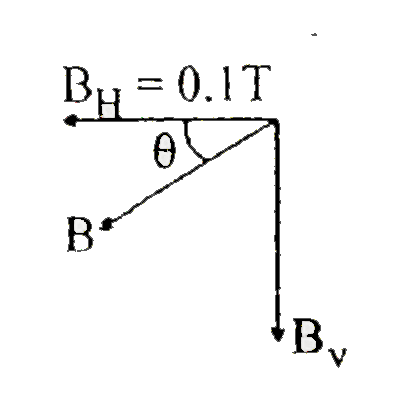 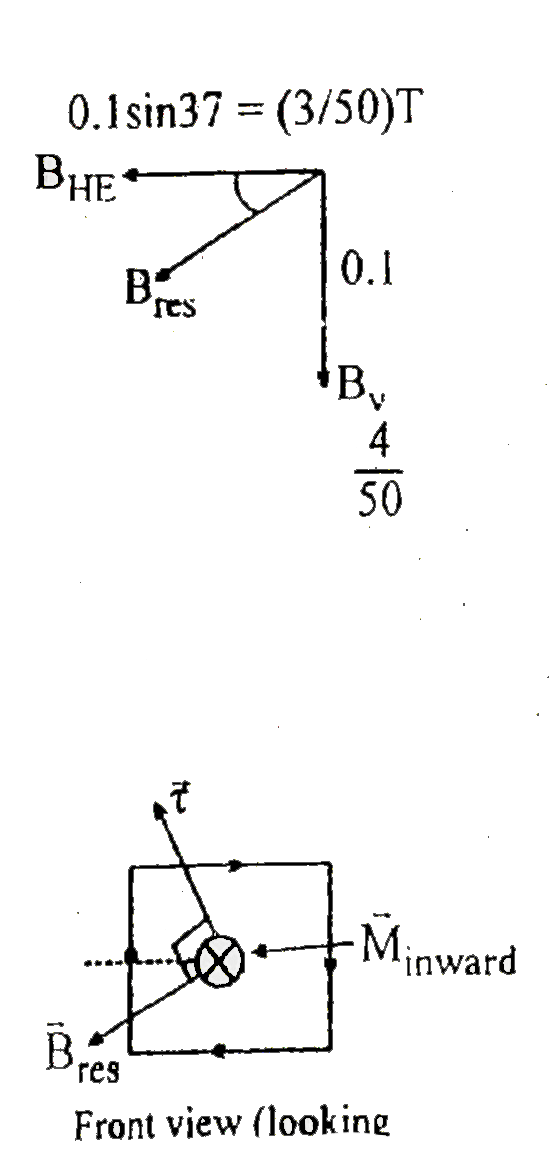
|
|
| 44. |
A 7.00-grain aspirin tablent has a mass of 448 mg. For how many kilometers would the energy equivalent of this mass power an automogbile? Assume 12.75 km/L and heat of combustion of 3.65xx10^(7)J//L for the gasoline usedin the automobile. |
|
Answer» |
|
| 45. |
A stationary charges produce an electrostatic field as wlell as a gravitational field but does not produce a magnitude field. |
| Answer» SOLUTION :TRUE -Only amoving CHARGES PRODUCES a magnitic FIELD. | |
| 46. |
A thin film of specific material can be used to decrease the intensity of reflected light.There is destructive interference fo waves from uppe rand lower surface of the fil,m.These films are called non-reflecting coatings.The process of coating the lens of or surface with non-reflectig film is called bloomingas shown in fig. Magnesium fluoride(MgF_(2)) is genertally used as anti-reflectioncoating.If refrative index of MgF_(2) is 1.35 then minimum thickness of film required is (Take lambda=550nm) |
|
Answer» `112.4mm` |
|
| 47. |
A thin film of specific material can be used to decrease the intensity of reflected light.There is destructive interference fo waves from uppe rand lower surface of the fil,m.These films are called non-reflecting coatings.The process of coating the lens of or surface with non-reflectig film is called bloomingas shown in fig. Choose the correct statements |
|
Answer» Both `1` and `2` SUFFER CHANGE of `PI` upon relfection |
|
| 48. |
A conducting sphere of radius 10 cm has an unknown charge. If the electric field 20cm from the centre of the sphere is 1.5 xx 10^(3)N//C and points radially inward, what is the net charge on the sphere? |
|
Answer» Solution :`R=10 cm =10 xx 10^(-2) m, r=20 cm=20 xx 10^(-2)m, E=1.5 xx 10^(3) NC^(-1)` `F_(1)=9 xx 10^(9) Q/r^(2), q=(ER^(2))/(9 xx 10^(9)) =(1.5 xx 10^(3) xx (20 xx 10^(-2))^(2))/(9 xx 10^(9)) =6.67nC` Charge q=-6.67 nC (since electric field is directed inward) |
|
| 49. |
In Fig. a spring of spring constant 3.75 xx 10^(4) N/m Container is between a rigid beam Spring and the output piston of a hydraulic lever. An empty container with negligible mass sits on the input piston. The input piston has area A_(i) and the output piston has area 18.0A_(i) Initially the spring is at its rest length. How many kilograms of sand must be (slowly) poured into the container to compress the spring by 5.00 cm? |
| Answer» SOLUTION :10.6 KG | |
| 50. |
In a Young's double slit experiment, the separation between the slits is 0.15 mm. In the experiment, a source of light of wavelength 589 nm is used and the interference pattern is observed on a screen kept 1.5 m away. The separation between the successive bright fringes on the screen is |
|
Answer» `5.9` mm `BARX=(lambdaD)/(d)` `=(589x10^(-9)xx1.5)/(1.5xx10^(-4)m)` `=589xx10^(-5)m` `=5.89xx10^(-3)m` `=5.9 mm` |
|