

Saved Bookmarks
This section includes 7 InterviewSolutions, each offering curated multiple-choice questions to sharpen your Current Affairs knowledge and support exam preparation. Choose a topic below to get started.
| 1. |
A long current wire is bent in the shapes shown in figure. The circular portion has radius R. The magnetic induction at the center of the circular segment is |
|
Answer» `-(mu_(0)I)/(4piR)[2hat(k)p+pihat(i)],-(mu_(0)I)/(4piR)[hat(k)+(PI+1)hat(i)],-(mu_(0)I)/(4piR)[hat(k)+hat(j)+(3pi)/(2)hat(i)]`  Magnetic field due to segment ,`AB,` `overset(rarr)(B_(1))=(mu_(0)I)/(4piR)(-hat(k))` Magnetic field due to circular segment `BCD`, `overset(rarr)(B_(2))=(mu_(0)I)/(2R)xx((pi)/(2pi))(-hat(i))` Magnetic field due to segment `DE`, `overset(rarr)(B_(3))=(mu_(0)I)/(4piR)(-hat(k))` Resultant magnetic field, `vec(B_(3))=vec(B_(1))+vec(B_(2))+vec(B_(3))""=-(mu_(0)I)/(4piR)[2hat(k)+pihat(j)]` `(b)` Magnetic field due to segment `AB`, `vec(B_(1))=(mu_(0)I)/(4piR)(-hat(k))` Magnetic field due to circular segment BCD, `vec(B_(2))=(mu_(0)I)/(2R)((pi)/(2pi))(-hat(i))` Magnetic field due to segment DE, `vec(B_(3))=(mu_(0)I)/(4pir)(-hat(k))` Resultant magnetic field `vec(B_(R))=vec(B_(1))+vec(B_(2))+vec(B_(3))=-(mu_(0)I)/(4piR)[hat(k)+(pi+1)hat(i)]` `(c)` Magnetic field due to segment AB, `vec(B_(1))=(mu_(0)I)/(4piR)(-hat(k))` Magneticfield due to circular segment BCDE, `vec(B_(2))=(mu_(0)I)/(2R)xx((3pi//2)/(2pi))(-hat(i))` Magnetic field due to segment EF, `vec(B_(3))=(mu_(0)I)/(4piR)xx(-hat(j))` Resultant magnetic field. `vec(B_(R))=vec(B_(1))+vec(B_(2))+vec(B_(3))=-(mu_(0)I)/(4piR)[hat(k)+hat(j)+(3pi)/(2)hat(i)]` |
|
| 2. |
A laser beam is used for carrying out surgery, because it |
|
Answer» is highly monochromatic |
|
| 3. |
Drawa schematicraydiagram of reflectingtelescopeshowinghow rayscomingfrom adistantobjectare receivedat the eye -piece . Writeits twoimportantadvantage overa refractingtelescope. |
|
Answer» Solution :Advantages: (i) No chromatic aberration. (ii) Easy mechanical SUPPORT (hight mechanical support is required, because mirror WEIGHTS much less than a lens of equivalent optical quality.) (iii) Large gathering POWER. (iv) Large magnifying power. (v) Large resolving power. (iv) SPHERICAL aberration is ALSO removed by using parabolic mirror. |
|
| 4. |
The danger signal of light is red, because red colour is least ....... |
|
Answer» REFLECTED |
|
| 5. |
A plane polarized light is incident on an analyser and when it is rotated to complete one rotation, one observes |
|
Answer» ONE extinction and two brightnesses |
|
| 6. |
Holes are charge carrier in |
|
Answer» INTRINSIC semiconductors (B) In p-type semiconductor, `n_h` GTGT `n_e` |
|
| 7. |
Two Indenical bodies are allowed to fall from different heights h_1 and h_2. The ratio of their momentum when they reach the ground is |
|
Answer» |
|
| 8. |
Redraw the diagram given below and mark the position of the centre of curvature of the spherical mirror used in the given set up. |
Answer» SOLUTION :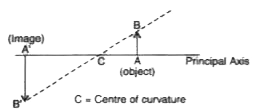
|
|
| 9. |
A plane electromagnetic wave travels in vacuum along sz - direction. What can you say about the direction of its electric and magnetic field vectors? If the frequency of the wave is 30 MHz, what is its waelength? |
|
Answer» Solution :As electromagnetic waves are transverse in nature, electromagnetic oscillations MUST be in X-y plane in a direction perpendicular to the direction of propagation of WAVE. In fact, vibrations of electric vector `vecE` take place along x - direction and that of magnetic vector `vecB` along y - direction. Here, frequency `v=30 MHz=30xx10^(6)Hz` `therefore"Wavelength "LAMBDA=(C)/(v)=(3xx10^(8))/(30xx10^(6))=10m.` |
|
| 10. |
Polarisation phenomenon is exhibited by ____waves only. |
| Answer» SOLUTION :TRANSVERSE. | |
| 11. |
Find the energy of an electron fo a hydrogenatom in a stationary state for which the wave function takes the from Psi(r )=A(1+ar)e^(-alpha r), where A, a and alpha are constant. |
|
Answer» Solution :The Schrodinger equation for the problem in Gaussian units `grad^(2)Psi+(2m)/(ħ^(2))[E+(e^(2))/(r )]Psi=0` In `MKS` units we should read `(e^(2)//4pi epsilon_(0))` for `e^(2)` we put `Psi=(chi(r ))/(r ).` Then `chi''+(2m)/(ħ^(2))[E+(e^(2))/(r )]xho=0` ....(1) We are given that `chi=rPsi=Ar(1+ar)e^(-ar)` so `chi'=A(1+2ar)e^(-ar)-alphaAr(1+ar)e^(-ar)` `chi''=alpha^(2)Ar(1+ar)e^(-ar)-2alphaA(1+2ar)+2aAe^(-ar)` Substituting in (1) GIVES the condition `alpha^(2)(r+ar^(2))=2alpha(1+2ar)+2a+(2m)/(ħ^(2))=0`....(2) `a alpha^(2)+(2m)/(ħ^(2))Ea=0`....(3) `a^(2)-4a alpha+(2m)/(ħ^(2))(E+e^(2)a)=0` (4) From (3) either `a=0`, In the first case `alpha=(me^(2))/(ħ^(2))=-(ħ^(2))/(2m)alpha^(2)=-(me^(4))/(2ħ^(2))` This state is the GROUND state. `a=alpha-(me^(4))/(8ħ^(2))` and `a= -(1)/(2)(me^(2))/(ħ^(2))` This state is one with `n=2(2s)`. |
|
| 12. |
An accelerated electron would produce |
| Answer» Answer :D | |
| 13. |
Choose the correct statement regarding X-ray . |
|
Answer» The wavelength of X-rays is of the order of 1 Å |
|
| 14. |
Give the uses of Foucault current. |
|
Answer» Solution :Though the production of eddy current is undesirable in some cases, it is useful in some other cases. A few of them are Induction stove: Induction stove is used to cook the food quickly and safely with less energy consumption. Below the cooking zone, there is a tightly wound coil of insulated wire. The cooking pan made of suitable material, is placed over the cooking zone. When the stove is switched on, an alternating current flowing in the coil produces high frequency alternating magnetic field which induces very strong eddy currents in the cooking pan. The eddy currents in the pan PRODUCE so much of heat due to Joule heating which is used to cook the food. (ii) Eddy current brake: This eddy current braking system is generally used in high speed trains and roller coasters. Strong electromagnets are fixed just above the rails. To stop the train, electromagnets are switched on. The magnetic field of these magnets induces eddy currents in the rails which oppose or resist the movement of the train. This is Eddy current linear brake. In some cases, the circular disc, connected to the wheel of the train through a common shaft, is made to rotate in between the poles of an electromagnet. When there is a relative motion between the disc and the magnet, eddy currents are induced in the disc which stopthe train.This is Eddy current circular brake. (iii) Eddy current testing: It is one of the simple non-destructive testing methods to FIND defects like surface cracks and air bubbles present in a specimen. A coil of insulated wire is given an alternating electric current so that it produces an alternating magnetic field. When this coil is brought near the test surface, eddy current is induced in the test surface. The presence of defects causes the change in PHASE and amplitude of the eddy current that can be detected by some other means. In this way, the defects present in the specimen are identified. (iv) Electro magnetic damping: The armature of the galvanometer coil is wound on a SOFT IRON cylinder. Once the armature is deflected, the relative motion between the soft iron cylinder and the radial magnetic field induces eddy current in the cylinder. The damping force due to the flow of eddy current brings the armature to rest immediately and then galvanometer shows a steady deflection. This is called electromagnetic damping. |
|
| 15. |
A rod of rest length L moves at a relativistic speed. Let L' = L / gamma . Its length |
|
Answer» must be EQUAL to L' |
|
| 16. |
Three cells of emf 16V, 2V and 3V and internal resistance 2Omega, 1Omegaand 1//2Omega respectively are connected with an unknown resistance R as shown in the figure. What is the value of R such that power developed through R is maximum in steady state condition? |
|
Answer» `1//2OMEGA` |
|
| 17. |
At y=1 cm, y = 3 cm y = 9 cm, y = 27 cm ... and so on, an infinite number of charges equal to 5C are placed. At x = 1 cm, x=2 cm, x=4 cm, X = 8 cm.... and so on, an infinite number of charges equal to -5C are placed. Find the electric potential at origin in volts. (K=(1)/( 4 pi epsi_0)) |
| Answer» Answer :B | |
| 18. |
The upper half of an inclined plane with an angle of inclination 4, is smooth while the lower half is rough. A body starting from rest at the top of the inclined plane comes to rest at the bottom of the inclined plane. Then the coefficient of friction for the lower half is |
|
Answer» `mu = 2 TAN theta` |
|
| 19. |
Two H atoms in the ground collide inelastically. The maximum amount by which their combined kinetic energy is reduced is |
|
Answer» 10.20 EV |
|
| 20. |
We know that electric current flows through a conductor only when some electric field is applied across it. This electric field applied constant force on electrons. But the motion of electrons is not accelerated . Why ? |
| Answer» Solution :Free electrons donot get a free straight path HO acceleates. So when electric field is applied to ametallic conductor then electrons move and then very soon collide with the metal ions LOSS energy. Due to several OBSTRUCTIONS in the path of electrons, electric field is not able to accelerate them continuosly . Rather electrons develop one CONSTANT average VELOCITY known as drift velocity. The moment applied potential difference is zero, electric current instantly becomes zero. a resistor continuously requires energy to maintain current through it. | |
| 21. |
A light bulb is rated at 100W for a 220 V supply. Find The resistance of the bulb, |
|
Answer» SOLUTION :We are given P = 100 W and V = 220 V. The resistance of the BULB is `R = (V^(2))/(P)=((220V)^(2))/(100 W)=484 OMEGA` |
|
| 22. |
The range of the projectile for a given initial velocity of projection is minimum, if the angle of projection is : |
|
Answer» 0 |
|
| 23. |
A man of mass M standing at a height hfrom the floor in a gravity free space throws a ball of mass m straight down with a speed u. When the ball reaches the floor, find the distance of the man above the floor. |
|
Answer» Solution :When the man throws the ball with VELOCITY u, he recoils with velocity V. `MU=MV`  `V=(mu)/M` Time taken by the ball to REACH the ground `t=h/u` Distance moved by man in this time `t=v.t =(mu)/M. h/u =m/M.h` HEIGHT of man at the time the ball strikes the ground is `H =h +m/M h, H=h (1+m/M)` |
|
| 24. |
(a) Derive the law of radioavtive decay, viz. N=N_(0)e^(-lambda t) (b) Explain, giving necessary reactions, how energy is released during (i) fission and (ii) fusion. |
|
Answer» Solution :(a) The following laws, known as the laws of radioactive DECAY: (1) It is a spontaneous phenomenon and one cannot PREDICT, when a particular atom will undergo disintergration. ACCORDING to radioactive decay law, `(dN)/(dt)propN ""(dN)/(dt)=lambdaN`.....(i) From the equation (i) `(dN)/(dt)= -lambdadt` Intergrating, we have `int (dN)/(N)= -lambdaint dt` or `Log_(e )N= -lambdat+K`, ......(ii) Where `K` is constant of intergration, when `t=0, N=N_(0)` On Setting `t=0` and `N=N_(0)` the equation (ii) `log_(e ) N_(0)= -lambdaxx0+k` `k=log_(e )N_(0)` Substituting for `K` in the equation (ii) `log_(e )N= -lambdat+log_(e )N_(0)` `"log"_(e )(N)/(N_(0))-lambda t , (N)/(N_(0))-e^(-lambdat)` `N=N_(0)e^(-lambda t)` (b) (i) The fission reaction of `._(92)uu^(325)` may be represented as given below: `{:(._(92).^(235),._(0)n^(1),[._(92).^(236)],),(._(56)Ba^(141),._(36)Kr^(92),3_(0)n^(1),Q):}` The energy `(Q)` released was estimated to be `200 MeV` per fission (or about `0.9 MeV` per nucleon) and is equivalent to the diffecence in MASSES of the nuclei before and after the fission. (ii) When two or more than two light nuclei fuse together to form harry nucleus wiht the liberation of energy, the releasing `24 MeV` of energy. The fusion reaction may be expressed as follow: ` H^(2)+_(1)H^(2)rarr_(2)H^(4)e+24MeV` The above nuclear fusion reaction is energetically possible, only if the mass of the `_(2)H^(4)e` nucleus is less than the sum of the massess of wo deuteron nuclei. |
|
| 25. |
One of the most dramatic videos on the web (but entirely fictitious) supposedly shows a man sliding along a long water slide and then being launched into the air to land in a water pool. Let's attach some reasonable numbers to such a flight to calculate the velocity with which the man would have hit the water. Figure a indicates the launch and landing sites and includes a superimposed coordinate system with its origin conveniently located at the launch site. From the video we take the horizontal flight distance as D = 20.0 m, the flight time as t = 2.50 s, and the launch angle astheta_0 = 40.0^@ . Find the magnitude of the velocity at launch and at landing. |
|
Answer» SOLUTION : (1) For projectile motion, we can apply the equations for constant acceleration along the HORIZONTAL and vertical axes separately. (2) THROUGHOUT the flight, the Vertical acceleration is `a_y = -g = -9.8 m//s^2` and the horizontal acceleration is `a_x` = 0. In most projectile problems, the initial challenge is to figure out where to start. There is nothing wrong with trying out various equations, to see if we can somehow get to the velocities. But here is a clue. Because we are going to apply the constant acceleration equations separately to the x and y motions, we should find the horizontal and vertical components of the velocities at launch and at landing. For each site, we can then combine the velocity components to get the velocity. Because we know the horizontal displacement D=20.0 m, let.s start with the horizontal motion. Since `a_x` = 0, we know that the horizontal velocity component`v_x`is constant during the flight and thus is always equal to the horizontal component `v_0` , at launch . we can relate that component , the displacement `x - x_0` and the flight time t = 2.50 s with eq. ` x - x_0 = v_0 t + 1/2 at^2` substituting `a_x = 0`, this becomes eq. with `x - x_0 = D` we the write ` 20 m = v_0 (2.0 s) + 1/2 (0)(2.50s)^2` `v_(0x) = 8.00 m///s` That is a component of the launch velocity , but we need the magnitude of the full vector , where the component form the legs of a right triangle and the vector forms the hypotenuse . we can them apply a trig DEFINITION to find themagnitude of the full velocity at launch : `cos theta_0= (v_(0x))/(v_0)` `v_0 = (v_(0x) )/(cos theta_0) = (8.00 m//s)/(cos 40^@)` ` = 10.44 m//s ~~ 10.4 m//s |
|
| 26. |
A circuits contains a capacitor and inductance each with negligible resistance. The capacitor is initially charged and the charging battery is disconnected. At subsequent time , the charge on the capacitor will |
|
Answer» INCREASE exponentially |
|
| 27. |
What is the number of atoms in an elementary cell of a face-centered cubic lattice? |
Answer» 
|
|
| 28. |
In case of a projectile if the maximum height reached is 1/4th the horizontal range, the angle of projectionis |
|
Answer» `60^@` |
|
| 29. |
NaCI में किस प्रकार का बिंदु दोष पाया जाता है |
|
Answer» फ्रेन्केल दोष |
|
| 30. |
A pointobject is placedon the principleaxisat 60cmin forntof a concavemirror of focal length40cm on the principleaxis. If the objectis movedwith a velocityof image (b) perpendicularaxis, find thevelocity of image at theat moment. |
|
Answer» |
|
| 31. |
What is the difference between an electromagnet and a permanent magnet ? How is an electromagnet designed ? State any two factors on which the strength of an electromagnet depends. |
Answer» Solution :An efficient way to make a magnet is to place a ferromagnetic rod in a solenoid and pass a CURRENT in it. The MAGNETIC field of the solenoid magnetises the ferromagnetic rod. An electromagnet is that which behaves as a magnet so long as current is being passed through the solenoid coil. As soon as current flow is STOPPED, an electromagnet loses its magnetisation. On the other hand, a permanent magnet, once magnetised by passing an electric current through solenoid coil, retains its magnetic behaviour for a long time at room temperature . 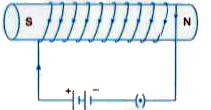 To design an electromagnet we take a soft iron and place it in a solenoid and pass a current . As relative permeability of soft iron is extremely hihg, the presence of soft iron core increases the magnetic field of solenoid coil by a thousand fold. When we switch off the solenoid current, the magnetism is effectively SWITCHED off because the soft iron core has a low retentivity. Strength of an electromagnet depends on (i) the number of turns per unit length in soleniod coil and current flowing through it, (ii) magnetic permeability of soft iron core. |
|
| 32. |
Due to the presence of the current I_(1) at the origin |
|
Answer» The forces on AB and DC are zero. |
|
| 33. |
In certain ac circuits, no power is developed even though current flows through it. Identify such a circuit from the following |
|
Answer» PURELY INDUCTIVE CIRCUIT |
|
| 34. |
A transistor is used in common emitter configuration. If alpha=.9. then the change in the collector current when the base current changes by1muA is |
|
Answer» `3muA` |
|
| 35. |
Taking the value of atomic masses from the tables, calculate the kinetic energies of a positron and a neutrino emitted by c^(11) nucleus for the case when the daughter nucleus does not recoil. |
|
Answer» Solution :We assume that the parent nucleus is at rest. Then since the daughter nucleus does not RECOIL, we have `vec(P)= -vec(P)_(v)` i.e., positron & `v` momentum are EQUAL and opposite. On the other hand `sqrt(C^(2)p^(2)+m_(e )^(2)c^(4))+cp=Q=` TOTAL energy released. (Here we have used the fact that energy of the neutrino is `|vec(P)_(v)|=cp`) Now `Q=[ ("MASS of "C^(||)"nucleus")-("Mass of "B^(||)"nucleus")]c^(2)` `=["Mass of " C^(||)"atom-Mass of " B^(||)"atom"-m_(e )]c^(2)` `=0.00213 am uxxc^(2)-m_(e )c^(2)` `=(0.00213xx931-0.511)MeV= 1.47MeV` Then `c^(2)p^(2)+(0.511)^(2)=(1.470cp)^(2)=(1.47)^(2)-(1.47)^(2)-2.94cp+c^(2)p^(2)` Thus `cp= 0.646 MeV=` energy of neutrino Also `K.E`. of electron `=1.47-0.646-0.511= 0.313MeV` |
|
| 36. |
In amplitude modulated wave, if l_l is r.m.s value of total modulated current and l_c is the r.m.s value of unmodulated carrier current, then l_c and l_l are related as (mu→modulation index) |
|
Answer» `l_c/l_l=(1+mu^2/2)^12` |
|
| 37. |
Number of significant figures in 6.45372 |
|
Answer» 4 |
|
| 38. |
In given circuit when switch S has been closed, then charge on capacitor A and B respectively |
|
Answer» `3q,6q` |
|
| 39. |
In Fig 32-24 a beam of light with intensity 43 W//m^(2) and polarization parallel to a y axis is sent into a system of two polarizing sheets with polarizing directions at angles of theta_(1)= 70^(@) and theta_(2)=90^(@) to the y axis . (a) What is the intensity of the light transmitted by the two sheet system ? (b) What is the transmitted intensity if instead the initial polarization is parallel top the x axis ? |
| Answer» SOLUTION :`(a) 4.4 W//m^(2), (B) 34 W//m^(2)` | |
| 40. |
A particle leaves the origin with an intital velocity hatv=(3.00hati) m/s and a constant acceleration when the particle reaches its maximum x coordinate ,What are (a) its velocity and (b)its position vector? |
| Answer» SOLUTION :(1.5 `HATJ` m/s, (B)4.5 H `HATI` -2.25 `hatj`)m) | |
| 41. |
In a step-down transformer the input voltage is 22 kV and the output voltage is 550 V. The ratio of the number of turns in the secondary to that in the primary is |
|
Answer» `1:20` |
|
| 42. |
As shown in the figure a vibrating tunning fork of frequency 512 Hz is moving towards the wall with a speed 2m/s. Take speed ofsound v= 340 m/s and answer the following questions. If the listener, along with the source, is moving towards the wall with the same spaed i e , 2 m/s. such that between the source and the wait, number of beats heard by him will be: |
|
Answer» 2 |
|
| 43. |
As shown in the figure a vibrating tunning fork of frequency 512 Hz is moving towards the wall with a speed 2m/s. Take speed ofsound v= 340 m/s and answer the following questions. Suppose that a listner is located at rest between the tuning fork and the wall, Number of beats heard by the listener per sec will be |
|
Answer» 4 |
|
| 44. |
As shown in the figure a vibrating tunning fork of frequency 512 Hz is moving towards the wall with a speed 2m/s. Take speed ofsound v= 340 m/s and answer the following questions. If the listener, along with the source, is moving towards the wall with the same speed, i.e., 2 m/s, such that the source remains between the listener and the wall, number of beats heard by The listener per sec will be |
|
Answer» 3 |
|
| 45. |
A rayof lightis incident onthesurfaceof a glassplateof refractiveindex sqrt(3) at thepolarisingangle . The angleof refractionoftheray is |
|
Answer» `60^(@), 30^(@)` |
|
| 47. |
Find the energy equivalent of the mass of an electron . Given mass of electron =9xx10^(-31) kg. |
|
Answer» `81 xx10^(-16) J` |
|
| 48. |
An astronomical refractive telescope has an objective of focal length 20 m and an eyepiece of focal length 2 cm. |
|
Answer» The length of the telescope tube is 20.02m. `f_0 + f_e = 20 + (0.02) = 20.02 m` Hence option (A) is correct. Magnification OBTAINED by telescope, `m=(f_0)/(f_e)=(20)/(0.02)=1000` Hence option (B) is ALSO correct. In case of telescope, final image is inverted w.r object. Hence option (C) is also correct. |
|
| 49. |
मानव युग्मकों में मौजूद गुणसूत्रों की संख्या क्या है |
|
Answer» 21 |
|
| 50. |
A convex lens has different media on its two sides. Its first focal length is 10 cm. An object is placed at a distance of 15 cm from the first principal focus. The lens produces its image on the other side at a distance of 20 cm from the second principal focus. The second focal lenght is : |
|
Answer» 30 cm `X_(1)X_(2) = f_(1)f_(2)` Here `X_(1) = - 15 cm` `X_(2) = + 20 cm` `f_(1) = - 10 cm` `(-15) (+ 20) = (- 10) f_(2)` `f_(2) = + 30 cm`. |
|