

Saved Bookmarks
This section includes 7 InterviewSolutions, each offering curated multiple-choice questions to sharpen your Current Affairs knowledge and support exam preparation. Choose a topic below to get started.
| 1. |
Derive the equation of torque on a magnetic needle in a uniform magnetic field. |
Answer» Solution :A compass needle of magnetic moment m is placed in a uniform magnetic field as shown in figure.  `NS=` magnetic length `=2l` `q_m=` strength of each POLE Magnetic dipole moment `m= q_(m) (2l)` ACCORDING to figure in right ANGLE `THETA NDS`, `ND=2 l sin theta` Force on S pole `=F_S = - q_m` B Force on N pole `=F_N = q_m B` These equal and unlike forces form a couple which tend to rotate the needle clockwise. {The torque on the needle} = {magnitude of either force `xx` perpendicular distance between the two forces.} `tau = q_m B xx ND` `tau = q_m B xx 2l sin theta` `tau = q_m (2l) B sin theta ` `THEREFORE tau = m B sin theta ` where `q_m (2l) =` magnetic dipole moment `m` `therefore overset(to) (tau) = overset(to) (m) xx overset(to) (B) ( because m and B` are vectors `)` |
|
| 2. |
Light of wave length 2480Å is incident on barium. Photoelectrons emitted from the surface of barium describe a circle of radius 100cm in a magnetic field of flux density (1)/(sqrt(17))xx10^(-5)T. Find the work function of barium. (given e/m =1.7xx10^(11) C/Kg ) |
|
Answer» Solution :K.E of electron, `K=(e^(2)B^(2)R^(2))/(2m)` `K=((e)/(m))(eB^(2)r^(2))/(2)=8xx10^(-20)J=0.5eV` WORK funtion `W=E-K_(max)=(12400)/(2480)-0.5eV=4.5eV` |
|
| 3. |
A charge Q is placed at each corner of a cube of side a. The potential at the centre of the cube is |
|
Answer» `(8Q)/(piin_(a)a)` |
|
| 4. |
The position of a particle is given by r=3.0thati+2.0t^(2)hatj+5.0 hatk. Where t is in seconds and the coefficients hav the proper units for r to be in matres. (a) find v(t)and a(t) of the particle (b). Find the magnijtude of direction of v(t) or t=1.0 s |
|
Answer» Solution :`V(t)(DR)/(dt)=(d)/(t)(30.t hati+2.0t^(2)hatj+5.0hatk)=3.0 hati+4.0.t hatj a(t)=(dv)/(dt)=+4.0 hatj` `a=4.0 m s^(-2)`along y directio (b)At `t=1.0s, v=3.0t hat i+4.0 hatj` It.s MAGNITUDE is `v=sqrt(3^(2)+4^(2))=5.0 m s^(-1)` and direction is `theta =TAN^(-1)((v_(y))/(v_(x)))= tan^(-1)((4)/(3))=53^(@)` with x-axis. |
|
| 5. |
When light ray travels from denser to rarer medium and if theta_1 is incidence and theta_2 is refraction angle, then ..... |
|
Answer» `theta_1 gt theta_2` `n_1sintheta_1=n_2sintheta_2` But `n_1 gt n_2` `THEREFORE sintheta_1 lt sintheta_2` `therefore theta_1 lt theta_2` |
|
| 6. |
The work function of Cs is 2.14 eV. Find (a) threshold frequency for Cs. (b) Wavelength of incident light if the photo current is brought to zero by stopping potential of 0.6V. |
|
Answer» Solution :(a) As work function `phi_(0)=2.14eV=2.14xx1.6xx10^(-19)J` `therefore"Threshold FREQUENCY "v_(0)=(phi_(0))/(h)=(2.12xx1.6xx10^(-19))/(6.63xx10^(-34))=5.17xx10^(14)Hz` (b) If stopping potential `V_(0)=0.6V`, then energy of incident photon `E=(hc)/(lambda)=phi_(0)+eV_(0)` `=2.14eV+0.6eV=2.74eV_(0)=2.74xx1.6xx10^(-19)J` `rArr""lambda=(hc)/(E)=((6.63xx10^(-34))xx(3xx(10^(8))))/((2.74xx1.6xx10^(-19)))=4.53xx10^(-7)m=453nm` |
|
| 7. |
Whichamongthe curvescannot possibly representelectrostatic fieldlines ? |
| Answer» SOLUTION :`9.81 xx10^(-4)` MM | |
| 8. |
Explain the classification of materials. |
|
Answer» Solution :Insulators: The valence BAND and the conduction band are separated by a large energy gap. The forbidden energy gap is approximately 6 eV in insulators. The gap is very large that electrons from valence band cannot move into conduction band even on the application of strong external electric field or the increase in temperature. Therefore, the electrical conduction is not possible as the free electrons are almost nil and hence these materials are called insulators. Its resistivity is in the range of 1011 - 1019m Metals: In metals, the valence band and conduction band overlap. Hence, electrons can move freely into the conduction band which results in a large number of free electrons in the conduction band. Therefore, conduction becomes possible even at low temperatures. The application of electric field provides sufficient energy to the electrons to drift in a particular DIRECTION to CONSTITUTE a current. For metals, the resistivity value lies between `10^(-2)` and `10^(-8)Omegam`. Semiconductors: In semiconductors, there EXISTS a row forhidden energy wap `(E_g lt3 eV)` between the valence band and the conduction hau t finite temperature thermal agitations in the solid can BREAK the covalent bond between the stoms covalent bond is formed due to the sharing of electrons to attain stable electronic curation This releases some electrons from valence band to conduction band. Since free electrons are small in number, the conductivity of the semiconductors is not as high as that of the conductors The resistivity value of semiconductors is from `10^(-5)` to `10^(6)Omegam`. |
|
| 9. |
Aperture of lens of a camera is f and its exposure time is (1)/(60) s. If aperture becomes 1.4 f, then what will be the exposure time ? |
|
Answer» `(1)/(42)` s `therefore ((t_2)/(t_1))=((f_2)/(f_1))^2` `therefore t_2=t_1xx((f_2)/(f_1))^2` `=(1)/(60)xx((1.4f)/(f))^2` `=((1.4)^2)/(60)=0.03266` `therefore t_2=(1)/(31)` s |
|
| 10. |
In a conducting hollow sphere of inner and outer radii 5 cm and 10 cm, respectively, a point charge 1 C is placed at point A, that is 3 cm from the center C of the hollow sphere. An external uniform electric field to magnitude 20 NC^(-1) is also applied. Net electric force on this charge is 15 N, away from the center of the sphere as shown. Find the magnitude of net force exerted on the charge placed at point A by the induced charges on the sphere |
|
Answer» 15 N |
|
| 11. |
Derivean expression for phase angle between the applied voltageand currentin a series RLC circuit. |
|
Answer» Solution :i. Consider a circuit containing a resistor of resistance R, a inductor of INDUCTANCE L and capacitor of CAPACITANCE C connected across an alternating voltage source (Figure). The applied alternating voltage is given by the equation. `v=V_(m)sinomegat`  ii. Let i be the resulting circuit current in the circuit at that instant. As a result, the voltage is developed across R, L and C. iii. We know that voltage across R`(V_(R))` is in phase with i, voltage across L`(V_(L))` leads i by `(pi)/(2) and voltage across C`(V_(c))` lags i by `(pi)/(2)` iv. The phasor diagram is drawn with current as the reference phasor. The current is represented by the phasor `vec(OI),V_(R)"by"vec(OA),V_(L)"by"vec(OB),V_(c)"by"vec(OC)" "" as "` shown in Figure. v. The length of these phasors are `OI=I_(m),OA=I_(m)R,OB=I_(m)X_(L),OC=I_(m)X_(c)` The circuit is either effectively inductive or capacitve or resistive that depends on the value of `V_(L)orV_(C).` Let us assume that `V_(L)gtV_(C)` so that net voltage drop across L-C combination is `V_(L)-V_(C)` which is represented by a phasor AD vi. By parallelogram law, the diagonal `vec(OE)` gives the resultant voltage v of `V_(R)and(V_(L)-V_(C))`and its length OE is EQUAL to `V_(m).` Therefore, `V_(m)^(2)=V_(R)^(2)+(V_(L)-V_(C))^(2)` `=sqrt((I_(m)R)^(2)+(I_(m)X_(L)-I_(m)X_(c))^(2))` `=I_(m)sqrt(R^(2)+(X_(L)-X_(C))^(2))` `or I_(m)=(V_(m))/(sqrt(R^(2)+(X_(L)-X_(C))^(2)))` `or I_(m)=(V_(m))/(Z)` where `Z=sqrt(R^(2)+(X_(L)-X_C)^(2))` vii. Z is CALLED impedance of the circuit which refers to the effectiveopposition to the circuit current by the series RLC circuit. The voltage triangle and impedance triangle are given in the Figure.  viii. From phasor diagram, the phase angle between v and i is found out from the following relation `tanphi=(V_(L)-V_(C))/(V_(R))=(X_(L)-V_(C))/(R)` Specia cases : i. If `X_(L)gtX_(C),(X_(L)-X_(C))` is positive and phase angle `phi` is also positive. It means that the applied voltage leads the current by `phi` ( or current lags behind voltage by `phi`). The circuit is inductive. `therefore v=V_(m)sinomega,i=I_(m)sin(omegat-phi)` ii. If `X_(L)ltX_(C),(X_(L)-X_(C))` is negative and `phi` is also negative. Therefore current leads voltage by `phi` and the circuit is capacitive. `thereforev=V_(m)sinomega,i==I_(m)sin(omega+phi)` iii. If `=X_(L)ltX_(C),phi` is zero. Therefore current and voltage are in the same phase and the circuit is resistive `thereforev=V_(m)sinomegat,i=I_(m)sinomegat.` |
|
| 12. |
What is the magnetic field at a point on the axial line on a current carrying circular loop? |
| Answer» Solution :`B= (mu_0 IR^2)/(2(R^2 +x^2)^(1//2)` (tesla ), where I - CURRENT , R-radius , x- DISTANCE from CENTER to the axial. | |
| 13. |
In the circuit shown in Fig. 4.64, the battery has an emf of 12.0 V and an internal resistance of 5R//11. If the ammeter reads 2.0 A, what is the value of R ? |
|
Answer» |
|
| 14. |
A galvanometer with coil resistance 12Omega shows full scale deflection for a current of 2.5mA. How will you convert it into an ammeter of range 0 to 7.5A. |
|
Answer» SOLUTION :`S=(I_gG)/(I-I_g)=(2.5xx10^-3xx12)/(7.5-2.5xx10^-3)=4xx10^-3Omega` By connecting `4xx10^-3 Omega` resistor parallel to the GALVANOMETER we can convert it into an AMMETER of range 0-7.5A. |
|
| 15. |
A platinum resistance thermometer makes use of the variation of a conductor with temperature. If the resistance of this thermometer is 5 Omega " at " 20^(@)C " and " 16 Omega when inserted in a furnace, find the temperature of the furnace. Given alpha for the platinum =0.0036^(@)C. |
|
Answer» |
|
| 16. |
An air chamber of volume V has a neck of cross-sectional area 'a' into which a light ball of mass (m) can move without friction. The diameter of the ball is equal to that of neck of chamber. The ball is pressed down a little and relaxed. If bulk modulus of air is B, the time periodof resulting oscillation of ball is given by: |
|
Answer» `T=2pisqrt((Ba^(3))/(mV))` |
|
| 17. |
In Young's double slit experiment with monochromatic light interference fringe are obtained on a screen placed at some distance from the slits. If the screen is moved by 5 xx 10^(-2) m towards the slit the change in fringe width is 3 xx 10^(-5) m. If the distance between the slits is 10^(-3) m the wavelength of the used is |
|
Answer» 6000 Å |
|
| 18. |
A metallic rod breaks when strain produced in the rod is 0.2%. The young's modulus of the material of the rod is 7 xx 10^9 N/m^2. What slould be it's area of cross section to support a load of 10^4 N. |
| Answer» Solution :Breaking stress = Y xx breaking STRAIN = `7 xx 10^9 xx 2/1000 = 14 xx 10^6 N/m^2` `there for` but breaking stress F/A `there for` `F/ "breaking stress" = `10^4/(14 xx 10^6) = 7.14 xx 10^-4 m^2` | |
| 19. |
A coil having turns and resistance R is connected with a galvanometer of resistance 4R. The combination is moved in time t s from a magnetic field W_(1), weber to W^(2) weber. The induced current in the circuit is |
|
Answer» `-(W_(1)-W_(2))/(5Rnt)` |
|
| 20. |
A body of mass 'm' moving with 3 km hr^(-1) collides with a body of mass 2 m at rest and sticks to it. The combination starts moving with velocity : |
|
Answer» `4 KMHR^(-1)` |
|
| 21. |
A block is pushed with some velocity up a rough inclined plane. It stops after ascending few meters and then reverses its direction and returns back to point from where it started. If angle of inclination is 37^(@) and the time to returen back then coefficient of friction is |
|
Answer» `9/20` |
|
| 22. |
A right angled prism is immersed in water. Whena ray of light is incident normally on a side adjacent to the right angle, the ray is totally reflected from the face opposite to the right angle and emerges through the other adjacent side of the right angle. But if the ray is incident normally on the face opposite to the right angle and no internal reflection takes place. If the other two angles of the prism are 60^(@) and 30^(@) respectively what is the range of the value of the refractive index of the material of the prism? Refractive index of water in vacuum = 1.33 |
|
Answer» |
|
| 23. |
A block of mass 10kg pushed by a horizontal force F on a horizontal rough plane moves with an aceleration 5ms^(-2). When force is doubled, its acceleration becomes 18ms^(-2). The coefficient of friction is (g=10ms^(-2)) |
|
Answer» 0.8 |
|
| 24. |
A photon having 8 eV energy is incident on metal suraface with threshold frequency of 1.6xx10^(15) Hz .Maximum kinetic energy of photoelectron emitted will be……. h=6.6xx10^(-34)JS,c=3xx10^(8)m//s eV=1.6xx10^(-19)JS |
|
Answer» Solution :`(1)/(2)mv_(max)^(2)=E-phi_(0)` `=(E-(hf_(0))/(e))eV [because phi_(0)=(hf_(0))/(e)]` `=(8-(6.6xx10^(-34)xx1.6xx10^(15))/(1.6xx10^(-19)))` |
|
| 25. |
The intensity of magnetization of a magnet of magnetic dipole moment 1.2 "Am"^(2) and dimension 0.15 m xx 0.02 m xx 0.01m is…..... A/m. |
|
Answer» `4 xx 10^(4) A//m` `M_1 = ("magnetic dipole moment")/( "volume")` `= (1.2)/( 0.15 xx 0.02 xx 0.01)` `= 4 xx 10^(4) A//m` |
|
| 26. |
The light waves of the rays have the same wavelength and amplitude and are initially in phase. (a) If 7.60 wavelengths fit within the length of the top material and 5.50 wavelengths fit within that of the bottom material, which material has the greater index of refraction? (b) If the rays are angled slightly so that they meet at the same point on a distant screen, will the interference there result in the brightest possible illumination, bright intermediate illumination, dark intermediate illumination, or darkness? |
| Answer» SOLUTION :(a) top, (b) broght INTERMEDIATE ILLUMINATION (phase difference is 2.1 wavelengths) | |
| 27. |
What are the majority carries in the P-type semiconductor ?How does a P-type semiconductor conductor? |
|
Answer» Solution :HOLE are the majority CARRIES in the P-type semiconductor When `EgtF` is applied,the holes of a P-type semiconductor drift in the direction of the field.Due to this FLOW,a CURRENT is fgenerated. |
|
| 28. |
Which of the following pair has same dimensions ? |
|
Answer» CURRENT DENSITY and charge density Surface Energy`=("Energy")/("area")` `=(ML^(-2)T^(-2))/(L^(2))` `ML^(0)T^(-2)` Hence`(b)` is the correct choice. |
|
| 29. |
The temperature of a furnance is 2324^(@)C and the intensity is maximum in its radiation spectrum at 12xx10^(3)Å, what is thesurface tempearture of the star ? |
|
Answer» `621.95Å` `T_(2)=(lamda_(1)T_(1))/(lamda_(2))` `rArrT_(2)(12xx10^(3)xx2324)/(4800)=6219.5^(@)C` Thus correct choice is (b). |
|
| 30. |
The fundamental frequencies of a closed pipe and an open pipe of different lengths are 300 Hz and 400 Hz respectively. If they are joined to form a longer pipe, the fundamental frequency of the long pipe so formed is |
| Answer» ANSWER :C | |
| 31. |
An electric dipole placed in a non-uniform electric field experience |
|
Answer» a)both TORQUE and net FORCE |
|
| 32. |
Find equivalent capacitance between A and B in the combination given below. Each capacitor is of 2 muF capacitance. |
|
Answer» SOLUTION :The ARRANGEMENT of CAPACITORS can be redrawn as shown in Fig., where `C_1 = C_2 = C_3 = C_4 = C_5 = 2muF`. Capacitane C. for parallel combination `C_2, C_3 and C_4` is : `C.= C_2 + C_3 + C_4 = 2 + 2 + 2 =6muF` Since `C_1,C. andC_5` are in series combination is given by the relation : `1/C = 1/C_1 + 1 /(C.) + 1/C_5 = 1/2 + 1/6 + 1/2 = 7/6 rArr 6/7 muF` 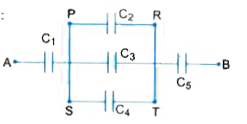
|
|
| 33. |
Light travels in two media A and B with speeds 1.8xx10^(8)ms^(-1) and 2.4xx10^(8)ms^(-1) respectively. Then tha angle between them is |
|
Answer» a. `SIN^(-1)((2)/(3))` |
|
| 34. |
Consider the four circuited shown in the figure, each consisting of a battry, a switch, a light bulb a resistor, and eutger a capacitory or an iductor. Assume the capacitor has a large capacitorand the inductor hasa large inductance but no resitance. The light bulb has high efficiency. glowing whenever it carries electric current. (i) Describe what the light bulb does in each of each of curcuits (a) through (d) after the switch is thrown closed. (ii) Describe what the light bulb does in each of circuits (a) through (d) when, having been closed for a long time interval, the switch is opened. |
|
Answer»
|
|
| 35. |
Which of the following statements about photon is incorrect? |
|
Answer» Photons EXERT no pressure |
|
| 36. |
Find the frequency of the third overtone of an air column vibrating in a pipe closed at one end. The length of the pipe is 30cm and the innter diameter of the pipe is 2 cm the speed of sound in air at room temperature is 350 m/s . |
|
Answer» SOLUTION :Data : L = 30cm = 0.3 mv = 350 m/s , d= 2 cm ` 2 XX 10^(-2)` m Pipe CLOSED at one END Fundamental frequency ` n= V/(4 (L+ 0.3d))` The frequency of the third overtone= 7n ` = (7v)/(4(L + 0.3d)) = ( 7 xx 350)/( 4 (0.3 + 0.3 xx 2 xx 10^(-2))` ` = ( 7 xx 175)/(2(0.3 + 0.006))= (7 xx 175)/( 2 xx 0.306)` 2002 Hz |
|
| 37. |
If the coils of a transformer are made up of thick wire, then ... |
|
Answer» eddy currents loss will be more |
|
| 38. |
A current of 3A is flowing in a linear conductor having a length of 40 cm. The conductor is placed in a magnetic field of strength 500 Gauss and makes an angle of 30° with the direction of the field. It experiences a force of magnitude |
| Answer» Answer :C | |
| 39. |
A planet of mass m rotates around a star of mass M. The time period of revolution is T, while the average distance of the planet from the star is a. It is known that there exists a relationship between them: find it. Assume the dimensional expression for G. |
|
Answer» |
|
| 40. |
A heavy nucleus at rest breaks into two frag ments which fly off with velocities in the ratio 8:1. The ratio of the radii of the fragments (assumed spherical) is |
|
Answer» `1:2` |
|
| 41. |
If the potential at A is 2000V the potential at B is |
|
Answer» 1500V |
|
| 42. |
Two slits are made one millimetre apart and the screen is placed one metre away. What is the fringe separation when bluegreen light of wavelength 500 nm is used? |
|
Answer» Solution :Fringe SPACING `=(Dlambda)/(d)=(1xx5xx10^(-7))/(1xx10^(-3))m` `=5xx10^(-4)m=0.5mm` |
|
| 43. |
Three photo diodes D_(1) D_(2) and D_(3) are made of semiconductors having band gaps of 2.5 eV, 2 eV and 3 eV respectively. Which of them will not be able to detect light of wavelength 600 nm ? |
|
Answer» Solution : Energy of light photon of wavelength `lambda = 600 NM = 600 xx 10^(-19)` m in eV is `E = (hc)/(e lambda) eV = ((6.63 xx 10^(-34))xx (3 xx 10^(8)))/((1.6 xx 10^(-19) xx (600 xx 10^(-9))) eV = 2.07` eV As band gaps of photodiodes `D_(1) D_(2) and D_(3)` are 2.5 eV, 2 eV and 3 eV respectively, it is clear that given light photon can be detected only by photodiode, `D_(2)` WHOSE band gap is less than E. THEREFORE `D_(1) and D_(3)` will not detect the given light. |
|
| 44. |
Three identical capacitors, each of capacitance C are connected in series. The capacitors are charged by connecting a battery of emf V to the terminals (a and d) of the circuit. Now the battery is removed and two resistors of resistance R each are connected as shown. find the heat dissipated in one of the resistors |
|
Answer» |
|
| 45. |
The number density of free electrons in a copper conductor is 8.5 xx 10^28 m^(-3) . How long does anelectron take to drift from one end of a wire 3.0 m long to its other end ? The area of cross section of the wire is 2.0 xx 10^(-6) m^2 and is carrying a current of 3.0 A. |
|
Answer» Solution :Here `n = 8.5 xx 10^28 m^(-3), A=2.0 xx 10^(-6) m^2, I = 3.0 A `and l = 3.0 m `because` Drift speed of electron `v_d = (I)/(NAE)`,hence TIME TAKEN by an electron to drift through the entire length of wire is given as: `t = (l)/(v_d) = (ln Ae)/(I) = (3.0 xx 8.5 xx 10^28 xx 2.0 xx 10^(-6) xx 1.6 xx 10^(-19) )/(3.0) = 2.7 xx 10^4 s ` |
|
| 46. |
State the law of radiactive disintegration. |
| Answer» Solution :Statement : The NUMBER of nuclei undergoing the DECAY PER UNIT time is DIRECTLY proportional to the number of nuclei in the sample. | |
| 47. |
Two polarising sheets are arranged with their axes parallel so that the intensity of transmitted polarized light is maximum. Through what angle must the sheet be rotated so that the intensity of transmitted light drops to1/3of the maximum intensity? |
|
Answer» SOLUTION :By LAW of Malus`I=I_(0)cos^(2) theta`But`I=(I_(0))/3 :.(I_(0))/3=I_(0)cos^(2) theta` `cos theta=+-1/(sqrt(3))`Hence`theta=54.73^(@)` |
|
| 48. |
Columb law for electrostatic force between two pointcharges and newtonlaw for gravitational force between twothe distancebetween the chargesand masses respectively (a) compare the strength of these forces by determining the ratioof their magnitudes (i) for an electronand a proton and (ii) for two protons(b) estimate the acceleratons of electron and proton due to theelectrical force oftheir mutual attarction when they are 1A (=10^(-10) m) a part (m_(p)=1.67xx10^(27) kg m_(e )=9.11xx10^(-31) kg) |
|
Answer» Solution :(a) (i) The electricforce betweenan electron and a protonat a distancer apart is where the negativesign indicates that the force isattarctive the correspondinggravitationforce `F_(G)=-G(m_(p)m_(e))/(r_(3))` however it may be mentionedhere that the sign of the two forcesare differentof these FORCES between two protonsinside a nucleus are `f_(e )-230 N`the ratio of the two forces showsthat electricalforces are enormously stonger than thethe gravitationalforces using newton secondlaw of motionf=ma the acceleration that an electron will undergo is comparing this with the value of acceleration due to gravitywecan conclude that the EFFECT of gravitationall field is NEGLIGIBLE on the motion of electronunder the actionof coulomb force due ot a proton the valuefroacceleartionof the proton is `2.3xx10^(8)N//1.67 xx10^(27) kg =1.4 xx10^(19) m//s^(2)` |
|
| 49. |
A car that's initially traveling at 10 m//s accelerates uniformly for 4 seconds at a rate of 2 m//s^(2) in a straight line. How far does the car travel during this time ? |
|
Answer» Solution :We're GIVEN `v_(0), t, and a`, and we're asked for s. So v is MISSING it isn't given and it isn't asked for , so we use Big Five #2. `DELTA s= v_(0) Delta t+(1)/(2)at^(2)=(10 m//s)(4 s)+(1)/(2)(2m //s^(2))(4 s)^(2)=56 m` |
|
| 50. |
The equation of a wave is y= 4sin [pi/2 (2t + 1/8 x)]where, y and x are in cm and t is in second |
|
Answer» The amplitude, wavelength, velocity and frequency of wave are `4cm, 16cm,32cm^(-1)`and 1Hz respectively with wave PROPAGATING ALONG + x direction |
|


