

Saved Bookmarks
This section includes 7 InterviewSolutions, each offering curated multiple-choice questions to sharpen your Current Affairs knowledge and support exam preparation. Choose a topic below to get started.
| 1. |
A : If .2a. is aperture of the lens, then resolving limit of telescope is (1.22 lambda)/(a) R : Resolving power of telescope is large when aperture of lens is small. |
|
Answer» Both A and R are TRUE and R is the correct EXPLANATION of A |
|
| 2. |
According to the formula obtained in Problem 30.18 the stationary value of the current can be reached only after infinite time. How can this be made consistent with the fact that actually the stationary value is reached in a finite time? What are the limits in which the formula obtained in Problem 30.18 is applicable? |
| Answer» Solution :The formula obtained in Problem 30.18 is no LONGER valid when the difference betiveen the stationary and the instantaneous CURRENTS becomes equal to the THERMAL curront fluctuations. After that a gradual increase in the current is REPLACED by the usual thermal fluctuations of the current around its equilibrium value. | |
| 3. |
A radio can tune over the frequency range of a portion of MW broadcast band: ( 800 kHz to 1200kHz ) . If its LC circuit has an effective inductance of 200 mu H. What must be the range of its variable capacitor ? |
|
Answer» Solution :For tunning a particular station in a radio, the frequency of free oscillations `f_(0) = ( 1)/(2pi sqrt( LC ))` is changed( by changing L or C ) and then when its is made equal to frequency f of radio waves transmitted by that station, the conditionfor resonance `f= f_(0)` is satisfied which gives RISE flow of maximum current in the CIRCUIT, producing sound with maximum clarity which ensures that particular radio station is tuned with our radio Now, `f_(0) = ( 1)/(2pi sqrt( LC ))` `:. f_(0)^(2) = ( 1)/( 4pi^(2) (LC))` `:. C = ( 1)/( 4pi^(2) f_(0)^(2) L )`...(1) For `(f_(0))_(max) = 1200 KHZ`, we have `C_("min") = ( 1)/( 4pi^(2) ( f_(0))_("max")^(2)L)` `= ( 1)/( ( 4) ( 3.14)^(2) ( 1200 xx 10^(3)) ( 200 xx 10^(-6)))` `= 88 xx10^(-12) F` `= 88 pF `...(2) For `(f_(0))_("min") = 800 kHz`, we have `C_(max) = ( 1)/( 4pi^(2) ( f_(0))_("max")^(2) L )` ` = ( 1)/(( 4) ( 3.14 ) ( 800 xx 10^(3))^(2) ( 200 xx 10^(-6)))` `= 198 xx 10^(-12) F` `= 198 pF `...(3) Final answer `:` From results (2) and ( 3), the required range of variable capacitor should be 88 pF to 198 pF . |
|
| 4. |
A conductor carries a current I parallel to a current strip of current per unit width j and width w, as shown in figure . Find an expression for the force per unit length on the conductor. Discuss the result when the width w approaches infinity. |
|
Answer» Solution :We consider a differential segment of thickness `dx`, carrying current `j dx`. The attractive force PER unit length is `(dF)/(L)=(mu_(0)I(j dx))/(2pir)` A symmetrical segment at `-x` exerts same magnitude of force, the `x-` components cancel and the resultant force is `(dF)/(L)=(mu_(0)I(j dx))/(2pir)cos theta` `=(mu_(0)Ijdx)/(2pi sqrt(h^(2)+x^(2)))xx(h)/(sqrt(h^(2)+x^(2)))` Integrating over half width of strip. `(F)/(L)=(mu_(0)Ijh)/(pi)int_(0)^(w//2)(dx)/(h^(2)+x^(2))=(mu_(0)Ij)/(pi)TAN^(-1)((w)/(2H))` When `w rarr oo , (F)/(L)rarr(mu_(0)Ij)/(2),` the force is attractive as expected for parallel currents. |
|
| 5. |
A hollow metal sphere of radius 5 cm is charged such that the potential on its surface to 10 V. The potential at the centre of the sphere is |
|
Answer» Zero |
|
| 6. |
When an electrical appliance is switched off sparking occurs why? |
| Answer» Solution :SELF induced emf is produced due to the sudden break in current. This PRODUCES the spark. | |
| 7. |
What is parallel connection of resistors ? Derive equation of equivalent resistance in parallel connection. |
|
Answer» Solution :`rArr` If ends of two or more resistors are JOINED together, then such arrangement is called parallel CONNECTION of resistors. `rArr` In parallel, voltage remains same in all resistors and currents flowing through resistors are different The sum of currents in all resistors is equal to the current flowing in circuit through battery. `rArr` Suppose `R_(1) and R_(2)` two resistors are connected as shown in figure at a and b POINTS with connection of battery of terminal voltage V, I current is passing in circuit and it will be divided in two parts at point a.  Let , currents passing through `R_(1) and R_(2) ` are `I_(1) and I_(2)` respectively. `rArr " At .a. point" , I = I_(1) + I_(2) "" `....(1) `rArr` According to Ohm.s law, p.d. about `R_(1)`, `V = I_(1) R_(1) rArr I_(1) = (V)/(R_(1)) "" `....(3) By substituting values in equation (1) from equation (2) and equation (3), `I = (V)/(R_(1)) + (V)/(R_(2))` `therefore(I)/(V) = (I)/(R_(1)) + (I)/(R_(2))"" [ because " Dividing by " V] ` but `(1)/(V) = R_(eq)` `therefore(I)/(R_(eq)) = (I)/(R_(I)) + (I)/(R_(2))` `rArr` thus, in parallel connection inverse of equivalent resistance is equal to the sum of inverse of all RESISTANCES. `rArr ` Hence, equivalent resistance is smaller than the smallest resistance. |
|
| 8. |
A microscope ishaving objective of focal length 1 cm and eyepiece of focal length 6 cm of tube length is 30 cm and image is formed at the least distance of distinct vision, what is the magnification produced by the microscope. Take D = 25 cm. |
|
Answer» 6 `m = (L)/(f_(0)) (1 + (D)/(f_(E)))` (where length of tube L = 30 cm, focal length of objective lens `f_(0) = 1 cm`, focal length of eye - PIECE `f_(e) = 6 cm, D = 25 cm`) `=(30)/(1)(1+(25)/(6))=30xx(6+25)/(6)` `= 5 xx 31` = ` 155 cm cong 150`. |
|
| 9. |
(A):The speedometer of an automobile measure the instantaneous speed of the automobile. (R ):Average velocity is equal to total distance divided by total time taken. |
|
Answer» |
|
| 10. |
When a coil is joined to a cell, current in it grows with a time constant tau. The coil is disconnected from the cell before the current has reached its steady-state value, and, it is then short-circuited. The current will now decrease with a time constant |
|
Answer» `TAU` |
|
| 11. |
What is magnetic declination ? |
| Answer» SOLUTION :If is define as the angle between GEOGRAPHICAL meridian and MAGNETIC meridean. | |
| 12. |
Mention any two factors on which the self inductance of a coll depends. |
|
Answer» Solution :`L=(mu_0mu_rN^2A)/l` Where, N -Number of TURNS, A -Area of cross SECTION, 1 -LENGTH of a solenoid. |
|
| 13. |
Let L be the set of all lines in a plane and let R be relation defined on L by the rule (x,y)ɛR if x is perpendicular to y. Then |
|
Answer» Reflexive |
|
| 14. |
Two point charges 4muC and 9muC are separated by 50 cm. The potential at the point between them where the field has zero strength is |
| Answer» Answer :A | |
| 15. |
In Young.s double slit experiment intensity at a point is (1"/"4) of the maximum intensity. Angular position of this points is |
|
Answer» Solution :`I= I_("MAX") COS^(2)(PHI/2) therefore (I_("max"))/(4)= I_("max") cos^(2)(phi/2)` `cos (phi)/(2)= (1)/(2) " or "(phi)/(2)= (pi)/(3)""therefore phi= (2pi)/(3)= ((2pi)/(LAMBDA))trianglex` where `trianglex = d SIN theta` `(lambda)/(3)= d sin theta, sin theta= (lambda)/(3d), theta= sin^(-1)((lambda)/(3d))`. |
|
| 16. |
In a series RLCAC circult, the frequency of source can be varied. When frequency is varied gradually in one direction from f_1 to f_2, the power is found to be maximum at f_1. When frequency is varied gradually at the other direction from f_1 to f_3 , the power is found to be same at f_1 and f_3. Match the proper entries from column-2 to column-1 using the codes given below the columns,(consider f_1 gt f_2) {:("Column-I",,"Column-II"),("when the frequency is equal to",,"The circuit is or can be"),("AM: arithmatic mean GM:geometic mean",,),("(P) AM of "f_(1) and "f"_(2),,"(1) capacitance"),((Q) "GM of "f_(1) and "f"_(3),,"(2) inductive"),("(R) AM of " f_(1) and "f"_(3),,"(3) resistive"),("(S) GM of " f_(1) and "f"_(3),,"(4) at resonance"):} |
|
Answer» `{:(,P,Q,R,S),((A),4,3,2,4):}` 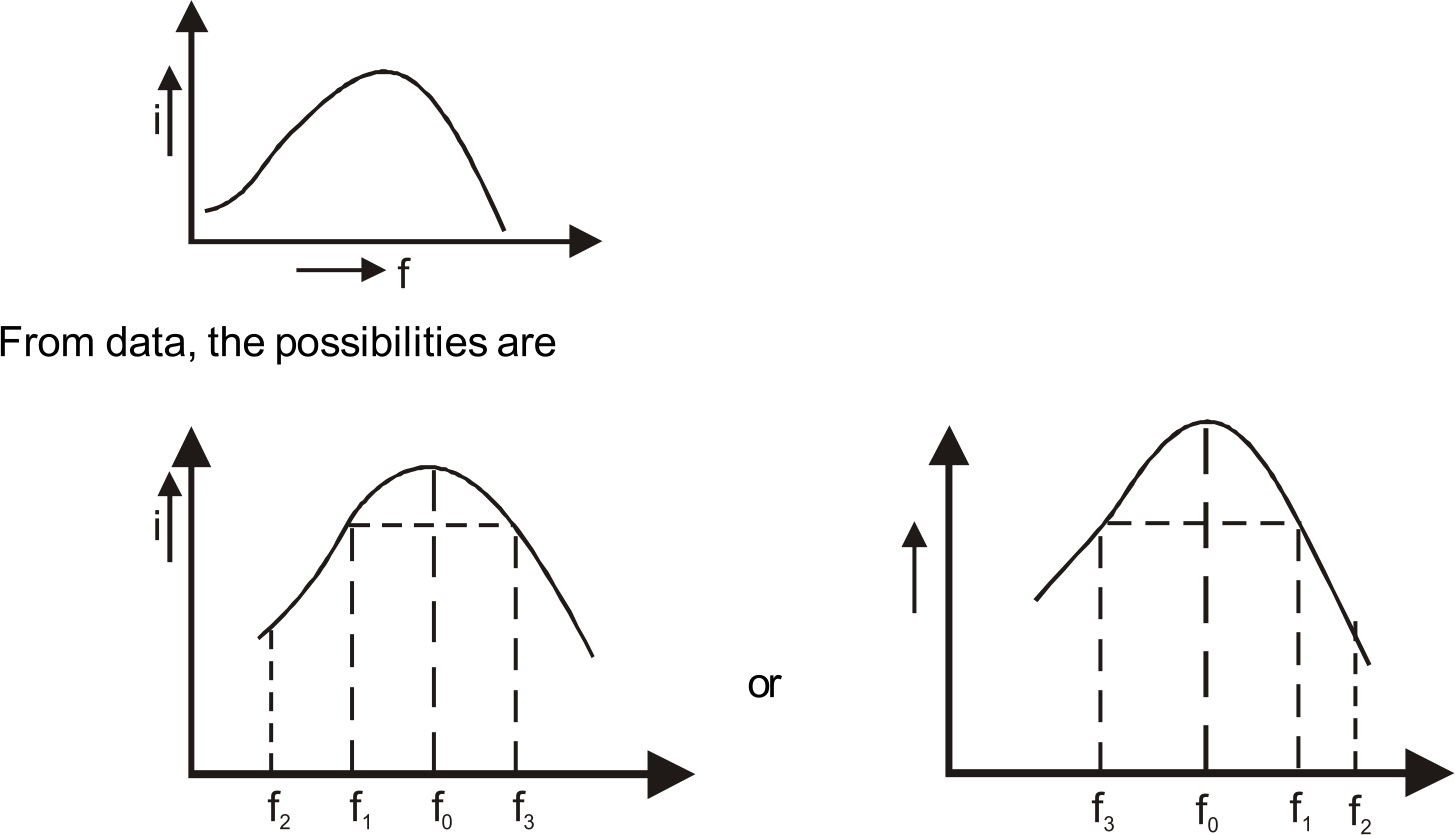 `f_(0)` is resonant frequency `RARR ` means as CIRCUIT being resistive. The circuit is capacitive when `f lt f_(0)` and inductive when `f gt f_(0)` Power at `f_(1)` and `f_(3)` same `rArr` is same `rArr` z same `rArr 2pi f_(1)L-1/(2pif_(1)C)=1/(2pif_(3)C)-2pif_(3)L` `rArr 2piL(f_(1)+f_(3))=1/(2piC)(1/(f_(1))+1/(f_(3)))` `rArr f_(1)f_(3)=1/(4pi^(2)LC)rArr sqrt(f_(1)f_(3))=1/(2pisqrt(LC))=(omega_(0))/(2pi)` `AM gt GM rArr (f_(1)+f_(3))/2 gt f_(0)` `rArr ` inductive at frequency =`(f_(1)+f_(3))/2` |
|
| 17. |
Assertion : The electric field due to a discrete charge configuration is not defined at the locations of the discrete charges. Reason : For a surface charge distribution, electric field is discontinuous across the surface. |
|
Answer» If both assertion and REASON are true and reason is the CORRECT EXPLANATION of assertion. |
|
| 18. |
In the circuit shown in Fig. 4.67, the resistance of the ammeter A is negligible and that of thevoltmeter V is very high. When the switch S is open, the reading of voltmeter is 1.53 V. On closing the switch S, the reading of ammeter drops to 1.03 V. Calculate : (i) emf of the cell (ii) internal resistance of the cell (iii) value of R. |
|
Answer» |
|
| 19. |
Which of the following equation gives the current flowing through the coil of M.F.G. ? |
|
Answer» `I=(K THETA)/(n AB)` |
|
| 20. |
A plane light wave falls on Fresnel mirrors at an inclination of alpha = 2. Detrmine the wavelength of light if the width of fringe on the screen is beta = 0.55 m: |
|
Answer» 220 nm As wave is plane wavefront, `r = infty` `THEREFORE beta = (lambda)/(2a)` `therefore lambda = 2 ALPHA beta = (2 xx 2PI)/(180 xx 60) xx 0.55 xx 10^(-3)` ` = 640 nm`. |
|
| 21. |
A car cover's a distance of 10 km along an inclined plane under the action of a horizontal force of 5 N. The work done on the car is 25 KJ the inclination of the plane to the horizontal is |
| Answer» ANSWER :C | |
| 22. |
उत्तर भारत के मैदान का निर्माण किस नदी तंत्र से हुआ है? |
|
Answer» गंगा नदी |
|
| 23. |
A ballis thrown form theorigin in the x - y planewithvelocity 28.28m/s at an angle 45^(@) to the x-axis. At the sameinstanta trolley alsostarts movingwith uniform velocityof 10 m/s alongthe positivex-axis . Initially rear end of the trolley is locatedat 38m from the origin. Determinethe timeposition at whichthe ball hitsthe trolley. |
|
Answer» Solution :Let t be the instantat whichthe ball hits rear face B ofthe trolley. Then`(v_(0) cos 45^(@) - u_(0))t= 38` (or) `t = (38)/(v_(0) cos 45^(@)-u_(0)) = (38)/(28.28 cos 45^(@) -10) = 3.8s` At t =3.8s , the y - coordinate of the ball is . `y = (v_(0) sin 45^(@)) t - (1)/(2) "gt"^(2) = 20T - 5t^(2)` (or) `y= 20(3.8) - 5(3.8)^(2) = 3.8m` Since`3.8 gt 2m,` therefore , the ball cannothit the rear face of the trolley. Now , we assume thatthe ball hitsthe topface BC ofthe trolley , and let t be that instnat . Then ` y = 2=20 .t^(2) or t^(2) - 4t . + 0.4 = 0 : t = 3.9s` Let d be the DISTANCEFROM the pointB at whichthe ballhits the trolley. Then , `d = (v_(0) cos 45^(@) - u_(0)) (t-t) = (20-10)(3.9-3.8)= 1m` 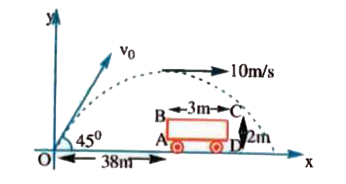
|
|
| 24. |
Sky wave propagation is used in |
|
Answer» RADIO COMMUNICATION |
|
| 25. |
To know the resistance G of a galvanometer by half deflection method,a battery of emf V_(E) and resistance R is used to deflect the galvanometer by angle theta.If a shunt of resistance S in needed get half deflection then G,R and S arc related by the equation |
|
Answer» `S(R+G)=RG` |
|
| 26. |
Identify the following electromagnetic radiations as per wavelength given . Write on application of each 10^(-8) mm |
| Answer» Solution :Ultraviolet RAYS used in FOOD PRESERVATION. | |
| 27. |
Identify the following electromagnetic radiations as per wavelength given . Write on application of each 10^(-3) mm |
| Answer» SOLUTION :`gamma-rays` USED in the TREATMENT of MALIGNANT TUMOURS. | |
| 28. |
Identify the following electromagnetic radiations as per wavelength given . Write on application of each 1 mm |
| Answer» SOLUTION :Microwaves, USED in RADAR SYSTEM for aircraft navigation. | |
| 29. |
Which of the following process processes are forbidden by the law of conservation of strangeness : (1)pi^(-)+prarr Sigma^(-)+K^(+), (2) pi^(-)+prarrSigma^(+)+K^(-), (3)pi^(-)+prarrK^(+)+K^(-)+n, (4) n+prarr ^^ ^(0)+Sigma^(+), (5) pi^(-)+nrarr Xi^(-)+K^(+)+K^(-), (6) K^(-)+prarr Omega+K^(+)+K^(0) ? |
|
Answer» Solution :(1) `PI^(-)+prarrSigma^(-)+K^(+)` `0 0 -1 1` so `DELTAS=0` allowd. (2) `pi^(-)+prarrSigma^(+)+K^(-)` `0 0 -1 1` so `DeltaS= -2` forbiddeb (3) `pi^(-)+prarrK^(-)+K^(+)+n` `0 0 rarr-1 1 0` so `DeltaS=0`, allowed (4)`n+prarr^^ ^(0)+Sigma^(+)` `0 0 -1 -1` so `DeltaS= -2`. forbidden (5) `pi^(-)+nrarr=^(-)+K^(+)+K^(-)` `0 0rarr -2 1 -1` so `DeltaS= -2`. forbidden. (6) `K^(-)+prarrSigma^(-)+K^(+)K^(o)` `-1 0 3+1+1` so `DeltaS=0` allowed. |
|
| 30. |
A galvanometer of resistance 25Omegameasures 10^(-3)A . shunt required to increase range up tow 2 A is |
|
Answer» `12.5 MOMEGA` |
|
| 31. |
Mention any two factors on which the capacitance of a parallel plate capacitor depends. |
| Answer» SOLUTION :AREA of the PLATES | |
| 32. |
The displacement of two interfering light waves are y_(1) = 4 sin omega t and y_(2) = 3 cos omega t. The amplitude of the resultant wave is (y_(1) and y_(2) are in CGS system) |
|
Answer» 5 cm |
|
| 33. |
Lencho went to.......for mailing the letter |
|
Answer» Town |
|
| 34. |
The block C shown in the figure is ascending with an acceleration a=3m//s^(2) by means of some motor not shown here. Find the acceleration of the bodies A and B of masses 10 kg and 5kg respectively in m//s^(2), assuming pulleys are massless and friction is absent everywhere. |
Answer» SOLUTION :Drawing F.B.D. diagrams.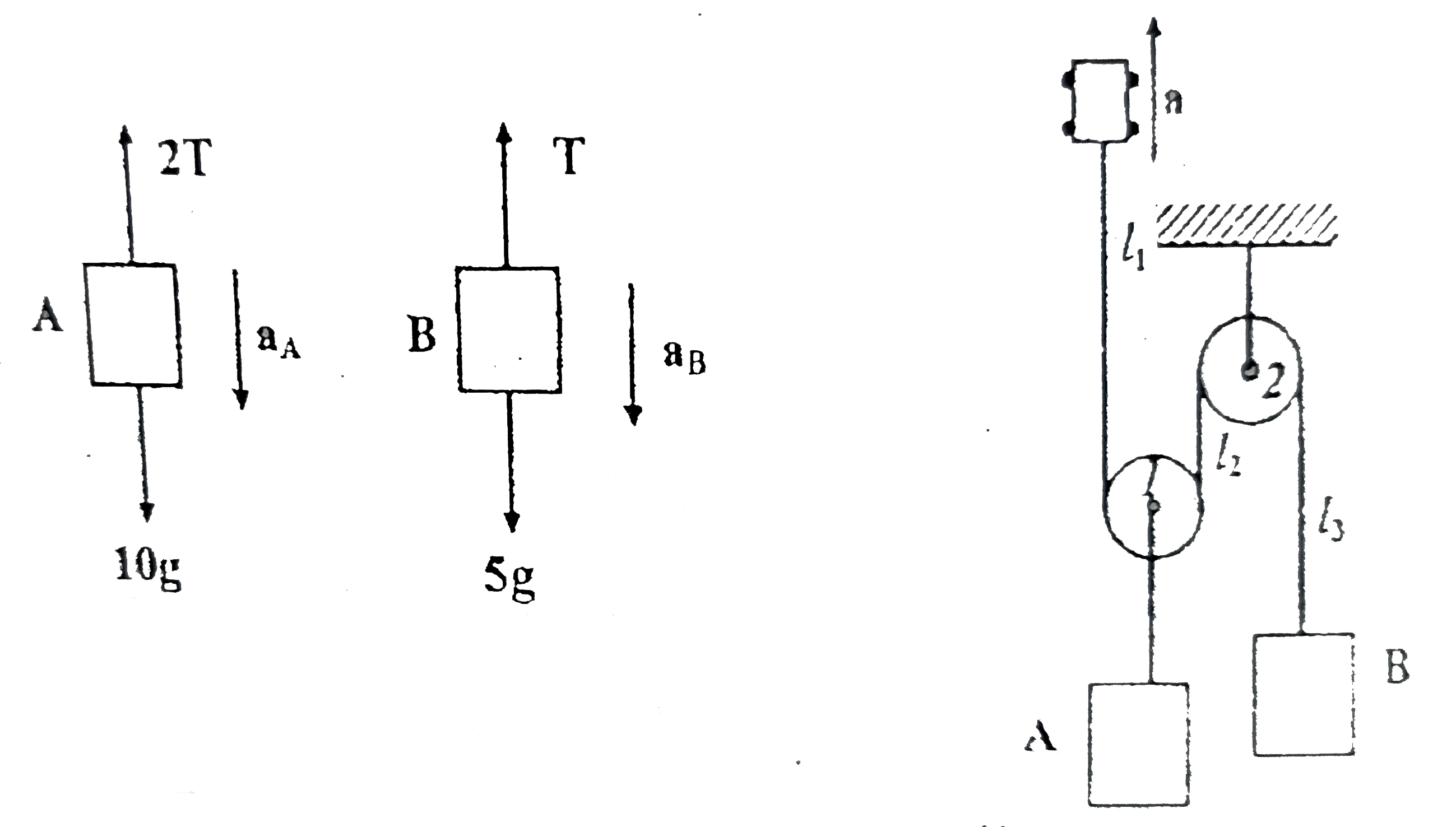 `10g-2T=10a_(A)``(1)` `5g-T=5a_(B)``(2)` `T` from EQUATIONS `(1)` & `(2)` we GET `10a_(A)-10a_(B)=0` `rArr a_(A)=a_(B)` `l_(1)+l_(2)+l_(3)=`constant `y_(E)+y_(A)+y_(A)+y_(B)=` costant Differentiating twice w.r.t. time, `a+2a_(A)+a_(B)=0` `2a_(A)+a_(B)=-3` or `3a_(0)= -3` `rArr a_(B)=-1m//s^(2)`, `a_(A)=-1m//s^(2)` `a_(A)=a_(B)=1m//s^(2)` upwards |
|
| 35. |
State and explain the laws of radioactive disintegration. On its basis define disintegration constant and half life period. |
|
Answer» Laws of Radioactive disintegration 1. Radioactivity is spontaneous process which does not depend upon external factors. During disintegration either `alpha` or `beta`-particle is emitted. Both are never emitted simultaneously. 3. Emission of `alpha`-particle decreases atomic number by two and mass number by 4. 4. Emission of `beta`-particle increases atomic number by one but mass number remains the same. 5. Emission of `gamma`-ray does not change atomic or mass number. 6. The number of ATOMS disintegrated per second is DIRECTLY proportional to the number of radioactive atoms actually present at that instant. This law is called radioactive decay law. i.e. `-(dN)/(dt) prop N` or `-(dN)/(dt)= lambda N`,...(i) where `lambda` is a constant called disintegration constant and depends upon the nature of the radioactive substance. Now from (i) , we have `(1)/(N) dN = - lambda dt` or `int 1/N dN = lambda int dt` or `log_(e)N=lambda t +C`,...(ii) where C is constant of integration. To determine its value. Let `N=N_(0)` initially, i.e. when `t=0, N=N_(0)` `log_(e)=N=0+C` Substituting the value of C in (ii) , we have `log_(e)N=-lambda t + log_(e)N_(0)` or `log_(e)N-log_(e)N_(0)=-lambda t` or `log_(e). (N_(0))/(N)= -lambdat` or `(N)/(N_(0))=e^(-lambda t)` or `N=N_(0)e^(-lambda t)` which is the required equation. Disintegrationconstant `(lambda)` is defined as the TIME after which the number of radioactive atoms reduce to 1/e times the original number of atoms. Half life period (T) is the time during which the number of atoms of a radioactive material reduces to half of the original number . |
|
| 36. |
A window whose area is 2m^2opens on a street where the street noise result in an intensity level atthe window of 60 dB. If an acoustic absorber is fitted at the window, how much energy from street will it collect in five hours |
|
Answer» `26 xx 10^(-13) J` |
|
| 37. |
If the momentum of a particle is doubled, then its de-Broglie wavelength will |
|
Answer» remain UNCHANGED |
|
| 38. |
In the circuit shown in the figure, if potential at point A is taken to be zero, the potential at point B is |
| Answer» ANSWER :D | |
| 39. |
The capacitance of parallel plate capacitor depends on the metal used to make the plates of capacitor. |
| Answer» Solution :FALSE – CAPACITANCE depends only on AREA of plates, distance between the plates and dielectric constant of INTERVENING medium. | |
| 40. |
A body released from the top of tower falls through half the height of the tower in 3 seconds. It will reach the ground after nearly |
|
Answer» 3.5 s |
|
| 41. |
A tuning fork and an organ pipe at temperature 88°C produce 5 beats per second. When the temperature of the air column is decreased to 51°C the two produce 1 beat per sec. What is the frequency of the tuning fork ? |
|
Answer» f.=81Hz |
|
| 42. |
As an electron makes a transition from an excited state to the ground state of a hydrogen like atom/ion. |
|
Answer» its kinetic energy increases but potential and total energy DECREASES `:.` Potential energy in `n^(th)` orbit. `P.E=-(27.2)/(n^(2))eV` Kinetic energy `KE=+(13.6)/(n^(2))eV` and total energy `E=-(13.6)/(n^(2))eV` Hence, electron transist in ground STATE (n = 1), the value of n decreases hence value of PE. decreases (It is negative). Since kinetic energy increases but potential and total energy decreases (it is negative). |
|
| 43. |
What is the phase difference between two simple harmonic motions represented by x_(1) = A sin(omega t + pi/6) and x_(2) = A cos (omegat)? |
|
Answer» `pi//6` `x_(2) =A cos omega t = A sin (omega t + pi/2)` PHASE difference, `DELTAPHI - phi_(2) - phi_(1)` `=(OMEGAT + pi/2) -(omega t+ pi/6) = pi/3` |
|
| 44. |
Prove that the critical orbital speed of a satellite in a near-Earth is 2Rsqrt(pi_(p)G//3), where p and R are the average density and radius of the Earth and G is the universal gravitional constant. |
|
Answer» Solution :Suppose a satellite is in a circular orbit of radius `r = R + h` around the Earth, where R is the radius of the Earth and h the ALTITUDE of the orbit. The critical orbital speed of the satellite is `v_(c)=SQRT((GM)/(r))""...(1)` Where M is the mass of the Earth and G the universal gravitional constant. For a low-altitude or near-Earth orbit `h LT lt R`, so that ignoring h , `r = R + h ~= R ` and `u_(c)~=sqrt((GM)/(R))""...(2)` If we consider the Earth to be a SPHERE of average density p, then `rho=("mass")/("volume")=(M)/((4)/(3)piR^(3))` `therefore M = (4)/(3)pirhoR^(3)""...(3)` Substituting this value of M in Eq. (2), we get, `u_(c)=sqrt((G((4)/(3)pirhoR^(3)))/(R))=sqrt((rpirhoGR^(2))/(3))=2Rsqrt((pirhoG)/(3))` Which is the required EXPRESSION. |
|
| 45. |
A carnot engine whose efficiency is 40 % recives heat at 500 K . If the efficiency is to be 50 %. The source temperature for the sameexhaust temperature is |
|
Answer» 900 K Where ` T_(1) andT_(2) ` be the TEMPERATURES of source and sinkrespectively . ` T_(2)/T_(1) = 1 -n=1- 40/100=60/100 = 3/5 ` ` T_(2) = 3/5 T_(1) = 3/5 xx 500 K = 300 K ` LET ` T_(1)`be the TEMPERATUREOF the source for the same sinktemperature. ` thereforeT_(2)/T_(1) = 1-n =1 - 50/100 = 1/2` ` T_(1) = 2T_(2) = 2xx 300 K = 600 K ` |
|
| 46. |
The dimensions of the quantities in one of the following pairs are the same. Identify the pair : |
|
Answer» TORQUE and energy Hence `(a)` is CORRECT. |
|
| 47. |
The value of workdone for rotating a magnet of magnetic moment M by an angle theta in external magnetic field H is given by |
|
Answer» `MH COS theta` |
|
| 48. |
A graph shown in the figure represents the variation of uniform magnetic field with time. If this field linked with a conducting loop completely and its perpendicular to the plane of the coil. In which time interval of induced emf in the coil is maximum ? |
|
Answer» A |
|
| 49. |
What is magnification ? |
| Answer» SOLUTION :It is the RATIO of SIZE of IMAGE to the size of OBJECT. | |
| 50. |
Briefly explain the three factors which justify the need of modulating low frequency signal into high frequencies |
|
Answer» Solution :FACTORS for justifying modulating SIGNALS are: (i) energy (strength of signal) is low, so it can't be transmitted directly to large distance. (II) HEIGHT of singal ANTENNA (transmitter and receive) `= (lamda)/(4)` (iii) Very high frequency signals can be transmitted without loss in air, only if the receiving antenna directly intercepts the signal from transmitting antenna. Also, there is fair chance of mixing up of signals from different transmitters. |
|